Themed Section: Science and Technology
Network Coding in a Bluetooth Network
Dr. K. Nachimuthu1, M. Nandhini2
1Research Advisor, Department of Computer Science, Jairams Arts and Science College, Karur, Tamil Nadu, India 2Research Scholar, Department of Computer Science, Jairams Arts and Science College, Karur, Tamil Nadu, India
ABSTRACT
Bluetooth is widely used today and the devices are cheap and have a low power consumption. Use of Bluetooth in a MANET as well as WSNs is therefore interesting.The overall aggregated bandwidth in a piconet is limited to 768kbps (Basic Data Rate). Using TDD, this bandwidth is shared between the nodes in a piconet based on the fairness algorithm applied . Thus the average bandwidth per node is reduced by the number of nodes transmitting in a piconet. If applying network coding to the piconet makes the communication more effcient, the required number of transmitted packets will decrease. A reduced number of transmitted packets will reduce the radiated power from the node. Furthermore, reduced radiated power will reduce the energy requirement, and increase the lifetime of the battery while maintaining the same bandwidth available. As Bluetooth is primarily used by small battery operated devices, an improved energy budget is welcome.
Keywords : TDD, Basic Data Rate, ISM, OBP, DNCBP, Active Slave Broadcast
I.
INTRODUCTIONBluetooth is a short range wireless technology intended to replace cables connecting portable and/or xed devices [1]. The Bluetooth speci cation is maintained by the Bluetooth Special Interest Group (SIG). The radio layer is responsible for transmitting and receiving packet of information on the physical channel. Bluetooth operates in the Industrial Scienti c Medical (ISM) band (2.4GHz), and uses 79 channels spaced 1MHz apart from each other [2]. A Bluetooth Security White Paper [3] recommends using long passkey and only pair devices in a secure environment. The computing complexity of generating the initialization key based on the passkey is not large. Using long passkey will increase the work load for an eavesdropper of nding the matching link key. None of the proposed scatternet formation algorithms is ful lling all of the above re-quirements. [4] compare some of the proposed algorithms, and evaluate the performance of three of the protocols (Blutrees [5],
BlueStars [6] and New Formation protocol [7]) using simulation. Slightly differentcriteria than the ones above have been emphasized in the comparison. Recent papers propose other algorithms like the Overlaid Bluetooth Piconet and Temporary Scatternet [8] and Enhanced AODV [9]. The first one pro-poses an interconnection method without scatternet formation, instead interconnecting stand alone piconet. A performance comparison of OBP and Bluetooth Scatternet [10] is made in [11], and conclude a resiliency to mobility and higher throughput. Low power consumption is emphasized as an important feature in the latter one (EAODV).
II.
THEORETICAL ANALYSISresponds and sends its packet destined for node 2. The master polls the next node, and passes data from the rst node to the second node. The second node responds, and passes its data to the master. This cycle repeats itself until the communication terminates, this protocol is illustrated in Figure 2(a). Assume again the same network topology as previously. Instead of following the previous protocol, the rst two polls from the master does not transfer any data but rather send simple poll packets with no payload. The master stores the received data from node 1 and node 2 in a buffer.
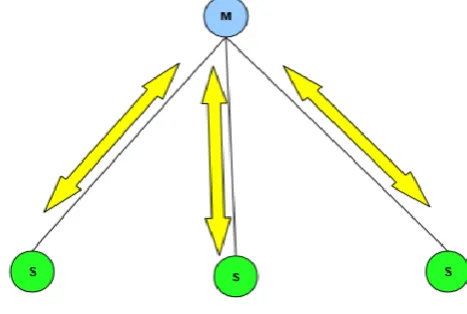
Figure 1. A simple piconet
It then performs combination of the two packets, and sends the encoded packet to both nodes as illustrated in Figure 2(b). This is possible either by using the reserved Active Slave Broadcast address (as carried out in an Emergency Data Delivery System or forcing the receivers to operate in promiscuous mode.
Figure 2. A two slave and one master Bluetooth network
III. THROUGHOUT IMPROVEMENT IN A
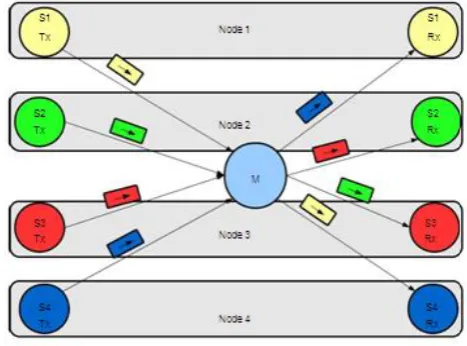
PICONET BY USING NETWORK CODINGIs it possible to improve the throughput in a piconet using network coding? This section will discuss how this could possible be done, and a protocol for deterministic network coding in Bluetooth piconet (DNCBP) is proposed. A network of a master node and four slave nodes. Between the four nodes tra c ows bi-directional and symmetric in pair as shown in Figure .3.
Figure 3. A piconet with four nodes and two bi-directional symmetric communication streams
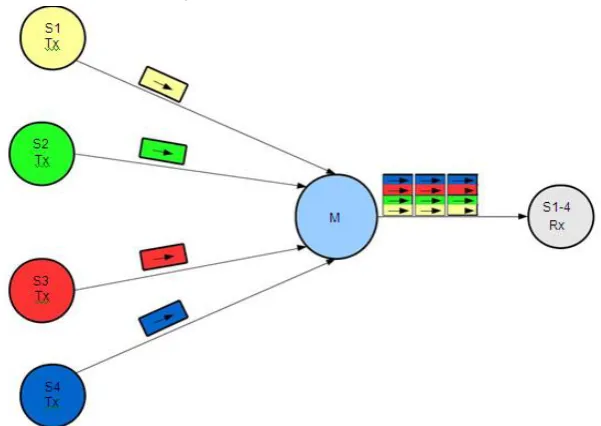
Figure 4. A piconet as a directed graph
Figure.4. On the right hand side of the gure is the transmitting part of the slave nodes (the sources), and the receiving part of the slave nodes (the sinks) is on the left hand side. The master node is in the middle. Figure 5 indicates a possible distribution and use of time slot in a TDD system. The overall capacity C is divided by the users. Transmission of one packet from
one slave to another slave, forwarded by the master is requiring two time slots; one from the source slave to the master, and another time slot from the master to the sink slave. Thus, with n slaves the average capacity per node Cn, is given by Cn = C=2n
Figure 5. TDMA frame structure
This will reduce the required bandwidth from the master; ergo it is possible to allocate more bandwidth to the slaves. In a Bluetooth network this is done by using DH3/ DH5 or DM3/DM5 in an asynchronous
mode. Due to the TDD scheme the master nodes have four periods available.
Figure 6. A piconet applying network coding illustrated as a directed graph
By using a synchronous mode, all frames are one time slot long, equally shared among all slaves and the master. Therefore, there will be no throughput improvement using network coding in synchronous mode as the master is required by the TDD protocol to transmit in all four time slots, even though the network coding only requires three.
node saves transmission of 2 or 4 time slots depending on using DH3 or DH5 accordingly.
Figure 7. TDMA frame structure in a piconet with network coding
IV. THEORETICAL ANALYSIS
In the given example, each unidirectional communication link requires three time slots to transmit the date from slaves to master, and three times three time slots to transmit from the master to the receiving slaves. In total 22 time slots including
one poll packet. In general the required number of time slots to transmit a DH3 packet from all source nodes are 3n + 3(n 1) + 1 = 6n 2
Theorem 1. The average throughput gain, G, using DNCBP-DH3 is G = 3n / 3n-1 where n is number of transmitting nodes.
If the throughput in two di erent scenarios is to be compared, and the amount of data transferred is equal in the two scenarios. I.e. bytes transferredA = bytes
transferredB. The aggregated throughput gain is found
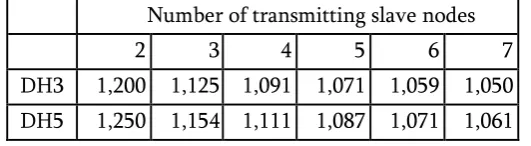
Figure 8. Gain by Using Network Coding Bluetooth
TABLE 1. THE GAIN USING DETERMINISTIC NETWORK CODING IN A BLUETOOTH PICONET
Number of transmitting slave nodes
2 3 4 5 6 7
DH3 1,200 1,125 1,091 1,071 1,059 1,050 DH5 1,250 1,154 1,111 1,087 1,071 1,061
A.Reduced energy consumption using network coding Previously it has been shown how the amount of data transferred from the master node is reduced, still maintaining the same amount of information. The time a Bluetooth device is transmitting is dependent
amount of data, and therefore will not reduce their power consumption.
B. Throughput improvement in a scatternet using network coding
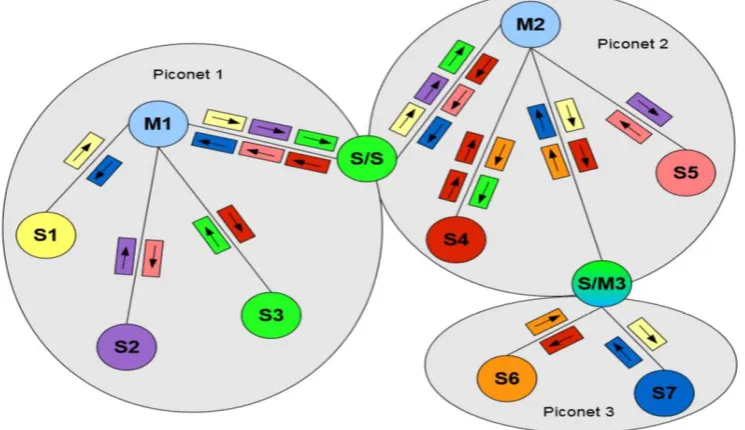
Is it possible to improve the throughput in a scatternet using network coding? This section will discuss this question, based on the discussion on piconet. Assume four bidirectional unicast in a scatternet as shown in Figure 9.
Figure 9. A scatternet with four bidirectional unicast
In this situation the gateway node between piconet 1 and piconet 2 is a slave-slave node. As a slave is not able to communicate directly to any other slave node, the gateway has to forward all the tra c between the piconets through the master nodes on both piconets. Thus, it is possible to bene t from applying network coding on the link to a slave-slave node. The Figure .9 includes also a situation of a master-slave gateway. The links between the master-slave gateway and the M2 node transfer tra c to and from both S6 and S7. In piconet 2 the M3 is a slave, and it is possible to apply network coding on the tra c from M2 to the slave (and M3) in the piconet.
V.
IMPLEMENTATION OF NETWORK CODING IN A BLUETOOTH NET-WORKBased on the discussion above network coding could be implemented in a Bluetooth network under the following conditions:
From the master node to the slaves in a piconet From the master node to the slave gateway node in a scatternet
A. Network coding approach
As described previously there are two di erent approaches for network coding, namely deterministic and random linear encoding. Deterministic linear encoding is preferred when the network topology is known. The random linear encoding is preferred when the network topology is not known or the network is frequently changing. That is, nodes may join or leave the network or the routing is changed over time. The latter situation is the case in an ad hoc network. By its nature a mobile ad hoc network changes the topology frequently. Thus, it would be ineffcient using a deterministic code. A central node would have to generate the coding coeffcient every time the topology changes. In addition, the node responsible for generation of the coe cient could be detached from whole or major parts of the network. This encourages the use of random network coding.
Despite a Bluetooth piconet is ad hoc by nature, the proposed use of network coding is applied on link level. The master is the central node knowing the topology in the net-work, in this case the piconet. This encourages the use of deterministic linear encoding. Furthermore it is possible to determine and use static coding coe cient, because the topology is always a star with a maximum of seven slaves.
A drawback of using deterministic network coding is the lack of erroneous protection of the data. If an error occurs, the receiver is not able to receive all packets in a generation. As a result, it is not able to decode all or some of the packets. Random network B. Implementation of Network Coding In A Bluetooth Network
The coding would add complexity, and require more computational power and memory the nodes. This encourages the use of deterministic codes if possible. However, applying network coding on broadcast tra c from one or multiple sources in a scatternet will require random linear encoding as:
1. There is no central node holding information about the topology
2. Nodes leave and join the network 3. Routing is changed as the nodes moves
The rest of this work will focus on the piconet situation. Assuming a con guration as Figure 3 consisting of eight unidirectional or four bidirectional communication streams. The maximum number of bidirectional communication links between any two slaves in a piconet is i=1 i, where n is the number of
slaves. If n = 7 i.e. the piconet is full, the maximum number of bidirectional communications between any two slave is 21.
Figure 10. Two ways Master-slave communication
Cycles
The piconet can not contain cycles as the proposed protocol include only network coding on a single link.
Alphabet size
the nite eld F2, and one such code is the parity check
code, shown here by its transposed generator matrix:
1 0 0
0 1 0
0 0 1
1 1 1
The encoding is possible to realize in the binary eld using a trivial MDS code - the parity check code, and still keep full rank. Thus GF (2) is su cient alphabet size.
Encoding
The encoding required in the proposed DNCBP protocol can be performed as listed below. Where the left most matrix is the situation with to slave nodes communicating bidirectional. This situation is a simple XOR of the two packets. The next matrix is used to encode in the situation where three nodes are communicating. Obviously it is not possible to communicate in pair with three nodes. Thus this situation requires one of the nodes to broadcast the same message to both of the other nodes. The third matrix is the situation where four nodes are communicating bidirectional pair wise.
m1 m1 m2 m1 m2 m3
a 1 a 1 0 a 1 0 0 b 1 b 0 1 b 0 1 0 c 1 1 c 0 0 1
d 1 1 1
The matrix can be extended up to the general form
where the rows are the original messages, and the columns are the combined packets Packet lengths When encoding data, the combined data have to be of equal length. The shorter packets are padded with 0s to become as long as the longest packets. The padding is proposed done by the master during the encoding and not by the slave before transmit-ting. E.g. a slave transmitting a packet of 100 bytes, would only transmit the header and the 100 bytes. If the slave did pad the data up to 339 bytes, the power consumption would triple for that packet. Therefore the proposed protocol is to have the master pad data as necessary. Security considerations
The proposed application of network coding in a Bluetooth network will enable all nodes to read all tra c in the piconet. In a piconet without network coding a slave is only receiving tra c destined by it self. However, there are recent presentation e.g. at the hmoocon 2009 [24] and interview at the Revision3 Internet Television, showing that sniffng of Bluetooth network is not only reserved for expensive commercial sniffng tools. An article by Max Moser gives an overview on how to turn a Bluetooth dongle into a sniffer. Based on this security measures should be in place to maintain con dentiality between nodes in a piconet both when using network coding and not if con dentiality is important. There are applications (e.g. P2P le sharing and information board) where the information is supposed to be shared between the nodes in the network. However, in this case integrity of the messages could be an issue.
Possible application
reduction for a pair of nodes communicating. However, as all nodes are able to read information destined to the other nodes it is possible to use the same protocols in other application as well. This could be e.g. message board, and P2P le sharing.
VI. CONCLUSION
This research is discussing a possible application of network coding in Bluetooth network. Due to the time division duplex (TDD) used in Bluetooth network there are several con-strains to take into account, compared to other wireless network protocols like wireless LAN (WLAN). One of them is that the slave node is not able to communicate directly with other slave nodes, but rather is required to communicate through a master node. A protocol for applying network coding in Bluetooth piconet has been proposed. The proposed protocol is using deterministic network coding to combine packets from the slaves at the master node. The master node forwards the combined packets to all slaves. It is required to transmit n 1 packets, where n is the number of source nodes. An encoding equation using a MDS code in the binary eld is proposed. Encoding in the binary eld makes the operation computationally easy. Furthermore, the proposed equation scales easily to the maximum number of nodes in a piconet. The encoding and decoding is performed using simple bitwise XOR of the packets, without need to store neither encoding matrices, nor look-up tables. This is an advantage particular for nodes with limited computational power and memory.
VII.
REFERENCES
[1]. Bluetooth Special Interest Group. The o cial bluetooth technology info site. http://www.bluetooth.com, 2008
[2]. William Stallings. Wireless Communications and Networks. Prentice-Hall, 2002.
[3]. Christian Gehrmann. Bluetooth security white paper. 2002.
[4]. Mohammed Shafkat Amin and Fahima Amin Bhuyan. An empirical study of blue-tooth scatternet formation protocol. Proceedings of the 2006 IEEE International Conference on Mechatronics and Automation, 2006
[5]. Gerely V. Zaruba, Stefano Basagni, and Imrich Chlamtac. Bluetrees - scatternet formation to enable bluetooth-based ad hoc networks. IEEE International Confer-ence on Communications (ICC2001), 2001
[6]. C. Petrioli, S. Basagni, and I. Chlamtac. Con guring bluestars: Multihop scatternet formation for bluetooth networks. IEEE Transaction on computers, special issue on Wireless Internet, 2002
[7]. C. Law, A.K. Mehta, and K.-Y. Siu. A new bluetooth scatternet formation protocol. Kluwer Academic Publishers journal on Mobile Networks and Applications, 2003
[8]. Sewook Jung, Alexander Chang, and Mario Gerla. New bluetooth interconnec-tion methods: Overlay bluetooth piconets (obp) and temporary scatternets (ts). Computer communications, 30(10), 2007
[9]. Omar Al-Jarrah and Omar Megdadi. Enhanced aodv routing protocol for bluetooth scatternet. Comput. Electr. Eng., 35(1):197{208, 2009 [10]. Stefano Basagni and Chiara Petrioli. A scatternet
formation protocol for ad hoc networks of bluetooth devices. IEEE Vehicular Technology Conference, 2002.
[11]. Sewook Jung, Alexander Chang, and Mario Gerla. Performance comparison of overlaid bluetooth piconets (obp) and bluetooth scatternet. In Wireless Communi-cations and Networking Conference, pages 505{510, 2006 [12]. Innovative Concepts. Uidm.
[13]. Aaron Drew. Slimsim - the wireless network coding network simulator. http://cs.anu.edu.au/ aaron/sim.php, 2005.
[14]. Norwegian Defence Research Establishment. Research and projects. http://www.mil.no/felles/ /start/FFI-prosjekter/, 2008.
[15]. Alaeddine El Fawal, Kave Salamatian, David Cavin, Yoav Sasson, and Jean-Yves Le Boudec. A framework for network coding in challanged wireless network. http://infoscience.ep .ch/record/88682?ln=en, 2006.
[16]. L. R Ford and D. R. Fulkerson. Maximal ow through a network. Canadian Journal of Mathematics 8, page 399404, 1956.
[17]. Christina Fragouli, Jean-Yves Le Boudec, and J•org Widmer. Network coding: an instant primer. SIGCOMM Comput. Commun. Rev., 36(1):63{68, 2006.
[18]. Christina Fragouli and Emina Soljanin. Information ow decomposition for network coding. IEEE Transactions on Information Theory, pages 829{848, 2006.
[19]. Christina Fragouli and Emina Soljanin. Network coding fundamentals. Found. Trends Netw., 2(1):1{133, 2007.
[20]. J.J. Garcia-Luna-Aceves and Ewerton L. Madruga. A multicast routing protocol for ad-hoc networks. pages 784{792, 1999.
[21]. Christian Gehrmann. Bluetooth security white paper. 2002.
[22]. The Shmoo Group. The shcmoocon 2009 conference.
http://www.shmoocon.org/2009/presentations.h tml, 2009.
[23]. Zygmunt J. Haas, Marc R. Pearlman, and Prince Samar. The zone routing proto-col (zrp) for ad hoc networks. http://tools.ietf.org/html/draft-ietf-manet-zone-zrp-04.txt, 2002.
[24]. Tracey Ho, Muriel Mdard, Ralf Koetter, David R. Karger, Michelle E ros, Jun Shi, and Ben Leong. Toward a random operation of networks.