Themed Section: Science and Technology
Digitized Meter and Invoice Generation
Swati Kasbe1, Kundan Khairnar1, Monika Mahale1, Prathamesh Pardeshi1, Prof. Bajirao Shirole2
1UG. Students, Department of Computer Engineering, SCOE Nashik, Maharashtra, India
2Professor, Department of Computer Engineering, SCOE Nashik, Maharashtra, India
ABSTRACT
The representative of electricity board monthly come and visits every residential and corporate zone and manually collects the readings from electricity meter. The data is recorded on a piece of paper along with a snap shot of the meter. There after the officials reads the snap shot and readings of the meter and then feed it to the local software for bill calculations. Finally the bills are sent. We as a consumer then make the payment for the received bill. Such a tedious process is this. Man made mistakes can be in huge numbers. Human resources are wasted and many other problems do occur. We finally thought of building a system that will do the above process automatically. The advancing mobile communication technology and the decrease in costs make it possible to combine mobile technology into electricity board automation systems. We propose a system that collects the consuming energy from residential and corporate zones and send it directly to the central-Server. The traditional approach for collection of energy consumption data is that the representatives of electricity board monthly comes and visit every residential and corporate and manually reads the consumption data from the meter. The data is recorded on a piece of paper along with a snap shot of the meter and finally submitted to the local electricity board office. There after the officials reads the snap shot and readings of the meter and then feed it to the local software for Invoice. Finally the bills are dispatched. We as a consumer then make the payment for the received bill. Such a hectic process is this. Man made mistakes can be countless. Human resources wasted and many other problems do occur. We finally thought of building a system that will do the above process automatically. Every Energy consumption meter will be attached to a microcontroller unit that will scan the meter reading after every one month. The meter reading will transmitted wirelessly to the local server along with the meter number. This data will be processed by the server and generates the bill automatically. Once the bill is generated an SMS alert will be send to the owner’s mobile number. According to the market need of Electric Meter. Now the system will use wireless controller. It is used since application don’t need high speed data rate, need to be low powered as well as low cost.
Keywords: Energy Meter, Microcontroller LPC 2148 , Mobile, Server, Buzzer, crystal oscillator.
I.
INTRODUCTION
The usual metering systems has many disadvantages as manual reading has faults such as errors in taking reading mistake, external conditions affecting readings ,delayed work. These ways of doing things also needs huge manpower. Smart meter reading system is one way to avoid these faults. Due to this
system, incorrect bills were delivered and huge economic loss of consumers.
performance. Smart meter reading enables utility companies to communicate remotely with residential utility meters using communications. electricity board can now set up two-way data communications between the utility’s data center and the meters. More detailed customer information can serve to offer enhanced services such as time-of-use pricing, management of demand, and load profiles.
Every Energy consumption meter will be attached to a microcontroller unit that will scan the meter reading after every one month. meter reading will transmitted wirelessly to the local server along with the meter number. This data will be processed by the server and generates the bill automatically. Once the bill is generated an SMS alert will be send to the owner’s mobile number.
II.
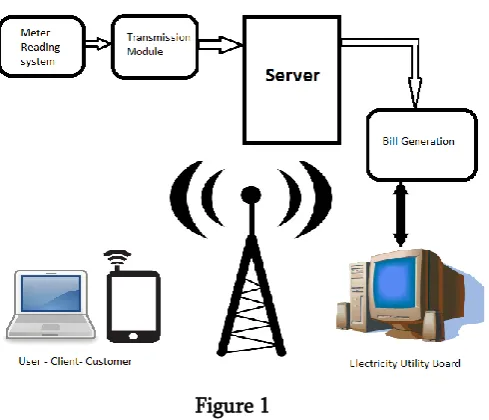
SYSTEM ARCHITECTUREFigure 1
Here the Meter reading system is the actually a meter which is going to take reading at customers end. The meter is embedded with several hardware to achieve the communication between the meter and server which is placed at electricity board office. The meter is attached with transmission module, here this
server. We are using wireless module for communication purpose and no need of any human efforts to take meter reading manually.
After receiving the reading at server side there will back office processing and calculation of bill and after calculation the bill will be generated and sent to customer via SMS.
The payment method used by us is very innovative and easy to use by any category of customers as here are two broad options for paying bill. One can pay bill manually by using payment gateway on our website. And another newly came option of payment is automatic deduction from bank account here the client or customer just need to add his account details and enable the automatic deduction option. The amount of bill will be automatically deducted from his/her account and SMS of that transaction will be received by customer.
This is how our system will work. We can also deactivate the meter by sitting in office and in one click if customer has not payed bill within certain period of time.
Figure 2. Block Diagram
management system based on user friendly software with two separate access support – one for consumer and another for the electricity authority.
We are using ,
LPC 2148: ARM is a family of instruction set architectures for computer processors based on a reduced instruction set computing (RISC) architecture developed by British company ARM Holdings.
LPC-P2148 is prototype board for LPC2148 ARM7TDMI-S microcontroller with USB 2.0 Full-speed device, multiple UARTs, SPI, SSP to I2C-bus and on-chip SRAM up to 40 kB, produced by NXP Semiconductors. With LPC-P2148 you can explore the features of LPC21XX family on budged, the board has everything necessary to build simple applications.
Crystal Oscillator: A crystal oscillator is an electronic oscillator circuit that uses the mechanical resonance of a vibrating crystal of piezoelectric material to create an electrical signal with a precise frequency. This frequency is commonly used to keep track of time, as in quartz wristwatches to provide a stable clock signal for digital integrated circuits, and to stabilize frequencies for radio transmitters and receivers. The most common type of piezoelectric resonator used is the quartzcrystal, so oscillator circuits incorporating them became known as crystal oscillators, but other piezoelectric materials including polycrystalline ceramics are used in similar circuits.
MAX 232: The MAX232 is a dual transmitter / dual receiver that typically is used to convert the RX, TX, CTS, RTS signals. The drivers provide TIA-232 voltage level outputs (about ±7.5 volts) from a single 5-volt supply by on-chip charge pumps and external capacitors.
Buzzer: It is an audio signalling device If electricity theft is detected or any misuse of meter is detected, then buzzer rangs.
Invoice Generation: Here the calculation is done of meter readings and the bill amount is sent to customer via SMS. Along with SMS we will also send link for bill payment and here we have two payment methods. First method is tradition online payment method and another one is auto deduction from bank account.
This project explores the development of wireless controller Based electricity bill. The purpose of this project is to build a digital electricity bill, which could be controlled using wireless controller.
Relay: the microcontroller sends a signal to the relay driver which in turn switches off the relay, such that the main supply to the load is switched off
LCD: LCD display is attached to engery meter and used to show the units consumed by customer.
Wireless Module: The wireless module is used to transfer reading of units and other details to our server.
Mainly, it is used for transferring data from hardware to server.
III.
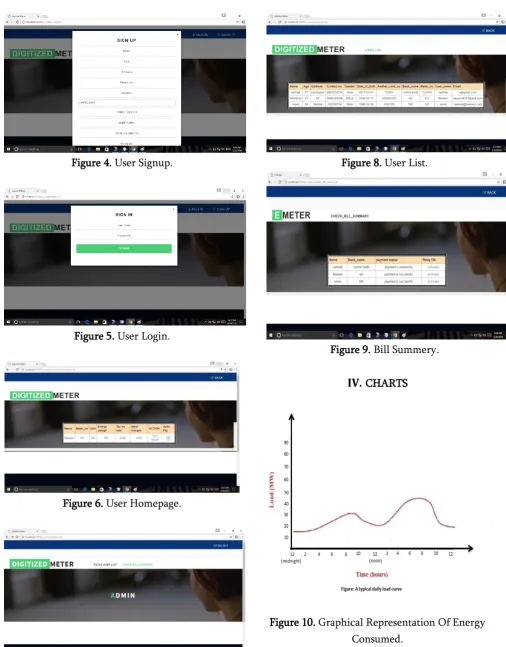
RESULTSFigure 4. User Signup.
Figure 5. User Login.
Figure 6. User Homepage.
Figure 7. Admin Homepage.
Figure 8. User List.
Figure 9. Bill Summery.
IV.
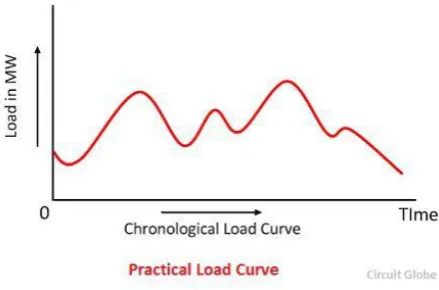
CHARTSFigure 11. Graphical Representation Of Energy Consumed.
We are going to show the graphical representation of energy consumed. These graphs will be shown in the admin area to get idea of load and energy consumption. If the admin finds any suspicious activity then he/she can take appropriate action on it.
V.
CONCLUSIONThis system gives an efficient knowledge about security, Communication System of Meter Reading and payment problems. Since all the vulnerabilities are closed to avoid any possible fraud, lose of electricity problem would be solved. The expense for meter reading and human efforts will be reduced, when the Digitized Energy Meter is introduced. The secure transmission will stop the fraud and theft of energy. The innovative and newly introduced payment method will give great ease of bill payment. And no one ever needs to stand in queue for hours to pay bill. The payment of bill is just one click far. So its very efficient and time saving. The security of this system can further be modified and according to improve the efficiency of the system.
VI.
REFERENCES
[1].Pradip W Kulkarni, Manisha V Shinde,
Automation of Electricity Billing Process, IEEE 2014.
[2].Automatic Electric Meter Reading Monitoring System Using GSM International Research Journal of Engineering and Technology (IRJET) e-ISSN: 2395-0056 Volume: 03 Issue: 05 — May-2016 [3].International Journal of Emerging Technology and
Advanced Engineering Website: www.ijetae.com (ISSN 2250-2459, ISO 9001:2008 Certified Journal, Volume 3, Issue 4, April 2013)
[4].Satellite Conference ICSTSD 2016 International Conference on Science and Technology for
Sustainable Development, Kuala
Lumpur,MALAYSIA, May 24-26, 2016 ISSN: 2348 [5].IJSRD - International Journal for Scientific Research Development— Vol. 3, Issue 03, 2015— ISSN (online): 2321-0613;Wireless Prepaid Energy Metering using RF and Arduino Technology [6].International Journal of Innovative Research in
Computer and Communication Engineering Vol. 3, Issue 3, March 2015;Prepaid Energy Meter with GSM Technology.
VII.
BIOGRAPHIES[7]. "Ms. Swati R. Kasbe, She is studying in Sanghavi College Of Engineering, Nashik, MH, India. She is student of Computer Engineering "
[8]. "Mr. Kundan A. Khairnar, He is studying in Sanghavi College Of Engineering, Nashik, MH, India. He is student of Computer Engineering" [9]. "Ms. Monika S. Mahale, She is studying in
Sanghavi College Of Engineering, Nashik, MH, India. She is student of Computer Engineerig Department. "