International Journal of Engineering Trends and Technology (IJETT) – Volume 9 Number 1 - Mar 2014
ISSN: 2231-5381
http://www.ijettjournal.org
Page 1Comparative Study of Pre Engineered and
Conventional Industrial Building
Pradeep V1, Papa Rao G2 1
MTech Student, 2Associate Professor
Civil Engineering Department, GVPCOE, VSKP, AP, INDIA
ABSTRACT
Long span, Column free structures are the most essential in any type of industrial structures and Pre Engineered Buildings (PEB) fulfil this requirement along with reduced time and cost as compared to conventional structures. This methodology is versatile not only due to its quality pre-designing and prefabrication, but also due to its light weight and economical construction. The present work presents the comparative study and design of conventional steel frames with concrete columns and steel columns and Pre Engineered Buildings (PEB). In this work, an industrial building of length 44m and width 20m with roofing system as conventional steel truss and pre-engineered steel truss is analyzed and designed by using STAAD Pro V8i.
Keywords: Pre-Engineered Building, Staad.Pro, Tapered Section.
I. INTRODUCTION
India has the second fastest growing economy in the world and a lot of it, is attributed to its construction industry which figures just next to agriculture in its economic contribution to the nation. In its steadfast development, the construction industry has discovered, invented and developed a number of technologies, systems and products, one of them being the concept of Pre-engineered Buildings (PEBs). As opposed to being on-site fabricated, PEBs are delivered as a complete finished product to the site from a single supplier with a basic structural steel framework with attached factory finished cladding and roofing components. The structure is erected on the site by bolting the various building components together as per specifications. PEBs are developed using potential design software. The onset of technological advancement enabling 3d modelling and detailing of the proposed structure and coordination has revolutionized Conventional building construction. Pre-Engineered Buildings (PEB) is the future for India. Most of the Indian business community is just started
to realize the benefits of PEB’s. Where you have been building with concrete for as long as anyone can remember, it is difficult to change. However India’s most progressive companies are seeing the benefits of PEB’s.
II. METHODOLOGY
In the present study an Industrial steel structure with Conventional steel structure with concrete columns, Conventional steel structure with steel columns and 3.Pre-Engineered structure are considered for the analysis, design using Staad.Pro V8i. Conventional Steel Building of length 20 m and span 44 m. Bay lengths are maintained at an interval of 4 m along length. The height of the truss is taken as a minimum pitch that is 1/5th of span. So slope of roof is taken as 21.8˚and covered with GI sheet. The spacing of purlins is maintained as 1.35 m. The eave height of the building has been taken as 5.5 m in which 3 m from ground level is used for brick work and remaining 2.5 m is used for cladding. Pre Engineered Steel Building of length 20 m and span 44 m. Bay lengths are maintained at an interval of 4 m along length. For this structure from general practice slope of the roof is taken as 5.71˚. The spacing of purlins is maintained as 1.26 m. The
eave height of the building has been taken as 5.5 m in which 3 m from ground level is used for brick work and remaining 2.5 m is used as cladding.
A. Pre Engineered Buildings
International Journal of Engineering Trends and Technology (IJETT) – Volume 9 Number 1 - Mar 2014
ISSN: 2231-5381
http://www.ijettjournal.org
Page 2 diagram. This leads to the utilization of non-prismatic rigidframes with slender elements. Tapered I sections made with built-up thin plates are used to achieve this configuration. Standard hot-rolled sections, cold-formed sections, profiled roofing sheets, etc. is also used along with the tapered sections. The use of optimal least section leads to effective saving of steel and cost reduction. The typical PEB frame of the structure is as shown in the Figure.
Fig.1 Single Frame of a Pre Engineered Building
B. Conventional Steel Buildings
Conventional steel buildings (CSB) are low rise steel structures with roofing systems of truss with roof coverings. Various types of roof trusses can be used for these structures depending upon the pitch of the truss. For large pitch, Fink type truss can be used; for medium pitch, Pratt type truss can be used and for small pitch, Howe type truss can be used. Skylight can be provided for day lighting and for more day lighting, quadrangular type truss can be used. The selection criterion of roof truss also includes the slope of the roof, fabrication and transportation methods, aesthetics, climatic conditions, etc. Several compound and combination type of economical roof trusses can also be selected depending upon the utility. Standard hot-rolled sections are usually used for the truss elements along with gusset plates. The CSB frame of the structure considered in the study is as shown in Figure.
Fig.2 Single Frame of a Conventional Steel Building
III. ADVANTAGES OF PEB
Following are some of the advantages Pre-Engineered Building Structures:
a) Buildings are generally constructed in just 6 to 8 weeks after approval of drawings. PEB will thus reduce total construction time of the project by at least 30%. This allows faster occupancy and earlier realization of revenue.
b) Because of systems approach, considerable saving is achieved in design, manufacturing and erection cost.
c) These can be easily expanded in length by adding additional bays. Also expansion in width and height is possible by pre designing for future expansion.
d) Buildings can be supplied to around 90m clear spans. This is one of the most important advantages of PEB giving column free space.
e) Buildings are manufactured completely in the factory under controlled conditions, and hence the quality can be assured. f) PEB Buildings have high quality paint systems for cladding and steel to suit ambient conditions at the site, which in turn gives long durability and low maintenance coats.
g) Buildings are supplied with polyurethane insulated panels or fibre glass blankets insulation to achieve required “U” values (overall heat transfer coefficient).
International Journal of Engineering Trends and Technology (IJETT) – Volume 9 Number 1 - Mar 2014
ISSN: 2231-5381
http://www.ijettjournal.org
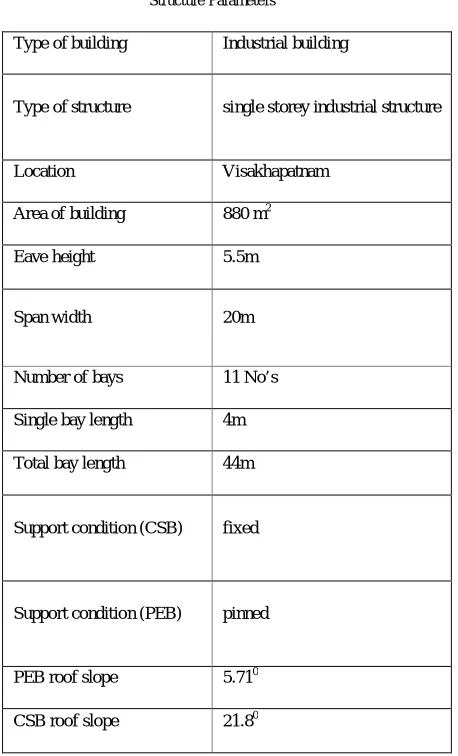
Page 3TABLE I Structure Parameters
Type of building Industrial building
Type of structure single storey industrial structure
Location Visakhapatnam
Area of building 880 m2
Eave height 5.5m
Span width 20m
Number of bays 11 No’s
Single bay length 4m
Total bay length 44m
Support condition (CSB) fixed
Support condition (PEB) pinned
PEB roof slope 5.710
CSB roof slope 21.80
IV. LOAD CALCULATIONS
C. Dead Load
Dead load is calculated According to IS: 875 (Part 1) – 1987[15].
Dead Load on Conventional Steel Building:
Weight of the G.I sheeting = 0.131 kN/m2
Weight of fixings = 0.025 kN/m2
Weight of services = 0.1 kN/m2
Total weight = 0.256 kN/m2
Spacing of the purlin = 1.35 m
Total weight on purlins = 0.256 × 1.35 = 0.345 kN/m
Dead Load on Pre-Engineered Building:
Weight of the G.I sheeting = 0.131 kN/m2
Weight of fixings = 0.025 kN/m2
Weight of services = 0.1 kN/m2
Total weight is = 0.256 kN/m2
Total weight on purlins = 0.256 × 1.26 = 0.322 kN/m
D. Live Load
The Live load is calculated according to IS: 875 (Part 2) – 1987 [16].
Live Load on Conventional Steel Building:
Live load on the sloping roof is = 750 – 20(α -10) N/m2
Where α = 21.8˚, Therefore live load = 0.514 kN/m2
Live load on purlins = 0.514 × 1.35 = 0.9179 kN/m
Live Load on Pre-Engineered Building:
Live load on purlins = 0.836 kN/m2
Therefore live load on purlins at 1.26 spacing
= 0.836 × 1.26 = 1.05 kN/m
E. Earthquake Load
Earthquake loads are calculated as per IS: 1893-2000 [17].
Earthquake Load on Conventional Steel Building:
Dead load = 0.256 kN/m2
Live load = 0.128 kN/m2 (25٪ of reduction as per IS 1893-2002)
Total load = DL+LL = 0.384 kN/m2
Bay width of the building is 4 m
International Journal of Engineering Trends and Technology (IJETT) – Volume 9 Number 1 - Mar 2014
ISSN: 2231-5381
http://www.ijettjournal.org
Page 4 Earthquake Load on Pre-Engineered Building:Dead load = 0.256 kN/m2
Live load = 0.209 kN/m2 (25٪ of reduction as per is 1893-2002)
Total load = 0.465 kN/m2
Bay width of the building is 4 m
Therefore earthquake load on rafter = 0.444 × 4 = 1.86 kN/m.
F. Wind Load
Wind load is calculated as per IS: 875 (Part 3) – 1987
Basic Wind speed Vb = 50 m/sec
Risk Coefficient K1 = 1
Terrain, Height and Structure size factor K2 = 1
Topography factor K3 = 1
Design Wind Speed Vz = VbK1K2K3 = 50 m/sec
Design Wind Pressure P = 0.06 Vz 2
= 1.5 kN/m2
The Internal Coefficients are taken as +0.5 and -0.5. Wind Load on individual members are then calculated by
F = (Cpe – Cpi) x A x P
Where, Cpe – External Coefficient
Cpi – Internal Coefficient
A – Surface Area in m2
P – Design Wind Pressure in kN/m2
V. STAAD PRO PROCEDURE
In the present study, Staad Pro software has been used in order to analyse and design Pre Engineered Structures and Conventional Steel Structure. It gives the Bending moment, Shear Forces, Axial Forces, Torsion, Beam Structures of a steel structure so that the design can be done using Tapered Sections and check for safety in Pre Engineered Buildings.
VI. RESULTS
Fig.3 Bending moments and Reactions at Supports
Fig.4 Bending moments and Reactions in Columns
International Journal of Engineering Trends and Technology (IJETT) – Volume 9 Number 1 - Mar 2014
ISSN: 2231-5381
http://www.ijettjournal.org
Page 5 Fig.6 Bending moments and Reactions at mid-span of RaftersFig.7 Bending moments and Reactions at end of Rafters
Fig.8 Bending moments and Reactions at Ridge Portion
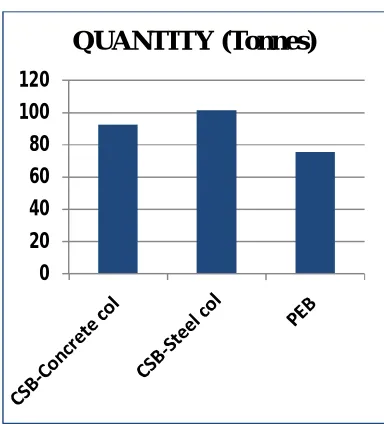
TABLE II
QUANTITY OF STEEL UTILIZED FOR THE STRUCTURE
CSB with Concrete Columns 92.663 Tonnes
CSB with Steel Columns 101.553 Tonnes
Pre-Engineered Building 75.645 Tonnes
VII. DISCUSSION
After Analyzing, at different load cases it is observed that the Axial force at supports in PEB (43.487 kN) is less when compared to that in CSB with concrete columns and steel columns (37.814 kN & 64.054 kN). Shear force at supports in PEB (178.708 kN) is less when compared to that in CSB with concrete columns and steel columns (226.003 kN & 186.14 kN). The Bending Moments at supports in PEB is negligible when compared to that in CSB with concrete columns and steel columns (151.955 kN & 171.955 kN).
In Columns, the Axial force in PEB (178.708 kN) is less when compared to that in CSB with concrete columns and steel columns (225.995 kN & 186.134 kN). Shear force in PEB (44.832 kN) is less when compared to that in CSB with concrete columns and steel columns (47.534 kN & 64.248 kN). The Bending Moments in PEB (354.358 kN) is more due to its light weight structure (Tapered Sections) when compared to that in CSB with concrete columns and steel columns (232.72 kN & 163.382 kN).
In Rafters, the Axial force in PEB (53.048 kN) is less when compared to that in CSB with concrete columns and steel columns (135.625 kN & 128.426 kN). Shear force in PEB (110.039 kN) is less when compared to that in CSB with concrete columns and steel columns (16.015 kN & 16.224 kN). The Bending Moments in PEB (252.821 kN) is more due
0 20 40 60 80 100 120
International Journal of Engineering Trends and Technology (IJETT) – Volume 9 Number 1 - Mar 2014
ISSN: 2231-5381
http://www.ijettjournal.org
Page 6 to its light weight structure (Purlins & Rafters) whencompared to that in CSB with concrete columns and steel columns (9.94 kN & 14.544 kN).
In Rafters at mid-span, the Axial force in PEB (46.794 kN) is less when compared to that in CSB with concrete columns and steel columns (135.335 kN & 178.16 kN). Shear force in PEB (59.685 kN) is more when compared to that in CSB with concrete columns and steel columns (1.426 kN & 1.61 kN). The Bending Moments in PEB (154.293 kN) is more due to its light weight structure (Tapered Sections) when compared to that in CSB with concrete columns and steel columns (1.447 kN & 1.959 kN). In Rafters at Ends, the Axial force in PEB (34.226
kN) is less when compared to that in CSB with concrete columns and steel columns (121.66 kN & 160.158 kN). Shear force in PEB (110.039 kN) is less when compared to that in CSB with concrete columns and steel columns (9.129 kN & 10.306 kN). The Bending Moments in PEB (252.821 kN) is more when compared to that in CSB with concrete columns and steel columns (9.94 kN & 13.456 kN). In Rafters at Ridge portion, the Axial force in PEB
(52.435 kN) is less when compared to that in CSB with concrete columns and steel columns (102.817 kN & 135.352 kN). Shear force in PEB (41.016 kN) is less when compared to that in CSB with concrete columns and steel columns (12.567 kN & 14.187 kN). The Bending Moments in PEB (166.829 kN) is more when compared to that in CSB with concrete columns and steel columns (2.993 kN & 4.052 kN).
VIII. CONCLUSION
This paper effectively conveys that PEB structures can be easily designed by simple design procedures in accordance with country standards. Low weight flexible frames of PEB offer higher resistance to earthquake loads. PEB roof structure is almost 26% lighter than Conventional Steel Building. In secondary members, light weight “Z” purlins are used for PEB structure, whereas heavier hot-rolled sections are used for CSB. Support reactions for PEB are lesser than CSB as per analysis. Light weight foundation can be adopted for PEB which leads to simplicity in design and reduction in cost of construction of foundation. Heavy foundation will be required for CSB structure. PEB building cost is 30% lesser than the cost of CSB structure. PEB offers low cost, strength, durability, design flexibility, adaptability and recyclability. To conclude “Pre-Engineered Building construction gives end
users a much more economical and better solution for long span structures where large column free areas are needed.
REFERENCES
[1] Aijaz Ahmad Zende, Prof. A. V. Kulkarni, Aslam Hutagia, “Comparative Study of Analysis and Design of Pre-Engineered- Buildings and Conventional Frames”, IOSR journal of mechanical and civil engineering, Volume 5, Issue 1, Jan.- Feb. 2013, pp 32-43.
[2] Bhavikatti S.S, “Design of steel structures by limit state method as per IS 800-2007”, I.K.International publishing house Pvt.Ltd. New Delhi, (2010).
[3] Darshana P.Zoad, “Evaluation of Pre-Engineering Structure Design by IS-800 as against Pre-Engineering Structure Design by AISC”, International Journal of Engineering Research and technology (IJERT), Volume-1, issue 5, July 2012.
[4] Duggal S.K, “Limit State Design of steel Structural” Tata McGraw Hill education private limited, New Delhi, (2010). [5] Jatin D.Thakar, P.G. Patel, “Comparative Study Of
Pre-Engineered Steel Structure by varying width of Structure”, International Journal of Advanced Engineering Technology, Volume IV, Issue III, Sept 2013, pp 56-62.
[6] Meera C.M, “Pre-Engineered Building Design of an Industrial Warehouse”, International journal of Engineering Sciences and Emerging Technologies, Volume 5, Issue 2, June – 2013, pp: 75-82.
[7] Parth Thakker “Conventional steel buildings v/s Pre-engineered buildings”.
[8] Shiyekar. M.R, “Limit State Design in Structural Steel”, PHI learning private limited, New Delhi (2011).
[9] Subramanian. N, “Pre- Engineered buildings selection of framing system, roofing and wall materials” The Master builder, July, 2008, pp 48-62.
[10] Subramanian N, “Design of steel structures”, Oxford higher education, Chennai (2008).
[11] Syed Firoz et al, “Design concept of Pre Engineered Building”, International Journal of Engineering Research and Applications (IJERA), Vol. 2, Issue 2, April 2012, pp.267-272.
[12] Vrushali Bahadure, R.V.R.K.Prasad “Comparison between Design and Analysis of various Configuration of Industrial Sheds”, International Journal of Engineering Research and Applications (IJERA), Vol. 3, Issue 1, Jan.-Feb 2013, pp: 1565-1568.
[13] Zamil steel, “Technical Manual” January 1999.
[14] IS 800, “General construct in steel – code of practice” Bureau of Indian standards, New Delhi, (2007).
[15] IS 875 (part 1) “Code of practice for design loads (other than earthquake) for building and structures”, dead loads, New Delhi, 1987.
[16]IS 875 (part 2) “Code of practice for design loads (other than earthquake) for building and structures”, Imposed loads, New Delhi, 1987.