1535-9778/07/$08.00⫹0 doi:10.1128/EC.00383-06
Copyright © 2007, American Society for Microbiology. All Rights Reserved.
Multiple Basic Helix-Loop-Helix Proteins Regulate Expression
of the
ENO1
Gene of
Saccharomyces cerevisiae
䌤
Meng Chen and John M. Lopes*
Department of Biological Sciences, Wayne State University, Detroit, Michigan
Received 5 December 2006/Accepted 1 March 2007
The basic helix-loop-helix (bHLH) eukaryotic transcription factors have the ability to form multiple dimer combinations. This property, together with limited DNA-binding specificity for the E box (CANNTG), makes them ideally suited for combinatorial control of gene expression. We tested the ability of all nineSaccharomyces
cerevisiaebHLH proteins to regulate the enolase-encoding geneENO1.ENO1was known to be activated by the
bHLH protein Sgc1p. Here we show that expression of anENO1-lacZreporter was also regulated by the other eight bHLH proteins, namely, Ino2p, Ino4p, Cbf1p, Rtg1p, Rtg3p, Pho4p, Hms1p, and Ygr290wp. ENO1-lacZ
expression was also repressed by growth in inositol-choline-containing medium. Epistatic analysis and chro-matin immunoprecipitation experiments showed that regulation by Sgc1p, Ino2p, Ino4p, and Cbf1p and repression by inositol-choline required three distal E boxes, E1, E2, and E3. The pattern of bHLH binding to the three E boxes and experiments with two dominant-negative mutant alleles ofINO4andINO2support the model that bHLH dimer selection affectsENO1-lacZexpression. These results support the general model that bHLH proteins can coordinate different biological pathways via multiple mechanisms.
The basic helix-loop-helix (bHLH) proteins are a large fam-ily of transcriptional regulators. Over 500 bHLH proteins have been identified in organisms fromSaccharomyces cerevisiaeto mammals (3, 5, 26, 35, 44, 45, 53, 63, 65, 78). They regulate a diverse array of cellular processes, including cell differentia-tion, development, and cell proliferation (7, 29, 30, 53, 57, 63, 66, 77). Five different properties of bHLH proteins generate sufficient diversity to regulate a variety of different transcrip-tional programs (53, 63). First, the structure of bHLH proteins includes two amphipathic ␣-helices, separated by a variable loop, which present hydrophobic residues on one face of each helix. This structure allows for the formation of homodimers or heterodimerization with several different partners (51, 76). In mammals, regulation of genes involved in proliferation and differentiation is governed by Max dimerized with Myc, Max, Mad, and Mxi (29, 30, 57, 66). Similarly, theS. cerevisiaeIno4p bHLH protein is a hub that interacts with all yeast bHLH proteins tested thus far (62). Second, dimerization juxtaposes two helices containing basic charged residues that create a DNA-binding interface (51, 53, 63, 76). Therefore, dimeriza-tion is a prerequisite for DNA binding. However, bHLH pro-teins have relatively limited DNA-binding specificity, since most interact with a sequence known as the E box (5⬘-CANN TG-3⬘) (9, 19, 21, 51, 76, 80). Conserved amino acids within the DNA-binding region interact with invariant nucleotides, while other residues provide specificity by interacting with the cen-tral variant nucleotides or, in some cases, nucleotides that flank the core sequence (9, 19, 21, 51, 76, 80). For example, Pho4p and Cbf1p homodimers both bind the consensus CACGTG sequence, but specificity is dictated by a flanking T nucleotide
that inhibits Pho4p binding but not Cbf1p binding (21). Third, some bHLH proteins, such as Ino2p, autoregulate their own expression. The Ino2p-Ino4p heterodimer is required for de-repression of the yeast phospholipid biosynthetic genes in re-sponse to inositol deprivation (32, 33, 67). Expression of an
INO2-catreporter requires both Ino2p and Ino4p (1, 2, 17).
Fourth, some family members lack the basic charged DNA-binding domain (HLH) and therefore can dimerize with other bHLH proteins but prevent their binding to DNA. The Id HLH protein acts as a dominant inhibitor by heterodimerizing with other bHLH proteins (E12 and E47) (31, 47, 59, 77). Dimerization with the Id protein prevents these other bHLH proteins from binding, either as homodimers or heterodimers with MyoD, to the muscle creatine kinase enhancer (31, 47, 59, 77). Yeast contains one potential HLH protein, encoded by YGR290w (a dubious open reading frame [ORF]). Lastly, some bHLH proteins are regulated by intracellular compart-mentation. Pho4p, Rtg1p, and Rtg3p are present in the cyto-plasm under repressing conditions and translocate to the nu-cleus under activating conditions (36, 37, 42, 74). Collectively, these features make the bHLH protein family particularly suited for combinatorial control of gene expression.S. cerevi-siaehas only nine predicted bHLH proteins and is therefore an excellent model system to examine how this family of transcrip-tion factors functranscrip-tion in the coordinatranscrip-tion of gene expression.
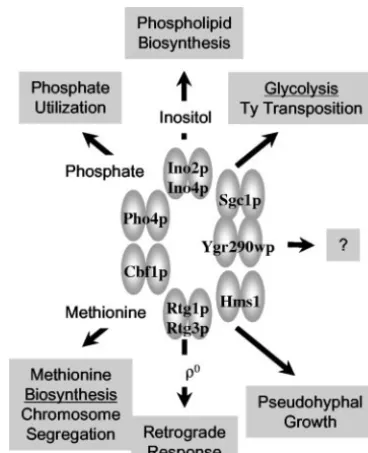
Yeast bHLH proteins regulate several important metabolic pathways, including phosphate utilization, glycolysis, and phos-pholipid biosynthesis (63). Pho4p was the first bHLH protein identified in yeast (6). Pho4p forms a homodimer that activates expression of thePHOregulon in response to phosphate lim-itation (Fig. 1) (60). The activity of Pho4p is regulated by nuclear translocation via phosphorylation at multiple residues (36, 37, 42). Like the case with Pho4p, Rtg1p and Rtg3p ac-tivities are also regulated by phosphorylation and nuclear translocation (34, 74). Rtg1p and Rtg3p form a heterodimer that regulates nuclear genes, such as CIT2, in response to * Corresponding author. Mailing address: Department of Biological
Sciences, Wayne State University, 5047 Gullen Mall, Detroit, MI 48202. Phone: (313) 993-7816. Fax: (313) 577-6891. E-mail: jlopes @sun.science.wayne.edu.
䌤Published ahead of print on 9 March 2007.
786
on September 8, 2020 by guest
http://ec.asm.org/
mitochondrial damage (0), a process known as retrograde regulation (Fig. 1) (11, 18). Ino2p and Ino4p form a het-erodimer that regulates a large set of genes, including the phospholipid biosynthetic genes, in response to inositol depri-vation (Fig. 1) (32, 33, 67). Cbf1p has a dual role in regulation of transcription and chromosome segregation (Fig. 1). Cbf1p binds the CACRTG element that is present in manyMETgene promoters as well as in the centromere DNA element I (12, 39). Hms1p and Ygr290wp have similarity with the HLH family but are the least characterized of the yeast HLH proteins (Fig. 1) (50). Hms1p is required for pseudohyphal growth. Ygr290wp is listed as a dubious ORF (http://www.yeastgenome .org/) and retains some degree of sequence conservation with the HLH domain but lacks a basic charged DNA-binding re-gion. Lastly, Sgc1p (Tye7p) forms a homodimer, activates the expression of glycolytic genes (i.e.,ENO1andENO2), and may also function in Ty1-mediated gene expression (Fig. 1) (48, 68). Sgc1p was identified in a genetic selection for mutants that simultaneously restored growth on glucose and expression of
an ENO1-lacZ reporter gene in a gcr1 mutant strain (58).
Grc1p is required for maximal expression of the enolase genes (ENO1 and ENO2) and several other glycolytic genes (49). Sgc1p and Gcr1p function to stimulate expression of theENO1
andENO2genes through parallel pathways, since agcr1 sgc1
double mutant strain is more defective in enolase gene expres-sion than either of the single mutant strains (68). In this study, we found that in addition to Sgc1p, several other bHLH pro-teins affect the expression of theENO1gene. This regulation requires that the bHLH proteins interact with three upstream activation sequence (UAS) elements that conform to the E box binding motif. Regulation through two of these UAS elements may be a recent evolutionary event, since these two elements are limited to theS. cerevisiaespecies. Epistasis analysis cou-pled with chromatin immunoprecipitation (ChIP) experiments
suggests that novel bHLH combinations may interact with these UAS elements.
MATERIALS AND METHODS
Strains, media, and growth conditions.Plasmid-containingEscherichia coli
DH5␣cells (Invitrogen, Carlsbad, CA) were grown in LB-Amp medium (10% [wt/vol] Bacto tryptone, 5% [wt/vol] yeast extract, 10% [wt/vol] NaCl, and 50
g/ml ampicillin) at 37°C. Plasmid-containingE. coliBL21(DE3)/pLysS cells (Novagen, Madison, WI) were grown at 37°C and 25°C in LB-Amp medium supplemented with 50g/ml chloramphenicol.
The S. cerevisiaestrains used in this study were BY4742 (MAT␣ his3-⌬1 leu2-⌬0 lys2-⌬0 ura3-⌬0), BY4741 (MATahis3-⌬1 leu2-⌬0 met15-⌬0 ura3-⌬0), and isogenic strains containingino2⌬,ino4⌬,pho4⌬,cbf1⌬,sgc1⌬,rtg1⌬,rtg3⌬,
hms1⌬, andygr290w⌬alleles (22, 81). Yeast cultures were grown at 30°C in a complete synthetic medium lacking inositol, choline, KH2PO4, and uracil (for
reporter plasmid selection) (38). Where indicated, 75M inositol (I⫹) and/or 1 mM choline (C⫹) was added. Low-Pimedium contained 0.22 mM KH2PO4and
20 mM KCl, and high-Pimedium contained 11 mM KH2PO4.
Plasmid construction.Plasmid YEp357R-ENO1contains 720 bp of the se-quence upstream of theENO1ORF and the first codon fused in frame to the
lacZreporter gene in YEp357R (56). This 720-bp region was previously shown to contain all of the regulatory elements necessary forENO1expression (79). YEp357R is a multicopy episomal plasmid with aURA3selectable marker (56). This fusion plasmid was constructed by first amplifying 1,000 bp of theENO1
promoter fromS. cerevisiaegenomic DNA (Invitrogen, Carlsbad, CA), using primers ENO1 F and ENO1 R (Table 1). The 1,000-bp PCR product was cloned into pGEM-T (Promega, Madison, WI) and sequenced, and then the ORF-proximal 720-bp sequence was excised by digestion with EcoRI and inserted into YEp357R.
Plasmids that complemented thecbf1⌬,sgc1⌬,ino2⌬, andino4⌬mutant alleles were constructed by cloning each ORF and promoter into pRS315. Plasmid pRS315-CBFIwas constructed by amplifying a 1,556-bp fragment fromS. cer-evisiaegenomic DNA (Invitrogen, Carlsbad, CA), using primers CBF1 F⬘ (po-sition⫺500) and CBF1 R⬘ (position ⫹1056) (Table 1). The 1,556-bp PCR product was cloned into pGEM-T (Promega, Madison, WI), sequenced, excised by digestion with NotI and XbaI, and ligated into pRS315. Likewise,
pRS315-SGC1was made using primers SGC1 F⬘(⫺1000) and SGC1 R⬘(⫹1426) (Table 1), which amplified theSGC1ORF, 1,000 bp of upstream sequence, and 550 bp of downstream sequence. The 2,426-bp PCR product was cloned into pGEM-T, sequenced, excised by digestion with BamHI and HindIII, and inserted into pRS315. Plasmids pRS315-INO2and pRS315-INO4were constructed previously (K. R. Gardenour and J. M. Lopes, unpublished data). Briefly, pRS315-INO2
was constructed by inserting a 2.4-kb SalI/ClaI fragment (containing 500 bp of promoter, theINO2ORF, and 400 bp of 3⬘-untranslated region [3⬘UTR]) from YCp50-INO2(17) into pRS200 (pRS200-INO2) and subsequently cloning a SalI/PstI fragment from pRS200-INO2into pRS315. Likewise, pRS315-INO4
was constructed by inserting a 2.4-kb SacII/SalI fragment (containing 500 bp of promoter, theINO4ORF, and 400 bp of 3⬘UTR) from YCp50-INO4-496 (64) into pRS315.
Plasmids were made to contain dominant-negative mutants of INO2and
INO4. The expressed mutants were capable of dimerization with other bHLH proteins but inhibited their binding to DNA because they either contained mutations in the DNA-binding basic charged domain (ino2-R13Land ino4-R13L) or completely lacked the basic charged domain (ino4-BRD). The ino4-BRDmutant was created by PCR. The region upstream of the basic charged domain (including 500 bp of theINO4promoter) was amplified using primers INO4F (containing a BamHI site) and INO⬘4R (Table 1) to yield a 650-bp product. The region downstream of the basic charged domain (including the
INO43⬘UTR) was amplified using primers INO⬘4F and INO4R (containing a KpnI site) (Table 1) to yield an 800-bp product. The two PCR products were annealed (primers INO⬘4R and INO⬘include a 30-bp overlap that deletes the basic charged region), extended, reamplified using primers INO4F and INO4R (to yield a 1,420-bp product), and cloned into pGEM-T. The insert was se-quenced, excised by digestion with BamHI and KpnI, and inserted into pRS315 to yield pRS315-INO4-BRD. Plasmids pRS315-INO2-R13Land pRS315- INO4-R13Lwere constructed previously by site-directed mutagenesis (Gardenour and Lopes, unpublished data). Briefly, YCp50-INO2 was mutagenized using a QuikChange XL site-directed mutagenesis kit (Stratagene, La Jolla, CA), using primers INO2 R13L 5⬘SD and INO2 R13L 3⬘SD (Table 1). TheINO2-R13L
mutant allele was sequentially cloned into pRS200 and pRS315 as described above. Plasmid pRS315-INO4was directly mutagenized using a QuikChange XL
FIG. 1. Biological processes regulated by yeast bHLH proteins. Refer to the text for descriptions.
on September 8, 2020 by guest
http://ec.asm.org/
site-directed mutagenesis kit and primers INO4 R13L 5⬘SD and INO4 R13L 3⬘
SD (Table 1).
Hemagglutinin (HA)-tagged derivatives ofCBF1,SGC1,INO2, andINO4to be used for ChIP assays were either generated or purchased. A YCp50-CBF1-HA
construct was created by mutational PCR. PCR was used to replace the second and third codons ofCBF1with a BglII site. To do this, a PCR using primers CBF1A and CBF1-HA 3⬘(Table 1) yielded a 500-bp product containing the
CBF1promoter and the new BglII site. A second PCR with the primers CBF1B and CBF1-HA 5⬘(Table 1) yielded a 1,520-bp product containing theCBF1ORF and the new BglII site. The PCR products were digested with BglII and ligated to create a product which contained theCBF1promoter and ORF with the BglII site. The ligated fragment was used for another round of PCR with the primers CBF1A and CBF1B, resulting in a 2,056-bp product. This PCR fragment was cloned into pGEM-T. A 120-bp BglII fragment containing three tandem copies of the HA epitope was isolated from pSM492 (8) and inserted into the pGEM-T derivative partially digested with BglII. A SalI-BamHI fragment was isolated from the pGEM-T derivative and cloned into YCp50. The YCp50-CBF1-HA
construct was confirmed by DNA sequencing. The YCp50-INO2-HAand
YCp50-INO4-HAplasmids have been described previously (17, 64). A strain containing an HA-taggedSGC1gene was purchased from Open Biosystems (Huntsville, AL). Three E boxes in theENO1promoter (positioned at⫺460,⫺656, and⫺704) were mutagenized using a QuikChange XL site-directed mutagenesis kit and the pGEM-T-ENO1promoter derivative described above. The E primer set (Table 1) was used to create three single E box mutants. The single mutants were used to create the three possible combinations of double mutants and the triple mutant. The mutantENO1promoters were cloned into YEp357R as described above.
Reporter enzyme assays. To assay-galactosidase (-Gal) activity, yeast strains were grown in 5 ml of appropriate medium to mid-log phase (60 to 80 Klett units) and pelleted by centrifugation at 5,000⫻gfor 10 min. The cell pellet was suspended in 200l of-Gal assay buffer (20% glycerol, 0.1 M Tris-HCl [pH 8.0], 1 mM dithiothreitol, and 1 mM phenylmethylsulfonyl fluoride [PMSF]), transferred to a sterile 1.5-ml microcentrifuge tube, and stored at⫺80°C
over-night. Cells were thawed on ice, and 100l of glass beads (0.45-mm diameter) was added. Cells were lysed by use of a vortex mixer six times for 15 s each. Cellular debris was removed by centrifugation at 14,000 rpm for 15 min at 4°C. The supernatant was transferred to another 1.5-ml microcentrifuge tube. To assay-Gal activity, reaction mixtures were set up with 20l of cell extract and 80l of-Gal assay buffer and incubated for 5 min at 28°C. The reaction was initiated by the addition of 40l of ONPG (o-nitrophenyl--D
-galactopyrano-side; 4 mg/ml). The absorbance of the reaction was measured by determining the optical density at 420 nm at 12-second intervals for a total of 30 min. Protein concentration was determined by the Bio-Rad Protein Assay (Bio-Rad, Rock-ville Center, NY). Both the-Gal activity reactions and the protein concentra-tion reacconcentra-tions were quantified using SoftmaxPro software and a Versamaxtunable
microplate reader (Molecular Devices, Sunnyvale, CA). Units of-Gal activity are given asA420/min/mg total protein⫻1,000.
ChIP assay.Yeast cell cultures (200 ml) were grown in I⫺C⫺medium at 30°C to mid-log phase (60 to 80 Klett units). Formaldehyde was added to a 1% final concentration, followed by a 30-min incubation at 30°C. Glycine was added to 125 mM, and the mixture was incubated for an additional 5 min. Cells were pelleted at 1,500⫻gfor 5 min, and pellets were washed twice with 700 ml of 1⫻
phosphate-buffered saline (0.43 mM Na2HPO4, 0.14 mM KH2PO4, 13.7 mM
NaCl, and 0.27 mM KCl) and once with 15 ml of bead-beater lysis buffer (50 mM HEPES-KOH, pH 7.5, 10 mM MgCl2, 150 mM KCl, 0.1 mM EDTA, 10%
glycerol, 0.1% NP-40, 1 mM dithiothreitol, 1 mM sodium metabisulfite, 0.2 mM PMSF, 1 mM benzamidine, and 1g/ml pepstatin). The cell pellet was weighed and resuspended in 2.5⫻bead-beater lysis buffer. One milliliter of the resus-pended cells was added to 1 ml of 0.45-mm glass beads. Cells were lysed in a mini-Beadbeater 8 with four 1-minute pulses at the highest setting (with cells being placed on ice for 2 min between pulses). The extract was recovered by pouring the bead-extract slurry into a 6-ml syringe fitted with a 25-gauge, 5/8-inch-long needle. The syringe was washed with 0.75 ml of bead-beater lysis buffer. The extract was sonicated three times for 30 seconds each, using a model 100 Sonic Dismembrator with a Branson 250 microtip sonicator (Fisher Scien-tific, Pittsburgh, PA) at 50% duty cycle with a power setting of 5, with cells being
TABLE 1. Oligonucleotides used in this study
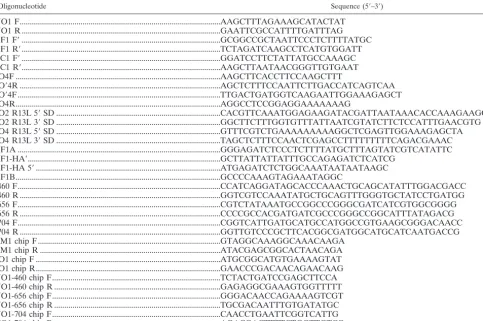
Oligonucleotide Sequence (5⬘–3⬘)
ENO1 F...AAGCTTTAGAAAGCATACTAT ENO1 R ...GAATTCGCCATTTTGATTTAG CBF1 F⬘...GCGGCCGCTAATTCCCTCTTTTATGC CBF1 R⬘...TCTAGATCAAGCCTCATGTGGATT SGC1 F⬘...GGATCCTTCTATTATGCCAAAGC SGC1 R⬘...AAGCTTAATAACGGGTTGTGAAT INO4F ...AAGCTTCACCTTCCAAGCTTT
INO⬘4R ...AGCTCTTTCCAATTCTTGACCATCAGTCAA INO⬘4F ...TTGACTGATGGTCAAGAATTGGAAAGAGCT INO4R...AGGCCTCCGGAGGAAAAAAAG
INO2 R13L 5⬘SD ...CACGTTCAAATGGAGAAGATACGATTAATAAACACCAAAGAAGCC INO2 R13L 3⬘SD ...GGCTTCTTTGGTGTTTATTAATCGTATCTTCTCCATTTGAACGTG INO4 R13L 5⬘SD ...GTTTCGTCTGAAAAAAAAAGGCTCGAGTTGGAAAGAGCTA INO4 R13L 3⬘SD ...TAGCTCTTTCCAACTCGAGCCTTTTTTTTTCAGACGAAAC CBF1A ...GGGAGATCTCCCTCTTTTATGCTTTAGTATCGTCATATTC CBF1-HA⬘...GCTTATTATTATTTGCCAGAGATCTCATCG
CBF1-HA 5⬘...ATGAGATCTCTGGCAAATAATAATAAGC CBF1B...GCCCCAAAGTAGAAATAGGC
E-460 F...CCATCAGGATAGCACCCAAACTGCAGCATATTTGGACGACC E-460 R ...GGTCGTCCAAATATGCTGCAGTTTGGGTGCTATCCTGATGG E-656 F...CGTCTATAAATGCCGGCCCGGGCGATCATCGTGGCGGGG E-656 R ...CCCCGCCACGATGATCGCCCGGGCCGGCATTTATAGACG E-704 F...CGGTCATTGATGCATGCCATGGCCGTGAAGCGGGACAACC E-704 R ...GGTTGTCCCGCTTCACGGCGATGGCATGCATCAATGACCG TCM1 chip F ...GTAGGCAAAGGCAAACAAGA
TCM1 chip R ...ATACGAGCGGCACTAACAGA INO1 chip F ...ATGCGGCATGTGAAAAGTAT INO1 chip R...GAACCCGACAACAGAACAAG ENO1-460 chip F...TCTACTGATCCGAGCTTCCA ENO1-460 chip R ...GAGAGGCGAAAGTGGTTTTT ENO1-656 chip F...GGGACAACCAGAAAAGTCGT ENO1-656 chip R ...TGCGACAATTTGTGATATGC ENO1-704 chip F...CAACCTGAATTCGGTCATTG
ENO1-704 chip R ...AGACGACTTTTCTGGTTGTCC
on September 8, 2020 by guest
http://ec.asm.org/
placed on ice for 2 min between pulses. The extract was cleared of debris twice in a microcentrifuge at full speed at 4°C for 5 min. Samples were fractionated in an agarose gel to ensure that DNA was sheared to a size range from 500 to 2,000 bp. The protein concentration was determined using the Bio-Rad Protein Assay, and 750 ng of extract was diluted with IP buffer (25 mM HEPES-KOH, pH 7.5, 150 mM KCl, 1 mM EDTA, 12.5 mM MgCl2, 0.1% NP-40, 1 mM sodium
metabisulfite, 0.2 mM PMSF, 1 mM benzamidine, and 1g/ml pepstatin) to a final reaction volume of 500l. Mouse anti-HA (clone 12CA5; Boehringer Mannheim) was added (to 2.5 ng/l) and incubated overnight at 4°C. The antibody-protein-DNA complexes were recovered with protein G beads (equil-ibrated in IP buffer) by incubation at 4°C for 1 to 2 h. The beads were washed four times for 15 min each with 1 ml of IP buffer at 4°C, 100l of IP elution buffer (50 mM Tris-HCl, pH 8.0, 10 mM EDTA, 1% sodium dodecyl sulfate) was added, and the samples were incubated at 65°C for 30 min. Samples were fractionated by centrifugation, and 80l of the supernatant was recovered. The elution step was repeated with 50l of IP elution buffer, and 50l of the supernatant was recovered and combined with the first eluate. Seventy microli-ters of each eluate was incubated overnight at 65°C to reverse cross-linking. Seventy microliters of Tris-EDTA (TE), pH 7.4, 1l of 20-mg/ml glycogen, and proteinase K (final concentration, 100g/ml) were added and incubated at 37°C for 2 hours. Samples were extracted with phenol-chloroform, and the organic phase was reextracted with 100l of TE. Sodium acetate was added to 0.3 M, and 2 volumes of 100% ethanol was added. DNAs were precipitated at⫺20°C for 1 h, collected by centrifugation, washed with 70% ethanol, and dried. DNAs were resuspended in 25l of TE with 100g/ml RNase A and incubated at 37°C for 30 min.
Immunoprecipitated DNA and input DNA were analyzed by real-time quan-titative PCR using an Mx3000P QPCR thermocycler and MxProQPCR software (Stratagene, La Jolla, CA). Specific primers (Table 1) flanking 60 to 90 base pairs of eachENO1E box, theINO1promoter, and theTCM1promoter were de-signed using Primer3 software (http://frodo.wi.mit.edu/cgi-bin/primer3/primer3 _www.cgi). Primer and template DNA concentrations were optimized, and amplification reactions with SYBR green were carried out for 1 cycle of 50°C for 2 min and 95°C for 10 min, followed by 40 cycles of 95°C for 15 s and 55°C for 1 min. The data were calibrated using theTCM1ChIP signal and normalized to the input DNA.
RESULTS
ENO1-lacZis regulated by multiple bHLH proteins.It was
known thatENO1expression is regulated by the Sgc1p bHLH protein and Gcr1p (49, 58, 68). Here we tested if other bHLH proteins also regulate ENO1 expression by using an ENO1-lacZreporter. TheENO1-lacZreporter was assayed in a wild-type and nine isogenic bHLH knockout strains. Since inositol, choline, and phosphate concentrations affect the functions of different bHLH proteins (Ino2p:Ino4p and Pho4p, respec-tively), ENO1-lacZ expression was tested under different growth conditions. We used the following four growth condi-tions: I⫺C⫺ low-Pimedium, I⫺C⫺ high-Pimedium, I⫹C⫹ low-Pimedium, and I⫹C⫹high-Pimedium. In the case of the
ino2⌬andino4⌬strains, the I⫺C⫺medium contained 10M inositol, which is required for growth of these mutant strains but still yields derepressed expression of their target genes (1, 17, 24).
As expected, theSGC1gene was required for maximal ex-pression ofENO1-lacZunder all four growth conditions (Fig. 2A) (58, 68). In addition, the data showed thatENO1-lacZ
expression in the wild-type strain was repressed in the presence of inositol-choline regardless of the phosphate concentration (Fig. 2A).ENO1-lacZ expression was reduced 51% and 21% by inositol-choline in low- and high-phosphate media, respec-tively (Fig. 2A). While these levels of repression are relarespec-tively modest, they are within the range observed for several well-characterized inositol-choline-responsive genes (14, 55, 69, 71). However, inositol-choline repression was not observed in
most other bHLH knockout strains (Fig. 2A). While this would be expected for theino2⌬andino4⌬strains, it was unexpected for the other bHLH knockout strains (Fig. 2A).
In addition, this experiment revealed that every yeast bHLH protein was required for maximalENO1-lacZ expression, al-though the ino2⌬, pho4⌬, rtg1⌬, cbf1⌬, and hms1⌬ strains showed the most dramatic effects, which resembled the effect of ansgc1⌬mutant. In this study, we focus on the Ino2p, Ino4p, Cbf1p, and Sgc1p bHLH proteins because the first three are associated with the response to inositol-choline (33, 67; Y. He, A. Shetty, and J. M. Lopes, unpublished results) and Sgc1p is well established as being required for maximal expression of
ENO1(58, 68).
A complementation test was performed to confirm that the decreased ENO1-lacZ expression (Fig. 2A) was due to the bHLH knockout alleles. The mutant strains were transformed with pRS315-based plasmids carrying theINO2,INO4,CBF1, orSGC1 gene under the control of its own promoter. The plasmids carrying theINO2,CBF1, andSGC1genes partially restoredENO1-lacZexpression to the wild-type levels of ex-FIG. 2.ENO1-lacZexpression is regulated by all bHLH proteins of
S. cerevisiae. (A) AnENO1promoter-lacZreporter gene was
trans-formed into a wild-type strain (WT) and nine bHLH knockout strains. Transformants were grown in the following four different media: I⫺C⫺, medium lacking inositol and choline (filled bars); I⫹C⫹, me-dium containing inositol and choline (bars with single horizontal stripe); Pi low, low-phosphate medium (hatched bars); and Pi high, high-phosphate medium (dotted bars). In the case of theino4⌬and
ino2⌬strains, the I⫺C⫺medium contained 10M inositol to allow for growth of these inositol auxotrophs. Cells were harvested in mid-log phase, and-galactosidase activity was quantified. The data represents the means⫾standard errors of the means for at least three experi-ments. (B) Complementation ofENO1-lacZexpression in the wild-type,ino2⌬,ino4⌬,cbf1⌬, andsgc1⌬strains. As a control, the ENO1-lacZplasmid and empty pRS315 plasmid were cotransformed into the wild-type strain. TheENO1-lacZplasmid and a pRS315-bHLH plas-mid were cotransformed into the relevant bHLH knockout strains.
on September 8, 2020 by guest
http://ec.asm.org/
pression (Fig. 2B). It is not unusual that these genes did not yield completely restored expression. However, theINO4 plas-mid did not appear to complement the defect in the ino4⌬
strain, even though it did complement the inositol auxotrophy and defectiveINO1-lacZexpression in anino4⌬strain (He et al., unpublished data). The reasons for this are not clear.
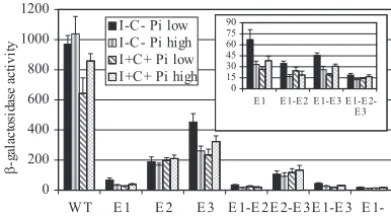
Three E boxes are required forENO1-lacZexpression.The bHLH proteins regulate transcription by forming protein dimers, most of which recognize DNA sequences called E boxes (CANNTG) (53, 63). There are five potential E boxes in the ENO1 promoter region present in the ENO1-lacZ con-struct used in this study. It was previously reported that se-quences required forENO1expression localize to the⫺ 724-to-⫺353 region, thereby eliminating two ORF-proximal E boxes (79). Therefore, we focused on the three ORF-distal E boxes (E-460 [E1], E-656 [E2], and E-704 [E3]; distances are relative to the start codon). We mutated each E box by site-directed mutagenesis and assayed the strains for -galactosi-dase activity (Fig. 3). All three E boxes were found to play a role inENO1-lacZ expression. Mutating the E1 box had the biggest impact, reducing expression 21.2-fold (average for the four growth conditions), while mutating the E2 and E3 boxes reduced expression 4.6- and 2.8-fold, respectively (Fig. 3). De-leting the E2 element, alone or in combination with E1 and E3, completely eliminated repression in response to inositol and
choline (Fig. 3). However, deletion of E1 and/or E3 eliminated repression in response to inositol and choline only in high-Pi medium (Fig. 3).
To determine if there is any synergy between the E boxes, every double mutant and triple mutant combination was cre-ated, and the effect of each pairwise combination of elements was determined. The triple mutant was almost completely de-void of UAS activity, suggesting that the three E boxes consti-tute all of the required positive regulatory elements (Fig. 3). To define the contribution of each E box to activation, double E box mutants were compared to the triple E box mutant. For example, to calculate the E1 contribution in I⫺C⫺ low-Pi medium, the activity in the E2⫹E3 mutant was divided by the activity in the E1⫹E2⫹E3 triple mutant (5.7-fold activation) (Table 2). To calculate the combined activation from the E1 and E2 elements, the activity in the E3 mutant was divided by the activity in the E1⫹E2⫹E3 triple mutant (24.3-fold activa-tion) (Table 2). The ratio of the observed activation from two elements to the product of the activation levels from the indi-vidual elements represents the synergy factor. A synergy factor of 1.0 indicates additive activation (i.e., no synergy) (41). The data showed that most E box relationships yielded synergy factors in the range of 0.8 to 1.8 under all growth conditions, showing the absence of synergy between the three E boxes.
Ino2p, Ino4p, Cbf1p, and Sgc1p regulateENO1-lacZ expres-sion through three E boxes.To define the bHLH protein–E-box interactions, we used two approaches, namely, an epistatic analysis and ChIP. The dual approach was expected to provide corroborating evidence, and the epistatic analysis could addi-tionally provide information about indirect regulation. For the epistatic analysis, the three E box mutant promoters were transformed into a wild-type strain and the nine bHLH knock-out strains. Cells were grown in I⫺C⫺low-Piand I⫹C⫹low-Pi media.
The results suggest that Sgc1p functions exclusively through the E1 element, since deleting theSGC1gene had no effect on expression from the E1 mutant promoter but affected expres-sion from the E2 and E3 mutants (Fig. 4). Likewise, Cbf1p functions through the E2 element (Fig. 4). The data suggest that Ino2p functions through the E3 element because deleting theINO2gene had virtually no effect on expression from the E3 mutant promoter. The data also suggest that Ino4p func-tions through the E1 and E3 boxes (Fig. 4). While deleting the
INO4gene affected expression from all three E box mutants, FIG. 3. Three E boxes (CANNTG) in the ENO1 promoter are
required for expression. Each of threeENO1promoter E boxes was mutated singly and in every possible combination. The wild-type (WT) and mutant promoters were assayed in a wild-type strain grown under the four conditions described in the legend to Fig. 2. The data repre-sent the means⫾ standard errors of the means for at least three experiments. (Inset) Mutants that yielded low levels of activity, using a different scale.
TABLE 2. Activation ofENO1-lacZexpression
ENO1-lacZ
mutant promoter
Fold activation (synergy factor)a
I⫺C⫺, low Pi I⫺C⫺, high Pi I⫹C⫹, low Pi I⫹C⫹, high Pi
Interaction between E1 and E2
Interaction between E1 and E3
Interaction between E2 and E3
Interaction between E1 and E2
Interaction between E1 and E3
Interaction between E2 and E3
Interaction between E1 and E2
Interaction between E1 and E3
Interaction between E2 and E3
Interaction between E1 and E2
Interaction between E1 and E3
Interaction between E2 and E3
E1 3.6 (0.8) 2.7 (0.9) 1.9 (0.8) 2.3 (1.1)
E2 10.1 (1.0) 13.6 (1.3) 14.3 (0.9) 12.8 (1.4)
E3 24.3 (1.8) 21.4 (1.4) 16.9 (1.6) 19.7 (1.3)
E1⫹E2 1.8 1.8 1.4 1.4 1.8 1.8 1.1 1.1
E2⫹E3 5.7b
5.7 7.5 7.5 8.4 8.4 8.1 8.1
E1⫹E3 2.4 2.4 2.1 2.1 1.3 1.3 1.9 1.9
aThe amount of activation and synergy factor were calculated as described in the text.
bThe amount of activation was determined relative to the activities in the triple mutant, which were as follows: for I⫺C⫺, low-P
imedium, 18.6 units; for I⫺C⫺,
high-Pimedium, 12.2 units; for I⫹C⫹, low-Pimedium, 13.9 units; and for I⫹C⫹, high-Pimedium, 12.4 units.
on September 8, 2020 by guest
http://ec.asm.org/
the most dramatic effect was with the E2 mutant. Thus, while Ino4p may function through all three E boxes, it is more likely that it functions through the E1 and E3 elements. It is curious that the inositol-choline response is mediated through the E2 element (Fig. 3 and 4), which does not appear to bind the Ino2p-Ino4p dimer but instead interacts with Cbf1p. As for the other five bHLH proteins, it was not possible to assign them to specific E boxes since the bHLH knockout alleles did not affect expression from any of the E box mutants. The simplest expla-nation is that the other five bHLH proteins may function co-operatively through multiple sites.
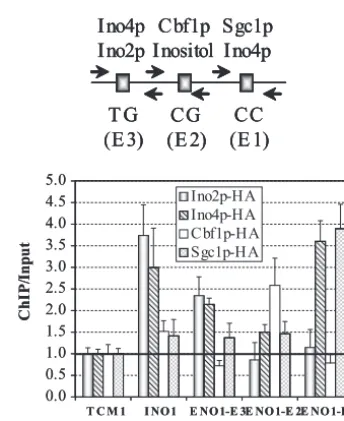
ChIP was used to define the direct regulators of ENO1
expression. TheTCM1promoter was used as a negative con-trol, and theINO1promoter served as a positive control for the binding of Ino2p and Ino4p. As expected, none of the bHLH proteins interacted with theTCM1promoter, whereas Ino2p and Ino4p interacted with theINO1 promoter (Fig. 5). The data show that all four bHLH proteins bind the ENO1 pro-moter directly in vivo via different E boxes. Moreover, the ChIP results are in complete agreement with the results of the epistatic study (compare Fig. 4 and 5). Ino2p and Ino4p inter-acted with the E3 box, but Ino4p also interinter-acted with the E1 element (Fig. 5). This is interesting because Ino4p does not homodimerize and usually requires Ino2p for binding to DNA (72). However, Ino4p has been shown to regulate some genes in the absence of Ino2p (67). Furthermore, Sgc1p also inter-acted with the E1 box, and while Sgc1p binds a consensus E box as a homodimer (68), it may bind theENO1E1 element as a heterodimer with Ino4p. Cbf1p was the only bHLH protein tested that interacted with the E2 box. This is curious since the
FIG. 4. Epistatic analysis of E box mutations in theENO1promoter and bHLH knockout alleles revealscis-elementtrans-factor relationships. IndividualENO1E box mutant promoters were assayed in wild-type (WT) and bHLH mutant strains grown in I⫺C⫺, low-Pimedium (filled bars)
and I⫹C⫹, low-Pimedium (hatched bars). The data represent the means⫾standard errors of the means for at least three experiments. Lines
denoting the level of expression in the wild-type strain were drawn to facilitate comparisons between strains. A summary of the bHLH protein–E-box relationships (as well as the inositol–E-box relationship) is diagrammed along with the identities of the variable nucleotides in each E box (CANNTG).
FIG. 5. ChIP analysis of bHLH protein binding to theENO1 pro-moter. ChIP and input DNAs were quantified by quantitative PCR and calibrated using the signal fromTCM1ChIP. The bHLH protein ChIP levels were normalized to the input chromatin and are shown relative to that of theTCM1control (set at 1.0). TheTCM1promoter served as a negative control, and theINO1promoter was a positive control for Ino2p and Ino4p binding. The data represent the means⫾standard errors of the means for at least three experiments. A summary of the bHLH–E-box relationships (as well as the inositol–E-box relationship) is diagrammed along with the identities of the variable nucleotides in each E box (CANNTG). The relative locations of primers used in the PCR are also depicted (arrows).
on September 8, 2020 by guest
http://ec.asm.org/
response to inositol-choline was found to be mediated by the E2 box and inositol-choline regulation was typically believed to be effected by Ino2p-Ino4p (13, 23, 27, 63). However, a recent microarray study identified a set of genes that are repressed by inositol and do not bind the Ino2p-Ino4p dimer but are instead part of the unfolded-protein response regulon (33).
INO4 andINO2 dominant-negative mutants affect expres-sion ofENO1-lacZ.The ability to form multiple dimer combi-nations is a general property of bHLH proteins (29, 30, 57, 66). The results described above showed that Ino2p, Ino4p, Cbf1p, and Sgc1p regulate the expression of ENO1-lacZ and sug-gested that novel dimers (such as Ino4p-Sgc1p) may contribute to this regulation. We have also previously shown that Ino4p can dimerize with every bHLH protein in a yeast two-hybrid assay (62). To determine if partner selection plays a role in
ENO1-lacZ expression in vivo, we used twoino4 alleles and
oneino2allele containing mutations in the basic region. In two of these mutants,ino4-R13Landino2-R13L(Gardenour and Lopes, unpublished data), the amino acid in the 13th position of the basic region was changed from an R to an L. This position of the basic region is highly conserved throughout bHLH proteins and contacts a G nucleotide in the fourth position of the E box (CANNTG) (63). However, MyoD con-tains an L amino acid at the 13th position of the basic region and contacts a C nucleotide in the 4th position of the E box (9). Therefore, while theino4-R13Landino2-R13Lmutants func-tion as dominant-negative mutants with respect toINO1 ex-pression, they are able to bind to E boxes that contain a C nucleotide at the fourth position (Gardenour and Lopes, un-published data). In the other mutant,ino4-BRD, we deleted the 13-amino-acid basic region.
Theino4and ino2mutants (in pRS315) were transformed into strains harboring the ENO1-lacZreporter, grown under the four conditions described above, and assayed for -galac-tosidase activity. The data clearly show that the presence of the R13L mutant bHLH proteins affects the expression of ENO1-lacZin several strains (compare Fig. 6 and 2A). Theino4-R13L
and ino4-BRD mutants reduced expression in the wild-type
strain, mostly under I⫺C⫺ conditions, and significantly re-ducedENO1-lacZ expression in theino2⌬and cbf1⌬strains (compare Fig. 6A and 2A; data not shown). This suggests that in theino2⌬andcbf1⌬strains, expression is dependent on a bHLH protein(s) (likely Sgc1p) that is inhibited from binding by the Ino4p-R13L (and Ino4p-BRD) mutant. However, in the
ino4⌬and sgc1⌬ strains, expression was either unchanged or increased slightly (compare Fig. 6A and 2A; data not shown). Likewise, the presence of theino2-R13Lmutant allele either had no effect on expression (cbf1⌬andsgc1⌬strains) or sig-nificantly increased expression (wild-type, ino2⌬, and ino4⌬
strains) (compare Fig. 6B and 2A). Because of the number of bHLH proteins that affectENO1-lacZ expression (Fig. 2A), there are numerous possibilities that could account for the increase in expression in the presence of theino4-R13Land
ino2R-13Lmutants. For example, the R13L mutation could
inhibit binding of a repressor protein or could recruit a differ-ent bHLH protein to the E1 site, which has a C nucleotide at the fourth position. Regardless of the explanation for the in-creased expression, the data support the conclusion that bHLH dimer formation affectsENO1-lacZgene expression in vivo.
DISCUSSION
The bHLH proteins have been studied extensively in higher eukaryotic cells. The bHLH family is a large and versatile family of transcription regulators (7, 30, 40, 43, 46, 77, 82). Most attention has been focused on their ability to form mul-tiple dimer combinations and, to a lesser extent, on their lim-ited DNA-binding specificity (4, 9, 10, 19, 21, 51, 57, 70, 75, 76, 80). Consistent with this, we have previously reported that Ino4p forms multiple dimers with other bHLH proteins via the yeast two-hybrid assay and biochemical copurification (62). This suggests that different bHLH proteins might also be in-volved in the coordination of different biological pathways through Ino4p. However, it has become evident that autoreg-ulation and cross-regautoreg-ulation of bHLH-encoding genes, inter-organellar transport, and inhibition of binding to promoters are also major contributors to how these proteins regulate gene expression (1, 59, 74). Naturally, in higher eukaryotes there are additional layers of complexity dictated by tissue-specific and development-tissue-specific distributions of bHLH pro-teins. Yeast has been a particularly fruitful system for studying this family of proteins with respect to how each protein or dimer functions in regulating a specific biological process (63) (Fig. 1). There is a relatively small number of bHLH proteins in yeast compared to those in Drosophila, Caenorhabditis
elegans, and mammals (3, 5, 26, 35, 44, 45, 53, 65, 78).
There-fore, yeast is ideally suited for the study of how the various FIG. 6. Expression ofENO1-lacZis altered inino4-R13L(A) and
ino2-R13L(B) dominant-negative mutants. TheENO1-lacZreporter
was assayed in wild-type (WT),ino2⌬,ino4⌬,cbf1⌬, andsgc1⌬strains grown under the four conditions described in the legend to Fig. 2.
ENO1-lacZtransformants contained pRS315 plasmids bearing either
the ino4-R13Lor ino2-R13Lmutant allele. The data represent the
means⫾standard errors of the means for at least three experiments.
on September 8, 2020 by guest
http://ec.asm.org/
mechanisms described above contribute to the coordination of different biological processes on the genomic scale.
The results presented here are striking because they show for the first time that multiple bHLH proteins, which are known to regulate different biological processes, also regulate a single gene in yeast. In the case of ENO1, all nine bHLH proteins were required to activate its expression (Fig. 2). Inositol-choline also repressedENO1-lacZ expression, and thereforeENO1expression is coordinated with phospholipid biosynthesis. The phospholipid biosynthetic genes are induced in the absence of inositol-choline via the Ino2p-Ino4p dimer.
ENO1did not emerge in genome-wide expression studies that identified inositol-choline- and Ino2p-Ino4p-regulated genes (33, 67). Furthermore, ChIP-chip analyses also did not identify Ino2p-Ino4p binding upstream of theENO1ORF (25, 52, 61). This is due in part to the stringent cutoffs used in the genome-wide studies but also may be due to the growth conditions we employed.
As described above, there are several possible mechanisms whereby bHLH proteins regulate ENO1 expression. They might regulate it by directly binding to theENO1promoter as homodimers or heterodimers. In this case, multiple dimers might bind multiple sites or compete for binding to the same site in theENO1promoter. TheENO1promoter contains five potential E boxes, three of which were investigated here be-cause published promoter deletion studies suggest that the two ORF-proximal elements are not required. The three distal E boxes were mutated, and the triple mutant virtually eliminated expression (⬍2% of wild-type promoter activity), supporting the conclusion that these elements are required for ENO1
expression (Fig. 3). The epistatic analysis showed that Ino2p-Ino4p binds to the most distal element (E3), Cbf1p binds to the E2 element, and Sgc1p and Ino4p bind the E1 element to regulate ENO1-lacZexpression (Fig. 4). In support of these results, the ChIP experiments showed that these bHLH pro-tein–E-box genetic interactions correlate with direct binding by the bHLH proteins (Fig. 5). Curiously, repression by inositol-choline appeared to occur through the E2 element which bound Cbf1p (Fig. 3 to 5). This was surprising since this
re-sponse is most frequently associated with Ino2p-Ino4p, which bound the E3 element. However, inositol-choline also affected expression through the E3 and E1 elements in high-Pimedium. Nevertheless, the E2 response could in fact be due to Cbf1p since we recently found that Cbf1p also regulates another inositol-choline-regulated gene (He et al., unpublished data). An important question to address is whether these elements and the cognate bHLH factors play an important role inENO1
expression or are minor contributors. To address this issue, we compared theENO1promoter sequences for several species of
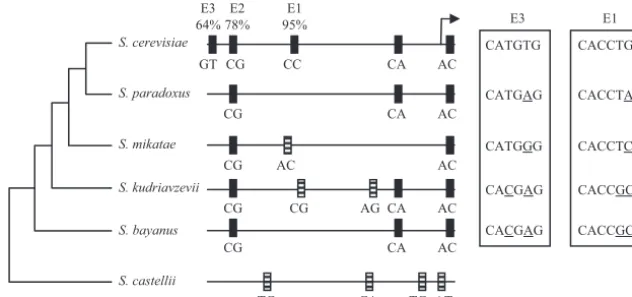
Saccharomyces (Fig. 7). It is obvious that the E2 element
evolved fairly early, as it appears inSaccharomyces bayanus. Thus, it appears that regulation in response to inositol-choline is an early event and must be important for several members of
the Saccharomyces genus (Fig. 7). The response to
inositol-choline is modest, which likely explains why it was not identi-fied in the genome-wide expression studies (33, 67). However, the repression level ofENO1is certainly comparable to that of several well-characterized inositol-choline-regulated yeast genes involved in fatty acid synthesis (FAS1,FAS2, andACC1) as well as the Kennedy pathway for phospholipid synthesis (CPT1) (14, 55, 69, 71). The E3 and E1 elements, however, appeared late and are restricted toS. cerevisiae, suggesting that they play a specialized role in this species (Fig. 7). Collectively, these observations suggest that these elements may have evolved for different reasons in the Saccharomyces genus. Another important consideration from these studies is that yeast promoter databases (e.g., see http://fraenkel.mit.edu/yeast _map_2006/) that list binding sites for transcription factors typically cross-list the ChIP-chip studies and conservation of DNA sequence elements. However, these three ENO1 pro-moter elements do not satisfy the minimum cutoffs imposed in databases (15, 16, 20, 25, 52).
It was already known that expression ofENO1is regulated by Sgc1p (58, 68). Here we found that Sgc1p interacted with the E1 element, either as a homodimer or as a heterodimer with Ino4p (Fig. 4 and 5). Previous studies using electro-phoretic mobility shift assays and DNase I footprinting exper-iments showed that recombinant Sgc1p binds one of the two FIG. 7. Evolution of the E1, E2, and E3 E boxes in the ENO1 promoter. The relevant sequences of the ENO1 promoters from six
Saccharomycesspecies were compared. TheSaccharomycesphylogenetic tree was produced with data from published reports (15, 16, 20, 28). The
relative position of the transcription start site is depicted as an arrow.S. cerevisiaeE boxes that are found in otherSaccharomycesspecies are shown as filled boxes, while putative E boxes not found inS. cerevisiaeare shown as horizontally striped boxes. The identities of the variant nucleotides in each E box element are noted below each E box. The sequences of the E1 and E3 boxes are shown next to the relevant species. The numbers by each E box at the top of the figure represent the percent decrease inENO1-lacZexpression when each E box is deleted.
on September 8, 2020 by guest
http://ec.asm.org/
ORF-proximal E boxes (not analyzed in this study) (68). The difference in these studies can be explained if binding to the E1 box occurs as an Sgc1p-Ino4p heterodimer, which was not tested in the published studies (68). Alternatively, the electro-phoretic mobility shift assay experiments did reveal additional bands at high Sgc1p concentrations that could reflect binding to the E1 element. Regardless of the explanation, the results we present here are corroborated by two distinct approaches, i.e., epistatic analysis and ChIP.
We and others have previously reported thatINO2 expres-sion is regulated by Ino2p and Ino4p (1, 2, 54, 73). We have found that SGC1 is autoregulated and cross-regulated by Cbf1p and Ygr290wp (M. Chen and J. M. Lopes, unpublished data), suggesting that these bHLH proteins may regulate
ENO1by regulating the SGC1gene. It will be interesting to determine if regulation ofSGC1expression affects global gene expression patterns. To do this, it will be necessary to define and mutate the elements in theSGC1promoter that are re-quired for regulation by Sgc1p, Cbf1p, and Ygr290wp. Exam-ination of theSGC1promoter reveals four potential E boxes, and three of these are conserved among at least four of the
Saccharomycesspecies. Theygr290wmutant yielded increased
expression of theSGC1-catgene, which is consistent with the observation that the YGR290w ORF is predicted to encode an HLH protein that lacks the basic region. Therefore, if this gene is in fact expressed, it could behave like the Id family, which inhibits dimerization with bHLH proteins and inhibits binding to DNA (59). However, YGR290w is listed as a dubious ORF based on available experimental and sequence comparisons (http://db.yeastgenome.org/cgi-bin/locus.pl?locus⫽YGR290w). This dubious ORF partially overlaps theMAL11gene, which encodes a high-affinity maltose transporter. Thus, there is a possibility that the phenotype we observe withSGC1-catis due to deletion of theMAL11 gene. Nevertheless, theSGC1-cat
phenotype will make it possible to distinguish between these two possibilities.
TheSaccharomyces cerevisiaebHLH protein interaction map
showed that Ino4p is a hub for binding of other bHLH proteins (62). Consistent with this observation, we showed that the
ino4-R13L(Fig. 6A) andino4-BRD(data not shown) mutants
completely alter expression from the ENO1 promoter. This was especially evident in theino2⌬andcbf1⌬mutant strains, where the expression ofENO1 was almost completely elimi-nated. Similarly, the ino2-R13Lmutant also affected ENO1-lacZexpression (Fig. 6B). Thus, we can conclude that dimeriza-tion selecdimeriza-tion does play a role in the expression ofENO1-lacZ. Consequently, our analysis of theENO1promoter has identi-fied that multiple bHLH proteins are required for expression through distinct mechanisms, including direct binding to dif-ferent E boxes, formation of multiple dimers, and regulation by a putative HLH protein (Ygr290wp).
WhyENO1is regulated by all of these bHLH proteins is, of course, the most important question to be asked. We favor the model that ENO1 is a particularly striking example of the various mechanisms whereby bHLH proteins regulate gene expression in yeast. However, it may be that some bHLH-mediated regulation is simply a reflection of noise in regula-tion. This may very well explain the effects of some but not all of the bHLH proteins. For example, it seems unlikely that the
ENO1promoter would have evolved the E1 and E3 boxes inS.
cerevisiaeif noise were the only explanation. Another
impor-tant consideration is whether or notENO1 is unusual in its response to bHLH proteins. We are currently analyzing four other well-studied promoters (INO1,CIT2,MET16, andPHO5) targeted by bHLH proteins. We find that all four promoters are regulated by several bHLH proteins, but none to the extent ofENO1(M. Chen, Y. He, A. Shetty, and J. M. Lopes, un-published data). This suggests that bHLH proteins themselves are not a source of unusually high noise in gene regulation, but we cannot preclude that theENO1 promoter is not noisy in and of itself. To a great extent, answering this question will depend on studies that determine the effects of regulation of
ENO1on yeast metabolism and fitness.
ACKNOWLEDGMENTS
We thank Linan Chen, Leandria Hancock, Niketa Jani, Ying He, and Ameet Shetty for discussions and comments on the manuscript.
This work was supported by a National Science Foundation grant (MCB-0110408) to J.M.L.
REFERENCES
1.Ashburner, B. P., and J. M. Lopes.1995. Autoregulated expression of the yeast INO2 and INO4 helix-loop-helix activator genes effects cooperative regulation on their target genes. Mol. Cell. Biol.15:1709–1715.
2.Ashburner, B. P., and J. M. Lopes.1995. Regulation of yeast phospholipid biosynthetic gene expression in response to inositol involves two superim-posed mechanisms. Proc. Natl. Acad. Sci. USA92:9722–9726.
3.Atchley, W. R., and W. M. Fitch.1997. A natural classification of the basic helix-loop-helix class of transcription factors. Proc. Natl. Acad. Sci. USA
94:5172–5176.
4.Bachhawat, N., Q. Ouyang, and S. A. Henry.1995. Functional characteriza-tion of an inositol-sensitive upstream activacharacteriza-tion sequence in yeast. A cis-regulatory element responsible for inositol-choline mediated regulation of phospholipid biosynthesis. J. Biol. Chem.270:25087–25095.
5.Bailey, P. C., C. Martin, G. Toledo-Ortiz, P. H. Quail, E. Huq, M. A. Heim, M. Jakoby, M. Werber, and B. Weisshaar.2003. Update on the basic helix-loop-helix transcription factor gene family in Arabidopsis thaliana. Plant Cell
15:2497–2502.
6.Berben, G., M. Legrain, V. Gilliquet, and F. Hilger.1990. The yeast regu-latory gene PHO4 encodes a helix-loop-helix motif. Yeast6:451–454. 7.Berkes, C. A., and S. J. Tapscott.2005. MyoD and the transcriptional control
of myogenesis. Semin. Cell Dev. Biol.16:585–595.
8.Berkower, C., D. Loayza, and S. Michaelis.1994. Metabolic instability and constitutive endocytosis of STE6, the a-factor transporter of Saccharomyces cerevisiae. Mol. Biol. Cell5:1185–1198.
9.Blackwell, T. K., J. Huang, A. Ma, L. Kretzner, F. W. Alt, R. N. Eisenman, and H. Weintraub.1993. Binding of myc proteins to canonical and nonca-nonical DNA sequences. Mol. Cell. Biol.13:5216–5224.
10.Blackwell, T. K., and H. Weintraub.1990. Differences and similarities in DNA-binding preferences of MyoD and E2A protein complexes revealed by binding site selection. Science250:1104–1110.
11.Butow, R. A., and N. G. Avadhani.2004. Mitochondrial signaling: the retro-grade response. Mol. Cell14:1–15.
12.Cai, M., and R. W. Davis.1990. Yeast centromere binding protein CBF1, of the helix-loop-helix protein family, is required for chromosome stability and methionine prototrophy. Cell61:437–446.
13.Carman, G. M., and G. M. Zeimetz. 1996. Regulation of phospholipid synthesis in the yeastSaccharomyces cerevisiae. J. Biol. Chem.271:13293– 13296.
14.Chirala, S. S., Q. Zhong, W. Huang, and W. al-Feel.1994. Analysis of FAS3/ACC regulatory region of Saccharomyces cerevisiae: identification of a functional UASINO and sequences responsible for fatty acid mediated repression. Nucleic Acids Res.22:412–418.
15.Cliften, P., P. Sudarsanam, A. Desikan, L. Fulton, B. Fulton, J. Majors, R. Waterston, B. A. Cohen, and M. Johnston.2003. Finding functional features in Saccharomyces genomes by phylogenetic footprinting. Science301:71–76. 16.Cliften, P. F., L. W. Hillier, L. Fulton, T. Graves, T. Miner, W. R. Gish, R. H. Waterston, and M. Johnston.2001. Surveying Saccharomyces genomes to identify functional elements by comparative DNA sequence analysis. Ge-nome Res.11:1175–1186.
17.Eiznhamer, D. A., B. P. Ashburner, J. C. Jackson, K. R. Gardenour, and J. M. Lopes.2001. Expression of the INO2 regulatory gene of Saccharomy-ces cerevisiae is controlled by positive and negative promoter elements and an upstream open reading frame. Mol. Microbiol.39:1395–1405. 18.Epstein, C. B., J. A. Waddle, W. T. Hale, V. Dave, J. Thornton, T. L. Macatee,
on September 8, 2020 by guest
http://ec.asm.org/
H. R. Garner, and R. A. Butow.2001. Genome-wide responses to mitochon-drial dysfunction. Mol. Biol. Cell12:297–308.
19.Ferre-D’Amare, A. R., G. C. Prendergast, E. B. Ziff, and S. K. Burley.1993. Recognition by Max of its cognate DNA through a dimeric b/HLH/Z do-main. Nature363:38–45.
20.Fischer, G., S. A. James, I. N. Roberts, S. G. Oliver, and E. J. Louis.2000. Chromosomal evolution in Saccharomyces. Nature405:451–454. 21.Fisher, F., and C. R. Goding.1992. Single amino acid substitutions alter
helix-loop-helix protein specificity for bases flanking the core CANNTG motif. EMBO J.11:4103–4109.
22.Giaever, G., A. M. Chu, L. Ni, C. Connelly, L. Riles, S. Veronneau, S. Dow, A. Lucau-Danila, K. Anderson, B. Andre, A. P. Arkin, A. Astromoff, M. El-Bakkoury, R. Bangham, R. Benito, S. Brachat, S. Campanaro, M. Cur-tiss, K. Davis, A. Deutschbauer, K. D. Entian, P. Flaherty, F. Foury, D. J. Garfinkel, M. Gerstein, D. Gotte, U. Guldener, J. H. Hegemann, S. Hempel, Z. Herman, D. F. Jaramillo, D. E. Kelly, S. L. Kelly, P. Kotter, D. LaBonte, D. C. Lamb, N. Lan, H. Liang, H. Liao, L. Liu, C. Luo, M. Lussier, R. Mao, P. Menard, S. L. Ooi, J. L. Revuelta, C. J. Roberts, M. Rose, P. Ross-Macdonald, B. Scherens, G. Schimmack, B. Shafer, D. D. Shoemaker, S. Sookhai-Mahadeo, R. K. Storms, J. N. Strathern, G. Valle, M. Voet, G. Volckaert, C. Y. Wang, T. R. Ward, J. Wilhelmy, E. A. Winzeler, Y. Yang, G. Yen, E. Youngman, K. Yu, H. Bussey, J. D. Boeke, M. Snyder, P. Philippsen, R. W. Davis, and M. Johnston.2002. Functional profiling of the Saccharo-myces cerevisiae genome. Nature418:387–391.
23.Greenberg, M. L., and J. M. Lopes.1996. Genetic regulation of phospholipid biosynthesis inSaccharomyces cerevisiae. Microbiol. Rev.60:1–20. 24.Griffin, J. D.2001. Phosphatidyl inositol signaling by BCR/ABL:
opportuni-ties for drug development. Cancer Chemother. Pharmacol.1:S11–S16. 25.Harbison, C. T., D. B. Gordon, T. I. Lee, N. J. Rinaldi, K. D. Macisaac, T. W.
Danford, N. M. Hannett, J. B. Tagne, D. B. Reynolds, J. Yoo, E. G. Jennings, J. Zeitlinger, D. K. Pokholok, M. Kellis, P. A. Rolfe, K. T. Takusagawa, E. S. Lander, D. K. Gifford, E. Fraenkel, and R. A. Young.2004. Transcriptional regulatory code of a eukaryotic genome. Nature431:99–104.
26.Heim, M. A., M. Jakoby, M. Werber, C. Martin, B. Weisshaar, and P. C. Bailey.2003. The basic helix-loop-helix transcription factor family in plants: a genome-wide study of protein structure and functional diversity. Mol. Biol. Evol.20:735–747.
27.Henry, S. A., and J. L. Patton-Vogt.1998. Genetic regulation of phospholipid metabolism: yeast as a model eukaryote. Prog. Nucleic Acid Res. Mol. Biol.
61:133–179.
28.Hittinger, C. T., A. Rokas, and S. B. Carroll.2004. Parallel inactivation of multiple GAL pathway genes and ecological diversification in yeasts. Proc. Natl. Acad. Sci. USA101:14144–14149.
29.Hooker, C. W., and P. J. Hurlin.2006. Of Myc and Mnt. J. Cell Sci.119:
208–216.
30.Hurlin, P. J., and S. Dezfouli.2004. Functions of myc:max in the control of cell proliferation and tumorigenesis. Int. Rev. Cytol.238:183–226. 31.Jen, Y., H. Weintraub, and R. Benezra.1992. Overexpression of Id protein
inhibits the muscle differentiation program: in vivo association of Id with E2A proteins. Genes Dev.6:1466–1479.
32.Jesch, S. A., P. Liu, X. Zhao, M. T. Wells, and S. A. Henry.2006. Multiple endoplasmic reticulum-to-nucleus signaling pathways coordinate phospho-lipid metabolism with gene expression by distinct mechanisms. J. Biol. Chem.
281:24070–24083.
33.Jesch, S. A., X. Zhao, M. T. Wells, and S. A. Henry.2005. Genome-wide analysis reveals inositol, not choline, as the major effector of Ino2p-Ino4p and unfolded protein response target gene expression in yeast. J. Biol. Chem.
280:9106–9118.
34.Jia, Y., B. Rothermel, J. Thornton, and R. A. Butow.1997. A basic helix-loop-helix-leucine zipper transcription complex in yeast functions in a sig-naling pathway from mitochondria to the nucleus. Mol. Cell. Biol.17:1110– 1117.
35.Jones, S.2004. An overview of the basic helix-loop-helix proteins. Genome Biol.5:226.
36.Kaffman, A., N. M. Rank, E. M. O’Neill, L. S. Huang, and E. K. O’Shea.
1998. The receptor Msn5 exports the phosphorylated transcription factor Pho4 out of the nucleus. Nature396:482–486.
37.Kaffman, A., N. M. Rank, and E. K. O’Shea.1998. Phosphorylation regulates association of the transcription factor Pho4 with its import receptor Pse1/ Kap121. Genes Dev.12:2673–2683.
38.Kelly, B. L., and M. L. Greenberg.1990. Characterization and regulation of phosphatidylglycerolphosphate phosphatase in Saccharomyces cerevisiae. Biochim. Biophys. Acta1046:144–150.
39.Kent, N. A., S. M. Eibert, and J. Mellor.2004. Cbf1p is required for chro-matin remodeling at promoter-proximal CACGTG motifs in yeast. J. Biol. Chem.279:27116–27123.
40.Kim, J. W., K. I. Zeller, Y. Wang, A. G. Jegga, B. J. Aronow, K. A. O’Donnell, and C. V. Dang.2004. Evaluation of myc E-box phylogenetic footprints in glycolytic genes by chromatin immunoprecipitation assays. Mol. Cell. Biol.
24:5923–5936.
41.Klinkenberg, L. G., T. Webb, and R. S. Zitomer.2006. Synergy among
differentially regulated repressors of the ribonucleotide diphosphate reduc-tase genes ofSaccharomyces cerevisiae. Eukaryot. Cell5:1007–1017. 42.Komeili, A., and E. K. O’Shea.1999. Roles of phosphorylation sites in
regulating activity of the transcription factor Pho4. Science284:977–980. 43.Lavista-Llanos, S., L. Centanin, M. Irisarri, D. M. Russo, J. M. Gleadle,
S. N. Bocca, M. Muzzopappa, P. J. Ratcliffe, and P. Wappner.2002. Control of the hypoxic response inDrosophila melanogasterby the basic helix-loop-helix PAS protein similar. Mol. Cell. Biol.22:6842–6853.
44.Ledent, V., O. Paquet, and M. Vervoort.2002. Phylogenetic analysis of the human basic helix-loop-helix proteins. Genome Biol.3:RESEARCH0030. 45.Ledent, V., and M. Vervoort.2001. The basic helix-loop-helix protein family:
comparative genomics and phylogenetic analysis. Genome Res.11:754–770. 46.Lee, J. E., S. M. Hollenberg, L. Snider, D. L. Turner, N. Lipnick, and H. Weintraub.1995. Conversion of Xenopus ectoderm into neurons by NeuroD, a basic helix-loop-helix protein. Science268:836–844.
47.Lin, C. Q., J. Singh, K. Murata, Y. Itahana, S. Parrinello, S. H. Liang, C. E. Gillett, J. Campisi, and P. Y. Desprez.2000. A role for Id-1 in the aggressive phenotype and steroid hormone response of human breast cancer cells. Cancer Res.60:1332–1340.
48.Lohning, C., and M. Ciriacy.1994. The TYE7 gene of Saccharomyces cer-evisiae encodes a putative bHLH-LZ transcription factor required for Ty1-mediated gene expression. Yeast10:1329–1339.
49.Lopez, M. C., and H. V. Baker.2000. Understanding the growth phenotype of the yeastgcr1mutant in terms of global genomic expression patterns. J. Bacteriol.182:4970–4978.
50.Lorenz, M. C., and J. Heitman.1998. Regulators of pseudohyphal differen-tiation in Saccharomyces cerevisiae identified through multicopy suppressor analysis in ammonium permease mutant strains. Genetics150:1443–1457. 51.Ma, P. C., M. A. Rould, H. Weintraub, and C. O. Pabo.1994. Crystal
structure of MyoD bHLH domain-DNA complex: perspectives on DNA recognition and implications for transcriptional activation. Cell77:451–459. 52.MacIsaac, K. D., T. Wang, D. B. Gordon, D. K. Gifford, G. D. Stormo, and E. Fraenkel.2006. An improved map of conserved regulatory sites for Sac-charomyces cerevisiae. BMC Bioinformatics7:113.
53.Massari, M. E., and C. Murre.2000. Helix-loop-helix proteins: regulators of transcription in eucaryotic organisms. Mol. Cell. Biol.20:429–440. 54.Miller, L. L., and J. M. Lopes.2001. Over-expression of the INO2 regulatory
gene alters regulation of an INO1-lacZ reporter gene but does not affect regulation of INO1 expression. Curr. Genet.39:77–82.
55.Morash, S. C., C. R. McMaster, R. H. Hjelmstad, and R. M. Bell.1994. Studies employing Saccharomyces cerevisiae cpt1 and ept1 null mutants implicate the CPT1 gene in coordinate regulation of phospholipid biosyn-thesis. J. Biol. Chem.269:28769–28776.
56.Myers, A. M., A. Tzagoloff, D. M. Kinney, and C. J. Lusty.1986. Yeast shuttle and integrative vectors with multiple cloning sites suitable for construction of lacZ fusions. Gene45:299–310.
57.Nair, S. K., and S. K. Burley.2006. Structural aspects of interactions within the Myc/Max/Mad network. Curr. Top. Microbiol. Immunol.302:123–143. 58.Nishi, K., C. S. Park, A. E. Pepper, G. Eichinger, M. A. Innis, and M. J.
Holland.1995. The GCR1 requirement for yeast glycolytic gene expression is suppressed by dominant mutations in the SGC1 gene, which encodes a novel basic-helix-loop-helix protein. Mol. Cell. Biol.15:2646–2653. 59.Norton, J. D., R. W. Deed, G. Craggs, and F. Sablitzky.1998. Id
helix-loop-helix proteins in cell growth and differentiation. Trends Cell Biol.8:58–65. 60.Ogawa, N., J. DeRisi, and P. O. Brown.2000. New components of a system for phosphate accumulation and polyphosphate metabolism in Saccharomy-ces cerevisiae revealed by genomic expression analysis. Mol. Biol. Cell11:
4309–4321.
61.Ren, B., F. Robert, J. J. Wyrick, O. Aparicio, E. G. Jennings, I. Simon, J. Zeitlinger, J. Schreiber, N. Hannett, E. Kanin, T. L. Volkert, C. J. Wilson, S. P. Bell, and R. A. Young.2000. Genome-wide location and function of DNA binding proteins. Science290:2306–2309.
62.Robinson, K. A., J. I. Koepke, M. Kharodawala, and J. M. Lopes.2000. A network of yeast basic helix-loop-helix interactions. Nucleic Acids Res.28:
4460–4466.
63.Robinson, K. A., and J. M. Lopes.2000. Saccharomyces cerevisiae basic helix-loop-helix proteins regulate diverse biological processes. Nucleic Acids Res.28:1499–1505.
64.Robinson, K. A., and J. M. Lopes.2000. The promoter of the yeast INO4 regulatory gene: a model of the simplest yeast promoter. J. Bacteriol.182:
2746–2752.
65.Ross, S. E., M. E. Greenberg, and C. D. Stiles.2003. Basic helix-loop-helix factors in cortical development. Neuron39:13–25.
66.Rottmann, S., and B. Luscher.2006. The Mad side of the Max network: antagonizing the function of Myc and more. Curr. Top. Microbiol. Immunol.
302:63–122.
67.Santiago, T. C., and C. B. Mamoun.2003. Genome expression analysis in yeast reveals novel transcriptional regulation by inositol and choline and new regulatory functions for Opi1p, Ino2p, and Ino4p. J. Biol. Chem.278:38723– 38730.
68.Sato, T., M. C. Lopez, S. Sugioka, Y. Jigami, H. V. Baker, and H. Uemura.
1999. The E-box DNA binding protein Sgc1p suppresses the gcr2 mutation,
on September 8, 2020 by guest
http://ec.asm.org/
which is involved in transcriptional activation of glycolytic genes in Saccha-romyces cerevisiae. FEBS Lett.463:307–311.
69.Schuller, H. J., A. Hahn, F. Troster, A. Schutz, and E. Schweizer.1992. Coordinate genetic control of yeast fatty acid synthase genes FAS1 and FAS2 by an upstream activation site common to genes involved in membrane lipid biosynthesis. EMBO J.11:107–114.
70.Schuller, H. J., K. Richter, B. Hoffmann, R. Ebbert, and E. Schweizer.1995. DNA binding site of the yeast heteromeric Ino2p/Ino4p basic helix-loop-helix transcription factor: structural requirements as defined by saturation mutagenesis. FEBS Lett.370:149–152.
71.Schu¨ller, H. J., R. Schorr, B. Hoffmann, and E. Schweizer.1992. Regulatory gene INO4 of yeast phospholipid biosynthesis is positively autoregulated and functions as a transactivator of fatty acid synthase genes FAS1 and FAS2 from Saccharomyces cerevisiae. Nucleic Acids Res.20:5955–5961. 72.Schwank, S., R. Ebbert, K. Rautenstrauss, E. Schweizer, and H. J. Schuller.
1995. Yeast transcriptional activator INO2 interacts as an Ino2p/Ino4p basic helix-loop-helix heteromeric complex with the inositol/choline-responsive element necessary for expression of phospholipid biosynthetic genes in Sac-charomyces cerevisiae. Nucleic Acids Res.23:230–237.
73.Schwank, S., B. Hoffmann, and H. J. Schuller.1997. Influence of gene dosage and autoregulation of the regulatory genes INO2 and INO4 on inositol/choline-repressible gene transcription in the yeast Saccharomyces cerevisiae. Curr. Genet.31:462–468.
74.Sekito, T., J. Thornton, and R. A. Butow.2000. Mitochondria-to-nuclear signaling is regulated by the subcellular localization of the transcription factors Rtg1p and Rtg3p. Mol. Biol. Cell11:2103–2115.
75.Shao, D., C. L. Creasy, and L. W. Bergman.1998. A cysteine residue in helixII of the bHLH domain is essential for homodimerization of the yeast transcription factor Pho4p. Nucleic Acids Res.26:710–714.
76.Shimizu, T., A. Toumoto, K. Ihara, M. Shimizu, Y. Kyogoku, N. Ogawa, Y. Oshima, and T. Hakoshima.1997. Crystal structure of PHO4 bHLH do-main-DNA complex: flanking base recognition. EMBO J.16:4689–4697. 77.Tapscott, S. J.2005. The circuitry of a master switch: Myod and the
regu-lation of skeletal muscle gene transcription. Development132:2685–2695. 78.Toledo-Ortiz, G., E. Huq, and P. H. Quail.2003. The Arabidopsis basic/
helix-loop-helix transcription factor family. Plant Cell15:1749–1770. 79.Uemura, H., Y. Jigami, H. Tanaka, N. Toshimitsu, M. Paterson, and S.
Nakasato.1985. Nucleotide sequence of the 5⬘flanking region responsible for the enhancement of the expression of yeast enolase 1 gene. J. Biochem. (Tokyo)98:859–862.
80.Van Antwerp, M. E., D. G. Chen, C. Chang, and E. V. Prochownik.1992. A point mutation in the MyoD basic domain imparts c-Myc-like properties. Proc. Natl. Acad. Sci. USA89:9010–9014.
81.Winzeler, E. A., D. D. Shoemaker, A. Astromoff, H. Liang, K. Anderson, B. Andre, R. Bangham, R. Benito, J. D. Boeke, H. Bussey, A. M. Chu, C. Connelly, K. Davis, F. Dietrich, S. W. Dow, M. El Bakkoury, F. Foury, S. H. Friend, E. Gentalen, G. Giaever, J. H. Hegemann, T. Jones, M. Laub, H. Liao, N. Liebundguth, D. J. Lockhart, A. Lucau-Danila, M. Lussier, N. M’Rabet, P. Menard, M. Mittmann, C. Pai, C. Rebischung, J. L. Revuelta, L. Riles, C. J. Roberts, P. Ross-MacDonald, B. Scherens, M. Snyder, S. Sookhai-Mahadeo, R. K. Storms, S. Veronneau, M. Voet, G. Volckaert, T. R. Ward, R. Wysocki, G. S. Yen, K. Yu, K. Zimmermann, P. Philippsen, M. Johnston, and R. W. Davis.1999. Functional characterization of the S. cerevisiae genome by gene deletion and parallel analysis. Science285:901– 906.
82.Zhuang, Y., P. Soriano, and H. Weintraub.1994. The helix-loop-helix gene E2A is required for B cell formation. Cell79:875–884.