INTRODUCTION
Migraine is a multifactorial genetic disease character-ized by recurrent headache attacks. The clinical presenta-tion depends on the patient’s genetic background as well as environmental factors [1-3]. A number of clinical subtypes of migraine have been described, two of which are migraine without aura (MO) and migraine with aura (MA) [4]. The annual prevalence of migraine in the Unites States (US) is 12%, and the prevalence is threefold higher in women compared to men [5]. In the eastern region of Turkey, the prevalence was reported as 10.3% in men and 23.1% in women [6]. The etiology of migraine is not well understood. Population-based studies showed that the familial risk of migraine has been increased [2,3,7]. A recent genome-wide association (GWA) study demonstrated a weak association between migraine and the following three single nucleotide polymorphisms (SNPs):
rs2651899 of the PR domain containing 16 gene (PRDM16), rs10166942 of the transient receptor potential cation chan-nel subfamily M member 8 (TRPM8), and rs11172113 of the low density lipoprotein receptor-related protein 1 (LRP1) [8]. Although a genetic component of migraine has been rec-ognized, the type and number of genes involved are largely unknown.
Human urotensin-II (U-II), an 11-amino acid cyclic pep-tide, is a potent vasoconstrictor. U-II and its receptor, UT, are widely expressed throughout the central nervous, cardio-vascular, renal, pulmonary, and metabolic systems. Elevated plasma levels and increased expression of U-II are found in many pathological conditions, including renal failure, hyper-tension, atherosclerosis, cirrhosis, congestive heart failure, diabetes, and metabolic syndrome [9]. For example, increased expression of U-II was observed in vascular smooth mus-cle cells due to hypoxia [10]. U-II may alter brain regions by directly affecting the vascular structures during the initiation and duration of migraine attacks.
The U-II gene (UTS2) is located on the human chromo-some region 1p36 and contains 5 exons [11]. Recent GWA studies identified the 1p36 region as one of the susceptibility
Lack of association between urotensin-II (
UTS2
) gene
polymorphisms (Thr21Met and Ser89Asn) and migraine
Betül Ozan1, Seniz Demiryürek1*, Muhammad Safdar2, Yusuf Inanc3, Abdullah Tuncay Demiryürek4
1Department of Physiology, Faculty of Medicine, University of Gaziantep, Gaziantep, Turkey, 2Department of Medical Biology, Faculty of Medicine, University of Gaziantep, Gaziantep, Turkey, 3Department of Neurology, Faculty of Medicine, University of Gaziantep, Gaziantep, Turkey, 4Department of Medical Pharmacology, Faculty of Medicine, University of Gaziantep, Gaziantep, Turkey
ABSTRACT
Migraine is a common neurovascular brain disorder with heterogeneous clinical presentation, including recurrent headache attacks. The patho-physiology of migraine is complex, and a number of genomic regions have been associated with the development of migraine. In this study, we analyzed the allele and genotype frequencies of the urotensin-II gene (UTS2) polymorphisms, Thr21Met and Ser89Asn, among Turkish patients with migraine. A total of 146 patients with migraine (14 with aura [MA group] and 132 without aura [MO group]) were genotyped for Thr21Met and Ser89Asn polymorphisms and compared with 154 age- and sex-matched healthy controls. The UTS2 gene polymorphisms were analyzed by polymerase chain reaction-restriction fragment length polymorphism (PCR-RFLP). No significant differences were observed in allele and genotype frequencies for Thr21Met and Ser89Asn polymorphisms between the patients with migraine and control group. Similarly, we did not observe significant differences in allele and genotype frequencies between MA and MO and control group. Moreover, the haplotype analysis showed no association between UTS2 gene haplotypes (MN, MS, TN, and TS) and migraine. In summary, Thr21Met and Ser89Asn polymorphisms of the UTS2 gene are not risk factors for migraine in our sample of Turkish migraine patients.
KEY WORDS: Aura; migraine; urotensin-II; UTS2 gene; polymorphism; Thr21Met; Ser89Asn
DOI: http://dx.doi.org/10.17305/bjbms.2017.2138 Bosn J Basic Med Sci. 2017;17(3):268-273. © 2017 ABMSFBIH
*Corresponding author: Seniz Demiryürek, Department of Physiology, Faculty of Medicine, University of Gaziantep, University Road, Gaziantep 27310, Turkey. Tel.: 90-342-3606060 Ext.74204. Fax: 90-342-3601617. E-mail: [email protected]
loci for migraine [8,12]. Moreover, a study on Turkish patients showed that UTS2 Thr21Met polymorphism was associated with the risk of migraine, but not UTS2 Ser89Asn polymor-phism [13]. The aim of this study was to further investigate the association between the two UTS2 polymorphisms and migraine in a Turkish population.
MATERIALS AND METHODS
Study population and collection of blood samples
The study group included 146 patients with migraine, and 154 unrelated healthy volunteers with no history of migraine. All patients were registered at the outpatient clinic of the Neurology Department, Faculty of Medicine, University of Gaziantep. This case-control study was approved by the local Ethics Committee, and it was con-ducted in accordance with the guidelines in the Declaration of Helsinki. Informed consent was obtained from all sub-jects prior to the study.
The patients were diagnosed by an interview as hav-ing either MA or MO. The questionnaires were prepared according to the International Headache Society (IHS) criteria for diagnosing migraine. Demographic details and clinical data such as migraine type and frequency, past med-ical history, hypertension history, concomitant drug history, and relevant family history were collected. The records of the cranial magnetic resonance imaging (MRI), computed brain tomography, and biochemical laboratory tests were evaluated for all patients. The control group was also sub-jected to the questionnaire by a neurologist specialized in migraines. The healthy control subjects were matched for age and gender and had no clinical evidence or family his-tory of migraine or other neurological diseases. In addition, they were without a history of coronary artery disease, diabetes mellitus, hypertension, inflammatory and autoim-mune diseases, or genetic disorders. The participants were all of Caucasian origin, and from the same geographical area (southeastern Turkey).
Venous blood samples were obtained for the molecular analysis of UTS2 gene polymorphisms. Genomic DNA was extracted from whole blood using a salting-out method as described previously [14] and stored at -20oC.
Polymerase chain reaction-restriction fragment
length polymorphism (PCR-RFLP)
Two primer sets were used, covering two polymorphic regions (Thr21Met and Ser89Asn) of the UTS2 gene [sequence in the National Center for Biotechnology Information (NCBI) database; NT_021937.19 contig]. The primers were designed with Primer Premier v.5.0 software (Premier Biosoft International, USA). The nucleotide composition of the primer sequences, amplicon size, and annealing tempera-tures are provided in Table 1. The PCR protocol included initial denaturation at 95°C for 4 minutes, 30 cycles of dena-turation (95°C for 30 seconds) for Thr21Met (T21M, rs228648, G62A) and 32 cycles of denaturation for Ser89Asn (S89N, rs2890565, C266T), annealing for 30 seconds at temperatures given in Table 2, elongation at 72°C for 30 seconds, and final elongation at 72°C for 4 minutes. The PCR was conducted on GeneAmp PCR System 9700 (Applied Biosystems, Foster City, CA, USA).
UTS2 Thr21Met polymorphism is characterized by G to A transition which leads to amino acid substitution of thre-onine to methithre-onine at amino acid position 21. We used NlaIII
restriction enzyme to identify the A/G mutation in the UTS2
gene. The wild-type DNA (21T) produced two bands, 109 and 32 bp long respectively, while the mutated DNA (21M) pro-duced three bands, 57, 52, and 32 bp in size, respectively.
A C/T mutation is present in UTS2 Ser89Asn polymor-phism. This mutation results in amino acid substitution of serine to asparagine at amino acid position 89. We identi-fied the C/T mutation by RsaI restriction enzyme. The wild-type DNA (89S) produced three bands, 161, 84 and 18 bp long respectively, while the mutated DNA (89N) yielded two bands (245 and 18 bp in size). Digested PCR products were resolved by size using 3% agarose gel electrophoresis and stained by ethidium bromide.
Statistical analysis
Data are expressed as mean ± standard deviation (SD) or percentage. GraphPad Instat version 3.05 (GraphPad Software Inc., San Diego, CA, USA) was used for the statis-tical analysis. Deviation from Hardy–Weinberg equilibrium (HWE) was determined by comparing the observed and
TABLE 1. Analyzed UTS2 gene polymorphisms, their gene locations, primer sequences, sizes of the amplicons, annealing temperatures and related amino acid changes
Reference SNP number Location Amino acid change Nucleotide composition (5’→3’) Expected size of PCR product Annealing temperature (°C)
rs228648 Exon 1 Thr21Met GGAAACCAACGTATTTCATC 141 bp 55°C
GCAAAAGAGGCAACTTACAGC
rs2890565 Exon 4 Ser89Asn GTGCCTGTCTGTCTGCATTCA 263 bp 57.7°C
expected genotype frequencies using the Chi-square test. Differences in genotype and allele frequencies were calcu-lated by the Chi-square or Fisher’s exact test. Differences in the mean values of the two groups were determined using the unpaired Student’s t-test. The risk was calculated as odds ratio (OR) with 95% confidence (CI) interval. Haplotype analysis was performed using SHEsis online software (http://analysis. bio-x.cn/myAnalysis.php). The level of statistical significance was set at p < 0.05.
RESULTS
Among 146 migraine patients, 14 were diagnosed with MA and 132 with MO. The demographic characteristics of the study population are shown in Table 2. There were no signifi-cant differences between the patient and control group in the mean age, sex distribution, alcohol consumption, and cigarette smoking. Both groups were in HWE (p > 0.05).
The distribution of SS and SN genotypes of UTS2
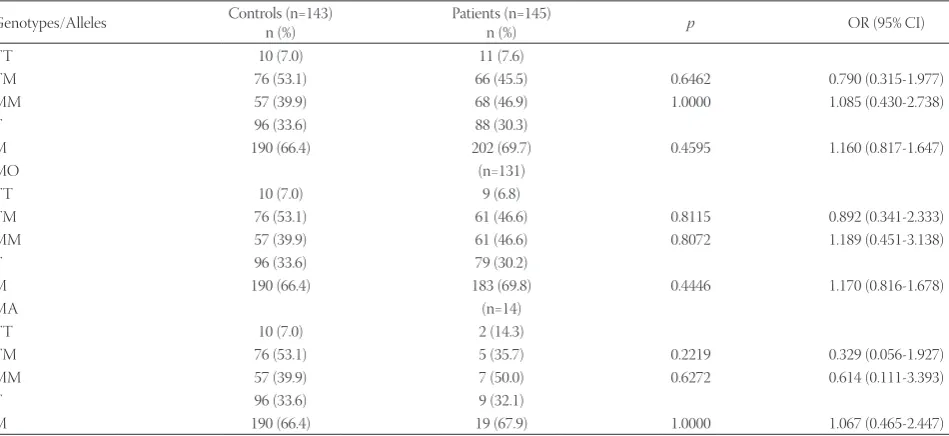
Ser89Asn polymorphism was 90.4% and 9.6%, respectively, in the patients with migraine compared to 92.2% and 7.8%, respectively, in controls (Table 3). Interestingly, we did not detect the NN genotype neither in the control nor in patient group. No significant differences were observed in allele and genotype frequencies for Ser89Asn polymorphism between the two groups (Table 3). The frequency of TT, TM, and MM genotypes of UTS2 Thr21Met polymorphism was 7.6%, 45.5%, and 46.9%, respectively, in the patient group, and 7%, 53.1%, and 39.9%, respectively, in the control group. The two groups did
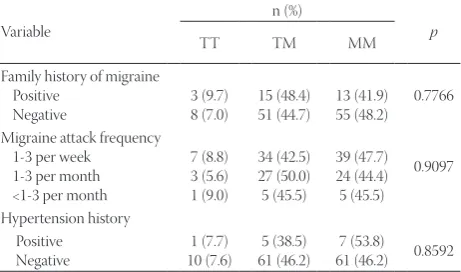
not differ significantly in the genotype and allele frequencies of Thr21Met polymorphism (Table 4). Similarly, we did not observe significant differences in allele and genotype frequen-cies between MA and MO and control group (Table 3 and 4). The haplotype analysis of Ser89Asn and Thr21Met polymor-phisms showed no association between MN, MS, TN, and TS haplotypes and migraine (Table 5). Ser89Asn and Thr431Asn polymorphisms were not associated with the family history of migraine, migraine attack frequency, or hypertension history (Table 6 and 7).
DISCUSSION
In the present study, we showed no significant associa-tion between migraine and UTS2 Thr21Met and Ser89Asn polymorphisms. Similarly, no significant relationship was observed between the UTS2 gene haplotypes and migraine in our sample of Turkish patients.
Our results indicate that the common genetic variation in the UTS2 gene unlikely plays a role in the development of migraine. However, these results are not in agreement with the findings reported by Geyik et al. [13] who found that Thr21Met polymorphism was associated with the risk for migraine. Several factors could have contributed to the dispa-rate results. First, although their study was conducted at the same university as ours, Geyik et al. [13] did not specifically indicate the ethnic background of their study population. In our study, all participants were Caucasians and of Turkish ori-gin. Another difference is that Geyik et al. [13] only included
TABLE 2. Demographic and clinical characteristics of participants
Patients (n=146) Controls (n=154) p
Mean age (years)* 33.8±9.9 33.4±8.8 0.7114
Sex
Female n (%)
Male n (%) 112 (76.7)34 (23.3) 117 (76.0)37 (24.0) 0.9884
Alcohol intake n (%) 2 (1.4) 4 (2.6) 0.6850
Cigarette smoking n (%) 31 (21.2) 33 (21.4) 0.9670
First degree family history of migraine n (%) Positive
Negative 115 (78.8)31 (21.2)
Migraine type n (%) MA
MO 132 (90.4)14 (9.6)
Migraine attack frequency n (%) 1-3/week
1-3/month <1-3/month
80 (54.8) 55 (37.7) 11 (7.5) Hypertension history n (%)
Positive
Negative 133 (91.1)13 (8.9)
Phonophobia n (%) 145 (99.3)
Photophobia n (%) 146 (100.0)
Nausea n (%) 146 (100.0)
Vomiting n (%) 143 (97.9)
patients with MA, while in our study, both MA and MO patients were investigated.
The effect of Thr21Met and Ser89Asn polymorphisms on the structure, function, and plasma levels of U-II is still unclear, and requires further studies. Previously, our molecular mod-eling analysis revealed that the two polymorphic regions of U-II protein interact with neighboring residues. Specifically, changes in 7 and 25 amino acid residues in U-II were associ-ated withThr21Met and Ser89Asn polymorphisms, respec-tively [15].
Migraine involves different changes in brain function and connectivity, as well as in the vascular system. For example, migraineurs have an approximately two-fold increased risk for ischemic stroke compared to non-migraineurs [16]; also, altered
vascular reactivity can be found in young migraineurs [17]. Moreover, it has been demonstrated that patients with chronic migraine have endothelial dysfunction and an increase in the arterial stiffness [18]. Nitric oxide (NO) is believed to contrib-ute to the pathogenesis of migraine. NO acts as a mediator of neurogenic dilatation of cerebral arteries [19], and it has been recognized as an essential molecule associated with pain during migraine attacks [20]. Migraine attacks are associated with intra and extracranial arterial dilatation, and this effect may be related to NO [19,20]. At low concentrations, U-II induces vasodilation in an endothelial-dependent manner. Effects of U-II on the endothelium can occur through the release of NO, prostaglandins, and endothelium-derived hyperpolarizing fac-tor [21]. Bicak et al. [22] reported low levels of U-II in the plasma
TABLE 3. Distribution of UTS2 Ser89Asn (S89N, rs2890565) polymorphism between groups
Genotypes/Alleles Controls (n=154)n (%) Patients (n=146)n (%) p OR (95% CI)
SS 142 (92.2) 132 (90.4)
SN 12 (7.8) 14 (9.6) 0.6826 1.255 (0.560-2.812)
NN 0 (0.0) 0 (0.0)
S 296 (96.1) 278 (95.2)
N 12 (3.9) 14 (4.8) 0.6895 1.242 (0.565-2.733)
MO (n=132)
SS 142 (92.2) 119 (90.2)
SN 12 (7.8) 13 (9.8) 0.6753 1.293 (0.568-2.940)
NN 0 (0.0) 0 (0.0)
S 296 (96.1) 251 (95.1)
N 12 (3.9) 13 (4.9) 0.6824 1.278 (0.573-2.851)
MA (n=14)
SS 142 (92.2) 13 (92.9)
SN 12 (7.8) 1 (7.1) 1.0000 0.910 (0.110-7.569)
NN 0 (0.0) 0 (0.0)
S 296 (96.1) 27 (96.4)
N 12 (3.9) 1 (3.6) 1.0000 0.914 (0.114-7.300)
OR: Odds ratio; CI: Confidence interval; MA: Migraine with aura; MO: Migraine without aura.
TABLE 4. Distribution of UTS2 Thr21Met (T21M, rs228648) polymorphism between groups
Genotypes/Alleles Controls (n=143)n (%) Patients (n=145)n (%) p OR (95% CI)
TT 10 (7.0) 11 (7.6)
TM 76 (53.1) 66 (45.5) 0.6462 0.790 (0.315-1.977)
MM 57 (39.9) 68 (46.9) 1.0000 1.085 (0.430-2.738)
T 96 (33.6) 88 (30.3)
M 190 (66.4) 202 (69.7) 0.4595 1.160 (0.817-1.647)
MO (n=131)
TT 10 (7.0) 9 (6.8)
TM 76 (53.1) 61 (46.6) 0.8115 0.892 (0.341-2.333)
MM 57 (39.9) 61 (46.6) 0.8072 1.189 (0.451-3.138)
T 96 (33.6) 79 (30.2)
M 190 (66.4) 183 (69.8) 0.4446 1.170 (0.816-1.678)
MA (n=14)
TT 10 (7.0) 2 (14.3)
TM 76 (53.1) 5 (35.7) 0.2219 0.329 (0.056-1.927)
MM 57 (39.9) 7 (50.0) 0.6272 0.614 (0.111-3.393)
T 96 (33.6) 9 (32.1)
M 190 (66.4) 19 (67.9) 1.0000 1.067 (0.465-2.447)
of migraine patients compared to healthy controls. However, it was also shown that plasma levels of U-II were significantly higher in MO patients [13]. Chuquet et al. [23] demonstrated that U-II administration into the lateral cerebral ventricle induced gradual and long-lasting elevation of cerebral blood flow in rats. In the same study, U-II exacerbated brain damage following an ischemic insult [23]. Finally, U-II induced norepi-nephrine, dopamine, and serotonin release from noradrenergic neurons [24]. Collectively, the above discussed findings indicate that U-II may play a role in the pathogenesis of migraine.
In conclusion, our study suggests no significant associa-tions between UTS2 Thr21Met and Ser89Asn polymorphisms and migraine. Thus, the UTS2 may not be a susceptible gene for migraine in our sample of Turkish patients with migraine. However, these results should be cautiously interpreted due to the small sample size of our cohort. Further studies with larger cohorts are required to investigate the exact role of U-II in migraine.
ACKNOWLEDGMENTS
This study was supported by a project (BAP TF.15.01) from the University of Gaziantep.
DECLARATION OF INTERESTS
The authors declare no conflict of interests.
REFERENCES
[1] Pietrobon D, Moskowitz MA. Pathophysiology of migraine. Annu Rev Physiol 2013;75:365-91.
https://doi.org/10.1146/annurev-physiol-030212-183717.
[2] Thomsen LL, Olesen J, Russell MB. Increased risk of migraine with typical aura in probands with familial hemiplegic migraine and their relatives. Eur J Neurol 2003;10(4):421-7.
https://doi.org/10.1046/j.1468-1331.2003.00621.x.
[3] Stewart WF, Bigal ME, Kolodner K, Dowson A, Liberman JN, Lipton RB. Familial risk of migraine: Variation by proband age at onset and headache severity. Neurology 2006;66(3):344-8. https://doi.org/10.1212/01.wnl.0000196640.71600.00.
[4] Headache Classification Subcommittee of the International Headache Society. The International Classification of Headache Disorders: 2nd edition. Cephalalgia 2004;24 Suppl 1:9-160.
https://doi.org/10.1111/j.1468-2982.2003.00825.x.
[5] Peck KR, Johnson YL, Smitherman TA. Migraine. Handb Clin Neurol 2016;138:283-93.
https://doi.org/10.1016/B978-0-12-802973-2.00016-1.
[6] Ozdemir G, Aygül R, Demir R, Ozel L, Ertekin A, Ulvi H. Migraine prevalence, disability, and sociodemographic properties in the east-ern region of Turkey: A population-based door-to-door survey. Turk J Med Sci 2014;44(4):624-9.
https://doi.org/10.3906/sag-1307-4.
[7] Mulder EJ, Van Baal C, Gaist D, Kallela M, Kaprio J, Svensson DA, et al. Genetic and environmental influences on migraine: A twin study across six countries. Twin Res 2003;6(5):422-31.
https://doi.org/10.1375/136905203770326420.
[8] Chasman DI, Schürks M, Anttila V, de Vries B, Schminke U, Launer LJ, et al. Genome-wide association study reveals three sus-ceptibility loci for common migraine in the general population. Nat Genet 2011;43(7):695-8.
https://doi.org/10.1038/ng.856.
[9] Ross B, McKendy K, Giaid A. Role of urotensin II in health and dis-ease. Am J Physiol Regul Integr Comp Physiol 2010;298(5):R1156-72. https://doi.org/10.1152/ajpregu.00706.2009.
[10] Hongfang J, Bailin C, Bin Z, Chunyu Z, Xinmin L, Weijin Z, et al. Effects of hydrogen sulfide on hypoxic pulmonary vascular struc-tural remodeling. Life Sci 2006;78(12):1299-309.
https://doi.org/10.1016/j.lfs.2005.07.009.
[11] Wenyi Z, Suzuki S, Hirai M, Hinokio Y, Tanizawa Y, Matsutani A, et al. Role of urotensin II gene in genetic susceptibility to Type 2 dia-betes mellitus in Japanese subjects. Diabetologia 2003;46(7):972-6. https://doi.org/10.1007/s00125-003-1145-1.
[12] Anttila V, Winsvold BS, Gormley P, Kurth T, Bettella F, McMahon G, et al. Genome-wide meta-analysis identifies new susceptibility loci for migraine. Nat Genet 2013;45(8):912-7.
https://doi.org/10.1038/ng.2676.
[13] Geyik S, Ergun S, Kuzudişli S, Şensoy F, Temiz E, Altunışık E, et al. Plasma urotensin-2 level and Thr21Met but not Ser89Asn poly-morphisms of the urotensin-2 gene are associated with migraines. J Headache Pain 2016;17:36.
https://doi.org/10.1186/s10194-016-0623-z.
[14] Kuzudisli SU, Yilmaz M, Gül Z, Demiryürek S, Yigiter R, Bozkurt H, et al. Investigation of the Rho-kinase 2 gene Thr431Asn polymor-phism in migraine. Neurol India 2014;62(1):9-14.
TABLE 5. Distribution of haplotype frequencies of UTS2 Thr21Met and Ser89Asn polymorphisms in migraine patients and controls.
Thr21Met Ser89Asn Controlsn (%) Patientsn (%) p OR (95% CI)
M N 8 (2.8) 9 (3.2) 0.7599 1.160 (0.446-3.017) M S 182 (63.6) 193 (66.4) 0.4555 1.141 (0.806-1.616)
T N 4 (1.4) 5 (1.6) -
-T S 92 (32.2) 83 (28.8) 0.3794 0.852 (0.597-1.217) OR: Odds ratio; CI: Confidence interval; Frequencies<3% in both control and case group were dropped from the analysis.
TABLE 6. Association between Ser89Asn (S89N, rs2890565) polymorphism and clinical variables
Variable SS n (%)SN NN p
Family history of migraine Positive
Negative 104 (90.4)28 (90.3) 11 (9.6)3 (9.7) 0 (0.0)0 (0.0) 1.0000 Migraine attack frequency
1-3 per week 1-3 per month <1-3 per month
72 (90.0) 50 (90.9) 10 (90.9) 8 (10.0) 5 (9.1) 1 (9.1) 0 (0.0) 0 (0.0) 0 (0.0) 0.9829 Hypertension history Positive
Negative 121 (91.0)11 (84.6) 2 (15.4)12 (9.0) 0 (0.0)0 (0.0) 0.3610
TABLE 7. Association between Thr21Met (T21M, rs228648) polymorphism and clinical variables
Variable
n (%)
p
TT TM MM
Family history of migraine Positive
Negative 3 (9.7)8 (7.0) 15 (48.4)51 (44.7) 13 (41.9)55 (48.2) 0.7766 Migraine attack frequency
1-3 per week 1-3 per month <1-3 per month
7 (8.8) 3 (5.6) 1 (9.0) 34 (42.5) 27 (50.0) 5 (45.5) 39 (47.7) 24 (44.4) 5 (45.5) 0.9097 Hypertension history Positive
https://doi.org/10.4103/0028-3886.128241.
[15] Okumus S, Igci YZ, Taskin T, Oztuzcu S, Gurler B, Eslik Z, et al. Association between Thr21Met and Ser89Asn polymorphisms of the urotensin-II (UTS2) gene, diabetes mellitus, and diabetic reti-nopathy. Curr Eye Res 2012;37(10):921-9.
https://doi.org/10.3109/02713683.2012.688181.
[16] Schürks M, Rist PM, Bigal ME, Buring JE, Lipton RB, Kurth T. Migraine and cardiovascular disease: Systematic review and meta-analysis. BMJ 2009;339:b3914.
https://doi.org/10.1136/bmj.b3914.
[17] Vanmolkot FH, Van Bortel LM, de Hoon JN. Altered arterial func-tion in migraine of recent onset. Neurology 2007;68(19):1563-70. https://doi.org/10.1212/01.wnl.0000260964.28393.ed.
[18] Jiménez Caballero PE, Muñoz Escudero F. Peripheral endothelial function and arterial stiffness in patients with chronic migraine: A case-control study. J Headache Pain 2013;14(1):8.
https://doi.org/10.1186/1129-2377-14-8.
[19] Olesen J. The role of nitric oxide (NO) in migraine, tension-type headache and cluster headache. Pharmacol Ther 2008;120(2):157-71. https://doi.org/10.1016/j.pharmthera.2008.08.003.
[20] Olesen J, Thomsen LL, Lassen LH, Olesen IJ. The nitric oxide hypothesis of migraine and other vascular headaches. Cephalalgia 1995;15(2):94-100.
https://doi.org/10.1046/j.1468-2982.1995.015002094.x.
[21] Ross B, McKendy K, Giaid A. Role of urotensin II in health and dis-ease. Am J Physiol Regul Integr Comp Physiol 2010;298(5):R1156-72. https://doi.org/10.1152/ajpregu.00706.2009.
[22] Bicak U, Karabiber H, Ozerol HI, Aslan M, Ilhan A, Yakinci C. Possible pathogenic link between migraine and urotensin-II. J Child Neurol 2008;23(11):1249-53.
https://doi.org/10.1177/0883073808318052.
[23] Chuquet J, Lecrux C, Chatenet D, Leprince J, Chazalviel L, Roussel S, et al. Effects of urotensin-II on cerebral blood flow and ischemia in anesthetized rats. Exp Neurol 2008;210(2):577-84. https://doi.org/10.1016/j.expneurol.2007.12.004.
[24] Ono T, Kawaguchi Y, Kudo M, Kushikata T, Hashiba E, Yoshida H, et al. Urotensin II evokes neurotransmitter release from rat cerebro-cortical slices. Neurosci Lett 2008;440(3):275-9.