[paparao al., 5(6): June, 2018]
ISSN 2349-0292
Impact Factor 3.802
GLOBAL JOURNAL OF ADVANCED ENGINEERING TECHNOLOGIES AND
SCIENCES
STUDY OF FUZZY MODELLING ON ELECTRICAL DISCHARGE MACHINING
(EDM) OF TOOL DIE STEEL
D.Paparao
Department of Production Engineering, National Institute of Technology Tiruchirapalli, Tamilnadu,
India
DOI
: 10.5281/zenodo.1302243
ABSTRACT
Estimating the performance becomes necessary in today’s modern world in order to reduce the number of experiments in precision manufacturing, especially in electrical discharge machining (EDM). Hence, in the present investigation fuzzy-based algorithm using MATLAB software for prediction of Material Removal Rate (MRR), Tool Wear Rate (TWR), and Surface Roughness (SR) in the EDM processes. The discharge current, pulse duration, and pulse-off time are selected as input variables and the responses like MRR, TWR, and SR are estimated. The proposed fuzzy model developed in this study provides a more precise and easy selection of any EDM input parameters for the required responses which leads to better machining conditions and decreases the machining costs. Observations indicate that the fuzzy modeling results of EDM were in good agreement with experimental findings demonstrating 90% predictions can be achieved.
KEYWORDS: Electrical discharge machining (EDM); Material removal rate(MRR); Tool wear rate(TWR); surface roughness(SR);Fuzzy modelling; MATLAB.
INTRODUCTION
Electro Discharge Machining (EDM) is an electro-thermal non-traditional machining Process, where electrical energy is used to generate electrical spark and material removal mainly occurs due to thermal energy of the spark. EDM is mainly used to machine difficult-to-machine materials and high strength temperature resistant alloys. EDM can be used to machine difficult geometries in small batches or even on job-shop basis. Work material to be machined by EDM has to be electrically conductive.EDM has been replacing drilling, milling, grinding and other traditional machining operations and is now a well-established machining option in many manufacturing industries throughout the world. And is capable of machining geometrically complex or hard material components, that are precise and difficult-to-machine such as heat treated tool steels, composites, super alloys, ceramics, carbides, heat resistant steels etc. being widely used in die and mould making industries, aerospace, aeronautics and nuclear industries. Electric Discharge Machining has also made its presence felt in the new fields such as sports, medical and surgical, instruments, optical, including automotive R&D areas. Electrical discharge machining is one of the non-conventional machining process that can be effectively used for difficult to machine materials by conventional methods. It is possible to control machining rate by properly controlling EDM parameters. The machining time and cost can be reduced by fuzzy logic modeling without doing further experiments. Therefore, fuzzy logic can be efficiently applied to process. In present work, a fuzzy rule based system is developed for better and user friendly selection of EDM parameters. Furthermore, an experimental data is required in order to predict the other output results.
EXPERIMENTAL RESULTS
The performance characteristics for this experiment like metal removal rate, tool wear rate and surface roughness were calculated.
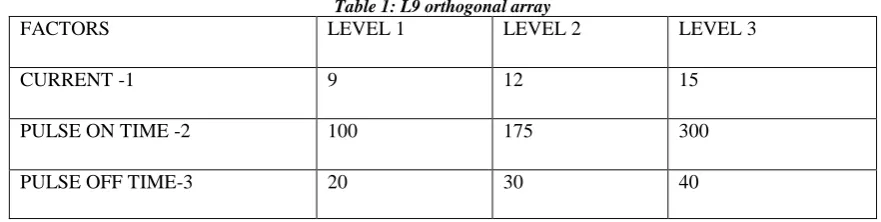
2.1)L9 orthogonal array:
Table 1: L9 orthogonal array
FACTORS LEVEL 1 LEVEL 2 LEVEL 3
CURRENT -1 9 12 15
PULSE ON TIME -2 100 175 300
[paparao al., 5(6): June, 2018]
ISSN 2349-0292
Impact Factor 3.802
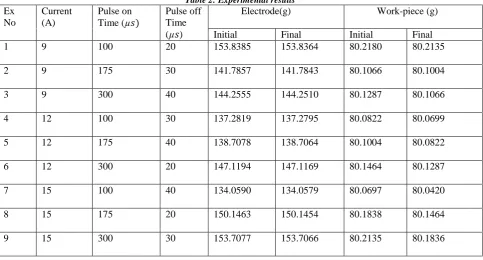
2.2) Observed data on experiment:Table 2: Experimental results Ex
No
Current (A)
Pulse on Time (µ𝑠)
Pulse off Time (µ𝑠)
Electrode(g) Work-piece (g)
Initial Final Initial Final
1 9 100 20 153.8385 153.8364 80.2180 80.2135
2 9 175 30 141.7857 141.7843 80.1066 80.1004
3 9 300 40 144.2555 144.2510 80.1287 80.1066
4 12 100 30 137.2819 137.2795 80.0822 80.0699
5 12 175 40 138.7078 138.7064 80.1004 80.0822
6 12 300 20 147.1194 147.1169 80.1464 80.1287
7 15 100 40 134.0590 134.0579 80.0697 80.0420
8 15 175 20 150.1463 150.1454 80.1838 80.1464
9 15 300 30 153.7077 153.7066 80.2135 80.1836
2.3)The performance characteristics:
Table 3: Performance characteristics
Ex No MRR (mm3/min 10-8) TWR ( mm3/min 10-2) SR,(µm)
1 2.96 1.17 2.03
2 4.07 0.78 2.09
3 14.53 2.52 2.70
4 8.09 1.34 2.10
5 11.97 2.84 2.04
6 11.64 1.40 2.84
7 18.22 0.61 2.11
8 24.60 0.50 2.96
9 19.53 0.61 2.80
[paparao al., 5(6): June, 2018]
ISSN 2349-0292
Impact Factor 3.802
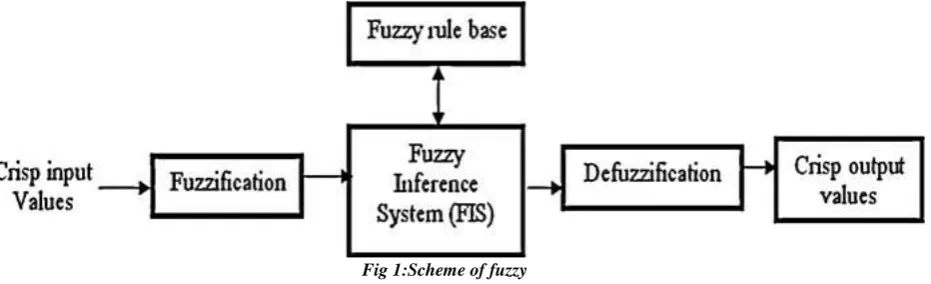
definition of performance characteristics such as lower-the-better, higher-the-better and nominal-the-better contains the degree of uncertainty andvagueness. Fuzzy logic has become a common tool to handle such information.It uses linguistic terms to develop reasonable relationship between input and output variables. In this paper the fuzzy model has been designed for selecting better EDM parameters. There are three main stages during the development of the model: formation of membership function (fuzzification), definition of the expert rules, and selecting defuzzification method.
3.2) Membership function (MF):
Membership function characterizes the fuzziness in a fuzzy set whether the elements in the set are discrete or continues in graphical form. There is an infinite number of methods to graphically depict the membership function that describes fuzziness. Since the membership function essentially embodies all fuzziness for the particular fuzzy set, its description is the essence of a fuzzy property or operation. Because of the importance of the shape of the membershipfunction, a great deal of attention has been focused on development of these functions: triangular, trapezoidal and Gaussian are some types of membership function shapes. In selectingthe membership functions for fuzzification, the events and types of membership function are mainly dependent upon the relevant event. So far there has been no standard method of choosing the proper shape of the membership functions for the fuzzy sets of thecontrol variables. Trial and error methods are usually exercised.
Fig 1:Scheme of fuzzy
3.3) Fuzzy expert rules:
The relationship between the input and output in a fuzzy model is characterized by a set of linguistic statement called fuzzy rules. They are defined based on experimental work and engineering knowledge. All of these rules are in the form of if-then. For examplein this paper one of these rules is: If current is VS and pulse duration is M then MRR is VS and TWR is M and SRis S.
3.4) Defuzzification:
Defuzzification refers to the method in which a crisp value is extracted from a fuzzy set as a representative value. In general there are several methods for defuzzifying fuzzy sets. Centroid of area is the most widely adopted defuzzification strategy which is reminiscent of the calculation of expected values of probability distributions. In this paper this method has been used.
3.5) Methods of Defuzzification:
There are many methods for defuzzification .One of the more common types of defuzzification technique is the maximum defuzzification techniques. These select the output with the highest membership function. They include:
First of maximum Middle of maximum Last of maximum Mean of maxima
[paparao al., 5(6): June, 2018]
ISSN 2349-0292
Impact Factor 3.802
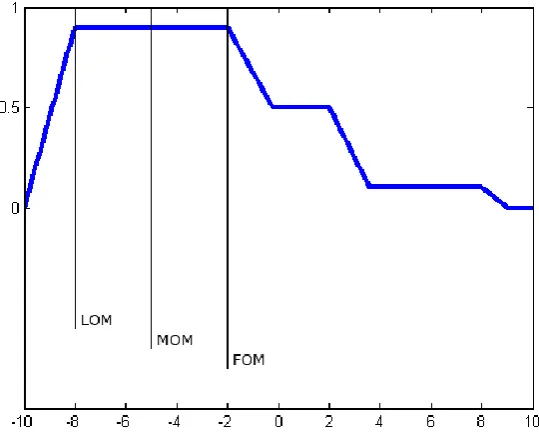
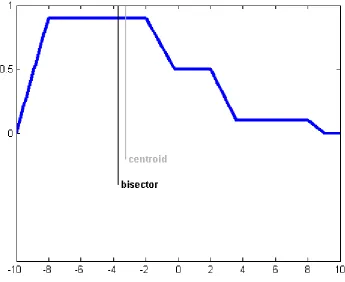
Given the fuzzy output:Fig 2:Defuzzification method
The first of maximum, middle of maximum, and last of maximum would be -2, -5, and -8 respectively as seen in the above diagram.The mean would give the same result as middle unless there is more than one plateau with the maximum value
Two other common methods are: Centre of gravity:
Calculates the center of gravity for the area under the curve Bisector method:
[paparao al., 5(6): June, 2018]
ISSN 2349-0292
Impact Factor 3.802
Fig 3:Center of gravity and Bisector method
3.6)Factorial design and fuzzy expressions:
[paparao al., 5(6): June, 2018]
ISSN 2349-0292
Impact Factor 3.802
Fig 4:Membership function for current
Fig 5:Membership function for Pulse-on time
[paparao al., 5(6): June, 2018]
ISSN 2349-0292
Impact Factor 3.802
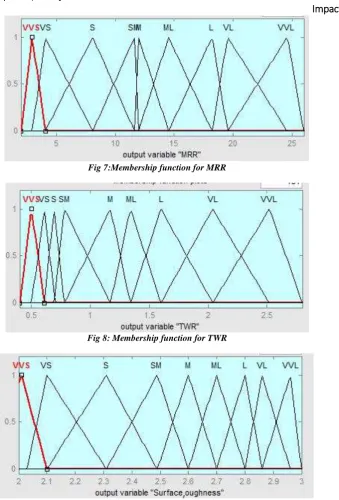
Fig 7:Membership function for MRR
Fig 8: Membership function for TWR
Fig 9:Membership function for surface roughness
[paparao al., 5(6): June, 2018]
ISSN 2349-0292
Impact Factor 3.802
DISCUSSIONSBy Mamdani inference, the fuzzy linguistic values and their membership values for the outputs were obtained. Afterwards, the defuzzification method by the centroid of area was used to calculatethe crisp values as the final outputs. Graphical representation of fuzzy surface and comparisonof experimental results and fuzzy prediction are illustrated in table 6.1 to 6.3.
Table 5:Experimental results Vs. modelling results for MRR: S.No Current
(A) Pulse on time(µs) Pulse off time(µs) Experimental MRR(mm3/min 10-2)
Modeling MRR (mm3/min 10-2)
Accuracy
1 9 100 20 2.96 3.02 97.9
2 9 175 30 4.07 5.09 79.49
3 9 300 40 8.09 7.54 93.2
4 12 100 20 11.64 10.93 93.9
5 12 175 30 11.97 11.12 92.89
6 12 300 40 14.53 13.96 96.07
7 15 100 20 18.22 19.10 95.17
8 15 175 30 19.53 20.27 95.90
9 15 300 40 24.60 25.40 96.74
Table 6:Experimental results Vs. modelling results for TWR: S.No Current
(A) Pulse on time(µs) Pulse off time(µs) Experimental TWR(mm3/min 10-2)
Modeling TWR (mm3/min 10-2)
Accuracy
1 9 100 20 0.5 0.41 82
2 9 175 30 0.61 0.51 83.6
3 9 300 40 0.69 0.79 85.5
4 12 100 20 0.78 0.88 87.18
5 12 175 30 1.17 1.06 90.59
6 12 300 40 1.34 1.48 89.55
7 15 100 20 1.6 1.41 88.12
8 15 175 30 2.04 1.81 88.72
9 15 300 40 2.52 2.73 91.66
Table7:Experimental results Vs. modelling results for surface roughness: S.No Current
(A)
Pulse on time(µs)
Pulse off time(µs)
Experimental SR (µm) Modeling SR (µm) Accuracy
1 9 100 20 2.03 2.03 100
2 9 175 30 2.1 2.3 90.47
3 9 300 40 2.31 2.7 83.11
4 12 100 20 2.49 2.79 87.95
5 12 175 30 2.6 2.85 90.38
6 12 300 40 2.7 2.98 89.62
7 15 100 20 2.8 3.01 92.5
8 15 175 30 2.86 3.02 94.4
9 15 300 40 2.96 3.18 92.56
CONCLUSIONS
[paparao al., 5(6): June, 2018]
ISSN 2349-0292
Impact Factor 3.802
the accuracy can be improved. Thus, the fuzzy modeling technique could be an economical and successful method for prediction of EDM output parameters according to input variables.REFERENCES
[1] Yih-fongTzengand Fu-chen Chen (2006),Multi-objective optimisation of high-speed electrical discharge machining process using a Taguchi fuzzy-based approach.
[2] Ozlem Salman and M. CengizKayacan(2007),Evolutionary programming method for modeling the EDM parameters for roughness.
[3] Ibrahem Maher, LiewHui Ling, Ahmed A. D. Sarhan,and M. Hamdi(2015),Improve wire EDM performance at different machining parameters – ANFIS modeling.
[4] S. Dewangan, S. Gangopadhyay and C.K. Biswas(2014), Study of surface integrity and dimensional accuracy in EDMusing Fuzzy TOPSIS and sensitivity analysis.
[5] OguzhanYilmaz , Omer Eyercioglu and Nabil N.Z. Gindy(2005), A user-friendly fuzzy-based system for the selection of electric discharge machining process parameters.
[6] Chen-Chun Kao, Albert J. Shih(2009),Design and tuning of a fuzzy logic controller for micro-hole electrical discharge machining.
[7] S.N. Joshi and S.S. Pande(2010),Intelligent process modeling and optimization of die-sinking electric discharge machining.
[8] JambeswarSahu, Chinmaya P. Mohanty and S.S. Mahapatra(2008),A DEA approach for optimization of multiple responses in Electrical Discharge Machining of AISI D2 steel.
[9] Sengottuvel.P, Satishkumar.S and Dinakaran(2004), Optimization Of Multiple Characteristics Of EDM Parameters Based On Desirability Approach And Fuzzy Modeling.
[10]R. K. Bhuyan, ShaliniMohanty and B.C. Routara(2016),RSM and Fuzzy logic approaches for predicting the surface roughness during EDM of Al-SiCp MMC.
[11]Chandramouli S and EswaraiahK(2016),Optimization of EDM Process parameters in Machining of 17-4 PH Steel using Taguchi Method.
[12]Manish Gangil, M. K. Pradhan, Rajesh Purohit(2016),Review on modelling and optimization of electrical discharge machining process using modern Techniques.
[13]ShaileshDewangan, SoumyaGangopadhyay and Chandan Kumar Biswas(2015),Multi-response optimization of surface integrity characteristics of EDM process using grey-fuzzy logic-based hybrid approach
[14]Ahmed A.D. Sarhan, Lim Siew Fen, Mum Wai Yip, M. Sayuti(2015),Fuzzy Modeling for Micro EDM Parameters Optimization in Drilling of Biomedical Implants Ti-6Al-4V Alloy for Higher Machining Performance.