Article
1
Multiferroic Hysteresis Loop
2
Alexander Ruff1,*, Alois Loidl1 and Stephan Krohns1,*
3
1 Experimental Physics V, Center for Electronic Correlations and Magnetism, University of Augsburg,
4
86159 Augsburg, Germany
5
* Correspondence: [email protected] or [email protected];
6
Tel.: +49-821-598-3606
7
Abstract: Multiferroics, showing both ferroelectric and magnetic order, are promising candidates
8
for future electronic devices. Especially, the fundamental understanding of ferroelectric switching
9
is of key relevance for further improvements, which however is rarely reported in literature. On a
10
prime example for a spin-driven multiferroic, LiCuVO4, we present an extensive study of the
11
ferroelectric order and the switching behavior as function of external electric and magnetic fields.
12
From frequency-dependent polarization switching and using the Ishibashi-Orihara theory, we
13
deduce the existence of ferroelectric domains and domain-walls. These have to be related to
14
counterclockwise and clockwise spin-spirals leading to the formation of multiferroic domains. A
15
novel measurement – multiferroic hysteresis loop – is established to analyze the electrical
16
polarization simultaneously as a function of electrical and magnetic fields. This technique allows
17
characterizing the complex coupling between ferroelectric and magnetic order in multiferroic
18
LiCuVO4.
19
Keywords: Multiferroicity; LiCuVO4; Spin-driven improper ferroelectricity; Hysteresis in magnetic
20
fields, Multiferroic Hysteresis Loop
21
22
1. Introduction
23
In the last years, multiferroic materials established a very important field of materials science as
24
they host inherent functionalities for novel electronic and magnetic devices [1]. Among these
25
materials, those who exhibit both, ferroelectric and (anti-)ferromagnetic order, are most prominent
26
as they usually exhibit large magnetoelectric effects [2,3]. Controlling the magnetic order via an
27
electric field and vice versa is a challenging task. Especially, systems with spin-driven ferroelectric
28
order formed by spiral or helical spin structures enable this approach [4,5,6]. The electrical
29
polarization arises directly from the non-collinear spin structure, for which LiCuVO4 is a
30
prototypical example [4,6,7,8]. As proposed, e.g., in Refs. [9,10,11], the presence of tilted spins (Si and
31
Si+1) at neighbouring atomic sites (i and i + 1) breaks the inversion symmetry via spin-orbit coupling
32
and is the microscopic mechanism for multiferroicity in these systems. This spin-driven improper
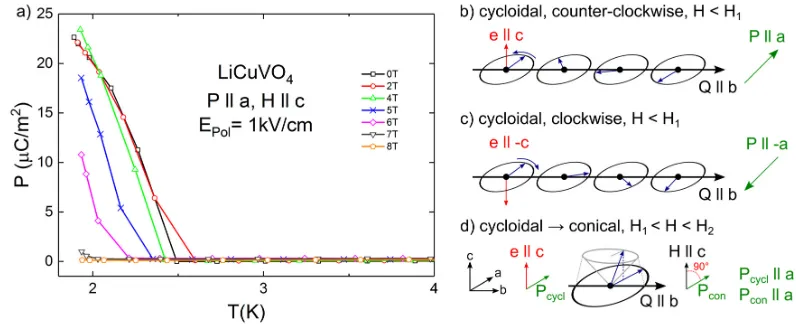
33
ferroelectricity leads to the following relation for the electrical polarization: P∝ e × Q, where Q
34
denotes the propagation vector of the spin spiral and e = (Si × Si+1) corresponds to the spiral axis, i.e.,
35
the normal vector of the spiral spin plane [7,10,11,12].
36
The spin-driven multiferroic compound LiCuVO4 provides a complex (H,T)-phase diagram for
37
the polarization at low temperatures [7]. An external magnetic field (H1 ≈ 2.5 T < H < H2 ≈ 7.5 T) is
38
able to from conical spin structures leading to a polarization perpendicular to the magnetic field
39
direction. For increased magnetic fields (H > H2) a modulated collinear spin structure is induced [13],
40
which suppress the helical spin state. Without an external magnetic field the spin spiral in LiCuVO4
41
is formed below TN= 2.5 K in the ab-plane (spiral axis e‖c) and propagates in the crystallographic b
42
direction (i.e., Q‖b) [7,8]. As predicted by theory (e.g., Refs. [10,12]) and confirmed by experiments
43
(e.g., Refs. [7,14]) this leads to a ferroelectric polarization along P‖a. Above H1, e aligns along the
44
external magnetic field direction. This allows switching of the electrical polarization according to
45
P∝ e × Q. Accompanied by the transition into the modulated collinear spin state above H2 the
46
ferroelectric state vanishes. Interestingly, not only the magnetic field has an impact on the
47
polarization of a LiCuVO4 single crystal but also an external electrical field [14]. This field can switch
48
the ferroelectric polarization implying that the spin helicity switches from clockwise to
49
counter-clockwise and vice versa. Such ferroelectric hysteresis loops have only rarely been
50
documented in spin-spiral multiferroics [3,4,14,15,16].
51
In the present work, we thoroughly analyze the electric and magnetic field dependent
52
ferroelectric hysteresis loops of single crystalline LiCuVO4. Special emphasis is put on two aspects:
53
firstly, the frequency dependence of ferroelectric hysteresis shows that the polarization varies with
54
respect to frequency and coercive field. We provide a fundamental basis, using Ishibashi-Orihara
55
theory for domain-wall movements [17], to explain the presence of multiferroic domains (clockwise
56
and counterclockwise spin-spirals). This allows further insights into the dynamics of multiferroic
57
switching processes. Secondly, on LiCuVO4 we demonstrate a novel multiferroic hysteresis loop
58
measurement, which enables unraveling the complex coupling of ferroelectric and magnetic order,
59
e.g., in the vicinity of the critical magnetic field H2. So far, only magnetic biasing fields are used for
60
ferroelectric hysteresis loop measurements in multiferroics [14,18].
61
62
2. Results and Discussion
63
64
Figure 1. Temperature dependent polarization along the a direction of a LiCuVO4 single crystal, measured
65
during heating after a poling field of 1 kV/cm was applied while cooling. The pyrocurrent measurements
66
were performed for various magnetic fields (up to 8 T) along the c direction. (b) – (d) illustrate possible
67
spin-spiral configurations in LiCuVO4, also including the directions of polarization, applied magnetic
68
field, spiral-axis and the modulation direction of the spin-spiral.
69
Figure 1a shows the temperature dependent polarization along the a direction, measured after
70
polarizing the sample during cooling down to 1.8 K with an electric field of 1 kV/cm. In addition, the
71
polarization was determined for different magnetic fields up to 8 T applied in c direction of the
72
sample. A polarization of up to 24 µC/m² for H < 4 T at low temperatures is for this specific
73
measurement configuration explained in terms of ferroelectric ordering, as described in Refs. [7,14].
74
For instance, in the absence of an external magnetic field the polarization appears at the long-range
75
magnetic order at TN = 2.5 K. For magnetic fields exceeding 2 T the ferroelectric transition shifts to
76
lower temperatures, which is in perfect agreement with reports of anomalies in temperature
77
dependent dielectric constants [14]. Finally, the electrical polarization vanishes for magnetic fields
78
above H2 coinciding with the paraelectric phase as consequence of the modulated collinear spin state
79
[7]. Hence, LiCuVO4 single crystal investigated in this work is an illuminating example for
80
spin-driven ferroelectric ordering for T < TN. The figures 1b-d illustrate possible spin-spiral states of
81
LiCuVO4 for zero and applied magnetic fields. We assume, that for H < H1(figs. 1b and 1c) purely
82
cycloidal spin states in the ab-plane exist, which allow the switching of the electrical polarization
83
so-called clockwise and counter-clockwise spin helicities. In an applied magnetic field H1 < H < H2
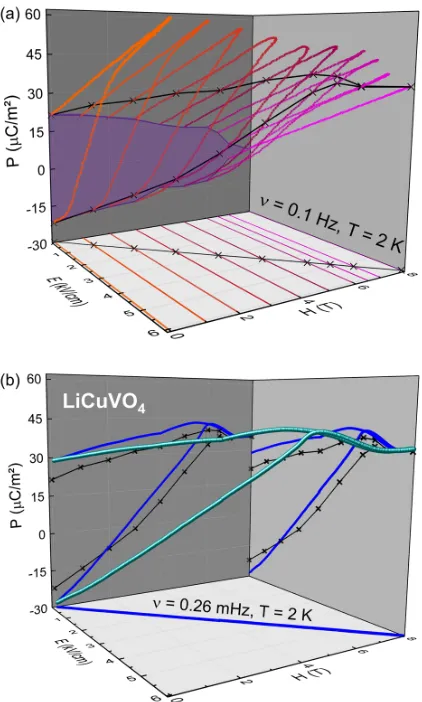
85
out of the spin-spiral a transvers conical configuration is formed gradually with increasing magnetic
86
field (figure 1d). Here, the polarization arises in the a direction in a distinct relationship to the
87
direction of the applied magnetic field [6]. Tilting the spin out of the ab-plane reduces on the one
88
hand the polarization based on the cycloidal state, but on the other hand may increase the
89
polarization of the conical configuration. The polarization derived from magnetocurrent
90
measurement (i.e., measuring the pyrocurrent signal at constant temperature but changing magnetic
91
field) [7] confirms this assumption, as the polarization changes from 0 to 24 µC/m² between H2 and
92
H1.
93
An inherent property of conventional ferroelectricity is by definition the switchability of the
94
spontaneous electric polarization by an external electric field. Ruff et al. [14] demonstrated, that even
95
for LiCuVO4 the improper ferroelectric order could be controlled by an electric field. As a
96
consequence of the relation P∝ e × Q, the spin helicity (containing both: modulation direction and
97
spin spiral axis) of multiferroic LiCuVO4 has to switch between counterclockwise and clockwise
98
direction [5,16]. Here, we investigate the electric polarization of these multiferroic domains as a
99
function of the frequency of the applied electric switching pulse. The switching kinetics in
100
conventional ferroelectrics are often interpreted using the Kolmogorov-Avrami-Ishibashi (KAI)
101
model [19,20,21,22]. In this case, ferroelectric domains grow unrestrictedly from nucleation centers
102
in an applied electric field. While switching the polarization, the domains start to overlap. Hence, the
103
overall switched volume fraction is based on: switching time, density of nucleus of reversed
104
domains, mobility of domain walls, dimension of domain growth, and the impact of the electric field
105
on moving domains. Ishibashi and Orihara (IO) [17,20] derived from the KAI model a more
106
simplified scenario, especially in the case of deterministic nucleation. Here, the volume fraction of
107
reversed polarization depends purely on the frequency of the applied field and its waveform
108
(normally sinusoidal). It turns out, that the analysis of coercive fields derived from hysteresis loops
109
measurements performed with various frequencies, can provide strong hints for the underlying
110
ferroelectric switching mechanism [20].
111
112
Figure 2. Frequency dependent ferroelectric hysteresis loops of a LiCuVO4 single crystal. The polarization
113
P was measured along the a direction at T = 2 K and in electric fields E up to 6 kVcm-1. The inset shows a
114
double-logarithmic representation of the coercive field Ecvs. frequency ν. The line denotes a linear fit
115
representing IO model resulting in a slope of β= 0.08.
116
In the scope of the IO scenario, we conduct a thorough analysis of frequency dependent
117
(0.1 Hz < ν < 300 Hz) ferroelectric hysteresis loops P(E) of multiferroic LiCuVO4 as shown in figure 2
118
sinusoidal electric field pulse a fully saturated hysteresis loop emerges. The tilt of the curve arises
120
from linear capacitance contributions. Positive-up-negative-down measurement reported within
121
Ref. [14] exclude for LiCuVO4 extrinsic effects, e.g., leakage current, giving rise to an artificial
122
hysteresis loop [23,24]. The remnant polarization of about 22 µC/m² confirms the polarization
123
derived from pyrocurrent measurements (Fig. 1). With increasing frequency the remnant
124
polarization only slightly decreases, while the coercive field rises from Ec (0.1 Hz) = 2.45 kV/cm to
125
Ec(300 Hz) = 4.18 kV/cm. The inset of figure 2 presents this ν-dependence of Ec in a
126
double-logarithmic scale. For higher frequencies ν > 1 Hz, log[Ec(ν)] shows an almost linear increase
127
in the log(ν) representation. For ν = 300 Hz slight deviations are expected as the full saturation is not
128
reached when applying an electric field pulse of Emax(300Hz) = 6 kV/cm (c.f. Fig. 2). In the scope of
129
the IO model, Ec should follow a simplified power law relation: Ec∝ νβ [20]. We use this model to
130
describe Ec(ν) and reveal a β–parameter of 0.08 (± 0.005), which is quite similar to β–values of
131
domain-wall movement in conventional ferroelectrics, like PZT (β = 0.05) [25] and SBT (β = 0.12) [26].
132
Hence, the frequency dependent hysteresis loops of LiCuVO4 can be comprehensible explained in
133
the framework of the IO model. Consequently, the volume fraction of reversed polarization has to be
134
directly linked to the magnetic order of counterclockwise and clockwise spin helicity. Thus,
135
multiferroic domains are formed in LiCuVO4, which can be controlled by an external electric field.
136
137
Figure 3. Ferroelectric hysteresis loops of a LiCuVO4 single crystal measured at 2 K and 0.1 Hz in
138
electrical fields up to 6 kV/cm-1. P is measured along the a direction. Static magnetic fields of up to 8 T are
139
applied along c direction. Insets (upper and lower) show the frequency dependent hysteresis loops
140
(0.1 Hz < ν < 300 Hz) in magnetic fields of 3 T and 6 T, respectively.
141
However, not only electric fields have an impact on the multiferroic domains but also applied
142
magnetic fields do so. Figure 3 shows P(E) measured in static external magnetic fields up to 8 T. The
143
magnetic field H is applied in the direction of the spiral axis e‖c, allowing P‖a even for H1 < H < H2
144
[14].For the frequency of P(E) we chose ν = 0.1 Hz, because the magnetic field enhances Ec. So, if Ec is
145
rather low, a fully saturated hysteresis loop can be achieved even in the presence of applied
146
magnetic fields. For increasing magnetic fields, but still below H1, the remnant polarization Pr
147
slightly decreases, while the coercive field strongly increases (from 2.45 kV/cm at 0 T to 3.91 kV/cm
148
at 3 T). In the regime H1 < H < H2 the remnant polarization declines until zero for H > H2. In contrast,
149
fields. The linear behavior of P(E) at H = 8 T points towards the absence of non-linear contributions,
151
which denotes the capacitive background of the complete system (sample and measurements
152
devices). Hence, this curve was used as background for all other measurements to determine the
153
intersection revealing the coercive fields. So, in a nutshell, we observe that external magnetic fields
154
lead to a strong decrease of the remnant polarization of multiferroic LiCuVO4. It seems that the
155
coupling of the external magnetic field on the spin spiral impedes, especially if the magnetic field
156
exceeds H1, the switchability of the multiferroic domains, which are accompanied with multiferroic
157
domain-wall movements. Indeed, frequency dependent P(E) loops with applied static magnetic
158
fields H‖c of 3 T and 6 T (two insets in figure 3), at increasing external magnetic fields and higher
159
frequencies of the P(E) loops reveal a strongly reduced Pr and a shift of Ec to higher values. However,
160
probably the applied electrical field is too low to reach saturation polarization. It seems plausible
161
that due to the multiferroicity, the external magnetic field influences the domain-wall movement
162
leading to deviations of the simple IO model.
163
164
Figure 4. (a) P(E) loops of a LiCuVO4 single crystal, which are the same as shown in figure 3. The
165
color-coded lines (orange to magenta) represent the positive half of the hysteresis loops at static magnetic
166
field. The crosses depict the intersection with the bisecting line in the E,H-plane. The P-values of these
167
intersections forms a multiferroic hysteresis loop derived in static magnetic fields (shown also in (b)). (b)
168
Multiferroic hysteresis loop of a LiCuVO4 single crystal measured at T = 2 K and 0.26 mHz, again with P
169
along the a direction and magnetic fields along the c direction. The dark-blue lines are projections of the
170
multiferroic hysteresis loop in P(E), P(H) and within H,E planes.
171
Hence, we performed a novel experiment measuring the polarization when varying
172
simultaneously the magnetic and electric fields with the same rise-time and waveform. This
173
Figure 4a shows the results of the hysteresis loop measurements of figure 3 in a P(E,H)
175
representation. The lines in the E,H-plane denote the applied static magnetic field. As proof of
176
concept, we show in figure 4b a multiferroic hysteresis loop (MHL) at low frequencies, to reach
177
saturation polarization, and in magnetic fields up to 8 T to detect the ferroelectric to paraelectric
178
transition at H2. We apply an electrical pre-poling pules at zero magnetic field to start at –Pr. The
179
same limits (Emax = 6 kV/cm-1 and Hmax = 8 T) are used to derive a multiferroic hysteresis loop from
180
intersections of P(E) loops (static magnetic fields) with a theoretical bisecting line in the E,H-plane
181
(c.f. black line and crosses in figure 4a). The derived P-values of that loop reflect roughly the curve
182
progression of the dynamic multiferroic hysteresis loop (figure 4b). The switching process of the
183
polarization from –Prto +Pr takes place over a broad range of electrical and magnetic fields differing
184
significantly from typical P(E) loops in static magnetic fields below H2. Approaching H2 the MHL
185
shows a clear peak like feature (i.e., E = 4.6 kV and H = 6.1 T) indicating an accelerated rise of P
186
before the polarization approaches zero in the non-collinear state. Above H2, the polarization
187
resembles the pure paraelectric background (about 36 µC/m² at 2 K and for 8 T). Interestingly, for
188
decreasing (E,H)-fields the peak-feature in P arises again. Below H2, the overall P for zero electrical
189
and magnetic fields reaches a value of about 29 µC/m², which agrees with results of pyrocurrent
190
(figure 1) and magnetocurrent (figure 4a of Ref. [7]) measurements. A pronounced MHL requires the
191
possibility to switch the polarization. For a cycloidal state this is allowed due to the formation of
192
clockwise and counter-clockwise spin spirals. However, for H > H1 we assume the emergence of a
193
transverse conical spin structure, for which an electrical poling seems to be impeded. This novel
194
MHL technique enables now to distinguish between switchable and non-switchable polarization
195
(via an electric field): In figure 4a the violet-shaded area in the P(H)-plane denotes the switchable
196
polarization for an applied electric field of Emax = 6.1 kVcm-1 and ν = 0.1 Hz. If we subtract from the
197
MHL-data (figure 4b) the paraelectric background, the switched polarization as a function of
198
increasing electrical and magnetic fields emerge and purely the electric contribution remains for
199
decreasing fields below H2(c.f. P(H) in figure 4b). As a consequence, polarization switching of
200
multiferroic domains is limited at high magnetic fields due to the formation of transvers conical spin
201
structures. One can speculate, that this complex interplay of electric and magnetic order in
202
multiferroic LiCuVO4 allows poling of P by electrical and reversed switching via magnetic fields.
203
Further detailed measurements are required to analyze this coupling. Finally, a distinct benefit of the
204
novel MHL technique is the precise measurement within a certain E,H parameter set enabling the
205
analysis of multiferroic coupling in the vicinity of critical electric and magnetic fields.
206
207
3. Summary
208
In summary, we have performed a thorough characterization of the switching polarization of
209
LiCuVO4, which is a prime-example of spin-driven multiferroicity, by investigating the ferroelectric
210
hysteresis loops as function of frequencies and magnetic fields below the ordering temperature.
211
From the frequency dependence of the coercive fields and using the Ishibashi-Orihara model, we
212
conclude the existence of ferroelectric domains. Magnetic domains of counter-clockwise and
213
clockwise spin-spirals representing rarely observed multiferroic domains accompany these
214
ferroelectric domains. To determine the complex interplay of this multiferroic state we establish a
215
novel technique: multiferroic hysteresis loop measurement. Therefore, both fields vary with the
216
same waveform and frequency allowing the analysis of P(E,H)-loops. From these measurements we
217
deduce the existence of a switchable polarization in the cycloidal state (H < H1). This is gradually
218
reduced by the formation of a polarization arising from the magnetic-field induced transvers-conical
219
state (H1 < H < H2), which only allows polarization switching via magnetic field. Hence, this novel
220
technique enables unraveling complex coupling phenomena in multiferroic systems and, if a
221
magnetic field of high rise-time is available also frequency dependent multiferroic hysteresis loop
222
measurements, which can provide promising insights to the switching kinetics of multiferroic
223
domains.
224
Materials and Methods
226
Sample Preparation: Single crystals of the orthorhombic distorted spinel compound LiCuVO4 were
227
grown from a LiVO3-based flux as described in detail in Refs [27,28]. Even a slightly variation in the
228
composition results in different sample properties. Therefore, the single-phase and stoichiometry of
229
the crystal was checked by X-Ray diffraction and differential dissolution technique, respectively. A
230
crystal with almost ideal Li and Cu sublattices [13] and a size of approximately 3 × 1 × 1 mm3 was
231
chosen and oriented by Laue diffraction technique.
232
233
Polarization measurements: The pyroelectric current and the hysteresis-loop measurements were
234
performed for electrical fields along the c direction and are in perfect agreement with previous
235
measurements on that sample [7,14]. For polarization measurements silver paint contacts were
236
applied to the single crystal in sandwich geometry to measure P along the a direction. For
237
measurements between 1.5 and 30 K and in external magnetic fields up to 9 T, a Quantum Design
238
Physical Property Measurement System and an Oxford cryostat equipped with a superconducting
239
magnet was used. To probe the ferroelectric order the pyroelectric current at fixed magnetic fields
240
was measured as a function of temperature between 1.8 K and 30 K utilizing a Keithley Electrometer
241
6517A. A typically temperature rate of 5 K/min was used. The spontaneous polarization was
242
obtained by integrating the current over the time. Further, in order to align the ferroelectric domains
243
a poling field of about 1 kV/cm was applied during cooling the sample through the magnetic
244
transition temperature. Hysteresis-loop measurements were made using an Aixacct TF2000
245
ferroelectric analyzer equipped with a high-voltage booster. All hysteresis curves show a certain
246
slope, which is independent of temperature and external magnetic fields, at least in the measured
247
ranges of the present work. This is due to the contribution of a linear capacity, which can be
248
neglected by subtraction a straight line with an appropriate slope leaving only the non-linear electric
249
contributions. In this manuscript we only use the corrected curves to evaluate the frequency
250
dependent coercive fields Ec. Furthermore, the coercive fields were calculated using
251
Ec = (|Ec+| + |Ec-|)/2, where Ec+ and Ec- are the positive and negative coercive fields.
252
253
Multiferroic hysteresis loop: For the multiferroic hysteresis loop measurement P(E,H) simultaneously
254
an electric and magnetic field with the same frequency was applied to the sample while the
255
polarization was determined. The frequency was limited by the maximum sweeping rate of the
256
magnetic field of 0.5 T/min of the Oxford Cryostat.
257
258
Acknowledgments: This is work was supported by the Deutsche Forschungsgemeinschaft via the
259
Transregional Collaborative Research Center TRR 80 (Augsburg/Munich/Stuttgart) and by the BMBF via
260
ENREKON 03EK3015.
261
Author Contributions: A.R. and S.K. designed the experiments. A.R. performed the measurements and
262
analyzed the data. A.R. and S.K. wrote the paper with contribution of A.L. S.K. supervised the project.
263
Conflicts of Interest: The authors declare no conflict of interest.
264
References
265
1. Fiebig, M.; Lottermoser, T.; Meier, D.; Trassin, M. The evolution of multiferroics. Nat. Rev. Mater.2016, 1,
16046.
2. Fiebig, M. Revival of the magnetoelectric effect. J. Phys. D: Appl. Phys.2005, 38, R123-R152.
3. Hill, N. A. Why Are There so Few Magnetic Ferroelectrics? J. Phys. Chem. B2000, 104, 6694-6709.
4. Cabrera, I.; Kenzelmann, M.; Lawes, G.; Chen, Y.; Erwin, R.; Gentile, T.R.; Leao, J.B.; Lynn, J.W.; Rogado,
N.; Cava, R.J.; Broholm, C. Coupled Magnetic and Ferroelectric Domains in Multiferroic Ni3V2O8. Phys.
5. Yamasaki, Y.; Sagayama, H.; Goto, T.; Matsuura, M.; Hirota, K.; Arima, T.; Tokura, Y. Electric Control of
Spin Helicity in a Magnetic Ferroelectric. Phys. Rev. Lett.2007, 98, 147204.
6. Tokura, Y.; Seki, S. Multiferroics with Spiral Spin Orders. Adv. Mater.2010, 22, 1554-1565.
7. Schrettle, F.; Krohns, S.; Lunkenheimer, P.; Hemberger, J.; Büttgen, N.; Krug von Nidda, H.-A.; Prokofiev,
A.V.; Loidl, A. Switching the ferroelectric polarization in the S=1/2 chain cuprate LiCuVO4 by external magnetic fields. Phys. Rev. B. 2008, 77, 144101.
8. Naito, Y.; Sato, K.; Yasui, Y.; Kobayashi, Y.; Kobayashi, Y.; Sato, M. Ferroelectric Transition Induced by the
Incommensurate Magnetic Ordering in LiCuVO4. J. Phys. Soc. Japan 2007, 76, 023708.
9. Gibson, B.J.; Kremer, R.K.; Prokofiev, A.V.; Assmus, W.; McIntyre, G.J. Incommensurate antiferromagnetic
order in the S = ½ quantum chain compound LiCuVO4. Physica B 2004, 26, 485901.
10. Katsura, H.; Nagaosa, N.; Balatsky, A.V. Spin Current and Magnetoelectric Effect in Noncollinear
Magnets. Phys. Rev. Lett. 2005, 95, 057205.
11. Sergienko, I.A.; Dagotto, E. Role of the Dzyaloshinskii-Moriya interaction in multiferroic perovskites.
Phys. Rev. B.2006, 73, 094434.
12. Mostovoy, M. Ferroelectricity in Spiral Magnets. Phys. Rev. Lett. 2006, 96, 067601.
13. Büttgen, N.; Krug von Nidda, H.-A.; Svistov, L.E.; Prozorova, L.A.; Prokofiev, A.; Aßmus, W.;
Spin-modulated quasi-one-dimensional antiferromagnet LiCuVO4. Phys. Rev. B2007, 76, 014440.
14. Ruff, A.; Krohns, S.; Lunkenheimer, P.; Prokovief, A.; Loidl, A. Dielectric properties and electrical
switching behaviour of the spin-driven multiferroic LiCuVO4. J. Phys.: Condens. Matter2014, 26, 485901. 15. Kimura, T.; Lawes, G.; Goto, T.; Tokura, Y.; Ramirez, A.P. Magnetoelectric phase diagrams of
orthorhombic RMnO3 (R=Gd, Tb, and Dy). Phys. Rev. B.2005, 71, 224425.
16. Tokura, Y.; Seki, S.; Nagaosa, N. Multiferroics of spin origin. Rep. Prog. Phys.2014, 77, 076501.
17. Ishibashi, Y.; Orihara, H. A Theory of D-E Hysteresis Loop - Application of Avrami Model - Integr.
Ferroelectr.1995, 9, 57-61.
18. Tokunaga, Y.; Taguchi, Y.; Arima, T.; Tokura, Y. Magnetic Biasing of a Ferroelectric Hysteresis Loop in a
Multiferroic Orthoferrite. Phys. Rev. Lett.2014, 112, 037203.
19. Orihara, H.; Hashimoto, S.; Ishibashi, Y. A Theory of D-E Hysteresis Loop Based on the Avrami Model. J.
Phys. Soc. Jpn.1994 63, 1031-1035.
20. Hashimoto, S.; Orihara, H.; Ishibashi, Y. Study on D-E Hysteresis Loop of TGS Based on the Avrami-Type
Model. J. Phys. Soc. Jpn.1994 63, 1601-1610.
21. Kolmogorov, A. N. A statistical theory for the recrystallization of metals. Izv. Akad. Nauk SSSR, Ser. Mat.
1937, 3, 355-359.
22. Avrami, M. Kinetics of Phase Change. II. J. Chem. Phys.1940, 8, 212-224.
23. Scott, J.F. Ferroelectrics go bananas. J. Phys.: Condens. Matter2008, 20, 021001.
24. Loidl, A.; Krohns, S.; Hemberger, J.; Lunkenheimer, P. Bananas go paraelectric. J. Phys.: Condens. Matter
2008, 20, 191001
25. Scott, J. F.; Ross, F. M.; Paz de Araujo, C. A.; Scott, M. C.; Huffman, M. Structure and Device Characteristics
of SrBi2Ta2O9-Based Nonvolatile Random-Access Memories. MRS Bull.1996, 21, 33-39.
26. Scott, J. F. Ferroelectric Memories, 1st ed.; Springer: Berlin Heidelberg, Germany, 2000; 978-3-642-08565-9.
27. Prokofiev, A.V.; Wichert, D.; Assmus, W. Crystal growth of the quasi-one dimensional spin-magnet