Page 1
Review of Potential High-Leverage and Inexpensive
Mitigations for Reducing Risk in Epidemics and Pandemics
David Manheim
1David Denkenberger
2,31) University of Haifa, Health and Risk Communication Research Center, Haifa, Israel
2) University of Alaska, Department of Mechanical Engineering, Fairbanks, Alaska, United States 3) Alliance to Feed the Earth in Disasters (ALLFED), Fairbanks, Alaska, United States
February 2020
Keywords: Mitigation; Risk Reduction; Global Catastrophic Biological Risk; Epidemics;
Disease X; Literature Review; Pandemics; Value of Information; Existential Risk
Abstract:
There are potentially promising mitigation activities for epidemic and pandemic scenarios that are not currently the subject of significant research effort. Large epidemics and pandemics pose risks that are important to mitigate, even if the likelihood of the events is low and uncertain. While some efforts are the subject of extensive funding and consideration, other approaches are neglected. Here, we consider such neglected interventions which could significantly reduce the impact of such an epidemic or large-scale pandemic. These are identified via a narrative literature review of extant literature reviews and overviews of mitigations in epidemic and pandemic situations, followed by consideration of the economic value of information of further study of heretofore neglected interventions and approaches.
Based on that analysis, we considered several classes of mitigations, and conducted more exploratory reviews of each. Those discussed include mitigations for (1) reducing transmission, such as personal protective equipment and encouraging improved hygiene, (2) reducing exposure by changing norms and targeted changes for high-risk or critical professions and activities, (3) reducing impact for those infected, and (4) increasing large scale resilience using disaster and infrastructure continuity planning.
Author’s Introductory Note: It is unfortunately easy to mistakenly assume that research on risk mitigation refers to or predicts a specific scenario, or that it says a scenario is likely. That approach fundamentally misunderstands why such high-consequence, low probability events are worth attention, but little can be done to clarify this other than clearly noting the issue in advance.
SCOPE AND AIMS
There has been unfortunately little work on considering how to mitigate unlikely but worrisome worst case disease outbreaks. More salient and less extreme threats, such as pandemic influenza, have received attention from sources in government [1] and public health [2] sources. In addition to focusing on less extreme potential events, most efforts focus primarily on biological research to enhance
countermeasures, both preventative and responsive, and often assume the availability of supplies, personnel, and other resources. However, worst case tail-risk pandemics are highly uncertain and less well investigated. [3] This leaves a gap in the literature that is particularly broad with regard to mitigation useful in worst case events. Such events pose particular challenges [4], which need to be addressed, and recent events with COVID-19 have made this even more clear. [5]
The primary goal of public health is promoting and ensuring health, including preventing disease. Public health also involves response to health disasters and disease when necessary. This secondary goal of response is also often only partially successful, especially when responding to epidemics. In extreme cases, public health infrastructure may not be sufficient, and systemic breakdown may not be graceful. While these worst case events are unlikely, they could occur if there is a 1) serious failure of the system, 2) an unexpected
convergence of disasters, and/or 3) a pathogen of high pandemic potential. While the mitigations considered in the paper may be useful in less extreme cases, they provide a focus and framework for the mitigations being considered.
For case one, there are scenarios where it is no longer possible to prevent an outbreak, but it is still possible, and critical, to reduce mortality and assist in triage-based planning. [6] The world has already seen local cases of such failure, and international response has helped contain many such events. At the same time, systems fail, and contemplating when and how they do so is critical both for preventing such failures, and for preparing for those (hopefully unlikely) cases of failure to respond successfully.
Case two, of compounding failures and unfortunate events, can be addressed by mitigating convergent risks. [7] Resilience to global catastrophe requires understanding failure modes for complex interconnected systems. [8, 9] Planning should therefore include understanding viability and availability of countermeasures even in extreme scenarios. Convergent risks include diseases that result from or contribute to infrastructural failure or failure of transport systems, or where inadequate response capacity accelerates outbreak severity.
Lastly, for case three, the paper focuses on pathogen types identified by Adalja et al. [10] as having high pandemic potential. This class of pathogens has several of the following characteristics: an “absence of an effective or widely available medical countermeasure, an immunologically naive population, virulence factors enabling immune system evasion, and respiratory mode of spread.” For this reason, similar to other warnings about complex system failures [8], Adalja et al. recommends “a focused approach with some flexibility.” [10] This paper identifies low cost preparatory mitigations which have the potential to significantly reduce risks in scenarios up to and including worst-case global pandemics, and which seem valuable to investigate further in the near-term. The classes of intervention we discuss focus on very-low-cost, potentially high-impact
METHODOLOGY
The current research intends to identify high value, low cost work that is both neglected and that can be useful in the near term. We therefore exclude research on technologies still being developed, those that are high cost, and those exclusively in the purview of health authorities or governments. While these excluded areas are some of the most important, we exclude them to allow identification of interventions that remain unexplored. As noted, this review is intended to address a number of gaps in the response literature. Literature reviews can serve many purposes, [11] and here they are used in two different ways, first a narrative meta-review focused on public health response literature, then an exploratory review of methods to address the challenges
identified.
The first review is of the public health response literature, which itself surveys other literature on interventions or makes policy recommendations. Following that review, we use a framework, explained below, to identify areas for further work that are potentially high value. The approaches span several very different areas of academic and applied research, from clinical medical research to public health, and from systems engineering to risk mitigation.
After intervention types and specific examples are identified, they are discussed and the second, exploratory review of the literature on each is presented. This review identifies specific approaches which seem likely to merit further research. Given the broad scope, and the focus on areas and approaches where little work has been done so far, this second identification and review is necessarily non-comprehensive. In addition, because there can be no literature about ideas which have not been explored, it focuses on extant literature which implies that these approaches could be useful.
Initial Narrative Review
In order to identify interventions that fit the above criteria, we present a brief narrative review of key public health literature on preparation, interventions, and response activities. [12, 13, 14, 15, 16] This allowed identification of classes of approach and tools that are already the subject of extensive research, and others that are at least somewhat underutilized. In the following section on intervention types, we present a summary of the classes of intervention we will consider further. Many of these are gaps which have previously been noted by others, but our work indicates that they have not all been remedied.
Framework
Following the initial literature review, we used a Value-of-Information approach proposed by Manheim [17] which suggests focus areas and intervention types for neglected scenarios, with potentially high impact. This approach suggests focusing on interventions where there is a clear causal connection to risk reduction. It also leads to considering ideas that are viable (even) in worst case scenarios, and to investigating ideas with uncertain impacts.
“Health care systems are not prepared for such outbreaks in virtually all countries, vaccines are difficult to develop, and [treatments] are unavailable.” -Orton et al. [18]
combination of uncertain risk and diminishing returns for investigating well-explored approaches is a reason to focus on these otherwise neglected approaches.
In considering the interventions, we are wary of assuming that there is “low-hanging fruit” that has mysteriously been ignored. We instead see clear reasons that these approaches are relatively neglected. First, other techniques are often available and more effective in less extreme cases. Second, most research attempts to focus on the most likely cases, where the novel interventions would be least marginally beneficial. Third, the benefits of many of the proposed mitigations are uncertain, and there is little reward for finding approaches less effective than current standards. Finally, many of the approaches do not directly prevent or treat disease, making them difficult to justify as medical or clinical research, and are not typically within the broad umbrella of health security [19], or they lie in the gap between biosecurity and biodefense [20] Despite these drawbacks, further investigation is warranted both due to value-of-information [17], and also from a cost-effectiveness perspective [21], since the costs to prepare and consider how to deploy them in the future is relatively small compared the the expected impact, even given the low likelihood of such events.
In addition to the above-mentioned concerns about the uncertainty of the risk, and of the impact, there is a more general concern in policy analysis that it is important to understand the theory of impact and how the intervention will achieve the desired objective when considering interventions. [18, 22, 23] Doing so prevents a wide class of failures, from conflating correlation and causation, to choosing metrics that worsen the problem, which can be problematic. [24] To address this challenge, we ensured that the interventions have one of two causal impacts. First, the interventions either reduce the transmission of the disease in the population, or reduce the impact. Transmissibility reduction can be achieved by reducing the probability that a given interaction causes infection (transmissibility reduction), or either reducing the number of interactions, or changing who is exposed to limit further exposure (exposure reduction). Impact mitigation involves either directly mitigating the symptoms and mortality rates of a disease, or reducing the large-scale impact of an epidemic.
Intervention Types
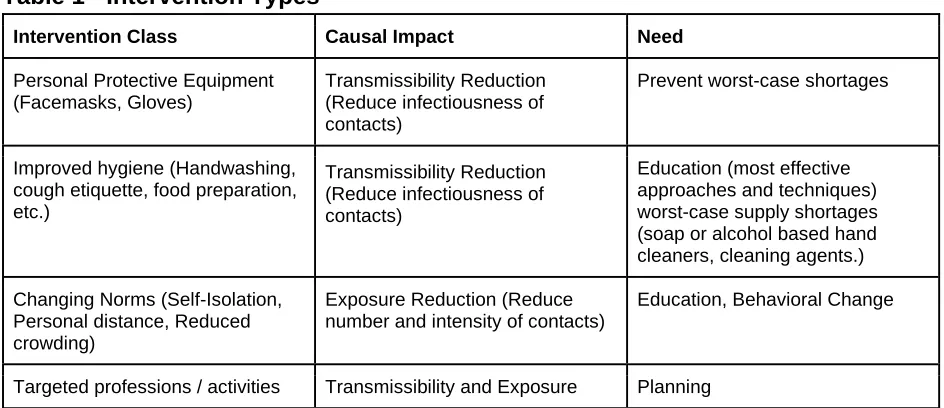
Before discussing the interventions individually in the following section, the table below lists the intervention classes discussed in the paper. For each class of intervention, the table includes the causal impact that allows them to mitigate the risk. Finally, the table suggests what the need is, i.e. what is required for the interventions to be viable in a pandemic, or what research is needed to find out if the approach is viable.
Table 1 - Intervention Types
Intervention Class Causal Impact Need
Personal Protective Equipment (Facemasks, Gloves)
Transmissibility Reduction (Reduce infectiousness of contacts)
Prevent worst-case shortages
Improved hygiene (Handwashing, cough etiquette, food preparation, etc.)
Transmissibility Reduction (Reduce infectiousness of contacts)
Education (most effective approaches and techniques) worst-case supply shortages (soap or alcohol based hand cleaners, cleaning agents.) Changing Norms (Self-Isolation,
Personal distance, Reduced crowding)
Exposure Reduction (Reduce number and intensity of contacts)
Education, Behavioral Change
(Restaurant workers, personal care providers, teachers)
Reduction (Reduce exposure to / from most likely and highest consequence vectors)
Home supportive care Impact Mitigation (Reduce lethality / intensity of infection)
Education, Supplies
Planning and resilience Impact Mitigation (Reduce impact, prevent secondary breakdowns)
Planning, Education
Note that while some social distancing [25] and self-isolation [26] would happen naturally due to fear in the extreme cases, this is not an unmitigated benefit, per our later discussion. In worst-case scenarios, distancing and isolation could accelerate failure of critical systems and procure basic necessities. In such a scenario, planned transmission reduction activities could have further deleterious effects. To address this, we also discuss transmission reduction interventions that encourage distancing that minimizes the spread of a disease in the worst cases and still allows continued provision of basic services. We also discuss impact mitigation to insulate critical systems and prevent complex systems failures that could result from large-scale disruptions.
TRANSMISSIBILITY-REDUCTION INTERVENTIONS
For many highly transmissible diseases, such as smallpox, mumps, and rubella five to seven infections would be caused by one infected person [27], if the exposed population was unvaccinated and had never before been exposed to the disease - as would be the case for a novel disease. More transmissible pathogens, like measles or pertussis, can spread to more than a dozen individuals per infected person in similar circumstances.
Unchecked transmission causes rapid exponential growth in the number of cases, and for fatal diseases, fatalities. The rate of spread, however, is a function of both the disease characteristics and the population behavior. This means the rate of spread is (approximately) halved if only half as many people are exposed to the disease due to reduced contact rates, or if the probability of transmission per contact is cut in half. Even in cases where transmission cannot be reduced sufficiently to stop further spread, slowed progression gives other forms of response more time to be effective.
There are a variety of approaches to reduce transmission. While medical approaches are being “debated ad-nauseum,” [28] other approaches have received less attention and research. Several low-cost non-medical countermeasures that would reduce spread have been recommended widely, for example by the WHO, [29] including personal protective equipment (PPE) like masks and gloves, reduction in the need for crowded public spaces, enhanced hygienic measures like frequent cleaning of door handles and other public surfaces, and similar measures.
Despite the utility of these approaches in all cases, in extreme scenarios there will be insufficient quantities of medical supplies, drugs, hospital space, and trained practitioners to implement most recommendations. [28] In the realm of non-medical countermeasures, much discussion has focused on how to motivate people to deploy countermeasures, or to comply with recommendations. Without supplies, education, and planning, however, motivation will be irrelevant, and in the presence of worst-case epidemics, motivation will likely not be as formidable a barrier.
Personal Protective Equipment
Supplies of PPE are potentially limited, especially in the short term. The pandemic supply chain network has begun addressing some parts of this, but it is still a work in progress. [30]This also critical because an outbreak can itself cut off supplies needed to address the disaster, as happened recently with health supplies provided from the epicenter of the COVID-19 outbreak. [31]Ensuring sufficient supplies are available where needed is critical, and similar work on addressing multiple objectives for distributing limited supplies in an emergency is particularly important. [32]
Longer term, for disease spreading more widely, most PPE items are not produced in sufficient quantities to address a larger scale need. This means that in addition to needing robust distribution networks, during the course of an outbreak, the demand for supplies might require production scale-up. Alternatively, it may be useful to ensure sufficient and/or redundant productive capacity exists. In some cases, it will be impossible to meet demand. One approach that potentially avoids both supply issues and logistics is improvisation: basic versions of some items could be made from available household supplies. In at least one case, such improvised supplies were used successfully during the 2014 Ebola outbreak in Liberia. [33, 34] The types of PPE that are most likely to be needed are facemasks, (rather than respirators [35],) eye
protection, and disposable gloves, as well as alternatives to each, or as a last resort, homemade variants. [36] Three approaches to consider for each class of items is stockpiling excess in advance, rapidly scalable production and redundant suppliers, and enabling the use of improvised alternatives. The resulting matrix of the nine possible approaches is worth investigation, and specific recommendations on which to pursue is beyond the current scope. At the same time, some general points about viability and effectiveness are worth noting. For many items, it is unclear how quickly production could be increased given current production capacities. For example, there is a significant expected shortfall for respiratory protection devices, i.e. facemasks. [37] For other items, the supply may be more flexible, but even if there is sufficient supply for medical workers, Patel et al [37] notes that demand from other people would overwhelm the supply.
Rapidly increased demand coupled with limited ability to scale production means that the prices of these items still would increase greatly in the event of a pandemic. Because ability to pay is uneven, this would lead to suboptimal provision from a social benefit standpoint, and would especially hurt less-developed countries. Excess production capacities would be helpful in such a case. At the same time, if sufficient capacity were built as a preventative measure, the resulting subsidized oversupply would have negative effects on the market, such as gluts that hurt the industry and reduce the long-term ability to supply products. For this reason, careful consideration is needed to understand how excess capacity could be built without devastating the extant market, or alternative approaches such as retrofitting other factories or home-production are needed. Even when supply is sufficient, logistics are a key concern [37] and this is a very general problem, with extensive literature on the problem and potential mitigations. [38] While ensuring continuity and availability of the international logistics systems is itself critical, some level of disruption is almost assured, and so multiple strategies from that literature are worth consideration. The availability of logistics networks and planning for worst-case epidemics is critical for other reasons as well, and will be discussed below as a form of impact mitigation.
Hygiene / Behavior Interventions
food or mucus membranes with unwashed hands, and other nearly-unconscious behaviors. For example, hand-to-face contact is common, and in normal situations people touch potential infectious parts of their face more than a dozen times per hour. [39] Cleaning of surfaces that can transmit infection is also a potentially important possibility, one which complements improving hygiene.
Hand-washing
Hand-washing plausibly reduces rates of transmission of disease by 50% in the general community, [40] but compliance rates are below 50% even among food-workers [41], day care workers [42], and hospital staff [43]. Substantially better hygiene is difficult, and success in increasing hand-washing in hospitals shows that progress is slow, but it is at least somewhat achievable [43] using various methods of encouragement [44] and education [45], and can be a major factor in reducing infectiveness [46].
Given the ubiquity of soap, supplies should be available unless supply chains fail severely. The critical factor is handwashing technique and thoroughness, and there is a large educational component required to improve handwashing technique, once people are convinced of its importance. For instance, ring wearing makes handwashing significantly less effective [47], and the presence of long nails is similarly problematic, but nail-brushing is effective [48]. Depending on mode of transmission, education and interventions to spur new norms around ring-wearing and long fingernails during a worst-case outbreak may be useful.
Sanitization
In addition to handwashing, other types of cleaning are important for hygiene. If needed, environmental cleaning could use soaps, or alcohol, but for surfaces and other objects better options are available. Sanitizing objects and surfaces that could harbor pathogens is often done with a dilute bleach (NaOCl) solution. Sufficient supplies of cleaning agents likely exist, but alternative sources may be useful. While it would be inadvisable to reduce chlorine use in drinking and wastewater treatment, or to attempt home production, potential sources include industrial processes such as polyvinyl chloride production.
Cough Etiquette
Many recommendations for behavior to prevent infections recommend coughing into a sleeve, hand, or tissue to reduce the spread of infections. While these behaviors change the spatial distribution of particles [49], it is unclear if this is significant, and is likely less useful than even makeshift masks. Behavior
changes are unlikely to be harmful, and may be beneficial as long as they do not displace more effective approaches such as masks. Because of the possible displacement effect, however, in the event of a respiratory illness pandemic it should not be a focus for education or shifting norms, especially if they compete with more effective alternatives.
Staying Healthy
Social behavior and norms
Earlier studies have looked at how infectious disease outbreaks can be contained via various forms of isolation or separation. Unlike those studies, we assume the methods can be effective and useful during a pandemic. Instead, we consider what can be done in advance of any such event to encourage
compliance with the interventions. Halloran et al. note the importance of timely response measures when discussing the joint effectiveness of medical interventions along with school closures, or forms of
distancing, and emphasizes how the timeliness, compliance and effectiveness of these interventions are connected. [55] For this reason, preparation for encouraging compliance before an outbreak, rather than in response to one, is critical.
Some studies discuss closing or minimizing interaction in schools, colleges, and (certain types of) workplaces, since a majority of infections occur in those settings - though additional infections occur in homes. The potential issue with this form of response is that it is unclear that the locations visited in place of educational or workplace interaction are less likely to spread disease. Inglesby et al notes that we have seen too few events to predict how people would respond today. [2] Preparation and careful prior
consideration are useful in ensuring, for instance, that we are not replacing transmission in college classrooms with greater transmission in dorms, clubs, and bars in the absence of classroom time. A parallel situation for school-aged children is understood to contribute to an acceleration of influenza spread among adults during the US Holidays and New Year when children are at home, [56] though the net effect may be a reduction in illness due to reduced transmission between children.
Containment
In early stages of spread, self- and public-reporting are useful for identifying infectious individuals. Approaches such as contact tracing, small scale isolation, and medical care, as well as more recent
approaches like control banding 52,53, are routinely used and are well-understood, and would be used in early stages of an outbreak. Later in the course of a disease, self-reporting and well-established approaches are unsustainable and possibly even unhelpful. This is because centralized quarantine becomes infeasible, and because milder cases are not reported. 54
Norms for interaction
As noted above, closing schools and businesses has unclear effects on spread, especially when considered at a community level. On the other hand, during a severe pandemic, it is likely that people will avoid interaction where possible, which is unlikely to lead to more interaction in other locations. Spontaneous distancing can be assisted with changing norms of interaction and contact-minimization. This could be essential in reducing the speed and extent of spread, and is more feasible than full isolation, as well as less costly than closing schools and businesses completely.
Norms for interaction during a pandemic will likely discourage handshakes and other physical touch, not eating in large groups or public places, and increased physical distance between individuals in public. The efficacy of the last in unclear [60], but is potentially helpful. Preparation needed for encouraging these is minimal, but a better understanding of how individuals can minimize their risk would be useful in helping people prioritize the changes they promote.
linked ventilation systems [64], factors that are not controllable by the residents. Reducing such crowding would have various positive public health and other effects, but as discussed in a later section regarding location-based mitigation, it is not clear how response activities can change this.
It may be important for public events to be cancelled, postponed, or moved online. Prior planning, especially for the last case, is useful. Many companies have plans in place for allowing wider telecommuting in the event of an emergency. In businesses where this is impossible, there are other ways work can change so that the probability of transmission and infection is minimized. Moving work from indoors to larger outdoor areas may sometimes be feasible, which can reduce disease transmission due to close quarters. As noted above, PPE and better hygienic behaviors are potentially helpful, but they are neither foolproof, nor guaranteed to be available or practical.
EXPOSURE REDUCTION INTERVENTIONS
In addition to approaches for reducing transmission rates, there are interventions that change the course of an epidemic by changing who is exposed. In addition to changing interpersonal norms for transmission reduction, changes to norms and rules in the labor market are plausibly important in both reducing spread, and reducing impact. It is clear both from contact tracing and from mathematical modeling that some professions and workplaces have an outsized effect on the transmission of respiratory disease. A related issue is that certain professions are necessary for continued provisions of basic necessities, though this is discussed in more detail later.
Given the issues involved, we consider professions, activities, and places of high concern, and note where the challenges in designing effective mitigations exist. As mentioned earlier, it is critical to note that naive interventions targeting populations, events, or locations that are very likely to spread a disease can easily backfire. For this reason, careful planning and research are important not only to discover effective ways to mitigate the problem, but also to ensure decisions made based on poor planning do not accelerate spread.
Quarantines and self-isolation
Quarantines are often mentioned as a first line of defense in case of a truly devastating disease. These can take many forms, including sick people staying in their homes, delays for entry into a country, and institutional quarantines like at hospitals. The latter two are difficult to enforce and it is not clear they have been effective in the past, or would be effective in the future. [65] The ineffectiveness of other approaches may make methods for promoting self-isolation worthy of further consideration, despite the difficulties. Norms around self-isolation, such as leaving work if exhibiting symptoms, could significantly reduce exposure to a disease even without enforced quarantines. To support this, mitigations discussed below seem more promising, especially once a disease is established.
As a disease spreads, those who are not sure they are infected might do well to stay away from hospitals and other locations where many sick people are present. More generally, those who are sick, or may be infectious should be encouraged to stay away from public gatherings, and to the extent possible, away from other people.
Especially in the event of a major pandemic, it will be difficult for people to successfully and safely self-isolate, because for instance, they would need to leave home to shop for food or basic supplies. This means self-isolation is unlikely to happen without messaging, volunteering, and/or infrastructure explicitly encouraging it. If self-isolation as a strategy is to be effective, work on investigating how to enable it and how to encourage it during a severe pandemic is warranted. For example, delivery service workers are susceptible to a disease, and the types of interactions they have could increase their own risk, thereby spreading the disease further.
High-transmission professions
Different professions have varying impacts on spreading disease. While a comprehensive identification of professions that are most important to consider is beyond the scope of this paper, such work could start with reviewing contact tracing in recent cases, and considering transmission dynamics in specific populations. To understand why identifying professions that are critical as vectors can be helpful, and what types of mitigations might be identified, two examples are worth highlighting.
One critical profession is food services and the transport of food, for two reasons. First, in some types of food services, conditions are lax [66] and transmission may be particularly likely due to food handling. Second, if a portion of workers is unable to work due to sickness, or is unwilling to work due to risks of contracting an infection, it is important to prioritize critical systems, first for immediate food needs, then for an expanding set of systems and infrastructure needed to continue supply of food. These systems are potentially very vulnerable [67], as discussed below.
A second important profession is flight attendants [68, 69] and other airline workers, who have historically been important vectors [70]. Unfortunately, a certain number of airline workers per flight is required by law in the United States [71], and due to tight schedules they are likely to work long hours and continue working while sick. There are policy remedies that could be considered for during an outbreak, including screening of flight personnel, relaxing requirements on flight attendants, reducing the number of flights, and as mentioned earlier, mandating PPE and prioritizing worker health. It is worth noting that public screening before domestic flights has been proposed, but it is unlikely to be effective [72], and if quarantine or similar measures are considered, it makes little sense to target airline passengers in particular.
Activities with high transmission potential
In early stages of a large-scale epidemic, there would be disruption of certain activities that typically involve high concentrations of people, as discussed above. These extend further than cancelling events, however, and may include reducing people’s presence in many venues, from restaurants to religious services, and from funeral homes to mass transit. Not only this, but as will be discussed in the section on impact mitigation, it may be worthwhile to shut down hospitals if they become more likely to spread a disease than to slow its spread, as could easily happen in an extreme event.
Some activities can be held outdoors, which would limit disease transmission somewhat, but most would still be avoided by concerned individuals. Other activities could continue to a lesser degree with online or otherwise via remote communication. Yet more activities could be performed in the home instead of in more-crowded venues, and this could dramatically reduce concentration on city streets.
we explore remote medicine and home medical care below.
Critical locations and location-based mitigations
Some locations are likely to be critical due to density and propensity to allow rapid spread. At a small scale, this includes dorms, barracks, and other areas with high population density. Once an infection is found, there is a natural tendency for others to remove themselves, but if these people are already infected, this can further spread a pathogen.
There are heightened concerns of transmission between attached dwelling units. Overall transmission could be reduced if people at high risk of being infected, or whose jobs are critical, relocated from apartment buildings to vacant (or second) single-family homes. If someone is diagnosed with the disease, there would likely not be time to relocate, but relocation of critical workers might feasibly be done after news of the pandemic in another region, before it spreads. Other ways of limiting transmission in residences of critical individuals and workers should be investigated. For example, sealing cracks between dwelling units could plausibly significantly reduce transmission, at least where there is not a central forced air system with recirculation.
At a larger scale, cities function in similar ways, both increasing risk of transmission, and accelerating spread. Precisely for this reason, cities may provide a useful focus for mitigation efforts. On the other hand, crowding in public places such as busses, trains, supermarkets, or streets, is an inevitable result of density, and reducing crowding will be difficult. For this reason, simply recommending reducing crowding [73] is unhelpful. For this reason, it seems important to identify and investigate specific opportunities to reduce crowding and encourage distancing. Such work identifying specific mitigations is helpful, especially when focused on places of concern like hospitals [74], but it must be sensitive to public needs and the realities of daily life.
IMPACT MITIGATION
Reducing the transmission and spread are useful to reduce the number of infections, but even for those infected, the impact of a disease can range from an inconvenience to a major event, or even to death. Impact mitigation at the personal level involves reducing the impact and mortality of a disease, while impact mitigation at a systemic level involves mitigating the impact of morbidity and mortality on the broader society.
Individual impact mitigation
At the individual level, the impact of the disease is an issue of how severe the disease is, how debilitating it is during its course, and whether and how quickly the individual recovers. Many of these impacts can be mitigated. In the case that a pandemic spreads significantly, many standard care approaches become infeasible, and alternative approaches are warranted. Research on planning for and responding to small scale mass-casualty events and disasters, such as the Agency for Healthcare Research and Quality (AHRQ)’s guide [75] informs our research and suggestions for larger scale events. After discussing medical care and general approaches, we discuss a few limitations of the modern health system, then briefly discuss non-hospital healthcare and supportive medical care as alternatives that are worth considering in some cases.
Medical care and general approaches
During the initial stages of the spread of a novel disease, policies and changes that can be made to ensure people seek treatment can be important for both treatment, and for identifying hotspots and mounting preventative measures. All of these types of interventions are critical, but are already the subject of considerable research, and lie entirely outside the scope of the current paper.
In addition to healthcare, overall good health is likely to reduce the impact of a disease, in addition to the earlier point about reducing probability of becoming infected. In addition to the fact that healthy behaviors reduce all-cause mortality [77], exercise and not smoking have specifically been found to reduce
infectious disease mortality. [78] In some cases, physical exercise has been tied to specific mechanisms, such as improved immune response. [79] This means the approaches discussed earlier promoting good health as a way to resist infection are relevant to reducing impact as well. It seems unsurprising but clear that people in overall good health, and who engage in healthy behaviors, are more likely to recover, recover more quickly, and be less likely to die from most diseases.
Health system capacity
Even in developed countries, health systems have limited capacities. If an outbreak of disease is not quickly contained, the health system could run out of space, caretakers, and/or supplies. After the spread of a disease, there are further concerns that health systems would be overwhelmed. Increasing capacity as a precaution would be expensive to the point of being impractical, but some planning for flexibly extending medical care and contingency planning of the type discussed more broadly later is potentially very valuable.
In many pandemic scenarios, a disease could exceed even the best-case extended capacity of normal medical systems. Excluding Japan, no OECD country has more than 1 bed per 100 citizens, and many non-OECD countries have far fewer. [80] As an illustrative example, in the United States, there is less than one staffed hospital bed per 400 people - even ignoring the fact that most would be occupied by other classes of patients, on average an overall morbidity rate of 0.25% would overwhelm hospitals if all sought treatment, and given the variability between regions, many areas would be overwhelmed much sooner. While China’s construction of new hospitals in reaction to 2019-NCoV [81] shows that additional space can sometimes be constructed quickly, this is likely neither viable in other countries, nor sufficient in extreme cases. Rationing care would be necessary [82], and so other plans would be needed.
Similar concerns exist about medical staffing, since there are limited numbers of doctors and nurses even in richer countries. Some of this could be addressed by redirecting specialists and staff dedicated to less urgent medical needs, which would require contingency planning, and other approaches for improving the resilience of these systems are important [83] but limited to providing “surge capacity” rather than
addressing needs far beyond typical usage levels. Not only are space and healthcare staff limited, but in pandemic scenarios hospitals and healthcare centers may become epicenters for further spread of a disease. If this is the case, healthcare centers might be better off shuttered or limited to non-infectious-disease operations rather than the status-quo. While that decision is not discussed here, the potential makes understanding other paths for care even more important.
Non-hospital health care
rationing, and for being premature in planning. [84] The current discussion will address neither of these concerns, except to note that short of embracing nihilism, there is no justification for engaging in ethical debates while ignoring the ethical imperative for preparation and planning. [83]
It is clear that in a large enough disaster there will simply be too few resources to go around, and triage is necessary. [83] Advance planning cannot eliminate the potential need for such decisions, but there are a variety of ways that treatment, rather than palliative care, could continue to be administered with limited
resources, and even without hospitals, during a pandemic event. Automated triage could allow instructions for treating many common ailments that lead to emergency care visits at home; infections, cuts, contusions, and similar issues can be treated with first aid rather than hospital care, and similarly, most broken bones can be splinted. While burns often require hospital care, first aid is critical in reducing their impact [85] and is still useful if hospital care is unavailable.
For other ailments, basic consultation for emergency care could occur via video, rather than emergency rooms or ambulance calls. Administration of medicines can occur at home, perhaps with telepresence supervision, and rules on delivery from pharmacies could be relaxed to allow for this. For abdominal and chest pain, some basic diagnostic tests could be done at home, and automated diagnostic criteria could be applied to suggest treatment if doctors are unavailable. It seems little of this is currently done routinely, even though in some cases of acute illness, home provision of care is already more helpful than hospital care [86] - not to mention far less expensive. Even when home care is inferior, research into the extent to which home care is possible, and investigation and preparation of resources could be valuable not only as a contingency, but as a supplement to current health-care offerings.
The other critical need is diagnosis and treatment of the epidemic itself. As mentioned above, it is likely that in an extreme scenario people who are, or might be, infected should stay away from hospitals. If a disease is very transmissible and dangerous, and spread has occurred past the point where hospitals are overwhelmed or shut down, diagnosis becomes far simpler, as it will be a very likely diagnosis if symptoms are present. In those cases, basic care may be possible without medical facilities. If treatments are known or discovered and can be produced in sufficient quantities, they can be distributed widely without hospitals. If not, supportive and
symptomatic care will be critical.
Supportive and symptomatic medical care
Minimizing disability and mortality is always important, but in extreme cases it may be a critical avenue to mitigate broader impacts. Many infectious diseases with high mortality rates are more survivable and have higher rates of recovery when symptomatic treatments are available. For example, Ebola has a mortality rate of 90% when untreated [87], but as the WHO notes, “rehydration with oral or intravenous fluids and treatment of specific symptoms, improves survival.” [87, 88] Oral rehydration is easy to administer at home, and in extrema, even intravenous (IV) fluids can be administered with minimal supplies - though given current bottlenecks, those supplies are almost guaranteed to be in short supply.
Most infectious diseases without direct treatments have similar protocols, with varying ability to administer the treatments outside of a healthcare setting. For example, most recommended clinical treatments [89] for Middle East respiratory syndrome-related coronavirus (MERS-CoV) are infeasible in non-medical settings. Even then, protocols that are helpful in treating the proximate causes of mortality may be possible without extensive training, including minimizing blood loss, or prone positioning [90] to improve oxygenation in severe cases. These types of treatments require guidance, but it is plausible that how-to videos would be sufficient to somewhat improve survival rates.
consideration. For example, IV supplies are likely to be in short supply in a pandemic, and as noted above, simple treatments like intravenous fluids may be useful for home-care. On the other hand, phlebotomy requires a degree of training that cannot easily be dispensed with, and inexperienced persons working in non-sterile environments seem likely to introduce infections. Relatedly, administration of antibiotics is recommended in a hospital setting, for example to prevent co-infections for Ebola. [87] While widespread use would accelerate serious concerns about antimicrobial resistance, this concern may become less critical during worst-case disasters.
Contingency planning, response, and resilience
Depending on the severity of the pandemic and/or the compliance with recommendations, there could be larger scale disruptions during the course of a pandemic, and more extreme measures may prove necessary. Recommending putting responsive measures in place after a pandemic has started, as the CDC did for COVID-19, [91] has some benefits, but these could be enhanced with earlier preparation, well before a novel threat emerges. In addition, broader preparation can go as far as enhancing
civilization-level resilience. The latter is a broad topic that is dealt with in other literature, but some issues are especially likely to be relevant for biological risks [92], and it is worth highlighting the mitigations that may apply.
Disaster planning and recovery are a rapidly growing part of business continuity planning, and can have broader benefits. The World Economic Forum lists spread of infectious disease as one of the ten highest impact risks [93], and they have a report [94] on how businesses should plan to mitigate impacts to their employees, suppliers, and supply chains. Many of the mitigations discussed in this paper are helpful not only for worst-case global pandemics, but for resilience to smaller or local events, and to a variety of other types of disasters, up to and including existential risks. [95] Such planning is complementary with many other recommendations for risk management, and can have broad benefits. For example, businesses that have contingency plans for workforce loss due to strikes or mass resignations will be resilient to mass absences due to illness as well. For similar reasons, general efforts to improve business and community resilience are likely to be viable in preventing worst-case events.
On the other hand, typical disaster planning will often prove insufficient for mitigating (much less frequent) worst case events. Complex systems can fail suddenly and catastrophically, and plans that allow for operating through short term interruptions or recovery are likely to prove unhelpful if the interruptions continue, or lead to longer term shortages. [96, 97] For this reason, it may be useful to identify how to mitigate broader impacts, with particular focus on maintaining supply chains for critical needs and some minimal communications infrastructure to allow recovery. Keeping in mind the scenarios of concern, one industry that could be especially important in disaster scenarios is funeral and crematory services.
Mitigating extreme impacts on productivity, society, and industry.
There are a variety of short and medium term needs for survival and basic human safety, which include heating, cooling, water and food. [98, 99] The types of programs already in place, such as the USDA’s plans for disaster response, are orders of magnitude too small to address larger risks. [100] In addition to these needs there are a number of critical systems that allow those needs to be met, including
telecommunications, power, and transport that allows provision of needed supplies, which need to be addressed in disaster planning.
impact during a pandemic might span from closing certain high contact sectors of the economy, discussed briefly above, all the way to mitigating the impact of losing the functioning of industrial civilization.
Maintaining basic services
Functioning of basic services could break down if there were insufficient willing and able labor force. Another potential failure mode is breakdown in trade between countries, which could be precipitated by fears of disease transmission. Countries that are dependent on imports of critical supplies such as food, or energy could be particularly vulnerable. Even in these cases, planning can make it possible to maintain essentially normal standards of living and safety.
If planned for, continued basic functioning of modern civilization may be possible with only a few percent of the current workforce. Essential services include treated water, sewage, electricity, fuel (natural gas, liquefied petroleum gas, fuel oil, etc.), and food production and delivery. There could be significantly reduced efficiency if such a transition needed to occur quickly, but in some cases, it may be relatively easy. For example, systems to eliminate much human interaction are already enabled by online ordering.
Similarly for basic healthcare, there would be reduced efficiency of healthcare providers coming to people’s houses instead of collecting infectious people together, but telemedicine may reduce the need for physical interaction in many cases. As discussed above, several other methods for expanding the ability for medical care to be provided are also possible, and are worth consideration.
To allow some degree of continued normalcy, plans are needed for the possibility that people abandon their jobs. Some industries would shut down, while others are essential services and would not be feasible/beneficial to shut down. In that case, some preparation could make it possible for emergency responders or workers from other industries to fill critical vacancies and ensure some continuity. Such work on ensuring basic provision of these services is to be addressed by national security research in certain countries, but this is a fundamental challenge for robustness in complex systems. [101]
Worst-case resilience
If other efforts are unsuccessful at curbing spread, and a worst-case catastrophic disease event pushes past the point where life-as-usual is possible, there is high value in ensuring that further collapse does not result. Even when collapse is only local, the knock-on effects of a partial collapse could make bad
scenarios far worse, and worsen disease spread, so mitigating those risks is particularly important. This is a broad area of research, but there is no need to be fatalistic [102], and several points from that literature are worth noting.
Food Supply and Distribution Systems (FSDS) are necessary for provision of basic supplies, especially for cities. IInterrupting domestic supply chains could exhaust the food supply available to cities in weeks, while interruptions lasting months would require continued international trade to provide food. [103] If disruption lasted longer, or was of broader scope, it would require agriculture not to be interrupted, which in turn requires water infrastructure, transport of supplies to farms, and similar.
worst-cases. [105]
Allowing continuation of communications is critical, and may be fairly straightforward if planned in advance. For example, one possibility is to use hobbyist shortwave radio systems with generators or independent solar power systems if grid power fails. More planning for resilience and worst-case mitigation options could be useful for ensuring knowledge and availability of such options at the local scale for disaster recovery, communicating needs, and assisting with other logistical issues.
CONCLUSIONS AND FUTURE WORK
In the paper, we have reviewed several intervention types and suggested concrete steps to better understand how to determine whether they are viable, and how to ensure they can be deployed. Some of the interventions should be recommended to planners in the near term, including better continuity planning for worst-case scenarios. Others are plausibly valuable avenues of research into how to implement solutions, such as research on how to provide PPE or alternatives at scale, research on home medical care, research
understanding how to reduce interpersonal exposure, and work on how various norms are likely to change in a pandemic and what can be done to influence them to reduce risk. Lastly, some are preparatory research projects to identify where further work is or is not likely to be useful. Examples include professions, activities, and locations of highest concern and potential mitigations to address them, the viability of quarantines, and the effectiveness of efforts to improve hygiene.
The usefulness of many of the mitigations we discuss is admittedly uncertain, and each is far short of perfectly effective. For this reason, some of the mitigations here are not appropriate for response to smaller-scale outbreaks where there is sufficient time and resources, or where a higher standard of response activities is possible. This means that while some of the suggested interventions will be valuable regardless of the context, others will be inadvisable in less extreme cases due to the availability of superior alternatives. Similarly, in health care isolation units and diagnostic laboratory settings, the goal of hygiene is a reduction in quantities of pathogens and probability of infection measured in orders of magnitude, rather than a moderate and uncertain reduction that can be accomplished in the less ideal context of infectious individuals circulating in the general population.
Despite this, these more speculative and less effective interventions are likely to be worthwhile when considered on a population basis, unless more effective methods are possible in their place. This leads to recommending preliminary research identifying which of these less-than-ideal, unproven interventions are most promising, and how to maximize the impact of the approaches. Such work makes it possible to reduce risk in extreme cases while avoiding actions and approaches that are costly if no pandemic emerges. 98 Important future work is to quantify the cost of preparations to reduce the damage of such events.
Despite the availability of approaches that are currently effective, events around the world have repeatedly shown that access to additional, lower tech or more resilient approaches sometimes become necessary. This implies such research can be highly cost-effective. We have sketched out how we believe significant
improvement is possible in the near term. Some interventions could help prevent wider spread, and others are valuable in cases where the disease is not recognized early enough to prevent global spread. Research and planning to ensure these interventions are known about and applied could plausibly reduce mortality
significantly, and make recovery more likely and more rapid. If there were extensive use of these interventions (which is made more realistic due to the fear involved in a serious event), overall mortality could be
Declarations
Acknowledgments
We would like to thank the anonymous reviewers for helpful comments and very rapid responses for this timely topic. David Manheim would like to thank Dr. Peter Tepler for conversation about medical interventions, and Dr. Gregory Lewis for early feedback on the concept and ideas in the paper.
Funding
Dr. Manheim reports grants from Effective Altruism Long Term Futures Fund and Open Philanthropy during the conduct of the study. Dr. Denkenberger has nothing to disclose.
Authorship Contributions
References
1. Iskander J, Strikas RA, Gensheimer KF, Cox NJ, Redd SC (2013). Pandemic influenza planning, United States, 1978–2008. Emerging Infectious Diseases, 19(6), 879.
2.Inglesby TV, Nuzzo JB, O'Toole T, Henderson DA. Disease Mitigation Measures in the Control of Pandemic Influenza. Biosecurity and Bioterrorism: Biodefense Strategy, Practice, and Science. Dec 2006. http://doi.org/10.1089/bsp.2006.4.366
3. Manheim D. (2018). Questioning Estimates of Natural Pandemic Risk. Health security, 16(6), 381-390. 4. Craig C. (2018). Risk management in a policy environment: The particular challenges associated with extreme risks. Futures.
5. World Health Organization. Risk communication and community engagement readiness and initial response for novel coronaviruses ( nCoV): interim guidance v1. No. WHO/2019-nCoV/RCCE/v2020. 1. World Health Organization, 2020.
6. Preston B, Nalau J. Triaging Climate Change. The RAND Blog, January 23, 2019. Available: https://www.rand.org/blog/2019/01/triaging-climate-change.html
7. Avin S, Wintle BC, Weitzdörfer J, Ó’hÉigeartaigh SS, Sutherland WJ, Rees MJ. "Classifying global catastrophic risks." Futures 102 (2018): 20-26
8. Baum, SD. Resilience to global catastrophe. Domains of Resilience for Complex Interconnected Systems 47, 2018.
9. Massaro E, Ganin A, Perra N, Linkov I, Vespignani A.. Resilience management during large-scale epidemic outbreaks. Scientific Reports 2018, 8(1), 1859. https://doi.org/10.1038/s41598-018-19706-2 10. Adalja A., Watson M, Toner ES, Cicero A, Inglesby TV. The Characteristics of Pandemic Pathogens. 2018. Available: http://www.centerforhealthsecurity.org/our-work/pubs_archive/pubs-pdfs/2018/180510-pandemic-pathogens-report.pdf
11. Jahan N, Naveed S, Zeshan M, Tahir MA. How to Conduct a Systematic Review: A Narrative Literature Review. Cureus. 2016;8(11):e864. Published 2016 Nov 4. doi:10.7759/cureus.864
12. Boin, A., Lagadec, P., Michel-Kerjan, E., & Overdijk, W. (2003). Critical Infrastructures under Threat: Learning from the Anthrax Scare. Journal of Contingencies and Crisis Management, 11(3), 99–104. https://doi.org/10.1111/1468-5973.1103001
13. Nicoll A. Personal (non-pharmaceutical) protective measures for reducing transmission of influenza – ECDC interim recommendations. Euro Surveill. 2006;11(41):pii=3061.
https://doi.org/10.2807/esw.11.41.03061-en
114. Bell D, Nicoll A, et al. (World Health Organization Writing Group) Non-pharmaceutical interventions for pandemic influenza, national and community measures. Emerg Infect Dis. 2006;12(1):88-94.
https://www.ncbi.nlm.nih.gov/pmc/articles/PMC3291415/
15. Inglesby TV, Nuzzo JB, O'Toole T, Henderson DA. Biosecurity and Bioterrorism: Biodefense Strategy, Practice, and Science. 2006. http://doi.org/10.1089/bsp.2006.4.366
16. Halloran ME, Ferguson NM, Eubank S, et al. Modeling targeted layered containment of an influenza pandemic in the United States. Proc Natl Acad Sci U S A. 2008;105(12):4639-44.
https://www.ncbi.nlm.nih.gov/pmc/articles/PMC2290797/
17. Manheim D. Value of Information for Policy Analysis: Understanding and Performing Value of Information Estimation for Complex Systems. RAND Corporation, Pardee RAND 2018. Dissertation. Available: https://www.rand.org/pubs/rgs_dissertations/RGSD408.html
18. Orton L, Lloyd-Williams F, Taylor-Robinson D, O’Flaherty M, Capewell S. The use of research evidence in public health decision making processes: systematic review. Public Health and Policy 2011, 6(7), 21–70. https://www.ncbi.nlm.nih.gov/pubmed/21818262
19. Aldis W. Health security as a public health concept: a critical analysis, Health Policy and Planning 2018, Volume 23, Issue 6, Pages 369–375, https://doi.org/10.1093/heapol/czn030
20. DiEuliis D, Rao V, Billings EA, Meyer CB, Berger, K. Biodefense Policy Analysis—A Systems-based Approach. Health Security Vol. 17, No. 2. 2019. http://doi.org/10.1089/hs.2018.0082
21. Barrett AM. Value of Global Catastrophic Risk (GCR) Information: Cost-Effectiveness-Based
22. Kok MO, Schuit AJ.. Contribution mapping: A method for mapping the contribution of research to enhance its impact. Health Research Policy and Systems 2012, 10, 21. https://doi.org/10.1186/1478-4505-10-21
23. Pearl J. Is scientific knowledge useful for policy analysis? A peculiar theorem says: No. Journal of Causal Inference 2014,2.1: 109-112.
24. Manheim D. Building Less Flawed Metrics: Dodging Goodhart and Campbell's Laws. Preprint, 2019, Available: https://mpra.ub.uni-muenchen.de/98288/5/MPRA_paper_98288.pdf
25. Glass, R. J., Glass, L. M., Beyeler, W. E., & Min, H. J. (2006). Targeted social distancing design for pandemic influenza. Emerging infectious diseases, 12(11), 1671-1681.
26. Funk, S., Gilad, E., Watkins, C., & Jansen, V. A. A. (2009). The spread of awareness and its impact on epidemic outbreaks. Proceedings of the National Academy of Sciences, 106(16), 6872 LP – 6877. Available: http://www.pnas.org/content/106/16/6872
27. Fine PEM. Herd immunity: history, theory, practice. Epidemiologic reviews, 1993 15.2: 265-302. 28. Hopmeier M. Issues Associated with Population Protection from Disaster and Infectious Disease and the Role of Public Health. Briefing, Triangle Lecture Series, Center for Public Health Preparedness and Research, Atlanta, GA,March 22, 2006. Available:
https://www.pitt.edu/~super1/lecture/lec31551/issues.pdf
29. Bell D, Nicoll A, et al. (World Health Organization Writing Group) Non-pharmaceutical interventions for pandemic influenza, national and community measures. Emerg Infect Dis. 2006;12(1):88-94.
https://www.ncbi.nlm.nih.gov/pmc/articles/PMC3291415/
30. Bergman S, “Acting against a risk that business cannot ignore: Partnerships for epidemic readiness” Breakfast Panel Discussion, 23 Jan 2019, SDG Tent at Davos 2019, Davos, Switzerland.
31. Lapook J. Surgical gown recall leaves medical centers scrambling. CBS News, January 31, 2020. Available: https://www.cbsnews.com/news/surgical-gown-recall-leaves-medical-centers-scrambling-2020-01-31/
32. Chen D, Ding F, Huang Y, Sun D. Multi-objective optimisation model of emergency material allocation in emergency logistics: a view of utility, priority and economic principles. International Journal of
Emergency Management 2018, 14(3):233-253.
33. Robyn Dixon. In Liberia, one woman's singular fight against Ebola. Los Angeles Times, Oct 6, 2014. 34. Park S-J, Umlauf R. "Caring as existential insecurity: quarantine, care, and human insecurity in the Ebola crisis." Somatosphere, November 24 (2014). http://somatosphere.net/2014/caring-as-existential-insecurity.html/
35. Radonovich LJ, Simberkoff MS, Bessesen MT, Brown AC, Cummings DA, Gaydos CA, Los JG, Krosche AE, Gibert CL, Gorse GJ, Nyquist AC. N95 respirators vs medical masks for preventing influenza among health care personnel: a randomized clinical trial. Jama. 2019 Sep 3;322(9):824-33.
36. Davies A, Thompson KA, Giri K, Kafatos G, Walker J, Bennett A. Testing the efficacy of homemade masks: would they protect in an influenza pandemic?. Disaster medicine and public health preparedness. 2013 Aug;7(4):413-8.
37. Patel A, Lee L, Pillai SK, Valderrama AL, Delaney LJ, Radonovich L. Approach to Prioritizing
Respiratory Protection When Demand Exceeds Supplies During an Influenza Pandemic: A Call to Action. Health Security 2019. http://doi.org/10.1089/hs.2019.0027
38. Chopra S, Sodhi MS. Supply-chain breakdown. MIT Sloan management review 2004, 46.1: 53-61. 39. Nicas M, Best D. A Study Quantifying the Hand-to-Face Contact Rate and Its Potential Application to Predicting Respiratory Tract Infection, Journal of Occupational and Environmental Hygiene 2008, 5:6:347-352, DOI: 10.1080/15459620802003896
40. Curtis V, Cairncross S. Effect of washing hands with soap on diarrhoea risk in the community: a systematic review. The Lancet Infectious Diseases, Volume 3, Issue 5, 2003, Pages 275-281, ISSN 1473-3099. https://doi.org/10.1016/S1473-3099(03)00606-6
41. Green LR, Selman CA, Radke V, Ripley D, Mack JC, Reimann DW, et al. Food Worker Hand
Washing Practices: An Observation Study. Journal of Food Protection 2006, 69(10):2417-2423. Available: http://www.jfoodprotection.org/doi/abs/10.4315/0362-028X-69.10.2417
42. Zomer TP, Erasmus V, van Beeck EF, Tjon-A-Tsien A, Richardus JH, Voeten HACM. Hand hygiene compliance and environmental determinants in child day care centers: An observational study. American Journal of Infection Control, 2013 41(6):497-502, ISSN 0196-6553.
43. Erasmus, Vicki, et al. "Systematic review of studies on compliance with hand hygiene guidelines in hospital care." Infection Control & Hospital Epidemiology 31.3 (2010): 283-294.
https://www.cambridge.org/core/journals/infection-control-and-hospital-epidemiology/article/systematic-
review-of-studies-on-compliance-with-hand-hygiene-guidelines-in-hospital-care/36AD78694A4A2BA831A598E9C935C92E
44.Morgan J. “Hospitals find creative ways to improve hand hygiene” Health Facilities Management Magazine, January 27, 2016. https://www.hfmmagazine.com/articles/2048-hospitals-find-creative-ways-to-improve-hand-hygiene
45. Tibballs J. Teaching hospital medical staff to handwash. The Medical Journal of Australia, 1996. 164(7): 395-398.Available: https://www.mja.com.au/journal/1996/164/7/teaching-hospital-medical-staff-handwash
46. Larson, E. (1988). A Causal Link Between Handwashing and Risk of Infection? Examination of the Evidence. Infection Control & Hospital Epidemiology, 9(1), 28-36. doi:10.1086/645729
47. Trick WE, et al. "Impact of ring wearing on hand contamination and comparison of hand hygiene agents in a hospital." Clinical infectious diseases 2003. 36(11):1383-1390.
https://academic.oup.com/cid/article/36/11/1383/303869
48. Lin C-M, Wu F-M, Kim H-K, Doyle MP, Michaels BS, and Williams LK. A Comparison of Hand Washing Techniques To Remove Escherichia coli and Caliciviruses under Natural or Artificial Fingernails. Journal of Food Protection 2003 66(12):2296-2301. http://www.jfoodprotection.org/doi/abs/10.4315/0362-028X-66.12.2296 49. Zayas G, Chiang MC, Wong E, et al. Effectiveness of cough etiquette maneuvers in disrupting the chain of transmission of infectious respiratory diseases. BMC Public Health. 2013;13:811. Published 2013 Sep 8. doi:10.1186/1471-2458-13-811
50. Renegar KB, Floyd RA, Krueger JM. Effects of Short-term Sleep Deprivation on Murine Immunity to Influenza Virus in Young Adult and Senescent Mice. Sleep 1998, 21(3):241–248,
https://doi.org/10.1093/sleep/21.3.241
51. Lange T, Perras B, Fehm HL, Born J. Sleep Enhances the Human Antibody Response to Hepatitis A Vaccination. Psychosomatic Medicine 2003. 65(5):831-835
https://doi.org/10.1097/01.PSY.0000091382.61178.F1
52. Scrimshaw, NS., SanGiovanni JP. Synergism of nutrition, infection, and immunity: an overview. The American Journal of Clinical Nutrition 1997 66(2):464S-477S.
53. Melamed, I., Kark, J. D., & Spirer, Z. (1990). Coffee and the immune system. International Journal of Immunopharmacology, 12(1), 129–134. https://doi.org/https://doi.org/10.1016/0192-0561(90)90076-Y
54. Gyongyi Szabo; Consequencesof alcohol consumption on host defense, Alcohol and Alcoholism,
Volume 34, Issue 6, 1 November 1999, Pages 830–841, https://doi.org/10.1093/alcalc/34.6.830
55. Halloran ME, Ferguson NM, Eubank S, et al. Modeling targeted layered containment of an influenza pandemic in the United States. Proc Natl Acad Sci U S A. 2008;105(12):4639-44.
https://www.ncbi.nlm.nih.gov/pmc/articles/PMC2290797/
56. Ewing A, Lee EC, Viboud C, Bansal S. Contact, Travel, and Transmission: The Impact of Winter Holidays on Influenza Dynamics in the United States. J Infect Dis. 2016;215(5):732–739.
http://doi.org/10.1093/infdis/jiw642
57. Sietsema M, Radonovich L, Hearl FJ, Fisher EM, Brosseau LM, Shaffer RE, and Koonin LM. A Control Banding Framework for Protecting the US Workforce from Aerosol Transmissible Infectious Disease Outbreaks with High Public Health Consequences. Health Security, 2019. 17(2)
http://doi.org/10.1089/hs.2018.0103
58. Eichner M. Case Isolation and Contact Tracing Can Prevent the Spread of Smallpox, American
Journal of Epidemiology, 2003. 158(2):118–128, https://doi.org/10.1093/aje/kwg104
59. Bell D, Nicoll A, et al. (World Health Organization Writing Group). Non-pharmaceutical interventions for pandemic influenza, national and community measures. Emerg Infect Dis. 2006;12(1):88-94. https://www.ncbi.nlm.nih.gov/pmc/articles/PMC3291415/
60. Gerace TA, Vorp R. Interpersonal distance: A factor in infectious disease morbidity and mortality? Medical Hypotheses 1985, 17(3):271–275. https://doi.org/10.1016/0306-9877(85)90133-1
62. Baker MG, et al. Infectious diseases attributable to household crowding in New Zealand: A systematic review and burden of disease estimate. Vol. 1. No. 1.26. Wellington: He Kainga Oranga/Housing and Health Research, 2013. http://www.healthyhousing.org.nz/wp-content/uploads/2010/01/HH-Crowding-ID-Burden-25-May-2013.pdf
63. Donnelly CA, Ghani AC, Leung GM, Hedley AJ, Fraser C, Riley S, et al. Epidemiological determinants of spread of causal agent of severe acute respiratory syndrome in Hong Kong. The Lancet 2003,
361(9371):1761–1766. https://doi.org/10.1016/s0140-6736(03)13410-1
64. Li Y, et al. Multi-zone modeling of probable SARS virus transmission by airflow between flats in Block E, Amoy Gardens. Indoor air 2005 15(2):96-111.
65. Sprague E, Reynolds S, Brindley P. Patient isolation precautions: are they worth it?. Canadian respiratory journal 2016 (2016).
66. Parrish AT, Graves MC, Harris JR, Hannon PA, Hammerback K, Allen CL. “Influenza vaccination status and attitudes among restaurant employees.” J Public Health Manag Pract. 2015 May-Jun; 21(3):E10-5.
67. Boin A, Lagadec P, Michel-Kerjan E, Overdijk W. Critical Infrastructures under Threat: Learning from the Anthrax Scare. Journal of Contingencies and Crisis Management 2003, 11(3):99–104.
https://doi.org/10.1111/1468-5973.1103001
68. Shankar AG, Janmohamed K, Olowokure B, Smith GE, Hogan AH, De Souza V, et al. Contact tracing for influenza A (H1N1) pdm09 virus–infected passenger on international flight. Emerging infectious diseases, 2014 20(1):118. https://wwwnc.cdc.gov/eid/article/20/1/12-0101_article
69. Whelan EA, et al. Prevalence of respiratory symptoms among female flight attendants and teachers. Occup Env Med 2003. 62:929–934.
70. Hertzberg VS, Weiss H, Elon L, Si W, Norris SL, The FlyHealthy Research Team. Behaviors, movements, and transmission of droplet-mediated respiratory diseases during transcontinental airline flights. Proceedings of the National Academy of Sciences Apr 2018, 115(14):3623-3627
https://doi.org/10.1073/pnas.1711611115
71. 14 CFR § 121.391, 1965. Air Carriers and Operators for Compensation or Hire: Certification and Operations; Operating Requirements
72. Nuzzo, J. B., Henderson, D. A., O’Toole, T., & Inglesby, T. V. (2006). Comments from the Center for Biosecurity of UPMC on proposed revisions to federal quarantine rules. Biosecurity and Bioterrorism: Biodefense Strategy, Practice, and Science, 4(2), 204–206.
73. Bell D, Nicoll A, et al. (World Health Organization Writing Group) Non-pharmaceutical interventions for pandemic influenza, national and community measures. Emerg Infect Dis. 2006;12(1):88-94.
https://www.ncbi.nlm.nih.gov/pmc/articles/PMC3291415/
74. Dugas AF, Morton M, Beard R, et al. Interventions to mitigate emergency department and hospital crowding during an infectious respiratory disease outbreak: results from an expert panel. PLoS Curr. 2013;5:ecurrents.dis.1f277e0d2bf80f4b2bb1dd5f63a13993. Published 2013 Apr 17.
https://www.ncbi.nlm.nih.gov/pmc/articles/PMC3644286/figure/d35e360/
75. Phillips SJ, Knebel A, eds. Mass Medical Care with Scarce Resources: A Community Planning Guide. Prepared by Health Systems Research, Inc., an Altarum company, under contract No. 290-04-0010. AHRQ Publication No. 07-0001. Rockville, MD: Agency for Healthcare Research and Quality 2007. 76. Muller MP, McGeer A, Straus SE, Hawryluck L, Gold WL. Clinical Trials and Novel Pathogens: Lessons Learned from SARS. Emerg Infect Dis. 2004;10(3):389-394.
https://dx.doi.org/10.3201/eid1003.030702
77. Loprinzi PD. Health behavior characteristics and all-cause mortality. Preventive medicine reports 2016, 3:276-278.
78. Hamer M, O'Donovan G, Stamatakis E. Lifestyle risk factors, obesity and infectious disease mortality in the general population: Linkage study of 97,844 adults from England and Scotland. Preventive
medicine. 2019 Jun 1;123:65-70.
79. Kohut ML, Arntson BA, Lee W, Rozeboom K, Yoon KJ, Cunnick JE, McElhaney J.. Moderate exercise improves antibody response to influenza immunization in older adults. Vaccine, 2004 22 (17-18):2298-2306.