Interannual Variability and Seasonal Predictability of
Wind and Solar Resources
Nir Y. Krakauer1,* and Daniel S. Cohan2
1 Department of Civil Engineering and NOAA-CREST, The City College of New York, New York,
NY 10031, USA
2 Department of Civil and Environmental Engineering, Rice University, Houston, TX 77005, USA;
* Correspondence: [email protected]; Tel.: +1-212-650-8003
Abstract: Solar and wind resources available for power generation are subject to variability due to meteorological factors. Here, we use a new global climate reanalysis product, Version 2 of the NASA Modern-Era Retrospective Analysis for Research and Applications (MERRA-2), to quantify interannual variability of monthly-mean solar and wind resource from 1980 to 2016 at a resolution of about 0.5 degrees. We find an average coefficient of variation (CV) of 11% for monthly-mean solar radiation and 8% for windspeed. Mean CVs were about 25% greater over ocean than over land, and, for land areas, were greatest at high latitude. The correlation between solar and wind anomalies was near zero in the global mean, but markedly positive or negative in some regions. Both wind and solar variability were correlated with values of climate modes such as the Southern Oscillation Index and Arctic Oscillation, with correlations in the Northern Hemisphere generally stronger during winter. We conclude that reanalysis solar and wind fields could be helpful in assessing variability in power generation due to interannual fluctuations in the wind and solar resource. Skillful prediction of these fluctuations seems to be possible, particularly for certain regions and seasons, given persistence or predictability of climate modes with which these fluctuations are associated.
Keywords: renewable energy; solar; wind; interannual variability; seasonal forecasting; teleconnections
1. Introduction
Solar (photovoltaic and thermal) and wind power are rapidly increasing in importance as components of the modern energy grid. Solar and wind resources vary widely in space and time, largely associated with weather factors. There is increasing interest in building on the past century’s advances in numerical weather prediction to forecast solar and wind availability at specific places and times, enabling better matching of energy supply, demand, and storage [1–4].
Forecasting of weather in the minutes to days ahead is well established. Most applications of solar [5–16] and wind [17–19] forecasting have been at these shorter durations, developing a wide variety of methods and tools. However, there is also longer-term variability in solar and wind resources, beyond the mean annual cycle. For example, interannual variability in solar resource has been mapped for the United States [20] and monthly and annual wind power resource and production in Portugal responds to large-scale atmospheric circulation patterns such as the North Atlantic Oscillation [21]. Solar radiation reaching the surface, particularly the direct fraction important for concentrating and thermal solar power applications, varies widely from year to year at some locations, driven by variation in cloudiness and in atmospheric aerosol loading [22]. In the western United States, atmosphere and ocean circulation patterns led to notably slacker wind than usual in the first half of 2015, a ‘wind drought’ which greatly affected power generation [23].
Weather forecasting at seasonal timescales (roughly, one to several months ahead) has also advanced in recent years, exploiting sources of relatively long-range predictability in the climate system [24–29]. The main variables forecast have typically been temperature and precipitation, with monsoon and drought forecasting for agricultural applications being an important focus [30–36].
The goal of this paper is to better understand global patterns of seasonal-scale interannual variability in wind and solar resources and consider to what extent this variability might be predictable up to several months in advance. To achieve this, we here (a) map the interannual variability and co-variability of monthly wind and solar resource fields in a global reanalysis product (MERRA-2) and (b) correlate wind and solar variability with values of major climate modes and study their potential predictability.
2. Methods
2.1. Reanalysis wind and solar resource fields
Version 2 of the NASA Modern-Era Retrospective Analysis for Research and Applications (MERRA-2) estimates the state of Earth’s atmosphere since 1980 by assimilating extensive meteorological observations to the dynamic climate model GEOS-5, at about 50 km spatial resolution [37–39]. Compared to the original MERRA [40], MERRA-2 assimilates a wider range of satellite data and in particular is the first major reanalysis to assimilate satellite aerosol observations [41], which is expected to be particularly useful for accurately representing solar variability in desert and polluted areas. The earlier MERRA product has been used for a study of wind power statistics in Great Britain, which found good correlations between the reanalysis winds and available in situ measurements [42]. Conversion of MERRA and MERRA-2 hourly meteorological variables to wind power and photovoltaic capacity factors, calibrated to available national and site level renewable power generation data, has also been carried out for a set of European countries [43,44].
We analyzed MERRA-2 products at the provided spatial resolution of 0.5 degree latitude and 0.625 degree longitude. The mean monthly MERRA-2 field we used as a proxy for solar resource is SWGDN, surface incident shortwave flux. This is expected to be roughly proportional to photovoltaic power production, though for concentrating systems, the direct solar flux is more important. As a proxy for wind resource, we used wind speed at 50-m height (calculated from the hourly velocity components, U50M and V50M, and averaged to monthly), which is comparable to the typical hub height of commercial wind turbines. In fact, the power available from wind scales as windspeed cubed (whose monthly mean is not provided as a reanalysis field), and real relationships between windspeed and wind power generation are more complicated. Still, it is empirically found that on a monthly timescale, fluctuations in mean wind speed are well correlated with wind power availability and with recorded power generation [23].
We also compared MERRA-2 shortwave flux with the corresponding monthly surface downwelling shortwave radiation product in Version 2 of the CM SAF cLoud, Albedo and RAdiation dataset from AVHRR data (CLARA) [47], a EUMETSAT Climate Monitoring Satellite Application Facility product based on the data record of Advanced Very High Resolution Radiometer instruments on polar-orbiting meteorological satellites. CLARA had quasi-global coverage for 1982-2015 on a 0.25 degree grid, which we regridded to the MERRA-2 grid before comparison. The (area-weighted) median correlation coefficient between CLARA and MERRA-2 interannual variability was 0.503, slightly better than the correlation of MERRA-2 with station cloudiness data. The mean inreannual coefficients of variation were quite similar (8.0% for subsampled MERRA-2, 8.6% for CLARA).
2.2. Wind and solar interannual variability
For each MERRA-2 pixel, given the mean wind/solar resource for each month Mi and its
interannual standard deviationσi, a coefficient of variationCVwas calculated as
CV= ∑
12
i=1σi ∑12
i=1Mi
. (1)
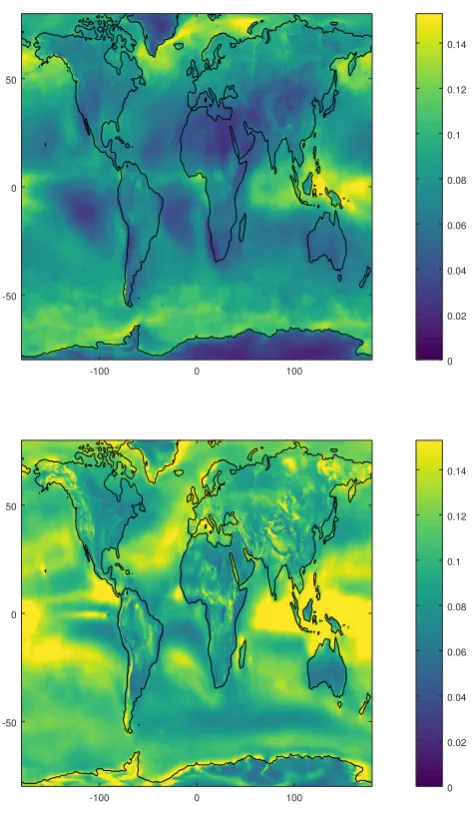
Dividing by the annual mean value, this formula avoids giving too much weight to variability in months when the average resource is low, such as high-latitude winters for solar resource. The mean standard deviation as well as the dimensionlessCVwere mapped, and their mean values were calculated for land and water pixels separately for three approximately equal-area latitude bands: 0°-19°(low latitude), 19°-42°(midlatitude), 42°-90°(high latitude).
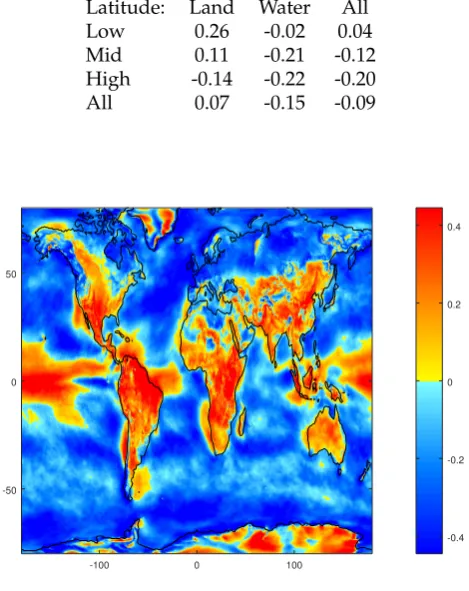
Since many power grids now include substantial amounts of both wind and solar generation, we also computed the correlation coefficient (for each grid cell and month of the year separately) between the wind and solar resources. Positive correlation between the two means that months with anomalously low wind resource will likely also have less solar resource than usual available, worsening the impact of interannual variability on power supply. Negative correlation means that fluctuations in the two resources will tend to offset each other, potentially mitigating the impact.
2.3. Wind and solar associations with climate modes and potential predictability
A number of recognized modes of variability in the climate system affect climate statistics over large areas throughout the globe. Here, we perform a preliminary assessment of to what extent solar and wind anomalies are associated with each of these climate modes. We do this by computing the adjusted coefficient of determination R2
adj between MERRA-2 solar or wind resource and the value of each climate mode, whereR2adjis calculated using the Pratt formula and intended to be an approximately unbiased measure [48–50] of what fraction of the resource variance could be explained by variability in the climate mode. Adjusted correlationRadj is obtained as ±
q
R2
adj, with the sign being the same as the unadjusted correlation, or 0 ifR2adj <0. R2adjwas computed separately for each MERRA-2 grid cell and for each month of the year, and then averaged to look at variation between land and ocean and by latitude and season. They were also computed for previous climate mode values (lagged up to 12 months) to provide an indication of to what extent future solar and wind resource fluctuations could be predicted given present conditions.
Note that for each grid cell and month, and assuming that resource and climate mode values from the 37 years are independent and normally distributed, R2adj ≥ 0.085 (|Radj| ≥ 0.30, corresponding to unadjusted|R| ≥0.33) are significantly different from zero at the 0.95 confidence level.
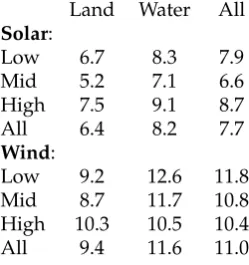
Table 1.Mean coefficient of variation (%) for monthly wind and solar resource, by latitude band.
Land Water All Solar:
Low 6.7 8.3 7.9
Mid 5.2 7.1 6.6
High 7.5 9.1 8.7
All 6.4 8.2 7.7
Wind:
Low 9.2 12.6 11.8
Mid 8.7 11.7 10.8
High 10.3 10.5 10.4
All 9.4 11.6 11.0
Arctic Oscillation (AO) A mode of surface-pressure variability between the Arctic and North Atlantic and Pacific [51].
North Atlantic Oscillation (NAO) A mode of 500-mb height variability between Greenland and the central North Atlantic [52].
Pacific Decadal Oscillation (PDO) A mode of North Pacific SST variability [53].
Pacific-North America Index (PNA) A mode of 500-mb height variability between the North Pacific and western North America [54].
Southern Oscillation Index (SOI) Surface pressure variability across the tropical Pacific [55].
2.4. Interannual variability over longer aggregation periods
Most of the analysis in this paper is for variability of monthly-mean solar radiation and windspeed. To begin to extend this to longer-lasting variability, such as the 2015 western USA wind drought (which lasted about 6 months) [23], we computed the CV also for 2-12 month aggregation periods. The mean CV is expected to decrease with increasing aggregation period, with the rate of decrease depending both on the autocorrelation of anomalies in consecutive months (which we found to be small but positive) and on any long-term ‘memory’ due to, for example, the association of anomalies with long-lasting climate modes.
3. Results
3.1. Interannual variability
The global mean (area-weighted) coefficient of variation, defined as above, was 8% for monthly solar radiation and 11% for windspeed. Across latitude bands, variability was greater, on average, over water than over land (Table1). Solar variability was lowest in midlatitudes compared to high and low latitudes. Wind variability peaked in low latitudes over water, but at high latitudes over land (Table1).
-100 0 100 -50
0 50
0 0.02 0.04 0.06 0.08 0.1 0.12 0.14
-100 0 100
-50 0 50
0 0.02 0.04 0.06 0.08 0.1 0.12 0.14
Figure 1.Interannual coefficient of variation for monthly surface (a) solar radiation, (b) windspeed.
-100 0 100 -50
0 50
-2 -1 0 1 2
-100 0 100
-50 0 50
-2 -1 0 1 2
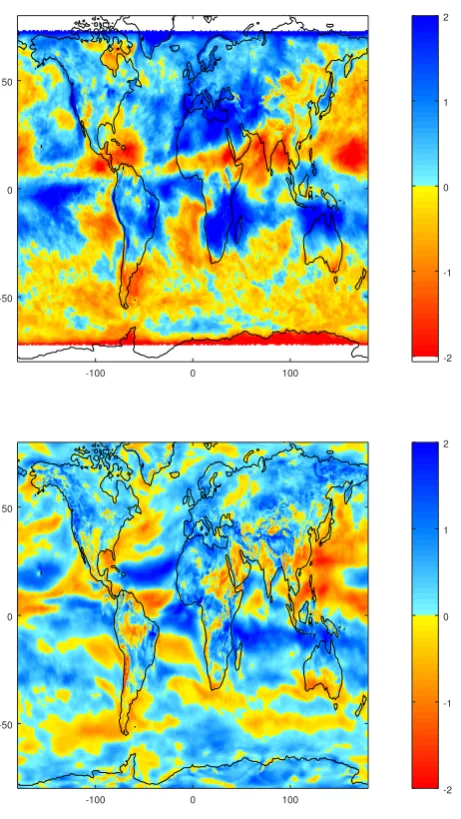
Figure 2.Base-2 logarithm of the ratio between January and July interannual coefficient of variation
for surface (a) solar radiation, (b) windspeed. A value of+1, for example, means that the CV is twice as large in January, while with a value of−1, the CV is twice as large in July.
Table 2.Mean correlation coefficient between wind and solar resource monthly anomalies, by latitude band.
Latitude: Land Water All
Low 0.26 -0.02 0.04
Mid 0.11 -0.21 -0.12
High -0.14 -0.22 -0.20
All 0.07 -0.15 -0.09
-100 0 100
-50 0 50
-0.4 -0.2 0 0.2 0.4
Figure 3.Mean correlation between anomalies in monthly surface solar radiation and windspeed.
3.2. Association with climate modes and predictability
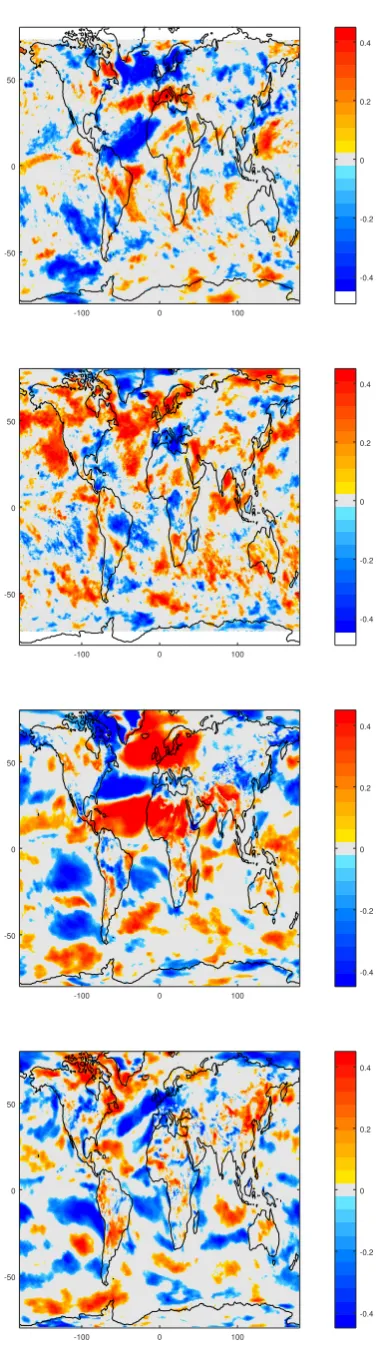
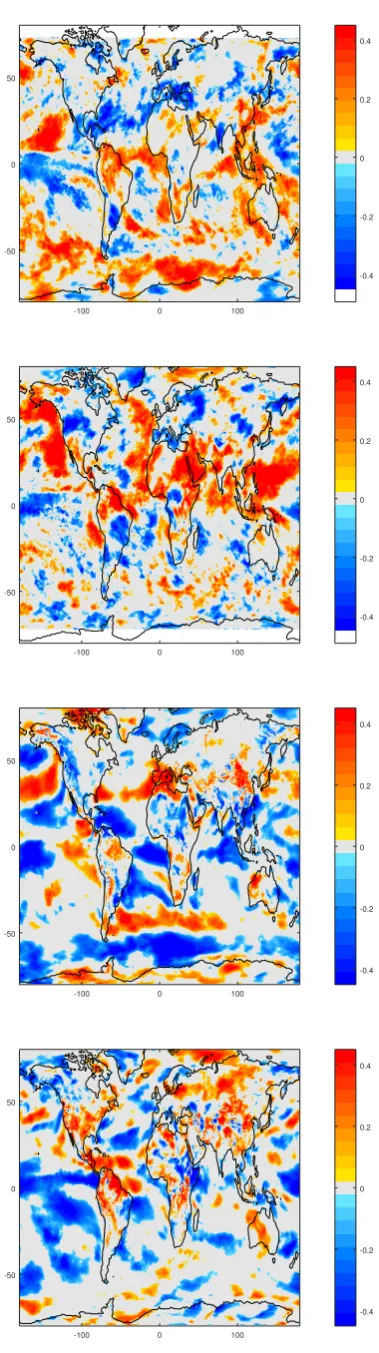
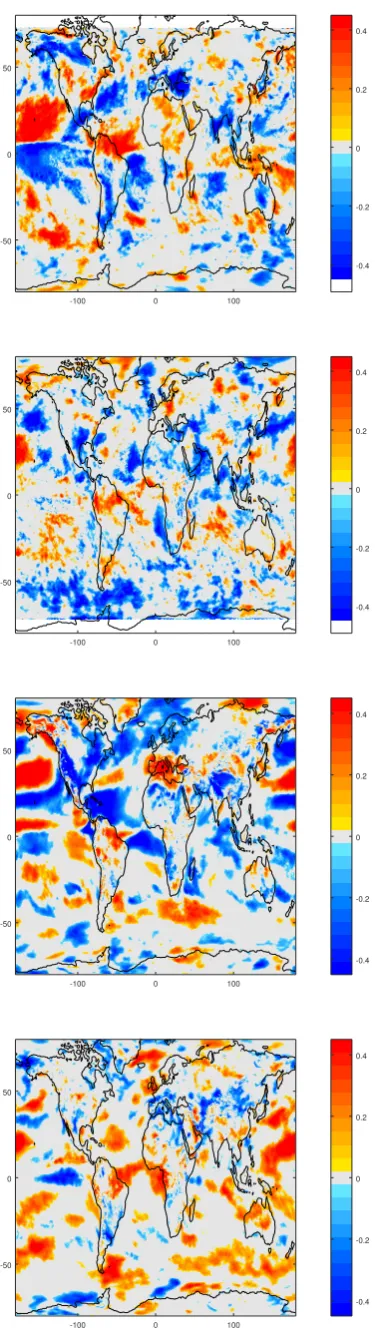
Averaged over all land areas, R2adj, the estimated fraction of variance in the monthly anomaly fields that could be explained by linear regression with the climate modes, was greatest for SOI in the case of solar radiation and greatest for AO for windspeed (Table3). SOI was the climate mode best associated with wind and solar variability at low latitudes, but explained little of the variance at high latitudes, where AO and NAO were the best associated. PDO was similar to SOI in having the strongest associations at low latitudes, while PNA had latitudinally more uniform and generally weaker correlations (Table3).
Many of these associations showed a marked seasonal variation in strength. In particular, over high-latitude land areas, AO and NAO were strongly correlated with solar and wind variability in December to March, with AO showing particularly good correlations with wind variability, whereas mean correlations in other months were much weaker (Figure4).
Table 3. Mean % variability (R2adj of linear regression) in monthly surface solar radiation and windspeed that could be explained by large-scale climate modes, by latitude band.
Solar: Wind:
Land Water All Land Water All AO
Low 0.51 0.65 0.62 1.71 0.80 1.01
Mid 0.97 0.75 0.81 1.84 1.74 1.77
High 2.12 1.20 1.43 3.81 1.73 2.25
All 1.20 0.86 0.95 2.44 1.42 1.68
NAO
Low 0.74 0.68 0.69 1.59 0.98 1.12
Mid 1.04 0.78 0.86 2.15 2.00 2.04
High 1.69 1.24 1.35 2.55 2.02 2.15
All 1.16 0.89 0.96 2.11 1.66 1.78
PDO
Low 3.21 3.98 3.80 2.13 3.52 3.19
Mid 1.89 2.04 2.00 1.26 1.34 1.32
High 0.58 0.77 0.72 0.58 0.86 0.79
All 1.86 2.29 2.18 1.30 1.92 1.76
PNA
Low 1.11 1.88 1.70 0.74 1.96 1.68
Mid 0.77 1.79 1.50 0.86 1.85 1.57
High 1.03 0.54 0.67 1.27 1.06 1.10
All 0.95 1.41 1.30 0.96 1.62 1.45
SOI
Low 4.83 7.84 7.14 4.15 7.78 6.93
Mid 3.76 3.46 3.54 1.73 2.73 2.45
High 0.67 0.59 0.61 0.28 1.22 0.99
All 3.08 4.03 3.79 1.99 3.94 3.44
2 4 6 8 10 12
0 1 2 3 4
R
2 adj
(%)
2 4 6 8 10 12
0 2 4 6 8
Month of year
R
2 adj
(%)
AO NAO PDO PNA SOI
Figure 4. Mean high-latitude land R2adj for correlation between monthly (a) solar radiation or (b)
-100 0 100 -50
0 50
-0.4 -0.2 0 0.2 0.4
-100 0 100 -50
0 50
-0.4 -0.2 0 0.2 0.4
-100 0 100 -50
0 50
-0.4 -0.2 0 0.2 0.4
-100 0 100 -50
0 50
-0.4 -0.2 0 0.2 0.4
Figure 5.Radjfor correlation with AO with (a) solar radiation in January, (b) solar radiation in July, (c)
-100 0 100 -50
0 50
-0.4 -0.2 0 0.2 0.4
-100 0 100 -50
0 50
-0.4 -0.2 0 0.2 0.4
-100 0 100 -50
0 50
-0.4 -0.2 0 0.2 0.4
-100 0 100 -50
0 50
-0.4 -0.2 0 0.2 0.4
-100 0 100 -50
0 50
-0.4 -0.2 0 0.2 0.4
-100 0 100 -50
0 50
-0.4 -0.2 0 0.2 0.4
-100 0 100 -50
0 50
-0.4 -0.2 0 0.2 0.4
-100 0 100 -50
0 50
-0.4 -0.2 0 0.2 0.4
-100 0 100 -50
0 50
-0.4 -0.2 0 0.2 0.4
-100 0 100 -50
0 50
-0.4 -0.2 0 0.2 0.4
-100 0 100 -50
0 50
-0.4 -0.2 0 0.2 0.4
-100 0 100 -50
0 50
-0.4 -0.2 0 0.2 0.4
-100 0 100 -50
0 50
-0.4 -0.2 0 0.2 0.4
-100 0 100 -50
0 50
-0.4 -0.2 0 0.2 0.4
-100 0 100 -50
0 50
-0.4 -0.2 0 0.2 0.4
-100 0 100 -50
0 50
-0.4 -0.2 0 0.2 0.4
The results presented so far are for associations between climate modes and solar and wind anomalies from the same month. Solar and wind anomalies can also be associated, to varying extents, with climate mode values from previous months (Figure10). AO and NAO are not very persistent across multiple months, and so the correlation strengths diminish rapidly as one goes earlier than the current month. SOI and especially PDO are persistent across months, so correlations decay more slowly, implying that future wind and solar anomalies should be partly predictable based on current values of these climate modes (Figure10).
0 2 4 6 8 10 12
0 0.5 1 1.5 2 2.5 3
R
2 adj
(%)
0 2 4 6 8 10 12
0 0.5 1 1.5 2 2.5
Lag (months)
R
2 adj
(%)
AO NAO PDO PNA SOI
Figure 10.Global mean landR2adjfor correlation between monthly (a) solar radiation or (b) windspeed
and values for different climate modes up to 12 months previous.
3.3. Longer aggregation periods
2 4 6 8 10 12 0.02
0.04 0.06 0.08 0.1 0.12
2 4 6 8 10 12
0.02 0.04 0.06 0.08 0.1 0.12
Figure 11.Global mean land (red) and ocean (blue) coefficient of variation between monthly (a) solar
radiation or (b) windspeed at aggregation timescales of 1 to 12 months. The expected values for an autoregressive process of order 1 that matches the 1 and 2 month values are also shown (dashed curves).
4. Discussion
The global-mean coefficients of variation for monthly-mean solar radiation and wind speed in the MERRA-2 reanalysis were found to be 11% and 8% respectively. While variability was lower on average over land than over oceans, some of the land areas that currently have the largest build-up of solar and wind energy generation, e.g. in India, China, Western Europe, and the United States, had greater than average variability. Variability is expected to be greater at the scale of individual generation plants, compared to the reanalysis grid scale, as also hinted by the larger median coefficients of variation in station observations compared to MERRA-2.
thermal equipment on the direct fraction of solar radiation. Nevertheless, based on our comparison with GHCN-D station and CLARA remote sensing observations and the finding that the 2015 wind drought experienced by wind power operators in the western US can be seen in MERRA-2 near-surface windspeed [23], the reanalysis products presented here appear to be useful in providing approximate numerical values for initial assessment of the magnitude of interannual variability and its impact on reliability and storage requirements [56].
Both wind and solar monthly anomalies were found to show some correlation with the climate modes tested. To the extent that these climate modes are persistent or dynamically predictable, long-range forecasts of these anomalies are possible. Statistical and dynamical methods can be used to predict sea surface temperatures [30,57,58], which are strongly associated with many of the climate modes, and there are also other sources of seasonal predictability, for example related to snow cover and soil moisture [59,60]. Thus, improvements in NAO forecasting have led to better winter wind power forecasts over Europe [61].
Many of the teleconnection correlations, particularly those for AO and NAO in winter (Figures 5and6), are of opposite sign between northern and southern Europe, implying that spreading and interconnecting wind and solar generation across the continent can mitigate the impact of interannual variability on power supply. Similarly, positive correlations between wind and solar variability, such as that seen in the southwestern US, can suggest the need for additional provision for reserve power or grid interconnections.
Predictability based on these climate modes is seen to be much greater for some locations and seasons than is the case in the global mean. The climate modes used here, taken from NOAA, are ones that are known to influence weather in the United States. For other locations, for example in the Southern Hemisphere, other climate modes, such as the Antarctic Oscillation [62], could have stronger associations with wind and solar fluctuations.
5. Conclusions
We find a substantial amount of interannual variability, with mean coefficients of variation of order 10% at the monthly timescale, in both solar radiation and windspeed, which could result in important fluctuations in the supplied power from solar and wind resources. Some of this variability correlates with values of climate modes, and persistence and predictability of these modes provides the potential for skill in seasonal prediction of these wind and solar fluctuations.
Acknowledgments: NYK gratefully acknowledges support from NOAA under grants NA11SEC4810004 and
NA15OAR4310080. The authors thank Dr. Daran Rife for valuable comments and help with data sets, and participants in the American Solar Energy Society annual conference for helpful discussion. All statements made are the views of the authors and not the opinions of the funders or the U.S. government.
References
1. Kostylev, V.; Pavlovski, A. Solar power forecasting performance–towards industry standards. 1st International Workshop on the Integration of Solar Power into Power Systems Aarhus, Denmark, 2011. 2. Masa-Bote, D.; Castillo-Cagigal, M.; Matallanas, E.; Caamaño-Martín, E.; Gutiérrez, A.; Monasterio-Huelín,
F.; Jiménez-Leube, J. Improving photovoltaics grid integration through short time forecasting and self-consumption.Applied Energy2014,125, 103–113.
3. Widén, J.; Carpman, N.; Castellucci, V.; Lingfors, D.; Olauson, J.; Remouit, F.; Bergkvist, M.; Grabbe, M.; Waters, R. Variability assessment and forecasting of renewables: A review for solar, wind, wave and tidal resources. Renewable and Sustainable Energy Reviews2015,44, 356 – 375.
4. Juban, R.; Ohlsson, H.; Maasoumy, M.; Poirier, L.; Kolter, J.Z. A multiple quantile regression approach to the wind, solar, and price tracks of GEFCom2014. International Journal of Forecasting2016,32, 1094 – 1102. 5. Hammer, A.; Heinemann, D.; Lorenz, E.; Lückehe, B. Short-term forecasting of solar radiation: a statistical
approach using satellite data. Solar Energy1999,67, 139–150.
7. Perez, R.; Moore, K.; Wilcox, S.; Renné, D.; Zelenka, A. Forecasting solar radiation – Preliminary evaluation of an approach based upon the national forecast database. Solar Energy2007,81, 809–812.
8. Reikard, G. Predicting solar radiation at high resolutions: A comparison of time series forecasts. Solar
Energy2009,83, 342–349.
9. Mellit, A.; Pavan, A.M. A 24-h forecast of solar irradiance using artificial neural network: Application for performance prediction of a grid-connected PV plant at Trieste, Italy. Solar Energy2010,84, 807–821. 10. Mathiesen, P.; Kleissl, J. Evaluation of numerical weather prediction for intra-day solar forecasting in the
continental United States.Solar Energy2011,86, 967–977.
11. Chow, C.W.; Urquhart, B.; Lave, M.; Dominguez, A.; Kleissl, J.; Shields, J.; Washom, B. Intra-hour forecasting with a total sky imager at the UC San Diego solar energy testbed. Solar Energy 2011,
85, 2881–2893.
12. Yang, D.; Gu, C.; Dong, Z.; Jirutitijaroen, P.; Chen, N.; Walsh, W.M. Solar irradiance forecasting using spatial-temporal covariance structures and time-forward kriging.Renewable Energy2013,60, 235 – 245. 13. Isvoranu, D.; Badescu, V. Preliminary WRF-ARW model analysis of global solar irradiation forecasting.
Mathematical Modelling in Civil Engineering2014,10, 1–8.
14. Chu, Y.; Li, M.; Pedro, H.T.; Coimbra, C.F. Real-time prediction intervals for intra-hour DNI forecasts.
Renewable Energy2015,83, 234–244.
15. Larson, D.P.; Nonnenmacher, L.; Coimbra, C.F. Day-ahead forecasting of solar power output from photovoltaic plants in the American Southwest. Renewable Energy2016,91, 11 – 20.
16. Golestaneh, F.; Gooi, H.B.; Pinson, P. Generation and evaluation of space–time trajectories of photovoltaic power.Applied Energy2016,176, 80 – 91.
17. Lange, M. On the uncertainty of wind power predictions – analysis of the forecast accuracy and statistical distribution of errors.Journal of Solar Energy Engineering2005,127, 177–184.
18. Hering, A.S.; Genton, M.G. Powering up with space-time wind forecasting.Journal of the American Statistical
Association2010,105, 92–104.
19. Gallego-Castillo, C.; Bessa, R.; Cavalcante, L.; Lopez-Garcia, O. On-line quantile regression in the RKHS (Reproducing Kernel Hilbert Space) for operational probabilistic forecasting of wind power. Energy2016,
113, 355 – 365.
20. Gueymard, C.A.; Wilcox, S.M. Assessment of spatial and temporal variability in the US solar resource from radiometric measurements and predictions from models using ground-based or satellite data.Solar Energy 2011,85, 1068 – 1084.
21. Correia, J.; Bastos, A.; Brito, M.; Trigo, R. The influence of the main large-scale circulation patterns on wind power production in Portugal. Renewable Energy2017,102, Part A, 214 – 223.
22. Gueymard, C.A. Temporal variability in direct and global irradiance at various time scales as affected by aerosols.Solar Energy2012,86, 3544 – 3553.
23. Rife, D.; Krakauer, N.Y.; Cohan, D.S.; Collier, J.C. A new kind of drought: U.S. record low windiness in 2015. Earthzine2016.
24. Koster, R.D.; Suarez, M.J.; Heiser, M. Variance and predictability of precipitation at seasonal-to-interannual timescales. Journal of Hydrometeorology2000,1, 26–46.
25. National Research Council. Assessment of Intraseasonal to Interannual Climate Prediction and Predictability. Technical report, 2010.
26. Troccoli, A. Seasonal climate forecasting. Meteorological Applications2010,17, 251–268.
27. Smith, D.M.; Scaife, A.A.; Kirtman, B.P. What is the current state of scientific knowledge with regard to seasonal and decadal forecasting?Environmental Research Letters2012,7, 015602.
28. Doblas-Reyes, F.J.; García-Serrano, J.; Lienert, F.; Biescas, A.P.; Rodrigues, L.R.L. Seasonal climate predictability and forecasting: status and prospects. Wiley Interdisciplinary Reviews: Climate Change2013,4. 29. Committee on Developing a U.S. Research Agenda to Advance Subseasonal to Seasonal Forecasting.; Board on Atmospheric Sciences and Climate.; Ocean Studies Board.; Division on Earth and Life Studies.; National Academies of Sciences, Engineering, and Medicine. Next Generation Earth System Prediction: Strategies for
Subseasonal to Seasonal Forecasts; National Academies Press: Washington, DC, USA, 2016.
31. Kumar, K.K.; Hoerling, M.; Rajagopalan, B. Advancing dynamical prediction of Indian monsoon rainfall.
Geophysical Research Letters2005,32, L08704.
32. Barnston, A.G.; Li, S.; Mason, S.J.; DeWitt, D.G.; Goddard, L.; Gong, X. Verification of the first 11 years of IRI’s seasonal climate forecasts. Applied Meteorology and Climatology2010,49, 493–520.
33. Barnston, A.G.; Mason, S.J. Evaluation of IRI’s seasonal climate forecasts for the extreme 15% tails. Weather
and Forecasting2011,26, 545–554.
34. Mwangi, E.; Wetterhall, F.; Dutra, E.; Di Giuseppe, F.; Pappenberger, F. Forecasting droughts in East Africa.
Hydrology and Earth System Sciences2014,18, 611–620.
35. Dutra, E.; Pozzi, W.; Wetterhall, F.; Di Giuseppe, F.; Magnusson, L.; Naumann, G.; Barbosa, P.; Vogt, J.; Pappenberger, F. Global meteorological drought – Part 2: Seasonal forecasts. Hydrology and Earth System
Sciences2014,18, 2669–2678.
36. Klemm, T.; McPherson, R.A. The development of seasonal climate forecasting for agricultural producers.
Agricultural and Forest Meteorology2017,232, 384 – 399.
37. Bosilovich, M.G.; Robertson, F.R.; Takacs, L.; Molod, A.; Mocko, D. Atmospheric Water Balance and Variability in the MERRA-2 Reanalysis. Journal of Climate2017.
38. Reichle, R.H.; Liu, Q.; Koster, R.D.; Draper, C.S.; Mahanama, S.P.P.; Partyka, G.S. Land surface precipitation in MERRA-2. Journal of Climate2017.
39. Wargan, K.; Coy, L. Strengthening of the Tropopause Inversion Layer during the 2009 Sudden Stratospheric Warming: A MERRA-2 Study.Journal of the Atmospheric Sciences2016,73, 1871–1887.
40. Rienecker, M.M.; Suarez, M.J.; Gelaro, R.; Todling, R.; Bacmeister, J.; Liu, E.; Bosilovich, M.G.; Schubert, S.D.; Takacs, L.; Kim, G.K.; Bloom, S.; Chen, J.; Collins, D.; Conaty, A.; da Silva, A.; Gu, W.; Joiner, J.; Koster, R.D.; Lucchesi, R.; Molod, A.; Owens, T.; Pawson, S.; Pegion, P.; Redder, C.R.; Reichle, R.; Robertson, F.R.; Ruddick, A.G.; Sienkiewicz, M.; Woollen, J. MERRA: NASA’s modern-era retrospective analysis for research and applications.Journal of Climate2011,24, 10.1175/JCLI–D–11–00015.1.
41. Randles, C.A.; da Silva, A.M.; Buchard, V.; Colarco, P.R.; Darmenov, A.; Govindaraju, R.; Smirnov, A.; Holben, B.; Ferrare, R.; Hair, J.; Shinozuka, Y.; Flynn, C.J. The MERRA-2 Aerosol Reanalysis, 1980 – onward, Part I: System Description and Data Assimilation Evaluation. Journal of Climate 2017, [http://dx.doi.org/10.1175/JCLI-D-16-0609.1].
42. Cannon, D.; Brayshaw, D.; Methven, J.; Coker, P.; Lenaghan, D. Using reanalysis data to quantify extreme wind power generation statistics: A 33 year case study in Great Britain. Renewable Energy2015,75, 767 – 778.
43. Staffell, I.; Pfenninger, S. Using bias-corrected reanalysis to simulate current and future wind power output.
Energy2016,114, 1224 – 1239.
44. Pfenninger, S.; Staffell, I. Long-term patterns of European PV output using 30 years of validated hourly reanalysis and satellite data.Energy2016,114, 1251 – 1265.
45. Menne, M.; Durre, I.; Vose, R.; Gleason, B.; Houston, T. An overview of the Global Historical Climatology Network-Daily database. Journal of Atmospheric and Oceanic Technology2012,29, 897–910.
46. Durre, I.; Menne, M.J.; Gleason, B.E.; Houston, T.G.; Vose, R.S. Comprehensive automated quality assurance of daily surface observations. Journal of Applied Meteorology and Climatology2010,49, 1615–1633. 47. Karlsson, K.G.; Riihelä, A.; Müller, R.; Meirink, J.F.; Sedlar, J.; Stengel, M.; Lockhoff, M.; Trentmann, J.;
Kaspar, F.; Hollmann, R.; Wolters, E. CLARA-A1: a cloud, albedo, and radiation dataset from 28 yr of global AVHRR data. Atmospheric Chemistry and Physics2013,13, 5351–5367.
48. Olkin, I.; Pratt, J.W. Unbiased Estimation of Certain Correlation Coefficients. Ann. Math. Statist. 1958,
29, 201–211.
49. Yin, P.; Fan, X. Estimating R2 Shrinkage in Multiple Regression: A Comparison of Different Analytical Methods. The Journal of Experimental Education 2001, 69, 203–224, [http://dx.doi.org/10.1080/00220970109600656].
50. Skidmore, S.T.; Thompson, B. Choosing the best correction formula for the Pearsonr2 effect size. The
Journal of Experimental Education2011,79, 257–278,[http://dx.doi.org/10.1080/00220973.2010.484437].
51. Baldwin, M.P. Annular modes in global daily surface pressure. Geophysical Research Letters 2001,
28, 4115–4118.
53. Mantua, N.J.; Hare, S.R. The Pacific Decadal Oscillation. Journal of Oceanography2002,58, 35–44.
54. Wallace, J.M.; Gutzler, D.S. Teleconnections in the Geopotential Height Field during the Northern Hemisphere Winter. Monthly Weather Review 1981, 109, 784–812, [http://dx.doi.org/10.1175/1520-0493(1981)109<0784:TITGHF>2.0.CO;2].
55. Horel, J.D.; Wallace, J.M. Planetary-Scale Atmospheric Phenomena Associated with the Southern Oscillation. Monthly Weather Review 1981, 109, 813–829, [http://dx.doi.org/10.1175/1520-0493(1981)109<0813:PSAPAW>2.0.CO;2].
56. Perez, M.J.R.; Fthenakis, V. Impacts of long-timescale variability in solar resources at high PV penetrations: Quantification. Photovoltaic Specialists Conference (PVSC), 2012 38th IEEE, 2012, pp. 002481–002486. 57. Krishnamurti, T.N.; Chakraborty, A.; Krishnamurti, R.; Dewar, W.K.; Clayson, C.A. Seasonal prediction of
sea surface temperature anomalies using a suite of 13 coupled atmosphere-ocean models.Journal of Climate 2006,19, 6069–6088.
58. Kumar, A.; Chen, M.; Zhang, L.; Wang, W.; Xue, Y.; Wen, C.; Marx, L.; Huang, B. An analysis of the nonstationarity in the bias of sea surface temperature forecasts for the NCEP Climate Forecast System (CFS) Version 2. Monthly Weather Review2012,140, 3003–3016. CFSv2.
59. Douville, H. Relevance of soil moisture for seasonal atmospheric predictions: is it an initial value problem?
Climate Dynamics2004,22, 429–446.
60. Wang, S.; Yuan, X.; Li, Y. Does a strong El Niño imply a higher predictability of extreme drought? 2017.
7, 40741.
61. Clark, R.T.; Bett, P.E.; Thornton, H.E.; Scaife, A.A. Skilful seasonal predictions for the European energy industry. Environmental Research Letters2017,12, 024002.