Rendering of 3D Dynamic Virtual Environments
Salvatore A. Catanese
Dept. of Physics Informatics Section University of Messina, Italy[email protected]
Emilio Ferrara
Dept. of Mathematics University of Messina, Italy[email protected]
Giacomo Fiumara
Dept. of Physics Informatics Section University of Messina, Italy[email protected]
Francesco Pagano
Dept. of Information Technology University of Milan, Italy
[email protected]
ABSTRACT
In this paper we present a framework for the rendering of dynamic 3D virtual environments which can be integrated in the development of videogames. It includes methods to manage sounds and particle effects, paged static geometries, the support of a physics engine and various input systems. It has been designed with a modular structure to allow future expansions.
We exploited some open-source state-of-the-art compo-nents such asOGRE,PhysX, ParticleUniverse, etc.; all of them have been properly integrated to obtain peculiar physi-cal and environmental effects. The stand-alone version of the application is fully compatible withDirect3D andOpenGL
APIs and adoptsOpenALAPIs to manage audio cards. Concluding, we devised a showcase demo which repro-duces a dynamic 3D environment, including some partic-ular effects: the alternation of day and night influencing the lighting of the scene, the rendering of terrain, water and veg-etation, the reproduction of sounds and atmospheric agents.
Categories and Subject Descriptors
H.5.1 [Information Interfaces And Presentation]: Mul-timedia Information Systems—Artificial, augmented, and vir-tual realities; I.2.1 [Computing Methodologies]: Appli-cations and Expert Systems—Games; I.3.7 [Computing Methodologies]: Three-Dimensional Graphics and Real-ism—Virtual reality
General Terms
Design, Experimentation
Keywords
Virtual Environments, Games
Permission to make digital or hard copies of all or part of this work for personal or classroom use is granted without fee provided that copies are not made or distributed for profit or commercial advantage and that copies bear this notice and the full citation on the first page. To copy otherwise, to republish, to post on servers or to redistribute to lists, requires prior specific permission and/or a fee.
DISIO 2011March 21, Barcelona, Spain. Copyright 2011 ICST, ISBN .
1.
INTRODUCTION
The design of virtual environments is a complex and ex-pensive process within the development of videogames. The improvements in programming video cards greatly increases the possibility of creating extremely involving interactive virtual environments and worlds with enhanced exploratory choices in immersive playing experiences.
Besides the generation of virtual object models such as buildings and landscapes and a real-time camera control for navigation in virtual environments, the development should provide the possibility to manage physical, environmental and collision effects. These elements determined a substan-tial increase of development costs in order to face the large amount of extra technical and artistic features. The result is that, in some cases, production costs are comparable to those of some film productions.
Although some virtual environment development toolkits are available, some of them provide only a subset of those in-struments which are necessary to completely develop virtual worlds. Some features particularly difficult to be simulated, such as wind, fire, smoke and water often need a further programming phase, thus still increasing development costs. In the last years there has been an increase in the num-ber of middlewares and frameworks (see further) which try to face the problem of fulfillment and optimization of 3D dynamic virtual environments in order to solve the techni-cal requirements of complex videogames. The framework we developed can be set in this category.
The virtual environment we describe in this paper is build on top of a previously developed middleware framework [2] with features to manage input devices, sound and music integration, networking support and physics effects imple-mentation. This work extends the features of this platform improving the graphical quality, the degree of realism and involvement of virtual scenes, when non-commercial engines and libraries are employed.
2.
RELATED WORK
physics, environmental effects, photo-realistic graphics, and so on. Our work focuses on some of these aspects and most of them have been already covered in specific related work. Because developing virtual environments fuses aspects of software engineering, architecture, artificial intelligence, 3D graphics, art and sound effects, frameworks and platforms supporting these steps have been developed in the last years. For example, Trenholme and Smith in [12] present an overview of several currently available commercial game engines (id Tech 3-4,CryENGINE,SourceandUnreal Engine 2), which are suitable for prototyping virtual environments. Similarly, Watson et al. [13] review the procedural modeling, examin-ing theCityEnginegame engine they developed, and study-ing the use of procedural urban modelstudy-ing in Electronic Arts’
Need for Speedgames, for representing virtual urban envi-ronments exploiting their middleware. On the other hand, in the academic field, a simple game engine (SAGE), de-veloped in a game programming class at the University of North Texas, is described by Parberry et al. in [7]. They show a sequence of demos implementing different function-alities; each demo extends its predecessor in a process called incremental development. SAGE generates 3D virtual en-vironments, that users can explore in real time, containing interactive objects. It includes a graphics renderer, using pixel shaders and HLSL, objects, terrain and some method for level-of-detail to increase rendering speed, input man-agement and collision detection. [7] shares similarities with our work in these aspects.
In the area of environmental effects simulation, several methods for reproducing weather phenomena, like particle-based rain techniques, are presented in [11]. The authors describe in details those methods to render, in a real-time system, very complex atmospheric physical phenomena such as strong rainfall, falling raindrops dripping off objects’ sur-faces, various reflections in surface materials and puddles, water ripples and puddles on the streets and so on.
Realistic animations of water, smoke, explosions, and re-lated phenomena are reproduced via fluids simulation. Wicke et al. [14] face the problem of high-resolution fluid mo-tion in real-time videogame applicamo-tions, describing some techniques on a scale previously unattainable in computer graphics. The central idea is to cover the simulation do-main with a small set of simulation primitives, called tiles. Each tile consists of a velocity basis representing the pos-sible flow within its sub-domain. The boundaries between sub-domains correspond to tile faces.
Finally, in the area of realistic graphics, an exterminated amount of work has been presented in the last years. An interesting interactive fractal landscape synthesizer on pro-grammable graphics hardware, which exploits the intrinsic strengths of GPUs to generate and render quality, high-resolution, textured and shaded terrains has been presented by Schneider et al. in [8]. The synthesis step is directly inte-grated into the rendering procedure and requires neither any polygonal representation nor a pre-processing stage. The al-gorithms are combined into a visual interface to allow the intuitive design of highly detailed terrain models.
An overview ofHalo 3’s unique lighting and material sys-tem and its main components is treated in [3]. Halo includes key innovations in the following areas: spherical harmonics lightmap generation, compression and rendering; rendering complex materials under area light sources; HDR rendering and post-processing. Some of the effects presented in that
work have been adopted also here (e.g. the HDR rendering).
3.
THE FRAMEWORK
The application we developed includes some of the most important open-source solutions used for the rendering of 3D virtual environments. We employed: OGRE (Objected-Oriented Graphics Rendering Engine) [10];Caelumfor photo-realistic creation of the sky, clouds and atmospheric agents;
Hydrax for the rendering of scenes including water and for the reproduction of its effects such as depth, foam, sunbeams through water surface, etc.
OGRE was chosen among other open-source engines for various reasons. Some graphical engines while showing a large list of features, can be hardly merged to create a us-able tool. Others are supplied with enchanting demos, but are scarcely helpful when a broader project is to be created. Finally, others are too much specific for a given type of video-game. What makes OGRE different from other graphical engines is the wide support community, the documentation and its being open-source.
We have usedPaged Geometry for the rendering of large amounts of little meshes needed to cover the surfaces of the environment: the library is specifically designed for the ren-dering of forests and outdoor scenes where mushrooms, rocks and blades of grass must be rendered in a performing way. ThePhysXengine has been chosen to dynamically simulate objects, collisions with the terrain and the static geometry (paginated or not) of the scene. PhysX is also suited to be integrated withOGRE via theNxOGREwrapper class. We have also used theOGREOggSound library in order to manage sounds, together with Particle Universe to create visually stunning particle systems.
We also introduced two techniques, namely “texture splat-ting” and “parallax mapping”, which improve the quality and the realism of the reproduced environment based on pro-gramming shaders. They will be described in detail in next sections. Our application extends a middleware framework presented elsewhere [2] which provides a starting point to ease the process of game development, discussed in the next section.
3.1
Basic Middleware Framework
The middleware framework at the core of the application consists of a series of tools which greatly eases the develop-ment of videogames based on 3D environdevelop-ments. It allows programmers and artists to focus on game dynamics and gameplay neglecting the technical aspects of development.
The system provides some features which ease the phases of development and in particular to: i) load a 3D scene cre-ated using graphical modeling softwares (e.g. Blender); ii) specify the physical qualities of an object (mass and phys-ical model) inside a scene; iii) export the 3D environment towards third part applications; iv) accomplish the render-ing of the dynamic environment; v) manage the motion of the objects thus accomplishing a physical simulation, and vi) save the videogame progress for further restore.
of the replaced package is maintained.
The main packages are those related to the management of the cycle of rendering (GameSystem), the I/O (GameIO), the interface with audio librariesOpenAL(GameAudio) and the control system of the character based onPhysX (Game-CharacterController). They also include the methods to load and save the scenes (GameSceneLoader).
3.2
Framework Extended Modules
The new modules we developed allow to accomplish the 3D rendering of a dynamic environment which includes the following features: day-night cycle simulation, to manage the lighting of the whole scene; realistic rendering of the water, with refraction and reflection effects on the objects in the scene; optimized rendering of static paged geometry; optimized and simultaneous rendering of the trees, grass and other static elements; free camera with variable velocity to explore the environment.
Moreover, the system supports: the terrain rendering and generation from “heightmaps”; collision detection viaPhysX; terrain texturing using the “texture splatting” technique; “parallax mapping” on road texture for good depth effect;
multiple sounds playing; multiple particle system effects. We introduced the possibility of managing random weather conditions, with dynamic wind variables (speed, direction); rain effects with different intensity, speed, direction (wind correlated); thunderstorm with lightning effects; sounds of thunders calculated according to the distance between the lightning and the observer, with real attenuation/distance retard to hear them; water surface update in base of weather conditions (calm or rough sea).
The stand-alone framework, written in C++, may be fur-ther extended to include third part libraries; extensions should be interfaced with existing modules, and eventually refac-toring the replaced libraries. It is compatible withOpenAL,
Direct3DeOpenGLAPIs, and supports a large number of video cards with 2.x pixel shader functionality.
4.
DYNAMIC VIRTUAL ENVIRONMENTS
The process of designing of virtual environments is build on top of a previously developed middleware framework [2]; this platform represents a solid starting point for the devel-opment of 3D games, including several features (e.g. input devices management, sound and music integration, network-ing support, physics effects implementation, etc.).
In this work we extend the features of this platform, in particular improving graphics quality aspects (introducing new rendering techniques) and the realism and the degree of credibility and involvement the designed virtual environ-ments could ensure (introducing realistic terrain generation techniques, weather management, particle systems, fluid dy-namics, load balancing of renderable elements, etc.).
4.1
Design of the Demo Environment
We also designed a demonstrating environment, which in-tegrates the previously listed features and is used as show-case for illustrating them. This virtual area reproduces the Port Royal Bay (Jamaica) (Figure 1); the place represents a realistic setting for a possible fantasy/adventure show-case demonstration; this because, during the 17th century, it was one of the main scenarios of piracy in the Caribbean Sea.
It was necessary to reproduce a realistic environment also with respect to the temporal period. It includes two main
Figure 1: Port Royal Bay (Jamaica) nowadays
areas: i) the city center (including buildings, the citadel, etc.); ii) the bay (shores, plains, forests, etc.).
We adopted two different scene managers to represent the areas: for the outdoor environment we use the TerrainScene-Manager, while for indoor places we adopt the BSPSceneM-anager (both of them are optimized for their different pur-poses). A small citadel has been designed viaBlender. The scene has been exported through anad-hocplug-in which ex-ploits theDotSceneextended DTD we previously presented [2]. The outdoor environment has been created using a ter-rain generation algorithm (details follow) starting from a heightmap taken from NASA altimetry satellites (Figure 3, top left).
4.2
The Terrain
The terrain generation problem is crucial for the creation of a realistic virtual environment. Several commercial prod-ucts already exist (e.g. Vue 9 Infinite Terrains 1), which produce realistic outdoor areas via different techniques. Our purpose is to integrate in our framework a feature for ob-taining similar results.
4.2.1
Terrain Generation via Maps
TheTerrainSceneManagerprovided withOGREsupports the generation of outdoor terrains via maps. In particular, a “heightmap” is used to define the topology of the terrain; this map is a grayscale image in which each pixel describes the altimetry of a corresponding terrain point (Figure 3, top left). After the terrain topology generation, textures are applied to it (Figure 4); then a base color is passed over the surfaces in order to diversify different areas, adopting a “color map” (Figure 3, bottom right); finally, a “detail map” (Figure 3, bottom left) is applied, which includes RGB and alpha channels (used for texture splatting and parallax mapping via shaders, details follow).
Figure 2, so as several following screenshots, shows the results for our show-case example; comparing these pictures with real photos (e.g. Figure 1) we observe the excellent degree of realism of the reproduced environment.
4.2.2
Maps and Texturing
1
Figure 2: 3D virtual reconstruction of the bay
Figure 3: Clockwise from top left: “heightmap”, “density map”, “coverage map”, “color map”
For our show-case demonstrative environment, four dif-ferent maps have been generated for creating the outdoor area (Figure 3): i) the “heightmap” (previously discussed); ii) a “density map”, which is adopted for adding entities like trees, grass, etc.; iii) a “coverage map” (containing informa-tion about the distribuinforma-tion of textures in the four channels, RGB and alpha) and iv) the “color map” (the base color passed on surfaces), used for texture splatting and parallax mapping processes.
Four textures have been applied to the terrain (Figure 4): i) pathway, ii) sand, iii) sand and grass and iv) short grass.
4.3
Rendering Techniques
The framework [2] relies onOGRE[10] for rendering the virtual environment. This open-source rendering engine pro-vides techniques and methods for representing 3D virtual scenes, exploiting the power of GPUs (Graphics Process-ing Units), supportProcess-ing both theDirect3D and theOpenGL
Figure 4: Textures for the terrain
Figure 5: Texture splatting and parallax mapping
pipelines.
Although several state-of-the-art algorithms have been al-ready implemented within the rendering engine, we intro-duced two techniques, namelytexture splatting andparallax mapping, which improve the quality and realism of the re-produced environment. These techniques are implemented via shaders.
4.3.1
Texture Splatting
The process oftexture splatting was originally described by Bloom [1] in 2000. The purpose of this technique is to merge several textures on a unique surface via alphamaps. An alphamap is a grayscale image which is included in the alpha channel of a texture.
Each pixel of the alphamap determines the degree of opac-ity or translucency of the pixel in the same position of the texture. In this technique the alphamaps are exploited to establish how much opaque or translucent has to be each pixel of the texture in the corresponding position within the alphamap. This is easily obtained by multiplying the alpha channel by the RGB channels. Alpha lies in the interval [0,1] (0 corresponds to completely transparent, 1 to completely opaque).
We extended the graphical features of the rendering en-gine implementing the texture splatting algorithm; it was adopted (together with parallax mapping), for example, to better reproduce the effect of pathways through the forest (Figure 5).
4.3.2
Parallax Mapping
This rendering technique has been introduced by Kaneko [4] in 2001, and represents an improvement of standard bump mapping algorithms; because of the computational overhead introduced, this technique has been widely exploited only in the last few years thanks to the adoption of GPUs program-ming. The parallax mapping is implemented using normal maps for displacing the position of texture coordinates on the rendered polygon, considering the value of the normal map in each point of the texture, as a function of the view angle in tangent space.
As shown in Figure 5, due to the parallax effect, this tech-nique improves the realism of texturing flat surfaces, giving the optic illusion of depth. The rendering engine has been extended for supporting the parallax mapping with multiple iterations of the process.
In order to create an illusion of being projected into an environment bigger than it really is, our framework includes the possibility of embedding the whole world inside a box, namely the skydome. The skydome represents a technique used for creating backgrounds. This way, distant and un-reachable objects such as the sky, boundary mountains, etc. are projected onto this container, thus obtaining the optic illusion of three-dimensional surroundings.
The skydome we adopted is a hemisphere (instead of a cube, as usual), in order to improve the degree of realism. The skydome could be fixed, but a realistic virtual environ-ment should include the possibility of reproducing dynamic skydomes. Our system introduces a novel approach to simu-late the day-night cycle, also including a dynamic represen-tation of clouds, sun/moon lighting and realistic positioning, astronomically correct starfield, and much more.
4.4.1
The Caelum Library
Caelum is an open-source library developed as a plug-in for OGRE which aims to support a photo-realistic repre-sentation of the skydome. It introduces the possibility of managing objects such as the sky (e.g. dynamic color modi-fication), clouds, sun and moon, the starfield, etc. Through the integration of this library within the framework we ob-tained a more attractive representation of the sky.
Several modifications to the core of this library have been introduced in order to: i) integrateCaelumwith theWeather
library we developed (e.g. to produce more realistic at-mospheric events); ii) exploit the particle system (e.g. for generating clouds); iii) communicate with the Hydrax li-brary for interchanging information about the position of the sun/moon (e.g. for generating effects of reflection of lighting on the water).
4.4.2
CaelumManager
CaelumManager is the class we developed to integrate the functionalities of the Caelum library, which works as a wrapper. This class provides methods to access objects and properties required to implement the elements we pre-viously described. It integrates methods for communicating with the WeatherManager, for managing the clouds, and with theHydraxManager, for reproducing the effect of in-teraction among the sun/moon, skydome and starfield with the water. Some additional minor modifications include in-terfacing this library with the scene manager and with the camera, for setting/getting the visibility of the sun or the moon with respect to the position of the character and the camera in the environment.
4.4.3
The Day-Night Cycle
After instantiating, theCaelumManagerloads a set of pa-rameter for initializing and managing related objects. Com-ponents managed by the library, after our improvements, are the followings: i) CAELUM COMPONENT SKY DOME; ii) CAELUM COMPONENT SUN; iii) CAELUM COMPO-NENT CLOUDS; iv) CAELUM COMPOCOMPO-NENT MOON and, finally, v) CAELUM COMPONENT POINT STARFIELD.
Because of our custom implementation of WeatherMan-ager, we do not manage the weather component included by default in theCaelum library. Several parameters are ini-tialized, for example thetime scale, which is a multiplier for representing the time passing in the game.
Figure 6: The day-night cycle simulation
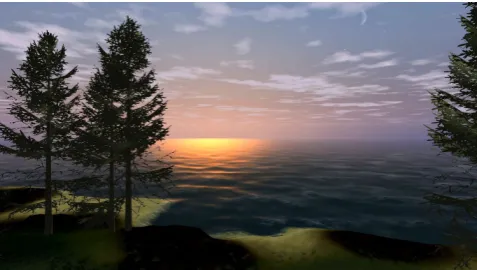
In our demo show-case this value is set to 8, so as repre-senting 1 minute in real as 8 minutes in game. We introduce also the possibility of setting latitude and longitude of the environment positioning, and the Gregorian calendar date of the simulation. In order to simulate the natural lighting we have also set a range for the ambient light, lying in the interval from the darkest blue (for the night) to the light-est yellow (for the day). Figure 6 depicts a dusk panorama, while several other figures within this section illustrate dif-ferent condition of lighting.
4.5
The Particle System
A particle system is helpful to simulate several fuzzy phe-nomena (e.g. fire, water, fog, rain, clouds, etc.) otherwise not easily and realistically reproducible with standard ren-dering techniques. There are several tools to render particle systems, usually adopting scripts to initialize, start and stop certain particle effects, able of contemporary manage differ-ent objects on the scene, hierarchies, etc.
Simulated particle systems should also be subjected to physics in order to reproduce a more realistic virtual world. Thus, in our project we implemented a particle system man-ager exploiting an existing library, namelyParticleUniverse. We integrated, through some modifications, its functionali-ties with those provided by other components of the frame-work. In our demo show-case this system is mainly used to create clouds, rain, hail and snow (see Figures 7 and 8).
4.5.1
The ParticleUniverse Library
ParticleUniverse is a library which can be incorporated inside theOGRE rendering engine to support particle sys-tems. This plug-in consists of an efficient run-time dynamic-link library, developed in C++, which enable the rendering engine to simulate particle systems running specific scripts. We exploited this library for generating realistic weather effects (e.g. rain, snow, clouds, etc.). Moreover, we intro-duced some modifications in order to integrate this library withCaelum,HydraxandPhysX, for representing dynamics among particle systems and the physics.
4.5.2
ParticleListManager
Moreover, it includes the interface toNxOGRE to man-age the physics of interactions among particle systems, or between a particle system and other physical objects on the scene.
4.6
The Weather
Commercial middleware tools likeSimul Weather 2 pro-vide realistic simulation and management of the weather condition within the reproduced virtual worlds. Usually some commonly supported features are the possibility of simulating clouds and related atmospheric effects (e.g. rain, snow, lightning, etc.).
During our development we noticed a lack of open-source products to this purpose. Thus, we decided to develop a new library from scratch, to be included as a plug-in inOGRE, but virtually independent from the platform in which it should run. This library should be integrated with the par-ticle system, because atmospheric effects are better repro-duced this way; it should also be connected to the physics engine, in order to reproduce physics effects; finally an in-terface to the scene manager is required to locate effects on the scene.
4.6.1
WeatherManager
OurWeatherManager class provides methods to manage the simulation of atmospheric effects on the scene. It extends the OGRE:FrameListener class overloading several impor-tant methods; it includes a list of particle systems (via Par-ticleUniverse), provides several attributes for personalizing the weather simulation and, finally it instantiates a couple of objects; the three most important objects are: i) Clouds; ii) Lightning and, iii) Rain. Its most important methods include the fader between different atmospheric condition, the wind simulator and the random precipitation generator. Finally, two methods for saving and loading the state of the system have been included.
4.6.2
Clouds and ManageClouds
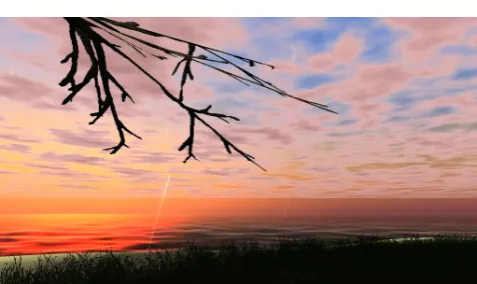
TheClouds class implements the cloud systems. Clouds can be distributed over an arbitrary number of different lay-ers. This class provides generative methods for instantiating a new cloud system, setting several attributes (e.g. the cov-erage of the clouds, the starting speed of each layer, etc.) and the methods for dynamically managing the system in real-time. The realistic effect of transition from an atmo-spheric condition to another is obtained using some fad-ing methods. Clouds strictly depend from the simulation of the weather condition (e.g. the wind) reflecting these changes, and additionally from some dynamically random calculated parameters which reproduce humidity, chance of raining, etc. In Figure 7, as in several other snapshots in this section, we show examples of the cloud system.
4.6.3
Lightning and ManageLightning
The Lightning class implements lightning and thunders. Each instance represents a single lightning event, with the related thunder. The lightning is managed as a particle sys-tem, while the thunder is just the associated sound event.
The sound of thunders is reproduced with a time delay calculated with respect to the distance of the lightning from the camera.
2
http://www.simul.co.uk/weather/
Figure 7: Clouds and the skydome
Figure 8: The effect of raining
4.6.4
Rain and ManageRain
Despite the name, theRainclass represents all the kind of precipitations (e.g. rain, hail, snow, etc.). Similarly to the previous class,Rainowns a proper list of sounds, a particle system, a scene node and a reference to the camera system. To increase the efficiency of this system, each precipitation is not executed over the whole scene, but just over the box containing the scene node the camera is currently pointing to. This way, precipitations just follow the character and the camera, increasing performances.
This class exposes methods to dynamically manage atmo-spheric events, to configure the precipitation particle system at run-time and, finally, to reproduce sounds connected to precipitations. Figure 8 is a snapshot of a rainy panorama.
4.7
Dynamic Simulation of Fluids
Several work [5, 14] covers the problem of simulating dy-namic fluids in videogames; moreover, some commercial mid-dleware engines have been specifically developed to man-age fluid dynamics (e.g. HydroEngine 3). In our project we integrated the Hydrax library, an open-source solution adopted to simulate the dynamics of water and, potentially, other fluids. In our show-case it performs at its best because the whole scene is located in a peninsula surrounded by the ocean (see Figures 9 and 11 for some eye-candy effects).
4.7.1
The Hydrax Library
Hydraxis developed as an open-source add-on forOGRE, which provides an intuitive library in order to render
photo-3
Figure 9: Lighting and reflection on water
realistic water scenes. This library is highly configurable, thus the most of the effects which do not directly depend on shaders can be generated and managed in real-time. This includes water depth and foam effects, smooth transitions and caustics, underwater light rays, etc.
Our improvements to the library include the possibility to manage the RTT (“Render To Texture”) texture qual-ity (e.g. to apply additional effects before displaying the final texture), theHydrax geometry (e.g. in order to calcu-late atmospheric effects on the water), etc. This was possi-ble becauseHydrax is based on a modular interface which supports several different water geometries: i) the infinite ocean module (i.e. a projected-grid-based algorithm); ii) the simple-grid module; iii) the radial-grid module.
4.7.2
HydraxManager
This is the wrapper class we developed to integrate the library in the framework. Moreover, it acts as an inter-face connectingHydrax with the CaelumManager and the
WeatherManager. Finally, it connects the library with other fundamental modules of the framework like the scene man-ager, the camera, etc.
HydraxManager provides several methods to manage the grids (i.e. projected, simple and radial ones).
4.7.3
Caelum and Weather on Water
The interaction amongHydrax and other components is managed by two methods we introduced from scratch, up-dateWeatherOnWater()andupdateCaelumOnWater().
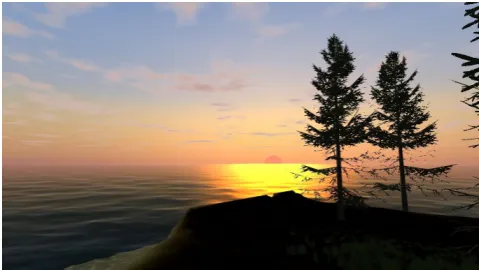
Their update is synchronized with thetimeScalefactor of the simulation, thus reducing the overload of the renderer without burdening on the graphics quality level and perfor-mances. The first method deals with managing the effects of interaction between the dynamic skydome and the water. For example it is involved in computing the reflection of the sun on the ocean, while it moves (thus, simulating the day-night cycle) and changes its position, color and intensity.
The latter, instead deals with simulating the tidal wave as a function of the weather conditions; thus, requiring the computing of the interaction between the wind (and, possi-bly, other atmospheric agents) with the water.
4.8
Outdoor Scenes
Industrial tools like speedtree 4 are specifically designed
to deal with large-scale outdoor environments. There are
4
http://www.speedtree.com/
several techniques which can be adopted to manage such large virtual environments; for example, it is possible to dy-namically load only the specific areas of the scene which are visible to the character. Another interesting approach is to dynamically balance the level of details (LOD) of the objects on the scene, with respect to the distance from the camera; intuitively, it is unnecessary to reproduce high quality ob-jects which are hardly visible because far from the camera; this way, it is possible to reduce the depth of field in order to decrease the number of objects to be rendered. To efficiently manage outdoor scenes we exploited thePaged Geometry li-brary, extending some limited features and integrating them within the framework. These features improve the realism of reproduced outdoor environments, thus allowing developers to design large scale virtual worlds.
4.8.1
The Paged Geometry Library
ThePaged Geometry engine is an open-source add-on to
OGRE which provides highly optimized methods for ren-dering massive amounts of small meshes, covering a possibly infinite area. It is particularly suited for representing forests and outdoor scenes, containing millions trees, grass, rocks, etc. Paged Geometry introduces the main advantage, with respect to plain entities, of allowing a dynamic balancing of the level of detail. This efficient approach ensures better per-formances in particular with outdoor scenes, which can ben-efit of a frame rate increase of an order of magnitude. The algorithm relies on paging the geometry: only entities which are immediately visible are loaded. This drastically reduces the memory requirement and avoids memory leaks for very large outdoor scenes. In details,Paged Geometry relies on three differentpaging systems: i)BatchPage; ii)WindPage; iii) ImpostorPage. The first is adopted to render elements near to the camera; it supports the dynamic lighting system. The second is similar and supports the animation of effects of the wind on the foliage. The latter is adopted to render objects far from the camera, usingstatic billboards instead of three-dimensional meshes; this system does not natively support the dynamic lighting, thus introducing graphics ar-tifacts in an environment completely based on this lighting system. We extended the library to support the dynamic lighting ofImpostorPage-based elements.
4.8.2
PagedGeometryManager
We developed a wrapper class, namely PagedGeometry-Manager, which integrates the library within the framework. This class provides connection to the scene manager, the camera manager, and to objects to be rendered. It deals in particular with the initialization of two components, the
TreeLoaderand theGrassLoader. Finally, we defined meth-ods to provide support to dynamic lighting, a feature not natively supported by the engine.
4.8.3
TreeLoader and GrassLoader
The first technique introduced in the library is the ran-dom generation of a ’forest’, adopting density maps (Figure 3, top right). A density map is a grayscale image whose areas represent positions of the map in which theTreeLoader and the GrassLoader can dynamically instantiate objects. Our
Figure 10: LOD balancing and paged geometry
Figure 11: Dynamic lighting and fluid dynamics
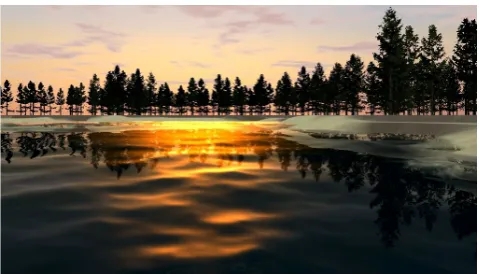
of blocks which represent the grid map. The level of detail is configured via methods to manage theBatchPage, Wind-Page and ImpostorPage sizes. The GrassLoader, instead, adopts only one level of detail (GrassPage). In Figures 10 and 11, we show the dynamic level of detail balancing.
4.8.4
Dynamic Lighting
We introduced the support to dynamic lighting inPaged Geometry, in particular on entities based on the Impostor-Page paging system. This technique is implemented using shaders. Our algorithm relies on the Per-Vertex lighting model, implemented on four light components: i) emissive light; ii) ambient light; iii) diffuse light and, finally, iv) spec-ular light. Dynamic lighting affects reflections (Figure 11).
5.
CONCLUSIONS
In this work we introduced novel extensions to our frame-work for supporting the game development process. It com-pletely relies on state-of-the-art open-source solutions. All the source-code has been released as open-source for possi-ble further improvements5. Our first contribution consists of improving existing libraries. We provided an integration interface to several components, obtaining, de facto, a valid middleware framework for supporting the development of 3D videogames set in virtual environments. Moreover, we developed from scratch a library providing features for the simulation of weather conditions in this environment. This work is testified by developing and illustrating a show-case
5
http://informatica.unime.it/velab/
demonstration which depicts some of the features our frame-work provides. This project could be still extended introduc-ing new features. Some future work will focus on increasintroduc-ing even more the degree of realism of the rendering engine, including new rendering techniques such as thetessellation
[6]. Additional environmental and atmospheric agents will be included, e.g. effects of the wind such as tornadoes, sand-storms, etc. Another important aspect to be introduced is the volumetric cloud simulation [9], thus improving the re-alism of these atmospheric agents.
Acknowledgments
Valerio Mazzeo contributed within his graduation disserta-tion to the design and implementadisserta-tion of this applicadisserta-tion.
6.
REFERENCES
[1] C. Bloom. Terrain texture compositing by blending in the frame-buffer. http://www.cbloom.com/3d, 2000. [2] S. Catanese, E. Ferrara, G. Fiumara, and F. Pagano.
A framework for designing 3d virtual environments. In
4th International ICST Conference on Intelligent Technologies for Interactive Entertainment, 2011. [3] H. Chen and X. Liu. Lighting and material of Halo 3.
InACM SIGGRAPH Classes, pages 1–22, 2008. [4] T. Kaneko, T. Takahei, M. Inami, N. Kawakami,
Y. Yanagida, T. Maeda, and S. Tachi. Detailed Shape Representation with Parallax Mapping. In
International Conference on Artificial Reality and Telexistence, volume 11, pages 205–208, 2001. [5] B. Klingner, B. Feldman, N. Chentanez, and
J. O’Brien. Fluid animation with dynamic meshes.
ACM Transactions on Graphics, 25(3):820–825, 2006. [6] C. Li, J. Li, and X. Tong. Method for Tessellation on Graphics Hardware, 2010. US Patent 20,100/214,294. [7] I. Parberry, J. Nunn, J. Scheinberg, E. Carson, and
J. Cole. SAGE: a simple academic game engine.Proc. of the 2nd Annual Microsoft Academic Days on Game Development in C. Sc. Education, pages 90–94, 2007. [8] J. Schneider, T. Boldte, and R. Westermann.
Real-time editing, synthesis, and rendering of infinite landscapes on GPUs. InProc. of Vision, modeling, and visualization, page 145, 2006.
[9] M. Stiver, A. Baker, A. Runions, and F. Samavati. Sketch Based Volumetric Clouds. InSmart Graphics, pages 1–12. Springer, 2010.
[10] S. Streeting, T. Muldowney, and J. O’Sullivan. Object-oriented graphics rendering engine. http://www.ogre3d.org.
[11] N. Tatarchuk. Artist-directable real-time rain rendering in city environments. InACM SIGGRAPH Courses, pages 23–64, 2006.
[12] D. Trenholme and S. Smith. Computer game engines for developing first-person virtual environments.
Virtual Reality, 12(3):181–187, 2008. [13] B. Watson, P. Muller, P. Wonka, C. Sexton,
O. Veryovka, and A. Fuller. Procedural urban modeling in practice.Computer Graphics and Applications, IEEE, 28(3):18–26, 2008.