Page 291
EDUCATION ON PROPHYLACTIC FOOTWEAR IN THE ELDERLY PEOPLE WITH DIABETES MELLITUS
Silvie Treterová
Palacký University Olomouc, Faculty of Health Sciences, Hněvotínská 976/3, 775 15 Olomouc, Czech Republic
Abstract
One of the objectives of a comprehensive specialized education for diabetics is to prevent the development of diabetic foot syndrome. All the diabetics, including old people, should take the preventive education on comprehensive foot care. Awareness and adherence to appropriate foot care, which also includes choice of high-quality prophylactic footwear, help to prevent the development of the above-mentioned syndrome. To find out the effect of education on the knowledge of prophylactic footwear and on the quality of the shoes worn for seniors with diabetes mellitus. The sample consisted of 278 seniors with diabetes mellitus, 134 (48.0 %) men and 144 (52.0 %) women monitored in outpatients' departments of diabetes and general practitioners' surgeries. Data collection was carried out through guided structured interview and completed with direct non-standardized observation. The average number of completed respondents' education sessions was 0.85 education session, half of them attended more than one education session. Women were shown to remember, on average, more criteria characterizing appropriate prophylactic footwear (1.86 criteria) compared to men (1.2 criteria) after an education session, after two education sessions, the gender difference was eliminated (on average, women and men remembered 3.19 and 3.22 criteria, respectively). Existing shoes showed the following parameters: closed shoe style (95.0 %), solid sole (80.0 %), Velcro and lacing fastening (71.0 %). The use of recommended prophylactic footwear was influenced by the number of criteria that seniors remembered within the provided education session. The appropriate shoes, according to educational recommendations, were worn by respondents who completed more education sessions.
Keywords:education, elderly people, diabetes mellitus, prophylactic footwear, diabetic foot syndrome
1. INTRODUCTION
Page 292
without advanced complications. They are recommended in the early stage of the disease when late complications of diabetes are not yet fully developed, especially in mild forms of peripheral neuropathy, or in patients with ischemic lower limb disease. In addition, they are suitable for patients with insignificant deformities and a positive history of the Diabetic Foot Syndrome, but without active ulceration (Jirkovská et al. 2006; Bakker et al. 2015; Jeffcoate et al. 2018).
2. MATERIALS AND METHODS
The research aimed to find out whether the respondents, seniors with diabetes mellitus, were educated on suitable prophylactic footwear within the prevention of the Diabetic Foot Syndrome and, if the education was performed, to identify the relation between the number of education sessions and the knowledge of respondents about recommended criteria of suitable prophylactic footwear. At the same time, the objective was to assess the real shoes of this group of respondents and to determine the impact of the education on the quality of worn shoes. The respondents were familiar with the research and provided their informed consent. The STATISTICA statistical program was used to analyse the data; the results were described using descriptive statistics, while determination of position characteristics, variability, concentration of selection, estimation of population characteristics, scaling of qualitative variables, investigation of probability distributions (alternative, normal), testing of statistical hypotheses (chi-square test), and alignment of statistical data using normal probability distribution were performed. Research questions
Were the respondents educated in the issues of prophylactic footwear within the prevention of the Diabetic Foot Syndrome? What are the relationships between the number of education sessions on the appropriate prophylactic footwear for seniors with DM and their knowledge of recommended criteria for preventive shoes?
Hypothesis
1H0 Knowledge of the prophylactic shoe criteria does not depend on the number of education sessions.
1HA Knowledge of the number of prophylactic shoe criteria varies depending on the number of
education sessions.
3. RESULTS
The research investigation provided the basic demographic data of the sample, which consisted of 278 (100.0 %) respondents, 134 (48.0 %) men and 144 (52.0 %) women (see Table 1). Some of these data were used from the research of M. Ambruzová (2018, pp. 38-40).
Gender Men Women Total
Age n % n % n %
60 – 65 21 7,7 33 11,9 54 19,6
66 – 70 50 17,9 46 16,6 96 34,5
71 – 75 26 9,2 37 13,4 63 22,6
76 – 80 19 6,9 14 5,0 33 11,9
81 – 85 10 3,5 9 3,3 19 6,8
86 – 90 7 2,5 5 1,8 12 4,3
91 – 95 1 0,3 0 0,0 1 0,3
Total 134 48,0 144 52,0 278 100,00
Page 293
Table 2 shows the results of respondents’ education, 48.0 % men and 52.0 % women were educated; 49.0 % men and 51.0 % women were not educated. When evaluating the number of educated and non-educated persons, we can say that there are no major differences between the genders. One education session was attended by 75.0 % men and 74.0 % women, 25.0 % men and 26.0 % women took two education sessions. The average number of the completed education session per respondent is 0.85 education session, the interval estimate for the population is from 0.81 to 0.89 education session. Half of the patients took more than one education session.
Educated respondents Non-educated respondents
Gender Men Women Total Men Women Total
Age n % n % N % n % n % n %
60 - 65 11 52,0 20 61,0 31 16,3 10 48,0 13 57,0 23 26,1
66 - 70 33 66,0 36 78,0 69 36,3 17 34,0 10 72,0 27 30,7
71 - 75 22 85,0 24 65,0 46 24,2 4 15,0 13 73,0 17 19,3
76 - 80 15 79,0 9 64,0 24 12,6 4 21,0 5 73,0 9 10,2
81 - 85 8 80,0 8 89,0 16 8,4 2 20,0 1 84,0 3 3,4
86 - 90 2 29,0 2 40,0 4 2,1 5 71,0 3 33,0 8 9,1
91 - 95 0 0,0 0 0,0 0 0,0 1 1,0 0 0,0 1 1,1
Σ 91 48,0 99 52,0 190 100,0 43 49,0 45 51,0 88 100,00
Table 2. Level of Education of Respondents (source: author of the contribution, 2019)
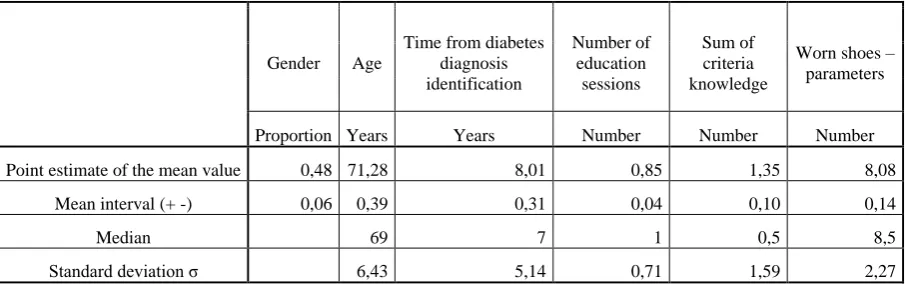
Based on the information obtained from the sample, Table 3 lists the point and interval estimates for the population of all the diabetics under the same conditions (from the same database). The sample is almost the same when converting to the population; the information obtained can be applied to all the diabetics living in the Czech Republic. Men are affected by diabetes in, on average, 0.48 ± 0.06 proportion of all the diabetics. The average age of a diabetes senior ranges from age of 70.9 to age of 71.7, half of them is older than age of 69. Based on the questionnaire survey, the average duration of the disease is about 8.1 years, the interval estimate of the average population is from 7.7 to 8.3 years. The average number of the completed education session per respondent is 0.85 education session, the interval estimate for the population is from 0.81 to 0.89 education session. Half of the patients took more than one education session. The standard deviation indicates that 68.26% of respondents fit into the “mean ± standard deviation” interval.
Gender Age
Time from diabetes diagnosis identification
Number of education
sessions
Sum of criteria knowledge
Worn shoes – parameters
Proportion Years Years Number Number Number
Point estimate of the mean value 0,48 71,28 8,01 0,85 1,35 8,08
Mean interval (+ -) 0,06 0,39 0,31 0,04 0,10 0,14
Median 69 7 1 0,5 8,5
Standard deviation σ 6,43 5,14 0,71 1,59 2,27
Page 294
The results regarding the relationships between the number of education sessions on appropriate prophylactic footwear for seniors with diabetes and their knowledge of recommended criteria for preventive shoes yielded the following findings shown in Tables 3 and 4. The respondents’ knowledge is expressed by the number of retained criteria for prophylactic footwear acquired during the education session.
Knowledge of Prophylactic Footwear Criteria
Ʃ criteria
Shoe length by 1–2 cm
Shoe
width Closed Rigid
sole
Upper without
seams
Heel height
Shoe fastening
Intromissive insole Other
Number 73 70 87 50 20 40 30 0 4 374
Proportion 0,26 0,25 0,31 0,18 0,07 0,14 0,11 0,00 0,01 *0,15
Table 4. Knowledge of Prophylactic Footwear Criteria * per person and criterion
Source: Author of the contribution, 2019
The answers given to the 9 criteria listed (closed shoes, shoe longer than the longest toe by 1–2 cm, wide shoe toe, rigid sole, upper without seams, heel height up to 2.5 cm and 2 cm for women and men, respectively, shoe fastening (Velcro, lacing), damping intermissive insole, and others), which characterize prophylactic footwear, within the questionnaire survey show that the best known criterion among respondents is the criterion of closed shoes, which is known by 31.0 % of them. Information about the insole properties are the least known (0 % of respondents). In order to evaluate the quality of knowledge, the sum of all the criteria can be used, the size of this indicator ranging from 0 to 9. It turned out that the respondents remembered a maximum of 5 criteria (see Table 5). Depending on the number of education sessions, the number of retained criteria increases.
Determination of the effect of the number of education sessions on the knowledge of prophylactic shoe criteria; 95.0 % probability that the observed dependencies would occur only by chance was chosen. The chi-square test was used to determine the effect of the number of education sessions (see Table 5).
Knowledge of the number of criteria
Number of education sessions Data 0 1 2 3 4 5 Ʃ
0 n 91 0 0 0 0 1 92
% 98,91 0,00 0,00 0,00 0,00 1,09 100,00
1 n 44 17 45 23 4 4 137
% 32,12 12,41 32,85 16,79 2,92 2,92 100,00
2 n 4 4 5 14 11 11 49
% 8,16 8,16 10,20 28,57 22,45 22,45 100,00
total n 139 21 50 37 15 16 278
% total 50,00 7,55 17,99 13,31 5,40 5,76 100,00
Observed frequencies 91 0 0 0 0 1 92,20
44 17 45 23 4 4 137,00
4 4 5 14 11 11 49,00
Page 295
Expected frequencies 46,00 6,95 16,55 12,24 4,96 5,29 92,00
68,50 10,35 24,64 18,23 7,39 7,88 137,00
24,50 3,70 8,81 6,52 2,64 2,82 49,00
Table 5. Determination of the Effect of the Number of Education Sessions on Knowledge of Criteria Source: Author of the contribution, 2019
Chi-square test significance: p-value = 1.67E-37,p < 0.05, and, therefore, we reject 1H0 at the level of
significance and accept the alternative hypothesis. Knowledge of number of prophylactic diabetic shoe criteria at patients with diabetes mellitus is affected by the number of completed education sessions. The probability that the observed differences would occur by chance is less than 5.0 %.
Only 2.95 % of respondents knew five criteria after the first education session. After the second education session, the knowledge of at least five prophylactic diabetic shoe criteria exceeded at 20.0 % of the total number of educated respondents. Without education, 98.9 % of patients did not know any criterion characterizing the prophylactic footwear. Statistical analysis was also used to identify differences in remembering prophylactic shoe criteria between genders. It turns out that women can retain more criteria than men. When completing one education session, they remembered 1.86 criteria on average compared to men who remembered 1.2 criteria. After two education sessions, the gender difference is eliminated (on average, 3.19 and 3.22 criteria for women and men, respectively).
4. DISCUSSION
Page 296
Page 297
prophylactic footwear. After the first education session, with the highest frequency, women remembered 1–2 criteria and men remembered 0–1 criterion. After two education sessions, with the highest frequency, women remembered 3–4 criteria and men remembered only 2–3 criteria. Only after completing two education sessions, the frequency of appropriate shoe criteria knowledge became normal; without education and after one education session, the frequency distribution does not show normal distribution characteristics. After analysing the results of our research, an alternative hypothesis that the knowledge of number of prophylactic diabetic shoe criteria at patients with diabetes mellitus is influenced by the number of completed education session has been accepted. We have confirmed the positive effect of repeated education on remembering the recommended criteria.Only after completing two education sessions, the frequency of appropriate prophylactic shoe criteria knowledge became normal. When completing one education session, women remembered 1.86 criteria on average compared to men who remembered 1.2 criteria. After two education sessions, the gender difference is eliminated (on average, 3.19 and 3.22 criteria for women and men, respectively). Healthcare professionals providing education should not neglect the importance of repeated information, advice, and recommendations.
5. CONCLUSION
This contribution aimed to point out the connections between education and patients’ knowledge on prophylactic footwear presented in our research, which helps to prevent late complications of diabetes, the Diabetic Foot Syndrome. The preventive shoes work together with appropriate foot care to prevent ulceration. We have proven that the education provided influences the patients’ knowledge, and for this reason it is necessary to open educational topics in the communication between healthcare professionals and patients repeatedly as only repeatedly provided information improves their knowledge and can cause the desired changes. At the same time, it is necessary to balance the provision of information, advice and recommendations with the patients’ attitudes. To time properly the communication of arguments leading to improved quality of life and postponed complications so that the diabetic is able to receive them; in this particular case, to purchase prophylactic footwear that reduce the risk of foot injuries compared to conventional ready-to-wear shoes.
REFERENCES
1. Ambruzová, M 2018, “Role of Footwear in Prevention of Diabetic Foot Syndrome in the Elderly” Bachelor thesis, Thomas Bata University, Faculty of Humanities, the Czech Republic.
2. Bakker, K et al., 2015 “On behalf of the International Working Group on the Diabetic Foot (IWGDF). Prevention and management of Foot Problems in Diabetes. Guidance Documents and Recommendations“ viewed 25 May 2019, <http://www.iwgdf.org>.
3. Czech Statistical Office 2018, “Demographic yearbook of the Czech Republic 2017“, Prague, Czech
Republic.
4. International Diabetes Federation. Clinical Practice Recommendation on the Diabetic Foot, “A guide for health care professionals : International Diabetes Federation, 2017“.
5. Jeffcoate, WJ et al. 2018, "Current Challenges and Opportunities in the Prevention and Management of Diabetic Foot Ulcers“, Diabetes Care, vol. 41, no. 4, pp. 645-652, viewed 13 June 2019, <https://doi.org/10.2337/dc17-1836>.
6. Jirkovská, A et al. 2006, “Diabetic Foot Syndrome”, Prague: Maxdorf, Czech Republic.
7. Jirkovská, A et al. 2016, “Recommended procedure for prevention, diagnosis and therapy of diabetic foot syndrome”, Prague: ČDS JEP, Czech Republic.
8. Juřeníková, P et al. 2018, “Selected Perioperative Problems of Vascularsurgical Patients”, Brno:
Page 298
9. Krátká, A 2017, “Basics of Pedagogy and Education in Nursing”, Zlín: Thomas Bata Univerzity.
10. Piťhová, P 2017, “Diabetic foot syndrome, Medicine for practice, vol. 14, no. 2, pp. 71-76, viewed
13 June 2019,
<https://www.medicinapropraxi.cz/artkey/med-2017020005_Syndrom_diabeticke_nohy.php?back=%2Fsearch.php%3Fquery%3DPi%25BBhov %25E1%26sfrom%3D0%26spage%3D30>.
11. Van Netten, JJ et al. 2018, “Diabetic Foot Australia Guideline on Footwear for People with Diabetes”, Journal of Foot and Ankle Research, vol. 11, viewed 13 June 2019, <http://doi.org/10.1186/s13047-017-0244-z>.