Page 100
SELF-REGULATION PECULIARITIES OF FUTURE MUSIC TEACHERS Rasa Kirliauskienė
Lithuanian University of Educational Sciences, Studentų 39, Vilnius, Lithuania
Abstract
Each teacher perceives the emotional experiences characteristic of being in front of the audience. However, not only good speaking skills are relevant for a future music teacher, managing the musical skills, which occur while performing is also significant. Music teaching profession is attributed to professions with greater degree of emotional tension, because it is constantly accompanied by concerts, causing varying degrees of mental stress. Thus, self-regulation is very important in future music teachers’ training.
Key words: future music teacher’s training, stage fright, self-regulation
1. INTRODUCTION
According to Gerstein (2014), self-regulation is necessary for maintaining one’s well-being, since it is an opportunity to control and influence the feelings, thoughts and behaviour as well as it creates the basis for both everyday decisions and long-term behavioural trends. Kirliauskienė (2001) also writes that levels of self-regulation are different – those that have good self-regulation can control their emotions, resist the impulsive behaviour, can cheer themselves when they feel bad, because they have a flexible range of emotional and behavioural reactions, which goes in line with environmental requirements. However, the human nervous system is capable of adapting; therefore, everyone with the flow of time can improve his or her emotional self-regulation. All feelings appear in the head and if fear or stress can appear in the thoughts, there they should disappear too, since one can deliberately let occur pleasant feelings, equanimity in a requiring situation or inner peace (Lin et al 2007; Wilson & Roland 2002). Many scientists agree to that idea by encouraging not fighting with fear in the mind, rather overcoming it by changing one’s thoughts. It is difficult to control emotions, but it is possible to choose the way of reacting to them by means of self-control, awareness of one’s moods, analysing them and behaving appropriately (Akyüzlüer 2014; Varela, Abrami & Upitis 2016; Hatfield, Halvari & Lemyre 2016; Papageorgi, Hallam & Welch, 2007).
Very often future music teachers before performing experience fear, stress, anxiety and negative thinking. When one does not know how to think positively, mind is filled with anxiety, therefore, in order to achieve effective self-regulation it is necessary to develop a habit of pushing the negative thoughts away and instead thinking about positive, useful things. While in the face of failures to anticipate the anxiety, negative thoughts and analyse the reasons, which encouraged them, so it would be possible to avoid the same mistakes in the future (Carnegie 2013). Music teacher’s profession according to Kirliauskiene (2005) is assigned to professions, to which the emotional tension is typical. It occurs because of concerts, which are an obligatory component of music teacher’s profession. However, concert activities of professionals and music teachers are different. The scholar points out the following differences:
Music teacher (differently from the conductor that leads the group of professional musicians) on the stage interacts with children and youth that have little experience and is responsible for the exposition of their artistic skills, success of which is often difficult to predict;
Music teacher – is a performer of a wide amplua, demonstrating the vocal and instrumental skills, conducting technique, speaking skills, etc. depending on the situation;
Page 101
These differences elicit the emotional tension during the public performance, thus, the problem becomes even more relevant. Therefore, the aim of this research is to disclose the peculiarities of self-regulation of future music teachers.
2. METHODS OF THE RESEARCH. FINDINGS AND INTERPRETATION
Methods of research and sample: analysis of scientific literature sources, interview. The semi-structured (oral) interview was employed. Qualitative research data are described applying content analysis. The scheme of categorisation was not planned in advance and it was devised on the basis of the received data. The research was carried out in 2016. The informants were from Lithuania University of Educational Sciences. In the research have participated 25 students of fourth year music pedagogy.
The aim of the first stage of the research was to reveal the reasons, which according to students lead to the emergence of the stage fright (see Table 1).
Table 1. Reasons for Emergence of Stage Fright According to Students
Category Subcategory Proving statements
Reasons for emergence of stage fright
Self-doubt “I really do not trust myself, since there are many colleagues who are more gifted and carry out various activities better than me, making me feel the stage fright <…>”.
“My self-doubt was enhanced in music school, when disregarding the lack of technique I was required to perform the music works not complying with my abilities <…>”.
“Everything would be good, but I feel a lack of self-confidence while performing, thus, the stage fright emerges <…>”.
Lack of preparation
“Anxiety occurs much earlier before performing, I start to think about how it will be, but maybe I should play more and think less <…>”.
“<…> I become more worried, when I feel that I’m not prepared enough, played too little <…>”.
“Sometimes I cannot sleep before performing on stage, I feel that I lack preparation, but it is too late because better to sleep more and focus than going to perform without sleeping <…>”.
Lack of stage experience
“I lack stage experience, thus, mu anxiety is stronger <…>”.
“Of course, the more I perform the more experience I gain the better I feel on stage; sometimes I’m able to relax <…>”.
“Not only my musical experience is insufficient, I cannot boast about it on stage either, thus, I feel anxious”.
“When there is a lack of stage experience, the stage fright emerges, but sometimes sincerity and sufficient preparation help a lot <…>”.
Personal qualities
“I’m an introvert, so playing or singing alone is best for me because performing publicly is scary”.
“I need a lot of time to feel good on stage; I think I am a very sensitive person, who cares a lot about what others will say about my performance <…>”.
“I’m very communicable, sincere person, but stage fetters me, I become a different person – lost, frightened <…>”.
Research results (Table 1) show that reasons for emergence of the stage fright according to students are the following: lack of self-confidence and preparation, lack of stage experience and personal qualities.
Page 102
capabilities and lack of maturity. The respondents have highlighted the insufficient preparation as one more cause of the stage fright, stating “Anxiety occurs much earlier before performing”, while lack of preparation evokes the early anxiety and uncertainty. The lack of stage experience does not let to relax and experience the happiness of performing on stage, but it is believed that with some time and by gaining more and more musical and stage experience, the quality of performance and well-being on stage will also be improving. Furthermore, personal qualities are an important subcategory according to students, when naming the reasons of appearance of stage fright. The evaluation and support are very important for especially sensitive people. It is not rare that the musicianship when alone is qualitative and helping to relax, but being on stage is more binding and often eliciting various unexpected things, which become one more reason for the emergence of stage fright.
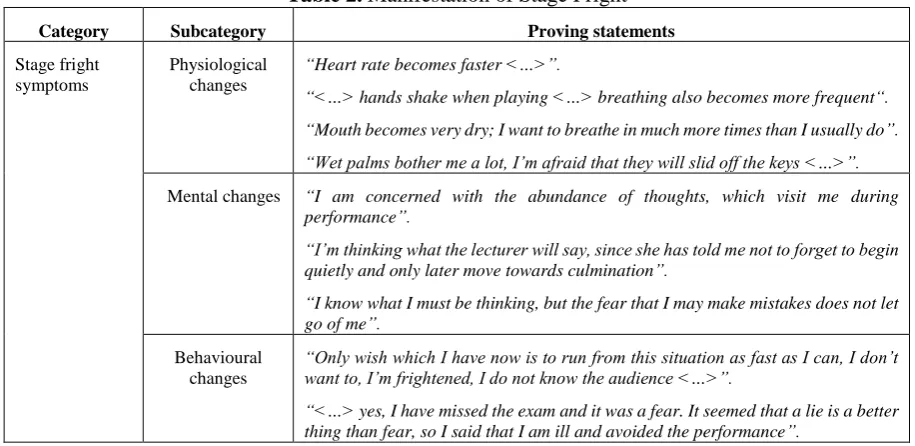
During the research, the attempt was made to find out what are the symptoms of the manifestation of stage fright (see Table 2).
Table 2. Manifestation of Stage Fright
Category Subcategory Proving statements
Stage fright symptoms
Physiological changes
“Heart rate becomes faster <…>”.
“<…> hands shake when playing <…> breathing also becomes more frequent“.
“Mouth becomes very dry; I want to breathe in much more times than I usually do”. “Wet palms bother me a lot, I’m afraid that they will slid off the keys <…>”.
Mental changes “I am concerned with the abundance of thoughts, which visit me during performance”.
“I’m thinking what the lecturer will say, since she has told me not to forget to begin quietly and only later move towards culmination”.
“I know what I must be thinking, but the fear that I may make mistakes does not let go of me”.
Behavioural changes
“Only wish which I have now is to run from this situation as fast as I can, I don’t want to, I’m frightened, I do not know the audience <…>”.
“<…> yes, I have missed the exam and it was a fear. It seemed that a lie is a better thing than fear, so I said that I am ill and avoided the performance”.
The research results presented in the Table 2 show that the stage fright manifests itself in physiological, mental and behavioural symptoms. Respondents state that they are bothered by dry mouth, trembling voice and breathing disorders while singing or speaking (when presenting a report, conducting a lesson). They also feel the faster heart beat during various activities. Not only the homeostasis disorder, which appears through physiological symptoms, bothers the students, they are also distracted by the variety of thoughts, which prevents them from focusing and disposing themselves to the performance, they are afraid of how the lecturers will evaluate the performance, wonder if they will not forget the text, etc. Moreover, stage fright also manifests through the change of behaviour. Informants underline that when conquered by fear they sometimes behave inadequately and even lie: “<…> yes, I have missed the exam
and it was a fear. It seemed that a lie is a better thing than fear, so I said that I am ill and avoided the performance”.
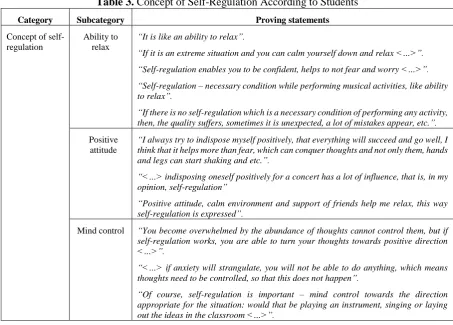
Having determined the symptoms of stage fright, it was also relevant to find out what the respondents know about the concept of self-regulation.
Page 103
“You become overwhelmed by the abundance of thoughts, cannot control them, but if self-regulation works, you are able to turn your thoughts towards positive direction <…>”.
Table 3. Concept of Self-Regulation According to Students
Category Subcategory Proving statements
Concept of self-regulation
Ability to relax
“It is like an ability to relax”.
“If it is an extreme situation and you can calm yourself down and relax <…>”.
“Self-regulation enables you to be confident, helps to not fear and worry <…>”. “Self-regulation – necessary condition while performing musical activities, like ability to relax”.
“If there is no self-regulation which is a necessary condition of performing any activity, then, the quality suffers, sometimes it is unexpected, a lot of mistakes appear, etc.”.
Positive attitude
“I always try to indispose myself positively, that everything will succeed and go well, I think that it helps more than fear, which can conquer thoughts and not only them, hands and legs can start shaking and etc.”.
“<…> indisposing oneself positively for a concert has a lot of influence, that is, in my opinion, self-regulation”
“Positive attitude, calm environment and support of friends help me relax, this way self-regulation is expressed”.
Mind control “You become overwhelmed by the abundance of thoughts cannot control them, but if self-regulation works, you are able to turn your thoughts towards positive direction <…>”.
“<…> if anxiety will strangulate, you will not be able to do anything, which means thoughts need to be controlled, so that this does not happen”.
“Of course, self-regulation is important – mind control towards the direction appropriate for the situation: would that be playing an instrument, singing or laying out the ideas in the classroom <…>”.
Furthermore (see Table 3), if there is no self-regulation or it is forgotten, then suffers the quality of activity: “If there is no self-regulation which is a necessary condition of performing any activity, then,
the quality suffers, sometimes it is unexpected, a lot of mistakes appear, etc.”.
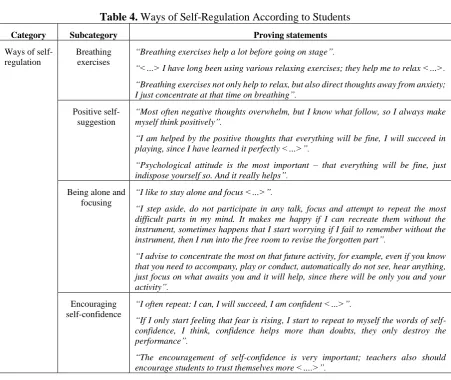
During the other stage of research it was analysed what ways of self-regulation are known to future music teachers (see Table 4).
Ways of self-regulation according to respondents are based on breathing exercises, positive self-suggestion, being alone and focusing and encouraging self-confidence. Breathing exercises not only help to relax, but also direct the thoughts away from negative feelings, while concentrating on the performance of exercises and focusing on that activity. Informants think that positive mind control is one of the ways of self-regulation enabling to help oneself before the performance, when negative thoughts about the future performance overwhelm: “Psychological attitude is the most important – that
everything will be fine, just indispose yourself so. And it really helps <…>”.
Page 104
Table 4. Ways of Self-Regulation According to Students
Category Subcategory Proving statements
Ways of self-regulation
Breathing exercises
“Breathing exercises help a lot before going on stage”.
“<…> I have long been using various relaxing exercises; they help me to relax <…>.
“Breathing exercises not only help to relax, but also direct thoughts away from anxiety; I just concentrate at that time on breathing”.
Positive self-suggestion
“Most often negative thoughts overwhelm, but I know what follow, so I always make myself think positively”.
“I am helped by the positive thoughts that everything will be fine, I will succeed in playing, since I have learned it perfectly <…>”.
“Psychological attitude is the most important – that everything will be fine, just indispose yourself so. And it really helps”.
Being alone and focusing
“I like to stay alone and focus <…>”.
“I step aside, do not participate in any talk, focus and attempt to repeat the most difficult parts in my mind. It makes me happy if I can recreate them without the instrument, sometimes happens that I start worrying if I fail to remember without the instrument, then I run into the free room to revise the forgotten part”.
“I advise to concentrate the most on that future activity, for example, even if you know that you need to accompany, play or conduct, automatically do not see, hear anything, just focus on what awaits you and it will help, since there will be only you and your activity”.
Encouraging self-confidence
“I often repeat: I can, I will succeed, I am confident <…>”.
“If I only start feeling that fear is rising, I start to repeat to myself the words of self-confidence, I think, confidence helps more than doubts, they only destroy the performance”.
“The encouragement of self-confidence is very important; teachers also should encourage students to trust themselves more <….>”.
However, respondents state the way opposite to that one (Table 4), mentioning as one of the possible self-regulation ways staying alone and focusing: “I like to stay alone and focus <…>”. The respondents also assign the encouragement of self-confidence to the ways of self-regulation. They think that lack of confidence may damage the quality of performance, thus, it is necessary to encourage self-confidence, which should be also done by teachers, constantly encouraging learners’ self-confidence.
Research results presented in Table 5 reflect the students’ well-being during certain activities.
Page 105
Table 5. Analysis of Students’ Well-Being
Category Subcategory Proving statements
Students’ well-being
Public performance
(concert)
“If I know that I will have to perform in front of a big audience, anxiety intensifies <...>”.
“Responsibility is very important, you cannot let down the people who trust you; one thing is to play alone and completely different when many people are listening to you, since you cannot start again from the beginning if you fail”.
“I like to play or sing to the audience in which there is no familiar people the most, since I don’t want to hear criticism because things do not always succeed <…>”.
Performance during exams
“The evaluation is very important for me, so I’m always very nervous during exams; I don’t think that it can be any other way <...>”.
“It is linked to evaluation, if there wouldn’t be a grade, I could relax more and my performance would be more musical <…>”.
“I try to perform as good as possible, but not always succeed, maybe I lack confidence, and sometimes maybe I don’t like the program which I perform <…>”.
Conducting a lesson
“My first lessons weren’t very successful because I felt a strong anxiety, now I already feel more confident, thus, I feel better too <…>”.
“I want to be a music teacher, so each lesson is an interesting achievement for me, even though I can’t defeat the anxiety <…>”.
“I don’t think that I have sufficient skills for all the activities, but I feel good enough when conducting, thus, I conduct a lot when teaching solfeggio, songs and even for rhythmic exercises”.
It is also achieved (see Table 5) with the help of strengthened motivation to become a music teacher and the choice of activities: “I don’t think that I have sufficient skills for all the activities, but I feel good
enough when conducting, thus, I conduct a lot when teaching solfeggio, songs and even for rhythmic exercises”.
During the following stage of research, the attempt was made to disclose the attitude of future music teachers towards the factors promoting the positive students’ state while they are on stage.
Page 106
Table 6. Factors Promoting Positive Students’ State while on Stage
Category Subcategory Proving statements
Promoting Factors
Assuredness “It is a guarantee of success, if you do not feel assuredness, don’t go to the stage at all, and forget it”.
“One of the most important things in human life is self-confidence, while on stage it is an inseparable part <…>”.
“Assuredness helps and motivates to feel good on the stage, maybe it could be even enlarged a bit <…>”.
Level of preparedness “If you are well prepared, feel good while waiting to go on stage”
“Not only confidence is important, good preparedness is necessary, and then assuredness will rise to another level too”.
“I wasn’t prepared, inadequately evaluated the situation, I will not do that again, it was horrible even for me <…>”.
Musical skills “If I would have more beautiful voice I would feel better, I try to put in a lot of effort, but the timbre is an inborn thing <…>”.
“<…> it is important to have musical abilities because if you have mastered some sort of musical activity it is obvious that your confidence grows”.
Stage experience “<…> yes, this is a very good factor, because, for example, I perform a lot so being in front of the audience and sing, dance or play makes no difficulty <…>”.
“A lot of people lack stage experience, but why then they refuse to perform when lecturers offer, how you gain it if you avoid it yourself <…>”.
Personal qualities “If you are willing to share artistic performance with others it helps to feel free on stage”.
“Decisiveness helps to go on stage; otherwise I would have escaped <…>”.
“I need attention, maybe even glory; this most probably motivates my well-being on stage”.
Favourable environment and
support
“I mostly like to perform and feel well in nursing homes, I feel so needed”. “I like to invite the support team, I feel more comfortable to perform on stage this way, as if I feel protected by them <…>”.
They mostly like to perform in the environment (see Table 6), where they feel support, being needed and safety. Informants agree that when going on stage are required decisiveness, good musical skills and a wish to share artistic performance, while positive state is promoted by the strive for attention and glory.
3. CONCLUSIONS
Page 107
According to informants, the concept of self-regulation is disclosed through ability to relax, positive attitude and mind control. Self-regulation is necessary while performing the teacher’s activities: conducting lessons, singing, playing, conducting, etc. According to students, the essence of self-regulation lies in the ability to relax, have a positive attitude and controlling one’s mind, while if there is no self-regulation or it is forgotten, then suffers the quality of activity.
Ways of self-regulation according to respondents are based on breathing exercises, positive self-suggestion, being alone and focusing and encouraging self-confidence. Breathing exercises not only help to relax, but also direct the thoughts away from negative feelings, while concentrating on the performance of exercises and focusing on that activity. Informants think that positive mind control is one of the ways of self-regulation enabling to help oneself before the performance, when negative thoughts about the future performance overwhelm.
REFERENCES
Akyüzlüer, F 2014, ‘Self-regulation skills of pre-service music teachers’, Educational Research and Reviews, vol. 9, no. 17, pp. 650 – 659.
Carnegie, D 2013, Kaip išvengti nerimo ir streso, Kaunas, Obuolys.
Gerstein, J 2014, ‘Self-Regulation: The Other 21st Century Skills’ [Accesed on 2017-02-03]. Retrieved from: <https://usergeneratededucation.wordpress.com/2014/08/24/self-regulation-the-other-21st-century-skills/>.
Hatfield, JL, Halvari, H, Lemyre, PN 2016, ‘Instrumental practice in the contemporary music academy: A three-phase cycle of Self-Regulated Learning in music students’, Musicae Scientiae, vol. 5, pp. 1–22. Kirliauskienė, R 2005, Muzikos mokytojo savireguliacija. Mokslinis metodinis leidinys aukštųjų mokyklų studentams, VPU, Vilniaus pedagoginio universiteto leidykla.
Kirliauskienė, R 2001, Studento, kaip atlikėjo, savireguliacijos pedagoginis skatinimas. Daktaro disertacijos santrauka. Socialiniai mokslai, edukologija, Vilnius, VPU.
Lin, P, Chang, J, Zemon, V, Midlarsky, E 2007, ‘Silent illumination: a study on Chan (Zen) meditation, anxiety, and musical performance quality’, Psychology of Music, vol. 36, no. 2, pp. 139–155.
Papageorgi, I, Hallam, S, Welch, GF 2007, ‘A conceptual framework for understanding musical performance anxiety’, Research Studies in Music Education, vol. 28, no. 1, pp. 83-107.
Varela, W, Abrami, PC, Upitis, R 2016, ‘Self-regulation and music learning: A systematic review’,
Psychology of Music, vol. 44, no. 1, pp. 55–74.