R E S E A R C H A R T I C L E
Open Access
Evaluation of features to support safety and
quality in general practice clinical software
Michelle Sweidan
1*, Margaret Williamson
1, James F Reeve
1, Ken Harvey
2, Jennifer A O
’
Neill
3, Peter Schattner
4and Teri Snowdon
5Abstract
Background:Electronic prescribing is now the norm in many countries. We wished to find out if clinical software systems used by general practitioners in Australia include features (functional capabilities and other characteristics) that facilitate improved patient safety and care, with a focus on quality use of medicines.
Methods:Seven clinical software systems used in general practice were evaluated. Fifty software features that were previously rated as likely to have a high impact on safety and/or quality of care in general practice were tested and are reported here.
Results:The range of results for the implementation of 50 features across the 7 clinical software systems was as follows: 17-31 features (34-62%) were fully implemented, 9-13 (18-26%) partially implemented, and 9-20 (18-40%) not implemented. Key findings included: Access to evidence based drug and therapeutic information was limited. Decision support for prescribing was available but varied markedly between systems. During prescribing there was potential for medicine mis-selection in some systems, and linking a medicine with its indication was optional. The definition of‘current medicines’versus‘past medicines’ was not always clear. There were limited resources for patients, and some medicines lists for patients were suboptimal. Results were provided to the software vendors, who were keen to improve their systems.
Conclusions:The clinical systems tested lack some of the features expected to support patient safety and quality of care. Standards and certification for clinical software would ensure that safety features are present and that there is a minimum level of clinical functionality that clinicians could expect to find in any system.
Background
Electronic prescribing (e-prescribing) offers an opportu-nity to improve the quality, safety and efficiency of health care and is now the norm in many countries [1]. There is evidence to show that e-prescribing (often with clinical decision support) is associated with a reduction in medication errors and incomplete or unclear orders, improved drug allergy detection and greater adherence with clinical practice guidelines [2-4]. There are however also reports of unintended negative consequences of e-prescribing, for example unfavourable effects on work-flow and the introduction of new types of errors [5,6].
Software systems for e-prescribing have been available for two decades, however standards and certification
processes for these systems have lagged behind develop-ment and use of the software. Currently there is little information for funders or users of these systems to assess how effectively a system supports healthcare safety and quality.
In Australia, general practitioners (GPs) have been using clinical software systems that include e-prescribing for more than 15 years, with rapid uptake encouraged by government incentives in the 1990s. These systems have been developed in an unregulated environment, with little evaluation of their impact on clinical practice or health outcomes. We wished to find out if current systems include features that facilitate improved patient safety and care, with a focus on quality use of medi-cines. Quality use of medicines is the judicious, effective and safe use of medicines, and in terms of clinical soft-ware functionality it encompasses the entire medication management process.
* Correspondence: [email protected]
1
NPS: Better choices, Better health, Level 7, 418A Elizabeth St, Surry Hills NSW 2010, Australia
Full list of author information is available at the end of the article
In previous work we identified a list of desirable soft-ware features (where feature includes functionality or other characteristic of a software system), with each feature being rated for its expected impact on safety, quality and usefulness to the clinician and the patient [7]. In this study the features were tested in seven clini-cal software systems. Here we report on the software testing process and the results for a subset of the features.
Methods
The study protocol was approved by the Australian Government Department of Health and Ageing Ethics Committee.
Features tested
Of the 114 software features previously identified, 104 were tested in software (10 were classified as ‘ aspira-tional’) [7]. In this paper we report on the results for the 50 features that were rated as likely to have a high impact on safety and/or quality of care, and that could be tested in software.
Software systems
Seven commonly used general practice clinical systems were evaluated: Best Practice™, Genie™, Medical Direc-tor 2™, Medical Director 3™, MedTech32™, Practix™ and Profile™. Added together, the users of these sys-tems account for more than 90% of Australian GPs. All the systems integrate prescribing within an electronic health record. For testing, the systems were purchased and installed on two dedicated laptop computers. Default settings in the software were not altered unless the test script specified a change. The software version tested was the most recent version of the software pro-duced and available on 1 January 2008.
Development of test scripts
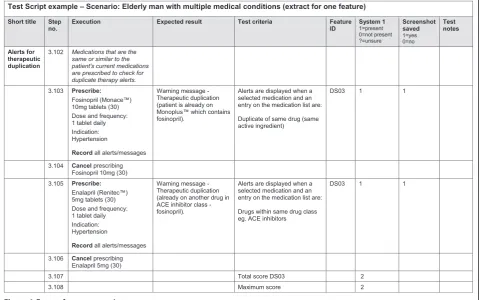
Test scripts were developed using clinical scenarios based on 11 imaginary patients visiting their GPs. For each of the features to be tested, one or more test cri-teria were developed. Each test script was prepared in a separate Excel worksheet and was designed to produce a logical flow for testing and to facilitate data entry; there were 660 executable steps and 350 test criteria in total for the 104 features. The test scripts were reviewed by a GP and a health informatician–they provided feedback on the content, format and clarity of the scripts. An extract from one of the test scripts is shown in Figure 1.
Software testing
Testing was undertaken independently by two research-ers in January to April 2008. The same researchresearch-ers also carried out pilot testing to assess the usability of the test
scripts and how the process flowed. Full testing fol-lowed, with the process being completed for each script across all seven systems prior to starting the next script. Approximately 2000 screenshots were saved by each tester.
At the completion of testing for each script, the results were reviewed and compared between the two researchers. Where their scores were in agreement, the test results were accepted. Where there was disagree-ment, four researchers (ZA, AS, MS, MW) met to dis-cuss the variation in results and reach a consensus decision, which in some cases required retesting. At the end of the test process, one of the researchers (MS) undertook a line-by-line review of all results to check the scores and to identify any results that were unclear, unexpected or inconsistent, and that required verifica-tion with an expert user or the software vendor.
A number of features could not be tested adequately within the test environment. A GP expert user of each system (nominated by the vendor of that system) was contacted in February 2009 to find out about implemen-tation of these features in their system. The test scripts were recast as interview questions that required a yes/ no response. A researcher interviewed each GP at their practice, requesting a demonstration on the computer or further details where applicable. The responses were recorded by hand. Expert users provided information on the processes for receipt of pathology results and incor-poration of these results into patient records, use of messaging, availability of system logs and ease of soft-ware updates.
Review of preliminary results with software vendors Test data were collated and the preliminary results were provided to each software vendor, with a request for feedback. They were informed that the preliminary results for their system would be reviewed based on their feedback, and that the scores would be revised if there was sufficient evidence to show that the system included any functionality in question. A face-to-face meeting or teleconference was held with representatives from each company in April 2009. Discussion focussed on features where the test results were unclear or where there was disagreement. The representatives provided a demonstration of the system and/or documentation of functionality to support any claims. Meeting notes were sent back to each vendor, with further comment invited by email.
Review of results by study guidance group
be easily accessed by the average GP, and a system should not‘pass’where a feature is available but which requires extensive configuration or assistance from the vendor in order to use it; (2) if a feature is dependent on an external source of information (eg, many of the decision support features), it should remain as a scored feature, but with a note that the feature is dependent on the availability of a suitable knowledge resource; and (3) for some features the results available were either not sufficient to score the item at all, or not to score it quantitatively - these were designated ‘not scored’ or ‘description only’. Most of the recommendations were accepted and scores were increased for all seven sys-tems, with between 9 and 18% of the scores being revised across the systems.
Results
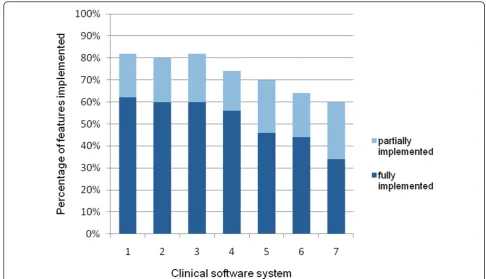
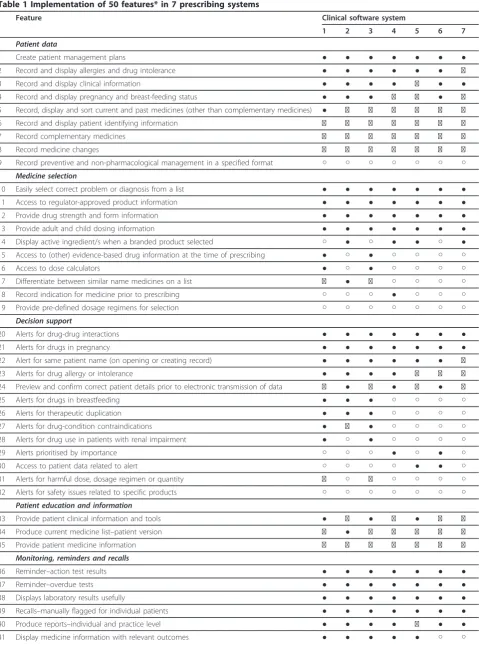
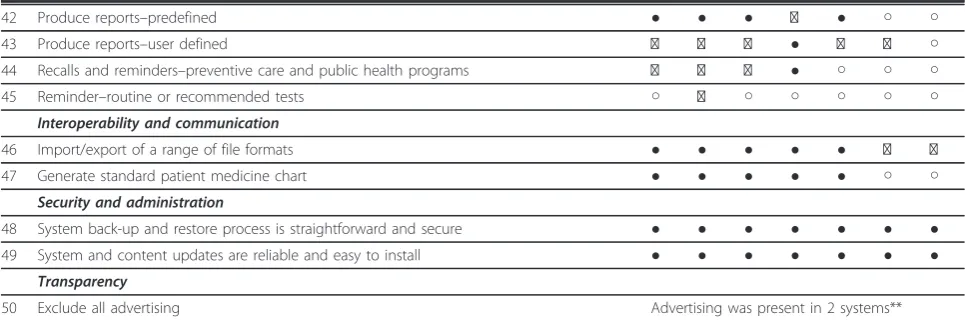
The implementation of the 50 scored features in seven clinical software systems is shown in Figure 2 and Table 1. Figure 2 provides an aggregate view of the implementation of the features: of the 50 features, the number that were fully implemented in the 7 systems ranged from 17-31 features (34-62%), with 9-13 (18-26%) features being partially implemented, and 9-20 (18-40%) not implemented. Table 1 shows the results by individual feature. The software systems are not
identified individually as our intention was to look at features across all systems and make general recommen-dations for improvement of clinical software.
Important safety features that were included in all or most systems were alerts for drug-drug interactions, drugs in pregnancy and allergies. Most systems dis-played information about allergies and pregnancy and breastfeeding status throughout the consultation. All systems had reminders for new pathology results that were abnormal and for overdue pap smears, and warned the user when creating or opening a record where there was another patient with the same name in the system.
There were also some gaps and limitations, as follows:
• Variable decision support for prescribing. Some sys-tems provided decision support for therapeutic duplica-tion (3 systems), drug-condiduplica-tion contraindicaduplica-tions (3 systems), drug use in breastfeeding (3 systems) and renal impairment (2 systems). There was little or no decision support for harmful dosage regimens or for safety issues related to specific products, such as recent warnings issued by the Therapeutic Goods Administra-tion. Several software vendors cited lack of viable access to suitable knowledge bases to implement some of these features.
•Limited access to evidence-based drug and therapeutic information. No system provided access to information Test Script example – Scenario: Elderly man with multiple medical conditions (extract for one feature)
Short title Step
no. Execution Expected result Test criteria Feature ID System 1 1=present 0=not present ?=unsure
Screenshot saved
1=yes 0=no
Test notes
Alerts for therapeutic duplication
3.102 Medications that are the same or similar to the patient's current medications are prescribed to check for duplicate therapy alerts.
3.103 Prescribe: Fosinopril (Monace™) 10mg tablets (30) Dose and frequency: 1 tablet daily Indication: Hypertension
Record all alerts/messages
Warning message - Therapeutic duplication (patient is already on Monoplus™ which contains fosinopril).
Alerts are displayed when a selected medication and an entry on the medication list are:
Duplicate of same drug (same active ingredient)
DS03 1 1
3.104 Cancel prescribing
Fosinopril 10mg (30)
3.105 Prescribe:
Enalapril (Renitec™) 5mg tablets (30) Dose and frequency: 1 tablet daily Indication: Hypertension
Record all alerts/messages
Warning message - Therapeutic duplication (already on another drug in ACE inhibitor class - fosinopril).
Alerts are displayed when a selected medication and an entry on the medication list are:
Drugs within same drug class eg. ACE inhibitors
DS03 1 1
3.106 Cancel prescribing Enalapril 5mg (30)
3.107 Total score DS03 2
3.108 Maximum score 2
from either of two key Australian medicines references– the Australian Medicines Handbook and Therapeutic Guidelines. These resources provide independent, evi-dence based drug information but at present they are not available in a format that can readily be incorpo-rated into clinical software systems. In relation to drug dosage, all systems provided adult and child dosing information that was based on the Australian regulator-approved product information, however this information source has limitations as it does not include off-label indications and often does not include paediatric dosage.
• Potential for medicine mis-selection at the time of prescribing. The display of medicines in most systems was not optimal–long lists of products were displayed in small windows that required extensive scrolling, and the same or similarly named products were listed together with no clear differentiation between them. Only one sys-tem implemented a method to reduce the risk of mis-selection by making product mis-selection a two-step process.
• Linking a medicine with its indication was optional. Linking was possible in all systems but in no case man-datory. Linking is important so that other health provi-ders know what the medicine is for when health information is communicated or shared, and for quality improvement activities eg, comparison of own prescrib-ing versus best practice guidelines.
• Definition of‘current medicines’vs ‘past medicines’ was not always clear. Some systems moved a medicine
from the‘current’to the ‘past’ list automatically after a certain period. This is a crucial component of a health record and there is no standard definition of ‘current medicines’and how they should be handled in an elec-tronic health record.
• Medicines lists for patients were suboptimal. All sys-tems produced a patient version of the current medi-cines list but in most cases it was suboptimal, being poorly formatted, omitting the purpose of the medicine, or using Latin or non-standard abbreviations.
•Some systems did not have warnings for allergy cross-sensitivities. Three systems did not provide an alert when a cephalosporin was prescribed in a penicillin-allergic patient.
• No standard way to record preventive care and non-pharmacological management. This is an increasingly important aspect of care; details were able to be recorded in different parts of the record or not at all.
• Limited patient resources. All systems provided access to Australian consumer medicines information leaflets. Availability of other patient resources was vari-able, ranging from none at all to two systems with a large number of resources, including leaflets on specific medicines, health conditions and nutrition.
Table 1 Implementation of 50 features* in 7 prescribing systems
Feature Clinical software system
1 2 3 4 5 6 7
Patient data
1 Create patient management plans ● ● ● ● ● ● ●
2 Record and display allergies and drug intolerance ● ● ● ● ● ● ◖
3 Record and display clinical information ● ● ● ● ◖ ● ●
4 Record and display pregnancy and breast-feeding status ● ● ● ◖ ◖ ● ◖
5 Record, display and sort current and past medicines (other than complementary medicines) ● ◖ ◖ ◖ ◖ ◖ ◖
6 Record and display patient identifying information ◖ ◖ ◖ ◖ ◖ ◖ ◖
7 Record complementary medicines ◖ ◖ ◖ ◖ ◖ ◖ ◖
8 Record medicine changes ◖ ◖ ◖ ◖ ◖ ◖ ◖
9 Record preventive and non-pharmacological management in a specified format ○ ○ ○ ○ ○ ○ ○
Medicine selection
10 Easily select correct problem or diagnosis from a list ● ● ● ● ● ● ●
11 Access to regulator-approved product information ● ● ● ● ● ● ●
12 Provide drug strength and form information ● ● ● ● ● ● ●
13 Provide adult and child dosing information ● ● ● ● ● ● ●
14 Display active ingredient/s when a branded product selected ○ ● ○ ● ● ○ ●
15 Access to (other) evidence-based drug information at the time of prescribing ● ○ ● ○ ○ ○ ○
16 Access to dose calculators ● ○ ● ○ ○ ○ ○
17 Differentiate between similar name medicines on a list ◖ ● ◖ ○ ○ ○ ○
18 Record indication for medicine prior to prescribing ○ ○ ○ ● ○ ○ ○
19 Provide pre-defined dosage regimens for selection ○ ○ ○ ○ ○ ○ ○
Decision support
20 Alerts for drug-drug interactions ● ● ● ● ● ● ●
21 Alerts for drugs in pregnancy ● ● ● ● ● ● ●
22 Alert for same patient name (on opening or creating record) ● ● ● ● ● ● ◖
23 Alerts for drug allergy or intolerance ● ● ● ● ◖ ◖ ◖
24 Preview and confirm correct patient details prior to electronic transmission of data ◖ ● ◖ ● ◖ ● ◖
25 Alerts for drugs in breastfeeding ● ● ● ○ ○ ○ ○
26 Alerts for therapeutic duplication ● ● ● ○ ○ ○ ○
27 Alerts for drug-condition contraindications ● ◖ ● ○ ○ ○ ○
28 Alerts for drug use in patients with renal impairment ● ○ ● ○ ○ ○ ○
29 Alerts prioritised by importance ○ ○ ○ ● ○ ● ○
30 Access to patient data related to alert ○ ○ ○ ○ ● ● ○
31 Alerts for harmful dose, dosage regimen or quantity ◖ ○ ◖ ○ ○ ○ ○
32 Alerts for safety issues related to specific products ○ ○ ○ ○ ○ ○ ○
Patient education and information
33 Provide patient clinical information and tools ● ◖ ● ◖ ● ◖ ◖
34 Produce current medicine list–patient version ◖ ● ◖ ◖ ◖ ◖ ◖
35 Provide patient medicine information ◖ ◖ ◖ ◖ ◖ ◖ ◖
Monitoring, reminders and recalls
36 Reminder–action test results ● ● ● ● ● ● ●
37 Reminder–overdue tests ● ● ● ● ● ● ●
38 Displays laboratory results usefully ● ● ● ● ● ● ●
39 Recalls–manually flagged for individual patients ● ● ● ● ● ● ●
40 Produce reports–individual and practice level ● ● ● ● ◖ ● ●
varied markedly. For example, in only one system could we easily produce a report to identify patients who had not returned for their third dose of human papilloma-virus vaccine.
• Pharmaceutical advertising was present in two sys-tems. This was displayed at the time of prescribing, often in a colourful, flashing format. Subsequently both systems removed this form of advertising.
Discussion Findings
The seven clinical software systems tested in this study all included some important safety and quality features however there were also gaps and limitations, as out-lined above. The scope and quality of decision support features were particularly variable–this followed from differences in the knowledge bases used, or in some cases differences in the way a knowledge base was incorporated in the system. Some recommended fea-tures could not be implemented at the time of the study, for example because there was no nationally accepted messaging standard or drug and disease terminology.
The user interfaces differed substantially from system to system and many features were implemented in dif-ferent ways, reflecting in part a lack of guidance for standardisation of clinical software. Up until recently there was little information or evidence on how to design the clinical software interface for usability and patient safety, however there is now work being done in this area [8-10].
Many of the software vendors welcomed the feedback from the study and indicated that they would incorpo-rate changes to improve their products. Apart from one company which develops its own in-house drug and decision support database, the others were reliant on commercial knowledge bases for decision support and they had little control over the content. They are keen for guidance and standards to facilitate development and interoperability of their products. The study has raised awareness of these issues in the medical software industry and has stimulated discussion about software standards.
Strengths and limitations
The software evaluation process was complex and resource intensive, and has not been done on this scale before in Australia. The methods for producing test scripts and the test process itself were developed and refined over the course of the project. Limita-tions of the study include that we did not measure the usability of features or examine in detail the quality of the integrated information, thus features that were fully implemented were present but would not necessarily perform optimally in practice. A small number of test examples were used to test each fea-ture; these were intended to be typical and were not exhaustive. Lastly, testing was done in a ‘laboratory’ environment using the default system settings; in real-life practice, these systems may perform differ-ently depending on the local system configuration and prescriber behaviour.
Table 1 Implementation of 50 features* in 7 prescribing systems(Continued)
42 Produce reports–predefined ● ● ● ◖ ● ○ ○
43 Produce reports–user defined ◖ ◖ ◖ ● ◖ ◖ ○
44 Recalls and reminders–preventive care and public health programs ◖ ◖ ◖ ● ○ ○ ○
45 Reminder–routine or recommended tests ○ ◖ ○ ○ ○ ○ ○
Interoperability and communication
46 Import/export of a range of file formats ● ● ● ● ● ◖ ◖
47 Generate standard patient medicine chart ● ● ● ● ● ○ ○
Security and administration
48 System back-up and restore process is straightforward and secure ● ● ● ● ● ● ●
49 System and content updates are reliable and easy to install ● ● ● ● ● ● ●
Transparency
50 Exclude all advertising Advertising was present in 2 systems**
●fully implemented (all test criteria met).
◖partially implemented (some test criteria met).
○not implemented (no test criteria met). Notes
* There were 7 other features that were classified as high impact on safety and/or quality but are not included in this table because they were either (a) tested but not able to be scored (knowledge base–content quality; use of standard messaging protocol; import/export patient clinical data) or (b) were considered ‘aspirational’at the time of the study and were not tested (alerts for best practice therapy; use of standard clinical terminologies and coding; support for selection of therapeutic options; use of a national unique patient identifier).
Other research
Other researchers have also reported limitations in the safety features and functionality of clinical software sys-tems. Fernando et al tested prescribing safety features in four general practice computer systems that were used by about 75% of GP practices in the UK [11]. The num-ber of appropriate alerts displayed in the four systems tested ranged from three to seven, out of a maximum score of 18. Examples of scenarios tested were “aspirin prescribed for a child of 8 years”, “methotrexate pre-scribed in pregnancy” and “sildenafil prescribed to a patient already using isosorbide mononitrate”. Overall, problems included a lack of contraindication alerts, the presence of spurious alerts, failure of drug allergy warn-ings, ease of overriding most alerts, and lack of audit trails [12].
Wang et al [13] conducted a field study in the United States to find out which of 60 recommendations to improve patient health outcomes and patients’ability to manage costs made by Bell et al [14] had been imple-mented in ten outpatient clinical software systems. For example, they examined whether systems provided access to evidence based information on drug effective-ness and safety at the time of prescribing, and whether the prescriber was alerted when a medication selected had a contraindication or precaution based on the patient’s allergies, current medications, medical condi-tions or laboratory findings. There was marked variation between the ten systems tested, with implementation of the 60 recommendations ranging from 33-77%. There are similarities between our results and those of both Fernando et al [11] and Wang et al, [13] notably in the variable implementation of software features related to the medicine selection process and clinical decision support.
General recommendations
Some general recommendations can be made based on our findings. Clinical decision support should be based on high quality, evidence based knowledge bases and appropriate rules; it should be clear and concise, and should include details about the source and currency of the information. Messages that disrupt the workflow (eg. alerts and warnings) should be limited in number to reduce alert fatigue, and information of lesser clinical importance should not interrupt the workflow. Clinical resources should be readily accessible during the consul-tation, with information available in a format that is easy to navigate (eg. not large PDF documents). Patient resources and reports should be presented in a user-friendly format and use appropriate language.
The system should assist the clinician to maintain up to date medicines and conditions lists. In order to reduce selection errors, pick lists (eg. for medicines)
should be limited in length and should be presented so that it is easy to differentiate between similar items. Scrolling should be avoided where possible, and espe-cially in small windows. The query and reporting func-tion should be flexible and easy to customise by an average user. The import and export of patient data between systems would be facilitated by an agreed docu-ment structure, use of the same (or mapped) medicines and clinical terminologies, and a defined minimum data-set for general practice (or other domain).
Need for software standards and certification
Our study shows that current Australian clinical soft-ware systems include some beneficial decision support tools and useful resources, but that there are also note-worthy flaws, such as potential for medicine selection errors and lack of or poor quality decision support in some areas. Standards and certification for clinical soft-ware would ensure that safety features are present and that there is a minimum level of clinical functionality that clinicians could expect to find in any system.
There is work underway internationally to define clini-cal software capabilities in various healthcare settings. For example in the UK the NHS has defined functional specifications for secondary care, [15] and data inter-change standards for primary care [16]. In the US the Certification Commission for Health Information Tech-nology (CCHIT) has produced certification criteria for a range of different types of electronic health record sys-tems [17]. The feature list from this study could be used as the basis for development of software standards to support quality and safety in Australian general practice.
Further work
There is a lot of activity in this area–much is being learnt and new functionality will become possible as technologies and systems are developed and software vendors seek to improve their systems. Any list of recommended software features or evaluation of soft-ware systems requires ongoing review.
From a research perspective, some of the features could be evaluated in more depth, as we have done pre-viously for drug interaction decision support [18]. It was evident during the study that more work needs to be done to develop high quality knowledge bases that pro-vide content for decision support, and that usability is a crucial issue that warrants evaluation and development of guidelines for software developers.
Conclusion
use of medicines. The work we have undertaken is an important precursor to achieving greater standardisation of clinical software systems.
Acknowledgements and funding
We wish to thank the following people who made a significant contribution to this study: Christine Walker contributed to the study design. Adi Smith contributed to the study design, carried out software testing, analysed data and performed administrative tasks. Zabin Ali carried out software testing. Jean Pierre Calabretto interviewed expert users. Malcolm Gillies, Jonathan Dartnell and Kitty Yu provided valuable comments on the manuscript. This study was carried out as part of the research activities of NPS. Independent, not-for-profit and evidence based, NPS enables better decisions about medicines and medical tests, and is funded by the Australian Government Department of Health & Ageing.
MS, MW and JR are employees of NPS and carried out this study as part of their day to day work. Among those who contributed to the study, AS, ZA, JPC, MG, JD and KY are (or were at the time of the study) also employees of NPS. JO’s employer (Episoft Ltd) received reimbursement for some of JO’s travel costs to attend face to face meetings.
Author details
1NPS: Better choices, Better health, Level 7, 418A Elizabeth St, Surry Hills
NSW 2010, Australia.2School of Public Health, La Trobe University, Bundoora
VIC 3086, Australia.3Medical Software Industry Association Inc, PO Box 1293,
Wahroonga NSW 2076, Australia.4Department of General Practice, School of
Primary Health Care, Monash University, Notting Hill VIC 3168, Australia.
5Royal Australian College of General Practitioners, 1 Palmerston Cres, South
Melbourne VIC 3205, Australia.
Authors’contributions
MW, MS and JR developed the idea for the study. All authors contributed to the study design and reviewed the results. MS carried out some of the software testing, analysed the results and drafted the manuscript. All authors revised the manuscript critically and approved the final manuscript.
Competing interests
JO represented the Medical Software Industry Association on the study guidance group; the MSIA covers more than 80 commercial companies with products and services in health IT.
Received: 20 February 2011 Accepted: 3 May 2011 Published: 3 May 2011
References
1. Schoen C, Osborn R, Doty M, Squires D, Peugh J, Applebaum S:A survey of primary care physicians in 11 countries, 2009: Perspectives on care, costs, and experiences.Health Affairs Web Exclusive2009, w1171-w1183. 2. Ammenwerth E, Schnell-Inderst P, Machan C, Siebert U:The effect of
electronic prescribing on medication errors and adverse drug events: A systematic review.J Am Med Inform Assoc2008,15(5):585-600. 3. Chaudhry B, Wang J, Wu S, Maglione M, Mojica W, Roth E, Morton SC,
Shekelle PG:Systematic review: impact of health information technology on quality, efficiency, and costs of medical care.Ann Intern Med2006, 144(10):742-752.
4. Mahoney CD, Berard-Collins CM, Coleman R, Amaral JF, Cotter CM:Effects of an integrated clinical information system on medication safety in a multi-hospital setting.Am J Health Syst Pharm2007,64(18):1969-1977. 5. Donyai P, O’Grady K, Jacklin A, Barber N, Franklin BD:The effects of
electronic prescribing on the quality of prescribing.Br J Clin Pharmacol
2008,65(2):230-237.
6. Koppel R, Metlay JP, Cohen A, Abaluck B, Localio AR, Kimmel SE, Strom BL: Role of computerized physician order entry systems in facilitating medication errors.JAMA2005,293(10):1197-1203.
7. Sweidan M, Williamson M, Reeve J, Harvey K, O’Neill J, Schattner P, Snowdon T:Identification of features of electronic prescribing systems to support quality and safety in primary care using a modified Delphi process.BMC Medical Informatics and Decision Making2010,10(1):21.
8. Defining and Testing EMR Usability: Principles and Proposed Methods of EMR Usability Evaluation and Rating.[http://www.himss.org/content/files/ HIMSS_DefiningandTestingEMRUsability.pdf].
9. Microsoft Health Common User Interface.[http://www.mscui.net/]. 10. Design for patient safety: guidelines for the safe on-screen display of
medication information.[http://www.nrls.npsa.nhs.uk/resources/? entryid45=66713].
11. Fernando B, Savelyich BS, Avery AJ, Sheikh A, Bainbridge M, Horsfield P, Teasdale S:Prescribing safety features of general practice computer systems: evaluation using simulated test cases.BMJ2004, 328(7449):1171-1172.
12. Avery AJ, Savelyich BS, Teasdale S:Improving the safety features of general practice computer systems.Inform Prim Care2003,11(4):203-206. 13. Wang CJ, Marken RS, Meili RC, Straus JB, Landman AB, Bell DS:Functional
characteristics of commercial ambulatory electronic prescribing systems: a field study.J Am Med Inform Assoc2005,12(3):346-356.
14. Bell DS, Marken RS, Meili RC, Wang CJ, Rosen M, Brook RH, Electronic Prescribing Expert Advisory Panel:Recommendations for comparing electronic prescribing systems: results of an expert consensus process.
Health Aff (Millwood)2004,Suppl Web Exclusives, W4-305-317.
15. ePrescribing Functional Specification for NHS Trusts (2007).[http://www. connectingforhealth.nhs.uk/systemsandservices/eprescribing/
baselinefunctspec.pdf].
16. GP Systems of Choice (GPSoC).[http://www.connectingforhealth.nhs.uk/ systemsandservices/gpsupport/gpsoc/standards].
17. Certification Commission for Health Information Technology.[http:// www.cchit.org/].
18. Sweidan M, Reeve JF, Brien JA, Jayasuriya P, Martin JH, Vernon GM:Quality of drug interaction alerts in prescribing and dispensing software.Med J Aust2009,190(5):251-254.
Pre-publication history
The pre-publication history for this paper can be accessed here: http://www.biomedcentral.com/1472-6947/11/27/prepub
doi:10.1186/1472-6947-11-27
Cite this article as:Sweidanet al.:Evaluation of features to support safety and quality in general practice clinical software.BMC Medical Informatics and Decision Making201111:27.
Submit your next manuscript to BioMed Central and take full advantage of:
• Convenient online submission
• Thorough peer review
• No space constraints or color figure charges
• Immediate publication on acceptance
• Inclusion in PubMed, CAS, Scopus and Google Scholar
• Research which is freely available for redistribution