25
First-principles Calculations on Electronic Properties
of LaNiO
3in Solid Oxide Fuel Cell Cathodes
Pham Ba Duy
*, Nguyen Duy Huy, Bach Thanh Cong
Computational Materials Science Laboratory,
Faculty of Physics, VNU University of Science, 334 Nguyen Trai, Hanoi, Vietnam
Received 09 August 2017
Revised 30 August 2017; Accepted 19 September 2017
Abstract: First-principles calculations based on the density functional theory are used to study the electronic structure of LaNiO3 perovskite for application of cathode material in solid oxide fuel
cell. Our results show that bulk LaNiO3 exhibits metallic behavior. For 1x1x1 LaNiO3 unit cell,
increasing in-plane strain leads to the increase in the density of states (DOS) at the Fermi level. On the other hand, the DOS at the Fermi level for 2x2x2 LaNiO3 supercell first increases with the
strain up to 3% and then decreases for larger values of the strain. The difference between the electronic structure of the 2x2x2 supercell and that of the 1x1x1 unit cell is attributed to the rotations of NiO6 octahedra.
Keywords: Solid oxide fuel cell, density functional theory, LaNiO3 perovskite, electronic
structures, strain.
1. Introduction
The perovskite LaNiO3 is frequently used as cathode material for solid oxide fuel cells due to its high temperature stability, acceptable thermal expansion, and the ability to enhance oxygen reduction reaction [1-4]. At cathode-electrolyte interface, the induced strain caused by lattice mismatch between LaNiO3 and electrolyte materials is expected to give rise to the reconstructions of the electronic structures of LaNiO3. Such electronic reconstructions could be important as they are tightly linked with the formation of oxygen vacancy and the conduction of oxygen ions, which greatly affect the operation of the fuel cell. On the other hand, previous publications have reported that the NiO6 octahedra rotated in bulk LaNiO3, alternating the electronic structure [5, 6]. As a result of the induced strain at the cathode-electrolyte interface, such octahedral rotations can be enhanced or suppressed.In this paper, we investigate the electronic structure and NiO6 octahedral rotations of LaNiO3 under epitaxial strain using first-principles calculations.
_______
Corresponding author. Tel.: 84-915054648. Email: [email protected]
2. Computational details
All calculations are performed based on the density functional theory [7] using plane-wave basis sets [8]as implemented in the Quantum Espresso package [9]. The exchange-correlation interaction is treated using local density approximation (LDA) with the Perdew-Zunger parametrization [10], and the electron-ion interaction is described by Vandebilt ultrasoft pseudopotentials [11].
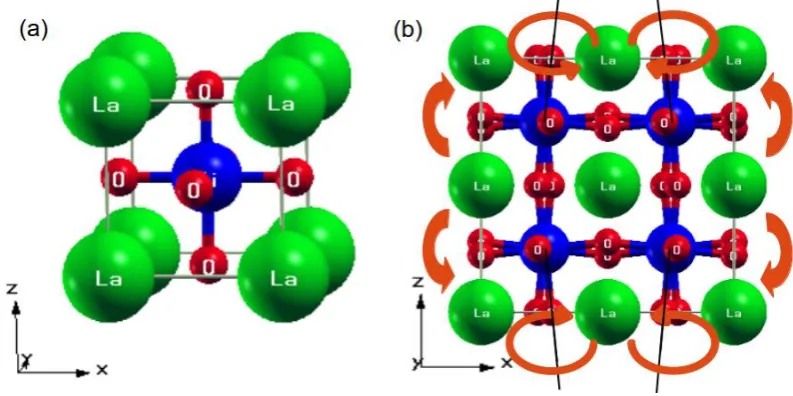
The computational models of 1x1x1 unit cell and 2x2x2 supercell of LaNiO3 are shown in Fig. 1. Periodic boundary conditions are imposed in all dimensions. The kinetic energy cutoff for wavefunctions is chosen at 680 eV and sufficient k-point sampling is employed in the Brillouin zone. Structural optimizations are performed until all remaining forces acting on each atom are less than 0.03 eV/Å.
Fig. 1.Computational models of (a) 1x1x1 LaNiO3 unit cell and (b) 2x2x2 LaNiO3 supercell without in-plane
strain, indicating rotations of NiO6 octalhedra. The small red, big green, and medium blue balls indicate O, La,
and Ni atoms, respectively. The rectangular boxes represent supercells.
Previous experimental publication has reportedthat the epitaxial strain at the interface of LaNiO3 layers and the substrate penetrates deep into the LaNiO3 inner layers [12]. Thus, it is assumed that the imposed strain throughout our models is uniform. To simulate the strained LaNiO3 layers, we fix the in-plane lattice parameters and allow the out-of-plane lattice parameter of the 1x1x1 unit cell to relax. We choose various in-plane strains from -3% to 5% as observed in experiments [13, 14]. Then, the 2x2x2 LaNiO3 supercell is constructed (by doubling the obtained lattice parameters of the 1x1x1 unit cell), allowing for local rotations of NiO6 octahedra.
3. Results and discussion
The optimized lattice parameters of the 1x1x1 LaNiO3 unit cell are found to be lcal=lx=ly=lz=
3.749 Å, which are 2.3% smaller than the published experimental data [3]. The underestimation of the lattice parameters is typical of LDA calculations [15, 16].
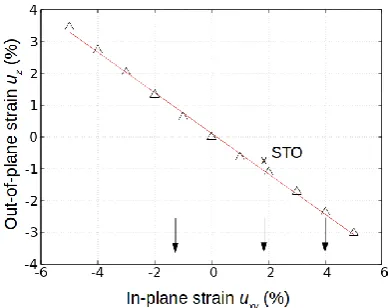
Figure 2 shows the out-of-plane strain uz = lz/lcal– 1as a function of the in-plane strain uxy = lx/lcal –
respectively, and lcal is the non-strained equilibrium one. It can be seen that uz declines (almost
linearly) by 0.6% for each 1.0% increase in uxy. The computed out-of plane strain of LaNiO3 on SrTiO3 substrate is found to be 1.0% as compared to the experimental value of 0.7% [5].
Fig. 2.Calculated out-of-plane strain uz vs in-plane strain uxy. x: experimental value for a LaNiO3 film
grown on SrTiO3 substrate. Vertical arrows designate
in-plane strains of commercially available substrates, from left to right: LaAlO3, SrTiO3, and KTaO3.
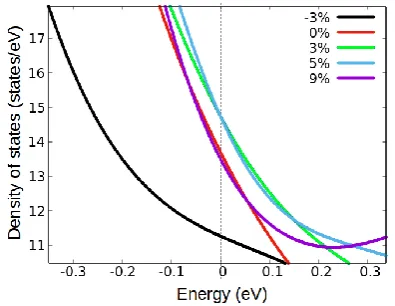
Fig. 3.Total DOS of 1x1x1 LaNiO3 unit cell for
various values of in-plane strain uxy. The Fermi level is chosen at 0 eV.
Figure 3 presents the total DOS of 1x1x1 LaNiO3 unit cell for various in-plane strains. As one can see, LaNiO3 keeps the metallic behavior, and the total DOS near the Fermi level is enhanced with the strain. Specifically, the DOS is increased by 2.7 times as uxy increases from -2% to 5%. Previous
publications have shown that states near the Fermi level of bulk LaNiO3 are formed by the hybridization between Ni 3d and O 2p orbitals [2, 17-19]. Thus, we plot in Fig. 4 the projected DOS of strained LaNiO3 onto Ni t2gand egorbitals. For the non-strained case, t2g-derived states are completely
filled, and the eg-derived states are occupied by one electron. For uxy> 0%, t2g-derived states become
partially occupied as a result of the changes in Ni-O bond distances. In the vicinity of the Fermi level, the density of t2g-derived states increases with increasing uxy, whereas that of eg-derived states first
increases and then decreases as uxy is larger than 3%. As the changes in the density of t2g-derived states
are substantial compared to those of eg-derived states, the total DOS at the Fermi level increases with
the in-plane strain.
For the 2x2x2 LaNiO3 supercell, the electronic structure is expected to deviate from that of the 1x1x1 unit cell. The rotations of NiO6 octahedra inside the supercell change the Ni-O-Ni bonding angles (see Fig. 1(b)) and thus alter the hybridization between Ni 3d and O 2p orbitals. Figure 5 indicates the dependence of Ni-O-Ni angles along the z direction (αz) and in the xy plane (αxy) on the
in-plane strain. It is noted that the in-plane strain in the case of 2x2x2 supercell is the same as that in 1x1x1 unit cell. By increasing uxy, αz (αxy) decreases (increases), implying the reduction (enhancement)
of the p-d hybridization. Thus, a competition in the contributions of p-d hybridized states along the z direction and in the xy plane to the electronic structure is expected. We plot in Fig. 6 total DOS of the 2x2x2 LaNiO3 supercell with respect to the in-plane strain. In contrast to the 1x1x1 unit cell case, where the DOS at the Fermi level increases with increasing uxy (see Fig. 3), the DOS at the Fermi level of the 2x2x2 supercell first increases with uxy up to 3% and then decreases. This behavior can be
Fig. 4.Projected DOS of 1x1x1 LaNiO3 unit cell onto (a) t2g and (b) egorbitals of Ni atom for various values of in-plane strain uxy. The Fermi level is chosen at 0 eV.
Fig. 5.Ni-O-Ni angles along z direction (red line) and in xy plane (black line) as functions of the
in-plane strain uxy.
Fig. 6.Total DOS of 2x2x2 LaNiO3 supercell for
various values of in-plane strain uxy. The Fermi level is chosen at 0 eV.
4. Conclusions
First-principles calculations are employed to investigate the electronic structure of bulk LaNiO3 under epitaxial strain. By applying strain, the Ni t2g-derived states of the 1x1x1 unit cell become
partially occupied. In the vicinity of the Fermi level, the density of the t2g-derived states increases with
uxy while that of the eg-derived states increases for uxy < 3% and then decreases for larger uxy. In
addition, the variation of density of the t2g-derived states is much larger than that of the eg-derived
Acknowledgements
This research is funded by the Vietnam National University, Hanoi (VNU) under project number QG.17.10.
References
[1] S. B. Adler, “Factors governing oxygen reduction in solid oxide fuel cell cathodes”, Chem. Rev. 104, 4791 (2004).
[2] M. L. Medarde, “Structural, magnetic and electronic properties of RNiO3 perovskites (R = rare earth)”, J. Phys.:
Condens. Matter 9, 1679 (1997).
[3] J.-S. Zhou, J. B. Goodenough, B. Dabrowski, P. W. Klamut, and Z. Bukowski, “Enhanced susceptibility in LNiO3 perovskites (L=La,Pr,Nd,Nd0.5 Sm0.5)”, Phys. Rev. Lett. 84, 526 (2000).
[4] J. B. Torrance, P. Lacorre, A. I. Nazzal, E. J. Ansaldo, and Ch. Niedermayer, “Systematic study of insulator-metal transitions in perovskites RNiO3 (R=Pr,Nd,Sm,Eu) due to closing of charge-transfer gap”, Phys. Rev. B 45,
8209(R) (1992).
[5] J. L. García-Muñoz, J. Rodríguez-Carvajal, P. Lacorre, and J. B. Torrance, “Neutron-diffraction study of RNiO3
(R=La,Pr,Nd,Sm): Electronically induced structural changes across the metal-insulator transition”, Phys. Rev. B 46, 4414 (1992).
[6] S. J. May, J.-W. Kim, J. M. Rondinelli, E. Karapetrova, N. A. Spaldin, A. Bhattacharya, and P. J. Ryan, “Quantifying octahedral rotations in strained perovskite oxide films”, Phys. Rev. B 82, 014110 (2010).
[7] A. E. Mattsson, P. A. Schultz, M. P. Desjarlais, T. R. Mattsson, and K. Leung, “Designing meaningful density functional theory calculations in materials science-a primer”, Modell. Simul. Mater. Sci. Eng. 13, R1 (2005). [8] G. Kresse and J. Furthmüller, “Efficiency of ab-initio total energy calculations for metals and semiconductors
using a plane-wave basis set”, Comp. Mater. Sci. 6, 15 (1996).
[9] P. Giannozzi et al., “QUANTUM ESPRESSO: a modular and open-source software project for quantum simulations of materials.”, J. Phys.: Condens. Matter 21, 395502 (2009).
[10] J. P. Perdew and A. Zunger, “Self-interaction correction to density-functional approximations for many-electron systems”, Phys. Rev. B 23, 5048 (1981).
[11] K. Laasonen, R. Car, C. Lee, and D. Vanderbilt, “Implementation of ultrasoft pseudopotentials in ab initio molecular dynamics”, Phys. Rev. B 43, 6796 (1991).
[12] A. Yu. Dobin, K. R. Nikolaev, I. N. Krivorotov, R. M. Wentzcovitch, E. Dan Dahlberg, and A. M. Goldman, “Electronic and crystal structure of fully strained LaNiO3 films”, Phys. Rev. B 68, 113408 (2003).
[13] J. Zhu, L. Zheng, Y. Zhang, X. H. Wei, W. B. Luo, and Y. R. Li, “Fabrication of epitaxial conductive LaNiO3
films on different substrates by pulsed laser ablation”, Mater. Chem. Phys. 100, 451 (2006).
[14] J. Yu, X. J. Meng, J. L. Sun, Z. M. Huang, and J. H. Chu, “Optical and electrical properties of highly (100)-oriented PbZr1−xTixO3 thin films on the LaNiO3 buffer layer”, J. Appl. Phys. 96, 2792 (2004).
[15] A. van de Walle and G. Ceder, “Correcting overbinding in local-density-approximation calculations”, Phys. Rev. B 59, 14992 (1999).
[16] P. Haas, F. Tran, and P. Blaha, “Calculation of the lattice constant of solids with semilocal functionals”, Phys. Rev. B 79, 085104 (2009).
[17] Š. Masys, S. Mickevičius, S. Grebinskij, and V. Jonauskas, “Electronic structure of LaNiO3−x thin films studied
by X-ray photoelectron spectroscopy and density functional theory”, Phys. Rev. B 82, 165120 (2010).
[18] L. Guan, B. Liu, L. Jin, J. Guo, Q. Zhao, Y. Wang, G. Fu, “Electronic structure and optical properties of LaNiO3:
First-principles calculations”, Solid State Commun., 150, 2011 (2010).