Original Research Article
Awareness of text neck syndrome in young-adult population
Pankti P. Samani
1, Neeraj A. Athavale
1*, Ashok Shyam
2, Parag K. Sancheti
2INTRODUCTION
A mobile phone is a device which is used for voice and data communication. Along with the basic voice function of a phone, current mobile phones may support many additional services such as text messaging, email, gaming, camera, Whatsapp, Facebook, GPS etc.1
The cervical spine is a continuous and coordinated network of muscles, nerves and joints, the pathway ranging from the brain to the spinal cord. Irritation along this pathway leads to pain.2 A recent systematic review done in Honk Kong suggests that prevalence of musculoskeletal problems with mobile phone usage are high ranging from 17.3% to 67.8% for neck complaints.3
The term “Text neck” was coined by Dr. Dean L. Fishman, a US chiropractor. The term of „Text neck or another phrase turtle neck posture can be described as a repeated stress injury and pain sustained from excessive watching or texting on handheld devices for long periods of time‟.2
Text neck leads to harmful symptoms such as neck pain, upper back pain, shoulder pain, chronic headaches and increased curvature of the spine.2,4 On using the mobile phone over long periods of time, users usually adopt prolonged forward head posture.4-7 A recent study done in Thailand shows that text neck syndrome has become a global epidemic affecting a large number of population of almost all ages who use mobile phones. Text neck syndrome is a growing health concern and can affect large number of population all over the world.4
ABSTRACT
Background: Text neck is a repeated stress injury and pain sustained from excessive watching or texting on handheld devices for long periods of time. Dependence of mobile phone is increasing rapidly and people spend long hours on mobile phone that lead to various musculoskeletal problems. This study will help us find the awareness of text neck syndrome and awareness of hazards which are caused by excess usage of phone. This study also aimed at finding the knowledge regarding the preventive measures of text neck syndrome.
Methods: The study design was an observational study with a sample size of 311. A self-administered questionnaire was distributed to all subjects. Results were calculated in percentile format.
Results: This study stated that 35% population has heard of text neck syndrome out of which only 8% population has knowledge of this syndrome. The results also stated that 21% population have knowledge regarding the preventive measures of this syndrome.
Conclusions: This study has demonstrated a low level of awareness of text neck syndrome amongst young adult population. Also it mentioned about lack of knowledge of preventive measures in this population.
Keywords: Text neck syndrome, Neck pain, Neck posture
1
Department ofPhysiotherapy, Sancheti Institute college of Physiotherapy, Pune, Maharashtra, India
2
Department of Orthopaedics, Sancheti Institute for Orthopaedics and Rehabilitation, Pune, Maharashtra, India
Received: 15 February 2018
Revised: 11 June 2018
Accepted: 12 June 2018
*Correspondence:
Dr. Neeraj A. Athavale,
E-mail: [email protected]
Copyright: © the author(s), publisher and licensee Medip Academy. This is an open-access article distributed under the terms of the Creative Commons Attribution Non-Commercial License, which permits unrestricted non-commercial use, distribution, and reproduction in any medium, provided the original work is properly cited.
If text neck is not treated or corrected in right time it can lead to serious permanent damage and can result into overuse syndrome or repeated stress injury. Long term untreated text neck can result into inflammation of the neck ligaments, muscles and nerves leading to permanent arthritic changes.2,4,8,9
It may also lead to some serious damage, such as Flattening of the spinal curve, onset of early arthritis, spinal misalignment, spinal degeneration, disc compression, disc herniation, etc.2,10
As the dependence of mobile phone is increasing rapidly and people spend long hours on mobile phone which lead to various musculoskeletal problems.1,6,7,11 This study will help us find the awareness of text neck syndrome as neck pain is an already prevalent significant health problem.
Presently less research is been done on Text Neck Syndrome so there is lack of literature. Thus this study will help us gain knowledge regarding this condition and its awareness amongst the population.
The objectives of this study are as follows 1) To check awareness of text neck syndrome in young-adult population. 2) To check the knowledge about text neck syndrome in young-adult population. 3) To check the knowledge of preventive measures for text neck syndrome.
METHODS
This is an “observational study” with a sample size of 311. Method of sampling used was “Purposive Sampling‟. This study was performed on the population living in Mumbai and Pune cities of Maharashtra. It was performed during the period of August 2017 to February 2018.
Subjects
311 subjects from various nonmedical institutions who use mobile phones participated in this study. The inclusion criteria was- Subjects using phone since past 1 year and their age should be between 18-24 years and the Exclusion Criteria was subjects having any congenital cervical problem and subjects with traumatic and pathological cervical problem.
Ethical approval was obtained from the institutional ethical committee and each subject signed an informed consent approved by the committee.
Questionnaire
A self-administered questionnaire was prepared in Google docs. The questionnaire included questions pertaining to 1) personal and information related to phone
usage 2) awareness and knowledge related to text neck syndrome 3) hazards of excess phone usage.
The questionnaire was pilot tested for its validity by panel of expertise and it was modified based upon feedback received from the final version of the questionnaire was then distributed to all subjects via email.
Data analysis
Descriptive statistics was conducted to evaluate the responses obtained from the subjects. The percentage of responses for each question was calculated.
RESULTS
Figure 1: Showing the results for question, have you heard about text neck syndrome?
This graph shows us that 65% population is not aware of text neck syndrome, 27% have heard about it but don‟t know what it is and 8% know about it.
Figure 2: Showing results on question, do you think you can prevent text neck syndrome?
This graph shows that 4% population think we cannot prevent text neck syndrome, 75% think we can prevent it but the method is not known to them and 21% think we can prevent it and know how it is to be prevented.
65%
27%
8%
0 50 100 150 200 250
No Yes,but don‟t know abt it
yesknow about it
No Yes,but don‟t know abt it yesknow about it
4%
75%
21%
0 10 20 30 40 50 60 70 80 90
No Yes don‟t know how Yes know how
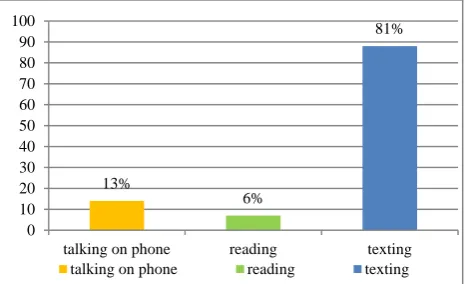
Figure 3 shows the causes of text neck syndrome.13% population thinks it is because of talking on phone, 6% think it‟s because of reading of text books and 81% population thinks it is because of texting.
Figure 3: Showing results on question, what do you think can cause text neck syndrome?
This graph shows results of from where has the population heard about text neck syndrome.
11% have heard from medical professional, 6% from multimedia, 59% from the internet, 18% from friends and 6% from other sources.
Figure 5: Showing results on, are you aware of any long term complications of text neck syndrome?
This graph shows us the results of awareness of long term complications of text neck syndrome.
The awareness of osteoarthritis of cervical spine is the maximum with a population of 69.72%. The awareness of PIVD is 64.22% and awareness of spondylosis is 54.12%.
Figure 6: Showing results of question, do you think your phone can cause following health hazards?
This graph shows us the results of knowledge of hazards of long term usage of mobile phone.
Figure 7: Showing results on question, in a day, how many hours do you spend on mobile phones other
than calls? 13% 6% 81% 0 10 20 30 40 50 60 70 80 90 100
talking on phone reading texting
talking on phone reading texting
11% 6% 59% 18% 6% 0 10 20 30 40 50 60 70
medical multimedia net friends others
medical multimedia net friends others
64.22 54.12 69.72 35.77 45.87 30.27
0 20 40 60 80
PIVD Spond OA
Yes
No
Knowledge of long term complications
3.53 6.1 9 8.36 4.5 6.1 9.32 11.25 22.82 27.65 24.75 10.61 17.36 25.08 26.68 32.47 27.33 24.11 20.9 22.82 25.72 38.9 27.33 28.29 32.47 36.01 35.69 28.29 19.61 11.25 7.71 10.28 27.97 18 11.57
0 20 40 60 80 100 120
neck arm shoulder upperback headache neck posture tingling
strongly disagree disagree slightly agree agree strongly agree
Knowledge of hazards of phone
11% 42% 27% 20% 0 20 40 60 80 100 120 140
1 hour 2-4 hours 4-6hours more than 6 hours 1 hour 2-4 hours 4-6hours more than 6 hours
Figure 8: Showing results on question, do you think you should minimize phone usage from health
perspective?
Figure 7 shows us the number of hours of mobile phone usage. 11% population uses phone for 1hour, 42% population uses phone for 2-4hours in a day, 27% population uses phone for 4-6 hours and 20% population uses phone for more than 6 hours in a day.
Figure 8 tells us that 13% population doesn‟t think that they should minimize phone usage and 87% think that they should minimize phone usage.
DISCUSSION
In present study we tried to gain in knowledge regarding awareness of text neck syndrome and knowledge of its preventive measures. Texting on mobile phones is an activity which involves looking into mobile screens in a flexed position of the neck with a forward head posture and with rounding of shoulders and movement of the thumb and arms in a continues pattern. If this posture is maintained over long time, the centre of weight for the head is pushed forward. This imbalance, causes constant contraction of musculature to compensate giving rise to text neck syndrome with symptoms such as neck pain, shoulder pain, upper back pain, forward head posture, muscle spasm etc.2,4,9,10,12 A 5 years cohort study on texting on mobile phones and musculoskeletal disorders in young population suggested that neck pain is the most prevalent short term as well as the long term effect of excess usage of mobile phones.13
A study by Hansraj states that normally our head weighs between 10-20 lb. While texting as the cervical flexion increases the effective weight on our neck increases the maximum being 60lb at 60 degrees.12 A total of 311 subjects participated in this study. The average age of the subjects was 21 out of which 27% have heard about TNS but don‟t know about it where as 8% have heard about TNS and know about it. 65% haven‟t heard about TNS. These results could be attributed to level education and level of ignorance regarding this syndrome. Out of 311 subjects, 109 answered the question on causes of TNS out of which 81% population answered that TNS is caused due to excess Texting on phone whereas 13% think it‟s because of talking on phone and 6% think it‟s because of reading of textbooks.
Most of the subjects use their mobile phone for 2-4 hours in a day (42%) and 27% population use their phone for 4-6 hours in a day. A study done in Korea mentions a positive relationship between hours of mobile phone use and subjective musculoskeletal problems.7 When smart phones are constantly used without any rest, and a poor posture is maintained over a long period of time, musculoskeletal pain can occur.7 From the graph we see that most of the subjects agreed that mobile phone usage can cause neck pain, headache and upper back pain and
most of them disagree that mobile phone usage can cause shoulder pain and arm pain. From the graph we see that 38.9% population agrees that neck pain could be a health hazard of excess usage of phone. A study done in Lahore, on prevalence of neck pain amongst under graduate students found out that 56.7% subjects from their study suffered from neck pain.14
Out of 109 subjects 75% subjects answered that preventing TNS is possible but the ways of preventing are not known to them. The possible reason for this could be lack of knowledge and ignorance towards this syndrome. Only 21% are aware of the preventive measures of TNS. The forward head position causes weight to be shifted anteriorly which puts stress on the lower cervical segments leading to various degenerative conditions of the neck. Out of 109 subjects, 45.87% are aware of spondylosis as a long term complication, 35.77% are aware of PIVD and 30.27% are aware of OA of cervical spine.
Thus we conclude that the awareness regarding TNS is not adequate and knowledge regarding this syndrome is important as it is a cumulative stress injury and can be prevented.
CONCLUSION
This study has demonstrated a low level of awareness of text neck syndrome amongst young adult population. According to this study only 35% population has heard of Text neck syndrome. Also it mentioned about lack of knowledge of Text neck syndrome in this population. Out of the people who have heard of text neck syndrome, only 21% know about the preventive measures.
Limitation of study
The study is restricted only to young-adult population.
Also due to time constrain has been done on a lesser population.
Future scope of study
The scope of this study will be to see prevalence of TNS in young adult population.
Also the scope will be to study associated risk factors and their prevention in details.
ACKNOWLEDGEMENTS
Funding: No funding sources Conflict of interest: None declared
Ethical approval: The study was approved by the Institutional Ethics Committee
REFERENCES
1. Kumar LR, Chii KD, Way LC, Jetly Y, Rajendaran V. Awareness of mobile phone hazards among university students in a Malaysian medical school. Health. 2011;3(07):406.
2. Neupane S, Ali UI, Mathew A. Text Neck Syndrome-Systematic Review. Imperial J Interdisciplinary Res. 2017;3(7):141-8.
3. Xie Y, Szeto G, Dai J. Prevalence and risk factors associated with musculoskeletal complaints among users of mobile handheld devices: A systematic review. Applied ergonomics. 2017;59:132-42. 4. Vate-U-Lan P. Text Neck Epidemic: a Growing
Problem for Smart Phone Users in Thailand. Int J Comput Internet Manag. IJCIM. 2015;23(3):55.1-55.6.
5. Lee JI, Song HS. The correlation analysis between hours of smartphone use and neck pain in the Gachon university students. The Acupuncture. 2014;31(2):99-109.
6. Kim MS. Influence of neck pain on cervical movement in the sagittal plane during smartphone use. J Physical Therapy Sci. 2015;27(1):15-7. 7. Kim HJ, Kim JS. The relationship between
smartphone use and subjective musculoskeletal symptoms and university students. J Physical Therapy Sci. 2015;27(3):575-9
8. AlZarea BK, Patil SR. Mobile Phone Head and Neck Pain Syndrome: Proposal of a New Entity. OHDM Headache. 2015;14(5):313-7.
9. Al-Gharabawi B. Text Neck Syndrome: A New Concern for Physical Therapists Worldwide”. EC Orthopaedics. 2017;8(3):89-91.
10. Walsh A. A Modern Spine Ailment: Text Neck. Spine-health. Available at: http://www.spinehealth. com/blog/modern-spine-ailmenttext-neck. Accessed on 5 November 2015.
11. Kim MS. Influence of neck pain on cervical movement in the sagittal plane during smartphone use. J Physical Therap Sci. 2015;27(1):15-7. 12. Hansraj KK. Assessment of stresses in the cervical
spine caused by posture and position of the head. Surg Technol Int. 2014;25:277-9.
13. Gustafsson E, Thomée S, Grimby-Ekman A, Hagberg M. Texting on mobile phones and musculoskeletal disorders in young adults: a five-year cohort study. Applied ergonomics. 2017;58:208-14.
14. Malik A, Pasha MU, Khalid S, Ahmad A, Gilani SA. Prevalence of neck pain among Undergraduate students of Lahore. Int J Scientific Engineering Res. 2017;8(10):569-76.