Original Research Article
A study to assess the effectiveness of short training session on
immunization knowledge of mothers attending immunization clinic
Anil Kumar Agarwal, Piyush Datt Swami*, Shatkratu Dwivedi
INTRODUCTION
One of the most significant contributions of the medical fraternity to mankind is the advent of vaccines. They are the most powerful, safe and cost-effective measures for prevention/control of a number of diseases especially under five children. Increasing immunization levels for under-five children is one of the highest priorities for the
Immunization Program.1 The purpose of the
immunization program is to achieve high vaccination
rates to control vaccine- preventable-diseases (VPDs) among groups who are susceptible to the diseases and reduce morbidity and mortality among them. There is ample evidence that health service provider practices are a key determinant of vaccination coverage among children.2,3
Strengthening routine immunization is one of the child survival strategies in India. It is notable that a committed, confident and competent vaccination workforce is
ABSTRACT
Background: Parents knowledge about immunization is India’s primary tool against the menace of child not immunized completely. The parents especially mothers should have basic knowledge of immunization in under five children.
Methods: The study evaluates knowledge and behaviour of mothers regarding the immunization of 250 infants who attended Immunization clinic of Madhav dispensary J.A. Hospital, Gwalior Madhya Pradesh by simple random sampling method under the PSBH project completed by MBBS Final Part I students.
Results: Brief structured interview with transient training and structured questionnaire techniques were used to collect responses from the mothers. In total 59.32% mothers were aware about the immunization aspects and only 45.8% were about the mandatory vaccines had been rendering adequate knowledge and they were not much reflective of the same when being questioned on the knowledge parameter. The study revealed that out of 250 mothers, 40% were in the age group of 21-25 years. After immunization based brief transient training given to mothers, their knowledge about immunization aspects and individual vaccines under five children was significantly improved from pre test assessment mean score 118.1±59.3 to post test assessment 224.1±89.6 respectively.
Conclusions: There are several loopholes in the mother’s knowledge regarding immunization. Many of them had no knowledge about compulsory vaccines. Despite inadequate knowledge and attitude of mothers towards infant immunization, the majority of mothers had good change (42.4%) and 32.3% due to seeking of information about practice of infant immunization and individual vaccine. From this point of view, it is possible to conclude that mothers’ immunization practice was not really based on their knowledge and attitude regarding immunization of infants. Maternal education and socio economic status were significantly associated with good knowledge.
Keywords: Immunization, Mother-knowledge, Under five children
Department ofCommunity Medicine, G.R. Medical College, Gwalior, Madhya Pradesh, India
Received: 14 March 2018
Accepted: 04 April 2018
*Correspondence:
Dr. Piyush Datt Swami,
E-mail: [email protected]
Copyright: © the author(s), publisher and licensee Medip Academy. This is an open-access article distributed under the terms of the Creative Commons Attribution Non-Commercial License, which permits unrestricted non-commercial use, distribution, and reproduction in any medium, provided the original work is properly cited.
integral to ensuring high vaccine coverage.4 Since mothers’ knowledge will reflect their attitude, continuing education can improve their knowledge base and practice level; it can change their behaviors and attitudes, and
improve immunization outcomes.5 Access to
immunization services and up to date immunization coverage are essential for protecting every age group from debilitating and potentially life threatening effects of infectious diseases. The risk of mortality and morbidity is statistically high during childhood period. Prevention is ultimately the most effective defense system in controlling infectious diseases. So the knowledge regarding immunization and attitude for seeking information about prevention of infectious disease among mothers of under five children is important.
The knowledge of parents is important factors for better immunization coverage. Studies did previously show misconceptions on parent’s knowledge towards childhood immunization. Mother’s educational status and knowledge was clearly associated with coverage of
immunization less knowledge among mothers bring
negative attitude and fear which leads to affect immunization status of their children. So, physicians must clearly communicate the benefits and risks to the mothers and try to increase the acceptance.6
Knowledge is necessary to take any decision. Mothers’ knowledge can help them to take proper decision regarding immunization of her child. Keeping the point of view this study was conducted to assess the knowledge and impact of brief transient training regarding immunization aspects and mandatory vaccines among mothers with under five children attending immunization clinic of Community Medicine Department in a tertiary care hospital in Gwalior, Madhya Pradesh, to find out the association of the knowledge level of mothers with some selected variables and to impart health education to mothers regarding childhood immunization.
METHODS Study design
This study was undertaken to explore the important parameters of Immunization in terms of knowledge and attitude of mothers attending the immunization clinic for their children vaccination. A pre-test, post-test
experimental design was adopted. Structured
questionnaire was prepared to collect
socio-demographical data, and assess knowledge. The questions regarding knowledge, was formulated in simple language for clarity and ease of understanding, on the basis of pertinent literature.The nature and purpose of study was explained to mothers. The study was carried out with mothers consent and cooperation. The basic information was collected in terms of her name, age, education and socio economic status. The Questionnaire was designed so as to cover routine different aspect related to
immunization and mandatory vaccine among children. Pretest assessment to determine the knowledge of Immunization, and mandatory vaccine among mothers was carried out before providing brief transient training and one post-test assessment was carried out just after completion of training. Pre and post- test assessment was conducted using the same questionnaire.
Sampling technique
Bysimple random sampling we included first 10 Mothers of under five children, who were registered in OPD/Immunization clinic on every day from 1st to 30th Dec, 2017. In 25 working days we have enrolled 250 mothers attending the immunization clinic and who give their consent for transient training of 30-45 minutes and applying pre test and post test questionnaire. There were 11 questions in the questionnaire regarding immunization aspects and 11 about mandatory vaccine. Each correct answer was given a score of 1. Thus, the test had maximum score of 250 in both pre and post test for each immunization aspect and mandatory vaccine answer. The data collected was statistically analyzed using MS Excel sheet.
Survey technique
Survey was carried by third year undergraduate students as a part of their project. They were properly trained in the interviewing technique and trained to ask questions in local Hindi language.
Socio-economic status
We used updated social classification.7
Ethical consideration and permission:
Ethical clearance was obtained from the Central research Committee of our college. Permission was obtained from the concerned authorities to conduct the study. Oral consent was taken from each study participants. Data was kept confidential under principal investigator.
Data collection
The questionnaire used for assessing immunization providers pre-and post-intervention had three sections: Section A assessed the socio-demographic characteristics of the participants. Section B assessed the knowledge on immunization aspects and Section C assessed their knowledge about individual compulsory vaccine. The questions in the questionnaire were drawn from the immunization training question database developed by
WHO.8
Intervention
on spot 30 to 45 minutes immunization refresher transient information was provided with the help of two posters demonstrations one for different aspects of immunization and another about the compulsory vaccine knowledge
following the pre-intervention assessment with
questionnaire.
Data analysis
Data entry and analysis were performed with Microsoft
Excel sheet. Participant’s socio-demographic
characteristics like age, educational background and socio-economic status. Summation of scores for each session of observation was then made to add up for each point of assessment. The approximate scores of individuals before and after transient training were compared using paired t-test with training intervention. Statistical significance level was set at p<0.05.
RESULTS
250 mothers who visited the immunization clinic OPD were interviewed using a pretested questionnaire and provided transient training as intervention about immunization and vaccine knowledge for filling their gaps’ and get impact in post tested questionnaire.
Socio-demographic profile of mothers
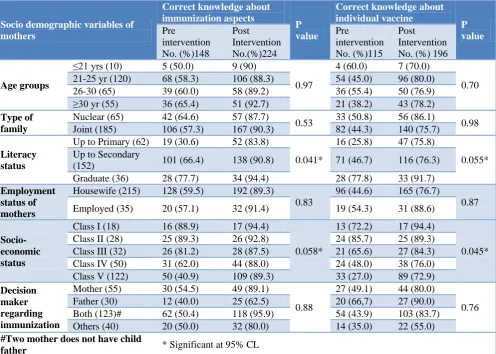
Table 3 shows that among the 250 mothers, most of them (74%) were in the age group of 21 to 30 years. Employment status wise, housewives were in majority (86%). 74% of mothers belonged to joint families. Nearly 60% of mothers were having education up to 12th Standard. In our study population, according to Socio-economic status, 48.8% were of lower class V, 44.4% from middle class II, III and IV while only 4.7% belong to High class I. When enquired to mothers about the decision maker in family regarding immunization of child, majority (49.7%) of them hold the view that both parents decide.
Knowledge of mothers regarding mandatory vaccines
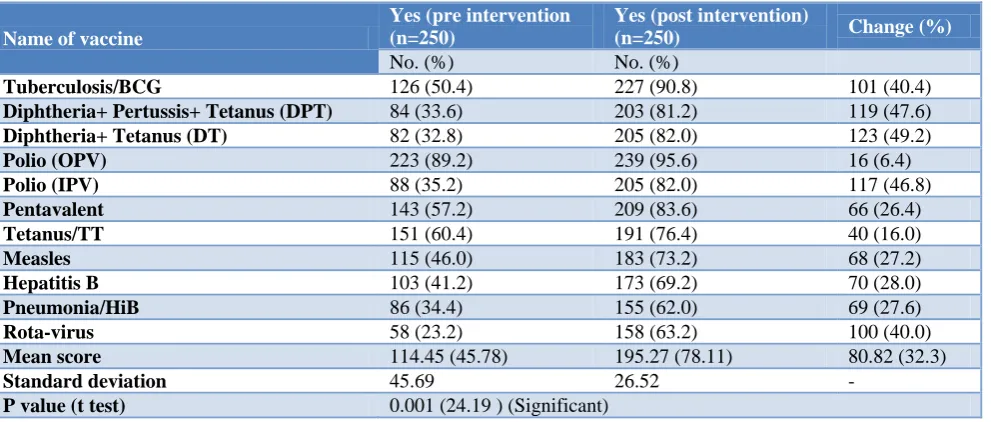
When asked about mandatory vaccines, 89.2% and 60.4% knew about OPV and TT and they also knew that it protects from polio and tetanus (Table 1). The knowledge regarding Pentavalent, BCG, and Measles vaccine was 57.2%, 50.4%, and 46.0% respectively. 34.4% knew about Hib vaccine. Only 33.6% of mothers knew about DPT and 23.2% were aware of recently launched ROTA virus vaccine. After briefing of small session about immunization (post intervention) knowledge of mothers regarding individual vaccine have been significantly (p=0.001) improved i.e., before intervention mean score 114.45 (45.8%) was changed to 195.27 (78.1%).
Table 1: Knowledge of mothers regarding mandatory vaccines.
Name of vaccine
Yes (pre intervention (n=250)
Yes (post intervention)
(n=250) Change (%)
No. (%) No. (%)
Tuberculosis/BCG 126 (50.4) 227 (90.8) 101 (40.4)
Diphtheria+ Pertussis+ Tetanus (DPT) 84 (33.6) 203 (81.2) 119 (47.6)
Diphtheria+ Tetanus (DT) 82 (32.8) 205 (82.0) 123 (49.2)
Polio (OPV) 223 (89.2) 239 (95.6) 16 (6.4)
Polio (IPV) 88 (35.2) 205 (82.0) 117 (46.8)
Pentavalent 143 (57.2) 209 (83.6) 66 (26.4)
Tetanus/TT 151 (60.4) 191 (76.4) 40 (16.0)
Measles 115 (46.0) 183 (73.2) 68 (27.2)
Hepatitis B 103 (41.2) 173 (69.2) 70 (28.0)
Pneumonia/HiB 86 (34.4) 155 (62.0) 69 (27.6)
Rota-virus 58 (23.2) 158 (63.2) 100 (40.0)
Mean score 114.45 (45.78) 195.27 (78.11) 80.82 (32.3)
Standard deviation 45.69 26.52 -
P value (t test) 0.001 (24.19 ) (Significant)
Knowledge level of mothers regarding other immunization aspects
We collected knowledge score through 11 questions asked in a pre testing questionnaire before and after of briefing learning session (Table 2). We found around 118 (47.2%) mothers had adequate knowledge after calculating mean scoring of all questions. Most of the mothers have knowledge about vaccination benefit,
Table 2: Knowledge of mothers regarding other immunization aspects.
S.No of
Question Questions
Correct knowledge about immunization aspects (n=250)
Yes (pre intervention No.(%)
Yes (post intervention) No.(%)
Change (%)
1 Vaccination benefits for? 176 (70.4) 232 (92.8) 56 (22.4)
2 Vaccination should start at? 171 (82%) 228 (91.2) 57 (22.8)
3 Vaccination is completed at? 163 (68.4) 231 (92.4) 68 (27.2)
4 Are there different vaccines for males and
females? 158 (65.2) 235 (94.0) 77 (30.8)
5 If the dose is missed is there any benefit in
taking it later? 111 (44.4) 234 (93.8) 123 (49.2)
6 Should a child with fever be given any
vaccine? 62 (24.8) 212 (84.8) 150 (60.0)
7 Are there any side effects of vaccines? 41 (16.4) 185 (74.0) 144 (57.6)
8 Does vaccine card help in monitering child’s
growth? 85 (34) 212 (84.8) 127 (50.8)
9 Do you know about vit. A vaccine benefit? 31 (12.4) 208 (93.2) 177 (70.8)
10 Should any cream/ointment be applied on
papule formed at injection site? 98 (39.2) 244 (97.6) 146 (58.4)
11 Polio drops should be given uptill which age? 203 (81.2) 244 (97.6) 39 (16.4)
Mean of correct No. 118.09 (47.2) 224.09 (89.64) 106 (42.4)
SD of correct No. 59.32 17.09
Table 3: Knowledge of mothers about Immunization according to their socio demographic variables.
Socio demographic variables of mothers
Correct knowledge about immunization aspects
P value
Correct knowledge about individual vaccine
P value
Pre
intervention No. (%)148
Post Intervention No.(%)224
Pre
intervention No. (%)115
Post Intervention No. (%) 196
Age groups
≤21 yrs (10) 5 (50.0) 9 (90)
0.97
4 (60.0) 7 (70.0)
0.70
21-25 yr (120) 68 (58.3) 106 (88.3) 54 (45.0) 96 (80.0)
26-30 (65) 39 (60.0) 58 (89.2) 36 (55.4) 50 (76.9)
≥30 yr (55) 36 (65.4) 51 (92.7) 21 (38.2) 43 (78.2)
Type of family
Nuclear (65) 42 (64.6) 57 (87.7)
0.53 33 (50.8) 56 (86.1) 0.98
Joint (185) 106 (57.3) 167 (90.3) 82 (44.3) 140 (75.7)
Literacy status
Up to Primary (62) 19 (30.6) 52 (83.8)
0.041*
16 (25.8) 47 (75.8)
0.055* Up to Secondary
(152) 101 (66.4) 138 (90.8) 71 (46.7) 116 (76.3)
Graduate (36) 28 (77.7) 34 (94.4) 28 (77.8) 33 (91.7)
Employment status of mothers
Housewife (215) 128 (59.5) 192 (89.3)
0.83
96 (44.6) 165 (76.7)
0.87
Employed (35) 20 (57.1) 32 (91.4) 19 (54.3) 31 (88.6)
Socio-economic status
Class I (18) 16 (88.9) 17 (94.4)
0.058*
13 (72.2) 17 (94.4)
0.045*
Class II (28) 25 (89.3) 26 (92.8) 24 (85.7) 25 (89.3)
Class III (32) 26 (81.2) 28 (87.5) 21 (65.6) 27 (84.3)
Class IV (50) 31 (62.0) 44 (88.0) 24 (48.0) 38 (76.0)
Class V (122) 50 (40.9) 109 (89.3) 33 (27.0) 89 (72.9)
Decision maker regarding immunization
Mother (55) 30 (54.5) 49 (89.1)
0.88
27 (49.1) 44 (80.0)
0.76
Father (30) 12 (40.0) 25 (62.5) 20 (66,7) 27 (90.0)
Both (123)# 62 (50.4) 118 (95.9) 54 (43.9) 103 (83.7)
Others (40) 20 (50.0) 32 (80.0) 14 (35.0) 22 (55.0)
#Two mother does not have child
Table 4: Pre and post-test comparison of mothers’ knowledge about individual vaccine and other immunization aspects.
Knowledge aspect
Knowledge Score Mean difference
(percentage difference)
t value P value
Pre-test Mean (SD)
Post-test Mean (SD)
Mandatory vaccine 114.45 (45.69) 195.27 (26.52) 80.82 (32.3) 24.19 0.001
Other immunization aspects 118.09 (59.32) 224.09 (17.09) 106 (42.4) 27.15 0.001
Other immunization aspects knowledge level of mothers according to socio-demographic variables
We analyzed the collected knowledge score of all 11 domain questions asked in a pre testing questionnaire before and after of briefing learning session according to socio demographic profile of participants (Table 3). We found that the knowledge level was more in the old age group mothers (>31 yrs) in comparison to younger age group (<21 yrs). We also found that the knowledge level among those mothers who were having high education level (12th and above) was more as compared to those having less education level (below 12th Std.) and the difference is highly significant. The mothers who were of high socio-economic status (Class I and II) were having significantly better knowledge as compared to mothers belonging to lower class (Class III, IV and V). There is no significant difference according to type of family and who take decision for child immunization.
Effect of the training intervention on the knowledge
The Table 4 shows that the mean and standard deviation of the level of knowledge of mothers about total 11 questions each described under individual vaccine and other immunization aspects pre test and after post test. Table shows that the correct score for knowledge of individual vaccine and other aspects of immunization achieved before learning was 45.78% and 59.32% with the mean (SD) score was 114.45 (45.69) and 118.09 (59.32) and after learning session it was increased up to 78.11% and 89.64% with the mean (SD) score was 195.27 (26.52) and 224.09 (17.09) respectively, which means that the learning session has helped to increase knowledge among participants by 32.3 and 42.4% respectively and this achievement was found statistically significant (p<0.001).
DISCUSSION
Despite health improvements in India over the last thirty years, lives continue to be severely affected by early childhood diseases. Various studies in recent past has revealed that implementation of immunization services under UIP are not up to satisfactory standards and still more efforts are needed for improving the quality of services for the successful achievement of expected targets.9 The present study has tried to identify the Knowledge, Attitude and Practice of mothers about immunization of infants in Gwalior of Madhya Pradesh.
Respondents' knowledge about mandatory vaccinations of infants is presented in Table 1. Mothers (45.78%) knew most of the mandatory vaccinations, since a large
proportion of respondents rightly believed that
vaccinations for poliomyelitis (89.2%), tetanus (60.4%), and measles (46%) were required for all infants. About half the sample (45.78%) correctly believed that the undesirable side-effects of vaccinations are a more important determinant of their value than whether they protect the infants from getting disease. Overall, 45.8% of mothers were aware about all nine mandatory vaccinations for infants (Tuberculosis, poliomyelitis, tetanus, diphtheria, hepatitis B. Pertussis, Rota virus & Measles). The results of pre intervention and post intervention analysis showed that this knowledge was significantly greater among mothers with a higher education level and among those who were belongs to higher socio economic status. Respondents' attitudes towards the utility of vaccinations for preventing infectious diseases were not much favorable (Mean of correct answer was 59.3%). Angelillo et al also tried to identify predictors of maternal knowledge, attitude and practice towards infant immunizations using multivariate analysis.10 Accordingly, literate mothers attending grade 1-8th were about two times (AOR=1.781, 95% CI: 1.035, 3.065) more likely to have good knowledge of immunization than illiterate mothers. Similarly, other study findings conducted in United Arab Emirates and Enugu (Nigeria) mothers attending secondary or higher educational status was significantly associated with good knowledge and acceptance of immunization.11,5
study since 73% of the respondents in Ambo were from rural areas. Similarly, 68.4% of mothers mentioned the time when infants should finish vaccination correctly (at nine months or before the first birth day). This is similar to study carried in Kerala but different from other study done in rural Nigeria, where only (14.1%) of respondents mentioned vaccination against childhood killer diseases should be completed at the age of nine months.12,5,13 The inconsistency might be due to the difference in study participants’ educational status since about 70% of mothers included for study in rural Nigeria were illiterates, which is quite higher than the illiteracy status of the present study.
Despite the fact that greater than half of respondents in this study have mentioned correctly the time when infants should begin and finish vaccination, only 16.4% and 24.8% of mothers correctly knew the side effects of immunization and vaccine provided during the fever respectively. This is consistent with the response of mothers in Indian study and study carried in rural Nigeria
which indicated that only 39.5% and 20.1%
respectively5 and contradicts with another finding in West Bengal study where 81.2% of respondents mentioned correctly the side effects of immunization.14 Our results indicate that lack of knowledge prevents Indian mothers from playing an effective role in the elimination of vaccine-preventable diseases in India. Indeed, less than half of the respondents (45.78%) could identify all the mandatory vaccines for infants. Of even greater concern is that only in between 30-40% knew that pertussis, measles, mumps, Rota virus and rubella were diseases that are vaccine-preventable in children. Moreover, the mothers' lack of knowledge about vaccinations is supported by the finding that the main reason for not vaccinating or not completing the vaccination schedule was that they had not been advised about them. The level of knowledge about mandatory vaccinations for infants correlated significantly with the mother's level of education and socio-economic status. Low education level of parents may be associated with nonadherence to vaccination programmes, and illiterate parents may be overrepresented among the nonresponders. It is also supported by previous study mentioned that higher knowledge about immunization & vaccine were more concern of the literate mothers with the higher educational level than those up to school levels.15
Another finding in the study was the limited knowledge of the mothers regarding immunization. Though a vast majority of the respondents agreed on the fact that immunization was important to protect their children from diseases, most of them could not even name one disease that immunization provided protection against. This finding was supported by the fact that the main reason for failure of immunization according to the study was lack of knowledge on the immunization schedule. Similar findings were seen in the study conducted by Victoria et al and Manjunath et al, who concluded that though many were aware of the importance of
vaccination in general, specific information on
importance of completing the schedule and knowledge on vaccine preventable diseases other than poliomyelitis were very limited.5,16
Surprisingly, the evidence of improvement was immediately after the short learning session, there was a leap in their mean score of mandatory vaccine knowledge as well as other immunization aspects knowledge. This general improvement in the participants’ performance in the immediate post-intervention assessment can be attributed to the effectiveness of the information provided. Continuing education as a single intervention is likely to be effective in the short term and can improve the performance of health care providers; however, to sustain effectiveness, additional interventions addressing health systems or community issues are required.17
CONCLUSION
As we were able to bring significant increase in knowledge of all domains of immunization our intervention can be consider as successful intervention. It was found that most of the mothers’ didn’t have the sufficient knowledge about the children immunization. Simpler guidelines on clinical basis of immunization are required so that mothers with a limited educational
background can decide fully about complete
immunization of their children. Majority of mothers didn’t know about most of immunization aspects, but it may improve significantly by updating their information through continuous education. Continuous education in the form of refresher training (in-service) should be on regular basis for updating the knowledge of mothers. The conclusion was that mothers need more information and knowledge to know various aspects of immunization of children.
Limitation
This paper has its own strength because it is based on primary data and can be used as base-line information for intervention programs and further investigations. On the other hand, as a limitation the study was a cross-sectional design and the associations observed may not be causal. Besides, it was institution based study and previously disappointed or dissatisfied mothers may not come to the same health institution again and the number of mothers having unfavorable attitude could be decreased.
Funding: No funding sources Conflict of interest: None declared
Ethical approval: The study was approved by the Institutional Ethics Committee
REFERENCES
2. Stockwell MS, Irigoyen M, Martinez RA, Findley S. How parents' negative experiences at immunization visits affect child immunization status in a community in New York City. Public Health Rep. 2011;126 Suppl 2:24-32.
3. Al-lela OQ, Bahari MB, Salih MR, Al-Abbassi MG,
Elkalmi RM, Jamshed SQ. Factors underlying inadequate parents' awareness regarding pediatrics immunization: findings of cross-sectional study in Mosul- Iraq. BMC Pediatr. 2014;14:29.
4. Leask J, Willaby HW, Kaufman J. The big picture in addressing vaccine hesitancy. Hum Vaccin Immunother. 2014;10(9):2600-2.
5. Brown VB, Abimbola O, Oluwatosin, Ogundeji
MO. Impact of training intervention on
immunization providers’ knowledge and practice of routine immunization in Ibadan, south-western Nigeria: a primary health care experience. The Pan Afr Med J. 2017;26:216.
6. Angadi MM, Jose AP, Udgiri R, Masali KA,
Sorganvi V. A Study of Knowledge, Attitude and Practices on Immunization of Children in Urban Slums of Bijapur City, Karnataka, India. J Clin Diagn Res. 2013;7(12):2803–6.
7. Agarwal AK. Social Classification: The Need to Update in the Present Scenario. Indian J Comm Med. 2008;33(1):50–1.
8. World Health Organization. Training for mid-level managers (MLM). Module 7: The EPI coverage survey. Available at: http://www.who.int/ vaccines-documents/. Accessed 13 November 2017.
9. Burman NR. Functioning of anganwadi centers
under ICDS scheme: An evaluative study, Assam Agriculture Univ., Faculty of Home Science, Department of child development and family relations, 2001.
10. Angelillo IF, Ricciardi G, Rossi P, Pantisano P, Langiano E, Pavia M. Mothers and vaccination: knowledge, attitudes and behaviour in Italy. Bull World Health Organization, 1999;77(3):224-9.
11. Berenson AB, Rahman M, Hirth JM, Rupp RE,
Sarpong KO. A brief educational intervention increases providers' human papillomavirus vaccine
knowledge. Hum Vaccin Immunother.
2015;11(6):1331-6.
12. Aslami AN, Athira TK, Ankitha K, Ahmmed A. Assessment of knowledge about immunization of under five children among mothers attending outpatient department of pediatrics in a tertiary care hospital in Kollam, Kerala. J of evidence based med & Hlthcare. 2015;2(29):4191.
13. National Primary Health Care Development Agency
(NPHCDA): Minimum Standards for Primary Health Care in Nigeria. Abuja; Nigeria. Abuja. NPHCDA; 2012.
14. Mandal S, Basu G, Kirtania R, Roy SK. Care Giver’s knowledge and Practice on Routine Immunization among 12-23 months children in a Rural Community of West Bengal. IOSR-JDMS. 2013:6:105-11.
15. Agarwal AK, Mahore RN. A Study on FAQs of the
mothers attending an immunization clinic in G.R.Medical College, Gwalior. J Preventive Social Med.2013;44(3-4):157-61.
16. Manjunath U. Maternal knowledge and perceptions about the routine immunization programme – A study in a semi-urban area in Rajasthan. Indian J Med Sci. 2003;57:158–63.
17. Dieleman M, Gerretsen B, van der Wilt GJ. Human
resource management interventions to improve health workers' performance in low and middle income countries: a realist review. Health Res Policy Syst. 2009;7:7.
Cite this article as: Agarwal AK, Swami PD, Dwivedi S.A study to assess the effectiveness of short training session on immunization knowledge of mothers attending immunization clinic. Int J