Original Research Article
A study of substance abuse among male engineering students staying at
hostels in a township near Kolkata
Kingsuk Sarkar*, Suman Kumar Roy, Ritesh Singh
INTRODUCTION
World today is witnessing a virtual epidemic of drug abuse.1 In India, youths are bearing the brunt of it. Industrialization, urbanization, migration, changing cultural values, increasing economic stress and loosening of traditional bonds are leading to initiation into substance abuse.2 According to World Health Organization, substance abuse is persistence or sporadic excessive drug use inconsistent with or unrelated to acceptable medical practice.3 Worldwide, nearly two billion people use alcohol, with more than one billion use tobacco4 and around 200 million people admitted of having used some type of illicit drugs.5 University or
college duration is also a sensitive and critical period, because substance use could be seen, especially among students under academic pressure, peer group effects, popularity and easy access to common substances.6 Harvard School of Public Health College Alcohol Study reported 44% American college students practice binge drinking.7 College students were twice as likely found to develop alcohol related and drug related disorders than the rest of the general population.8,9 In a probabilistic study of college students carried throughout Brazil, men were found to have tried illicit drugs more than women in lifetime.10 Another study carried out among intercollege students in Dehradun district, substance abuse was found to be significantly higher among male students (45.8%)
ABSTRACT
Background: Substance is being more common during college days, due to academic pressure, peer group effects, popularity and easy access to common substances. Men are more likely to engage in substance abuse. This was supposed to be more common in hostels. A study was carried out among male engineering students staying at hostels - with aims to find out the magnitude of substance abuse, to assess the potential risk of different substances abused and to find out a comparison between these two groups.
Methods: Study was carried out with the help of two part questionnaire, one part containing alcohol, smoking and substance involvement screening test 8 item screening tool proposed by WHO (WHO-ASSIST). Other part contained socio demographic information. First 50 students, in each two colleges were enrolled in the study after getting their consent.
Results: Ever use of tobacco product was found to be 66.0% and 22.0%, of alcoholic beverages: 72.0% and 26.0%, of cannabis: 46.0% and 14.0% - for students of government and private engineering college respectively. In the past 3 months, tobacco (36.0%) followed by cannabis (12.0%) were found to be the most commonly abused substances in government engineering college students while both (6.0%) cannabis and tobacco were the commonest substances of daily abuse among private engineering college students.
Conclusions: High level of substance abuse was found to be present among male engineering students staying at hostels with higher level found among students of government engineering college.
Keywords: Substance abuse, ASSIST-WHO
Department ofCommunity Medicine, College of Medicine and JNM Hospital, Kalyani, West Bengal, India
Received: 26 June 2018
Accepted: 12 July 2018
*Correspondence:
Dr. Kingsuk Sarkar,
E-mail: [email protected]
Copyright: © the author(s), publisher and licensee Medip Academy. This is an open-access article distributed under the terms of the Creative Commons Attribution Non-Commercial License, which permits unrestricted non-commercial use, distribution, and reproduction in any medium, provided the original work is properly cited.
compared to female students (7.3%) and prevalence of substance use was found to be significantly more in the students who were living away from their homes. 11 According to a study carried out in neighbouring Pakistan, majority of the male hostel students are affected negatively due to drug use.12 Another thing of concern was that while experiencing serious levels of substance abuse, college students seldom realize the need for treatment or seek help at all. 13
Based on these, a cross sectional study was carried out in 2 engineering colleges (one government and another private) located in Kalyani Municipality among male engineering students pursuing B.Tech degree and staying at hostels, with aims to find out the magnitude of substance abuse among them, to assess the potential risk of different substance of abuse present in them and to draw a comparison between these two groups of engineering students. There has been a dearth of studies regarding substance abuse in college students as well as about students pursuing professional courses in Eastern India, particularly in West Bengal. Kalyani being a planned township under Kolkata Metropolitan Development Authority Kolkata, is coming out as an education hub.14 It already hosts three engineering colleges, one government medical college, one law college, one university, Institute of Public Health and Policy, Indian Institute of Information Technology Kalyani, National Institute of Biomedical Genomics, Eastern Regional Station of National Dairy Research Institute, apart from one general degree college. Indian Institute of Science Education and Research- Kolkata (main campus) of agriculture university and that of West Bengal University of Animal and Fishery Sciences are also located nearby Kalyani.15
METHODS
The present study, cross-sectional, descriptive in nature had been conducted in two engineering colleges located in Kalyani Municipality. One was the Government Engineering College, Kalyani and the other, a private one. It was carried out with the active participation of 3rd semester undergraduate MBBS students of the College of Medicine and JNM Hospital, Kalyani during the 3rd week of August, 2015 following arrangements of prerequisite permission from the Medical College authority as well as engineering college officials.
The questionnaire consisted of two parts, first part had few demographic questions like age, year of study, type of family etc. Second part consisted of 8-item WHO-ASSIST screening tool that collected information concerning substance abuse spanning lifetime as well as past three months indicating the likelihood of risk and harm that might had been caused by the said abuse of substances. Three types of risks were classified- low, moderate and high. Moderate means there are potential risk present while high risk signified high risk of experiencing severe problems (health, social, financial,
legal, relationship) and are likely to be dependent.16 Prior to the study proper, questionnaire was introduced to a group of few undergraduate engineering students and their response was noted to find out needed modifications and alterations, in a private engineering college located in Kalyani, that was not included in the study later on.17 During the study period, on each engineering college, a small health talk regarding awareness about substance abuse was organized which were actively manned by undergraduate medical students preceding data collection. Data was collected from male students fulfilling the criteria, after securing written consent. On each college, out of the male engineering students who were presently staying at hostels and showed interest and fulfilled the inclusion criteria, first 50 students who expressed interest, were invited to fill up the schedule ensuring privacy and anonymity.
Only those male students who were then pursuing B. Tech in their 2nd year to 4th year of study, and those who stay together at college provided hostels’ and gave consent were only included in the study. Students staying at rented apartments, in private mess, as well residing as paying guests outside were excluded as well. As it was just the beginning of the session, 1st year students were excluded.
Data was tabulated and analysed with MS Office and SPSS software using mostly descriptive statistical methods.
RESULTS
The study population consisted of male engineering students. In case of government engineering college, mean age was 20.48 and for private engineering college it was 20.02 years. The minimum family income of the students of the government college was found to be Rs.3500/- and that of the private engineering college was Rs.10000/-pm.
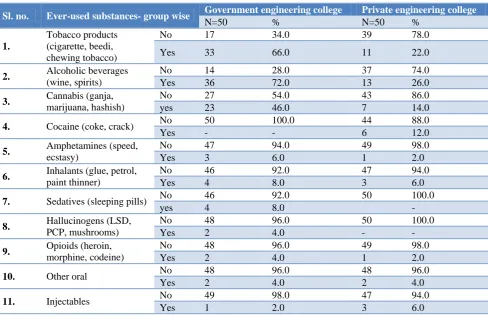
Alcohol and related drinks were the most common substance of abuse among both the groups, 72.0% and 26.0% among government and private engineering college students respectively. Among, the students of Governments College no abuse of cocaine or related product could be found whereas there was no reported abuse of sedatives or hallucinogens among private engineering college students. Among the other substance not included in the ASSIST schedule was steroid supplements taken for perceived health and fitness benefits.
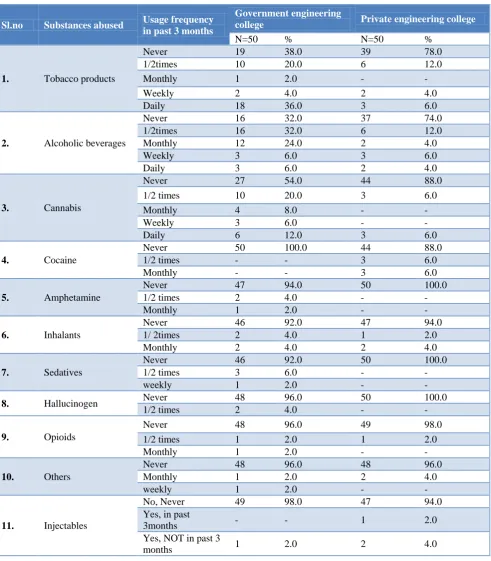
Tobacco products (36.0%) were found to be the most common substance abused daily in past 3 months by government engineering college students while cannabis (6.0%) was found to be the commonest daily abused substance by private college students.
Table 1: Socio demographic profile of the hostel dwelling male engineering students.
Sl. No Socio demographic variables Government engineering college Private engineering college
N=50 % N=50 %
1. Age
18 - - 2 4.0
19 8 16.0 20 40.0
20 21 42.0 14 28.0
21 12 24.0 6 12.0
22 7 14.0 5 10.0
23 2 4.0 3 6.0
2. Type of family Nuclear 28 56.0 33 66.0
Joint 22 44.0 17 34.0
3. Monthly family income (1000 ₹)
<25 26 52.0 10 20.0
25-50 14 28.0 21 42.0
50-75 5 10.0 6 12.0
75-100 - - 2 4.0
>100 5 10.0 11 22.0
4. Academic years of study
2nd 8 16.0 22 44.0
3rd 21 42.0 14 28.0
4th 21 42.0 14 28.0
5. Parents staying together
currently
yes 45 90.0 47 94.0
No 5 10.0 3 6.0
Table 2: Ever use of substances of addiction by the hostel dwelling engineering students.
Sl. no. Ever-used substances- group wise Government engineering college Private engineering college
N=50 % N=50 %
1.
Tobacco products (cigarette, beedi, chewing tobacco)
No 17 34.0 39 78.0
Yes 33 66.0 11 22.0
2. Alcoholic beverages
(wine, spirits)
No 14 28.0 37 74.0
Yes 36 72.0 13 26.0
3. Cannabis (ganja,
marijuana, hashish)
No 27 54.0 43 86.0
yes 23 46.0 7 14.0
4. Cocaine (coke, crack) No 50 100.0 44 88.0
Yes - - 6 12.0
5. Amphetamines (speed,
ecstasy)
No 47 94.0 49 98.0
Yes 3 6.0 1 2.0
6. Inhalants (glue, petrol,
paint thinner)
No 46 92.0 47 94.0
Yes 4 8.0 3 6.0
7. Sedatives (sleeping pills) No 46 92.0 50 100.0
yes 4 8.0 -
8. Hallucinogens (LSD,
PCP, mushrooms)
No 48 96.0 50 100.0
Yes 2 4.0 - -
9. Opioids (heroin,
morphine, codeine)
No 48 96.0 49 98.0
Yes 2 4.0 1 2.0
10. Other oral No 48 96.0 48 96.0
Yes 2 4.0 2 4.0
11. Injectables No 49 98.0 47 94.0
Yes 1 2.0 3 6.0
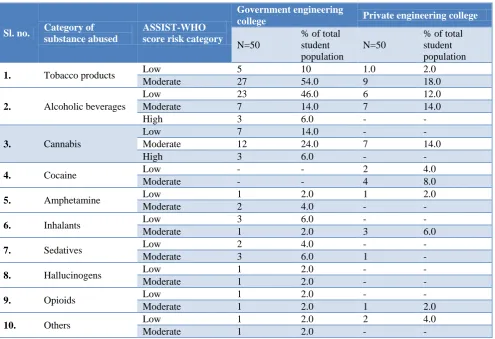
Among the government engineering college students, 3 were found to be of high risk for addiction with alcoholic beverages and cannabis related products, according to scoring by WHO-ASSIST score. They are likely to be dependent on future. 16
and use of injectable drugs (p=0.045), ever use of inhalants and monthly family income (p=0.023); years in age of the students and frequency of alcohol abuse in past 3 months (p=0.005), age in years and frequency of cannabis abuse in past 3 months (p=0.00), academic years
of study and frequency of alcohol abuse in past 3 months (p=0.26), academic years of study and frequency of cannabis abuse in past 3 months (p=0.02) – among the students studying in the private engineering college.
Table 3: Frequency of substance abuse in past 3 months- category wise.
Sl.no Substances abused Usage frequency in past 3 months
Government engineering
college Private engineering college
N=50 % N=50 %
1. Tobacco products
Never 19 38.0 39 78.0
1/2times 10 20.0 6 12.0
Monthly 1 2.0 - -
Weekly 2 4.0 2 4.0
Daily 18 36.0 3 6.0
2. Alcoholic beverages
Never 16 32.0 37 74.0
1/2times 16 32.0 6 12.0
Monthly 12 24.0 2 4.0
Weekly 3 6.0 3 6.0
Daily 3 6.0 2 4.0
3. Cannabis
Never 27 54.0 44 88.0
1/2 times 10 20.0 3 6.0
Monthly 4 8.0 - -
Weekly 3 6.0 - -
Daily 6 12.0 3 6.0
4. Cocaine
Never 50 100.0 44 88.0
1/2 times - - 3 6.0
Monthly - - 3 6.0
5. Amphetamine
Never 47 94.0 50 100.0
1/2 times 2 4.0 - -
Monthly 1 2.0 - -
6. Inhalants
Never 46 92.0 47 94.0
1/ 2times 2 4.0 1 2.0
Monthly 2 4.0 2 4.0
7. Sedatives
Never 46 92.0 50 100.0
1/2 times 3 6.0 - -
weekly 1 2.0 - -
8. Hallucinogen Never 48 96.0 50 100.0
1/2 times 2 4.0 - -
9. Opioids
Never 48 96.0 49 98.0
1/2 times 1 2.0 1 2.0
Monthly 1 2.0 - -
10. Others
Never 48 96.0 48 96.0
Monthly 1 2.0 2 4.0
weekly 1 2.0 - -
11. Injectables
No, Never 49 98.0 47 94.0
Yes, in past
3months - - 1 2.0
Yes, NOT in past 3
Table 4: Category wise risk profile of engineering students staying at hostel according to WHO-ASSIST score.
Sl. no. Category of substance abused
ASSIST-WHO score risk category
Government engineering
college Private engineering college
N=50
% of total student population
N=50
% of total student population
1. Tobacco products Low 5 10 1.0 2.0
Moderate 27 54.0 9 18.0
2. Alcoholic beverages
Low 23 46.0 6 12.0
Moderate 7 14.0 7 14.0
High 3 6.0 - -
3. Cannabis
Low 7 14.0 - -
Moderate 12 24.0 7 14.0
High 3 6.0 - -
4. Cocaine Low - - 2 4.0
Moderate - - 4 8.0
5. Amphetamine Low 1 2.0 1 2.0
Moderate 2 4.0 - -
6. Inhalants Low 3 6.0 - -
Moderate 1 2.0 3 6.0
7. Sedatives Low 2 4.0 - -
Moderate 3 6.0 1 -
8. Hallucinogens Low 1 2.0 - -
Moderate 1 2.0 - -
9. Opioids Low 1 2.0 - -
Moderate 1 2.0 1 2.0
10. Others Low 1 2.0 2 4.0
Moderate 1 2.0 - -
But within, the government engineering college students significant relationship could only be established between monthly family income and ever use of tobacco products (p=0.015), age of the students and ever use of tobacco products (p=0.018); type of the family and frequency of alcohol abuse in past 3 months (p=0.20).
DISCUSSION
A professional course is meant for creating professionals, whose knowledge and conduct could be trusted at face value. Ethics and moral values are as important as intellectual brilliance.18
A Jaipur based study carried on engineering students found nearly, 23% of the students reported smoking of tobacco with 8.68% of the subjects were current smokers. About 34% and 20.48% reported sensible and binge level of alcohol drinking, respectively. Cannabis use by students was nearly 11.80% whereas 6.90% used inhalants. The percentage of students who used ecstasy, lysergic acid diethylamide, and cocaine were nearly 1% each. It also showed alcohol addiction progresses with passing academic years.19 Findings of this study was somewhat similar to that of the findings of the private engineering college in our study.
A study carried out by Community Medicine Department of Government Medical College Chandigarh found prevalence of substance abuse among engineering passed graduates to be as high as 52.0%. Age was found to be significantly associated with substance abuse.20 Another study carried out among high school students in rural areas of West Bengal found high level (55.6%) of substance abuse among boys.21 One more study carried out among medical students in Kolkata based medical college found prevalence of substance abuse to be quite substantial- tobacco (57.38%), alcohol (27.25%), cannabis (10.38%), amphetamine (1.12%), Inhalable substance (0.75%), hallucinogen (0.38%), sedatives (3.75%) and opium (1.50%).22 These findings got some familiarity with the findings of the government engineering college.
living away from their homes.11 Early adulthood was a period of adjustments to new patterns of life and new social expectations especially when they enter into organization stage.24 The concept of hostel is not only limited to place of residence, hostel is a human practical laboratory.12 Kalyani is located around a distance of 52 Km away from the centre of Kolkata and is also near to the Bangladesh border. According to news reports, Kolkata, doubles up as a destination and transit point for cannabis consignments headed for the northern part of the country.25 Qualitative research suggests that a shared route of administration (i.e. via inhalation) for the common forms of both tobacco and cannabis may contribute to their co-occurring use. That may partly explain higher rate of cannabis abuse.26
In general, government run institutions and its hostels have less strict regulations. Many government institutions have become battlegrounds for political rivalry resulting in poor governance leading to poor quality of education as well.27 Private ones need to maintain their discipline for the sake of a better image. This may be the reason for difference in addiction profile pf these two groups of students, leaving aside their socio demographic characteristics, which in many cases didn’t show much significant influence.
CONCLUSION
There has been considerable difference in the socio demographic, substance abuse and risk profile between the hostel dwelling students of government run engineering college and privately owned engineering college. Overall, substance abuse was found bit common among government engineering college students. This needs further probing. Timely intervention with involvement of the faculty members, peer educators and establishing support group as well as regular vigilant supervision could improve the prevailing situation. Limitations
A mix method study could have been more engrossing.
ACKNOWLEDGEMENTS
Help and participation of the 3rd Semester undergraduate students of COMJNM and H was highly instrumental. Help of the Principals of the Government Engineering College as well as that of the two private engineering colleges along with their managerial staffs and faculty members were invaluable. Mr. Raju Dasgupta, Asssitant Professor & statistician, Department Community Medicine, COMJNM & H, also helped a lot with his thoughtful suggestions.
Funding: No funding sources Conflict of interest: None declared Ethical approval: Not required
REFERENCES
1. Kishore J. National Health Programme of India. India. 7 th ed. Delhi, DL: Century; 2007: 374-389. 2. Nadeem A, Rubeena B, Agarwal VK, Piyush K.
Substance abuse in India. Pravara Med Rev. 2009;1(4):4-6.
3. World Health Organization (WHO).Substance abuse. Terminology and classification. Geneva: World Health Organization; 2015. Available at: www.who.int/substance_abuse/terminology/abuse/e n. Accessed on 12 August 2015.
4. United nations Office on Drugs and Crime (UNODC). WORLD Drug Report:2008.New York: United Nations; 2008. Available at: ww.unodc.org/documents/wdr/WDR_2008/WDR_2 008_eng_web.pdf. Accessed on 12 June 2015. 5. United nations Office on Drugs and Crime
(UNODC). WORLD Drug Report: 2008. New York: United Nations; 2011. Available at: ww.unodc.org/documents/wdr/WDR_2011/WDR_2 011_eng_web.pdf. Accessed on 12 June 2015. 6. Abbasi-Ghahramanloo A, Fotouhi A, Zeerati H,
Rahimi-Movaghar A.prescription Drugs, Alcohol, and Illicit Substance use and Their Correlations Among Medical Science Studemts in Iran. Int J High Risk Behaviors Addiction. 2015;4(1):e21945. 7. Wechesler H, Nelson TF. What we have learned
from the Harvard School of Public Health College Alcohol Study: Focussing attention on college student alcohol consumption and the environmental conditions that promote it. J Studies Alcohol Drugs. 2008;69(4):481-90.
8. Compton WM, Thomas YF, Stinson FS, Grant BF. Prevalence, correlates, disability, and comorbidity of DSM-IV drug abuse and dependence in united States: Results from the national epidemiological survey on alcohol and related conditions. Arch General Psychiatr. 2007;64(5):566-76.
9. Hasin DS, Stinson FS, Ogburn E, Grant BF. Prevalence, correlates, disability, and comorbidity of DSM-IV alcohol abuse and dependence in united States: Results from the national epidemiological survey on alcohol and related conditions. Arch General Psychiatr. 2007;64(7):830-42.
10. Andrade AG, Duarte PCAV, Barroso LP, Nishimura R, Alberghini DG, Oliveira LG. Use of alcohol and other drugs among Brazilian college students: effects of gender and age. Revista Brasileira de Psiquiatria. 2012;34(3):294-305.
11. Juyal R, Bansal R, Kishore S, Negi KS, Chandra R, Semwal J. Substance Use Among Intercollege Students in District Dehradun. Indian J Community Med. 2006;31(4):252-4.
12. Iftikhar A, Ajmal A. A Qualitative Study Investigating the Impact of Hostel Life. Int J Emergency Mental Health Human Resilience. 2015;17(2):511-5.
seek help despite serious substance use problems. J Substance Abuse Treatment. 2009;37(4):368-78. 14. Kalyani Municipality. Nature by Heart and mind.
Available at: www.kalyanimunicipality.org. Accessed on 18 April 2017.
15. Expanding Horizons: Higher Education in West Bengal-RUSA.2017. Available at www.rusa.nic.in/ download/202/pulications/3193/expanding-horizon-higher-education-in-west-bengal.pdf. Accessed on 20 April 2017.
16. World Health Organization(WHO).The Alcohol, Smoking and Substance Involvement Screening Test (ASSIST). Manual for use in primary care. Geneva: World Health organization; 2015. Available at: www.who.int/substance_abuse/ activities/assist/en. Accessed on 18 August 2015. 17. Pilot Survey. Explorable.com; 2018. Available at
www.explorable.com/pilot-survey. Accessed on 25 June, 2015.
18. Technical education- Challenges Ahead. Education plus.thehindu.com:2010. Available at: https://www .thehindu.com/features/education/Technical-education-mdash-challenges-ahead/article16811848 .ece. Accessed on 21August 2017.
19. Shavi GR, Chaudhary P, Agarwal M, Joshi P, khan M, Bhaskar R K. Alcohol and Drug use among Jaipur Based Engineering Students: A Questionnaire Based Observational Study. Int J Prevent Public Health Sci. 2015;1(1):9-13.
20. Gupta S, Sarpal SS, Kumar D, Kaur T, Arora S. Prevalence, Pattern and Familial Effects of Substance Use Among the Male College Students – A North Indian Study. J Clin Diagnos Res. 2013;7(8):1632-6.
21. Sikder G, Das D. Substance Abuse among Senior School Students in a Rural Area of west Bengal, India. IOSR J Dental Med Sci. 2017;16(1verXI):49-55.
22. Datta A, Bhattacharyya A, Naskar NN. A Study of Substance Abuse among Medical Students of a Medical College in Kolkata. Indian J Hygiene Public Health. 2015;1(1):41-7.
23. Global Adult Tobacco Survey (GATS).Factsheet. Global Adult Tobacco Survey: 2009-2010. India, West Bengal: 2009-2010. Available at http://www.cancerfoundationofindia.org/activities/to bacco-control/advocacy/pdf/GATS%202010%20 West%20Bengal%20data.pdf. Accessed on 12 October 2017.
24. Srivastava P, Singh N. An evaluation of quality of life among hostel inmates. Int J Home Sci. 2016;2(3):96-8.
25. Banerjje T, Khanna R. High times for ganja trade: Shadow men help spread illegal business. News. City news. Kolkata News. 2017. Available at https://timesofindia.indiatimes.com/city/kolkata/hig h-times-for-ganja-trade/articleshow/56863874.cms. Accessed on 11 September 2017.
26. Agarwal A, Lynskey MT. Tobacco and cannabis co-occurrence: does route of administration matter? Drug Alcohol Dependence. 2009;1;99(1-3):240-7. 27. ’Reasons for low employability of engineering
graduates.’ BITS Pilani's professors A.K Sarkar and S.K Choudhary discuss why the employability of Indian graduates seems to be very low. Opinion. Deep dive.businesstoday.com; 2014. Available at https://www.businesstoday.in/opinion/deep-dive/a.- k.-sarkar-s.k.-choudhury-on-engineering-students-employment/story/205041.html. Accessed on 20 September 2017.