http://www.ijcmph.com pISSN 2394-6032 | eISSN 2394-6040
Original Research Article
Awareness, knowledge and attitude regarding eye donation in school
going children in Uttarakhand
Anuradha Raj*, Renu Dhasmana, Harsh Bahadur, Surendra Singh Bhandari
INTRODUCTION
Corneal diseases are among the major causes of vision loss and blindness in the world today according to the World Health Organization.1 In India, there are approximately 6.8 million people who have corneal blindness with vision less than 6/60 in at least one eye, out of which, about 1 million are bilateral blind.2 According to NPCB, there are currently 1,20,000 corneal blind persons and there is addition of 25,000-30,000 cases every year in the country.3 Approximately we need 1,00,000 good quality of corneas for transplantation by
proper health care education and conventionally cured by corneal transplantation for which awareness regarding eye donation is essential. Infective keratitis either active or healed act as the major indication for keratoplasty.4 There is a huge gap in the demand and supply and to fill this gap we need to make the people aware and motivated about eye donation, especially youth which is comprised of students which are an important part of our society and can act as best motivators.5 In view of that this study was conducted to evaluate awareness and knowledge regarding eye donation in school going children as these students are future of the nation and their knowledge,
ABSTRACT
Background: Corneal blindness is one of the major causes of blindness in India which can be treated by corneal transplantation but collection of cornea lacks behind the requirement. Therefore awareness regarding eye donation and also willingness to pledge for the same is the need of the hour. Students form the backbone of any society which can motivate the society regarding eye donation only if they are well aware. This study was conducted to evaluate awareness and knowledge regarding eye donation in school going children.
Methods: Total 375 students of schools were surveyed between 25th August to 8th September 2017. We used a pre- tested, semi-structured questionnaire to obtain information from the students regarding awareness of eye donation and willingness to pledge eyes for eye donation.
Results: Out of total 375 subjects, 290 (77.3%) were aware of eye donation amongst which males were maximum 194 (66.89%) as compared to females 96 (33.10%). 231 (61.1%) students were willing to pledge eyes for eye donation which was maximum with males 142 (61.47%). There was significant difference between male and females about the knowledge regarding which, part of the eye can be utilized after eye donation, place of eye donation, what to do for eye donation in the event of a death, facial features after donation was significant with p value (0.00) each.
Conclusions: The awareness regarding eye donation is high among males as compared to females and despite being aware response for pledging eyes is not that good which means further motivation is needed for eye donation among students especially females.
Keywords: Awareness, Pledging, Corneal transplantation, Eye donation, School going children
Department of Ophthalmology, Himalayan Institute of Medical Sciences, Swami Rama Himalayan University, Swami Ram Nagar, Jolly Grant, Dehradun, India
Received: 14 February 2018
Accepted: 07 March 2018
*Correspondence:
Dr. Anuradha Raj,
E-mail: [email protected]
Copyright: © the author(s), publisher and licensee Medip Academy. This is an open-access article distributed under the terms of the Creative Commons Attribution Non-Commercial License, which permits unrestricted non-commercial use, distribution, and reproduction in any medium, provided the original work is properly cited.
awareness and attitude towards eye donation can decide the future of eye donation in the nation.
METHODS
It was a cross- sectional study which was conducted between 25th August to 8th September 2017, the period that is observed as National Fortnight on Eye Donation. We obtained approval from institutional research and ethical committee to conduct this study. The study was carried out in four randomly selected schools of Haridwar. All the students of standard VIII, IX and X of these four schools constituted the study population. The school authorities were contacted two weeks prior to the study and were explained about the nature and purpose of the study. All the schools were surveyed on separate days. We could cover all the students present on that particular day of survey and that came to be 375. We used a pre- tested, semi-structured questionnaire to obtain information from the students. Questions were in local language and it included demographic details, student’s knowledge and awareness regarding eye donation, myths related to eye donation and sources of information regarding eye donation. The ophthalmologists, para-medical ophthalmic assistant and eye donation counselor of a tertiary care level hospital collected all the information.
Statistical analysis
Initially data obtained were entered into an excel spreadsheet and then transferred to SPSS software (Statistical Package for Social Sciences, version 22, SPSS Inc, Chicago, IL) for analysis. Statistical data were expressed in terms of means ± standard deviations (mean±SD). The descriptive statistics was used to express data in terms of frequency and percentage. Pearson Chi-square test was used to find out the association between
categorical variables. P<0.05 was considered statistically significant.
RESULTS
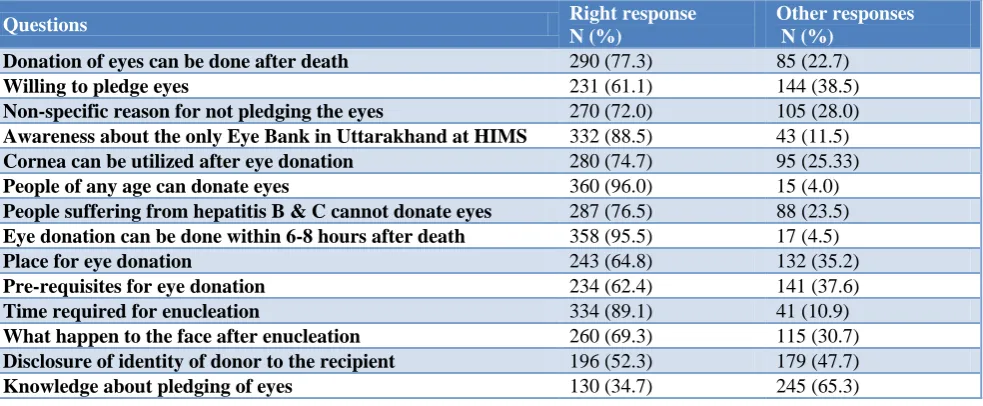
A total of 375 students participated in this study and all students submitted their responses. Out of 375, 264 (70.4%) were males and 111 (29.6%) were females Figure 1. Average age of the students involved in study was 15.01 years. 290 (77.3%) were aware about donation of eyes can be done after death and 231 (61.1%) students were willing to pledge eyes. Awareness was maximum among males 194 (66.89%) as compared to females 96 (33.10%). Willingness to pledge eyes for eye donation was 231 (61.1%) which was maximum with males 142 (61.47%).
The location to donate eyes & only eye bank in Uttarakhand was known to 332 (88.5%) students. The ideal time of eye donation is within 6 hours of death was known to 358(95.5 %) of the students. Disclosure of identity of donor cannot be done was known to only 196 (52.3%) of students.
Figure 1: Distribution of the students among both genders.
Table 1: Awareness and knowledge on eye donation.
Questions Right response
N (%)
Other responses N (%)
Donation of eyes can be done after death 290 (77.3) 85 (22.7)
Willing to pledge eyes 231 (61.1) 144 (38.5)
Non-specific reason for not pledging the eyes 270 (72.0) 105 (28.0)
Awareness about the only Eye Bank in Uttarakhand at HIMS 332 (88.5) 43 (11.5)
Cornea can be utilized after eye donation 280 (74.7) 95 (25.33)
People of any age can donate eyes 360 (96.0) 15 (4.0)
People suffering from hepatitis B & C cannot donate eyes 287 (76.5) 88 (23.5)
Eye donation can be done within 6-8 hours after death 358 (95.5) 17 (4.5)
Place for eye donation 243 (64.8) 132 (35.2)
Pre-requisites for eye donation 234 (62.4) 141 (37.6)
Time required for enucleation 334 (89.1) 41 (10.9)
What happen to the face after enucleation 260 (69.3) 115 (30.7)
Disclosure of identity of donor to the recipient 196 (52.3) 179 (47.7)
Table 2: Myths on eye donation.
Questions Right responses N (%) Percentage (%)
Donation of eyes lead to blindness in the next birth 338 (90.1) 37 (9.9)
Prohibited entry in the heaven after eye donation 288 (76.8) 87 (23.2)
Financial transaction to the relatives of donor for eye donation 252 (67.2) 123 (32.8)
Corneal blind recipient gets cornea free of cost 188 (50.1) 187 (49.9)
Table 3: Relationship of the gender with the awareness of eye donation.
Responses Male N(%) Female N(%) P* value
Are you aware about eye donation?
Can be done before death 16 (4.26) 3 (0.80)
0.04
Can be done after death 194 (51.73) 96 (25.60)
Can be done during life 50 (13.33) 12 (3.20)
Don't know 4 (1.06) 0 (0.00)
Willing to pledge eyes today
Yes 142 (37.86) 89 (23.73)
0.00
No 13 (3.46) 2 (0.53)
I will think 99 (26.40) 19 (5.06)
Don't know 10 (2.66) 1 (0.26)
Reason for not pledging the eyes
Religious 38 (10.13) 5 (1.33)
0.02
Facial disfigurement 25 (6.66) 10 (2.66)
Blindness in next birth 22 (5.86) 5 (1.33)
Any other reason 179 (47.73) 91 (24.26)
Awareness about the only eye bank in Uttarakhand at HIMS
Yes 229 (61.06) 103 (27.46)
0.04
No 10 (2.66) 2 (0.53)
May be 15 (4.00) 0 (0.00)
Don't know 10 (2.66) 6 (1.60)
P*- P value statistically significant calculated by Pearson Chi-Square.
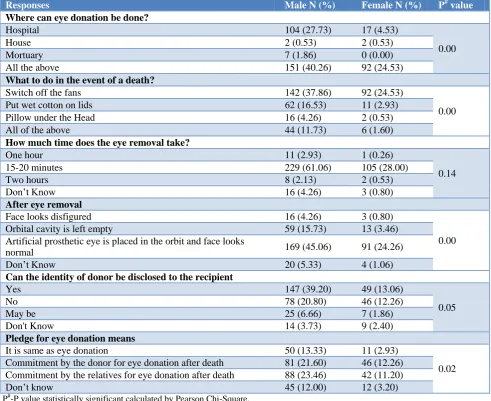
Table 4: Relationship of the gender with the knowledge of eye donation.
Responses Male N (%) Female N (%) P# value
Which part of the eye can be utilized after eye donation
Whole globe 68 (18.13) 4 (1.06)
0.00
Cornea 175 (46.66) 105 (28.00)
Retina 18 (4.80) 1 (0.26)
Don't Know 3 (0.80) 1 (0.26)
Who can donate eye
People of any age 252 (67.20) 108 (28.80)
0.85
Suffering for Rabies 4 (1.06) 1 (0.26)
Less than one year of age 5 (1.33) 1 (0.26)
Don't Know 3 (0.80) 1 (0.26)
Who cannot donate eyes
People suffering from hepatitis B & C 197 (52.53) 90 (24.00)
0.48
Diabetic people 30 (8.00) 11 (2.93)
Who wear spectacles 19 (5.06) 4 (1.06)
Don't Know 18 (4.80) 6 (1.60)
After death, eyes should be donated within
6-8 hours 251 (66.93) 107 (28.53)
0.39
10-24 hours 8 (2.13) 2 (0.53)
Time does not matter 3 (0.80) 0 (0.00)
Don’t know 2 (0.53) 1 (0.26)
Responses Male N (%) Female N (%) P# value
Where can eye donation be done?
Hospital 104 (27.73) 17 (4.53)
0.00
House 2 (0.53) 2 (0.53)
Mortuary 7 (1.86) 0 (0.00)
All the above 151 (40.26) 92 (24.53)
What to do in the event of a death?
Switch off the fans 142 (37.86) 92 (24.53)
0.00
Put wet cotton on lids 62 (16.53) 11 (2.93)
Pillow under the Head 16 (4.26) 2 (0.53)
All of the above 44 (11.73) 6 (1.60)
How much time does the eye removal take?
One hour 11 (2.93) 1 (0.26)
0.14
15-20 minutes 229 (61.06) 105 (28.00)
Two hours 8 (2.13) 2 (0.53)
Don’t Know 16 (4.26) 3 (0.80)
After eye removal
Face looks disfigured 16 (4.26) 3 (0.80)
0.00
Orbital cavity is left empty 59 (15.73) 13 (3.46)
Artificial prosthetic eye is placed in the orbit and face looks
normal 169 (45.06) 91 (24.26)
Don’t Know 20 (5.33) 4 (1.06)
Can the identity of donor be disclosed to the recipient
Yes 147 (39.20) 49 (13.06)
0.05
No 78 (20.80) 46 (12.26)
May be 25 (6.66) 7 (1.86)
Don't Know 14 (3.73) 9 (2.40)
Pledge for eye donation means
It is same as eye donation 50 (13.33) 11 (2.93)
0.02
Commitment by the donor for eye donation after death 81 (21.60) 46 (12.26)
Commitment by the relatives for eye donation after death 88 (23.46) 42 (11.20)
Don’t know 45 (12.00) 12 (3.20)
P#-P value statistically significant calculated by Pearson Chi-Square.
Table 5: Relationship of the gender with attitude and myths of eye donation.
Responses Male N (%) Female N (%) P^ value
What has been the source of your awareness regarding eye donation?
Family/friends/doctor 7 (1.86) 8 (2.13)
0.04
Television/radio/posters/pamphlets/internet 31 (8.26) 14 (3.73)
Magazine/newspaper 8 (2.13) 0 (0.00)
All of the above 218 (58.13) 88 (23.46)
Would you like to spread awareness regarding eye donation in society
Yes 256 (68.26) 110 (2.93)
0.46
No 2 (0.53) 1 (0.26)
May be 4 (1.06) 0 (0.00)
Don't know 2 (0.53) 0 (0.00)
Donation of eyes lead to blindness in the next birth
Yes 4 (1.06) 1 (0.26)
0.44
No 233 105
May be 12 2 (0.53)
Don't know 14 3
Prohibited entry in the heaven after eye donation
Yes 24 4 (1.06)
0.15
No 196 92
May be 27 7
Don't know 17 8
Responses Male N (%) Female N (%) P^ value
Do the relatives of donor get any money for eye donation?
Yes 31 17
0.53
No 176 76
May be 31 11
Don't know 26 7
Corneal blind recipient gets cornea free of cost
Yes 137 51
0.76
No 69 32
May be 34 16
Don't know 24 12
P^-P value statistically significant calculated by Pearson Chi-Square.
280 (74.7%) students had the knowledge that the cornea is used for eye donation and only 360 (96.0%) knew that people of any age can donate eyes. 287 (76.5%) students knew that people suffering from hepatitis B & C cannot donate eyes. After enucleation no disfigurement of face of donor happen was known to 260 (69.3%) students (Table 1).
No myth like people who donate their eyes may be born blind in their next birth were prevailing among 338 (90.1%) students. 252 (67.2%) students were aware about no financial transaction to the relatives of donor for eye donation and 188 (50.1%) students knew that corneal blind recipient gets cornea free of cost (Table 2).
Difference between male and females about the awareness of eye donation, willingness to pledge eyes, reasons for not pledging the eyes and awareness about the location of eye bank in Uttarakhand was significant with p value (0.04, 0.00, 0.02 and 0.04) respectively (Table 3).
Difference between male and females about the knowledge regarding which, part of the eye can be utilized after eye donation, place of eye donation, what to do for eye donation in the event of a death, facial features after donation was significant with p value (0.00) each. The knowledge about the fact that Identity of donor cannot be disclosed to the recipient showed significant difference between males and females with P value of 0.05. There was significant difference between males and females about the knowledge of the meaning of pledging and source of awareness of eye donation with P value of 0.02 and 0.04 respectively (Table 4 and 5).
DISCUSSION
In the present study 70.4% were males and 29.6% were females in contrast to a study done by Biswas et al in which 55% were females.6
Data from our study shows that, 77.3% of the students were aware that eyes could be donated after death but only 61.1% of them were willing to pledge their eyes which showed that despite being aware of eye donation low proportion of people were ready to pledge eyes
which are a real matter of concern. Detailed knowledge of eye donation is mandatory to transform awareness into the pledging and procurement of more corneas. In a study among the south Indian population, 50.7% of participants were aware of eye donation which was quiet less as compare to current study.7
Though 61.1% were willing to pledge their eyes in the current study but only 12% pledged their eyes out of which 7.2% were students who were ≥18 years of age rest 4.8% students motivated their parents and grandparents to pledge their eyes. Krishnaiah et al conducted a study on awareness of eye donation in the rural Indian population of all ages showed that only about one fifth of those aware of eye donation pledged their eyes, which is quite less as compared to the current study in which 12% pledged their eyes, it could have been more pledging but major chunk of the students involved were less than 18 years, which shows that students are important determinants in promoting eye donations as they are the future potential donors.8
Biswas et al reported that media publicity plays an important role to increase awareness of eye donation and to educate the students who can act as motivators for enhancing eye donation and increasing eye health care awareness in the community which holds true for the current study where media was responsible for awareness among 12% of the students.6 This shows that mass media alone is not sufficient for awareness regarding eye donation, but there is a great need to educate students about preventive and curative aspects of corneal blindness and they can motivate their friends and family members about eye donation.
believed that they will get blindness in next birth after eye donation.
It is expected that the number of individuals with unilateral corneal blindness in India will increase to 10.6 million by 2020.10 So long as there is a properly documented will of the donor and written consent of relatives, no law prevents removal of donor eyes for corneal grafting. Higher secondary school students are the future citizens for the country. If they are sufficiently educated about eye donation they can spread the message among their friends and family members. Thus they will act as important motivators and ultimately enhance eye donation rates in our country.
Corneal transplantation being the most successful of all organ transplantation remains the major treatment option for various corneal pathologies and it prevent corneal blindness. Backlog of corneal transplantation can be cleared by increasing the corneal procurement and its further utilization. It is very important for people to be aware of time limit for eye donation as it may not be useful to utilize eyes for donation that are donated later than 6 hours after death. In the present study 95.5% students were aware about the ideal time required for corneal donation which is higher than George et al (79.5%) and Bhandary et al (88%).9,11
A similar result was found in a preliminary survey conducted by the Aravind Eye Care System on the level of awareness of eye donations in an adult population of the state of Tamil Nadu in southern India.7 In the present study males were more aware and were ready to pledge eyes and there was significant difference on the awareness and attitude towards eye donation between both gender. In contrast Krishnaiah et al reported that females were less willing to pledge eyes but there was not any significant association between gender regarding willingness to donate eyes.8 It is our moral responsibility to motivate school going students, illiterates and rural population for this noble cause. It might be a good idea, if managers of movie theatres are motivated to present a video show on the importance and reasonable details of eye donation at the time of screening the movie. This could have a greater impact if any presentation on eye donation can be broadcasted by a prominent film stars or sport persons. There is also a great need to educate students in all fields, medical professionals about eye donation, so as to enable the younger generation to act as future motivators for enhancing eye donation rates.12 Studies have shown that training of staff is significantly associated with higher rates of donation.13
The consent of the family is of utmost importance for eye donation as the pledge can be respected only if the family consents for eye donation so involvement of the governmental and non-governmental organizations should participate in training the hospital medical staff, nurses and counselors who can motivate positively the
next of the kin of the deceased for eye donation whenever there is a death.
Grief counseling of relatives by hospital medical staff following death in the hospitals has been successful in procuring organs.14
Indian legislation needs modifications to enhance eye donation like in USA the Presumed Consent Law which means if the dead person has not registered any objection to donate while alive, consent is presumed and eyes can be removed as required. 15 In India we do not yet have such legislation; the government should introduce the concept of "presumed consent" to boost eye donations. Such legislation would emphasize the government's commitment to the cause of eye donation. Another area of legislation is the " required request law" wherein it becomes mandatory for all health care staff institutions coming into contact with families to make a request for eye donation.
CONCLUSION
The data from the present study suggest that students need more awareness regarding eye donation. To translate awareness into action appropriate strategies have to be developed to increase the knowledge about eye donation. It is encouraging that male students were predominantly ready to pledge their eyes and were found more motivated. More focus is required for enhancing the eye donation by making the school going students mainly females as they are the future citizen who will imply all the strategies for this noble cause. Although awareness regarding eye donation is high, there is lack of knowledge and motivation related to eye donation and the myths are still prevailing in the society despite being highly aware.
ACKNOWLEDGEMENTS
Authors would like to thank Mr. Shubham Pandey, Assistant Professor & Mr. Ankit, Lecturer, Dept. of Bio Statistics for Statistical analysis. We would like to also thank Mrs. Rashmi Chauhan, Principal of Angle Academy School and Mrs. Neha Malik, Muskan foundation, Haridwar, Uttarakhand. The authors express their sincere thanks to all the students for sparing their time to participate in this study.
Funding: No funding sources Conflict of interest: None declared
Ethical approval: The study was approved by the Institutional Ethics Committee
REFERENCES
2. Sinha R, Sharma N, Vajpayee RB. Corneal Blindness—Present Status A look at the leading causes of and current treatment success with blindness worldwide. Cataract & Refract Surg today. 2005.
3. Gupta N, Tandon R, Gupta SK, Sreenivas V, Vashist P. Burden of Corneal Blindness in India. Indian J Community Med. 2013;38:198–206.
4. Raj A, Gupta N, Dhasmana R, Nagpal RC, Bahadur
H, Maitreya A. Indication and visual outcome of penetrating keratoplasty in tertiary eye care institute in Uttarakhand. J Clin Diagn Res. 2016;10:1-4. 5. Dhaliwal U. Enhancing eye donation rates. Training
students to be motivators. Indian J Ophthalmol 2002;50:209-12
6. Biswas J, Bandyopadhyay S, Das D, Mandol KK, Saha I, Ray B. A study in awareness about eye health care and eye donation among secondary level students of North Kolkata, India. Kathmandu Univ Med. 2010;8(31):317-20.
7. Priyadarshan B, Srinivasan M, Padmavathi A, Selvam R, Saradha R, Nirmalan PK. Awareness of eye donation in an adult population of southern India. A pilot study. Indian J Ophthalmol. 2003;51:101–4.
8. Krishnaiah S, Kovai V, Nutheti R, Shamanna BR, Thomas R, Rao GN. Awareness of eye donation in the rural population of India. Indian J Ophthalmol. 2004;52:73-8
9. George S, Mohan P. Awareness, Knowledge and
Attitude regarding eye donation in
Thiruvanantapuram district south India. Int J Recent trends in Sci Tech. 2015;14:322-5.
10. Dandona R, Dandona L. Corneal blindness in a southern Indian population: Need for health
promotion strategies. Br J Ophthalmol.
2003;87:133–41.
11. Bhandary S, Khanna R, Rao KA, Rao LG, Lingam KD, Binu V. Eye donation - Awareness and willingness among attendants of patients at various clinics in Melaka, Malaysia. Indian J Ophthalmol. 2011;59:41-5.
12. Dhaliwal U. Enhancing eye donation rates. Training students to be motivators. Indian J Ophthalmol. 2002;50:209-12.
13. Evanisko MJ, Breasley CL, Brigham LE, Capossela C, Cosgrove GR, Light J, et al. Readiness of critical care physicians and nurses to handle requests for organ donation. Am J Crit Care. 1998;7:4-12. 14. Vernale C. Critical care nurses' interactions with
families of potential organ donors. Focus Crit Care. 1991;18:335-9.
15. Farge EJ, Silverman LM, Khan MM, Wilhelmus KR. The impact of state legislation on eye banking. Arch Ophthalmol. 1994;112:180-5.