Comparison of PCA Based and 2DPCA
Based Face Recognition Systems
Dr. V. RADHA
Associate Professor, Avinashilingam Deemed University for Women, Coimbatore, TamilNadu, India.
M. PUSHPALATHA
M.Phil Scholar, Avinashilingam Deemed University for Women, Coimbatore,TamilNadu, India.
Abstract:
With the growth of information technology coupled with the need for high security, the application of biometric as identification and recognition process has received special attention. The biometric authentication systems are gaining importance and in particular, face biometric is more preferred for person authentication because of its easy and non-intrusive method during acquisition procedure. Various methods are used for facial recognition, out of which Principal Component Analysis (PCA) based systems are frequently used. This paper compares the performance of two face recognition systems, which focus on the use of PCA for the analysis and recognition while using face biometric for authentication. Several experiments were conducted to evaluate the performance the two systems and were assessed in terms of accuracy and speed.
Keywords: Eigenfaces; PCA ; 2DPCA; Euclidean distance; volume measure; free space. 1. Introduction
Research on biometric authentication has gained renewed attention in recent years, brought on by an increase in security concerns. The recent world attitude towards terrorism has influenced people and their governments to take action and be more proactive in security issues. This need for security also extends to the need for individuals to protect, among other things, their working environments, homes, personal possessions and assets.
Biometrics is one area of technology, whose usage is increasing steadily, can automate the process of people identification based on physical or behavioural characteristics [9]. As a result of this evolution, a new breed of techniques and methods for user identity recognition and verification has appeared based on the biometric features that are unique to each individual [3] [22].
Several state-of-the-art biometric techniques have been developed in recent years which use a variety of human characteristics for identification and recognition. These include fingerprint [1], signature [20], iris [4], retina [5], hand [8], voice [27] and facial recognition [15][16]. Each biometric trait has its strengths and weaknesses, and the choice of a specific trait depends upon the requirements of the application [19]. Among them face recognition is frequently used to discriminate authorized and unauthorized persons, as they are least intrusive with high public acceptability.
The methods used in face recognition can be broadly classified into, image feature based and geometry feature based methods. Image feature based methods or template based methods, estimate the correlation between a face and one or more templates, which is later used during recognition. They capture and analyze the global features of a face. Successful and efficient templates can be constructed using tools like Support Vector Machines (SVM) [11], Linear Discriminant Analysis (LDA) [7], Principal Component Analysis (PCA), Independent Component Analysis [10], Kernel Methods [29] and Fisher’s Linear Discriminate (FLD) [30]. Geometry feature-based methods concentrate on local facial features and their geometrical relationships. Successful methods based on geometry features are proposed by [13] and [26]. Some researchers have also used the color shape and texture of a face [21].
secondly, the Euclidean distance measure (DM) is replaced by a more sophisticated method called volume measure (VM).
The paper is organized as below. Section 1 introduced the topic under discussion. Section 2 lists the general steps used in face recognition system. Section 3 and 4 explains the methodology used by TMPCA and 2DPCA. Section 5 presents the results of the experiments conducted and Section 6 concludes the work.
2. General Steps in Face Recognition System
A face recognition system is a computer application, which automatically identifies a person from an image database or video. The general steps used are, Image Acquisition - Face images are normally acquired by scanning a digital photography as by using cameras to capture live picture of a person, Segmentation or face detection - Segmentation is the process which detects the location of a face in the acquired image, Feature selection - Both the studies use Principle Components Analysis (PCA), which is commonly referred to as the eigenface method, Comparison - The features of the input image is compared with that of the database values and matching scores are calculated. In an identification application, scores indicate how closely the input image matches with each image in the database. In a verification application, the input image is only compared with one template in the database, Score Matching - In this step; the best matching score is detected and declared as the recognized face.
3. TMPCA Face Recognition Model
The TMPCA system conducts face recognition in two steps, Initialization process and Recognition process. The initialization process performs the following operations.
Acquisition of images to prepare the training set.
Calculation of Eigenfaces for these acquires images. After calculation, M images with high eigenvalues were considered and they were termed as face space. When new faces arrive, the eigenvalues were updated and recalculated.
The corresponding distribution in M-dimensional weight space for each known individual, by projecting their face images on to the “face space” was calculated.
The initialization steps were repeated as and when need arises and from time to time whenever there is a free excess operational capacity. This data was cached and was in the further steps thus successfully eliminating the overhead of re-initializing, decreasing execution time thereby increasing the performance of the entire system. After initializing the system, the recognition process is conducted which involves the following steps.
Calculation of a set of weights based on the input image and the M eigenfaces by projecting the input image onto each of the eigenfaces
Determine if the image is a known or unknown face by checking to see if the image is sufficiently close to a “free space”.
If it is a face, then classify the weight pattern as either a known person or as unknown.
Update the eigenfaces or weights as either a known or unknown If the same unknown person face is seen several times then calculate the characteristic weight pattern and incorporate into known faces. The TMPCA system, offers the last step of the recognition process as an optional step, which can be ignored or implemented according to the requirement of the application.
4. 2DPCA Face Recognition Model
Normally, the PCA-based face recognition methods, the 2D face image samples usually have been transformed into 1D image vectors by some technique like concatenation [28]. 2DPCA model is a method that uses the 2D features, which are features obtained directly from original vector space of a face image rather than from a vectorized 1D space. The notion of 2DPCA was initially proposed by [6], which was enhanced by [2]. The advantages of 2DPCA over PCA were presented by [12], [24] and [25]. The usage of 2DPCA for face recognition is a novel idea and is discussed in this section. The steps of 2DPCA face recognition model are given below.
Acquire face images to form a training set (X1, X2, ..XN)
Extract features using 2DPCA for each training sample and each testing sample.
Classify and recognize the image using Volume measure (VM)
Give the result of recognition.
A T A det A Vol (1)
where A is the matrix of full column rank and AT is its transpose. The process of classification and recognition is described below.
Considering a training face set {X1,X2, . . . ,XN}, 2DPCA uses all training samples to build the total sample
covariance matrix C (Equation 2).
C = E[X-E(X))T (X-E(X))] =
N
1
i i
T
i X) (X X)
X ( N
1 (2)
where Xi is the ith training sample, which is a h x w matrix, X denotes the mean sample matrix of all training
sample matrix, and N is the number of training samples. The crucial idea of 2DPCA is to select some good projection vectors. To choose good projection vectors, the total scatter of the projected samples is used [28], which can be denoted by the trace of the covariance matrix of the projected feature vectors. So the following criterion was adopted.
J (w) = tr (Sw) (3)
where Sw is the covariance matrix of the projected feature vectors of the training images, and tr(Sw) stands for
the trace of Sw. Obviously, to maximize the criteria in Equation (3) Swis equal to find a projection direction w,
onto which the total scatter of the projected samples is maximized. The covariance matrix Sw can be written by
SW = E[y – E(y)] T
[y-E(y)] = E[X-E(X))w]T [(X-E(X))w] (4)
From the definition of image covariance matrix in Equation (1), J(w) can be obtained by using the following equation.
J(w) = wTCW (5)
The optimal projection axes, w1,w2, . . . ,wd, are the orthonormal eigenvectors of C corresponding to the first
d largest eigenvalues. It is proved by [12] that the covariance matrix in 2DPCA can be computed more accurately than that in PCA and it can also be computed easily. So a feature matrix Yi = [yi1, yi2, … yid] for
each training face sample (or each sample in gallery set) [18] can be obtained by yik=Xiwk, k = 1,2,. . . ,d.
In the similar fashion, the 2DPCA model also gets a feature matrix Yt=[yt1, yt2, … ytd] for each testing face
sample after the transformation by 2DPCA mentioned (described) above. Then, a nearest neighbor classifier based on the matrix distance is used for classification.
d 1
k tk ik 2
i
t,Y) arg min ||y y ||
Y ( d min arg C (6)
where d(Yt, Yi) = d
1
k tk ik 2
|| y y
||
,
C [1, 2, … N],and the distance between Yc and Yt is minimal. Then, Ytbelongs to the class where Yc belongs to. This classification measure is based on the matrix distance proposed
by [28] and is used in 2DPCA.
5. Results and Discussion
To ascertain the performance of the models, several experiments were conducted. All the experiments were conducted using a Pentium IV machine with 2GB RAM. Performance evaluation was done vigorously for the two studied models.
5.1. Performance Parameters
In order to evaluate the overall performance of the biometric system, the False Acceptance Rate (FAR), False Recognition Rate (FRR), Accuracy and Recognition Time were used. From these two important measures, the accuracy of the system can be calculated using the formula (Equation 7).
Another parameter that was used during experimentation is the time parameters. The execution time is calculated as the total time measurement from the start of the program until its termination, that is, the time taken for the system to test whether the given input face is recognized or not.
5.2. Test Images
The training and testing images used to compare the performance of TMPCA and 2DPCA models is given in Figure 1a and 1b. A total of 20 training images and 10 test images was used during experimentation. All the images used were of colour JPEG format with size 180 x 200 pixels.
Fig. 1a. Training Images
Fig. 1b. Test Images
5.3. Results
During face recognition, a threshold value was used to control the amount of accuracy required and was accepted from the user as input value. The False Acceptance rate (FAR), False Rejection Rate (FRR) and the overall accuracy of the system were calculated. Table 1. shows the result of FAR and FRR obtained for a threshold value of 100.
Table 1. Accuracy Analysis
Model Used FAR FRR Accuracy (%)
TMPCA 0.41 1.23 99.18
2DPCA 0.26 0.43 99.66
The results projected shows that the 2DPCA produces better accuracy than TMPCA. The 2DPCA shows a 0.48% increase in accuracy efficiency when compared with TMPCA.
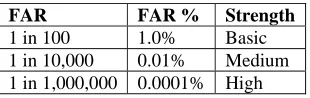
The UK Biometrics Working Group [23] has suggested a scheme for understanding relative biometric accuracy rates that is shown in Table 2. According to them, a recognition system provides basic security, if the FAR is less than one per cent, medium if it is less 0.01 per cent and the system provides high security if the FAR is less than 0.0001%.
Table 2. A Scheme for understanding relative Biometric strengths
FAR FAR % Strength
1 in 100 1.0% Basic 1 in 10,000 0.01% Medium 1 in 1,000,000 0.0001% High
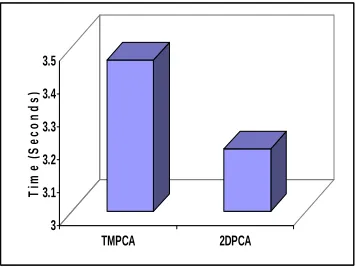
From the results it can be seen both the models are very fast and taken on average less than 3.3 seconds to give the result. The 2DPCA was able to given a recognition result in less than 3.19 seconds, while the TMPCA took less than 3.46 seconds. Again, it can be seen from the results that 2DPCA outperforms TMPCA in terms of recognition speed. The time gain obtained through 2DPCA over TMPCA is 7.8%.
Thus, the fast result producing nature along with the high accuracy makes both the models a very good candidate for person authentication in basic security area. It was observed that among the two models studied, 2DPCA was better both in terms of accuracy and speed.
6. Conclusion
The primary objective of this study is to compare biometric recognition system based on face using Principal Component Analysis. Biometric facial recognition has the potential to provide significant benefits to society. Among the various methods used, PCA method is most frequently used and this study compared the work of two novel models based on PCA. This paper is a comparison study of two face recognition system based on Principal Component Analysis. This results of comparison reveals that even though, both the models compared produce good recognition accuracy and are fast, the performance of 2DPCA method is better than the TMPCA method. The faces used during experimentation are faces collected from the Internet and in future standardized datasets like AR database, FERET and Stringling face databases may be used for further evaluation. The work can be extended to include other non-PCA methods such as SVM, FLM and LDA. Another research direction is to develop hybrid models that combine these methods. In particular, future studies are planned to envisage the blending of the two techniques 2DPCA with Linear Discriminant Analysis (LDA) for face recognition.
References
[1] Arvind, M. (2009) Biometrics - Finger print, Iris, Retina and Pupil Recognition : Biometrics for beginners, Version 3, Knol, 2009, (http://knol.google.com/k/ arvind-muthukrishnan/biometrics-finger-print-iris-retina-and/3ktp6efifnl1p/7).
[2] Chen, S., Zhu, Y.L., Zhang, D.Q. and Yang, J.Y. (2005) Feature extraction approaches based on matrix pattern: MatPCA and MatFLDA, Pattern Recognition Letters, Vol. 26, No. 8, Pp.1157–1167.
[3] Cuntoor, N., Kale, A. and Chellappa, R. (2003) Combining multiple evidences for gait recognition. In: Proceedings of the international conference on acoustics speech and signal processing, Vol. 3, Pp 33–36.
[4] Daugman, J. (2006). Probing the uniqueness and randomness of iriscodes: results from 200 billion iris code comparisons. Proceedings of IEEE, Vol. 94, No.11, Pp. 1927-1935.
[5] Dowling, J. (2007) Retina, Scholarpedia, Vol.2, No.12, P.3487.
[6] Hong, Z.Q. (1991) Algebraic feature extraction of image for recognition, Pattern Recognition, Vol. 24 , No.3, Pp. 211–219.
[7] Huang, J., Yuen, P.C., Chen, W. and Lai, J.H. (2003) Component-based LDA Method for Face Recognition with One Training Sample, IEEE International Workshop on Analysis and Modeling of Faces and Gestures, Pp.120.
[8] Jain, A.K., Nandakumar, K. and Nagar, A. (2008) Biometric Template Security, EURASIP Journal on Advances in Signal Processing, Vol. 2008, Article ID 579416.
[9] Kale, A., Sundaresan, A., Rajagopalan, A.N., Cuntoor, N.P., Roy-Chowdhury, A.K., Kruger, V. and Chellappa, R. (2004) Identification of humans using gait, IEEE Trans Image Process, Vol. 13, No.9, Pp. 1163–1173.
[10] Kim, J., Choi,J., Juneho, Y. and Turk, M. (2005) Effective Representation Using ICA for Face Recognition Robust to Local Distortion and Partial Occlusion, IEEE Transactions on Pattern Analysis and Machine Intelligence, Vol. 27, Issue 12, Pp. 1977-1961.
[11] Kisku, D.R., Mehrotra, H., Sing, J.K. and Gupta, P. (2008) SVM-based Multiview Face Recognition by Generalization of Discriminant Analysis, International Journal of Computer Systems Science and Engineering (formerly International Journal of Intelligent Systems and Technologies), Vol. 3, No. 3, pp. 174179.
[12] Kong, H., Li, X.C., Eam, K.T., Wang, J.G. and Ronda, V. (2005) Generalized 2D principal component analysis, Proceedings of IEEE International Joint Conference on Neural Networks, Montreal, Canada.
[13] Lanitis, A., Taylor, C.J. and Cootes, T.F (1997) Automatic interpretation and coding of face images using flexible models. IEEE Transactions on Pattern Analysis and Machine Intelligence, Vol. 19, No.7, Pp.743–756.
3 3.1 3.2 3.3 3.4 3.5
Ti
m
e
(
S
e
c
onds
)
TMPCA 2DPCA
[14] Lata, Y.V., Tungathurthi, C.K.B., Rao, H.R.M., Govardhan, A., and Reddy, L.P. (2009) Facial Recognition using Eigenfaces by PCA, International Journal of Recent Trends in Engineering, Vol. 1, No. 1, Pp.587-590.
[15] Li, S.Z. and Jain, A.K. Eds., (2005) Handbook of face recognition, Springer.
[16] Mendez, D.C., Mendez, S.C., Quezada, A.L., Rudolph, H. and Lehman, M. (2009) Face recognition system using fringe projection and moiré: characterization with fractal parameters, IJCSNS International Journal of Computer Science and Network Security, VOL.9 No.7, Pp. 78-84.
[17] Meng, J. and Zhang, W. (2007) Volume measure in 2DPCA-based face recognition, Pattern Recognition Letters, Science Direct, Elsevier, Vol 28, Pp.1203-1208.
[18] Phillips, P.J., Moon, H., Rizvi, S.A. and Rauss, P.J. (2000) The FERET evaluation methodology for face- recognition algorithms, IEEE Trans. Pattern Anal. Machine Intell., Vol.22, No.10, Pp.1090–1104.
[19] Prabhakar, S., Pankanti, S. and Jain, A.K. (2003) Biometric recognition: security and privacy concerns, IEEE Security & Privacy Magazine, Vol. 1, No.2, Pp. 33-42.
[20] Sanchez-Reillo, R. (2000) Hand geometry pattern recognition through Gaussian mixture modelling, Proceedings of 15th International Conference on Pattern Recognition, Vol. 2 , Pp. 937 -940.
[21] Shin, Y., Kim, J., Lee, Y., Shin, W. and Choi, J. (2007) Performance Evaluation Model for the Face Recognition System, Frontiers in the Convergence of Bioscience and Information Technologies, Pp.704-708.
[22] Toledeno, D.T., Pozo, F.R., Trapote, A.H. and Gomez, L.H. (2006) Usability evaluation of multi-modal biometric verification systems, Interacting with Computers, Elsevier Science Inc. New York, USA, Vol. 18, No.5, Pp.1101-1122.
[23] UK Government Biometrics Working Group (BWG). (2003). Biometric security concerns. URL:
http://www.cesg.gov.uk/site/ast/biometrics/media/Biometric SecurityConcerns.pdf
[24] Wang, L.W., Wang, X. and Feng, J.F. (2006) On image matrix based feature extraction algorithms, IEEE Trans. Systems Man Cybernet. – Part B, Cybern., Vol.36, No.1, Pp.194–197.
[25] Wang, L.W., Wang, X., Zhang, X.R. and Feng, J.F. (2005) The equivalence of two-dimensional PCA to line-based PCA. Pattern Recognition Letters, Vol.26 , No.1, Pp. 57–60.
[26] Wiskott, L., Fellous, J., Kruger, N. and Malsburg, C. (1997) Face recognition by elastic bunch graph matching. IEEE Transactions on Pattern Analysis and Machine Intelligence, Vol. 19, No.7, Pp.775–779.
[27] Woodward, J.D., Orlands, N.M. and Higgins, P.T. (2003) Biometrics, McGraw Hill Osborne, New York.
[28] Yang, J., Zhang, D., Frangi, A.F., Yang, J.Y. (2004) Two-dimensional PCA: A new approach to appearance-based face representation and recognition, IEEE Trans. Pattern Anal. Machine Intell, Vol.26, No.1, Pp.131–137.
[29] Yang, M. (2002) Kernel Eigenfaces vs. Kernel Fisherfaces: Face Recognition Using Kernel Methods, Proceedings of the Fifth IEEE International Conference on Automatic Face and Gesture Recognition, P.215.