Optimizing OLSR Protocol for VANET
Kanika Gupta
Department of Electronics and Communication Engineering SSGI, Bilaspur
Yamuna Nagar, India Email: [email protected]
Asst. Prof. Saurabh Kohli
Department of Electronics and Communication Engineering SSGI, Bilaspur
Yamuna Nagar, India Email: [email protected]
Abstract: Vehicular ad hoc network is a non infrastructure network where each network node not only acts as a host but also acts as a router. The environment is highly dynamic due to mobile nature of nodes. The proper functioning of these networks depends upon a routing protocol that can respond to the rapid changes in the topology. Our interest is focused on the OLSR routing protocol, which uses hello and (TC) topology control messages to discover and then disseminate link state information all through the mobile ad hoc network. We discuss the impact of Hello messages on the performance of OLSR in term of packet delivery ratio, delay and throughput. The objective of this thesis is to study the impact of tuning on the performance of mobile routing Protocol, OLSR, which is proactive routing protocol. Since not many VANETs have been deployed, most of the studies are based on simulation. Also for this thesis, experiments are conducted by network simulator2.34 by using tool command language. A basic framework is employed to analyze the performance of routing protocol OLSR by tuning its parameters. We firstly evaluated the performance in terms of QOS by applying an optimization strategy that obtains automatically efficient OLSR parameter configurations by coupling two different stages: an optimization procedure and a simulation stage. It is observed that tuned-OLSR outperformed OLSR. The three basic parameters are tuned by applying genetic (GA), simulate annealing (SA) and particle swarm (PSO) algorithms. It shows considerable increase in throughput, packet delivery ratio and a substantial decrease in delay as compared to the respective performance of OLSR. The optimization methodology presented in this work (coupling meta heuristics and a simulator) offers the possibility of automatically and efficiently customizing any protocol for any VANET scenario.
Keywords:Vehicular Adhoc Networks (VANET),Routing Architecture for VANET, Challenges, Taxonomy of routing protocols
1. INTRODUCTION
1.1 Vehicular Adhoc Networks (VANET):
Vehicular ad hoc network is a special form of MANET which is a vehicle to vehicle & vehicle roadside wireless communication network. It is independent & self-organizing wireless communication network, where nodes in VANET involve themselves as servers and/or clients for exchanging & allocating information [1].
VANET, a special case of MANET, has set of distinctive property. Highways, junctions, traffic lights, avenues restrict movements of nodes. It generates specific mobility patterns opposed to MANET. Vehicles shift very faster than nodes in MANET gives shorter connection time between nodes. So network disconnection taken place recurrently and route maintenance is harder compared to MANET [2].
1.2Routing in VANETs
Taxonomy of routing protocols:
Figure1: Taxonomy of routing protocols
1.2.1Transmission strategies based classification
According to transmission strategies routing can be named under Unicast, broadcast and multicast. Multicast further partitioned into geocast and cluster based routing protocols.
TABLE 1:TRANSMISSION STRATEGY BASED CLASSIFICATION
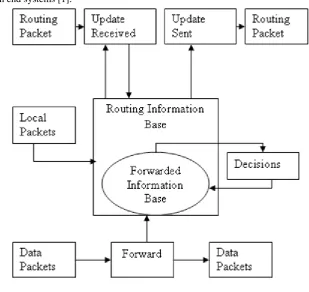
1.3 Routing Architecture for VANET
• A set of routing protocols that allow end systems and intermediate systems to gather and distribute the information necessary to determine routes.
• A routing information base including this information, from which routes between end systems can be computed i.e. directory information base, the routing information base is a concept and it doesn't exist as a single entity. The routing information base can be thought of as the combined (distributed) information of an entire subsystem concerning the routing relevant connectivity between the components of that subsystem.
• A routing algorithm that uses the information contained in the routing information base to derive routes between end systems [1].
Figure 2: Architecture of VANET
1.4 Challenges
VANET is not restricted up to Vehicle-to-Vehicle communication, it takes assistance of road side infrastructure that can also participate in communication between vehicles, but our main stress is on Vehicle-to-Vehicle communication. There are various challenges for VANET name as high speed of vehicle, dynamic route finding, structure, reflecting objects, other obstacles in path of radio communication, roadside objects, diverse direction of vehicles, concern about privacy, authorization of vehicle, safety of data and sharing of multimedia services. High pace of vehicle requires regular update of routing table whereas dynamic route finding would outcome into high time loss before static communication. Various user group among VANET are frequently used in traffic management agencies, getting popular, highway safety agencies, law enforcement agencies and emergency services [3].
2. RELATED WORK
The research work performed in this area by different researchers is presented as follows:
B.Paul et. al. [1] presented the pros and cons of VANET routing protocols for inter vehicle communication. VANET (Vehicular Ad-hoc Network) is a new technology which has taken enormous attention in the recent years. Due to quick topology changing and frequent disconnection makes it difficult to design an efficient routing protocol for routing data among vehicles, named V2V or vehicle to vehicle communication and vehicle to road side infrastructure, calledV2I. The existing routing protocols for VANET are not efficient to meet every traffic scenarios. Thus design of an efficient routing protocol has taken important attention. So, it is very necessary to identify the pros and cons of routing protocols which can be used for advance improvement or development of any new routing protocol.
(MANET), is a capable approach for the intelligent transport system (ITS). VANET allows vehicles to form a self-organized network with no required for a permanent infrastructure. As the VANET has a potential in improving road safety, real time traffic update and other travel comforts, it move attention of the researcher. Though VANET and MANET shares some common characteristics like self-organized network, effective topology, ad hoc nature etc, VANET differs from MANET by challenges, application, architecture, power restriction and mobility patterns, so routing protocols used in MANET are not applicable with VANET. New routing strategy for VANET has been projected by many researchers in recent year. This paper provides focus on the diverse aspects of VANET like architecture, characteristic, challenges, glimpse of routing protocols, and simulation models used for VANET.
Yugal Kumar et. al. [3] focused on the routing concept for the VANET i.e. principles for routing, breakdown of the routing function and requirement. The data delivery through Vehicular Ad-hoc Networks is challenging since it must capably handle quick topology changes and a fragmented network. The Inter-vehicle communication system is an adhoc network with high potency and varying number of nodes, where mobile nodes dynamically create temporary networks and transmitting messages from one node to others by using multiple hops due to limitation of short choice. The routing in vehicular Ad hoc Networks (VANET) has involved many attentions during the last few years.
Jamal Toutouh et. al. [4]This paper discusses a series of representative meta heuristic algorithms (PSO,DE,GA, and SA) in order to find automatically optimal configurations of OLSR routing protocol. In addition, a set of realistic VANET scenarios (relayed in the city of M´alaga) have been defined to perfectly evaluate the performance of the network under the automatically optimized OLSR. Experiments depict that the tuned OLSR configurations result in better QoS than the standard (RFC 3626) and then various human experts, making it amenable for utilization in VANETs configurations.
Jatin Gupta et. al. [5] OLSR routing protocol is one of the leading used proactive routing protocol used in MANETS. The MANETS is an autonomous network, containing of many sensor nodes, which are mobile in creation. The routing is the most key matter in MANETS, as the nodes are mobile in nature, so there is no rigid topology. In this paper, the prime focus is on the OLSR routing protocol, which uses hello and (TC) topology control messages to find out and then disseminate link state information all through the mobile ad hoc network. The paper discusses the impact of Hello messages on the presentation of OLSR in term of load, delay and throughput using OPNET.
M. Gunasekar et. al. [6] (VANET) Vehicular adhoc network provides wireless communication among vehicles lacking any underlying network infrastructure. In such Network, Quality-of-service (QoS) is complex because the network topology may change continually and the available state information for routing is inherently imprecise. Though, due to the vehicle movement, restricted wireless resources and the lossy characteristics of a wireless channel, supplying a reliable multihop communication in VANETs is principally challenging. Therefore, offering an efficient routing technique is crucial to the deployment of VANETs. The paper proposes an Intelligent Water Drops (IWD) algorithm to optimize the parameter setting in (OLSR) optimized connect state routing protocol. IWD Algorithm harmonizes the parameters in OLSR for superior Qos. The QoS versions of the IWD tuned OLSR routing protocol do better the Packet Delivery Ratio, reduce the communication cost and network traffic stress in the high speed movement scenarios.
Venkatesh et. al. [7] reviewed the existing routing protocols for VANETs and classify them into a taxonomy based on key attributes name as network architecture, applications supported, routing techniques, forwarding strategies, mobility models and quality of check metrics. The performance of routing protocols depends on diverse internal factors such as mobility of nodes and external factors name as road topology and restrictions that block the signal. This demands a greatly adaptive technique to deal with the dynamic scenarios by choosing the best routing and forwarding strategies and by using suitable mobility and propagation models. The paper delivers important protocols belonging to unicast, multicast, geocast and transmit categories. Strengths and weaknesses of diverse protocols using topology based, position based and cluster based approaches are analyzed. Emphasis is agreed on the adaptive and context-aware routing protocols. Recreation of broadcast and unicast protocols is presented out and the results are presented.
P. Jacquet et. al.[9] proposed and discussed optimized link state routing protocol(OLSR),for mobile wireless networks. It is optimization over a pure link state protocol as it minimize the size of information sent in messages and furthermore, reduces the number of retransmissions to flood these messages in whole network. Optimal routes are provided in terms of hops, which are immediately available when needed. The paper describes it the best protocol for large and dense ad-hoc networks.
Kunal Vikas Patil et.[10]addressed a routing protocol which replaces the standard greedy approach with necessity first algorithm. The vehicular ad hoc network (VANET) is a superior new technology. Vehicular ad hoc network (VANET) is a sub class of MANET that is mobile ad hoc networks. The OLSR is best suitable for larger mobile network. It is having affecting factors name configuration; multipoint relays. Using proposed protocol the network traffic load of administrative packet is reduced. The proposed new routing protocols are best suitable for vehicular network which are highly dynamic in nature.
Kuldeep Vats et. al. [11] discusses and evaluates “Optimized Link State Routing Protocol” OLSR routing protocol to better presentation. Using OPNET simulator tools for the performance of OLSR routing protocol simulation, created in (30 nodes) small network, medium size network (40 nodes) and large network (50 nodes) the complexity of the mobile ad-hoc network is analyzed. The MPR count, ”HELLO” message sent ,routing traffic sent and received, total TC message sent and onward, total hello message and TC traffic sent are studied.
3. PROPOSED WORK
A) Problem Formulation:
The most salient feature of VANETS is the exchange of up-to-date information among vehicles. For this, packets travel from one node to another. But in a network with high mobility and no central authority, travelling becomes a complex task. The routing protocol operates in the core of VANETs, discovering updated paths among the nodes to allow the effective exchange of data packets. For this reason this thesis deals with the optimization of a routing protocol, specifically the Optimized Link State Routing (OLRS) protocol. This protocol has been chosen since it presents a series of features that make it proper for highly dynamic ad hoc networks, and concretely for VANETs.
B) Proposed Work
The main drawback of OLSR is the need of preservance of routing table for all the possible routes. Such a drawback is negligible for scenarios with few nodes, but for huge dense networks, the overhead of control messages could use additional bandwidth and provoke network congestion. However, this precise performance of OLSR depends significantly on the selection of its parameters. Here, genetic algorithm, simulate annealing and particle swarm optimization are applied to changes the time interval for broadcasting HELLO messages. Hence, computing an optimal configuration for the parameters of this protocol is crucial before deploying any VANET, since it could positively improve the QoS, with a high implication on enlarging the network data rates and reducing the network load. All these features make OLSR a good candidate to be optimally tuned and justify our election. So, the objectives of our thesis may be stated as:
[1] Simulation of OLSR protocol with standard values.
[2] Optimization framework to automatically tune the OLSR configuration by various optimizations like SA, GA and
PSO
[3] Performance evaluation of optimized OLSR Protocol.
4. RESULTS AND ANALYSIS
To increase the through put, packet delivery ratio and to decrease End-to-End Delay and packet drop Genetic, Simulate annealing and Particle swarm optimization algorithms are used. The data are selected and transferred from the source to the destination. In this we implemented the simulation of OLSR protocol and evaluated its performance such as throughput, packet delivery ratio, packet drop and end- to-end delay. An attempt is made to analyze the impact of “Hello packets” on the packet delivery ratio, delay and throughput. An attempt is made to improve the performance of algorithm by varying time interval of “Hello” packets and discussing the variation shown by the results. Usually or default value of OLSR is set at 2.0 Hello interval.
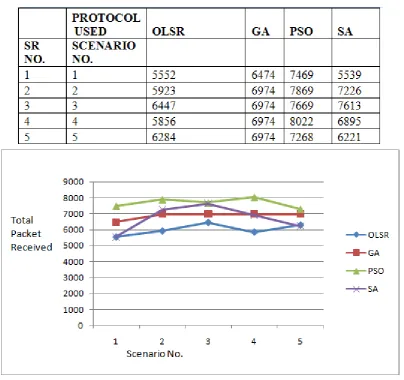
TABLE 2:ANALYSIS FOR TOTAL PACKET RECEIVED IN VARIOUS OPTIMIZATION TECHNIQUES
Figure 3: Comparisons of various optimization techniques on the basis of total packet received From the above figure, we can conclude that PSO has highest packet received and OLSR has lowest packet received.
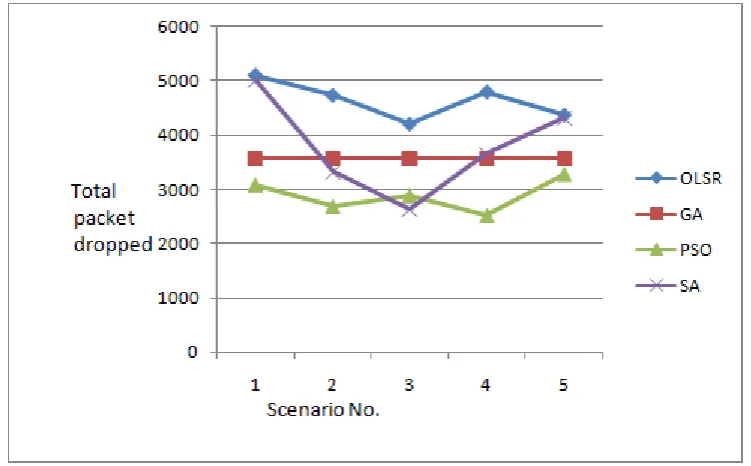
Figure 4: Comparisons of various optimization techniques on the basis of total packet dropped From the above figure, we can conclude that OLSR has highest packet dropped and PSO has lowest packet dropped.
TABLE NO.4ANALYSIS FOR PACKET DELAY RATIO (PDR) IN VARIOUS OPTIMIZATION TECHNIQUES
delay ratio.
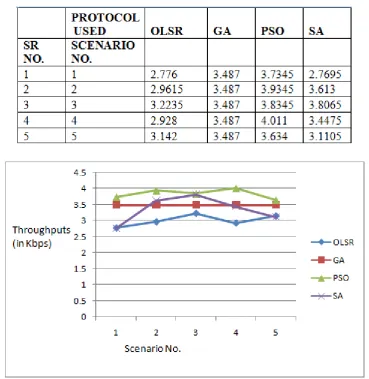
TABLE NO.5ANALYSIS FOR THROUGHPUT (IN KBPS) IN VARIOUS OPTIMIZATION TECHNIQUES
Figure 6: Comparisons of various optimization techniques on the basis of throughputs (in Kbps) From the above figure, we can conclude that PSO has highest throughput and OLSR has lowest throughput.
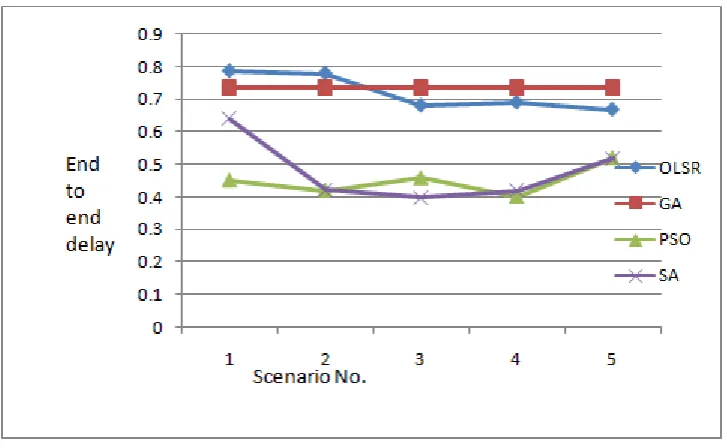
Figure 7: Comparisons of various optimization techniques on the basis of end to end delay
From the above figure, we can conclude that OLSR has highest end to end delay and PSO has lowest end to end delay.
5. CONCLUSION AND FUTURE SCOPE
In this thesis, we have addressed the optimal parameter tuning of the OLSR routing protocol to be used in VANETs by using an automatic optimization tool. For this purpose, we have defined an optimization strategy based on coupling optimization algorithms (GA) and the ns-2 network simulator. Also, differentiation between the optimized OLSR configurations and standard one are done. The validation of the optimized configurations that are found by comparing with each other and with the standard tuning, studying their performance in terms of QoS over VANET scenarios is done. We can conclude that in PSO ,we obtained highest packet received, throughput and PDR and lowest packet drop and end to end delay. PSO gives the best results among PSO,GA and SA for tunning of OLSR. SA gives better results than GA but lesser than PSO. VANETs are worthy of furthermore study and research, and it is believed that more applications and research results exist in the future. In the future, a main research issue of vehicular ad hoc networks focuses on designing an integrated system architecture that can make use of multiple dissimilar technologies and heterogeneous vehicular networks. Thus, developing reliable and flexible system architecture is one of the main research trends. In future our target is to further tune the performance of OLSR along with other parameters such as TC or MID values can be done.
REFERENCES
[1] Bijan Paul, Md. Ibrahim and Md. Abu NaserBikas, “VANET Routing Protocols: Pros and Cons”International Journal of
Computer Applications (0975 – 8887) Volume 20– No.3, April 2011.
[2] Mr. Bhagirath Patel, Ms. Khushbu Shah,”A Survey on Vehicular Ad hoc Networks” IOSR Journal of Computer
Engineering (IOSR-JCE), Volume 15, Issue 4,Dec 2013.
[3] Mr.Yugal Kumar, Mr.Pradeep Kumar and Mr.AkashKadian, “A Survey on Routing Mechanism and Techniques in
Vehicle to Vehicle Communication (VANET)” International Journal of Computer Science & Engineering Survey (IJCSES) Vol.2, No.1, Feb 2011.
[4] Jamal Toutouh, Jos´eGarc´ıa-Nieto, and Enrique Alba, “Intelligent OLSR Routing Protocol Optimization for VANETs”
IEEE TRANSACTIONS ON VEHICULAR TECHNOLOGY, IN PRESS, 2012 IEEE.
[5] Jatin Gupta, AmandeepVerma,“Exhaustive Study on the Influence of Hello Packets in OLSR Routing Protocol”
International Journal of Information and Computation Technology, Volume 3, Number 5 (2013), pp. 399-404..
[6] M.Gunasekar, S.J.Hinduja, “Automatic Tuning Of OLSR Routing Protocol Using IWD in VANET,”International
Journal of Innovative Research in Computer and Communication Engineering., Vol.2, Special Issue 1, March 2014.
[7] Venkatesh, A Indra, RMurali,” Routing Protocols for Vehicular Adhoc Networks (VANETs): A Review” Journal of
Emerging Trends in Computing and Information Sciences, Vol. 5, Issue 1, January 2014.
[8] Padmavathi.K, Thivaharan.S,”An Improved OLSR Protocol for Reducing the RoutingOverhead in
[9] Jacquet,P.Muhlethaler,T.Clausen,A.Laouiti,A.Qayyum,L.Viennot,”Optimized Link State Routing Protocol for Ad hoc Networks”
[10]KunalVikasPatil,M.R. Dhage, “The Adaptive Optimized Routing Protocol for Vehicular Ad-hoc Networks”
International Journal of Computer Science and Network, Volume 2, Issue 3, June 2013.
[11]Kuldeep Vats, Monika Sachdeva, Dr. KrishanSaluja, AmitRathee, “ Simulation and Performance Analysis of OLSR