(PLATES 1-1 5)
lrT
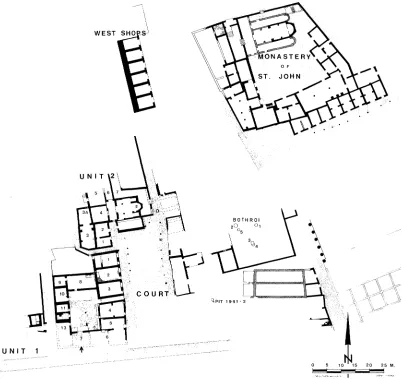
lNIT 1, a large rectangular structure with a paved central court, was erected in the last U) third of the 1 3th century, just south of what in the Roman period had been the temenos of Temple E (Fig. 1, P. 1). 'Only one room (1) of the Frankish building, a space subdivided by a north-south partition, interrupts the rectangular form of the 13th-century complex. The room projects
1 The American School of Classical Studies at Athens was able to conduct its 1994 excavation season at Ancient Corinth only because of the cooperation and good will of a number of persons and agencies. First and foremost of those to be thanked are the Greek Archaeological Service and its Director, Ioannis Tzedakis. K. Phani Pachyianni, the Ephor of the Argolid and the Corinthia, and Professor William D. E. Coulson, the Director of the American School of Classical Studies at Athens, have my gratitude for their year-round availability when help or consultation was needed. I also warmly thank Zoe Aslamantzidou and the staff of the Archaeological Service at Corinth for their help and cooperation.
Special mention should be made this year of Dr. Sarah Vaughan and the Wiener Laboratory. Because of the arrangements made by Dr. Vaughan, Corinth was able to expand its investigation and the effectiveness of its research in the following areas:
1. The water-sieving of an assortment of floor levels within a series of dining rooms in the Demeter Sanctuary on the north slope of Akrokorinthos. Excavation was supervised by Dr. Nancy Bookidis. The analysis of the collection of recovered floral and faunal remains is being made by Dr. Lynn Snyder and ProfessorJulie Hansen.
2. The analysis of the skeletal remains of the Frankish period excavated between 1989 and 1994 is being made by Dr. Ethne Barnes.
3. The examination of limestone quarries in the Corinthia is being made by Dr. Christopher Hayward, with the expectation that this study will be the basis for a larger study on the economics of the Corinthian quarry industry from the Archaic through the Roman period.
4. Analysis of plasters, cements, and concretes is being conducted by Dr. Ruth Siddall, with the hope that the analysis of specific samples will produce precise terms for describing the various materials. Already it has been determined that specific ingredients are used for Corinthian mortars according to their various functions.
Dr. David Romano and a staffoffive continued the computerization of the archaeological remains exposed by the American Excavations at Corinth, in preparation for a detailed publication of the data collected.
Again this year, as in years past, the Corinth staff not only made the numerous activities of the excavation possible but focused efficiently and effectively upon the activities of the season. For this, primary thanks go to Dr. Nancy Bookidis, Curator of the Corinth Museum, and to Aristomenes Arberores, foreman of the Corinth Excavations of the American School. Dr. Orestes Zervos, numismatist of the excavation, has used his skills and patience not only to serve the numismatic community but also to give added meaning to the yearly excavation report.
Miss Stella Bouzaki, conservator, labored carefully and effectively with the large range of excavation materials, while Messrs. Nikolas Didaskalou, Anastasios Papaioannou, and George Arberores applied their skills mostly to the restoration of pottery, stone, and glass. I would like to thank as well the excavation photographers, I. Ioannidou and L. Barzioti, for their excellent site and find photographs, especially those used in this year's report. Finally, thanks go to the students who supervised areas excavated during the 1994 spring season. The supervisors during the regular campaign were Ms. Angeliki Kosmopoulou, Ms. Alison Lonshein, and Ms. Colette Czapski, Dr. Martha Habash, and Mr. Sean Hemingway.
Hesperia 64.1, 1995
American School of Classical Studies at Athens is collaborating with JSTOR to digitize, preserve, and extend access to Hesperia
2 CHARLES K. WILLIAMS, II AND ORESTES H. ZERVOS
UNIT 2H \~~~~~~~~~~~~~ .,
U N I \2\ 0'
5 7
BOTH ROI
2 z O U:RTe | <.o. , 0 0
5~~~~~~~~~~~~~~~~
13 2 ~~~~~~~~~~~~~~~ 6~~~3
UNIT 1 -
~~~~~~~~~~~~~~~~0 5 10 15 2 20 25 M.
FIG. 1. General plan, west side of Frankish Corinth, ca. A.D. 1300
northward from the northeast corner of the unit. In so doing, it impinges upon the site of a Roman stoa that earlier had defined the south side of the Roman temenos of Temple E. The placement of the Frankish building appears to have been determined, however, by the course of the paved decumanus of the Roman period that had passed south of the Roman temenos. The later use is attested by the numerous levels of road metal that accumulated here into the Turkish period.2 The south side of the Frankish structure took its orientation from this thoroughfare, and the main entrance to the building appears to have been through the fa,ade that flanked the road.
A gravel-surfaced square, apparently with free public access, lies along the east side of Unit I and is connected by a narrow corridor to the paved court at the core of the building.
2
The corridor runs east-west between the third and fourth room on the east side of the building, counting from room 1 at the northeast corner of the unit.
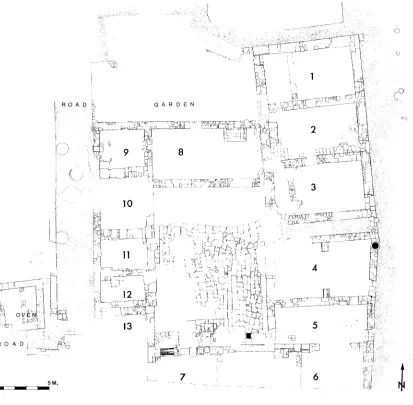
The building just described was first identified as Unit 1 in the excavation season of 1990. By the end of the excavation season of 1994 the unit had been almost totally cleared, leaving only its south facade and the southwest corner of the structure buried in undug fill. Thus it is now possible to determine various functions within the building and to identify it as a hostel, hospice, or inn, probably set up to serve the sick, the poor, and pilgrims passing through Corinth to and from the Near East (Fig. 2).
t
:R O A D G A R D E N c t S X '5 000t ' X 2 0: I 0
ROAD~~~~~~ a. GA DE
p
2
9 ~~8
3 10
-- 4
D. S M 2 T - - -T--7-1
0 5M. ~~~~~~L 76
FIG. 2. Unit 1, ca. 1300, plan
4 CHARLES K. WILLIAMS, II AND ORESTES H. ZERVOS
well have been set up in room 4, where two tokens were found; a third token was recovered in debris from a collapsed wall in the adjacent passageway.3
Hospital facilities are to be inferred from the finds recovered from room 5. In the destruction debris of that room were found a large number of pharmaceutical containers, including six albarelli, or drug pots, and seven ovoid-bodied jars, one of which comes from Mameluk Egypt.4 Jars of this type, like the albarelli, are known to have been used by mediaeval pharmacists. A large doorway on the south side of the pharmacy opens into room 6. The area assigned to rooms 6 and 7 in the 1993 excavation must now be reanalysed and reapportioned.5
This year three occupational phases have been distinguished here. The first is syn- chronous with the phase of Unit 1 that came to an end in A.D. 1312. The second phase
is a repair probably made immediately after the Catalan disaster, the third, at some as yet undetermined later date.
Room 6 lies at the southeast corner of Unit 1. The room may well have been used as an infirmary or dormitory. In the first phase the room was about 12.50 m. long from east to west, with a transverse masonry arch or rib spanning the room at a point 4.84 m. from its east wall. The remains of that rib, as preserved today in the north wall of the room, include a poros foundation protruding 0.31 m. above the clay floor. This foundation supports the bottommost voussoir or springer, which is secured to the backing wall by cement. The springer, placed on end, is 0.25 m. thick and 0.64 m. wide; its concave face is ca. 0.42 m. high. The 0.64 m. dimension represents the full width of the masonry rib itself. The keystone was found where it had fallen on the clay floor in the middle of room 6. Part of a hearth platform is preserved against the north wall, slightly west of the transverse arch; it projects 0.55 m. into the room. This fireplace apparently was not used for cooking, for no bones or evidence of food was found in the vicinity. Its main purpose probably was to warm the space. After 1312 the southeast corner of Unit 1 was radically redesigned. A fragment of an insubstantial north-south wall, 0.40 m. wide, was revealed standing just west of the arch that had been near the middle of room 6 (Fig. 2, dotted north-south wall in room 6). The wall has no foundation but, rather, was constructed over the destruction debris of A.D. 1312. This
light wall, reconstructed with a length of 6.55 m., apparently was to serve as the eastern limit of the room. The eastern five and a half or so meters of the original room 6 were left unroofed and united with the graveled court east of Unit 1. The original east wall was reduced to the level of the original floor, and a hard surface was formed in the postdestruction era over the disturbed destruction debris that had found its way into the trench after the stones had been removed. The door or broad opening that had connected room 5 to room 6 before the Catalan sack was closed, for if allowed to remain open, it would have afforded a broad access to the exterior, not to the now truncated room 6.
3 Williams and Zervos 1992, pp. 142, 178; Williams and Zervos 1993, p. 34.
4 For albarelli, see Williams and Zervos 1994, nos. 18-29, pp. 16-22; for the Mamelukjar, no. 1 1, pp. 14-15.
Fragments of a second Egyptian Mameluk jar, C- 1993-40 a-A, were recovered from disturbed fill within the same area. Originally the pot from which these sherds came may have been used in room 5.
About the only find of interest recovered from the area of room 6 is a lead ampulla, MF-1994-9, found near the north end of the transverse arch in earth immediately above the destruction debris of 1312.6
In the third phase, room 6 was again altered, this time by the construction of a new east wall, which angled south-southeast from the east side of the arch in the north wall. Its south end disappears within the unexcavated south scarp of the excavation. This new partition made room 6, at a minimum, 7.08 m. long.
The main entrance into Unit 1 is called room 7; it stands immediately west of room 6. Although badly damaged by overbuilding, it still preserves enough of its original plan to permit the following description and to allow one to assume that it served as an entrance hall. Room 7 is a space 5.63 m. wide east-west, if measured along its north wall. Set into the north wall a bit west of the central axis of the room is a doorway, 1.71 m. wide; it allows communication between the room and the paved court at the heart of the unit. The eastern jamb of this door is 1.68 m. west of the northeast corner of the room. Between 1.95 m.
and 2.18 m. west of this same corner are preserved two poros blocks of a curb, set into the floor of room 7. On the east side of the curb, the floor is earthen, well packed with broken tiles laid flat; on the west side of the curb and sloping downward toward the west is a cobbled floor, appropriate for heavy human and animal traffic. Evidence is preserved for a doorway in both the east and west walls of the hall. The eastern door opens directly into room 6 with its central arch. The room to the west of the entrance hail is, as of the end of 1994, totally unexcavated, but it seems likely that this will prove to be a stable for housing horses and pack animals and perhaps also a storage room for provisions. As yet, no such supply room has been identified in Unit 1.
Room 8 is on the opposite, or north, side of the court. A well-preserved built hearth still stands against its north wall. When this room was excavated the floor around the hearth was found covered in heavy ash mixed with a large amount of faunal material, ranging from the teeth of cows and sheep to bird bones. To the east side of the hearth were found a number of fragmentary cooking pots. The evidence definitely indicates that the hearth was used for the preparation of foods. Along the east wall ran a sluice by which water could be drained from the room. Finally, evidence for dining was recovered from the clay floor of the court immediately south of room 8: the clay was found to be liberally packed with bones, assumedly thrown there by persons eating the food prepared in room 8.
Room 9 occupies the northwest corner of Unit 1, adjacent to room 8. It is almost square, 3.45 m. north-south by 3.95 m. east-west; it was entered by a doorway 0.96 m. wide through its east wall, which serves as a party wall with room 8. The clay floor of room 9 and the stone threshold of that doorway are flush, one step higher than the floor of room 8. Because the threshold preserves traces of pivot holes, one can restore a single-leafed door here. At floor level within room 9 and against the west wall is a rectangular fireplace, 1.05 m. by 2.10 m., once framed by stone curbing. The floor of the hearth is paved with reused tiles. Few bones were found around the hearth but perhaps enough to suggest that this room was used for reception and some private dining.
6
6 CHARLES K. WILLIAMS, II AND ORESTES H. ZERVOS
North of rooms 8 and 9 is a walled court devoid of architectural features. Access to it is by means of a small door or gate at the northeast corner of the area, by which the space is connected to the public graveled roadway that delineates the north side. Another access into the space is preserved close-by the first, this one leading from room 1. Excavation of a small trench in the southwest corner of the court produced fine, soft soil, almost no sherds, and even fewer rocks. By comparison with the fills that have been found elsewhere at this level, one conclusion easily made is that this had been garden soil. If that is so, and the conclusion seems logical, the door leading from the court into the partitioned west end of Room 1 may well have served as access into a storeroom for garden equipment and, perhaps, for the storage of produce, seeds, and roots.
It appears that Unit 1 was designed to serve the outside world as well as persons residing on the premises. This can be postulated from the architectural remains of room 2, adjacent to the northeast corner room of Unit 1. Room 2 originally had its floor completely tiled. Traces of that tiling now exist throughout the room, but the tiles themselves are well preserved only in patches. The best-preserved segment is in the southwest corner, adjacent to a raised rectangular hearth that is built against the west wall. The room served as a kitchen, and as might be expected, bone and ash were found covering the tiles in situ beside the hearth. Built into the east wall of the room are a window and a door, both opening onto the public graveled court east of the unit. The window was of generous proportions, as is attested by its marble sill, and was closed by a two-valved set of shutters or leaves of a window. Apparently the food prepared within the room was served primarily through this opening. To judge from the generous proportions of the room, however, the existence of the window does not preclude the use of some of the floor space for inside dining.
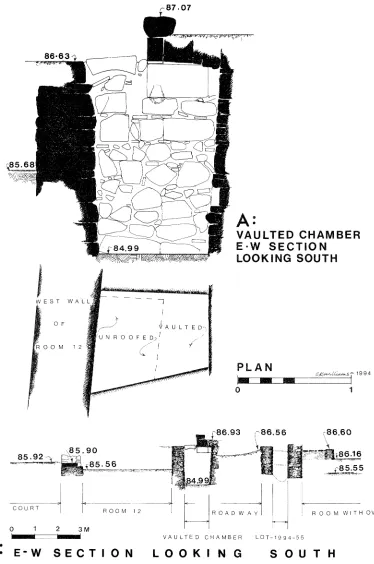
RooM 12 OF UNIT 1 AND THE VAULTED CHAMBER (Fig. 3)
Room 12 of Unit 1 has been set apart in this report because at least three building periods can be identified within its fabric. A heavy north-south wall underlies the east end of the earlier plaster floor, indicating that the wall definitely predates the initial construction of the unit. Room 12 in its next phase was ca. 1.40 m. wide from north to south and 3.90 m. long. Its west wall is 0.55 m. wide and rises to a maximum preserved height of 0.93 m. above the original floor. The south wall, applied directly against the north face of a preexisting structure to the south, is ca. 0.48-0.53 m. wide. The east wall is wider than the other original walls of the room, its superstructure being ca. 0.87 m. thick. Its foundation is thicker still, for the socle projects ca. 0.08-0.10 m. from the west face of the wall. Even so, its fabric preserves no signs of alteration or supplementary construction. The north wall of the room, if stripped of its additions, is ca. 0.50-0.52 m. wide. Its foundation reaches a depth of at least 0.85 m. below the earlier of the two plaster floors.
_.07
86 63 -
_ F V'AUI-TED-,
86.93 p-86.56 p86.60
5.68 - 8 c* 't-4 . S i'.
85.92
'w
WI
;
D tr
~,5.55
V A
U-L-T E CMBER VA LTD - 1994-55
B:E-W
S E C TIO N LOOKING SOUTH8 CHARLES K. WILLIAMS, II AND ORESTES H. ZERVOS
the paved court, at ca. 85.92 m. above sea level, is two to three centimeters higher than the top of the threshold at ca. +85.90 m. It appears likely, because the exterior paving is higher than the threshold, that the court was paved some time after the construction of Unit 1. This supposition seems well taken, for the paving blocks are set directly upon a hard-packed gravel surface, which probably served as the first occupation level of the court. Two plaster floors, one immediately over the other, run to the base of all four walls of room 12. Sometime after the laying of the second floor, however, a supplementary dry wall was built against the south face of the north wall, narrowing room 12 by 0.44-0.47 m. This dry wall was built without foundations, directly upon the plaster floor. A buttress 0.70 m. wide projects southward into the room for 0.57 m. from the face of the addition, thereby forming a small alcove 0.90 m. wide between the pier and the west wall; no evidence exists for a complementary pier projecting from the south wall. Not only is room 12 different from all other rooms of the unit because of its plaster floors but both plaster floors lie well below the level of the paved court and the threshold into room 12.
The last use of any part of room 12 is seen in a segment of its west wall, still intact to a height of ca. 0.93 m. above the plaster floor (Fig. 3, section B). Against the west face of this fragmentary wall was erected a vaulted structure, the interior space of which is rhomboid in plan. The crypt extends for an interior east-west length of 1.07 m. and was dug down into the layers of road metal immediately west of Unit 1. Its eastern end wall is 0.83 m. wide from north to south; its western end wall is narrower, being only 0.58 m. wide. The crypt was entered through a rectangular opening 0.83 m. north-south by 0.56 m. east-west at the eastern end of the ceiling; 1.70 m. below the soffit of the vault is a hard, earth floor at an elevation of +84.99 m. The vault, 0.58 m. long from east to west, roofs the area from the point of access to the west wall of the chamber. At the west wall the maximum clear height of the chamber is ca. 1.60 m. The vault, where it is visible at the mouth of the entrance, was constructed of four poorly set voussoirs; a fifth was used as a capping stone along the top of the south wall of the entrance to the crypt (Fig. 3, section A).
Just west of the access, that is, at the eastern end of the vault where the springers meet the north and south side walls, two shallow sockets or depressions have been hacked into the opposing walls, as if a horizontal wooden crossbar had spanned the space (Fig. 3, section A). Also, a small horizontal channel runs within the back or west wall of the crypt at about 0.45 m. above the floor; it is apparently the slot for a rectangular wooden member long since rotted away.
It is suggested here that the chamber may have served as a small root cellar for the storage of supplies demanding a cool place or for the hanging and seasoning of game and suspension of various provisions from the wooden beam. Since the room was found devoid of any artifacts from its original occupation, one is hard put to be precise about the function the room was designed to serve. No primary debris was found within the chamber; rather it was found full to the vault with discarded bones, shells, glass, and pottery.
A more difficult question now presents itself. Why was this room completely filled with garbage and discarded pottery, some pots still whole and much only cracked or chipped? This is especially true of the glazed and cooking wares. The coarse and matt-painted wares, on the other hand, are all fragmentary, as though they were shoveled into the chamber more carelessly and brought from a greater distance. The fill was homogeneous from top to bottom, with sherds joining from multiple levels within the fill; one cannot say that small amounts of refuse were dumped periodically, thereby building up a stratified deposit over time. One possible explanation comes to mind: the material may have been discarded because of the Black Death. If some member or members of the household had succumbed, measures such as the cleaning out of the kitchen and pantry may have been taken to purify the household and protect the uninfected members. It seems less likely that this cleanup took place in the aftermath of an Arabic attack on Corinth in 1327 or in the years following.7 In the aftermath of a sack, unbroken pots might well have been saved, or if shoveled into the vaulted chamber, they would have been mixed with such destruction debris as wood, iron nails, building blocks, tiles, and the like; no such debris was found within the chamber.
This vaulted chamber is important because it brings into focus facts about post-1312 Corinth that were not clearly distinguishable before this year. Now, over the ruins of Unit 1, traces of a substantial new building with a new design are emerging. After A.D. 1312 the
west wall of Unit 1 was largely cannibalized to its stone foundations, except for the small segment of the west wall of room 12 that remained standing to a height of over 0.70 m., to be reused as the east wall of the new vaulted chamber. Until now, archaeological evidence has indicated that cleanup activity after the Catalan attack occurred only along the east side of the unit and that those repairs were quite minimal.
Over 1.30 cubic meters of refuse were removed from the vaulted chamber. From this fill were recovered 83 complete or largely complete glazed table-ware vessels, 39 or more in cooking-ware fabric, at least 23 of coarse ware, including eleven fragmentary amphoras, and over 34 glass vessels; also recovered was an assortment of faunal material. The amount and range of discarded organic material indicates that the segment of society with which we are dealing was maintaining a standard of living well above the normal subsistence level. Fragments of eggshell, apparently from chicken eggs, were found throughout the fill, as were bird and fish bones, fish scales, a variety of sea shells, the remains of sea urchins, and tortoise shells. The remains of three kittens were an unexpected part of the mix.8 Most common, however, were the skeletal remains of sheep and goat, including skulls and horns. These two types of animals must have supplied the bulk of the table meat for this group.
7 Jacoby 1974, pp. 235, 253.
8
10 CHARLES K. WILLIAMS, II AND ORESTES H. ZERVOS
The assemblage may well be the discards from a single household. In any case, the deposit shows that a high standard of living was maintained by at least certain people or groups in Corinth after 1312 and that a healthy import trade continued between Corinth and Italy after the Catalan attack, even if only for a short period. In other words, Corinth may not have been reduced to a devastated wasteland after 1312, even though the numismatic evidence would seem to suggest otherwise.
ROADWAY AND ENCLOSURE WALL WEST OF UNIT 1
A series of hard road surfaces are built up against the west wall of Unit 1. The road metal into which the west wall of the unit was dug is in places as much as a meter higher than the floors found within room 10, 1 1, or 12 (Fig. 3). Circulation in the street was heavy enough to pack the discrete levels into crusts of road metal; one of the lowest such surfaces excavated is cut by the foundation trench of the west wall of the unit. Traffic was apparently not so heavy that the roadway could not be used for burying garbage: two large Frankish bothroi that were dug through the roadways have been excavated this year.9
A stone wall 0.55 m. wide defines the west side of this 3.38 m.-wide roadway. Where preserved, the wall is constructed in the Byzantine manner, with liberal use of tiles in both horizontal and vertical stone joints. Its foundation trench, visible along the east side, opens from the same road level as that of the west wall of Unit 1. Although the enclosure wall is deeply founded, it is not so heavily constructed that it should be identified as a defense wall. More probably it should be construed as a compound wall or a wall protecting the limits of monastic property. It may have been constructed in the late 12th or early 13th century, but in either case it appears to have been built well before Unit 1 took on the form it had just before A.D. 1312.
In its late 13th-century phase the wall was pierced by an opening immediately west of Room 13 of Unit 1. Two heavy foundations flank the east side of the opening; the south one preserves the lowest course of a rectangular superstructure 0.64 m. east-west by 1.04 m. north-south. Two piers thus can be restored as reinforcing the jambs of the wall opening, in a manner which suggests that they were part of a simple gate construction.
The west end of a poros-sided drain, its bottom unlined, lies in the middle of the street between the piers of the gate, packed within the top level of the road gravel there. This appears to be the original starting point of the drain. Thereafter it follows fill that slopes downward toward the east and is buried in fill that overlies the paved court of Unit 1; here the stratum immediately supersedes the paving chronologically. The drain is better built at its lower east end than in the section preserved in the gravel roadway. At court level the drain walls are carefully constructed of pieces of squared poros, with fitted poros slabs
still in situ covering the drain. The drain is preserved for about ten meters, but there is no indication now of the point to which the water was being channeled. The aspect of this drain that is most important here, however, is the hint that it gives about the use of the area immediately after the destruction of Unit 1 in A.D. 13 12. The drain is contemporary with the
last graveled road surface west of Unit 1, yet it postdates the destruction of the southwest corner of Unit 1 and its court. Here again are indications that, although people still carried on their daily life after the sack, Unit 1, as it existed before A.D. 1312, was now destroyed.
The road metal can be followed westward past the gateway in the enclosure wall. Immediately to the north of this portion of the east-west road, separated from the north- south enclosure wall by a space 0.60 m. wide, stands yet one more Frankish building. Although relatively narrow in its overall north-south dimension, the one room of this structure that was excavated in 1994 has extremely deep foundations. The reason for this is especially apparent in its north wall, which descends through soft fill to the ruins of the hypocaust of a Roman bath (P1. 2, upper left).' 0 The only distinguishing features preserved in this room were a clay floor at an elevation of 86. 16 m. above sea level, a bench, and a small built oven (Fig. 2; Fig. 3, right side of section B. The bench is marked with an elevation of 86.60). The bench is built against the east wall of the room and is raised about 0.40 m. above the floor. Laid upon the south end of the bench is a tiled area enclosed by a narrow mud-and-tile wall. When excavated, this paved area was covered by ash and carbon. From these remains a small built oven, perhaps used for bread and home cooking, can be restored in the southeast corner of the room.
The erection of this Frankish building probably should be placed within the late third or early in the fourth quarter of the 13th century. This date can be deduced from the pottery recovered from dumped fill contained between the foundation of the east wall of the building and the west face of the enclosure wall of Unit 1. l l
UNIT 2
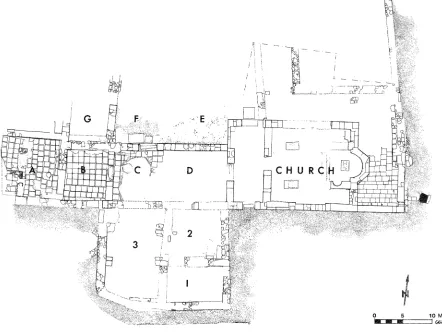
The history of Unit 2 (Fig. 4) is more complex than that of Unit 1. It stands immediately north and northeast of Unit 1 and gives definition to the north side of the public graveled court just as Unit 1 does to the west side. Unit 2 can be identified as a monastery or convent, for at the southeast corner of this as yet incompletely excavated complex stand the remains of a church of Byzantine style with a cross-in-square plan. Some parts of this unit probably were standing before the Frankish conquest of the Morea; it went through at least two radical alterations before it apparently ceased to exist as a monastery or convent.
The first phase of Unit 2 as a monastery or convent should be considered, according to our present state of knowledge, as having been planned within a rectangle ca. 36 meters wide from east to west. The north-south dimension is still to be determined by future excavation,
10 Ihe north and east wall of the Frankish room, as well as the floor, were removed in the course of the excavation of 1994 in order to reveal the remains of an underlying Roman bath. The south end of the west wall of the hypocaust of this bath was truncated during the construction of the Frankish building, for the bath appears to have been visible as a ruin into the Frankish period.
12 CHARLES K. WILLIAMS, II AND ORESTES H. ZERVOS
G FE
0 H-~~~~~~~~~~~~~~~~~~~~~~~~~~~~~~~~~~~~~~~~~~~~~~~~~~~~~~~~~~~~~~~~~~~~~~~~~~
C D C H U RCHHE
30
* 5 lO M.
FIG. 4. Unit 2, ca. A.D. 1300, plan
for only the south side of the unit has been cleared. The southeastern corner stands just west of manhole 1934-13,12 with the south wall of the complex forming the south wall of the paved court east of the church, the south wall of the church itself and its narthex, the south wall of either one or two rooms immediately west of the narthex (Fig. 4: C and D), and the south wall of two more rooms still farther west (Fig. 4: A and B). The westernmost room of this sequence is subdivided by two partition walls so that a closetlike space ca. 1.30 m. east-west by 1.85 m. north-south is formed in the southwest corner of that room. A three-roomed projection southward from this original east-west wall (Fig. 4: rooms 1-3) may well not be contemporaneous with the original fabric, and thus it is not considered here as part of the first phase of construction. It may be noted that on the plan the east exterior wall of this addition is not in line with the west wall of the narthex and, apparently, did not bond with the original south wall of the unit. The west wall of the addition is also staggered and is not
aligned with the north-south partition wall to its north, which, indeed, is part of the original
construction. 13
A detailed description of the excavated remains of Unit 2 follows, starting with room A at the southwest corner of the original complex and continuing eastward toward the church in sequence along the south side of the unit.
Room A is fully excavated and now stands cleared to its original tiled floor (P1. 3, foreground). The room is ca. 5.00 m. wide at the west end and 5.20 m. wide at the east; it measures ca. 5.03 m. from the east wall to the west. Most of its southern wall is robbed of its fabric to well below the floor level of the room, as is the southern half of the west wall. The northernmost 1.90 m. of that wall, the north wall, and the northernmost 2.45 m. of the east wall of the room are generally preserved to heights varying between 0.05 m. and 0.62 m. above the tile floor. These walls once were covered with a heavy coat of white plaster, much of which is still in place; mud mortar was used between the blocks of the walls themselves. The walls are constructed in random ashlar with horizontally laid tiles at the joints. Tiles placed vertically do exist but are a rare phenomenon, indeed. Only one entrance is attested for room A, in its east wall. The southern half of the doorway now is totally robbed of its stones. The northern jamb is preserved at 2.45 m. from the northeast corner of the room. Certainly no door ever existed in the north wall; probably none existed in the west or the south wall either.
The construction in this room, as well as in rooms B and C, indicates a higher standard of living for the occupants of Unit 2 than is commonly found in this period at Corinth, for tiled floors are generally laid only in kitchens or where water is used continuously. In Unit 2, rooms A, B, and C have paved floors, and the tiles are set in cement. The tiles are roughly square but sometimes vary as much as seven centimeters in width or length. They are larger than those used anywhere in Unit 1, ranging as they do between 0.39 m. and 0.51 m. on a side. The tiles generally fall into two groups by size, the larger between 0.43 and 0.49 m., 0.44 m. and 0.51 m., and 0.45 m. and 0.50 m. on a side; the smaller between 0.39 m. and 0.41 m. and 0.40 m. and 0.42 m. on a side. The tiles are not set closely together; sometimes the joint between them is as wide as six centimeters. No fragments of tiles appear to be set vertically as spacers, as was done in room 2 of Unit 1.
Room C may well be the nucleus of a residential or reception area within Unit 2, but the position of its east wall cannot as yet be determined, and its north wall is poorly preserved. The exact course of the north wall has now been documented, but the wall itself has been extensively mutilated by a late pit that penetrates the tiled floor of the room and disturbs the wall at foundation level (Fig. 4; the pit can be seen in the middle of the photograph, Plate 3). As described in the previous report, the doorway through the north wall of room C is 1.62 m. wide and has a marble threshold with a doorstop along its northern edge. 14 A second, similar doorway, 1.36 m. wide with a marble threshold and a 0.10 m.-wide stop, is to be found in
13 The rooms of the addition are numbered 1, 2, and 3; those of the original unit are numbered alphabetically,
without respect to the numbering system used for the rooms of the later, rebuilt monastery/convent published in the previous Hesperia reports. For the numbering of rooms in the later period, see the plan in Williams and Zervos 1993, figs. 1 and 3; Williams and Zervos 1994, figs. 1 and 7.
14 Williams and Zervos 1994, p. 30. The door in the north wall of room C (there called room 3) is mentioned
14 CHARLES K. WILLIAMS, II AND ORESTES H. ZERVOS
the west wall of room C, with its northern jamb preserved 1.37 m. south of the northwest corner of the room. Here, as with the door in the north wall, the jambs are constructed of monumental blocks. All four jamb blocks are reused without having been retrimmed; those of the door in the west wall rise 1.146 m. and 0.93 m. above the tiled floor. The shorter, southern jamb is 0.64 m. wide, the taller, northern jamb 0.568 m. wide. These large jambs are constructed differently from those preserved in the west wall of room B. There the
existing jamb rises to a height of over 0.94 m., but the preserved segment is composed of three blocks, not one.
The floor of room C had originally been tiled in the same manner as the floors of the two rooms to its west. In room C, however, only those tiles that are close to the south and west walls now remain in situ. The center of the floor was removed when the large pit, mentioned above, was dug through the tiles from an overlying level. In the future it may be possible to establish the position of the east wall of the room. Now, however, this party wall between rooms C and D is buried in fill added over room D to an elevation between 85.54 m. and 85.60 m. above sea level. This operation probably took place in the third quarter of the 13th century and can be equated with the major alteration of room F, whose floor was also raised to this level. Subsequently, at least ten skeletons were interred within room D, or room 4 as it is called in its later state. At least two of the graves are marked by headstones.
The west wall of the narthex serves as a party wall between the anteroom of the church and room D. The two spaces are connected by a doorway with marble threshold similar to those used in rooms B and C. Little else can be said about room D until it is excavated to its earliest Frankish levels.
The space immediately north of room C has a history of change and drastic alteration that may be symptomatic for the whole of Unit 2. In this one area, however, the original phase with its alterations, one major rebuilding, and improvements show most clearly the extensiveness of the rebuilding programs that were undertaken by the monastery/convent between its inception and its apparent abandonment after 1312.
Area E-F may well have been a single, large exterior space in the first architectural phase of the monastery or convent. Thereafter this space was subdivided by a north-south wall with large amounts of fill brought in to raise the floor level on both sides of the new partition (cf. Fig. 1, Unit 2, room 5). After dumped fills reached an elevation of 85.54-85.62 m. above sea level in area F, a platform, its north side built as steps, was constructed against the west face of the new party wall. 15 The stairway may well have served as the means of access from this open area to the church complex through a room or rooms that were built over area E. Pottery lot 1994-27 offers a good date ante quem for the new floor laid within room F at an elevation of +85.54-85.62 m. (e.g., P1. 13:a, b, d, and f; also note 19 below). It is made up of pottery from a bothros that appears to have been dug immediately after the floor was laid. Thus the second major architectural phase of Unit 2 can be dated by the filling operation for the floor and the laying out of rooms 47 over rooms A through G; the initial occupation for the second phase can be dated by the fill from the bothros.
15 The space is marked "stairwell" on the plan in Williams and Zervos 1994, fig. 7. For discussion, see
In its first monastic phase the undivided area E-F stretched westward for 9.75 m. from the northwest corner of the narthex; the width from north to south, however, is yet to be determined because the north wall is still buried in unexcavated fill. The south wall of area E is well built, largely of rectangular poros blocks placed on end. As it extends farther westward, it serves as the party wall between rooms C and F and between rooms B and G. Access to the southern rooms was through a doorway in room C. To protect the occupants of the tile-floored rooms of Unit 2 from the accumulation of mud in the area north of room C and in the entrance of room C itself, builders at some time laid a series of large blocks in front of the door as a crude stoop. These blocks were laid along the south wall of the space E-F and over a strip of the court where the generally preserved lime-cement floor does not exist. This east-west strip is ca. 0.75 m. broad and appears to define the north edge of an early foundation trench.
Clues within the complicated stratigraphy of rooms F and G indicate that at least one architectural phase of the complex preexists the period of the level to which rooms F and G have been cleared this year. Before examining the evidence for the earliest architectural phase in these rooms, however, it is best to identify those elements which should be assigned to the phase contemporary with the tiled floors of rooms A, B, and C.
Room F is at least 5.55 m. wide from east to west. Its west wall is constructed in two sections, divided by a space 1.10 m. wide that had probably been designed to be a doorway. Evidence for a threshold exists only in a hollowing out of the north face of the squared poros block that serves as the southern jamb foundation. This poros block, crudely chiseled as it was to receive the threshold, probably also supported the south jamb of the door. The top of the missing threshold may have been set ca. 0.40 m. above the plaster floor of area E-F and just about flush with the contemporary floor of room G to the west. South of the reputed doorway is a wall 0.65 m. wide, rather well built with shaped poros blocks, tiles, and sparingly applied cement. The wall is supported by a wider foundation made of smaller, more roughly shaped stones. The east face of the foundation projects between 0. 10 and 0. 15 m. from the wall and descends for a full 1. 10 m. If the west side of the foundation projects in the same manner (the foundation is here covered by earth), the full foundation should be restored as ca. 0.90 m. wide, about the same thickness as the northern segment of this same north-south wall.
Room G is slightly narrower, east to west, than the adjacent room to its south, room B. Room G is ca. 3.605 m. wide east-west, if measured along its north wall; room B is 3.28 m. to 3.30 m. measured at about mid room. The difference occurs in part because the east and west walls of the two rooms are not parallel and the walls are not all of the same thickness.
PRE-MONASTIC REMAINS BENEATH UNIT 2
16 CHARLES K. WILLIAMS, II AND ORESTES H. ZERVOS
same period or slightly earlier is a well, still unexcavated, that lies under the marble-paved floor of the narthex of the church.
The foundation of the south wall of the pre-monastic complex appears to have been enlarged and reused for the construction of the monastery. One wall that extends northward from the foundation trench can be distinguished 11.35 m. west of the narthex, or 0.68 m. from the western wall of room F This trench is now backfilled with earth, having had all its stones removed. The stones, apparently, were removed from all the foundations at the southeast corner of the pre-monastic complex, but the white lime-plaster floor of the early room that the walls enclosed was found preserved under the earliest floor of room F, ending in a clear line ca. 0.75 m. north of the south wall of room F The lime floor definitely was not found extending eastward into the area later occupied by room E of the monastery/convent. Although the evidence is meager, it seems possible that the church had originally been constructed as a freestanding building, perhaps in the second half of the 12th century, and set in an open space paved in gravel. Only later, possibly at the beginning of the 13th century, were rooms attached to give it its monastic form.
STRATIGRAPHY AND POTTERY STYLES OF THE FRANKISH PERIOD In the course of excavation over the last five years the general history of Italian ceramic imports to Corinth during the Frankish period has become increasingly clear, especially when considered in relation to the contemporary historical scene. With the capture of Akrokorinthos in A.D. 1210, the Franks obtained total control of the Corinthia. Subse-
quently, rather than being apportioned to a titled lord of the Morea, it was retained by the Villehardouin princes as their personal fief. Apparently little change took place in the Frankish Corinthia until the Franks had subjugated the rest of the Morea. Nauplion fell in 1210, Argos in 1212, and Monemvasia, the last Byzantine stronghold in the Peloponnesos,
inA.D. 1249.
The potters at Corinth working during the early years of the Frankish occupation produced fine wares that continued to be decorated in local styles such as sgraffito, incision, and champleve, along with a lower percentage of late green and brown painted wares. A number of lots exist at Corinth that illustrate the continuity of shape and style from the Byzantine 12th into the Frankish 13th century. 16
Excavation in 1994 produced a series of similar pottery lots that illustrate this transitional period. The strata that supplied some of this pottery are associated with rooms A and B of
16 In this report the term "sgraffito"
is used for designs scratched through the slip of a glazed pot and into the underlying clay by a sharp needlelike instrument. "Incised" is used for decoration cut through the slip by a broad-ended instrument. "Champleve" is reserved for decoration in which whole fields of slip are cut or scraped down into the underlying clay in order to introduce areas of "color" within what otherwise would be an incised design. The artist or technician may cut away any area, such as background, part or parts of a body, or a piece of clothing, in order to give visual clarity to a complex incised design.
Unit 2 (p. 13 above), which, being adjacent and connected by a doorway, proved to preserve an identical stratigraphical sequence at the lower levels.
In room A a mixed debris of stones and roof tiles with an admixture of paving tiles covered the tile floor. About 0.22 m. above the tiles was a floor level in which stones, not tiles, were employed for a rather spotty paving of the refurbished space. This level went through the doorway between rooms A and B and continued through the doorway that connects room B to room C, here called, with the reordering of the complex, room 3a. Unit 2 was totally redesigned and rebuilt when this second floor level was superseded. (For the plan of Unit 2 as altered, see Figure 1.) Rooms A and B were abandoned and filled with rocky debris. The doorway between them was closed by stones, with the bedding for the blocking wall 0.28 m. above the original tile floor of room A. The doorway that had originally connected room B to room C also was closed by a stone wall; its bedding was 86.40-86.42 m. above sea level or about 31 or 32 centimeters above the marble threshold, which sits at an elevation of +85.09-85.107 m.
Room C lost its identity in this general redesign. The doorway in its north wall, which had previously given access to room F on the north, was closed. In fact, a new wall was built at this time against the south face of the original north wall of room C, a new north-south wall was erected to form the east wall of the new space, and at the same time the south wall of room C was dismantled. By this alteration room C was absorbed into room 3 to the south, the combination producing a space with a maximum north-south length of ca. 13 meters. Once the alteration was accomplished, a large pit, almost the size of what had been room C, was dug into this new area. (The pottery from the pit is stored in pottery lots 1994-42, 1994-43, and 1994-44.) The pit was sunk through the original tile floor of the room and a layer of white marl over it. Thereafter this large pit was filled, and at some later moment in the history of the room, a new, smaller pit was dug into the backfill of the first pit.
Room F also was radically redesigned at this time. It appears, in fact, that rooms 1, 2, and 3 (including 3a) of Unit 2 were blocked off, becoming a self-contained apartment, with no connection between the newly subdivided suite of rooms and the rest of Unit 2. This reapportionment of spaces seems logical, if the functions of the different spaces are considered. 17
Before the floor of room F was covered with a series of tipped fills to an elevation of 85.54-85.64 m. above sea level, the persons who were altering the area constructed a north-south wall between areas E and F. In the proposed design this party wall would separate room 5 (area E of the original phase) from the area that was to contain a stairway (area F of the original phase). This dividing wall was built on a series of earth strata, all together 0.27 m. deep, covering the original floor of room E The new builders established their working floor well above these strata, at an elevation of +85.54-85.64 m., mixed their cement, and constructed the stairway against the newly erected north-south wall.18
The pottery of lot 1994-27 is representative of a Corinthian ceramic assemblage of the second and very early third quarters of the 13th century (e.g., P1. 13:b, d, and f); the pottery was recovered from a bothros that had been dug into a construction floor
17 See Williams and Zervos 1993, pp. 9-12, esp. p. 12, for the industrial functions of rooms 1 through 3.
18 CHARLES K. WILLIAMS, II AND ORESTES H. ZERVOS
(85.54-85.62 m. above sea level) in the area that earlier had been area E The main feature of this newly designed space is the stairway that rests on the construction floor. This is called a construction floor because of a lime pit that appears to have been dug into it and because of the lime crust (a working floor) that is to be associated with the construction of the stairway adjacent to it. The pottery from lot 1994-27 must descend into the third quarter of the century because a coin of Alphonse, Count of Toulouse (coin 1994-289) was recovered from within the fill of the lime pit.19 Lot 1994-27 (e.g, P1. 13:a, b, d, and f) has in it little of what one might call a new Frankish style; only 12 fragments of murky green and ochre were identifiable. On the other hand, 2 fine sgraffito sherds in medallion style, 1 measles-ware plate fragment, and 2 fragments of chafing dishes are all that stand out in this lot as Byzantine glazed wares of the 12th century. Most of the decoration on the glazed material is coarse sgraffito, incised, and champleve. Rabbits, a bear, and other animals decorate medallions or extend across the whole floor to the rim. Crosshatched rims are common. Some green painted sgraffito and a large fragment of a brown painted bowl with crimped rim help give a fuller picture of the assemblage that should be expected at this time. The one Protomaiolica bowl fragment suggests that this fill might best be placed late in the first quarter or within the second quarter of the 13th century. Certainly it need not be placed later.
Within the complex stratigraphic sequence of this area one can see rather clearly the proportional changes among different imported fabrics and the evolution of pottery styles during the first hundred years or so of Latin control of Corinth.
One of the most noticeable additions to the ceramic history of Corinth is the local Frankish murky green and brown painted pottery, accompanied by murky glaze-painted, slip-decorated bowls and plates, which, as pottery lot 1994-27 shows, isjust becomingpopular at the time of the drastic alteration of Unit 2. These products are more crudely potted than the Byzantine wares of the 12th century; the walls are thicker, and the wheelmarks and paring on the exterior are generally undisguised. The darkness of the ochre and green may well have appealed to the Latins because of its closer resemblance to metal table wares than to anything that was being produced by the Byzantines, whose preference apparently was for clearer glazes, even when colored.
Three types of imported pottery start to appear around the beginning of the second quarter of the 13th century. One is Zeuxippos ware, which appears in Corinth in various examples of its two classes, with Class 1 imported to the end of the 13th century. Problems
19 Lot 1994-27. Of 3.09 kg. of glazed wares, only 0.20 kg. is identifiably Byzantine in date. Forty-nine Frankish sgraffito, incised, and champleve fragments together weigh 1.26 kg. Murky-glazed Frankish fragments, 12 in all, are 0.18 kg. by weight. A single sgraffito-decorated bowl fragment with green lustrous paint and clear glaze, of a type found almost always in Frankish contexts, weighs 0.09 kg. Three brown-painted sherds, of which one large fragment has a crimped rim, weigh 0.28 kg. Clear-glazed pottery, much if not all of which looks early Frankish in fabric and form, is represented by 48 sherds; they weigh a total of 0.80 kg.
Of the exotic imported wares the lot contains only 1 fragment of Protomaiolica, the glazed but undecorated base of a bowl, and 6 small fragments of blue-glazed frit, probably from the Near East; all together they account for only 0.03 kg. The 0.25 kg. that is not accounted for in these figures is made up of variously glazed sherds, most of which can be paralleled in other Frankish contexts of the early 13th century.
Only one coin (1994-269, illegible Byzantine) is associated with this lot.
exist in the identification of the place or places of manufacture, for the fabric is commonly found in Constantinople, Cyprus, and northeast Italy around Venice. It would be natural for the Venetian territory to supply Corinth with its first Frankish imports, since the Fourth Crusade was greatly helped financially by Venice, but the Venetian pottery industry did not produce glazed table wares until the second half of the 13th century and thus probably would not have been prepared to produce such a product for mass export until late in the century.20
A second nonlocal fabric is a green and brown painted ware, with either sgraffito or champleve decoration, apparently produced in Serres and thereabouts in northern Greece.21 Imports from this area may well have stopped with the fall of Thessaloniki and its return to Byzantine control; such reasoning might explain the rarity of this fabric and its presence, when it does appear, in the earlier Frankish deposits.
The third import is Protomaiolica from southern Italy. A representative deposit of early 13th-century pottery, related to some disaster that postdates the Byzantine surrender of Akrokorinthos, was identified this year. This is a debris, perhaps slightly disturbed, that directly overlay the tiled floors of rooms A and B of Unit 2. Along with the local glazed wares, the debris contained part of the rim of a single Protomaiolica plate, C-1994-47, painted with a guilloche pattern entwined around blue eyes (P1. 12). This seems to be a very early Corinthian import from southern Italy.
Very little securely stratified evidence exists for the date of the earliest importation of Protomaiolica from Italy, but it first appears, apparently, with the Zeuxippos wares. At that time its importation may not be connected with any concerted commercial endeavor, for the early Protomaiolica bowls and pitchers are decorated with specialized elements such as the personal shield devices or with scallop-shell decoration; these are pots that pilgrims might have purchased in Italy on their way to the Holy Land. In other cases the bowl may be painted with a special scene, such as a ship at sea.22
The date for the importation of the first Protomaiolica to Corinth has been discussed elsewhere with the conclusion that the fabric may have been introduced to the Morea before the Fourth Crusade.23 Today the stratified deposits excavated at Corinth cannot be used
20 It is because of Venetian financial backing, in fact, that the Villehardouins had a contract with Venice
allowing her to maintain a trading quarter in any towns of her choice in the Morea. Such a quarter would include a church and courts and have freedom from local taxation for its Venetian traders. See Setton 1978, pp. 36-39; also Abulafia 1980.
21 Pottery from Serres, Thessalonica, and its vicinity has been identified in the Corinth collection. I thank Drs. E. D. and H. Maguire for their help and insight in examining the examples presented below. For pottery from Thessaloniki, C-1992-47 a, b, cf. Vavylopoulou-Charitonidou 1989, cup no. 73, p. 223, fig. 45; C-60-357, bowl possibly related to Vavylopoulou-Charitonidou 1989, cup no. 83, p. 220, fig. 28.
Glazed vessels from Serres include C-60-307 a, b; C- 1986-61 (Sanders 1987, no. 11, p. 174, pl. 23); C-1992-66 a, b. For the identification of C-60-307 a, b, see Papanikola-Bakirtzis, Maguire, and Maguire 1992, p. 35, note 23. This is the MacKay "unique bowl" no. 20: MacKay 1967, p. 256.
22 For shield devices, see C-34-756, Corinth XI, no. 942, pl. XXXVIII:j; C-35-631 (P1. 12), Corinth XI, no. 941, pl. XXXVIII:i; also CP-1488, C-35-441 (P1. 12), and possibly CP-1486. C-37-2000 (P1. 12) is a table amphora with shield decoration on two sides of its body. See Corinth XI, no. 931, p. 261, fig. 89:b, its decoration described there as a plump fish placed vertically. For bowls with pilgrim-shell decoration, see C-29- 13 (P1. 12) and C-34-682 (P1. 12). For C- 1934-682, see Corinth XI, no. 836, pl. XXXIV:a.
20 CHARLES K. WILLIMS, II AND ORESTES H. ZERVOS
to verify this early date. With a new analysis of the deposits that previously suggested a possible pre-Frankish importation of Protomaiolica wares, one is more inclined to date the material well into the first third of the 13th century. For example, Corinth pottery lot 299 includes 2 rim sherds from Zeuxippos bowls of the 13th century, fragments of 4 of the murky green and brown plates, and bowls that definitely postdate the Latin conquest, as well as a fragmentary plate decorated with slip and murky Frankish paint and glaze, a Frankish pedestal bowl, and three fragments, possibly of one plate, in champleve style, which now should be considered Frankish in date.
Lot 264 does not supply so vivid an argument for a 13th-century date, but of its 45 glazed sherds (1.52 kg.), three are South Italian, all, in style and decoration, fitting well into the first half of the 13th century. Five sgraffito sherds are of 13th-century form and style, along with at least 2 incised and 4 Frankish green and brown sherds. In other words, over a fourth of the glazed ware is recognizably Frankish, while other sherds are clear glazed or too fragmentary to be assigned a precise date before or after 1300.
Sometime late in the third quarter of the 13th century the locally made murky-glazed bowls appear to have gone out of production.24 Their place is taken by a deep flaring bowl that has a ring foot and a vertical rim; its walls are generally thinner. The glaze no longer covers the whole interior floor; rather, it is applied in circles over the slip of the interior wall. The more carelessly executed bowls of this type have the glaze dripped onto the floor, many in a random manner without a special pattern in mind. A good example of the local ware decorated in this style can be seen in a plate and a bowl recovered from a bothros dug within room 3a of Unit 2. The pit was filled well before the Catalan sack and contained a relatively large amount of Protomaiolica, a fragment of Veneto ware, and metallic ware. The Veneto sherd and the coins indicate that this assemblage might be dated to the last quarter of the 13th century.25
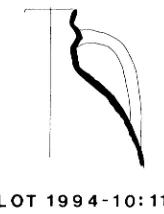
Another illustrative ceramic assemblage, stored as pottery lot 1994-55 and weighing 8.59 kg., is of the same period as, or slightly earlier than, the pottery from pit 1992-1;
evidence for the importation of Protomaiolica before the Latin conquest. Lots 133 and 266 do not now have enough glazed wares in them to be representative samples. Lots 264 and 229 are obviously Frankish in date according to the chronology that I present here. I cannot place lots 264 and 299 before the end of the first quarter of the 13th century.
See also Corinth XI, p. 107, where Morgan concludes that the coin evidence "may indicate that the importation [of Protomaiolica] to Corinth preceded the conquest of the Latins by a quarter century or more." Unfortunately, the evidence with which Morgan had to work was not derived, by and large, from delicately separated strata. New numismatic studies of the coins of the 12th and 13th centuries as well demand a reinterpretation of the evidence used by Morgan. MacKay notes a confusion about coin identification (p. 263, note 38). The question is reexamined by M. L. Coulson (Coulson 1992).
24 See Williams 1978, p. 34, pl. 6, Corinth pottery lot 1977-11. This is an assemblage that contained 22
coins, none of which was minted later than A.D. 1261. The deposit contains large parts of a bowl, C-1977-5,
and a plate, C-1977-2, both with spiral decoration in murky glaze. One painted, incised plate, C-1977-4, is an example of the incised-sgraffito style employed earlier in the century.
For a bothros, probably of the same date, that contained more examples of the murky green and brown painted style, see Williams 1977, pp. 67, 79-81, pls. 31, 32. Again, the coins continue into the third quarter of the century, the latest minted under Louis IX, A.D. 1226-1270.
25 Williams and Zervos 1993, pit 1992-1, deposit 3, pp. 17-20, marked as deposit 3 on fig. 3; list of coins
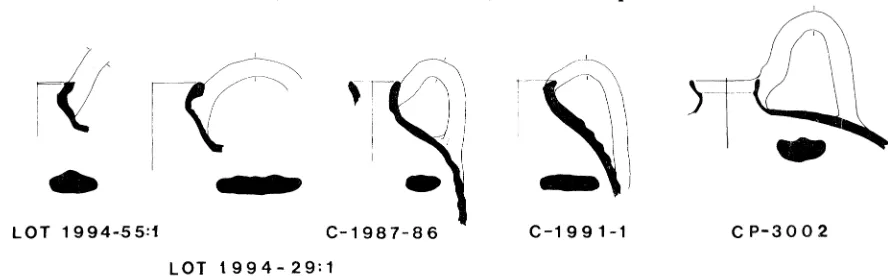
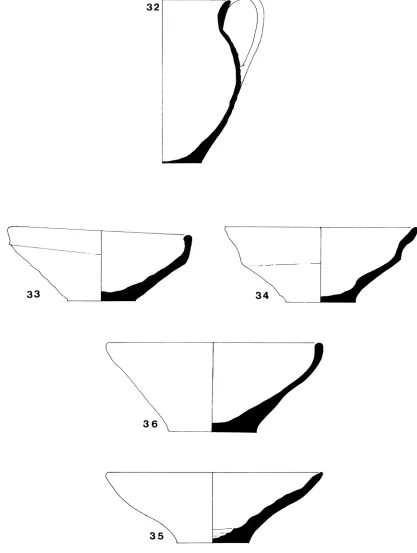
it perhaps falls completely within the third quarter of the century. The assemblage was recovered from fill tipped in as packing between the foundation of the west enclosure wall of Frankish Unit 1 and the foundation of the east wall of the small building immediately west of the enclosure (Figs. 2, 3). Among the contents are three small fragments of the murky green and brown wares, probably mixed in from slightly earlier Frankish use levels, one green drip-glazed bowl rim, and a large part of a dish decorated in the drip-glazed technique (e.g. P1. 1 3:e). The last dish preserves its ring foot and full profile. Also retrieved from the same deposit are a number of fragmentary amphoras; one is of the low-necked class with high-swung handles (Fig. 5: 30). Another is of the matt-painted class with vertical neck and outward-thickened rim, triangular in section. It definitely is not concave just below the lip on the interior, a feature that is found in all later amphoras of this type (Fig. 5: 28-29 B). Rather, it resembles in profile amphora 5 from well 1992-1, dated by numismatic evidence within the third quarter of the 13th century or slightly later.26
Once the Corinthian pottery industry reached this low level in the production of its glazed wares, the attraction of buying South Italian wares can perhaps be understood. Protomaiolica, as attested in the deposits around Units 1 and 2, makes its appearance in Corinth before the middle of the 13th century; but this fabric does not seem to have been imported to Corinth in bulk as a mass-produced commodity before the sixties or seventies of the century. The successful commercial introduction of South Italian ceramics may well be related to the sudden allegiance that is made by the Prince of the Morea to the Neapolitan Throne after the fall of Latin Constantinople to the Byzantine emperor. It might be argued that at this time the political relations with South Italy are cemented and the commercial strings are tied.
Other fabrics appear at Corinth just after the Protomaiolica. Veneto ware, both in its rouletted form and in a plain slipped and glazed ware, becomes popular at the end of the century.27 Both the green and the brown metallic-ware pitchers, in round-mouthed and trefoil-mouthed versions, become popular at this time and may have been just about the only pitchers seen on the better tables. One of their earliest forms is quite elaborate, with twisted handles and pinched cords applied to the body. A related fabric, here called ivory ware, appears both in pitcher forms and in open shapes. The ivory-ware potters cornered the Corinthian market on lavers.
Bowls and plates from north of Rome, probably from around Orvietto or Viterbo, start making their appearance on the tables of Corinth in the last third of the century; popular are the Archaic Maiolica fabrics, decorated with green and tin glazed, especially in the form of pitchers and deep bowls. Less numerous but even more identifiable is a second type of pitcher, this one with a distinctive spout, that is imported from this same area.28
The coarse wares of the period, especially the amphoras, all appear to be local. If wine or oil was being brought from abroad, it was coming in barrels, not in earthenware amphoras. Of interest, however, but from a deposit not related to Units 1 and 2, is the finding of a
26 Williams and Zervos 1992, pp. 145-149; see fig. 5 for the profile of amphora 1991-13:5.
27 For a discussion of Veneto and metallic wares, including ivory wares, in the Corinth inventory, see Williams
1991, pp. 263-282.
22 CHARLES K. WILLIMS, II AND ORESTES H. ZERVOS
cork stopper, apparently from a storage jar. The stopper must have originated in Spain (lot 332, second quarter of the 13th century).
A.D. 1312 is a watershed date for Corinth. The Catalans attacked and destroyed both
Unit 1 and Unit 2. Until 1994 it was not possible to identify with certainty any deposit of pottery that could be dated after A.D. 1312. This year, however, the vaulted pit that
was built west of the west wall of Unit 1 was found filled to its top with table wares of the second quarter of the 14th century (pp. 6-10 above). Enough complete pots were recovered to allow the luxury of considering this to be a valid sample of imports traded in Corinth after the Catalan attack. To be noted are 12 almost identical gridiron Protomaiolica bowls, their interiors decorated with a band of brown-glazed chevrons (e.g. 6), that are part of the assemblage. These are from South Italy, probably manufactured in Brindisi. Four complete, or almost complete, initialed Protomaiolica RMR bowls come from the deposit (P1. 6). The letter m appears on two; b and k each appear once. The differently marked bowls imply, perhaps, that they belonged to, or were to be used by, specific individuals within a household or establishment. In any case, the RMR bowls were manufactured in a center of production separate from the bowls decorated with gridiron medallions, even though both were manufactured within the territorial limits of the Kingdom of Naples.29
Also from southern Italy, perhaps not far from Brindisi, comes a series of plates, all with the same profile but with different floor decoration (1A). Again, the color scheme has been reduced to brown and black; red and green are not used.
Definite changes in the types, forms, and quantities of imports can be distinguished between the assemblages that are dated to the quarter century before the Catalan invasion of
1312 and the deposits now under discussion, which are dated postdestruction. Noticeable is the absence, in these later deposits, of Veneto carinated bowls of the rouletted sort. In fact the shape that is now imported from the Veneto is a shallow bowl with a more saucerlike shape; even so, not many of these are present in the deposit (e.g., 16, 17). Most noteworthy, however, is the appearance of a hemispherical bowl in a relatively new fabric, white Maiolica (P1. 7: 21; see also P1. O:d). This white Maiolica form, along with other forms in this fabric that have not been seen at Corinth before the excavation of this deposit, is identified as from Pisa, rather than from Monto Lupo close to Siena. The locale of production can be identified by the ring foot; the area north of Siena customarily made its bowls with a disk foot. Shapes such as a saucer with horizontal rim (22) and a deep bowl with countercurved sides (20) also are represented in this clay and glaze (P1. 7).
The appearance of Pisan wares at Corinth in the first half of the 14th century can possibly be connected to the activities of Tuscan bankers at Corinth and perhaps specifically to the Acciaiouli family. The Acciaiouli were given Corinth in the 1360's, and during the
14th century Florence was depending more and more upon Pisa as its port to the sea. With both Venice and Florence interested in this part of Greece and the Angevine court of Naples still maintaining its control over the Latin Morea, it should not be surprising to find the presence of the political powers reflected in the imported pottery at Corinth.
29 C-1991-4, Williams and Zervos 1992, no. 29, pl. 39, possibly same ligature as Corinth XI, no. 875; 8,