An iterative Power Allocation Alogrithm for Energy
Efficiency Optimization in Massive MIMO Systems
Yuanyuan Ren
1,一
, Panpan Miao
2and Yanhui Lu
311st [email protected], Zhengzhou University,Zhengzhou,Henan,450001 China
22nd [email protected], Zhengzhou University,Zhengzhou,Henan,450001 China
33rd [email protected], Zhengzhou University,Zhengzhou,Henan,450001 China
Abstract
In this paper, a transmitting power allocation strategy for users jointed together pre-coding is presented to eliminate inter-users interference and improve the energy efficiency of Massive MIMO systems. The power allocation model is formularized as energy efficiency optimization problem of the users ’ power and circuit power consumption. We demonstrate that energy efficiency is a convex function of users’ power. In order to reduce the complexity of traditional power allocation algorithm, an iterative power allocation algorithm based on convex optimization theory is proposed to figure out the optimal value of each user power. The simulation results show that the iterative algorithm can effectively improve the energy efficiency of Massive MIMO systems.
一
Corresponding author. Yuanyuan,Ren,Email:[email protected]
1. Introduction
The Internet of Things is an important part of the new generation of information technology. It can connect objects and bring convenience to people's lives. The fifth generation of mobile communication technology (5G) will make the Internet of things have more powerful communication capabilities, so that the Internet of Things is more widely used. In the 5G research and development, energy efficiency has aroused people's attention. Improving energy efficiency is not only conducive to reducing the interference of co-channel users, but also reducing the environmental pollution. MIMO is one of the most important technology to improve spectral efficiency
[1]. Massive MIMO can significantly improve the energy
efficiency and spectral efficiency by increasing the
number of antennas at the base station [2]. But as the
number of base station antennas increases, the loss of the
RF chains will also increases[3]. Therefore, the power loss
of RF chains must be taken into account in analyzing the
energy efficiency of Massive MIMO systems [4]. At the
same time we should pay attention that the less number of RF chains is used, the smaller capacity of the system will be[5].
In recent years, there are many energy efficiency
studies on MIMO systems [6] [7]. For example, in [6], it
studied how to improve the energy efficiency of sensors in MIMO systems based on Alamouti diversity. Radio resource allocation is an effective way to improve energy
efficiency [8]. In [9], the optimal energy efficiency
allocation algorithm in OFDMA system was studied. In [10], the optimal energy efficiency algorithm is studied in the distributed antenna system. In [11], the energy efficiency of the uplink multiuser systems is analyzed. It is proved that the energy efficiency function is a quasi-concave function of the power matrix, and based on this analysis, an iterative power allocation algorithm is proposed.
The existing research results show that most power allocation algorithms usually assume that the base station
Keywords:MassiveMIMO,energyefficiency,powerassumption,convexfunction
Received on 22 February 2017, accepted on 09 April 2017, published on 14 April 2017
Copyright©2017 Yuanyuan,RenAuthoretal.,licensedtoEAI.Thisisanopenaccessarticledistributedunderthetermsofthe
CreativeCommonsAttributionlicence(http://creativecommons.org/licenses/by/3.0/),whichpermitsunlimiteduse,distributionand
reproductioninanymediumsolongastheoriginalworkisproperlycited.
allocates power to users evenly, ignoring the energy efficiency optimization problem when users allocated power unequally. Based on these researches, this paper eliminates the interference between users by decomposing the channel matrix and applying pre-coding technique. And then a new power consumption model is founded, which takes the users ’ power and circuit power into account. After we deduce the expression of energy efficiency, the convexity of energy efficiency is proved, based on convex optimization, an iterative power allocation algorithm is proposed to solve the energy efficiency optimization problem. The simulation results show that the iterative algorithm can effectively improve the energy efficiency of Massive MIMO system.
2. System model
In Massive MIMO downlink systems, we assumed that
the number of base station antennas is N and the receiver
has K single antenna users. The system model is shown
in figure 1.
Figure1.The model of massive MIMO system
The signal received by the client is,
Where y and xare the received and transmitted signal
vectors of K1 respectively[1], His the Rayleigh fading
channel matrix of K N ,Qis the pre-coding matrix of
N K , n is the noise vector of K1 ,
1, 2,...., K
diag p p p
P represents the , power
allocated to each user of K K .
Using singular value decomposition (SVD),
H
H = UΣV . (2)
U and Vare the unitary matrices of K K and
N N respectively,Σis the diagonal matrix of K N ,
At the receiver, we use Zero Forced (ZF) receiver to eliminate the interference between users, the received signal can be rewritten as
Wn WHQPx
Wy
'
y
. (4)1 ( H ) H
W U U U . (5)
Wis the linear receive of K K . Assuming that the
transmitter has known the channel state information, we decomposes the modal and uses the pre-coding at the
transmitter, that isQ = V. At the receiver ZF pre-coding
is used. Modal decomposition diagram shown in Figure 2.
Figure2.Modal decomposition
The received signal is reduced to,
Where n' Wn (U U UH )1 H ,nis a Gaussian white
noise with a zero mean and a variance of 2. The
signal-to-noise ratio of the userk is given by,
Then the total capacity of the system can be written as,
3. Power consumption model
The total power consumption is defined as,
r c out
sum Np Kp
p
p
. (9)
Where, the first part is the power amplifier consumption, it is related to the transmitter output power
out
p and amplifier efficiency
. The latter two parts of(9) are the power consumption of the RF chain. pcand
r
p are the power consumption at the transmitter and the
receiver respectively, the output power is determined by
1 2
{ , ,..., ,0,...,0}K
diag
Σ . (3)
2 2 k k k
p
. (7)
2 2 2 1 log (1 )
K
k k k
p
C B
. (8)
y = HQPx + n. (1)
' '
1 K out k k
p
p
. (10)4. Definition of Energy Efficiency and
Proof of Its Convexity
Energy efficiency is defined as the total capacity of the system divided by the total power consumption, which can be expressed as,
2
2 2
1
1
log (1 )
K k k k K sum k k c r p B C U p p Np Kp
. (11)4.1. Proof of convexity of energy efficiency
Based on the energy efficiency optimization model established in this chapter, with the increase of the user's power, the system energy efficiency increases first and then decreases. The energy efficiency is the convex function of the user's power. That is there is an optimal user power distribution can make the maximum energy efficiency.
Proof: In order to analyze the relationship between the power allocated by the user and the energy efficiency of the system, the energy efficiency function is written as a
function of
p
k,
2
2 2
1
1
log 1( )
K k k k k K k k c r p B p Np Kp y p
. (12)In order to judge the relationship between the energy efficiency function and the user power in (12), we can first find the partial derivative of the function with the
respect to
p
k , determine the nature of its derivativefunction .The derivative function after derivative is (13) ,
2 2 1 2 2 2 2 1 2 1 log 11 ( )
ln2
K
k K
k k k k
c r k k k k K k k k c r p p
Np Kp B
p Np Kp B p y p p
. (13)In order to determine the positive or negative properties of (13), the denominator is definitely greater than zero, only need to judge the positive or negative of the molecules. Because the positive or negative of the
molecule is not easy to judge, the molecule can be expressed as the (14).
2
12 2 2 2 2 1 log 1 ln 2
1 ( )
K k
k k
k c r
k k K k k k p Np Kp p B
g p B
p
. (14)The partial derivative of g p
k with the respect tok
p is the (15).
4 1 2 2 2 2 2 2 2 2 2 2 4 1 2 2 2 ln 2 1 ln 2ln 2 1
0 ln 2
K k
k k k
c r
k k k
k k k k k k K k k k c r k k p Np Kp p Np Kp
g p B
p p B B p p B p
. (15)(15) is a number less than zero, so g p
k is adecreasing function with respect to
p
k ,because
| k 0 22
0k
k p Npc Kpr
g p B
. (16)
| k ln 2 lim log 2 1 22 0k
k k
k p B K p p
g p
. (17)
Since the first part of (17)is a constant and the latter
part is infinite when
p
k tends to infinity, so (17) is lessthan zero. That is, with the increase of pk , the value of
k / ky p p
is greater than zero and then less than zero.
In other words y p
k
monotonically increasing firstand then monotonically decreasing. So there is an optimal
k
p to make the efficiency function obtain the maximum
value.
In summary, with the increase of user power, the system energy efficiency increases first and then decreases, that is, there is an optimal user power to make the efficiency obtain the maximum value. Therefore, through the power distribution algorithm, we can find the optimal value of the energy efficiency function.
The energy efficiency function is the convex function
ofpk .Therefore, the optimal value of user power can be
obtained by solving the derivative of the function U with
the respect to pk , then letting the derivative function
equal to zero, we can obtain,
2 2
2 2
ln 2 ln 2
0
k
k k
B
B if U
p U
else
. (18)
(18) has gotten the expression of the user power
optimal value, but the expression of U implies pk , we
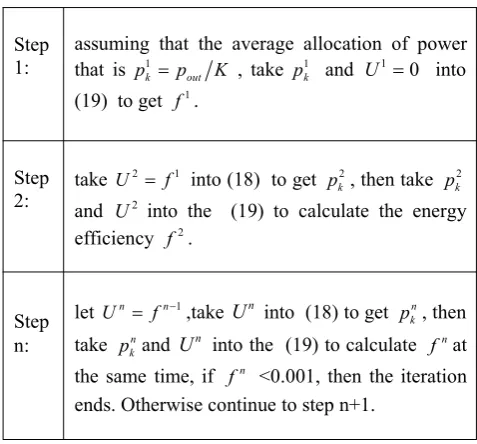
can not get the optimal value of the user power directly. Therefore, an iterative power allocation algorithm is proposed to obtain the optimal value. Define:
2
1
2 2
1
( ) log (1 )
K k K
k k k
k c r
k
p p
f p B U Np Kp
. (19)(18) and (19) can get the energy efficiency of
the system by updating and iterating constantly. When the maximum energy efficiency is obtained, (19) should be zero, so the iteration continues until (19) is sufficiently small to meet the convergence requirement. This power allocation algorithm is summarized in Table 1.
Table 1. An iterative power allocation algorithm
6. Simulation results
The following is the simulation results to verify the effectiveness of the algorithm. Assuming that the base station bandwidth is 10 kHz, the power consumption of each RF chain at the transmitter and receiver is 100 mW. The noise power is -114dBW / MHz and the power amplifier efficiency is 0.5. Define the equal power allocation algorithm is that the transmitted power is allocated equally for each user ,
Figure 3 shows the relationship between the power consumption and the number of antennas. From the figure 3, we can see that, with the increase of the transmit antenna number, the total power consumption of the system is constantly increasing, and the more users at the receiver, the greater the power consumption. This is because under this paper’s power consumption model, the total power consumption is a linear relationship with the number of transmitting antennas and users
50 100 150 200 250 300 350 400 450 500 0
50 100 150 200 250
Number of base station antennas
P
ow
er
c
on
su
m
pt
io
n(
W
)
user=2 user=4 user=8 user=16
Figure 3.Relationship between power consumption
and transmitting antennas number
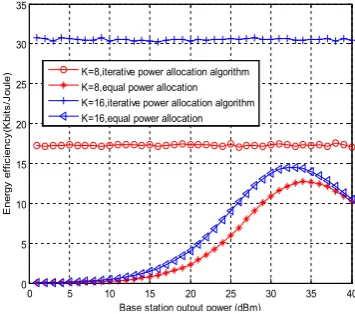
Figure 4 is an energy efficiency comparison between the iterative power allocation algorithm and the equal power allocation algorithm when the number of base station antennas is 128. It can be seen that the energy efficiency of the iterative power allocation algorithm is higher than the equal allocation power. Because the user’s power in iterative power allocation algorithm is optimal, it is independent with the output power of base station, and it can be approximately a straight line. However when the user allocates the output power equally, the energy efficiency increases first and then decrease, that is because the power consumption increases with the increase of output power, but when the output power is less than 32dBm, the system capacity increases more than the power consumption, the energy efficiency increases. When the output power is greater than 32dBm, the system capacity increases less than the power consumption, so energy efficiency reduces. At the same time we can see Step
1: assuming that the average allocation of powerthat is 1
k out
p p K , take 1
k
p and U10 into
(19) to get f1.
Step
2: take
2 1
U f into (18) to get 2
k
p , then take 2
k
p
and U2 into the (19) to calculate the energy
efficiency f2.
Step n:
let Un fn1,takeUn into (18) to get n
k
p , then
take n
k
p and Un into the (19) to calculate fnat
the same time, if fn <0.001, then the iteration
ends. Otherwise continue to step n+1.
K p p out
that in the same algorithm the more users, the greater the energy efficiency.
0 5 10 15 20 25 30 35 40
0 5 10 15 20 25 30 35
Base station output power (dBm)
E
ne
rg
y
ef
fic
ie
nc
y(
K
bi
ts
/J
ou
le
) K=8,iterative power allocation algorithm K=8,equal power allocation K=16,iterative power allocation algorithm K=16,equal power allocation
Figure 4. Energy efficiency comparison between iterative
power allocation algorithm and equal power allocation
Figure 5 shows the relationship between the number of base station antennas and the energy efficiency. It can be seen that with the increase of base station antenna number, the energy efficiency increases first and then decrease, in other words, there exists an optimal number of base station antennas to maximize energy efficiency. This is because when the number of base station antennas is small, with the increase of the transmitting antenna number, the RF chain consumes less power and the system capacity increases more quickly, so the energy efficiency increases. However, when the number of base station antennas is large, the loss of the RF chain becomes large and the capacity increases slow relatively, so the energy efficiency reduces. And the more number of users, the greater energy efficiency of the system.
10 20 30 40 50 60
0 50 100 150 200 250 300 350 400 450 500
Number of base station antennas
E
ne
rg
y
ef
fic
ie
nc
y(
bi
ts
/J
ou
le
)
user=2 user=4 user=8 user=16
Figure 5. Energy efficiency of the iterative power
allocation algorithm
7. Summary
In this paper, an iterative power allocation algorithm is proposed to improve the energy efficiency of Massive MIMO systems. Firstly, a new power model is founded, which takes the users ’ power and circuit power into account. Based on this model, we deduce the expression of energy efficiency and an iterative power allocation algorithm is proposed by using convex optimization to obtain the optimal value of user power. Then the influence of the algorithm on the total power consumption of the system is analyzed. The power efficiency of the proposed power algorithm and average power allocation is compared. The simulation results show that the proposed iterative power allocation algorithm can
significantly improve the energy efficiency of the system.
References
[1] Lee, B.M, Choi, J.H, Bang, J.H.: An energy efficient antenna selection for large scale green MIMO systems[C]. IEEE International Symposium on Circuits and Systems. IEEE, 2013:950-953.
[2] Ngo, H.Q, Larsson, E.G, Marzetta, T.L.: Energy and Spectral Efficiency of Very Large Multiuser MIMO Systems [J]. IEEE Transactions on Communications, 2013, 61 ( 4 ): 1436-1449.
[3] Hamdi, R. and Ajib, W.: Joint Optimal Number of RF Chains and Power Allocation for Downlink Massive MIMO Systems. Vehicular Technology Conference (VTC Fall), 2015 IEEE 82nd, Boston, MA, 2015, pp.1-5. [4] Wang, A. Y, Chao, S, Sodini, C.G, and Chandrakasan,
A.P.: Energy efficient modulation and MAC for asymmetric RF microsensor system. In Proc. 2001 Int. Symp. Low Power Electronics and Design, pp. 106–111. [5] Pei, Y, Pham, T.H, Liang, Y.C.: How many RF chains are
optimal for large-scale MIMO systems when circuit power is considered?[C] Global Communications Conference. IEEE, 2013:3868-3873.
[6] Cui, S, Goldsmith, A. and Bahai, A.: Energy-efficiency of MIMO and cooperative MIMO techniques in sensor networks. In IEEE J. Sel. Areas Commun., vol. 22, no. 6, Aug. 2004, pp. 1089–1098.
[7] Kim, E.P. And Shanbhag, N.R.: An energy-efficient
multiple-input multiple-output (MIMO) detector
architecture. In 2011 IEEE Workshop on Signal Processing Systems.
[8] Li, G.Y, Xu, Z, Xiong, C.: Energy-efficient wireless communications: tutorial, survey, and open issues[J]. IEEE Wireless Communications, 2011, 18(6): 28-35.
[9] Yuming Miao,Xiaoyan Huang,Supeng Leng.Optimal
Energy Efficiency Allocation in OFDMA
System[J].Journal of Electronics & Information
Technology,2014,36(7)(in Chinese).
[10] Feng, W, Chen, Y, Ge, N, Lu, J.: Optimal Energy-Efficient Power Allocation for Distributed Antenna Systems with Imperfect CSI. In IEEE Transactions on Vehicular Technology, vol.PP, no.99, pp.1-1.