Multi-Radio 5G Architecture for Connected and
Autonomous Vehicles: Application and Design Insights
Ioannis Mavromatis
∗, Andrea Tassi
∗, Giovanni Rigazzi, Robert J. Piechocki, Andrew Nix
Department of Electrical and Electronic Engineering, University of Bristol, Bristol, UK
Abstract
Connected and Autonomous Vehicles (CAVs) will play a crucial role in next-generation Cooperative Intelligent Transportation Systems (C-ITSs). Not only is the information exchange fundamental to improve road safety and efficiency, but it also paves the way to a wide spectrum of advanced ITS applications enhancing efficiency, mobility and accessibility. Highly dynamic network topologies and unpredictable wireless channel conditions entail numerous design challenges and open questions. In this paper, we address the beneficial interactions between CAVs and an ITS and propose a novel architecture design paradigm. Our solution can accommodate multi-layer applications over multiple Radio Access Technologies (RATs) and provide a smart configuration interface for enhancing the performance of each RAT.
Receivedon 29 January 2018;acceptedon 23 February 2018;publishedon 20 March 2018
Keywords: Connected and Autonomous Vehicles, CAV, DSRC, LTE-A, mmWave, Layered Services, V2X, C-ITS, Fog Computing.
Copyright© 2018 IoannisMavromatis etal., licensed to EAI. Thisis anopen access article distributedunderthe terms of the Creative Commons Attributionlicense (http://creativecommons.org/licenses/by/3.0/), whichpermits unlimited use,distributionandreproductioninanymediumsolongastheoriginalworkisproperlycited.
doi:10.4108/eai.20-3-2018.154368
1. Introduction
The introduction of autonomous vehicles will represent the biggest revolution on our roads since the advent of internal combustion engine. The benefits include traffic reduction and increased traffic predictability, better road safety, new mobility options and social inclusion. Recent forecasts estimate that globally the number of people living in urban areas is due to increase to over66% by 2050 [1]. In particular, road congestion determines substantial productivity losses. Consider the simple act of searching for a parking space; this represents around30% of all road traffic in mid-to-large cities, mainly due to two factors:
• a lack of knowledge - If the drivers were aware of
the presence of a traffic jam, they would try and avoid congested roads by selecting a different route (vehicle rerouting), or they would choose alternative transportation means (road off-loading);
• a lack of confidence - Drivers are not aware of
the location of the next available parking slot and cannot quickly reach their destinations, wasting time in painstakingly looking for available spaces and even driving erratically.
∗
Corresponding authors: I. Mavromatis ([email protected]) and A. Tassi ([email protected]).
Traditional Intelligent Transportation Systems (ITS) should allow a user: (i) to plan the journey ahead, and (ii) to react to traffic jams by rerouting vehicles. However, given the expected population growth, road congestion needs to be prevented more proactively.
Next-generation Cooperative ITSs (C-ITSs) are expected to bring the paradigm of Mobility-as-a-Service (MaaS) to a whole new level by means of Connected Autonomous Vehicles (CAVs). A critical factor in a CAV-based MaaS paradigm is represented by autonomous vehicles that cease to beautonomous systemsand become cooperative entities. Specifically, cooperation among autonomous vehicles is enabled by the sharing of sensor data and maneuvering intentions in Vehicle (V2V) and Vehicle-to-Infrastructure (V2I) fashion. For these reasons, MaaS city models based on CAVs have the potential to overcome the users’ lack of knowledge and confidence, by means of intelligent route planning systems, and efficient resource allocation strategies for road systems.
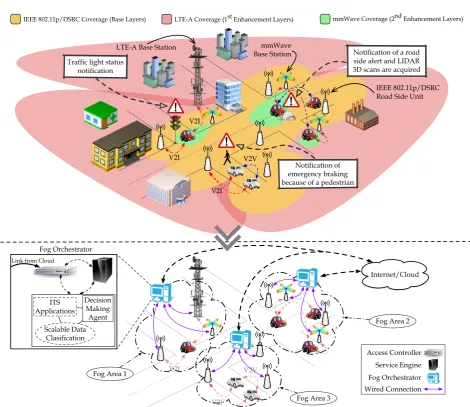
In Section 2, we introduce a novel C-ITS framework based on a heterogeneous communication infrastructure, as shown in Fig. 1. Section 3 shows how the proposed C-ITS framework enables efficient Vehicle-to-Everything (V2X) communications among CAVs by: i) handling scalable ITS applications consisting of independent data streams, and mapping onto different V2X layers, and ii) employing
Research Article
EAI Endorsed Transactions
V2I V2V
V2I
Internet/Cloud
Fog Area 1
Fog Area 2
Fog Area 3 ITS
Applications
Scalable Data Clasification
Decision Making Agent Fog Orchestrator
Wired Connection Fog Orchestrator Service Engine Access Controller
Link from Cloud
IEEE 802.11p/DSRC Road Side Unit LTE-A Base Station
V2I V2I
V2V
LTE-A Coverage (1st Enhancement Layers)
mmWave Base Station
mmWave Coverage (2nd Enhancement Layers)
V2I Traffic light status
notification
Notification of a road side alert and LIDAR 3D scans are acquired
Notification of emergency braking because of a pedestrian IEEE 802.11p/DSRC Coverage (Base Layers)
Figure 1. General overview of the considered system model. The proposed ITS design framework ensures
analog-like performance degradation communications among CAVs by means of multi-layer V2X communications over an heterogeneous network infrastructure.
multiple Radio Access Technologies (RATs) to deliver each data stream, according to target Quality-of-Service (QoS) constraints. In Section 4, we first illustrate the key components of CAVs and identify the necessity for an abstract plane responsible for the management and coordination of the system. Then, an overview of the candidate RATs is provided, along with a discussion on their benefits and limitations. Finally, we present our envisioned C-ITS architecture and examine all its components as well as discuss prospective V2X use cases. Conclusions and future research avenues are drawn in Section5.
2. C-ITS Communication Systems
The principle of MaaS makes possible for the end-users to access a range of next-generation transportation services aided by accurate navigation, journey information with vastly improved road safety. These services will improve the users’
travel experience and provide higher efficiency on how an ITS works. Undoubtedly, a reliable communication system is an enabler for cooperative MaaS frameworks and a key component in next-generation C-ITSs.
CAVs will be equipped with several sensors to maneuver and plan their trajectory ahead. The short-term trajectory planning is essentially achieved by the information gathered from the on-board sensors [2]. For instance, this is the case of an obstacle (e.g., a pedestrian) avoidance maneuver to be performed [3]. However, for more sophisticated scenarios (e.g. a CAV intending to park at an empty space beside the next roadblock), the long-term trajectory planning requires two key elements. At first, information from the surrounding environment should be collected [4]. Secondly, a
Decision-Making agentis required [5]. This agent, using the acquired
lane for better positioning on the road [6], rerouting CAVs due to traffic congestion, etc.).
Each ITS service has specific requirements regarding the data that should be acquired and exchanged. For example, a “collision avoidance by cooperative maneuvering” application is benefited by the almost instantaneous exchange of high-resolution LiDAR or camcorder data [7]. Considering that a 3D-LIDAR can generate a data stream of several
hundreds of megabit-per-second, both the data rate and
latency of communication links are fundamental key performance indicators (KPIs) in delivering a high precision and low-risk maneuver [8]. On the other hand, information such as the position of the next traffic light or the next parking space is of less significance, require lower data rate and is more tolerant to communication latency.
Based on the unique application requirements and taking into account the diverse features of each potential RAT, we designed our system based on a scalable data architecture. The idea of scalability in data has originally been applied to video transmissions where a scalable video stream consists of
abase layerand multipleenhancement layers. The base layer
allows users to achieve a basic reconstruction quality, which is gradually improved as soon as the enhancement layers are successfully received. The same principle trespassed the natural boundaries of multimedia communications and is being applied to design systems capable of an analog-like service degradation [9].
The different data streams in our system are mapped onto different RATs and the central coordination takes place in a Software-Defined Networking (SDN)-like approach (Fig. 1). The Decision-Making agent is responsible for the automated driving applications, which require nearly instantaneous decision-making and reliable communication links. The design of this agent is outside the scope of this work but the reader can go into more details on the topic in [5].
The separation of the data and the control plane enables two prominent features of this system. At first, it enables the management capabilities and the dynamic network resource allocation required by a fifth-generation (5G) vehicular communication framework [10]. Decisions are being taken with respect to various network KPIs, such as the availability of a RAT or the load of a communication link. Later, a centralized control over the heterogeneous network provides a global view and a unified configuration interface. In our system, we assume that our network is clustered in different management areas called Fog Areas. Each Fog Area is centrally managed by aFog Orchestrator(FOs) and consists of a number of multi-RAT Road Side Units (RSUs) and controls multiple CAVs. The FOs represents the logical entities encapsulating the core components of our system. Within these entities, the automated driving decisions are taken and data streams are mapped onto the different RATs.
Utilizing this Fog Computing implementation, our central-ized controller will be responsible for the generation and the processing of all the messages. The different radios will be solely responsible for relaying the message to and from the
CAVs. Our envisaged solution still interacts with a cloud-based city-wide connection, which it interfaces with the
Access Controller in the FO. In particular, the cloud-based
service will only be in charge of recording city-scale data, interconnecting the different Fog areas and enforcing city-scale policies to be put in practice.
The above design paradigm can provide the necessary abstraction and virtualization for a next-generation C-ITS system. Hiding the different heterogeneous details of the various RATs and CAVs and simplifying the deployment of a new ITS service. This system architecture can accommodate next-generation ITS applications with strict QoS constraints bringing us closer to the paradigm of MaaS. In the following sections, we will describe the core network architecture and system components.
3. Candidate RATs for V2X links
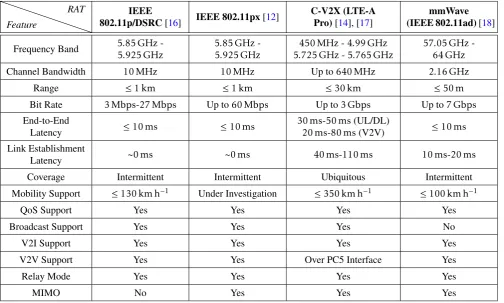
Currently, the IEEE 802.11p/Dedicated Short Range Commu-nications (DSRC) [11] and its extension IEEE 802.11px [12], 3GPP’s LTE-Advanced (LTE-A) Pro [13] with its Cellular-V2X (C-Cellular-V2X) capabilities [14] and, millimeter-wave (mmWave) frequency systems [15] have emerged as potential RATs for V2X communications. This section will briefly present the pros and cons of these technologies and their impact on vehicular communications. Table1summarizes the main features and the additional capabilities provided by all the considered communication solutions.
3.1. IEEE 802.11p/DSRC and IEEE 802.11px
IEEE 802.11p/DSRC represents the suite of IEEE 802.11s and IEEE P1609.x standards, describing a system operating in the frequency range5.850 GHzto5.925 GHz, with a decen-tralized architecture that supports V2X communications. The IEEE 802.11p standard defines the PHY and MAC layers. More specifically, on top of the MAC layer, a Carrier Sense Multiple Access with Collision Avoidance (CSMA/CA) access to the medium, supports different QoS profiles by the Enhanced Distributed Channel Access (EDCA) protocol. The IEEE 802.11p/DSRC implementation of the EDCA is inher-ited from IEEE 802.11e with little modification. With regards to the PHY layer, the Orthogonal Frequency Division Multi-plexing (OFDM) mechanism is adopted, which allows users to achieve a maximum PHY transmission rate of 27 Mbps at a speed of130 km h−1. However, due to the overhead of the communication protocols, the actual network throughput achieved is limited to about 15 Mbps [19]. The reserved 75 MHz of the spectrum is divided into seven channels each of10 MHzbandwidth, where channel 178 (the Control Channel, CCH) is solely intended for broadcasting safety and mission-critical messages, and six channels (the Service Channels, SCHs) being used for all other applications.
Table 1. Candidate RAT solutions for V2X communications
Feature
RAT IEEE
802.11p/DSRC[16] IEEE 802.11px[12]
C-V2X (LTE-A Pro)[14], [17]
mmWave (IEEE 802.11ad)[18]
Frequency Band 5.85 GHz -5.925 GHz
5.85 GHz -5.925 GHz
450 MHz-4.99 GHz 5.725 GHz-5.765 GHz
57.05 GHz -64 GHz
Channel Bandwidth 10 MHz 10 MHz Up to640 MHz 2.16 GHz
Range ≤1 km ≤1 km ≤30 km ≤50 m
Bit Rate 3 Mbps-27 Mbps Up to60 Mbps Up to3 Gbps Up to7 Gbps
End-to-End
Latency ≤10 ms ≤10 ms
30 ms-50 ms(UL/DL)
20 ms-80 ms(V2V) ≤10 ms Link Establishment
Latency ~0 ms ~0 ms 40 ms-110 ms 10 ms-20 ms
Coverage Intermittent Intermittent Ubiquitous Intermittent
Mobility Support ≤130 km h−1 Under Investigation ≤350 km h−1 ≤100 km h−1
QoS Support Yes Yes Yes Yes
Broadcast Support Yes Yes Yes No
V2I Support Yes Yes Yes Yes
V2V Support Yes Yes Over PC5 Interface Yes
Relay Mode Yes Yes Yes Yes
MIMO No Yes Yes Yes
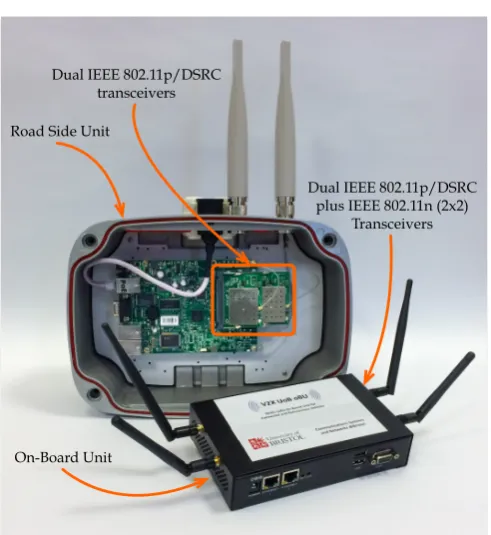
channel erasures increases more than linearly with the vehicle density. As a result, IEEE 802.11p/DSRC tends to be more suitable for transferring low bitrate data streams in vehicular environments characterized by low-to-medium road density and vehicle speed. Examples of an IEEE 802.11p/DSRC Road Side Unit (RSU) and On-Board Unit (OBU) are shown in Fig.2.
IEEE 802.11p/DSRC drawbacks are currently being addressed by an enhanced vehicular communication standard, denoted as IEEE 802.11px [12]. IEEE 802.11px builds the IEEE 802.11ac PHY layer. As such, the Low Density Parity Check (LDPC) codes for channel coding and the Space Time Block Coding (STBC) increase the performance under noisy channel transmissions improving the perceived Signal-to-Noise-plus-Interference (SINR). It is expected the packet delivery rate (PDR) to improve by 40% at a transmitter-receiver distance of 300 m compared to the legacy IEEE 802.11p. Also, Multiple-Input Multiple-Output (MIMO) antenna capabilities, the improved OFDM pilot layouts and the introduction of Very High Throughput (VHT) frame, are expected to enhance the channel capacity of a factor of10 compared to the IEEE 802.11p PHY layer. The new IEEE 802.11px/DSRC will adopt the Outside the Context of a BSS (OCB) operation of IEEE 802.11p/DSRC introducing backward compatibility with its predecessor. Despite the IEEE 802.11px being still in its early development stages, it is expected to replace the legacy IEEE 802.11p in the next
years. It is worth noting that even though IEEE 802.11px is expected to improve the system performance compared to its predecessor, still it cannot accommodate the huge amount of data required by next-generation C-ITS services.
3.2. 3GPP LTE-Advanced Pro and C-V2X
LTE and its major enhancement, LTE-A Pro, represent the 5G of cellular communications standards defined by 3GPP to provide high data rate, ubiquitous coverage and global connectivity for mobile cellular users [14]. The air interface can support Time-Division Duplexing (TDD), Frequency-Division Duplexing (FDD), and Half-Duplex FDD, as well as scalable channel bandwidths (1.4 MHz - 20 MHz). Furthermore, a maximum of 32 component carriers can also be aggregated in LTE-A Pro, leading to a maximum aggregated bandwidth of 640 MHz. Support for Licensed Assist Access (LAA), enhanced LAA and LTE WiFi Aggregation (LWA) is also added, which means that additional bandwidth can be made available by aggregating data together from regular LTE bands, the 5GHz LTE-unlicensed spectrum, and common WiFi networks.
Dual IEEE 802.11p/DSRC transceivers
Road Side Unit
On-Board Unit
Dual IEEE 802.11p/DSRC plus IEEE 802.11n (2x2)
Transceivers
Figure 2. Low-latency Linux Kernel implementation of
IEEE 802.11p/DSRC units prototyped by the University of Bristol. The figure shows units designed for a road side and an on-board vehicle deployment.
efficiency can be obtained, even at high mobility speeds and under dynamic propagation environments. Besides, high data rates are potentially supported, ranging from300 Mbps and75 Mbpsin the LTE downlink and uplink respectively, to theoretically 3 Gbps in the case of the LTE-A Pro downlink [20]. Multicast/broadcast services are also fully supported employing the evolved Multimedia Broadcast and Multicast Service (eMBMS) – thus enabling broadcasting of vehicular service messages in cross-traffic assistance applications [21].
Along with the eMBMS framework, V2V capabilities are built upon an enhanced LTE Direct mode and allow any network entity to engage to device-to-device (D2D) communications. The C-V2X operation of LTE-A Pro introduces two new radio interfaces. The cellular interface (namely asUu) that supports V2I links and the PC5 interface, which is responsible for the V2V communications. The configuration of the sidelinks (V2V links) depends on the availability of cellular coverage. When it is present, control information is transmitted to CAVs using the Uu interface and V2V communications is established. As for drawbacks we observe, that radio resources need to be allocated by each base station to which each CAV connects to. Currently, this key procedure is only accepted in principle but is not part of any LTE-A standard amendments.
Due to the flat architecture, applications demanding low-to-medium latency requirements can be supported without
affecting the network scalability. In particular, up to 80 ms end-to-end delay can be reached over an LTE-A Pro network. However, tactile-likelatency requirements smaller than 10 ms cannot be fulfilled in the presence of higher cellular traffic load. Furthermore, terminals in idle mode need to re-establish a connection with the base station (additional link establishment latency of up to110 ms), thus spending additional time to reach to the connected state. This leads to severe performance degradation in safety-critical applications [22].
3.3. Millimeter Wave Systems
Systems based on mmWave are expected to play a pivotal role in 5G cellular systems. A mmWave system operates in the spectrum between 30 GHz and 300 GHz. For what concerns the application domain of local area networking, the IEEE 802.11ad standard is gaining momentum [23,24]. In this standard, the carrier frequencies are spread around 60 GHz, with a channelization of 2.16 GHz. Also, any mmWave system imposes the adoption of large antenna arrays to achieve high array gains through beamforming techniques. The high array gains, along with large channel bandwidths, allow the system to achieve high data rates (typically several gigabits-per-second). IEEE 802.11ad ensures data rates higher than 7 Gbpsand an end-to-end latency smaller than10 ms.
From the signal propagation perspective, Line-of-Sight (LOS) communications are characterized by path loss exponents smaller than2.8, while Non-Line-of-Sight (NLOS) communications may present much higher path loss exponents. In fact, due to their reduced wavelength, mmWave systems are susceptible to blockages. For these reasons, typical NLOS path loss exponents span between 3.8 and 5.6[20].
As a prospective 5G wireless solution, mmWave systems proved to be a viable alternative to traditional cellular net-works and wireless backhauling systems, while the possi-bility of using this technology to support the communica-tions in next-generation ITS systems is being extensively investigated. In particular, the European Commission is cur-rently considering the possibility of supporting standardiza-tion activities of ITSs based on mmWave systems to be operated across a dedicated band spanning between63 GHz and64 GHz[23].
4. Proposed ITS Agent Design for
Next-Generation CAVs
This section describes the proposed ITS agent design for next-generation ITSs featuring CAVs through heterogeneous RATs, as shown in Fig. 3. With regards to Section 2, we observe that the ITS agent interacts with the Decision-Making agent to achieve ITS service goals, for instance, by implementing long-term driving maneuvers (ITS Agent to Decision Making agent signaling) or adapting the service goals in accordance with detected car accidents (Decision Making agent to ITS agent signaling). A FO responsible for a specific fog area, and most importantly the embedded Decision-Making agent, can directly access all the generated data within this area. Applications and services requiring data from other city regions or Fog areas can access them via the cloud-services communication links.
Since IEEE 802.11p/DSRC access network does not rely on any core networks, this ensures low latencies V2X communications at the cost of reduced coverage. To this end, it appears natural to relay safety/mission-critical messages via an IEEE 802.11p/DSRC network when: i) they are relevant to surrounding vehicles, ii) are characterized by low data rate, and iii) tolerate atactile-like end-to-end latency. For instance, this is the case of messages signaling that a vehicle triggered its emergency braking system. This information is likely to be relevant only to the immediate surrounding vehicles. On the other hand, if vehicles get involved in an accident in the middle of an intersection, this can have a disruptive impact on all the traffic flow across a large area of the city. In that case, it is worth taking advantage of an LTE-A Pro network to notify the disruption across geographically larger areas. Whereas, the authorities via the mmWave communication infrastructure can gain access to the vehicle camcorders or LiDARs to assess the severity of the accident (see Fig.1).
As mentioned in Section2, the proposed system paradigm is based on the idea of data scalability, and a data stream admission control and RAT selection, all being part of the ITS agent entity. For this system, one base layer and two enhancement layers will be considered. The next sections present the key ITS agent components and their fundamental operations.
4.1. Service Plane
As illustrated in Fig.3a, the Service Plane is the place where all the next-generation ITS services and applications are developed regardless of how the data streams will be mapped onto multiple sublayers and regardless of which RAT will be used to transmit each sublayer. We consider the following key next-generation ITS services, which are expected to enhance the CAV-based MaaS paradigm:
• Intelligent Traffic Planning: Future ITS traffic planning
services are needed to reroute autonomous vehicles in the event of traffic jams, to coordinate traffic lights for
offloading a congested road, or to provide drivers with essential up-to-date information.
• Smart Emergency Vehicle Routing: This service is a
specialization of the previous one, it assists emergency vehicles and provides the best route to reach a destination. Typical critical situations correspond to immediate medical assistance or disaster emergency management, such as fire alarms, where police vehicles need to promptly escort the fire trucks. Under these circumstances, the surrounding vehicles must be informed of the approaching emergency vehicles and rerouted to drastically reduce the traffic congestion. Furthermore, a traffic light synchronization system can minimize the overall journey time. A more complex use case scenario corresponds to a fully autonomous E-Ambulance system, where vehicles are equipped with health monitoring devices, such as wearable sensors, able to transmit the collected patience’s data to the hospital or to a control center before reaching their destinations.
• Multimodal Commuting: This service aims to
dynam-ically and adaptively plan the route of a road user, combining different transportation systems, depending on start and end-points. For instance, an intelligent commuting system can notify drivers of available park-ing areas, where a shuttle bus service is offered to efficiently carry the employees to their workplace.
About the aforementioned ITS applications, Table 2 considers some examples of data streams being exchanged, their impact on the ITS service and the estimated amount of sensor data to be transmitted/received. As an example, it is worth mentioning that a state-of-the-art front looking radar can generate up to 2800 Mbps, while a camcorder operating at 640×480 pixels and 30 frames per second,
can generate more than 400 Mbps of uncompressed video data [26]. As described in Section 2, each ITS service has unique requirements with regard to the sensor data to be exchanged. The above figures of merit prove the necessity for a scalable data plane design and a flexible system architecture to accommodate these needs.
4.2. Scalable Data Plane
In the proposed system design, the Service Plane builds upon a Scalable Data Plane, which is in charge of:
• Handling data streams from the lower system planes and dispatching them towards the Service Plane;
• Grouping data streams on the basis of their geographi-cal relevance and QoS requirements.
IEEE 802.11p/DSRC LTE-A Millimeter Waves Smart Emergency
Vehicle Routing Intelligent Traffic Routing Commuting PlanningMultimodal
Raw Sensor Data Streams Enhanced Feature
Data Streams Alarm Messages
and Basic Features Data Streams
Access Controller Service
Engine
Service Plane
Scalable Data Plane
Access Plane Control Plane
Basic Layer 1st Enhancement Layer 2nd Enhancement Layer ITS Agent
Decision - Making Agent
(a)Structure of an ITS agent
LTE-A mmWave (IEEE 802.11ad) IEEE 802.11p/DSRC
IEEE 802.11p PHY IEEE 802.11p MAC
LLC
LTE-A PHY LTE-A MAC RLC PDCP
IEEE 802.11ad PHY IEEE 802.11ad MAC
LLC IPv6
TCP/UDP WSMP
Transport Layer Network
Layer
Access Layer Sensory Feature Streams
(1st Enhancement Layer)
Raw Sensory Data Streams (2nd Enhancement Layer) Basic Safety Messages
(Basic Layer)
V2X Applications ApplicationLayer
(b)Detail of the Access Plane
Figure 3. Proposed ITS agent architecture and detail of the proposed Access Plane incorporating the considered
RATs.
Table 2. Relevant messages for next-generation ITS Services
ITS Services Example Message Types Impact on ITS Services Estimated
Sensor Data
Intelligent Traffic Planning
City-wide map grids and road shape reports. Enabling the origin-to-destination long-term journey planning
10 Kbpsto 10 Mbps
City-wide knowledge of CAV positions Congestion prevention 10 Kbpsto 800 Kbps
Routes and destination in low resolution Congestion prediction and high level rerouting
80 Kbpsto 800 Kbps
Smart Emergency
Vehicle Routing
LiDAR sensor raw data streams exchanged
and processed in real-time Precise high-mobility maneuvers
50 Mbpsto 250 Mbps Accurate representation of the nearby moving
obstacles
Decision making through accurate object tracking
80 Kbpsto 800 Kbps
Trajectory paths with time profiles
Enhanced cooperation between CAVs improving long-term
maneuver smoothness
80 Kbpsto 800 Kbps
Multimodal Commuting
Available parking spaces in close proximity Reducing the overall commuting time
10 Kbpsto 10 Mbps
City-wide knowledge of CAV positions Refinement of the expected arrival time
10 Kbpsto 800 Kbps Information on road disruptions (for e.g.,
accidents, adverse weather conditions) Smart CAVs rerouting
30 Kbpsto 100 Kbps
for Road Safety Applications, in a V2X fashion. Among the fundamental SAE J2735 messages, it is worth mentioning the Basic Safety Messages (BSM), which are broadcast up to every 0.1 s and contain core vehicle information, such as vehicle size, GPS location, braking system status, etc. Along with the other SAE J2735 messages (e.g., Intersection Collision Avoidance, Road Side Alert, etc.), BSMs allow the proposed ITS design to support basic safety/mission-critical ITS functionalities, such as support to navigation, obstacle avoidance, traffic light status notification, etc. Given their low
data rate, nearlytactile-like latency, and local relevance, the V2X base layers are transmitted over IEEE 802.11p/DSRC communication links.
The considered next-generation ITS applications (see Section 4.1) build upon the aforementioned basic ITS functionalities and impact on potentially large areas of a city. These services are expected to deal with feature
streams generated by each vehicle out of its on-board
stream is given by the 3D bounding box representation of objects surrounding each vehicle [27]. These data are being processed using sensor data fusion techniques and independently generated by each CAV [27]. These highly refined information streams need to be shared among a large number of vehicles to allow them to take long-term decisions. In particular, the first enhancement layer requires a communication system providing large coverage and links capable of megabits-per-second, though there is no need for
tactile-like latencies. Hence, we refer to LTE-A Pro as the
proposing RAT.
As discussed, the first enhancement layer is the result of sensory data processing carried out by each vehicle independently. Considering the Smart Emergency Vehicle Routing application, in the case of large-scale accidents, city-level emergency rooms may find it convenient to gather raw sensor data from multiple vehicles, combine them and then extract the required features. In fact, in the case of LiDAR data, combining raw data acquired from different locations can eliminate multiple blind spots and lead to a more accurate 3D bounding box object representation [28]. Streams of raw sensory data define the V2I second enhancement layer. Transmitting raw sensory data requires communication links capable of a gigabit-per-second, which implies the adoption of the mmWave infrastructure. However, due to the intermittent connectivity level associated with this technology, no reliability constraints should be associated with the second enhancement layer.
4.3. Access and Control Planes
To guarantee high system flexibility and adaptability, we propose to separate the Access Plane, encapsulating all the considered RATs, from the Control Plane, which is responsible for the data stream admission control and RAT selection. As discussed in Section2, this approach is largely adopted in the research domain on SDN, where decoupling the network functionalities from the RAT in use enables high system programmability, and abstracts the network infrastructure from services [10].
The Access Plane encompasses the three RAT solutions mentioned above, thus realizing a heterogeneous network capable of operating under various conditions and fulfilling diverse QoS profiles. As shown in Fig.3b, each of the adopted standards is characterized by different protocol stacks. Besides the PHY and MAC layer described in Section 3, IEEE 802.11p/DSRC and IEEE 802.11ad mmWave include the typical Logical Link Control (LLC) layer in charge of flow and error control, whereas LTE-A adopts the Radio Link Control (RLC), responsible for error detection and recovery, and the Packet Data Convergence Protocol (PDCP) for packet integrity protection and header compression. Moreover, in addition to the traditional TCP/IP suite located on top of the access layer, IEEE 802.11p/DSRC embraces the Wireless Access in Vehicular Environments (WAVE) Short Message Protocol (WSMP), supporting the one-hop
broadcast transmission of high priority and time sensitive data messages.
To achieve the necessary level of abstraction, we consider a Control Plane consisting of two distinct system components:
theService Engineand theAccess Controller. The former is
responsible for classifying the incoming data streams based on the Scalable Data Plane configuration, while a decision algorithm determines which data stream must be processed.
The Access Controller then chooses the appropriate RAT
based on the decisions made by the Service Engine in accordance with the Scalable Data Plane, as discussed in Section 4.2, as well as taking into account the availability of the chosen technology. Both system components are integrated within the logical entity of the FO.
4.4. Cooperation between Different RATs
In the previous sections, we described the key components of the proposed multi-radio 5G architecture paradigm, and we established a connection between the different scalable data layers and the individual RATs. The abstraction and virtualization introduced by this design, as discussed, can pave the way for more reliable ITS applications and services. Building upon the flexibility provided by this system, we can enhance the performance of each RAT even further and overall, provide a more robust system.
More specifically, the cooperation between different RATs can be enabled within a fog area. The FO can utilize the already exchanged ITS application data to fine-tune each radio. For example, a significant fraction of the Beacon Intervals (BIs) introduced in IEEE 802.11ad is occupied by the necessary beamforming operations between the devices. In particular, as observed in [29], about1/3of the BI length is to be allocated for beamforming operations. However, by taking advantage of the BSMs (exchanged via IEEE 801.11p/DSRC), which encapsulate position and heading information of a CAV, our FO unit can track a vehicle on the road, inform the mmWave RSU about the estimated position of the vehicle and provide the necessary and pre-calculated beamforming information. This has the potential of improving the network throughput [25,29].
By following a similar approach, FOs can contribute to delivering a system with advance user-authentication functionalities [30]. In fact, users’ credentials can be generated and processed by each FOs rather than in a single centralized node. Similarly, FOs can also be used to implement advanced PHY layer security features, for instance, based on random network coding strategies [31,32].
presented the proposed C-ITS architecture, explored its main components and listed the benefits of our design paradigm.
Future research efforts will be targeted towards the performance benchmarking of the underlying heterogeneous access networks in city-wide network deployments.
Acknowledgment
This work was partially supported by the University of Bristol and the Engineering and Physical Sciences Research Council (EPSRC) (grant ref. EP/I028153/1).
References
[1] (2014) World’s population increasingly urban with more than half living in urban areas. Tech. rep.,
The United Nations. URL http://www.un.org/
en/development/desa/news/population/ world-urbanization-prospects-2014.html. [2] LI, C., LI, X., LI, J., ZHU, Q. and DAI, B. (2017)
Trajec-tory Planning for Autonomous Ground Vehicles Driving in Structured Environments. InProc. of 9th International Confer-ence on Intelligent Human-Machine Systems and Cybernetics (IHMSC) 2017, 2: 41–46. doi:10.1109/IHMSC.2017.125. [3] CHEN, Y., PENG, H. and GRIZZLE, J.W. (2017) Fast
Trajectory Planning and Robust Trajectory Tracking for Pedestrian Avoidance. IEEE Access 5: 9304–9317. doi:10.1109/ACCESS.2017.2707322.
[4] UHLEMANN, E. (2016) Connected-Vehicles Applications Are Emerging.IEEE Vehicular Technology Magazine11(1): 25– 96. doi:10.1109/MVT.2015.2508322.
[5] GONZÁLEZ, D., PÉREZ, J., MILANÉS, V. and
NASHASHIBI, F. (2016) A Review of Motion Planning
Techniques for Automated Vehicles. IEEE Transactions on Intelligent Transportation Systems 17(4): 1135–1145. doi:10.1109/TITS.2015.2498841.
[6] CHEN, X., MIAO, Y., JIN, M. and ZHANG, Q. (2017) Driving Decision-making Analysis of Lane-Changing for Autonomous Vehicle under Complex Urban Environment. InProc. of CCDC 2017: 6878–6883. doi:10.1109/CCDC.2017.7978420. [7] OBST, M., HOBERT, L. and REISDORF, P. (2014)
Multi-sensor Data Fusion for Checking Plausibility of V2V Commu-nications by Vision-based Multiple-object Tracking. InProc. of IEEE VNC 2014: 143–150. doi:10.1109/VNC.2014.7013333. [8] KUMAR, S., SHI, L., AHMED, N., GIL, S., KATABI, D. and
RUS, D. (2012) Carspeak: A Content-Centric Network for Autonomous Driving.ACM SIGCOMM Computer Communi-cation Review42(4): 259–270.
[9] OSSEIRAN, A., BOCCARDI, F., BRAUN, V., KUSUME, K., MARSCH, P., MATERNIA, M., QUESETH, O. et al. (2014) Scenarios for 5G mobile and wireless communications: The Vision of the METIS Project.IEEE Communication Magazine
52(5): 26–35. doi:10.1109/MCOM.2014.6815890.
[10] XIA, W., WEN, Y., FOH, C.H., NIYATO, D. and XIE, H. (2015) A Survey on Software-Defined Networking. IEEE Communications Surveys Tutorials 17(1): 27–51. doi:10.1109/COMST.2014.2330903.
[11] UHLEMANN, E. (2015) Introducing Connected Vehicles. IEEE Vehicular Technology Magazine 10(1): 23–31. doi:10.1109/MVT.2015.2390920.
[12] (2017)LTE-V2X and IEEE802.11p/ITS-G5 Spectrum Sharing at 5.9 GHz. Tech. rep. URLgoo.gl/aZg5gT.
[13] LAURIDSEN, M., GIMENEZ, L.C., RODRIGUEZ, I.,
SORENSEN, T.B. and MOGENSEN, P. (2017) From lte to
5g for connected mobility.IEEE Communications Magazine
55(3): 156–162. doi:10.1109/MCOM.2017.1600778CM. [14] MOLINA-MASEGOSA, R. and GOZALVEZ, J. (2017)
Lte-v for sidelink 5g Lte-v2x Lte-vehicular communications: A new 5g technology for short-range vehicle-to-everything communica-tions. IEEE Vehicular Technology Magazine 12(4): 30–39. doi:10.1109/MVT.2017.2752798.
[15] NITSCHE, T., CORDEIRO, C., FLORES, A.B., KNIGHTLY, E.W., PERAHIA, E. and WIDMER, J.C. (2014) IEEE 802.11ad: Directional 60 GHz Communication For Multi-Gigabit-per-Second Wi-Fi. IEEE Communications Magazine
52(12): 132–141. doi:10.1109/MCOM.2014.6979964. [16] STROM, E.G. (2011) On Medium Access and Physical
Layer Standards for Cooperative Intelligent Transport Systems in Europe. Proceedings of the IEEE 99(7): 1183–1188. doi:10.1109/JPROC.2011.2136310.
[17] LEE, K., KIM, J., PARK, Y., WANG, H. and HONG, D. (2017) Latency of Cellular-Based V2X: Perspectives on TTI-Proportional Latency and TTI-Independent Latency. IEEE Access5: 15800–15809.
[18] GHOSH, A., THOMAS, T.A., CUDAK, M.C., RATASUK, R., MOORUT, P., VOOK, F.W., RAPPAPORT, T.S.et al.(2014) Millimeter-Wave Enhanced Local Area Systems: A High-Data-Rate Approach for Future Wireless Networks. IEEE Journal on Selected Areas in Communications32(6): 1152– 1163. doi:10.1109/JSAC.2014.2328111.
[19] MAVROMATIS, I., TASSI, A., PIECHOCKI, R.J. and NIX, A.R. (2017) Agile Calibration Process of Full-Stack Simulation Frameworks for V2X Communications. InProc. of IEEE VNC 2017.
[20] CHOI, J., PRELCIC, N.G., DANIELS, R.C., BHAT, C.R. and HEATH JR., R.W. (2016) Millimeter Wave Vehicular Communication to Support Massive Automotive Sensing. submitted to IEEE Communication Magazine.
[21] TASSI, A., EGAN, M., PIECHOCKI, R.J. and NIX, A. (2017) Wireless vehicular networks in emergencies: A single frequency network approach. InProc. of SigTelCom 2017: 27– 32. doi:10.1109/SIGTELCOM.2017.7849790.
[22] ARANITI, G., CAMPOLO, C., CONDOLUCI, M., IERA, A. and MOLINARO, A. (2013) LTE for Vehicular Networking: A Survey.IEEE Communications Magazine51(5): 148–157. doi:10.1109/MCOM.2013.6515060.
[23] (2016) C-ITS Platform. Tech. rep., European
Commission. URL http://ec.europa.
eu/transport/themes/its/doc/
c-its-platform-final-report-january-2016. pdf.
[24] TASSI, A., EGAN, M., PIECHOCKI, R.J. and NIX, A. (2017) Modeling and Design of Millimeter-Wave Net-works for Highway Vehicular Communication.IEEE Trans-actions on Vehicular Technology 66(12): 10676–10691. doi:10.1109/TVT.2017.2734684.
[26] GRZYWACZEWSKI, A. (2017) Training AI for Self-Driving Vehicles: the Challenge of Scale.
Tech. rep., NVIDIA Corporation. URL https:
//devblogs.nvidia.com/parallelforall/
training-self-driving-vehicles-challenge-scale/. [27] ASVADI, A., GIRÃCOˇ , P., PEIXOTO, P. and NUNES, U.
(2016) 3D Object Tracking using RGB and LIDAR data. In Proc. of IEEE ITSC 2016: 1255–1260.
[28] ZHAO, G., XIAO, X., YUAN, J. and NG, G.W. (2014) Fusion of 3D-LIDAR and Camera Data for Scene Parsing.Journal of Visual Communication and Image Representation25(1): 165– 183.
[29] MAVROMATIS, I., TASSI, A., PIECHOCKI, R.J. and NIX, A. (2017) Beam Alignment for Millimetre Wave Links with Motion Prediction of Autonomous Vehicles. In IET
Colloquium on Antennas, Propagation & RF Technology for Transport and Autonomous Platforms, to be published. [30] RIGAZZI, G., TASSI, A., PIECHOCKI, R.J., TRYFONAS, T.
and NIX, A.R. (2017) Optimized Certificate Revocation List Distribution for Secure V2X Communications. In Proc. of IEEE VTC-Fall 2017.
[31] KHAN, A.S., TASSI, A. and CHATZIGEORGIOU, I. (2015) Rethinking the Intercept Probability of Random Linear Network Coding. IEEE Communications Letters 19(10): 1762–1765. doi:10.1109/LCOMM.2015.2470662.