Developing an Approach to Include Fathers in Children’s Social Care
Name of Student: Gavin Swann
Doctorate in Social Work and Management: 15th May 2015
2
Acknowledgements
I want to express my thanks to those people who took part in the research, shared ideas, their time and energy.
Firstly; I am indebted to my managers Joy and Cathy for allowing me the opportunity to undertake this research and then for supporting the research and our inclusive agenda over the last three years. In turn, I need to thank Tony and Kim as without your support and reflection I would not have been able to devote time and energy to this study.
I then want to thank every social worker, manager and colleague who, in whatever way, listened and reflected on their practice. I especially want to thank Maureen, Jenny, Alison, Tony, Stefan, Sara and Peter, you know who you are, you worked on the boundary, you promoted our agenda and you never doubted our intentions.
My thanks then go out to all those peers and colleagues, external to the council, who have supported and guided me and my fellow co-inquirers. I am especially thankful to Emily, Cathy, Clare, Adrianne, Neel and Mark.
My biggest thanks, of course, goes to those social workers and managers who took on the identity and the commitment of co-operative inquirers. Yvonne, Martin, Matthew, Ben, Neil, Godiva, Amanda, Cathal, Peter, Audrey, Sarah and David. You worked so hard for eighteen months. Thank you for your consideration, your time and for keeping this project in your minds. Again, we could not have done it without you.
I then want to thank those people ‘behind the scenes’, without your technical advice and support I could not have gathered the quantitative data or presented it so aesthetically. Jerrell, Aisha, Bianca, Melisa, Marcia and of course Fatima, I am eternally grateful.
I would also like to thank my ‘idealised parents’; Agnes and Andrew who provided me with a safe and sophisticated supervisory environment where I could shed my defences and consider ‘what was really going-on.’
To Jelia, my wife, who has made it all so worthwhile
And finally thanks to my mother, father and my wider family and friends who stuck it out and supported me in this endeavour.
3
Abstract
The thesis describes a piece of research undertaken by a group of social work practitioners who experimented with different techniques and practices in their work-place in an attempt to include fathers. The research took place over a thirty-six month period in a Local Authority Children’s Service in London. The research was supported by senior managers within Children Social Care and by the Local Safeguarding Children Board.
The research asks why and how fathers have been excluded from children and family social work. The research goes on to asks what strategies, methods, conditions and techniques promote inclusive practice for fathers whilst examining the role of ‘the self’ as a researcher, practitioner and participant. The research strategy was based on the participation of practitioners in a co-operative inquiry supported by ‘a before and after’ case file audit designed to test whether the co-operative inquiry, which operated within a ‘front-line’ child protection service, brought about practice change.
The aims of the research were; to design and implement a co-operative inquiry, instigate a range of inclusive targets to support the implementation of a father inclusive strategy across the whole system.
The research concluded that children and family social work is one of the few institutions to confront the perversities and abuses of traditional gender and power relations and this confrontation has led to ‘paternal alienation’.
The work of the co-operative inquiry led to an increase in fathers identified and assessed. An increase in fathers attending meetings and reviews and an increase in fathers recorded as having parental responsibility and an increase in contact arrangements for fathers. There was also a sizeable increase in social workers’ considering the father’s situation in ongoing planning for the child.
We learnt that we can include fathers if there is ‘a whole system and a participative approach’ which identifies how covert power and gender relations influence behaviour in practice. To achieve greater father inclusion social workers’ anxieties need to be contained through safety planning systems and quality reflective supervision. For fathers to be included senior managers must support the activity in the long term, (ten to fifteen years), collect data and set targets whilst strategically committing and realigning resources to meaningfully address domestic abuse.
4
supports emergent creativity whilst espousing staff cohesion simultaneously championing social worker empowerment.
5
Contents
Cover 1
Acknowledgements 2
Abstract 3
Contents 4
Chapter 1 Introduction 11
Part One: Introducing the Research 12
Rationale: Why to include fathers 12
The Research 14
Aims of the Research 15
Thesis Structure 16
Part Two: The Author’s Influence 19
Context 19
Background to Project; The Personal Context of the Research and
Reflexive Considerations 19
My Father 20
My Mother 21
My Childhood 22
My Adulthood 22
What has this to do with the Research? 23
Background to the Project: The Professional and Academic
Context of the Research and Reflexive Considerations 23 Linking the Personal and the Professional with the Research 26
On Completing the Research I discovered 28
Conclusion 29
Chapter 2: The Macro and Micro Theoretical Conceptual Perspectives to Understand Why Children’s Social Care Needs to Include Fathers.
Introduction 31
Contemporary Masculinity 31
Contemporary Fatherhood 37
Evolving UK Legislation and Social Policy 41
Concluding the Macro Theoretical Perspective 43
Micro Theoretical Perspectives 44
Social Work in the Modern Age 44
Gender Bias, paternal alienation or Simply Pragmatic Practice 45 The Constructions and Pathologies of Masculinity in Social
Work 46
An Overview of the Evidence Base; Social Work Practice and
the Invisibility of Fathers 49
The Education and Training of Social Workers and Research
about Men and Masculinity 51
6
The Construction of Men as Violent in Social Work 52
Domestic Violence 53
A Defended System 55
Understanding how Violence Influences the Social Work
System 55
Defended Organisations Defended Professionals 57 The Role of Supervision in the Inclusion of Fathers in Social
Work 58
How to Include Fathers in Social Work Interventions and Services 59
Conclusion 62
Chapter 3 Methodology 64
Introduction 65
A Visual Map of the Implementation of the Research 67
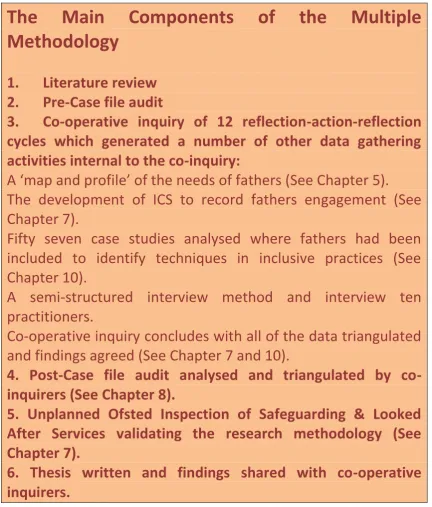
Part One: The Multiple Method 68
Literature Review 71
Pre & Post-Case file Audits 72
Action Research Supporting Researcher Reflexivity 73
What is Co-Operative Inquiry? 73
Data Gathering Methods which emerged during the course
of the Co-operative Inquiry 76
Mapping and Profiling 77
Performance Information 78
Case Studies 78
Interviews 79
Part Two: How was the Data Analysed? 79
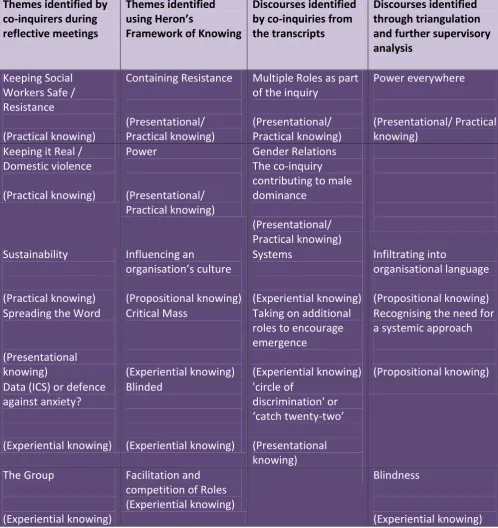
Application of Heron’s Framework of Knowing 80
4 Steps to Making Sense: A Reflective Framework 83
Triangulation 85
Discourse Analysis: An analysis of the transcripts of Each Co-inquiry 86 An Analysis of the Pre and Post Case-File Audit 88 Data from the Co-Inquiry Analysed Externally and fed-back 88
Sense Making 89
Ofsted: An Independent Evaluation of the Research 90 An Example of this Analytical Framework in Application 91
Part Three: The Co-operativeInquiry as a Social Science 92 The Community of Inquiry within the Community of Practice 92
Length of Inquiry 93
An Apollonian Culture 94
Divergence and Convergence 95
Research Cycling 96
Transformational Inquiry 96
Recording 96
7
Part Four The Legitimacy of the Method, Validity and Reliability 98 Generalisability, Reliability and Replicability 98
Ethics Approval 99
An Inside Researcher 100
Validity and Validity Procedures 101
Conclusion 105
Chapter 4 The Chronology of Research Activity 106
Chapter 5: The Research Begins 113
Introduction 114
Part 1: ‘Preparing the Ground’ 115
Strategy 1: to Garner and Sustain Organisational and Senior
Management Support 115
Strategy 2: Initiating the inquiry and recruiting participants 117 Preparing the Ground: Inducting Potential Research
Participants (14th December 2009 – 14th January 2010). 118 The Second Induction Meeting and First Reflection Phase 14.1.10 120
Part 2: Piloting the First Reflection – Action – Reflection Cycle 131
Reflections on the Induction Process 132
Part 3: Preliminary Reflections on Establishing a Co-operative
Inquiry 136
Initiating and facilitating the co-inquiry; the complexity of roles 136 The Complexity of Power in the Initial Stages of the Inquiry 139
Early Reflections on the Co-Inquiry Group 140
Conclusions 142
Chapter 6: Implementation of the Co-operative Inquiry 143
Introductions 144
An Initial Thematic Pattern 145
Keeping Social Workers Safe 145
Containing Resistance 150
Multiple Roles as Part of the Inquiry 151
Power Everywhere 153
Keeping it Real 154
Power & Gender Relations 155
The Co-inquiry Contributing to Male Dominance 156
Sustainability 156
Influencing an Organisation’s Culture 156
Systems 157
Infiltrating into organisational language 157
Spreading the Word 158
Critical Mass 158
8
Recognising the Need for a Systemic Approach 159
Data or Defence against Anxiety? 160
Blinded 161
'Circle of Discrimination' or ‘Catch Twenty-Two’ 161
The Group 161
Facilitation and the Competition of Roles 164
Still Blind 165
Conclusion 165
Chapter 7: The Co-operative Inquiry makes Conclusions 166
Introductions 167
Thematic Pattern 168
Fear Too Containment; a story of Competing Anxieties 169
Anxiety Leads to Blindness 169
Safety and Containment 169
From Blindness to Sight; More Men Assessed and Included 169
Blindness and Organisational Sub-Culture 170
Keep Focused on the Basics 171
A Good Practice Guide to Engage Fathers 176
A Learning Organisation 186
More Men Assessed and Included 187
Measuring the Involvement of Fathers in the Social Work Process
Using ICS 189
The Circle of Interlocking Oppressions 192
Passivity 192
Silencing & Blindness 193
Power 194
Unconscious Re-enactment of Male Domination Mirroring the
Experiences of Women 195
The Group 196
Dominant Organisational Culture 197
Dominant constructions 197
Unconscious Re-enactment of Male Domination; Silence and
Blindness Continue 200
The Personal, the Professional and the Managerial ‘Self’ 200
Paternal Alienation 201
Triangulation 201
Replicating the Research 206
A Female Initiator 206
A Need to Address Methodological Limitations 207
Leading the Inquiry 208
Barriers 208
An Unexpected and Unplanned Independent Evaluation and Validation
of the Research by OFSTED 209
9
Chapter 8 The Case File Audits; A Pre and Post Comparison 211
Introduction 212
Summary of Method 212
Findings from Comparative Case-file Audits 2009 and 2012 213
Data Recorded about Fathers 213
Fathers and their Children 213
Fathers & the Social Work Process 215
Fathers & the Child Protection Process 215
Fathers & the Family Group Conference Process 216
Analysis 216
Triangulation 217
Conclusion 217
Chapter 9: Understanding Organisational Transformation
Introduction 219
Theoretical Underpinnings in Developing a Sustainable Change 220 Process within a Complex Adaptive Organisation
Organisational Prerequisites to encourage transformation in CSC 223 Establishing Conditions for Emergence; Developing
an Alternative Sustainable and Inclusive Approach to Change
Management: The Methodology 224
Implementing a Co-operative Inquiry Group Aimed at Increasing the
Engagement of fathers in Social Work Practice 229
Developing my Management Skills 231
Transactional and Transformational Leadership:
Finding a Middle Ground 232
Understanding Organisational Transformation Concluding Reflections 232
Chapter 10: Conclusions
Introduction 235
Why have Fathers been Continually Excluded from the
Social Work Task? 235
How do we Currently Exclude Fathers from Social Work
Practice? 237
Is it possible to create the conditions, in one Local Authority,
for Fathers’ to be included in social work practice? If so, how? 240 What Strategies, Methods and Techniques Appear to
Promote Inclusive Practice for Men? 243
Why am I Doing this Research? What is the Connection Between the Personal, Professional and Managerial Self and what was the
Impetus to Initiate and Complete this Project? 246
Further Research 248
10
Glossary of Terms 250
References 256
Appendices
Appendix 1 Case File Audit Template 290
Appendix 2 The Research Chronology 292
Appendix 3 Agreed Contract of Participation 334
Appendix 4 Examples of Actions from Co-operative Inquiry
Meetings 340
Appendix 5 Children Social Care Paternal Pledge 349
Appendix 6 Ethics 352
11
pppppppp
12
Chapter 1: Introduction
1. Part One: Introducing the Research
As a social worker, whenever I have worked with fathers, I cannot help but think of my own father and how I experienced him as a parent. After all, he was my primary and most influential reference point. As I became seasoned as a social worker, I began to reflect that colleagues must share similar thoughts. These early reflections led me to study the role of fathers, especially abusive fathers within statutory Children’s Social Care interventions.
This research describes an experiment where a group of social workers applied different techniques to include fathers in statutory social work assessments and interventions. In this introduction, I describe the rationale for the research, the research questions and aims and I describe the structure of this thesis. My primary intention is to; ‘delve beneath surfacing meaning’ to understand the complexities of organisational life that obstruct social workers and organisations from the primary task. Holding this in mind, I reflect over the professional and personal reasons that brought about this research and which influenced the research process and findings.
2. Rationale: Why include fathers?
The literature on masculinity and fatherhood has recently shifted focus toward the study of the exclusion of fathers from statutory services. (Ashley et al: 2011, 2008, 2006, Amussen & Weizel: 2011, Hahn: 2011, Featherstone et al: 2010 and 2007, OFSTED: 2011, Fatherhood Institute: 2010 – 2005 and Smithgall: et al 2009). This research contributes to this ‘shift in focus’ by providing colleagues with a detailed analysis of the implementation of an action research project to include fathers within a Children’s Social Care Service in London. The demonstration of power and control through violence, particularly domestic abuse and the subsequent fear it creates is a constant thread that ‘weaves’ its way through this thesis.
The rationale to include fathers is founded in statue and through research. For example; the law clearly requires father involvement as fathers have the right to family life. The Gender Recognition Act (2004) explicitly requires that services make available equal but separate services for women and men. (Fatherhood Institute: 2011).
13
My assertion is that fathers involvement in children’s lives must be assessed, that they could be both a risk and resource to children and if abusive, then they must be held to account for that abusiveness.
In 2009, I completed a small preliminary research activity on how social workers thought about men. I discovered that fathers were excluded due to shifting social, structural and demographic changes as well as specifically due to the nature of modern social work. I learnt that social workers exclude fathers because of the influence of their family origin, life experience and through assumption and prejudice. The research exposed an endemic fear in social workers, (who are predominately female), that they will be at risk of violent sexual attack by fathers. The research determined that social workers had an important function in role modelling behaviours to; demonstrate survival, that it was possible to escape from gendered oppression and structural discrimination, that it is right to strive to hold men responsible for their children actions and abuses, whilst also role modelling skills, language and techniques in how to be a good mother. The research revealed that social work organisations have a responsibility to support social workers engage fathers, for example;
ensuring there are functioning health and safety procedures, that appropriate reflective supervision takes place,
that Key Performance Indicators on father engagement are used,
that training is provided in masculinity and father engagement and that there is appropriate challenge.
I concluded with the recommendation that Children Social Care implement a series of procedures, policies and practices to support the inclusion of fathers. From that experience, I developed five research questions which act as the foundation for this research in order to achieve my overall aim of improving practice.
Why have fathers been continually excluded from the social work task?
How do we currently exclude fathers from social work practice?
Is it possible to create the conditions, in one Local Authority, for fathers to be included in social work practice? If so, how?
What strategies, methods and techniques appear to promote inclusive practice for men?
Why am I doing this research? What is the connection between the personal, professional and managerial self and what was the impetus to initiate and complete this project?
14
3. TheResearch
The research was conducted in a Children’s Social Care Service in central London over a three year period. The borough is typically diverse in terms of ethnicity, culture, class and economic circumstance. 116 languages are spoken and the borough scores high in relation to poverty measures.
The research is a linear and process related inquiry. I have used co-operative inquiry, psychoanalytical thinking, complexity and systems thinking to facilitate reflexivity, to conceptually organise my thoughts and find answers. I describe the research process because I want to pass on the experience and collective knowledge of our successes and failures in trying to include fathers in social work interventions. This thesis acts as a vehicle to evaluate the research.
I explore how defensive thinking can be proactively deconstructed. To achieve this, I adopted a pro-feminist orientation and have turned to psychodynamic and realist social constructionist perspectives. As the research matured, I have also applied chaos and complexity theories to further understand how a group of practitioners can facilitate change within a highly complex organisation. (Pawson: 2006).
A number of possible theoretical positions could have been utilized during the life of the research. However, as the research evolved and we achieved greater insight, an association appeared in the relationship between the research aims and the research processes as we applied the research methodology. For example; as social workers we are confronted each day by the gross inequalities of gender and power relations through domestic abuse, the sexual abuse of children and the rape of women. As the research progressed, I realised these gender and power relationships and inequalities, (although in a covert and unconscious manner), were present within the research activity itself. The analysis of gender, in relation to the research questions, provided ample material. However, I feel I need to mention this because I could have equally explored race and racism, class and classism or sex and sexuality to the same degree of detail. I chose gender because of the obvious links to the research questions and its dominance. This thesis charts my learning and development as a student, manager, researcher, social worker and as a man. I reflect on key learning points with the aim to augment and sophisticate my effectiveness as a manager and leader as well as be a better man. I attempted to accomplish this by assuming, what Hughes and Pengally (2004) describe as a ‘third position’ as a research practitioner researching ‘inside’ my own organisation. I believe this research represents ‘a valid body of knowledge’. It is a piece of work which is grounded in evidence based practice because it is conducted at the very heart of the social work profession by a group of social worker practitioners who became a ‘community of practitioners’ converging to share and to learn collectively.
15
participated. I believe each Chapter demonstrates that this work is mine and it is original. My fellow co-inquirers attended six weekly co-operative inquiry meetings and actively worked towards engaging fathers in our organisation. This research adds to the knowledge in the area of father inclusion, risk assessment in child protection, domestic abuse, management, leadership, group work and participation and collaboration in achieving organisational change. (Rosenberg & Wilcox: 2006, Stacey: 2003). The research has the ultimate goal of contributing to keeping children safe whilst remaining within their families. (Cook-Craig & Sabah: 2009).
To create a conceptual model, grounded and thoroughly test by the co-operative inquiry, of a sustainable system that brings about transformation in one area of practice in one local authority.
1. To design and implement a co-operative inquiry to include fathers in Children’s Social Care in order to achieve practical, operational systemic change to front line services. This will include the need to develop comprehensive syntheses of existing research in order to develop a collective overview as to what works. (Pawson: 2006).
2. Develop the skills of co-inquirers in facilitation, group processes and methods and practices of inclusive practice whilst developing my own management and group facilitation skills.
3. Create and adopt a fatherhood strategy with realistic goals and targets. This should include a policy for communicating with fathers and an explicit code of practice for dealing with fathers and male carers. This strategy should be communicated and discussed with all staff and visible for families.
4. Identify objectives for engagement with fathers as a whole agency, individual services and individual staff, with these objectives being discussed in supervision and appraisal systems as well as being used for performance management.
5. Refine the existing referral and assessment process and the accompanying paperwork to ensure that fathers’ data is collected explicitly, systematically and accurately.
6. Use data collection system/s to regularly assess patterns of use in services, and identify areas where fathers are not being included to focus communication and services.
7. Ensure that training is available for staff at every level of the organisation/s in father-inclusive practice. This will ensure that father-inclusive practice Objective of the Research
16
becomes embedded in all levels of work and not reliant on the commitment of targeted services or committed individuals within teams.
8. Establish better pathways and referral processes between generic “preventative” provision including Children’s Centres and related services and “crisis” intervention services. This could enable vulnerable fathers to be identified and supported earlier.
9. Ensure appropriate focused and gender specific information is available to give fathers ante-natally and subsequently. This information, publicity and communication should state “mother, fathers and other care
In order to achieve these research aims I have adopted an action research methodology which was supported via a case-file audit as a pre and post-test of the action research.
4. Thesis Structure
I have taken Pawson’s (2006) and Heron’s (1996) advice in writing this thesis which follows a rather adventurist, practice and evidence based structure. The ground is cleared, principles incorporated, an assessment is provided, claims are made, claims are authenticated, points of view are taken and exemplified and conclusions made. I repeatedly link and cross reference method with findings throughout the thesis.
The thesis is divided into ten Chapters.
This Chapter provides the reader with an overview of the research including the research questions, aims and a rationale why fathers need to be included. I dedicate most of this Chapter to my personal, professional and academic biographical journey so the reader is aware of the ‘lenses’ I use to interpret the data. I link how these biographical experiences brought me to the research questions whilst advising the reader that the influences of these biographical experiences can be located in most pages of this thesis.
Chapter 2reviews current thinking in and around the research questions and topic. It is my description of an objective reality. Chapter 2 starts with a series of hypotheses about the macro causal relationships as to the exclusion of fathers from statutory children and family social work intervention. Hegemonic and non-hegemonic masculinity, the changing nature of the modern family are discussed and analysed. Using international research, I apply these hypotheses and causal relationships to UK children and family social work. I describe, in technical detail, the causes to fathers’ ‘invisibility’ in social work whilst naming what techniques work in father inclusive practice.
17
describe how we applied the research methodology and how we made sense of the data. I describe the data analysis process and procedures and the salient features that classify the logic behind the methodological cycle of reflection and action that defines co-operative inquiry.
Chapter 4 is a chronological summary recording the key stages of methodological implementation. This chapter needs to be read in-conjunction with Appendix 2 which chronological records the process of research cycling identifying what was emergent, all actions and occurrences and new practices that were generated from the process of research. The chronology is crucial to this thesis acting as the official record of the research experience and application and evidence of the methodology.
Chapter 5 concentrates on how the co-operative inquiry was established. There is a description, a reflection and an analysis of the identification and induction of potential research participants and then the first full reflection – action – immersion – reflection cycle and a description of the application of the analytical framework. The voices of the co-inquirers dominate this chapter.
Chapter 6 follows on by describing the initial themes identified from ten research cycles with reflection absorbed in deconstructing complex and ‘unspoken’ themes. In this sixth chapter, the intermediate themes, discourses and postulations start to emerge again through the voices of the co-inquirers.
In Chapter 7I review how the co-operative inquiry concluded. I analyse the process, views and reflections of co-operative inquiry members from the final two cycles of action and reflection. I concentrate on ‘what has not been said but has been operating beneath the surface of the inquiry. (Huffington, C. et al 2007: 1)
Chapter 8provides an analysis of the findings from the pre and post-case file audit. .
Chapter 9 reviews the research experience, the process of emergence and organisational change by applying a systems perspective, complexity and chaos theories.
Chapter 10 I re-evaluate the research questions correlating research actions and reflections with emergence. I conclude the thesis with a discussion on how the research aims were achieved and what inhibited further research activity.
Co-18
operative inquiry is founded on empowerment and encourages reflection for example see; Rudolph et al (2009) and Senge and Scharmer (2009) who undertook a similar exercise amongst practitioners in a complex organisation. Co-operative inquiry has the capacity to develop and empower social workers and serve our profession by providing a regular ‘space’ where we, as practitioner / researchers, could reflect together on the learning from our actions for example see Marshall (2009) or Heron and Reason (2009). It is a proven method for those practitioners researching their own organisation for example see; Chisholm (2009) and Barrett (2009). Co-operative inquiry appeals to the principles and ethics of the social work profession. Subsequently I use many quotes from those who took part in the research; their voices can be heard in every Chapter.
19
Part Two: The Author’s influence
Action research supports introspection which proved pivotal because of my self-awareness in terms of the topic and my function, role and influence. This is why I explore my influence on the research process by providing a personal biography and reflecting on how this has influenced the research design, process, analysis and outcomes. My introspection, via the personal biography, provides an examination of the filters and lenses through which I see the world. Reflecting on the personal biography helps explore and understand my unique and individual influence on the research. The personal biography attempts to explain through example how and why I understood and organised the research and why I made the conclusions I did. Reflection, using action research facilitated further introspective, peer critique and mutual collaboration. The personal biography informs how my personal history has led me to this research. It outlines my values and informs my subjectivity. It positions my gender, ethnicity, class and cultural influence and professional experience in relation to the research and to those co-inquirers.
It identifies where the power is held in relation to this research project and identifies my position in the power hierarchy and is an example of reflexivity in research that typifies this research project. (Reason and Bradbury et al: 2009, Winter & Munn-Giddings: 2003).
The research methodology with its focus on practice, practitioner participation and reflection are concepts advanced by Professor Eileen Munro (2011) in her review of the Child Protection System in England. Professor Munro endorsed the need for re-organisation and practitioner empowerment based on principles of reflection and systems. This thesis advances these principals not only in social work practice but in alternative ways to manage and organise social work services, a further rationale for the personal biography.
1. Context
I reflect on why I chose this subject to research. I position myself critically evaluating my own involvement, my influence and my assumptions and how they have influenced this research experience. I think it crucial that I place ‘myself’ within the research and identify what is distinctive about this experience and what makes it distinctive from what other men might bring to the research.
2. Background to the Project; The Personal Context of the Research and Reflexive Considerations
20
that the perspectives or ‘lenses’ I utilize to interpret the research experience have shaped the process and the outcomes. Therefore, insight into how my personal biography influences the research is a constant source of data as well as a valid point of reflection. I summarise my parents’ lives and my own childhood as well as my current circumstances in an attempt, inter-generationally, to link them with the research questions.
3. My Father
My father was born in 1938 in London. He was the second child; his sister was born in 1936. My paternal grandparents were killed in 1941. My father and his sister were then separated and my father was placed in an orphanage remaining there for the remainder of the war. This had a devastating effect on my father’s development as he had lost his primary attachment figure and was subjected to abuse and neglect whilst institutionalised. He was also bullied at school by his peers and verbally humiliated by teachers as he suffered from dyslexia. Aged 7 my father was adopted by his maternal aunt and her husband. My father’s sister remained separated from my father and was cared for by her great grandmother. His adopted father died in 1965 and his adopted mother lived on until 1989. My father met my mother in 1963, they married in 1965 moved from London to Kent in 1966 and I was born in 1967. My brother was born in 1969.
In speaking to my father about his childhood he looks back on his adoptive parents with love and respect and to this day, speaks fondly of both of them especially his adopted father who he idealised. My father speaks fluently and reliably about his childhood although he glosses over the first few years. He much prefers the account of his happy, advantaged and secure later childhood with his adoptive parents. My father remained in their care until he achieved majority when he was ‘called up’ as part of his National Service. After two years of service including military action in Libya and Suez he returned to London and entered a career in international logistics.
My mother reports that the first few years after my and my brother’s birth were happy. However, by 1974 my father had started drinking heavily. At the same time my father’s career flourished. He was promoted quickly from one management position to the next. His office was based in central London however with his promotion came an expectation that he travel internationally. As his career grew so did the number of weeks and months he spent away from the family home. My father considered that part of his employment function was to socialise, we would often have visitors from across the world staying with us and inevitably alcohol became a powerful enabler in social activities.
21
My father has a strong work ethic and a potent sense of his gender identity, role formation and hierarchies. He understood his role as a father to be a provider especially in terms of my and my brother’s education. My father held strong, socially constructed patriarchal values which were driven generationally and within his cultural and patriarchal context as a hegemonic male. After their divorce my father married his former secretary in 1987. They have remained married. My father retired at the age of 52 and they both moved to the north of England. They returned to London in 2002. On reflection the early formation and construction of ‘father’ which developed in me was one of a traditional head of a nuclear family who was distant and maintained hegemony through economic and physical power.
4. My Mother
My mother was born in 1941 she had an older brother born in 1938 and a younger brother born in 1952. My maternal grandparents were married for 20 years. My maternal grandmother’s life was devastated in 1955 when my maternal uncle, my mother’s older brother, died of TB. Within a year my maternal grandmother died leaving my mother, aged 14, as the main carer for both her father and younger brother then aged 6. This had a profound and lasting effect on my mother shaping a powerful maternal function as a carer and limiting her educational career.
Aged 18 my mother trained as a secretary. She was a talented, attractive woman receiving many offers of marriage. Aged 23 my mother met my father. At this point, my parents presented as a heterosexual couple supported within a predominately paternal kinship system of extended family, which included the majority of its important social relations. Among fewer variations than in our contemporary society, my father was typically the manager of the nuclear family’s property, he represented the family in public duties and functions and provided material support as gender roles within society, at that time, were structured patriarchally. At the centre of the family system were my brother and I and we were cared for primarily by my mother. Again I was constructed into a nuclear family model with Eurocentric influence. (Ross & Savada; 1988).
22
5. My Childhood
In discussing my first years of life with my mother she reported a relatively happy time in her relationship with my father. I was breast fed for the first 8 months and my father was supportive of my mother. I was able to internalise, at this age, a protective father figure. For me my circumstances deteriorated when I was sent to a private school. I struggled due to my own dyslexia but also because of the difficulties I was having at home. A cycle developed where I involved myself in negative attention seeking behaviour at school that resulted in physical discipline and conflict at home. This cycle continued and worsened as my mother and father’s relationship deteriorated.
In my early teenage years my father and I regularly disagreed, argued and on occasion fought. I was unable to identify with my father in adolescence as I had become competitive, defensive, oppositional and aggressive. He could not understand my rebellion and why I was throwing away an education he was paying for. I now know that the intensity of my rebellion was an indication of my need for closeness to my father.
Interestingly, my brother had an alternative and more productive coping mechanism, where he focused on his education becoming a ‘straight A’ student and head boy.
6. My Adulthood
Following my parents’ divorce I saw my father twice in the next twelve years. I had split off everything that was bad about my parents’ relationship and my childhood and projected it into my father where I was happy for it to remain whilst idealising my mother which I now recognise as ‘a quasi-paternal bond of substitution’. (Barrett: 1993).
Once I started studying social work which, by its nature, encourages you to consider and reflect on your own family experience, I started to reassess my relationship with my father. My studies allowed me to start the process of repairing the relationship and my own emotional state. I began to empathise with my father’s childhood experiences, coupled with my own maturation, felt equipped emotionally to reunify with my father. Simply, I did not want to hold on to such anger or negativity any longer. Tentatively, I reintroduced my father back into my life and since the late 1990s we have resolved many of our difficulties although some subjects have not been spoken of. My father has just had his seventy sixth birthday. I would now describe our relationship as supportive, loving and truthful.
23
7. What Has This To Do With The Research?
I embarked on this research conscious that my memories and subsequent constructions of fathers would influence this research. It is clear that my father has remained very present in my mind.
My choice of profession, (conscious and unconscious), has provided me with a platform to explore my relationship with my father whilst evolving into an interest in including non-resident, abusive, absent or simply excluded fathers into the lives of their children.
Although not unique these experiences have shaped my perspective, in terms of the research in the following ways:
I projected the image of a distant / absent yet powerful image of man into my concept of fathers.
I disliked and easily accepted and supported the negative image of marginalised fathers and I failed to see the value of fathers.
8. Background to the Project; The Professional and Academic Context of the Research and Reflexive Considerations
I have been a social worker since 1998. During my undergraduate studies, (1993 – 6), I volunteered as an advocate for people with mental health problems who were subject to long-stay psychiatric hospitalisation. My role was to advocate and support inpatients, (many of whom who had been institutionalised for forty years or more), as they were discharged into community accommodation. During one meeting, I met a male social worker who told me that; ‘although social work was not what it was, if I really wanted to make a difference, I needed to qualify’. About the same time, I was reading a great deal of political philosophy and was particularly attracted to the work of Jean-Jacques Rousseau especially his treaty; ‘The Social Contract’ (1762).
I was enamoured by his concepts of collective responsibility, the ‘academic and experiential’ led me to study for a postgraduate Diploma in Social Work (1996-1998). Once qualified, I worked in south London in an initial response children and families team from 1998 to 2000. In 1999 I completed an MSc in Social Work; my research looked at factors that promoted stability and instability for children in foster care in my employing borough.
24
experienced and maintained a prejudice of fathers as abusive, absent and without value to children.
I had always been interested in international social work and had made contacts with a number of international organisations in an attempt to be considered for employment abroad. In February 2004 I was facilitating visitors from UNICEF from across Central Asia explaining concepts of western social work. Two weeks later I was offered a job, by one of those visitors, in Central Asia. By April 2004 I had moved to Kyrgyzstan. I then spent the next three years working for a number of different non-governmental organisations including UNICEF, the European Commission and EveryChild across the former Soviet Union. My role included: establishing social work systems and services, promoting family and community care, (rather than the institutionalisation of children), training police and social workers and developing social work undergraduate courses, investigating abuses of children in institutions, developing services and supports for children with disabilities and completing needs and strengths based area assessments. Throughout these international and cross cultural experiences I observed a similar behaviour by those working with children and families; i.e. that fathers were marginalised.
In late 2006 I returned to London, (and to a job as a team manager in a child protection team), to enrol on the Masters in Child Protection and Complex Case-work course at the Tavistock and Portman. This was a unique and life changing experience. Thoughts of my childhood and my early relationships with my father were re-awakened and have followed me throughout these the last eight years. As part of the first year of the course I had to undertake a twenty week child observation. I had made arrangements to observe a mother and her three week old child.
This observation had a powerful impact upon me emotionally. During the observations, I identified very strongly with the paternal function and at times felt a strong desire to substitute for the father in that function. On reflecting on my observations, I thought, felt and even acted in a paternal capacity to support the mother. The child observations left me wanting to explore further what was meant by paternal function and it incrementally influenced the rest of my studies. As part of the second year I chose to complete a clinical piece of work with a non-resident father and his son where I worked with them both on their relationship, issues of identity, (the boy was mixed heritage), and facilitated communication with the mother and father.
For my second year placement, I was placed in a Family Assessment Service which was a ‘tier four’ provision specialising in the assessment of children and families with complex child protection needs. I spent one day a week for a year assessing fathers who had emotionally, physically or sexually abused or neglected their child.
25
prejudicial views towards men in social work; ‘always a suspicion that the male is an abuser or a perpetrator of violence or a predatory threat to women and children’.
In 2008, in the final year of the course, I conducted a small piece of practitioner-research in my organisation entitled; ‘How Are Men Thought About in Social Work Practice’. I arranged two separate focus groups; one of male social workers and the other of female social workers and asked them the same questions about what they thought of men in social work. We discovered additional reasons why men are generally excluded from statutory child protection and child-in-need social work interventions.
Negative socially constructed images of men by a predominately female workforce. These images are continually reinforced with social workers experiencing men as abusive or absent or without value to the child and mother.
Social workers’ fear violent physical and or sexual attack.
Social workers individual, (personal), experiences of abusive men
Social workers hold deeply entrenched personal, individual, collective, social psychological defences towards men. (Whittaker: 2011).
Institutional and organisational defences which encourage exclusion have become a professional and organisational culture where paternal alienation is perceived as legitimate, entrenched and endemic within organisational systems determining practice outcomes.
A lack of organisational support for staff to engage abusive men.
I argue that this leaves a large percentage of children, allocated within Children’s Social Care, without an adequate risk assessment of the father potentially leaving children and mothers vulnerable to abuse.
After completing the MA course, I still had the interest and motivation to continue to study. My original research established baseline information. Subsequently, and with the backing from my employing organisation, I was tasked with establishing a research project to develop new practices, procedures and systems to include men in social work practice within my employing Local Authority’s statutory Children-in-Need Service. On reflection, my studies have incrementally informed my exploration. An opportunity presented itself; to establish a change management project and integrate the project into a professional doctorate. A research methodology was needed which would be able to provide a containing environment to explore the identified defensive thinking, behaviours and a strategy operationalised to bring about change. I was attracted to the family of Action Research most notably co-operative inquiry as I had written about its values in a paper after establishing a ‘ThinkSpace’ for social workers in 2008 and 2009. (Obholzer & Roberts; 2002).
26
Subsequently, I established a group of social workers and managers, who had the collective goal of improving social work practice in relation to including fathers. Our aim was to develop evidence based practice at the heart of a social work service. The research questions were formed by different perspectives from within the group as well as through supervision, coupled with O'Hagan's (1997) strategies of avoidance and Dienhart's (1998) gender sensitive approach as well as more globally relevant discourses.
9. Linking the Personal and the Professional with the Research
I had, (and still do), a real desire to explore and deconstruct my prejudicial views in an attempt to understand myself, my own practice and that of others as an aid to improve practice because, if I held these views, then I am sure so do many other social workers.
I recognise my research is driven by the need to understand and work with the stigma and shame attributed to men in the esoteric world of child protection. I further recognise that my research is driven by my need to repair my own relationship with my father but I also now recognise that I am trying to repair other relationships too. As a male social worker, working in the realm of male oppression, I became aware of my connection to male abuse, sharing masculinity with these male abusers, whilst being associated to those abusers in the minds of their victims and subsequently feeling ‘dirty’ and ‘damaged’ through that association. Over the course of my career I have had to understand and come to terms with the friction, stresses and unhappiness these circumstances have produced. I have questioned whether I could role model a different progressive form of masculinity, in an attempt at reparation as I wanted to support other men repair their relationships with children and families, [where safe]. (I further deconstruct my reasons for undertaking this research in Chapters 7 and 10.
27
I question whether my motivation to complete this research is in fact an attempt to become something different because by acknowledging what men do I dissociate myself and say I am different. Obviously, our gender is always with us and I enact my work as a social worker, manager, researcher and student in the context of my gender and vice versa. My research cannot escape the societal constructs of power and gender meaning this work will have different meanings to every reader. Subsequently, my gender can be found in every word of this thesis. (Frosh: 1994).
Therefore, in this study my professional and personal experience as a white middle-aged British male who has access to male hegemony, as a social worker, a student, as a teacher of social work and as a manager have inspired, encouraged and strongly shaped this research enquiry. Indeed, as a white male, with the category entitlements this affords, I believe I am in a position to comment on what it is like to be a man whilst exploring the presence and effects of masculinity in Children’s Social Care. These roles also influence how I have interpreted the literature and research findings. I have made every effort to identify how my personal ‘lenses’ and my social and emotional construction have influenced the research in an attempt to recognize my bias, however I will never be fully aware. (Speer: 2005). I conclude that I was motivated to complete this research because of the influences of traditional masculine behaviours and constructions of; competition, narcissism, power and a need to impress my father. I was further motivated through my desire to continue to repair my relationship with my father as well as a desire to understand my own childhood. I was inspired to gain further insight into my own internal world and my understanding of what it means to be a man and a father. I was also motivated to gain greater insight into my sense of self as a leader and manager. These factors unconsciously influenced the research process whilst also making my research perspective exceptional.
To generate alternative perspectives I attended a monthly men’s group for eighteen months. This experience left me knowing that there are many varieties of masculinity whilst providing me with an opportunity to learn and share other men’s experiences and perspectives of their own masculinity. I also attended four days training on working with men. I interviewed my father and mother and discussed my assumptions in tutorials and psychoanalytical supervisions. I committed to these activities to learn more about myself in the role of a practitioner researcher researching men and male abuse. This raised my levels of consciousness about masculinity and power and allowed me further insight into my own motivations and behaviours. However, my influence remains a constant and has implications for the interpretation of the findings which is why I have presented my biography to the reader to assist others to see how and why I am interpreting the data in the way I am. I believe this can only contribute to methodological rigour and validity. I explore further my motivations and how they influenced the research outcomes in Chapters 7 and 10.
28
I regularly refer to how I interpret the data and my bias and my perspectives which significantly influenced the entire research process. I have attributed the origins of behaviour and the roles I have chosen to a range of discourses that operate within our society. Reflexive analysis has allowed me to appreciate and respect the multiple meanings and realities conveyed in the research.
The co-operative inquiry group broadened my awareness but I have tried hard to remain open to my limitations. Regular supervision and group supervision over the last 3 years, has allowed for what Bannister describes as 'disciplined questioning' over my research methodology and its limitations. (1996, p 50). Supervision has allowed for a continuous process of constructive criticism and deliberation over alternative interpretations and given me a number of other ‘lenses’ in which to review this research process. In order to encourage reflexivity I kept a diary throughout.
10. On completing the research I discovered:
We discussed, throughout the co-inquiry that paternal alienation is caused by a range of complex macro and micro variables. However, what I originally failed to take account of was the pervasive role of gender and power relations. As members of society, our individual social constructions of our gendered roles unconsciously determine social workers’ and organisations’ behaviour. I now realise this means fathers are excluded automatically and instinctively. The re-enactment of gendered identities, and thus power relations, was palpably present throughout the research.
1.
I conclude that fathers have been excluded from the social work task because: paternal alienation is a natural psychological and practical response to male abuse. Social work, over decades, has become blind to father involvement as a defence against fear of physical and sexual attack. Managers, local authorities’ social services departments, Ofsted inspectors and academics have all colluded in silence, blind to the abuse caused by men. As a profession, we are not trained to work with fathers or abusers and we do not understand masculinity nor are we resourced to work with fathers. Meaning abusive men are not held to account, whilst abused women and children remain at risk, perpetuating the cycle of abuse and contributing to the continued marginalisation of fathers’ and costing our society millions.
We determined that by using a participatory activity, such as co-operative inquiry, it is possible to create the conditions for a change in social work practice, indeed the
The research brought about practice improvement. For example:
A 27% increase in fathers recorded on case file information
I A 33% increase in the numbers of fathers’ record in assessments and
29
influence of the research methodology was crucial because it employs the traditions and principals and ethics of our profession. This research further confirms that to involve fathers we need to recognise and repeatedly and openly discuss how inequality, power and our individual social constructions influence our thinking. I further realise that there is a greater probability of achieving sustainable change if the culture that operates in the organisation supports emergent creativity whilst espousing staff cohesion simultaneously championing social work empowerment. I learned that the organisational history and current organisational culture has great bearing on the possible outcome of the project. I further concluded that my masculinity heavily influenced the research process and outcomes. Finally, I conclude that the theory of triangulation offers social workers and managers a connection between the personal, professional and managerial self that is highly relevant to our professional, organisational and personal lives.
We learned that fathers can be included in social work assessments if there is a whole system and a participative approach which identifies how covert power and gender relations influence our behaviour in practice. As a profession we need to be open to learning collaboratively in developing practice. But to achieve greater father inclusion social workers’ anxieties need to be contained and workers need to be given permission to be afraid and describe the fear preferably in quality reflective supervision. We further know that for fathers to be included senior managers in local authorities must support the activity in the long term, (ten to fifteen years), collect data and set targets over father inclusion. We further identified that local authorities’ need to strategically commit and realign resources to meaningfully address domestic violence.
I have realised that organisations cannot be changed by plan or desire so I have studied emergence in complex systems which has allowed me to reflect on creativity and the conditions to foster emergence. Emergence can materialise in incomprehensible ways. (Stacey, Griffin & Shaw: 2006).
Conclusion
Reflexivity has encouraged me to provide the reader with a biography which I have then linked to the aims of the research. I recognise that the salient relationships of my childhood continue to influence my thinking and behaviour and in turn this thesis which I return to in Chapters 7 and 10. Chapter 2 reviews the literature.
30
Chapter 2: The Macro and Micro Theoretical Conceptual Perspectives
to Understand Why Children’s Social Care Needs to Include Fathers.
31
Chapter Two
1. Introduction
This Chapter is controversial and emotive. It is important to state from the outset that this Chapter does not set out to promote the rights of fathers’ nor does it attempt to rationalise or deny male abuse, in fact quite the opposite. This Chapter is ‘a call to action’ evidencing the need to include men in the social work process to risk-assess them and hold them accountable for their behaviour. Where possible it may be conceivable to treat their violent and or abusive behaviour but a risk assessment may also indicate that separation and supervised contact is the only safe response. Fathers’ involvement is only appropriate if it is in the child’s interest and where it can be undertaken safely.
This Chapter provides a macro context exploring masculinity and fatherhood and relating the discussion to the more technical micro landscape of Children Social Care. I précis the changing nature of contemporary Western masculinity exploring concepts of hegemonic and non-hegemonic masculinities and reflect on the modern interpretation and perceptions of fatherhood in relation to the research inquiry. I investigate violence, particularly domestic abuse from these perspectives. I offer a comprehensive synthesis of existing research in order to produce objective overviews of why men are excluded from Children Social Care. In combination with realist social constructivism psychoanalytical thinking allows for a depth of exploration not permitted by other perspectives. Other theories considered as potential analytical perspectives for this Chapter were; the impact of the capitalism model of production, the Marxist (1904) counter-argument and Foucault’s perspectives on power (2000, 1999, 1995 & 1980). However, it is beyond the scope of this thesis to consider every potentially relevant theory or examine every fact or hypothesis in exploring the research questions.
I identify complex, hidden, unconscious and socially constructed reasons as to men’s exclusion from Children’s Social Care. In this Chapter I locate the first two research questions and the aims of the project within a professional ‘terrain’ identifying gaps in current practice:
1. How do we currently exclude fathers from social work practice?
2. Why have fathers been continually excluded from the social work task?
2. Contemporary Masculinity
32
categoriser) for advantage or disadvantage, for privilege or repression. Gender and gendered identities, gender stereotypes, sex appropriate standard roles, behavioural norms and assumptions about maleness and femaleness are then constructed within this socially constructed dominator model. As a result, one of the most problematic and enduring characteristics within human culture is the inequity and discrimination between men and women. (As Marx’s labour theory denotes, society depends upon the replication of social structures to provide context and perpetuate culture). (Connell: 2002).
Masculinity is a symbolic script, a cultural construct, endlessly variable and, in contemporary society, not always necessary. Historically, femininity has been defined as the negative to masculinity although Frosh (1994) posits this means masculinity is, in actuality, a negative identity learnt by defining itself in opposition to emotionality and connectedness. This means masculinity has no secure base, no positive substance but is rather founded only on the prohibition of ‘the other’ a precarious and untenable position which is always under threat. Men are structurally dominant over women but individually men experience powerlessness and a denial of inner emptiness. In Western market-led countries, the traditional and somewhat restricted notions of masculinity and manhood, (and therefore natural dominance through rationality, pseudo-independence, physical strength, and traditional work based spheres of masculine expressive activities), has been fragmented by feminism and other cultural critiques due to a period of rapid cultural alteration. Men and masculinity can only be experienced in a ‘bi-polar’ construction of; self-hatred or idealisation, the good or the bad man. (Quite simply, the ‘Ubiquitous Male defined by the triad Man-the-Impregnator-Protector-Provider’, sexual universals and biological determination are no more). (Burk & Speed: 1995)
In spite of this, reserves of more primitive male thinking remain endemic and inherent dominating society in an increasing bid to defend against the loss of power. Men maintain control over political, economic, judicial, educational and medical systems.
These gender based patterns of power and control are persistently internalised and reproduced in our most intimate relationships through the generations. Jukes (1999) argues that control and power, and the abuse employed to acquire and maintain both, are part of a spectrum of abusive controls to ensure male domination and the provision of services and caretaking from women. The dehumanisation of the ‘other’ through abusive control is central acting as a ‘frustration pre-emption’ strategy. Despite our social revolution, femininity remains a subordinate and, on occasion, a denigrated state whilst patriarchy, Kraemer (1999) argues, impoverishes the male personality through its rigidity, emptiness and frailty. (Maguire: 2002).
33
what Maguire describes as ‘womb envy’. (2004) Many men are unable to manage this continuum and fluidity in their identity and respond through violence, in particular, to women in order to maintain the ‘illusory authority of the phallus’. (Seager and Thummel 2009, Maguire: 2009 Burk & Speed: 1995, Gilmore: 1990).
In Western market economies there is a powerful correlation between the social organisation of production and the dominance of the male image. The complexity of modern industrial society requires an aggressive gender male role. Indeed capitalism needs patriarchy and hegemonic masculinity. However, it remains the case that the assumptions on which contemporary conventional masculinity are built has become less tenable as women have become economically and socially empowered. (Seager and Thummel 2009).
This thesis conceptualises masculinity in plural and hierarchical terms with some masculinities being socially central and or more correlated with authority and social power over other subordinated non-hegemonic masculinities. Hegemonic masculinity has multiple meanings but it signifies a normative cultural dynamic by which men maintain a controlling position in society. Hegemonic masculinity is constructed and reconstructed to suit social change. Hegemonic masculinity is characterised through cultural consensus, marginalisation and dehumanisation of ‘the other’ or any competitor. (Stainistreet et al; 2010 and Smithgail et al: 2009).
Connell & Messersschmidt (2005) propose a model of hegemonic masculinity which is based on privilege and power and emphasises the agency of women whilst explicitly identifies the ‘geography’ of masculinity through local, national and global constructs, socio-cultural circumstance and structure. This hegemonic and multiple masculinity model encompasses a range of dynamics including the interplay between power and gender dynamics which interplays with ethnicity, class and region. These dynamics determine the nature of masculinity its form, local context and impact meaning masculinity is a learnt social practice.
Depending on perspectives there is a misperception as to who is a hegemonic male. Hegemonic masculinity is not a fixed model. In Connell & Messersschmidt’s (2005) model they suggest the existence of external and internal hegemonic masculinities. External refers to the institutionalisation of men’s dominance over women whilst internal refers to the social ascendancy of one group of men over another. Hegemonic masculinity is fluid amalgamating, negotiating, translating and reconfiguring masculinities to maintain external masculine hegemony.
34
Men, in their desire to be hegemonic position themselves between some or all of these masculinities. The existence of multiple masculinities evidences the complexities of gender construction for men as well as the existence of active struggle for dominance that is implicit in the Gramscian, (Connell: 1977), concept of hegemony. A further component of this complexity is that gender is constructed from one’s individual structural circumstance. (Stainistreet et al; 2010 Smithgail et al: 2009 and Connell and Messerschmidt; 2005)
Despite much change hegemonic masculinity remains omnipresent and so one has to ask; what crisis in masculinity? I concur with Jukes (1999) who regards talk of a crisis in masculinity as an attack on feminism. Men and women’s psychological development reflect [differently] the patriarchal culture in which we live. Eichenbaum and Orbach (1983) argue this means that women are left incomplete, powerless, over-dependent, passive and without a solid sense of self and separateness. This is reinforced through patriarchal cultural domination and so women become ‘comrades in their captivity’. (Maguire: 2002).
Radical feminism locates masculinity as, by its nature, oppressive and either needed to be fought against or avoided through separation. (This is a powerful argument. I believe this radical feminist perspective operates legitimately yet silently in Children’s Social Care as an overt reaction to the atrocities of male abuse through the solidarity of women and a resistance to the dependence on men that stifles women’s potential).
But are all men really complicit? Seager and Thummel (2009) and Frosh (1994) and others describe ‘versions of masculinities or multiple masculinities’ rather than man being categorised as homogeneous. These versions of masculinity are constricted to a polarity of either ‘properly’ masculine or feminine and widespread due to the intergenerational transmission of gender codes. Frosh (1994) convincingly argues that masculinity is fundamentally a negative identity structured by a range of ethnic, class and cultural experiences and fantasies. Frosh continues that masculinity is understood only by splitting off intellect from emotional literacy and connectedness with ‘the other’ which are then both repressed.
35
Exploring non-hegemonic masculinity further; academics such as Connell (1995) and Whitehead (2005) have developed this conc