c
Performance Evaluation of Models Established for the Estimation of Diffused Solar
Radiation: Case Study Lahore, Pakistan
Saif ur Rehman
1, Muhammad Shoaib
1, Imran Siddiqui
2*, S. Zeeshan Abbas
2 1Department of Physics, Federal Urdu University of Arts S & T, Karachi Pakistan
2
Department of Physics, University of Karachi, Pakistan
*
Email:
[email protected]
Received: 26 March, 2019 Accepted: 01May, 2019
Abstract: A suitable design of solar power project requires accurate measurements of solar radiation for the site of investigation. Such measurements play a pivotal role in the installation of PV systems. While conducting such studies, in general, global solar radiation (GSR) is recorded, whereas diffuse component of solar radiation on a horizontal surface is seldom recorded. The objective of the present study is to assess diffuse solar radiation (DSR) on horizontal surfaces by using polynomial models for Lahore, Pakistan (27.89 N, 78.08 E) and by correlating clearness index with diffuse fraction. The established models are compared with some of the existing models from the literature. Performance of models is evaluated by employing five goodness-of-fit (GoF) tests that are, mean bias error (MBE), root mean square (RMSE), Coefficient of Determination (R2), Mean Absolute Percentage Error (MAPE) and Akaike’s
Information Criterion (AIC). The comparison of the results of goodness-of-fit tests with those of existing models indicate that the models established in the present study are performed better as compared to the existing models. The values of statistical error analysis further suggested that a cubic model with a good accuracy of 97.5% and AIC of -22.8 is relatively more suitable for this climatic region for estimating diffuse solar radiation. The study shows that the model developed is in good agreement with Elhadidy and Nabi model with an accuracy of 96.1% and AIC of 4.4 and satisfactory results are obtained for Lahore. The findings can help to give a generous understanding of solar radiation in order to optimize the solar energy conversion systems. The results of this study provide a better understanding of the associations between global solar radiation, clearness index and diffused fraction for the region under study.
Keywords: Global horizontal radiation, diffuse solar radiation, polynomial models, clearness index, Lahore.
Introduction
For the implementation of solar power projects, the knowledge regarding the solar irradiance data and their components at study site must be known prior to the design of the project. Solar energy is environmentally friendly, plentiful and easy to utilize. Due to the geographical location of Pakistan and long sunshine duration, solar energy has a significant role to play in generating electrical energy. Average value of global solar radiation over Pakistan ranges from 1500 W/m2
-day to 2750 W/m2-day throughout the year. GSR has
two components (i) DSR and (ii) direct solar radiation. Correct knowledge of GSR and its components for the site under study is of practical importance in designing and execution of a solar energy conversion system (Kumar and Uman, 2005). On the other hand, in developing countries, like Pakistan which are technically and financially constrained, the diffuse radiation data are not available for many sites. In such scenarios DSR data are usually predicted using modeling and simulation technique, using various meteorological and geographical data as input variables for models (Halawa et al., 2014).
Oliveira et al. (2002) constructed models based on linear regression approach for estimating hourly, daily and monthly DSR in the city of Sao Paulo, Brazil. Soares et al. (2004) applied artificial neural network in estimating DSR. As input parameters to the network,
the authors used GSR and other meteorological parameters. Shamshirband et al. (2016) estimated DSR by the SVM-WT model. These techniques are complex and required a bulk amount of data. Additionally, a number of studies were conducted to develop mathematical models for the estimation of DSR on a horizontal surface. These studies used a range of parameters as input such as sunshine hours, relative humidity, declination angle and latitude. (Wang et al., 2018; Jamil and Akhtar, 2017; Sabzpooshani and Mohammadi, 2014; Li et al., 2012; Li et al., 2012; Li et al., 2011).
Liu and Jordan (1960) originate a correlation between GSR and extraterrestrial solar radiation. Using this ratio, they estimated the diffuse component of global horizontal solar radiation for USA. This technique of estimating DSR is used by a number of research groups. Iqbal (1980) modified the idea of Liu and Jordan (1960) and determined the DSR in Canada.
Ulgen and Hepbasli (2009) estimated the monthly
mean daily DSR using eight models for three big cities in Turkey. In case of the unavailability of observed data, DSR is determined by fitting a model to data which is available for regions with similar climate
conditions. Torres et al. (2010) compared the
performance of various models in estimating hourly DSR in Pamplona, Spain. Erbs et al. (1982) conducted a study which correlates diffuse and GSR on a horizontal surface using clearness index. Lam and Li
ISSN: 2223-957X
(1996) obtained a linear relation between GSR and mean DSR by using clearness index.
The studies conducted in this regard for Pakistan, Ulfat et al. (2012) developed empirical model for Islamabad, Pakistan for the determination of diffuse component using a relationship containing diffuse fraction and clearness index. Ahmed et al. (2009) estimated global and DSR for Hyderabad, Sindh, Pakistan using models given by Liu and Jordan. Ahmad and Naqvi, (1981) in an analysis, proposed a model for Karachi, Pakistan, for the assessment of DSR using correlation between diffuse fraction and clearness index and their model was based on regression analysis.
The current study is based on the construction of mathematical models to estimate DSR using correlation between clearness index and diffuse fraction. The study also aims at comparing the performance of these models with existing models based on the measured data recorded for Lahore using statistical indicators. Nevertheless, the study is significant in a sense that up-to-date data are used for developing the proposed model enumerating some useful results.
Materials and Methods
Study Area and Data Description
The measuring station is located in Lahore city, at Latitude N 31.6944°, Longitude E 74.2442°, with its altitude 220 m above mean sea level. Lahore is characterized as a semi-arid climate. In the present study Diffuse and GSR data for Lahore are used. The data were collected from the study project ESMAP (2015). Measurements were performed from October 2014 to January 2017. Measuring equipment is located on the top of the Center of Energy Research at the University of Engineering and Technology (UET) campus in Lahore, Pakistan. The station was outfitted with Kipp and Zonen CMP10 pyranometer for Global horizontal radiation measurement and CSPS Twin-RSI for DSR measurement. These measurements were recorded through a Campbell Scientific CR1000 data logger. The data are recorded at intervals of 10 minutes. In the preprocessing phase, the recorded data were averaged, first on hourly basis and then on monthly basis.
Models in Literature
Some models are chosen from literature for comparison purposes. These models correlate diffuse fraction and clearness index. The selection of these models is based on their performance and climate conditions prevailing in the regions for which these models were designed. Table 1 lists these selected models for comparison. In these equations, Hd is
monthly mean daily DSR (MJ/m2-day), H is monthly
mean daily GSR (MJ/m2-day), H
o is monthly mean
daily extraterrestrial radiation (MJ/m2-day), and K T is
the ratio of global to extraterrestrial solar radiation (KT
= H/H0). Diffuse fraction Kd is the ratio of diffuse to
GSR (Kd = Hd/H). The average daily extraterrestrial
solar radiation on a horizontal surface can be estimated for different latitudes from the solar constant, the solar declination and day of the year using Eq. 1 as
presented by Duffie and Beckman (2013). In the
following equation the average day of the month is considered according to Klein (1977).
H0=24π × 3600ISC�1 + 0.033 cos �360365 dn��
��2π60�sinφsinδ+ cosφcosδsinωs� (1)
ωs= cos−1(– tanδ tanφ) (2)
Where angle 𝛿𝛿 can be calculated by the Eq. 3
δ = 23.45 sin�360 284 + dn
365 � (3)
Monthly average estimated value of H0, observed
values of H, and of Hd are shown in Figure. 1. The
maximum value of Hd is observed to be 11.56 MJ/m2
-day in July while minimum value of Hd is 5.42 MJ/m2
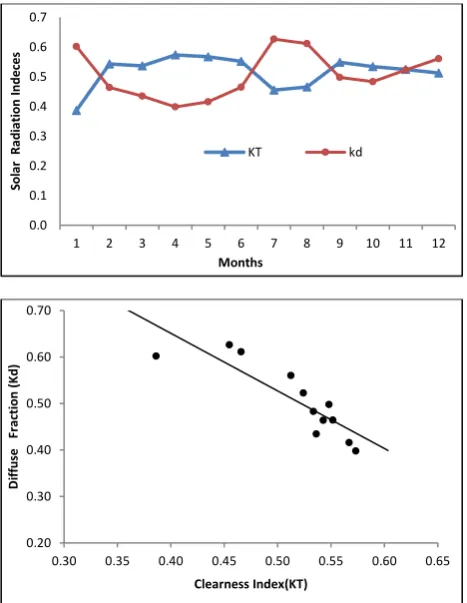
-day found in December. Figure 2a shows monthly variation of clearness index (KT) and diffuse fraction Kd. As observed, April and May are more clear months
of the year (KT = 0.57), the lowest value of clearness
index (KT = 0.39) is found for the month of January.
The lowest value of diffuse fraction (Kd = 0.4) is
observed during the month of April, whereas July shows maximum value of diffuse fraction (Kd =0.63).
A high value of clearness index indicates reasonably good availability of solar radiation, which provides good opportunity for solar energy utilization. In Figure 2b diffuse fraction (Kd) is plotted as a function of
clearness index (KT) and a reciprocal trend is observed
between these two parameters.
Fig. 1 Plot of monthly solar radiation as monthly mean global horizontal radiation (H), extraterrestrial solar radiation (Ho), and
DSR(Hd) for Lahore.
0 5 10 15 20 25 30 35 40 45
Jan Feb Mar Apr May Jun Jul Aug Sep Oct Nov Dec
S
o
lar
R
ad
iat
io
n
(M
J/
m
2
-d
ay)
Months H0
H
Fig. 2 (a) Monthly Variations of the KT and the Kd. (b) Scatter plot
of Kd versus KT.
Table 1 The models picked from literature for current study with the author and study location
Model No
Regression Equation Author and locations
M1 HHd= 1.0 - 1.13 KT Page (1967) for USA
M2 HHd= 0.999 - 1.1283 KT Alnaser (1989) for Bahrain
M3 HHd= 1.102 - 1.299 KT AL-Hamdani et al . 1989 for
Baghdad
M4
Hd
H = -1.271+8.925 KT
-10.5 𝐾𝐾𝑇𝑇2
Elhadidy and Abdel-Nabi (1991) for Saudi Arabia
M5
Hd
H= - 6.5707+ 42.611
KT- 81.113 𝐾𝐾𝑇𝑇2 + 48.849
𝐾𝐾𝑇𝑇3
Ulgen K and Hepbasli (2009) for Turkey
M6
Hd
H= - 1.390-4.027 KT +
5.531𝐾𝐾𝑇𝑇2-3.108𝐾𝐾𝑇𝑇3
Abdalla(1987) for Doha
(Qatar)
M7 Hd
H= 1.2313 𝑒𝑒−2.2(𝐾𝐾𝑇𝑇)
Sanusi and Abisoye (2013) for Lagos, Nigeria
M8
Hd
H= -1.018-1.167
KT+0.024𝐾𝐾𝑇𝑇2
Jiang (2009) for China
The proposed models in the present study estimate monthly mean DSR by establishing a correlation between diffuse fraction and clearness index. The coefficients of proposed models are determined using regression analysis on the data of the diffuse fraction (Kd) and the clearness index (KT) by varying the
degree of the polynomials. Proposed models are presented in Table 2.
Model Performance Evaluation
The estimated values are tested against observed values through statistical analysis. The tests performed in this study include the Mean Bias Error (MBE), Root Mean Square (RMSE), Coefficient of Determination (R2), Mean Absolute Percentage Error (MAPE), and
Akaike’s Information Criterion (AICC). The best
model is the one with the lowest AICC. These
indicators are defined respectively as:
𝑴𝑴𝑴𝑴𝑴𝑴=1𝑛𝑛∑ �𝐻𝐻di
,cal
−𝐻𝐻di
,meas
�
𝑛𝑛
𝑖𝑖=1 (4)
𝑹𝑹𝑴𝑴𝑹𝑹𝑴𝑴=�𝑛𝑛1∑ �𝐻𝐻di
,cal
−𝐻𝐻di
,meas
�2
𝑛𝑛
𝑖𝑖=1 (5)
𝑴𝑴𝑴𝑴𝑴𝑴𝑴𝑴=𝑛𝑛1∑ ��𝐻𝐻d
i,cal𝐻𝐻−𝐻𝐻di,meas
d i
,meas
��
𝑛𝑛
𝑖𝑖=1 × 100 (6)
𝑴𝑴𝑨𝑨𝑨𝑨𝑨𝑨=𝑛𝑛.𝑙𝑙𝑛𝑛 �1𝑛𝑛∑ �𝐻𝐻di
,cal
−𝐻𝐻di
,meas
�2
𝑛𝑛
𝑖𝑖=1 �+ 2𝑘𝑘+2𝐾𝐾𝑛𝑛−𝐾𝐾−1(𝐾𝐾+1)(7)
where Hd
i,meas and Hdi,cal are the observed and
estimated ith mean value of DSR, k is the number of parameter plus one and n is the number of data points.
Results and Discussion
By using the available measured data for global solar radiation at Lahore station and least square regression method, four models have been developed for the study area. The models are given in Table 2. Models proposed in this study and known models in literature are used for the estimation of monthly mean values of DSR. These estimated values are plotted in Figure 3 and in Figure 4 for all months along with the measured data. As it is clear from Figure 3, the values obtained from the models developed in current study area adequately close to the observed data. Whereas, the values obtained from existing models are significantly far from the observed values, model (M1, M2, M3, M6, M7 and M8) underestimated the Hd values while
model (M4) overestimated Hd values (Fig. 4). The
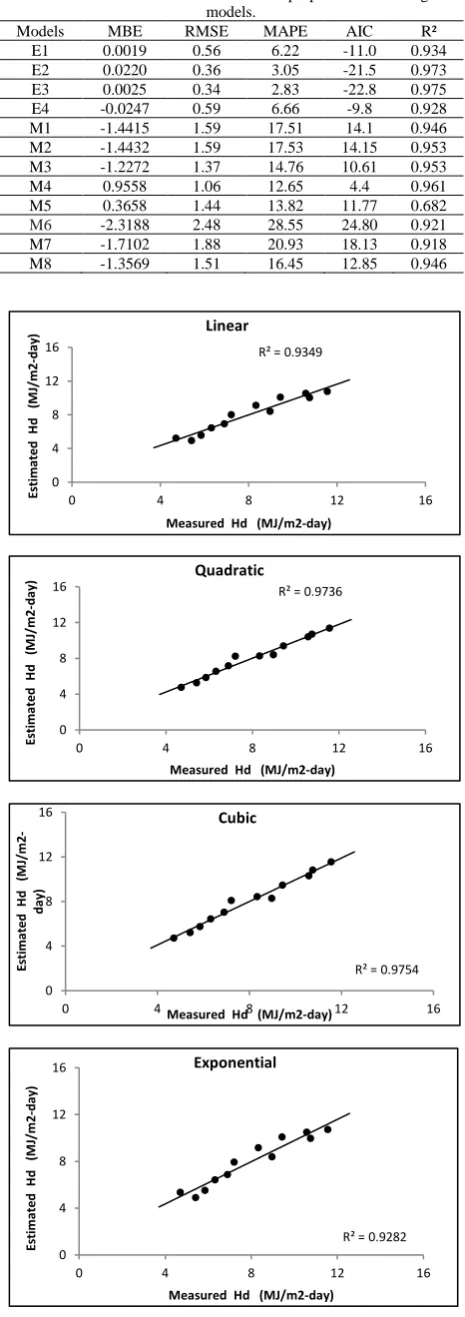
performance of models could be verified from scatter plots. Figure 5 is the scatter plot between estimated values of Hd (from the models developed in current 0.0
0.1 0.2 0.3 0.4 0.5 0.6 0.7
1 2 3 4 5 6 7 8 9 10 11 12
So
la
r R
ad
ia
tio
n
In
de
ce
s
Months
KT kd
0.20 0.30 0.40 0.50 0.60 0.70
0.30 0.35 0.40 0.45 0.50 0.55 0.60 0.65
Di
ffu
se
F
ra
cti
on
(K
d)
Clearness Index(KT)
Table 2 Equations of the models developed using measured data of Lahore station.
Model No. Model Type Regression Equation
E1 Linear
Hd
H= 1.1469 - 1.2396 KT
E2 Quadratic
Hd
H = -1.271+ 8.925 KT- 10.5 𝐾𝐾𝑇𝑇2
E3 Cubic
Hd
H = - 6.5707+ 42.611 KT-
81.113 𝐾𝐾𝑇𝑇2+48.849 𝐾𝐾𝑇𝑇3
E4 Exponential Hd
study) and measured values of Hd. The cubic model
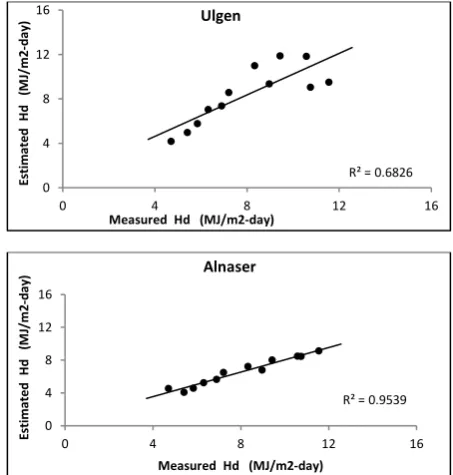
shows a strong correlation (R² = 0.975) between estimated and observed values. Figure 6 shows the scatter plots between estimates of Hd values (from
models picked from literature) and observed values of Hd. It is clear that Elhaddidy and Nabi (1991) model
shows a higher value of Coefficient of Determination (R2=0.961) of correlation and all other plots show poor
relationship.
Fig. 3 Plots between estimated values and measured data at Lahore of monthly average daily DSR from developed models.
A thorough analysis has been performed through statistical analysis to assess the performance of all models considered in current study. Table 3 summarizes the results of statistical tests. It is quite evident that the results of current study models are more accurate as compared to the models considered from literature. Further, it is found that the best results are obtained from model E3 (cubic) with Positive bias having MBE = 0.0025 MJ/m2-day, RMSE = 0.34
MJ/m2-day, MAPE = 2.83%, R2 = 0.975 and lowest
AIC (−22.8). Although MBE is least for linear model but, AIC’s test was conducted for all the models, which reveals that AIC is lowest for model E3 (cubic). This confirmed the better performance of the cubic model.
Fig. 4 Comparison among the estimated values from existing models and measured data at Lahore of monthly average daily DSR from the existing models.
Table 3. Performance indicators for the proposed and existing models.
Models MBE RMSE MAPE AIC R² E1 0.0019 0.56 6.22 -11.0 0.934 E2 0.0220 0.36 3.05 -21.5 0.973 E3 0.0025 0.34 2.83 -22.8 0.975 E4 -0.0247 0.59 6.66 -9.8 0.928 M1 -1.4415 1.59 17.51 14.1 0.946 M2 -1.4432 1.59 17.53 14.15 0.953 M3 -1.2272 1.37 14.76 10.61 0.953 M4 0.9558 1.06 12.65 4.4 0.961 M5 0.3658 1.44 13.82 11.77 0.682
M6 -2.3188 2.48 28.55 24.80 0.921 M7 -1.7102 1.88 20.93 18.13 0.918 M8 -1.3569 1.51 16.45 12.85 0.946
Fig. 5 Plots between the estimated values and measured data for the monthly average daily diffuse solar radiation in Lahore using the four candidate models.
0 2 4 6 8 10 12 14
1 2 3 4 5 6 7 8 9 10 11 12
D
iff
us
e S
ola
r R
ad
ia
tio
n (
M
J/
m
2-day)
Months
Measured Linear Exponential Cubic Quadradic
0 2 4 6 8 10 12 14
1 2 3 4 5 6 7 8 9 10 11 12
D
iff
us
e S
ola
r R
ad
ia
tio
n (
M
J/
m
2-day)
Month
Measured Ulgen
Page Alhadidy
Alnaser AL-Hamadani
Abdalla Sanusi and Abisoye
Jiang Y
R² = 0.9349
0 4 8 12 16
0 4 8 12 16
Es
tim
ate
d
H
d (M
J/
m
2-da
y)
Measured Hd (MJ/m2-day)
Linear
R² = 0.9736
0 4 8 12 16
0 4 8 12 16
Es
tim
ate
d
H
d (M
J/
m
2-da
y)
Measured Hd (MJ/m2-day)
Quadratic
R² = 0.9754 0
4 8 12 16
0 4 8 12 16
Es
tim
ate
d
H
d (M
J/
m
2-da
y)
Measured Hd (MJ/m2-day)
Cubic
R² = 0.9282 0
4 8 12 16
0 4 8 12 16
Es
tim
ate
d
H
d (M
J/
m
2-da
y)
Measured Hd (MJ/m2-day)
Fig. 6 Plots between the estimated values and measured data using existing models for the monthly average daily DSR in Lahore.
Conclusion
In this study, four new models (linear, quadratic, cubic and exponential) and eight models from the literature have been used to estimate the monthly mean DSR on horizontal surface at Lahore. The comparison between developed models of current study and the models picked from literature has been carried out by using five statistical tests. All the tests were conducted using measured data of Lahore station. The statistical indicators show that the models proposed in the current study performed better than the models picked from literature. Furthermore, it is noted that amongst the proposed models, model E3 delivered the highest performance according to statistical analysis with MBE = 0.0025, RMSE = 0.34, MAPE = 2.83, AIC = -22.8 and R² = 0.975. The study is in good agreement with the diffuse solar radiation model obtained by Elhaddidy and Nabi (1991) and is in good comparison with the observed values for Lahore for diffuse solar radiation with MBE = 0.9558, RMSE = 1.06, MAPE = 12.65, AIC = 4.4 and R2 = 0.961. This study was
directed with the main objective to produce computationally simple and accurate diffuse radiation models. The estimated method involved incorporating traditional clearness index - diffuse ratio models. In conclusion, this study provides a method for estimating diffuse solar radiation with acceptable accuracy at Lahore and is useful for designing energy production systems using solar energy.
Acknowledgement
Authors acknowledge the support of Department of Physics, Federal Urdu University of Arts, Science and Technology (FUUAST) Karachi, Pakistan, and Department of Physics, University of Karachi for
R² = 0.9466
0 4 8 12 16
0 4 8 12 16
Es
tim
ate
d
H
d (M
J/
m
2-da
y)
Measured Hd (MJ/m2-day)
Page
R² = 0.9611 0
4 8 12 16
0 4 8 12 16
Es
tim
ate
d
H
d (M
J/
m
2-da
y)
Measured Hd (MJ/m2-day)
Elhadidy
R² = 0.9218 0
4 8 12 16
0 4 8 12 16
Es
tim
ate
d
H
d (M
J/
m
2-da
y)
Measured Hd (MJ/m2-day)
Abdalla
R² = 0.9539 0
4 8 12 16
0 4 8 12 16
Es
tim
ate
d
H
d (M
J/
m
2-da
y)
Measured Hd (MJ/m2-day)
AL-Hamdani
R² = 0.9184
0 4 8 12 16
0 4 8 12 16
Es
tim
ate
d
H
d (M
J/
m
2-da
y)
Measured Hd (MJ/m2-day)
Sanusi and Abisoye
R² = 0.9463 0
4 8 12 16
0 4 8 12 16
Es
tim
ate
d
H
d (M
J/
m
2-da
y)
Measured Hd (MJ/m2-day)
Jiang
R² = 0.6826 0
4 8 12 16
0 4 8 12 16
Es
tim
ate
d
H
d (M
J/
m
2-da
y)
Measured Hd (MJ/m2-day)
Ulgen
R² = 0.9539 0
4 8 12 16
0 4 8 12 16
Es
tim
ate
d
H
d (M
J/
m
2-da
y)
Measured Hd (MJ/m2-day)
conducting this research. Authors also acknowledge Alternate Energy Development Board for providing data for the study.
References
Abdalla, Y.A. (1987). Solar radiation over Doha (Qatar). International Journal of Solar Energy, 5, 1-9.
Ahmad, F., Naqvi, S.A., (1981). Characteristic distribution of total, direct and diffuse solar radiation at Karachi. Pak. J. Sci. Res., 24, 171. Ahmed, M.A., Firoz, A., Akhtar, M.W. (2009).
Estimation of global and diffuse solar radiation for Hyderabad, Sindh, Pakistan. Journal of Basic &
Applied Sciences, 5,73-77.
Al-Hamdani, N., Al-Riahi, M., Tahir, K., (1989). Estimation of the diffuse fraction of daily and monthly average global radiation for Fudhaliyah, Baghdad (Iraq). Solar energy, 42, 81-85.
Alnaser, W.E., (1989). Empirical correlation for total and diffuse radiation in Bahrain. Energy, 14, 409-414.
Duffie, J.A., Beckman, W.A. (2013). Solar engineering of thermal processes, 56. John Wiley & Sons,
New York, USA.
Elhadidy, M.A., Abdel-Nabi, D.Y., (1991). Diffuse fraction of daily global radiation at Dhahran, Saudi Arabia. Solar Energy, 46, 89-95.
Erbs, D.G., Klein, S.A., Duffie, J.A. (1982). Estimation of the diffuse radiation fraction for hourly, daily and monthly-average global radiation. Solar Energy, 28, 293-302.
ESMAP (2017). Data and information obtained from World Bank via energydata.info, under a project funded by the energy sector management assistance program (ESMAP).
https://energydata.info/dataset/pakistan-solar-measurement-wbg-esmap
Halawa, E., Ghaffarian Hoseini, A., Li, D.H.W. (2014). Empirical correlations as a means for estimating monthly average daily global radiation: a critical overview. Renewable energy, 72, 149-153.
Iqbal, M., (1980). Prediction of hourly diffuse solar radiation from measured hourly global radiation on a horizontal surface. Solar Energy, 24, 491-503.
Jamil, B., Akhtar, N. (2017). Comparative analysis of diffuse solar radiation models based on sky-clearness index and sunshine period for humid-subtropical climatic region of India: A case study. Renewable and Sustainable Energy
Reviews, 78, 329-355.
Jiang, Y. (2009). Estimation of monthly mean daily diffuse radiation in China. Applied Energy, 86, 1458-1464.
Klein, S.A. (1977). Calculation of monthly average insolation on tilted surfaces. Solar Energy, 19, 325-329.
Kumar, R., Umanand, L. (2005). Estimation of global radiation using clearness index model for sizing photovoltaic system. Renewable Energy, 30, 2221–33.
Lam, J.C., Li, D.H. (1996). Correlation between GSR and its direct and diffuse components. Building and environment, 31, 527-535.
Li, H., Bu, X., Lian, Y., Zhao, L., Ma, W. (2012). Further investigation of empirically derived models with multiple predictors in estimating monthly average daily diffuse solar radiation over China. Renewable Energy, 44, 469-473.
Li, H., Bu, X., Long, Z., Zhao, L., Ma, W. (2012). Calculating the diffuse solar radiation in regions without solar radiation measurements. Energy, 44, 611-615.
Li, H., Ma, W., Wang, X., Lian, Y. (2011). Estimating monthly average daily diffuse solar radiation with multiple predictors: a case study. Renewable
energy, 36, 1944-1948.
Liu, B.Y., Jordan, R.C. (1960). The interrelationship and characteristic distribution of direct, diffuse and total solar radiation. Solar Energy, 4, 1-19. Oliveira, A.P., Escobedo, J.F., Machado, A.J., Soares,
J. (2002). Correlation models of diffuse solar-radiation applied to the city of Sao Paulo, Brazil. Applied Energy, 71, 59-73.
Page, J.K. (1967). August. The estimation of monthly mean values of daily total short wave radiation on vertical and inclined surfaces from sunshine records 40S-40N. In Proceedings of the United Nations Conference on New Sources of Energy: Solar Energy, Wind Power and Geothermal Energy, 21-31, Rome, Italy.
Sabzpooshani, M., Mohammadi, K. (2014). Establishing new empirical models for predicting monthly mean horizontal diffuse solar radiation in city of Isfahan, Iran. Energy, 69, 571-577.
Sanusi, Y.K., Abisoye, S.G. (2013). Estimation of diffuse solar radiation in Lagos, Nigeria. In 2nd International Conference on Chemical, Environmental and Biological Sciences, 17-18,
Dubai (UAE).
Shamshirband, S., Mohammadi, K., Khorasanizadeh, H., Yee, L., Lee, M., Petković, D., Zalnezhad, E. (2016). Estimating the diffuse solar radiation using a coupled support vector machine–wavelet transform model. Renewable and Sustainable
Soares, J., Oliveira, A.P., Božnar, M.Z., Mlakar, P., Escobedo, J.F., Machado, A.J. (2004). Modeling hourly diffuse solar-radiation in the city of São Paulo using a neural-network technique. Applied
Energy, 79, 201–214.
Torres, J.L., De Blas, M., García, A., De Francisco, A. (2010). Comparative study of various models in estimating hourly diffuse solar irradiance.
Renewable Energy, 35, 1325-1332.
Ulfat, I., Javed, F., Abbasi, F.A., Kanwal, F., Usman, A., Jahangir, M., Ahmed, F. (2012). Estimation of solar energy potential for Islamabad, Pakistan.
Energy Procedia, 18, 1496-1500.
Ulgen, K., Hepbasli, A., (2009). Diffuse solar radiation estimation models for Turkey’s big cities. Energy
Conversion and Management, 50, 149-156.