©2015 JNAS Journal-2015-4-10/1067-1072 ISSN 2322-5149 ©2015 JNAS
Power Quality Improvement Using a Novel
Seamless Control Strategy for DSTATCOM
Abbas Khorshidi
Electrical Engineering Department of Abadan Oil Refining Co.Iran
Corresponding author:
Abbas Khorshidi
ABSTRACT: This paper presents the modeling and implementation of a three-phase DSTATCOM (Distribution Static Compensator) using STF (Self Tuning Filter) based IRPT (Instantaneous Reactive Power Theory) control algorithm for power quality improvement. An adaptive fuzzy logic controller is used to control the dc bus voltage of VSC (Voltage Source Converter) based DSTATCOM to improve the response and to reduce the overshoot and undershoot of traditional PI (Proportional-Integral) controller under unbalanced loading conditions and supply voltage fluctuations. The effectiveness of the proposed control algorithm is demonstrated through simulation using MATLAB SIMULINK.
Keywords: DSTATCOM, Fuzzy Logic, Power Quality.
INTRODUCTION
1068
damping of these modes, it is of interest to study FACTS power oscillation damping (POD) controllers [17]. In large power systems the number of inter-area modes is usually larger than the number of control devices available [3]. Generally, damping of power system oscillations is not the primary reason of placing FACTS devices in the power system, but rather power flow control [6, 7].In this paper, an improved reference supply currents extraction algorithm for an indirect current control is proposed using a STF(Self Tune Filter) in DSTATCOM under distorted AC mains along with an adaptive fuzzy PI controller to regulate its DC bus voltage. As the proposed control algorithm is based on an indirect current control technique where extraction of fundamental components of load currents has major role in the control, it has less switching ripple in supply currents, superior performance during load perturbations and a simple structure compared to direct current control technique. It improves the dynamic performance due to the elimination of low pass filters. The proposed control algorithm of a DSTATCOM is implemented for the compensation of nonlinear loads in a distribution system with an adaptive fuzzy logic control of DC bus voltage of VSC of DSTATCOM. This effectively performs the functions of DSTATCOM such as reactive power compensation, harmonics attenuation and load balancing.1. Control algorithm and system structure
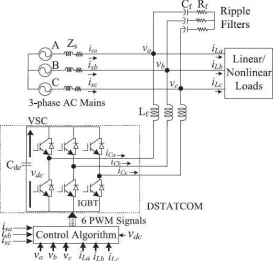
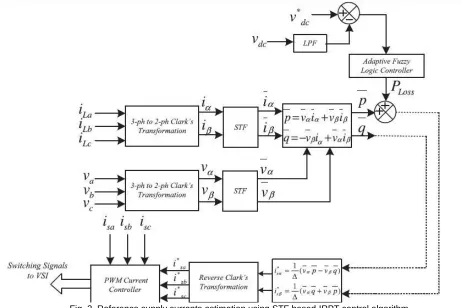
Fig. 1 shows a schematic diagram of a three phase VSC based DSTATCOM connected to a three phase distorted voltages of AC mains feeding nonlinear loads with a source impedance (Zs). For the control of DSTATCOM, sensed input variables are PCC (Point of Common Coupling) voltages of (va,vb,vc), supply currents (isa, isb, isb), load currents (iLa, iLb, iLc) and DC bus voltage (vdc) of VSC used in DSTATCOM. Effectiveness of the compensator depends upon the accuracy of extracted fundamental active power and reactive power components of load currents. Interfacing inductors (Lf) are connected at AC output of the VSC for reducing ripple in compensating currents. A three phase series connected capacitor (Cf) and a resistor (Rf) as a passive ripple filter is used at PCC parallel to the loads to suppress high frequency switching noise at PCC voltages caused due to switching of VSC. The DSTATCOM compensating currents (iCa, iCb, iCc) are injected to cancel the reactive power components and harmonics of the load currents. For an effective operation of DSTATCOM, it is necessary to maintain constant DC capacitor voltage of VSC of DSTATCOM. It is realized using an adaptive fuzzy logic based PI controller. The designed value of different auxiliary components of DSTATCOM such as interfacing AC inductors, DC bus voltage and value of DC bus capacitor for simulation and its implementation are given in Appendices A and B respectively. Fig. 2 shows a block diagram of STF (Self Tuned Filter) based IRPT (Instantaneous Reactive Power Theory) control algorithm for estimation of reference supply currents through the extraction of fundamental load active power and reactive powers.
1069
Fig. 2. Reference supply currents estimation using STF based IRPT control algorithm
2. Design of adaptive fuzzy logic controller for DC bus voltage control
PI (Proportional Integral) controllers are used in industries provide good performance once tuned when the parameters used are not of much variations. However, when one applies these PI controllers for nonlinear systems as conditions vary, further tuning is required. Henceforth, a supervisory control of gains of PI controller through the fuzzy logic is presented to improve the performance of the system during transients. Two inputs to the fuzzy logic controller are chosen as an error in DC bus voltage and the derivative of error in DC bus voltage respectively. The value of kp(m - 1) and ki(m -1) are initialized from various inferences and then the gains achieved from fuzzy
calculation are added to get the modified value as kp(m) and ki(m).
)
1
(
)
1
(
)
(
)
1
(
)
1
(
)
(
m
k
m
k
m
k
m
k
m
k
m
k
i i i p p p (1)Where
k
p and
k
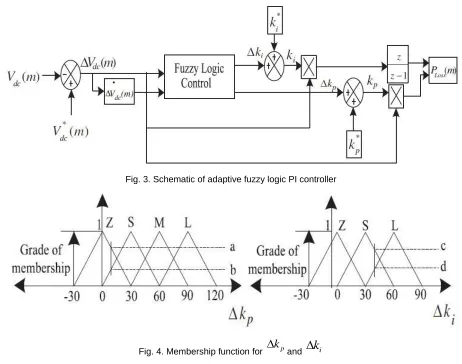
i are the incremental changes in PI controller gains obtained from the fuzzy logic controller. Aschematic of adaptive fuzzy logic controller is shown in Fig. 3 where the two inputs at mth sampling instant are
)
(
m
V
d c
and its derivative
V
dc(
m
)
. Its optimized output values are kp and ki. Fig. 4 shows the membership
functions.
According to the schematic, one can write the following expression for adaptive fuzzy logic controller as, (2)
(
)
(
1
)
(
)
)
1
(
)
(
m
P
m
k
V
m
V
m
k
V
m
P
Lo ss
Lo ss
p
d c
d c
i
d c(3)
Where kp is the proportional gain constant and ki is the integral gain and Vdc(m),
V
dc(
m
)
and
V
d c(
m
)
are sensed,reference and error signal of DC link voltage at mth sampling instant respectively. The output of the adaptive fuzzy logic controller accounts for the losses in DSTATCOM, and it is considered as the loss component of these supply currents. This component PLoss(m) given in Eq. (3) is added with the average real power for controlling the
)
(
)
(
)
(
m
V
*m
V
m
V
d c
d c
d c1070
DSTATCOM. In the proposed fuzzy logic controller, the input variables
V
d c(
m
)
and its derivative
V
dc(
m
)
are set as (negative large, negative medium, negative small, zero, positive large, positive medium, positive small) and respective abbreviations are (NL,NM, NS, Z, PL, PM, PS}. According to the rules IF-THEN form is used to obtain Dkp and Dki values. Here PS for DVdc(m) is defined as the condition when the DC bus voltage is deviating from the reference value with a small amount which is greater than the sensed value and NS is defined as the condition when the DC bus voltage of VSC of DSTATCOM is deviating from the reference value which is smaller than the sensed value and similarly other abbreviations can be defined.
The rule structure is formed by taking the following important points into consideration.
(1) If the error is small and the derivative of error is positive small and DC bus voltage is deviating from the sensed value then increase kp with a small amount.
(2) If the error is small and the derivative of error is positive small and DC bus voltage is approaching the sensed value then increase ki with a small amount to reduce steady state error.
(3) When the error and the derivative of error are positive medium or negative medium, in order to reduce the overshoot of system response, kp and ki should not be too big. The value of kp should be medium and ki should be small to ensure good system response.
Fig. 3. Schematic of adaptive fuzzy logic PI controller
Fig. 4. Membership function for
k
pand
k
i3. Simulation results
1071
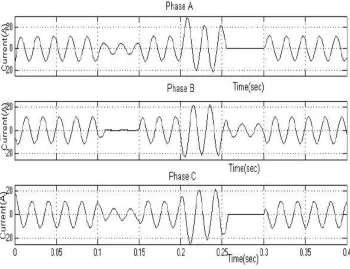
Fig. 5. Current waveform without DSTATCOM
1072
CONCLUSION
This paper has presented the power quality problems such as voltage sags, interruption, and voltage swell. The objective of work is to study the performance of DSTATCOM for mitigating voltage sag, interruption, and to improve the power quality in distribution network with non-linear load. The investigation is made on different condition for nonlinear load. In this work the investigation is composed of power system distribution system with and without DSTATCOM. Power factor comparison for source and load side. So it can be concluded that DSTATCOM effectively improves the power quality in distribution network.
ACKNOWLEDGEMENT
This work was significantly supported by the of Abadan Oil Refining Co.Iran. The authors are really indebted to the technical section manager of this Co. for his supportive character and patient.
REFERENCES
1- Pinaki M and Ganesh Kumar Venayagamoorthy. 2010. “An Adaptive Control Strategy For DSTATCOM Application in an Electric Ship power System”, IEEE Transaction on Power Electronics, vol25, no1,January 2010, pp95-104.
2- Sunil Kumar and Bhim Singh. 2010. “Modified Power Balance Theory for Control of DSTATCOM”, IEEE Press, 2010, pp1-8.
3- RS Bajpai and Rajesh Gupta. 2010. “Sliding Mode Control of Converter in Distributed Generation Using DSTATCOM”, IEEE Press 2010.
4- Juan Segundo-Ramirez, Aurelio Medina and ArindamGhosh. 2009. “Stability Analysis Based on Bifurcation Theory of the DSTATCOM Operating in Current control Mode”, IEEE Transaction on Power Delivery, vol24, no3, July 2009, pp.1670-1678.
5- Zhang Dongliang, Li Guoxin, Wang Chonglin and Tang jieJie. 2009. “Modeling and Simulation of DSTATCOM Based on Switch Function”, IEEE Press (ICIEA) 2009, pp2297-2301.
6- Longhui Wu, Fang Zhuo, Pengbo Zhang, Hongyu Li, Zhaoan Wang. 2007. Study on theinfluence of supply-voltage fluctuation on shunt active power filters. IEEETrans Power Delivery 2007;22(3).
7- Hong-Seok, Hyun-Gyu P, Kwanghee N. 1999. An instantaneous phase angle detectionalgorithm under unbalanced line voltage condition. In: Proc of IEEE 30thannual power electronics specialist conference, vol. 1; 1999. p. 533–7.
8- Singh BN, Chandra A, Al-Haddad K. 2000. DSP-based indirect current-controlledSTATCOM. Part I: Evaluation of current control techniques. IEE ProcElectrPower Appl 2000;147:107–12.
9- Ajami A, Hosseini HS. 2006. Application of a Fuzzy controller for transient stabilityenhancement of ac transmission system by STATCOM. In: Proc of internationaljoint conference SICE-ICASE; 2006. p. 6059–63.
10- Tzafestas S, Papanikolopoulos NP. 1990. Incremental fuzzy expert PID control. IEEETrans Industr Electron 1990;37(5):365–71.
11- Passino KM, Yurkovich S. 1998. Fuzzy control. Menlo-Park, California: Addison-Wesley Longman Inc.; 1998.