Volume 2007, Article ID 24863,15pages doi:10.1155/2007/24863
Research Article
Multiple Description Coding with Redundant Expansions and
Application to Image Communications
Ivana Radulovic and Pascal Frossard
LTS4, Swiss Federal Institute of Technology (EPFL), Signal Processing Institute, 1015 Lausanne, Switzerland
Received 15 August 2006; Revised 19 December 2006; Accepted 28 December 2006
Recommended by B´eatrice Pesquet-Popescu
Multiple description coding offers an elegant and competitive solution for data transmission over lossy packet-based networks, with a graceful degradation in quality as losses increase. In the same time, coding techniques based on redundant transforms give a very promising alternative for the generation of multiple descriptions, mainly due to redundancy inherently given by a transform, which offers intrinsic resiliency in case of loss. In this paper, we show how partitioning of a generic redundant dictionary can be used to obtain an arbitrary number of multiple complementary, yet correlated, descriptions. The most significant terms in the signal representation are drawn from the partitions that better approximate the signal, and split to different descriptions, while the less important ones are alternatively distributed between the descriptions. As compared to state-of-the-art solutions, such a strategy allows for a better central distortion since atoms in different descriptions are not identical; in the same time, it does not penalize the side distortions significantly since atoms from the same partition are likely to be highly correlated. The proposed scheme is applied to the multiple description coding of digital images, and simulation results show increased performances compared to state-of-the-art schemes, both in terms of distortions and robustness to loss rate variations.
Copyright © 2007 I. Radulovic and P. Frossard. This is an open access article distributed under the Creative Commons Attribution License, which permits unrestricted use, distribution, and reproduction in any medium, provided the original work is properly cited.
1. INTRODUCTION
Efficient transmission of information over erasure channels has attracted a lot of efforts over the years, from different research communities. Such a problem becomes especially challenging when the coding block length is limited, or when the channel is not perfectly known, like in most typical image communication problems. It becomes therefore nontrivial to efficiently allocate the proper amount of channel redun-dancy, in order to ensure the robustness to channel erasures and, in the same time, to avoid wasting resources by over-protecting the information. When information losses are al-most inevitable, and complexity or delay constraints limit the application of long channel codes, or retransmission, it be-comes primordial to design coding schemes where all avail-able bits can help the signal reconstruction.
An elegant solution to that kind of problems consists in describing the source information by several descriptions that can be used independently for the signal reconstruction. This is known as multiple description coding (MDC). The motivation behind multiple description coding is to encode the source information in such a way that high-quality
recon-struction is achieved if all the descriptions are available, and that the quality gracefully degrades in case of channel loss. As represented inFigure 1, the distortion depends on the num-ber of descriptions available for the reconstruction, and typi-cally decreases as the number of descriptions increases. Since multiple description coding offers several advantages, such as interesting graceful degradation in the presence of loss, and a certain robustness to uncertainty about channel characteris-tics, it has motivated the developments of numerous interest-ing codinterest-ing algorithms. Some of these approaches completely rely on the redundancy present in the source, while others try to introduce a controlled amount of redundancy such that the distortion after reconstruction gracefully degrades in the presence of loss. The main challenge remains to limit the in-crease of rate compared to a single description case, and to trade offside and central distortions depending on the chan-nel characteristics.
Source Encoder R1
R2
Channel 1
Channel 2
Side decoder
Central decoder Side decoder
D1≥D(R1)
D12≥D(R1+R2)
D2≥D(R2)
Figure1: MDC with two descriptions, encoded with ratesRi. The
distortion depends on the number of descriptions available at re-ceivers.
flexible overcomplete expansion methods, particularly for multidimensional signals like natural images dominated by geometric features, where classical orthogonal transforms have shown their limitations. Transforms that build a sparse expansion of the signal, over a redundant dictionary of func-tions, are able to offer increased energy compaction, and de-sign flexibility that often results in interesting adaptivity to signal classes. In addition, since the components of the signal are not orthogonal, they offer intrinsic resiliency to channel loss, which naturally makes redundant transforms interest-ing in multiple description codinterest-ing schemes.
In this paper, we build on [1] and we present a method for the generation of an arbitrary numberN≥2 of descrip-tions, by partitioning generic redundant dictionaries into co-herent blocks of atoms. During encoding, atoms of the same dictionary partition are distributed in different descriptions. Since they are chosen from blocks of correlated atoms, such an encoding strategy does not bring an important penalty in the side distortion. In the same time, as they are still diff er-ent, they all contribute to improvement of the reconstruc-tion quality, and therefore decrease the central distorreconstruc-tion as opposed to the addition of pure redundancy. The new en-coding scheme is then applied to an image communication problem, where it is shown to outperform classical MDC schemes based on unequal error protection of signal com-ponents. The main contributions of this paper reside in the design of a flexible multiple description scheme, able to gen-erate an arbitrary number of balanced descriptions, based on a generic dictionary. It additionally outperforms classical MDC schemes in terms of average distortion, and resilience to incorrect estimation of channel characteristics.
The paper is organized as follows.Section 2presents an overview of the most popular multiple description coding strategies, with an emphasis on the redundant transforms and their potentials. In Section 3, we show how to parti-tion redundant dicparti-tionaries, in order to generate multiple descriptions with a controlled correlation. Reconstruction of the signal with the available descriptions is discussed, and the influence of the distribution of atoms in the redundant dictionary is analyzed.Section 4presents the application of the proposed multiple description coding scheme to a typical image communication scenario, whileSection 5finally pro-vides simulation results that highlight the quality improve-ments compared to MDC schemes based on atom repetition, or unequal error protection. Finally,Section 6concludes the paper.
2. RELATED WORK
This section presents a brief overview of multiple descrip-tion coding techniques, with a particular emphasis on algo-rithms based on redundant transforms, and methods applied to multidimensional signals like images or video. The first and certainly simplest idea for the generation of multiple de-scriptions is based on information splitting [2], which basi-cally distributes the source information between the different descriptions. This technique is quite effective if redundancy is present in the source signal, as it is typically the case in im-age and video signals. For example, wavelet coefficients of an image could be split into polyphase components [3]. Simi-larly, video information can be split into sequences of odd and even frames, which has been applied for the generation of two descriptions of video [4]. However, information split-ting is generally limited to the generation of two descriptions due to drastic loss in coding efficiency when the number of descriptions increases.
Multiple descriptions can also be produced by extend-ing quantization techniques with proper index assignment methods. These techniques lead to a refined quantization of the source samples, when the number of description in-creases. Multiple description coding based on both scalar and vector quanitzations have been proposed [5,6]. The multi-ple description scalar quantization (MDSQ) concept has also been successfully applied to the coding of images (see, e.g., [7] or [8]) or image sequences [9]. However, multiple de-scription coding based on quantization techniques is mostly limited to two descriptions due to the rapid increase in com-plexity when the number of descriptions augments.
Transform coding has also been proposed to produce multiple descriptions [10], where it basically helps in reintro-ducing a controlled amount of redundancy to a source com-posed of samples with small correlation (as produced by typ-ical orthogonal transforms). This redundancy becomes even-tually beneficial to recover the information that has been lost due to channel erasures. The JPEG image coding standard can be modified to generate two descriptions by rotating the DCT coefficients [11,12], and reintroducing a nonnegligi-ble correlation between them. In practice however, the design of optimal correlating transforms is quite challenging. While solutions hold for a Gaussian source in the case of two de-scriptions, the generalization to a larger number of descrip-tions does not have yet any analytical solution.
of multiple descriptions is quite limited by the fact that not all subsets of received frame components enable a good signal reconstruction [13]. In [15], the authors compare four MDC schemes for video, based on redundant wavelet decomposi-tions, and they give an insight in the tradeoffbetween the side and central distortions for the two schemes that per-form best. Another related work is presented in [16], where a scheme for multiple description scalable video coding based on a motion-compensated redundant analysis was proposed. In [17,18], the authors propose to generate two descrip-tions of video sequences with a matching pursuit algorithm. In their implementation, the elements of a redundant dic-tionary (the so-called atoms) that best approximate a signal are repeated in both descriptions, while the remaining atoms are alternatively split between the descriptions. The redun-dancy between the descriptions is controlled with a number of shared atoms. The same principle, combined with mul-tiple description scalar quantization, can also be found in [19,20], where the authors used the orthogonalized version of matching pursuit. However, the problem with these solu-tions is that they do not exploit the redundancy inherently offered by the transform, but they rather introduce channel redundancy by repeating the most important information. If no loss occurs, such a repetition results in an obvious waste of resources. This is exactly what we propose to avoid in the multiple description coding algorithm that relies on parti-tioning of the redundant dictionary into coherent blocks of atoms. In this way, descriptions can be made similar to being robust to channel erasures, yet different enough to improve the signal reconstruction when the channel is good.
3. MULTIPLE DESCRIPTION CODING WITH REDUNDANT DICTIONARIES
3.1. Motivations
While most modern image compression algorithms, such as the JPEG standard family, have been designed following the classical coding paradigm based on orthogonal transform and scalar quantization, new representation methods have recently been proposed in order to improve the shortcom-ings inherent to classical algorithms. Even if important im-provements have been offered by different types of wavelet transforms, optimality of the approximation is only reached for specific cases. In particular, it has been shown that wavelet transforms are suboptimal for the approximation of multidi-mensional signals like natural images, which are dominated by edges and geometric features. Adaptive and nonlinear ap-proximations over redundant dictionaries of functions have emerged as an interesting alternative for image coding, and have been proven to be highly effective, especially at low bit rate [21].
In addition to increased design flexibility, and improved energy compaction properties, redundant dictionaries also offer some intrinsic resiliency to loss of information, due to channel erasures, for example. Since the components of the signal expansion are not orthogonal, efficient reconstruction strategies can be derived in order to estimate lost elements, and to improve the quality of the signal reconstruction. That
quality can yet be dramatically improved by a careful signal encoding strategy, where information has to be arranged in such a way that the simultaneous loss of important corre-lated components becomes unlike. This naturally leads to the concept of multiple description coding that exactly pursues this objective. Instead of introducing redundancy in the sig-nal expansion to fight against channel loss, one can exploit the redundancy of the dictionary and partition it, such that multiple complementary yet correlated descriptions can be built by proper distribution of the signal components.
The inherent redundancy present in the transform step and the good approximation properties offered by overcom-plete expansions obviously motivate the use of redundant dictionaries in the design of joint source and channel cod-ing strategies. Multiple description image codcod-ing stands as a typical application where the benefits of properly designed redundant dictionary are particularly advantageous. While previous works mostly use complex frame construction, or unequal protection based on forward error correction mech-anisms [13,14], we propose in this paper to build multiple descriptions with a dictionary partitioning algorithm, and a greedy signal approximation based on a modified matching pursuit algorithm.
3.2. Definitions
Before going more deeper into the construction of descrip-tions, we now fix the notations and definitions that are used in the rest of this paper. We consider a scenario withN de-scriptions that are denoted by Di, with 1 ≤ i ≤ N. Each description containsMsignal components, and descriptions are balanced in terms of size and importance. The distortion induced by the signal reconstruction with only one descrip-tion is called thesidedistortion, while the distortion after re-construction from several descriptions is calledpartial dis-tortion. Finally, if all the descriptions are used for the signal reconstruction, the distortion is called thecentraldistortion. In the case where all descriptions have approximately equal size, and all the side distortions are similar, we say that the descriptions arebalanced.
We now briefly recall a few definitions that allow to char-acterize redundant dictionaries. First, we consider a set of signalssthat lay in a reald-dimensional vector spaceRd
en-dowed with a real-valued inner product. We further assume that any of these signals is to be represented with a finite col-lection of unitary norm elementary signals called theatoms. Denote byD = {ai}|i=D1|such a collection of|D|atoms that
we call adictionary. Redundant dictionaries are such that the number of atoms in the dictionary is usually much bigger than the dimensionality of the signal, that is,|D| d. There is no particular constraint regarding the dictionary, except that it should span the entire signal space.
Several metrics have been proposed to characterize the redundant dictionaryD. For example, thestructural redun-dancyβreports the distribution of atoms in the dictionary, and is written as
β= inf
a,a=1
sup
p∈D
Basically, it measures the cosine of maximum possible angles between any direction of the signals, and its closest direction among the atoms inD. The structural redundancyβ obvi-ously depends on the dictionary construction and controls the approximation rate for overcomplete signal expansions over the dictionaryD.
Another metric, which is often simpler to compute, re-flects the worst-case correlation between any two atoms in the dictionary. It is defined as thecoherenceof the dictionary, and is written as
μ= max
{ap,aq}∈D
ap,aq. (2)
Obviously, orthogonal basis has a coherence μ = 0, while highly redundant dictionaries have coherence close to 1. Since the coherence only reflects an extreme property of the dictionary, the cumulative coherence μ1(m) has been pro-posed to measure the maximum total correlation between a fixed atom withmdistinct atoms. It is written as
μ1(m)=max |Λ|≤mmaxap∈Λ
λ∈Λ
ap,aλ, (3)
whereΛ ⊂ D. In general, the cumulative coherence gives more information about the dictionary, but it is more dif-ficult to compute. In the worst case, we can bound it as
μ1(m)≤mμ.
Finally, it is often useful to partition redundant dictio-naries into groups of atoms, for tree-based search algorithms [22], for example, or for controlling the construction of mul-tiple descriptions, as detailed later. In this case, the dictionary
D is partitioned into blocks or subdictionaries {Di} such
thatiDi = D andDi∩Dj = ∅fori /= j. It then
be-comes interesting to characterize the distance between these subdictionaries. The block coherenceμBis therefore defined by
μB=max
i /=j ap∈Dmaxi,aq∈Dj
ap,aq. (4)
A special class of redundant dictionaries represents the dic-tionaries that can be partitioned into independent groups of correlated atoms, which are calledblock-coherent dictionar-ies.
3.3. MDC with partitioned dictionaries
Multiple description coding is an efficient strategy to fight against channel erasures, and redundant dictionaries of func-tions certainly offer interesting properties for the construc-tion of correlated descripconstruc-tions. Descripconstruc-tions, which typically represent sets of signal components, should be built in such a way that they are complementary in providing a good sig-nal approximation, and yet correlated to provide robustness to channel erasures. We propose to achieve this construction by partitioning the dictionary into blocks of similar atoms. Each atom of a block is then put in a different description, which ensures that descriptions are correlated. In the same time, since atoms in a block are different, they all contribute in improving the approximation of the signal.
In more details, recall that our objective is to generate an arbitrary numberNof descriptions of the signals, which are balanced in size and distortion. Each description contains a subset of atoms drawn from the dictionary D, along with their respective coefficients that represent the contribution of the atom in the signal approximation. We first partition the dictionary into clusters ofNsimilar atoms. Each of these clusters is represented by a particular function that we call a molecule. A molecule is representative of the characteristics of the atoms within a cluster, and can be computed, for ex-ample, as a weighted sum of theNatoms of the cluster.
Then, instead of searching for the atoms that best approx-imate the signals, the signal expansion is performed at the level of molecules. When the best representative molecules are identified, the atoms that compose the corresponding cluster in the dictionary are distributed between the diff er-ent descriptions. This strategy first does not penalize consid-erably the side distortion, resulting from the reconstruction of the signal with one description only, since the atoms in dictionary clusters are likely to be very correlated. Second, proper reconstruction strategies are able to exploit the infor-mation brought by the different atoms of a cluster, in order to increase the quality of the signal approximation. Finally, it is interesting to note that a search performed on the molecules typically decreases the computational complexity of the sig-nal expansion (e.g., a typical speedup factor of log2Ncan be achieved with respect to a full search on the dictionary).
More formally, suppose that a set ofMmolecules{mj}
are selected as the best representative features of the signals. The multiple description coding scheme allocates the child
aijof moleculemjto the descriptioni, wherei=1, 2,. . .,N.
The atoms that compose the descriptionican subsequently be represented by a generating matrix Φi, withΦi = {aij}
and j = 1, 2,. . .,M. In addition to atoms, the descriptions also carry coefficients that reflect the relative contribution of each atom in the signal reconstruction. Coefficients are sim-ply given by the projection of the signalsonto the generating matrixΦias
ΦisT=Ci, (5)
whereCi= s,aigives the contribution of each atom inΦi. Ci’s are continuous-valued vectors, which obviously need to be quantized before coding and transmission. We assume in this paper that they are uniformly quantized intoCi, with the same scalar quantizer and the same quantization step sizeΔ for all the coefficients. Even if that quantization strategy may not be optimal, it consists on a very common model used for the quantization of coefficients obtained by frame expan-sions (e.g., [13,23]), and we use it also in this paper, for the sake of simplicity. We additionally assume that all the coeffi -cients are quantized to the next lower quantization level, and thatΔis small enough. The quantization noise then becomes independent of the signal, and we can write
Ci=Ci+η, (6)
whereηdenotes the quantization noise. The quantized co-efficientsCi’s together with indices of atoms fromΦifinally
3.4. Signal reconstruction
The signal is eventually reconstructed with the descriptions that are available at the decoder, after possible erasures on a lossy channel. The redundant signal expansion proposed in the previous section obviously does not conserve the en-ergy of the signal, which cannot be reconstructed by a simple linear combination of vectorsCi’s and the atoms from the generating matricesΦi, obtained from the available
descrip-tions. We therefore need to design a decoding process that removes the redundancy that has been introduced in the en-coding stage, and we distinguish between two cases, based on the number of available descriptions.
If only one descriptioniis available, the signal is simply reconstructed by determining the best approximation ri of the signalsin a least-mean-square sense. It is given by
ri=Φ†
i ·Ci T
=Φ†
i ·
Ci+η T, (7)
whereTand†, respectively, denote the transpose and pseu-doinverse operations. Such a reconstruction induces an MSE distortionDithat can be expressed as
Di=s−ri 2 S = s− Φ† i ·
Ci+η T2
S . (8)
HereSdenotes the signal size. The distortion is composed of the distortionDiadue to the approximation ofsoverΦi, and
the distortion due to quantizationDqi. Recall that these two
terms can be separated due to the high-rate approximation assumption that leads to the independency of the signal and the quantization noise. The source distortion can be further expressed as
Dia=
s2−trssTΦT i
ΦiΦTi
−1 Φi S
= s2−tr
CT i
ΦiΦTi
−1 Ci
S ,
(9)
whereScorresponds to the signal size and tr(·) denotes the matrix trace. In order to bound the distortionDia, we
con-sider the worst-case scenario where the correlation between any atoms inΦi is equal toμB, which is the maximal
pos-sible correlation between any two partitions in the dictio-naryD. In this case, (ΦiΦTi)−1is a matrix having elements
(1 +μB(M−2))/(1−μB)(1 +μB(M−1)) on the main di-agonal, and−μB/(1−μB)(1 +μB(M−1)) elsewhere. There-fore, we have
Dai ≤ s2
S −
iC2i
S1−μB +
μB iCi
2
S1−μ2B(M−1) +μB(M−2)
≤s2
S −
iCi2 S1 +μB(M−1) .
(10)
Similarly, the quantization distortion can be written as
Dqi = Δ2
3Str
ΦiΦTi
−1
. (11)
An upper bound on the quantization distortion can be de-rived by assuming the worst-case scenario, where the corre-lation between any pair of atoms is given byμB:
Dqi ≤ MΔ2
3S
1 +μB(M−2)
1 +μB(M−1) 1−μB
≤MΔ2
3S
1 1−μB.
(12)
We can note that the application of scalar quantization on correlated components induces a distortion that is inversely proportional to 1−μB. Note that the quantization error could be reduced by orthogonalization ofΦiat encoder, or by
us-ing vector quantization, for example. The design of an opti-mal quantization strategy for redundant signal expansions is however beyond the scope of the present paper.
Finally, ifk ≥ 2 descriptions are available for the signal reconstruction, we can proceed in a similar way. Denote byK
the set of receivedkdescriptions, and byrKandDKthe cor-responding reconstruction and distortion, respectively. The best signal approximation in a least-mean-squares senserKis obtained by grouping the generating matrices and coefficient vectors of the available descriptionsi, with 1≤i≤k. Denote by ΦK the set ofk received matrices and byCK the
corre-sponding set of received coefficients. The reconstruction can therefore be expressed as
rK=Φ†
K·CK T
. (13)
Since the matrix ΦK has dimensions kM ×M,
comput-ing its pseudoinverse is quite involvcomput-ing. However, the com-putational complexity can be drastically reduced using the fact that Φ†K = ΦTK(ΦKΦTK)†. Namely, instead of
comput-ing a pseudoinverse ofΦK, we simply compute the inverse of ΦKΦTKthat is a symmetricM×Mmatrix.
The MSE distortion after signal reconstructionDKagain contains two components, the distortion due to the signal approximation DKa, and the distortion due to quantization DqK. The distortion due to the signal approximation can be
written as
DaK=
s2−trssTΦT K
ΦKΦTK
−1 ΦK
S . (14)
Similarly to the single-description case, it can be bounded as
DKa ≤ s2
S −
kM i=1Ci2
S1 +μ(kM−1) , (15)
where we consider the worst-case scenario with any two atoms having a correlationμthat is the maximal correlation between any pair of atoms in the dictionaryD. The quanti-zation distortion is given by
DqK=Δ 2
3Str
ΦKΦTK
−1
. (16)
Under similar assumptions, it can be bounded by
DKq ≤ MΔ2
3S
1 +μ(M−2)
1 +μ(M−1) (1−μ)≤
kMΔ2
3S
1
Clustered redundant dictionary Atoms molecules
Cluster 1 . . .
Clusterk Original image
+
− −
Cluster (molecule)
selection
×Ci
Atom
splitter i < L Yes
No Reconstruction from molecules −
+
− +− −
Atom selection
+ alternation
N N
Quantization + coding
N descriptions
×Ci i≤M−L
Yes No
Figure2: Block diagram of the multiple description image coding algorithm.
We can note that the distortion at reconstruction is clearly linked to the properties of the dictionary, as expected. In particular, partial and central distortions are influenced by the coherence within the dictionary, while the side distor-tion depends on the block coherence. The design of an op-timal dictionary has therefore to trade offcorrelation within dictionary partition, and correlation between dictionary par-titions. The compromise between side and central distor-tions is typical in multiple description coding, and the best working point depends on the quality of the communication channel. In the next section, we present an application of the above scheme to a typical image communication scenario.
4. MULTIPLE DESCRIPTION IMAGE CODING
4.1. Overview
This section proposes the application of multiple descrip-tion coding with redundant dicdescrip-tionaries, to a typical image communication problem. The overall description of the al-gorithm is given in Figure 2. The redundant dictionary is partitioned into blocks of similar atoms, and each partition is represented by the molecules. The image is first decomposed into a series ofLmolecules, which are iteratively selected with a modified matching pursuit algorithm. The children atoms are distributed into the different descriptions. Each descrip-tion is later refined by the addidescrip-tion ofM−Latoms. The resid-ual signal, after subtraction of the approximation obtained with the molecules, is decomposed with a typical matching pursuit algorithm. The selected atoms are distributed in a round-robin fashion, to the different descriptions. Finally, coefficients are computed by projection of the signal on the set of atoms that compose each description. Eventually, they are uniformly quantized and entropy-coded along with the atom indexes, to form the final descriptions. The next sub-sections describe in more details the key parts of the multiple description image coding algorithm.
4.2. MDC with modified matching pursuit
Even if redundant dictionaries present interesting advantages for the approximation of multidimensional signals like im-ages, searching for the sparsest (shortest) signal representa-tion in a redundant dicrepresenta-tionary of funcrepresenta-tions is in general an NP-hard problem [24]. Fortunately, it is usually sufficient to find a nearly optimal solution that would reduce the search complexity in a great manner, and very simple algorithms like matching pursuit [25] have been shown to provide very good approximation performance.
Matching pursuit is a simple greedy algorithm that itera-tively decomposes any functionsin the Hilbert spaceHwith atoms from a redundant dictionary. Let all the atoms, de-noted byai, have a unit normai2 =1 and letD = {ai}, i=1, 2,. . .,|D|. By settingR0=s, the signal is first decom-posed as
R0=a0,R0a0+R1, (18)
wherea0is chosen so as to maximize the correlation withR0:
a0=arg max
D
ai,R0, (19)
andR1is the residual signal after the first iteration. The algo-rithm proceeds iteratively, by applying the same procedure to the residual signal. It can be shown that the energy of the residual afterMiterations satisfies
RM2
= s2− M−1
i=0
Ri,ai2
. (20)
The approximation performance of matching pursuit is tightly linked to the structure of a dictionary, and it has been demonstrated that the norm of the residual afterMiterations can be bounded by [26]
RM2
≤1−α2β2 RM−12≤
1−α2β2 Ms2,
where β is the structural redundancy defined in (1) and
α ∈ (0, 1] is an optimality factor. This factor depends on the algorithm that searches for the best atom in the dictio-nary, at each iteration (e.g.,α=1 for a full-search strategy). Matching pursuit represents a simple, flexible, yet efficient algorithm for signal expansion over redundant dictionaries. We therefore choose to use a modified matching pursuit al-gorithm to decompose the image in a series of molecules.
We propose to generateN descriptions by distributing similar, but not identical, atoms in different descriptions. As explained in the previous section, this can be achieved by computing the representation of the signal on the level of molecules, instead of the atoms themselves. TheLmolecules
mi, i = 1,. . .,L, that best approximate the signalsare se-lected by running matching pursuit on the set of molecules, which yields
s= L−1
j=0
Rj,mjmj+RL. (22)
The multiple descriptions are then built by distributing each atom from the blocks corresponding to these molecules, into different descriptions. Formally, if a moleculemjis chosen in the jth stage of MP, we attribute its childaijto descriptioni,
withi=1, 2,. . .,N.
Redundant expansions offer the possibility of capturing most of the signal energy in a few atoms. That property is typically observed also for matching pursuit expansions, where the first selected atoms are the most important ones for the signal approximation (see (21)). In the same time, atoms that are selected after in later iterations only bring a small contribution to the signal reconstruction. We therefore propose to adopt a two-stage algorithm, where the first iter-ations are run on molecules, which capture most of the im-age energy. It offers us the possibility to put similar, and high energy atoms in the different descriptions. However, it may be wasteful to code with redundancy the molecules that only bring a small contribution. Therefore, the second stage of the encoding runs a classical matching pursuit algorithm on the atoms themselves, and distribute them in the different de-scriptions without any added redundancy. The most efficient joint source and channel coding schemes proceed by unequal error protection, and we basically pursue the same idea here. After theLmost significant molecules have been identi-fied, a residual signal is built by subtracting the reconstructed signal with all the selected molecules, from the original im-age. A matching pursuit expansion of the residual signal is then performed on the level of atoms. The atoms are simply distributed alternatively between descriptions, to eventually generate descriptions with a total ofM atoms. Upon com-pleting both stages, theM atoms in descriptioniare gath-ered in a generating matrixΦi= {aij}, with j =1, 2,. . .,M,
where the first Lrows of Φi are children of theL selected
molecules, and the remaining M −L rows correspond to atoms that are alternatively distributed between descriptions. To generate descriptioni, the signal is finally projected onto
Φi,Ci=ΦisT.Cis are uniformly quantized intoCi. Together
with indices of atoms inΦi,Ciare attributed to descriptioni.
Note finally that the choice of the number of molecules
Ldepends on the transmission channel properties, and di-rectly trades offthe side and central distortions. We will see below how one can choose optimalLbased on losses in the network.
4.3. Dictionary
A great amount of research has focused on the construc-tion of “good” dicconstruc-tionaries. Some examples include spikes and sinusoids [27], wavelet packets [28], frames [29], or Ga-bor atoms [25], for example. We propose to use here an overcomplete dictionary composed of edge-like functions, as proposed in [21]. The structured dictionary is built on two mother functions. First, an isotropic Gaussian 2D function is responsible for efficient representation of the low-frequency characteristics of an image:
g1(x,y)=√1 πe
−(x2+y2)
. (23)
The second mother function is an anisotropic function that consists of Gaussian along one direction and a second deriva-tive of a Gaussian along another direction:
g2(x,y)=√2
3π
4x2−2 e−(x2+y2)
. (24)
Such a shape is chosen in order to capture the contours that represent most of the content of natural images. Geomet-ric transforms (translation, rotation, and scaling) are then applied to the mother functions to build a structured re-dundant dictionary. We allow the translation parameters to be any integers smaller than the image size. The scaling is isotropic and varies from 1/32 to 1/4 of the image size on a logarithmic scale with a resolution of one third of octave. As for the second function, we use the same translation parame-ters and the scaling parameparame-ters are uniformly distributed on a logarithmic scale from one to 1/8 of the image size, with a resolution of one third of octave. We also allow the rotation parameter to vary in increments ofπ/18.
The dictionary is finally partitioned into blocks of similar atoms, represented by molecules. In general, such partitions can be obtained by either atop-downor abottom-up cluster-ing approach. The former method tries to segment the initial dictionary into a number of subdictionaries, each of them consisting of atoms that satisfy some similarity constraints. Alternatively, the bottom-up approach groups the atoms as long as similarity constraints are satisfied. Since the bottom-up approach becomes rapidly complex when each cluster has to contain a fixed numberNof atoms, we propose to use a top-down approach in this paper.
molecule can be computed as a simple weighted sum of the atoms it spans, taking into account the distance from the cor-responding atoms. Different metrics can be used for the dis-tance measure; one of the most popular ones isd(ai,aj) =
1− |ai,aj|2. If the atoms are strongly correlated, their
dis-tance is close to 0, while in the case of orthogonal atoms this distance is 1.
4.4. Distortion model
We have previously derived the upper bounds on both recon-struction and quantization errors based on some dictionary properties as well as number of descriptions and number of atoms per description. However, since these bounds are com-puted in the worst-case scenario in terms of atom correlation, they are generally too loose in practical applications like im-age coding.
In order to define tighter bounds for the encoding scheme proposed above, we bound its behavior by the perfor-mance of a classical matching pursuit algorithm. Indeed, the signal reconstruction (13) leads to the best approximation in a least-squares sense, which is not necessarily the case in classical reconstructions with simple linear combinations of atoms selected by matching pursuit. Therefore, we can always bound the distortion due to our least-mean-squares approx-imation, by the matching pursuit distortion given in (21).
Finally, we can model the distortion due to signal approx-imation as the sum of two terms, corresponding to the two coding steps of the proposed scheme. The first one refers the distortion due to the approximation withLmolecules, while the second one describes the distortion due to the refinement stage ofM−Latoms. We can approximate it in the following manner:
Da
K=c+a·bL+cK+aK·b k(M-L)
K . (25)
The shape ofDaK fits the shape given by (21), up to an
additive constant. The distortion decay is captured by terms
a,b,c,aK,bK,cK, that are chosen to fit best the real distortion values. Similarly, the quantization distortion is modelled as
DqK=k·dK·Δ2. (26)
This model keeps the shape of derived upper bounds in (12) and (17), up to multiplicative constants that are again chosen to fit the real quantization distortion values.
This distortion model can now be used to find the opti-mal number of moleculesLand the optimal number of de-scriptions for a given communication channel, such that the average distortion is minimized. The average distortionDav
is given as
Dav=
N
|K|=0
N |K|
pN−|K|(1−p)|K|DK, (27)
where p is the channel loss probability andDø = s2/S.
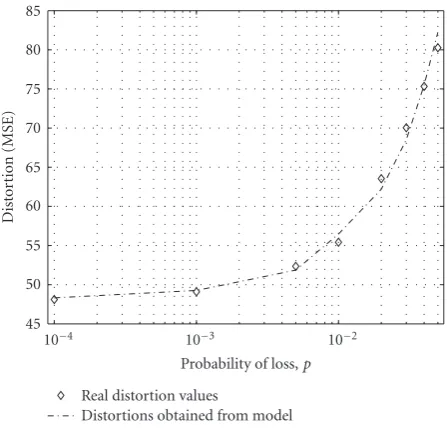
Figure 3finally illustrates the model accuracy. It shows the minimal achievable average distortion for three descriptions for loss probabilities ofp∈[10−4, 0.05]. We can see that the
model provides a very good approximation of the actual dis-tortion values.
85 80 75 70 65 60 55 50 45
D
ist
or
ti
on
(MSE)
10−4 10−3 10−2
Probability of loss,p Real distortion values
Distortions obtained from model
Figure3: Minimal achievable average distortions for the case of three descriptions: real values versus model.
5. SIMULATION RESULTS
5.1. Settings
This section analyzes the performance of the proposed cod-ing scheme, in typical image communication scenario. We assume that each description corresponds to one packet, and therefore is either received error-free or completely lost. We show the results for Lena and Peppers images, both of size 128×128, obtained by averaging over 1000 simulations of random packet losses. The distortion of the reconstructed signal is the mean square error (MSE). Finally, we do not implement any concealment or postfiltering strategy at the decoder.
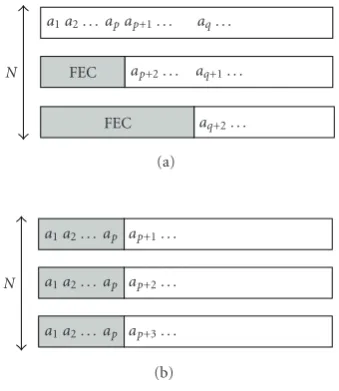
We first show the behavior of the proposed scheme as a function of number of descriptions and network losses. We then analyze in more details the performance of our scheme in the case where the number of descriptions is limited to 2 and, respectively, 3 descriptions. We compare these perfor-mances to two MDC schemes that implement simple atom repetition [17], and unequal error protection (UEP) [31]. These two schemes are illustrated inFigure 4. The atom shar-ing scheme repeats a certain number of the most impor-tant atoms ai in all the descriptions, while the remaining atoms are alternatively split between descriptions. On the other side, FEC scheme applies a systematic code, column-wise across the N-packet block. Here, atoms are protected according to their importance.
a1a2. . . apap+1. . . aq. . .
FEC ap+2. . . aq+1. . .
FEC aq+2. . .
N
(a)
a1a2. . . ap ap+1. . .
a1a2. . . ap ap+2. . .
a1a2. . . ap ap+3. . .
N
(b)
Figure4: (a) FEC scheme and (b) atom sharing scheme.
scheme is less sensitive to bad estimation of the loss proba-bility, which clearly penalizes optimized unequal error pro-tection schemes.
5.2. Optimal number of descriptions
In the first experiment, we observe the behavior of the pro-posed MDC scheme, when the overall bit rate is fixed and the number of descriptions varies. We fix the total number of atoms to 600 and vary the number of descriptions between 2 and 4, as well as the number of atoms per description. We use 11 bits to code the atom indexes, and all the coefficients are quantized uniformly with the step size 1, which results in the total rate of 1.35 kB. We choose the optimal number of moleculesLin each of the cases, in such a way that the aver-age distortion is minimized. The minimal achievable averaver-age distortions are computed as a function of packet loss proba-bilityp, wherep∈[10−4, 0.05]. The results are illustrated in
Figure 5.
When the losses are very low (i.e., p < 10−3), a small
number of descriptions are generally the best choice, as they allow for efficient redundancy and good approximation per-formance since the number of closely related atoms is small. As the losses increase, the optimal number of descriptions also augments, as expected. However, the significant diff er-ence in performance can only be observed when the loss rate exceeds 1%. At a loss rate of 5%, four descriptions improve the performance of 1.7 dB, respectively, 0.2 dB, with respect to the cases with 2 and 3 descriptions only. Note that sim-ilar observations have already been reported in other MDC schemes (e.g., [32,33]). It confirms that the case of two de-scriptions, which is the most frequently studied, is not neces-sarily optimal, and that the ability to generate more descrip-tions is certainly beneficial at high loss rates. Finally, we can conjecture that in realistic cases, building more than four de-scriptions only brings negligible improvements, and this is the limit we will use in our simulations.
31.5 31 30.5 30 29.5 29 28.5 28 27.5
PSNR
(dB)
10−4 10−3 10−2
Probability of loss,p Two descriptions
Three descriptions Four descriptions
Figure5: Comparison of minimal achievable distortions for two, three, and four descriptions, when the total rate is fixed (Lena im-age).
5.3. Two descriptions
We now compare the performance of our scheme forN=2 descriptions with other MDC strategies (whenN = 2, the UEP scheme is equivalent to the atom sharing scheme). We first observe the evolution of the minimal achievable aver-age distortion with respect to the packet loss probability p. Similar to the previous experiments, we build descriptions withM =300 atoms, of 18 bits each (i.e., the total bit rate is again around 1.35 kB). The number of shared atoms in the atom sharing scheme, and the number of moleculesLin the proposed scheme are optimized. The results are shown in Figure 6. We can see that our scheme provides improvement of up to 0.6 dB compared to the atom sharing (and UEP) scheme. This is due to the fact that our scheme takes advan-tage from all the received atoms, while the existing schemes cannot use the redundant atoms, which are a waste of re-sources when no loss occurs.
Next, we compare both schemes optimized for a given loss ratio p, but when the actual channel characteristics are somewhat different (as it may happen in practical scenar-ios when channel status changes).Figure 7shows the perfor-mance of both schemes optimized for p = 10−3, while the
actual loss probability covers the range [10−4, 0.1]. We can
see that our scheme always gives better results and the im-provement is up to 1.4 dB. While the atom sharing scheme seems to work well in the very narrow range around the loss, it is optimized for our scheme tends to be more robust in much wider range of losses, and thus more resilient to bad estimation of the channel characteristics.
31.5 31 30.5 30 29.5 29 28.5 28 27.5 27
PSNR
(dB)
10−4 10−3 10−2
Probability of loss,p Our scheme
Atom sharing scheme
Figure6: PSNR versus loss probability for the proposed scheme, and the atom sharing scheme, optimized for two description and a total rate of 1.35 kB (Lena image).
32 31 30 29 28 27 26 25 24 23 22
PSNR
(dB)
10−4 10−3 10−2 10−1
Probability of loss,p Our scheme
Atom sharing scheme
Figure 7: PSNR versus actual loss probability, for the proposed scheme, and the atom sharing scheme, optimized for two descrip-tions and a total rate of 1.35 kB, and a loss probability of 10−3(Lena image).
images are given inFigure 8, for our scheme, and the atom sharing scheme. We can observe that the side reconstruction is better for the proposed MDC scheme (i.e., 3.5 dB ment), while the central reconstruction gives an improve-ment of 0.4 dB. The difference in side distortion is mostly due to the fact that the number of repeated atoms is very small in the atoms sharing scheme optimized for low loss probability (p = 10−3). Better central distortion is expected, since the
important atoms are not repeated in our scheme, and
cor-PSNR=22.1 dB PSNR=31.2 dB
PSNR=18.6 dB PSNR=30.8 dB
Figure8: Reconstructed Lena images, as a function of a number of received descriptions, from 1 description on the left column, to 2 descriptions on the right column. (Top row: our scheme, Bottom row: atom sharing scheme.)
related, yet different atoms bring more information for the reconstruction.
5.4. Three descriptions
We now consider the case ofN = 3 descriptions, and pro-pose a similar analysis as above. The minimal average distor-tion as a funcdistor-tion of p for the proposed scheme, an MDC scheme based on atom sharing, and an unequal error pro-tection scheme is given in Figures 9 and 10 for the Lena and Peppers images, respectively. We see that our scheme outperforms the existing schemes in a wide range of losses, especially at low packet loss ratios, where the advantage in the central distortion becomes predominant (i.e., improve-ment of about 0.6 dB in the case of Lena). As the losses ex-ceed 2%, the FEC scheme tends to slightly outperform our scheme, and at p = 5% the improvement reaches almost 0.3 to 0.5 dB. This can be explained by the fact that the FEC scheme protects different atoms according to their impor-tance, and therefore is more flexible to protect the strongest atoms, which is beneficial at high loss rate. It is also inter-esting to notice that the FEC and atom sharing scheme per-form similarly at low losses, while there is an increasing gain in favor of FEC scheme as the loss ratio increased, since re-dundancy is allocated more efficiently with an unequal error protection strategy.
31.5
31
30.5
30
29.5
29
PSNR
(dB)
10−4 10−3 10−2
Probability of loss,p Our scheme
Atom sharing scheme FEC scheme
Figure9: PSNR versus loss probability, for the proposed scheme, the UEP FEC scheme, and the atom sharing scheme, optimized for three descriptions and a total rate of 1.35 kB (Lena image).
28
27.5
27
26.5
26
25.5
PSNR
(dB)
10−4 10−3 10−2
Probability of loss,p Our scheme
Atom sharing scheme FEC scheme
Figure10: PSNR versus loss probability, for the proposed scheme, the UEP FEC scheme, and the atom sharing scheme, optimized for three descriptions and a total rate of 1.35 kB (Peppers image).
probability of p = 10−3, respectively, p = 5·10−3, and we
compute the average distortion when the actual loss proba-bility varies. It can be seen again that the FEC scheme works well in a very narrow range of losses. Namely, when the loss probability increases, the FEC scheme becomes very vulner-able, giving the sharpest decrease in quality out of all com-pared schemes. It is also interesting to note that even if the
32 31 30 29 28 27 26 25 24 23 22
PSNR
(dB)
10−4 10−3 10−2 10−1
Probability of loss,p Our scheme
FEC scheme Atom sharing scheme
Figure11: PSNR versus actual loss probability, for the proposed scheme, the UEP FEC scheme, and the atom sharing scheme, opti-mized for three descriptions and a total rate of 1.35 kB, and a loss probability of 10−3(Lena image).
28 27.5 27 26.5 26 25.5 25 24.5 24 23.5 23
PSNR
(dB)
10−4 10−3 10−2 10−1
Probability of loss,p Our scheme
Atom sharing scheme FEC scheme
Figure12: PSNR versus actual loss probability, for the proposed scheme, the UEP FEC scheme, and the atom sharing scheme, opti-mized for three descriptions and a total rate of 1.35 kB, and a loss probability of 5·10−3(Peppers image).
PSNR=14.3 dB PSNR=21.8 dB PSNR=31.3 dB (a) Proposed scheme.
PSNR=18.2 dB PSNR=20.7 dB PSNR=30.7 dB
(b) Atom sharing scheme.
PSNR=11 dB PSNR=19.5 dB PSNR=30.8 dB
(c) FEC scheme.
Figure13: Reconstructed Lena images, as a function of a number of received descriptions, from 1 description on the left, to 3 descriptions on the right column.
Finally, we represent the decoded images, reconstructed with different numbers of descriptions, for the three schemes that have been optimized for loss probabilitiesp=10−3and p = 5·10−3, respectively. Figures13and14illustrate this
comparison for two images, respectively, Lena and Peppers. We observe that since the UEP-based FEC is clearly opti-mized for low loss probability, the side and even partial dis-tortions are generally quite unimportant. On the other side, the proposed scheme and the atom sharing scheme are more conservative in allocation of redundancy, and therefore more resilient to changes in the actual loss probability. Finally, we
can observe that our scheme, as expected, always performs best when all descriptions are available, since it does not send pure redundancy for important components, but rather cor-related information that still improve the central distortion.
5.5. Improved FEC reconstruction
PSNR=15.1 dB PSNR=21.4 dB PSNR=27.6 dB (a) Proposed scheme.
PSNR=18.1 dB PSNR=20.4 dB PSNR=27.3 dB
(b) Atom sharing scheme.
PSNR=11.6 dB PSNR=22.1 dB PSNR=27.5 dB
(c) FEC scheme.
Figure14: Reconstructed Peppers images, as a function of a number of received descriptions, from 1 description on the left, to 3 descriptions on the right column.
case of MDC based on UEP protection, by using a simi-lar projection method as in the MDC scheme proposed in this paper. This projection method will then optimize, in a least-mean-square sense, the approximation that can be con-structed from the available atoms. For the sake of complete-ness, we provide here a comparison between the proposed MDC scheme and an FEC scheme whose reconstruction is improved by the projection method. We keep the same sim-ulations settings as before, with a total rate equivalent to 600 atoms, and we vary the number of descriptions and number of FEC packets in order to reach the optimal working point for different channel loss probabilities. Results are depicted inFigure 15for the Lena image. While the reconstruction is
slightly improved in the FEC scheme, the performance does not change significantly. We can see that our scheme still pro-vides better results in the range of losses [10−4, 10−2], mainly
due to an improved central distortion. As the losses increase, the FEC scheme will tend to perform better, since it provides a high protection to the most important components, and tends to provide a slightly better side distortion, when opti-mized for high loss rates.
6. CONCLUSIONS
31.5
31
30.5
30
29.5
29
PSNR
(dB)
10−4 10−3 10−2
Probability of loss,p Our optimized scheme
Improved FEC scheme
Figure15: PSNR quality versus loss probability, for the proposed scheme and an FEC scheme that uses the projection method (Lena image).
dictionaries. Instead of repeating signal components, or adding pure redundancy to the signal decomposition, redun-dant transforms with partitioned dictionaries allow to con-trol the correlation between the description, and put dif-ferent, yet correlated atoms, in different descriptions. This allows for improving the central distortion, as descriptions nicely complement each other, without important penalty on the side distortion. Besides its flexibility, the proposed scheme presents the advantage by allowing for the generation of an arbitrary number N of balanced descriptions, while most of the schemes are generally limited to 2 descriptions.
The application of the new multiple description cod-ing scheme to a typical image communication scenario demonstrates that it outperforms other MDC schemes based on atom repetition, or unequal FEC protection, especially for low-loss probability. In addition, the proposed scheme presents an increased resilience to wrong estimation of the communication channel characteristics, while unequal error protection schemes are very sensitive to differences between expected and actual loss probabilities. While the proposed method can interestingly be implemented for any generic dictionary, the definition of optimally distributed dictionar-ies, for typical MDC scenarios, is still under investigation.
ACKNOWLEDGMENT
This work has been supported by the Swiss National Science Foundation Grant PP-002-68737.
REFERENCES
[1] I. Radulovic and P. Frossard, “Multiple description image cod-ing with block-coherent redundant dictionaries,” in Proceed-ings of Picture Coding Symposium, Beijing, China, April 2006.
[2] N. S. Jayant, “Subsampling of a DPCM speech channel to pro-vide two ‘self-contained’ half-rate channels,”The Bell System Technical Journal, vol. 60, no. 4, pp. 501–509, 1981.
[3] W. Jiang and A. Ortega, “Multiple description coding via polyphase transform and selective quantization,” in Visual Communications and Image Processing, vol. 3653 of Proceed-ings of SPIE, pp. 998–1008, San Jose, Calif, USA, January 1999. [4] J. G. Apostolopoulos, “Reliable video communication over lossy packet networks using multiple state encoding and path diversity,” in Visual Communications and Image Processing, vol. 4310 ofProceedings of SPIE, pp. 392–409, San Jose, Calif, USA, January 2001.
[5] V. A. Vaishampayan, “Design of multiple description scalar quantizers,”IEEE Transactions on Information Theory, vol. 39, no. 3, pp. 821–834, 1993.
[6] V. A. Vaishampayan, N. J. A. Sloane, and S. D. Servetto, “Multiple-description vector quantization with lattice code-books: design and analysis,”IEEE Transactions on Information Theory, vol. 47, no. 5, pp. 1718–1734, 2001.
[7] S. D. Servetto, K. Ramchandran, V. A. Vaishampayan, and K. Nahrstedt, “Multiple description wavelet based image coding,”
IEEE Transactions on Image Processing, vol. 9, no. 5, pp. 813– 826, 2000.
[8] M. Srinivasan and R. Chellappa, “Multiple description sub-band coding,” inProceedings of IEEE International Conference on Image Processing (ICIP ’98), vol. 1, pp. 684–688, Chicago, Ill, USA, October 1998.
[9] A. Jagmohan, A. Sehgal, and N. Ahuja, “Two-channel predic-tive multiple description coding,” inProceedings of IEEE Inter-national Conference on Image Processing (ICIP ’05), vol. 2, pp. 670–673, Genova, Italy, September 2005.
[10] V. K. Goyal and J. Kovaˇcevi´c, “Generalized multiple descrip-tion coding with correlating transforms,”IEEE Transactions on Information Theory, vol. 47, no. 6, pp. 2199–2224, 2001. [11] Y. Wang, M. T. Orchard, and A. R. Reibman, “Multiple
de-scription image coding for noisy channels by pairing trans-form coefficients,” inProceedings of 1st IEEE Workshop on Mul-timedia Signal Processing, pp. 419–424, Princeton, NJ, USA, June 1997.
[12] V. K. Goyal, J. Kovaˇcevi´c, R. Arean, and M. Vetterli, “Multi-ple description transform coding of images,” inProceedings of IEEE International Conference on Image Processing (ICIP ’98), vol. 1, pp. 674–678, Chicago, Ill, USA, October 1998. [13] V. K. Goyal, J. Kovaˇcevi´c, and J. A. Kelner, “Quantized frame
expansions with erasures,” Applied and Computational Har-monic Analysis, vol. 10, no. 3, pp. 203–233, 2001.
[14] S. S. Channappayya, J. Lee, R. W. Heath Jr., and A. C. Bovik, “Frame based multiple description image coding in the wavelet domain,” inProceedings of IEEE International Confer-ence on Image Processing (ICIP ’05), vol. 3, pp. 920–923, Gen-ova, Italy, September 2005.
[15] T. Petris¸or, C. Tillier, B. Pesquet-Popescu, and J.-C. Pesquet, “Comparison of redundant wavelet schemes for multiple de-scription coding of video sequences,” inProceedings of IEEE In-ternational Conference on Acoustics, Speech and Signal Process-ing (ICASSP ’05), vol. 5, pp. 913–916, Philadelphia, Pa, USA, March 2005.
[16] T. Petris¸or, C. Tillier, B. Pesquet-Popescu, and J.-C. Pesquet, “Redundant multiresolution analysis for multiple description video coding,” inProceedings of 6th IEEE Workshop on Multi-media Signal Processing (MMSP ’04), pp. 95–98, Siena, Italy, September-October 2004.
and Systems for Video Technology, vol. 12, no. 6, pp. 566–575, 2002.
[18] T. Nguyen and A. Zakhor, “Matching pursuits based multiple description video coding for lossy environments,” in Proceed-ings of IEEE International Conference on Image Processing (ICIP ’03), vol. 1, pp. 57–60, Barcelona, Spain, September 2003. [19] H.-T. Chan, C.-M. Fu, and C.-L. Huang, “A new error resilient
video coding using matching pursuit and multiple description coding,”IEEE Transactions on Circuits and Systems for Video Technology, vol. 15, no. 8, pp. 1047–1052, 2005.
[20] G. Karabulut and A. Yongacoglu, “Multiple description coding using orthogonal matching pursuit,” inProceedings of the 3rd Annual Mediterranean Ad Hoc Networking Workshop (Med-Hoc-Net ’04), pp. 529–534, Bodrum, Turkey, June 2004. [21] R. M. Figueras i Ventura, P. Vandergheynst, and P. Frossard,
“Low-rate and flexible image coding with redundant represen-tations,”IEEE Transactions on Image Processing, vol. 15, no. 3, pp. 726–739, 2006.
[22] P. Jost, P. Vandergheynst, and P. Frossard, “Tree-based pursuit: algorithm and properties,”IEEE Transactions on Signal Pro-cessing, vol. 54, no. 12, pp. 4685–4697, 2006.
[23] G. Rath and C. Guillemot, “Frame-theoretic analysis of DFT codes with erasures,”IEEE Transactions on Signal Processing, vol. 52, no. 2, pp. 447–460, 2004.
[24] G. Davis, S. Mallat, and M. Avellaneda, “Adaptive greedy ap-proximations,”Constructive Approximation, vol. 13, no. 1, pp. 57–98, 1997.
[25] S. G. Mallat and Z. Zhang, “Matching pursuits with time-frequency dictionaries,”IEEE Transactions on Signal Process-ing, vol. 41, no. 12, pp. 3397–3415, 1993.
[26] S. G. Mallat,A Wavelet Tour of Signal Processing, Academic Press, San Diego, Calif, USA, 2nd edition, 1999.
[27] S. S. Chen, D. L. Donoho, and M. A. Saunders, “Atomic decomposition by basis pursuit,”SIAM Journal on Scientific Computing, vol. 20, no. 1, pp. 33–61, 1999.
[28] R. R. Coifman and M. V. Wickerhauser, “Entropy-based algo-rithms for best basis selection,”IEEE Transactions on Informa-tion Theory, vol. 38, no. 2, part II, pp. 713–718, 1992. [29] I. Daubechies,Ten Lectures on Wavelets, SIAM, Philadelphia,
Pa, USA, 1992.
[30] P. Jost, P. Vandergheynst, and P. Frossard, “Tree-based pursuit,” Tech. Rep. TR-ITS-2004.13, Ecole Polytechnique F´ed´erale de Lausanne, Lausanne, Switzerland, July 2004. [31] P. Frossard and P. Vandergheynst, “Unequal error protection
of atomic image streams,” Tech. Rep. TR-ITS-2005.007, Signal Processing Institute, Lausanne, Switzerland, January 2005. [32] I. Radulovic and P. Frossard, “Fast index assignment for
bal-anced N-description scalar quantization,” in Proceedings of Data Compression Conference (DCC ’05), p. 474, Snowbird, Utah, USA, March 2005.
[33] J. Østergaard, J. Jensen, and R. Heusdens, “n-Channel sym-metric multiple-description lattice vector quantization,” in