R E S E A R C H
Open Access
Clause complexing in systemic functional
lingustics
–
towards an alternative
description
Thomas Hestbæk Andersen
*and Alexandra Emilie Møller Holsting
* Correspondence:thandersen@sdu. dk
Department for Language and Communication, University of Southern Denmark, Campusvej 55, DK–5230 Odense M, Denmark
Abstract
This article examines Halliday & Matthiessen’s systemic functional description of expanding clause complexing. As a perspective, their description is compared to the Cardiff Grammar’s treatment of clause combining. In particular, the article discusses the Hallidayan approach to the subordinate clause in a hypotactic clause complex: functionally speaking–and contrary to Halliday and Matthiessen’s claims–it is far from convincing that a subordinate clause upholds its functional meanings, i.e. its functions as a‘move’(interpersonal meaning), a‘figure’(experiential meaning) and a ‘message’(textual meaning); and systemically speaking, it is problematic to see why all hypotactic clause complexes are agnates with paratactic clause complexes, and why no subordinate clauses in hypotactic clause complexes could be said to be agnate with a prepositional phrase. In the final part of the article, we shall provide principles for a solution to the problematic issues at stake in the Hallidayan approach.
Keywords:Clause complex, Hypotaxis, Expansion, Figure, Move, Message
Introduction
In this article, we shall review the systemic functional description of clause complexing and point out some problematic issues in this description. Since these problems adhere to both the functional anchoring and the sytemic organisation of systemic functional linguistics, we shall examine clause complexing from both angles. The functional per-spective deals with the lexicogrammatical categories clause and clause complex and their relatedness to the semantic categories of figure, move and message. The systemic angle is concerned with whether paratactic and hypotactic clause complexes are most adequately treated as agnates or whether the subordinate clause of a hypotactic clause complex share more features with constituents of the simplex clause. In the final part of the article, principles for an alternative description of clause complexing within a systemic functional framework will be sketched out, i.e. we shall provide an alternative description that accounts for the problems uncovered in our review. This alternative
description is mainly anchored in our work in Danish and German, but it may with some modifications be suitable for the description of English as well.
The article will be based on Halliday’s description of English, i.e. on the so-calledIFG tradition of systemic functional linguistics (Halliday 1994; Halliday & Matthiessen2004; Halliday and Matthiessen,2013); in other words, we shall not examine Fawcett’s–or the Cardiff grammar’s–description of clause combining in detail, but merely employ this as a perspective. Halliday, Matthiessen and other proponents of the IFG tradition have pro-vided descriptions of clause complexing in numerous articles, chapters and books. We shall, however, mainly and throughout refer to Halliday and Matthiessen’s Halliday’s Introduction to Functional Grammar (Halliday and Matthiessen,2013), since this is the latest version of the most comprehensive and authoritative description of English lexico-grammar within theIFGtradition.
The clause complex inIFG
A clause complex is defined as a grammatical construction consisting of two or more (simplex) clauses and accounts for examples like the following (1–10) (see Halliday and Matthiessen2013: 447 on "basic types of clause complexes"; an explanation of the use of Arabic numbers and Greek letters follows on the next page):
(1) [1] John didn’t wait; [2] he ran away.
(2) [α] John ran away, [β] which surprised everyone. (3) [1] John ran away [2] and Fred stayed behind. (4) [α] John ran away, [β] whereas Fred stayed behind. (5) [1] John was scared, [2] so he ran away.
(6) [α] John ran away [β] because he was scared. (7) [1] John said: [2]“I’m running away”. (8) [α] John said [β] that he was running away. (9) [1] John thought to himself: [2]“I’ll run away”. (10)[α] John thought [β] he would run away.
In its most abstract sense a ‘complex’ (be it a clause complex, a group complex or a word complex) displays a particular structure that differs from that of a ‘ sim-plex’ (a single clause, a single group, a single phrase or a single word) in that it does not consist of different functional elements but of functional elements of the same kind. While we in a clause observe different functional elements (e.g. Subject, Finite and Predicator) forming a multivariate structure, what we see in the clause complex is a univariate structure where each functional element (each clause) stands in the same relation to the other functional elements (the other clauses) in the same structure: “each new element is related to the previous simply as the
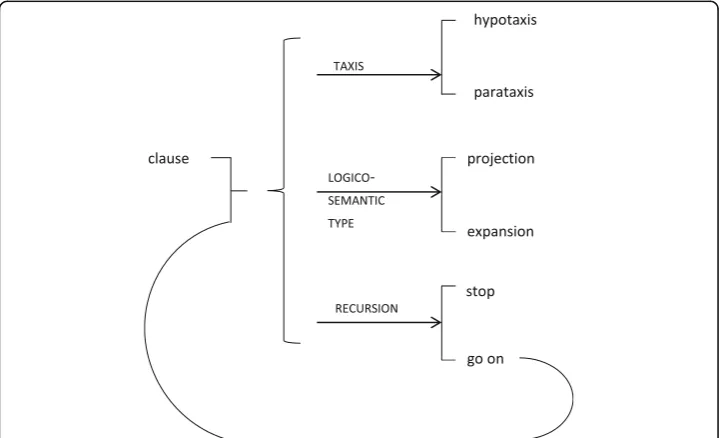
network for clause complexing therefore involves the system of RECURSION, which organises the choices ‘stop’and ‘go on’1.
The system network in Fig.1displays two other simultaneous systems.
The lexicogrammatical2 system of TAXIS describes the relation between clauses ac-cording to their interdependency; two clauses may have equal status or unequal status. If their status is equal, they are related through parataxis (this is noted with Arabic numbers, viz. the clauses are numbered as 1, 2, 3, etc. according to the sequence in which they occur); if their status is unequal, they are related through hypotaxis (this is noted with Greek letters, viz. the clauses are labelled as α,β,γ, etc., according to their place in the dependency hierarchy), and they therefore constitute a superordinate and a subordinate clause. Clauses related through parataxis and the superordinate clause in a hypotactic clause complex (the α-clause) uphold the interpersonal status of a ‘free’ clause, while the subordinate clause in a hypotactic clause complex (the β-clause) has the status of a ‘bound’clause (cf. Halliday and Matthiessen,2013: 170). The categories
‘free’and ‘bound’are the results of choices made in the interpersonal system of FREE-DOM (Halliday and Matthiessen,2013: 185). If a bound clause functions as part of an-other clause (as a constituent or part of a constituent, which e.g. is the case for restricted relative clauses), it is said to be‘embedded’. As opposed to clause complexes, constructions with embedded clauses form multivariate structures.
The lexicogrammatical system named LOGICO-SEMANTIC TYPE organises clauses ac-cording to the ideational relation between them; this relation can be either projecting or expanding, i.e. the figurative meaning of one clause can project the figurative mean-ing of the related clause (as an idea or a locution), or the figurative meanmean-ing of one clause can be expanded (: elaborated, extended or enhanced) by the figurative meaning of the related clause.
Examples (1–10) above illustrate the different types of clause complexing also shown in Table1 below, which intersectsTAXISwithLOGICO-SEMANTIC TYPE(cf. Halliday and Mat-thiessen2013: 447).
In this paper, we shall focus only on the expanding clause complex and leave out that of projection. Projection and expansion display some fundamental differences, since paratactic expansion is symmetrical (cf. Halliday and Matthiessen2013: 446).
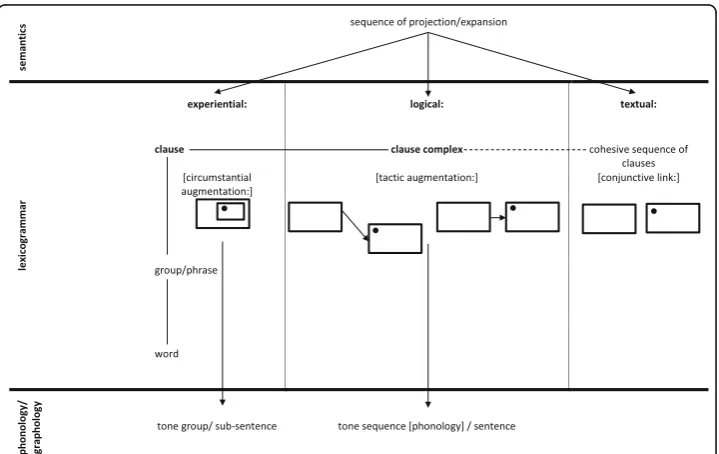
Expansion and projection are not features of the clause complex only. They are con-sidered ‘semantic domains’, i.e.“semantic systems that are realised by grammatical sys-tems operating in more than one place in the grammar” (Halliday and Matthiessen, 2013: 666). This is illustrated by Fig.2.
The figure shows how a sequence of figures (the rectangles) may be realised lexico-grammatically (i) in the experiential structure of the clause (whereby one figure is lexi-cogrammatically integrated in the other, cf. example (11) below), (ii) as a clause complex with a logical structure (indicated by the arrows) of either hypotaxis (indicated by the unlevelled rectangles, cf. example (12)) or parataxis (levelled rectangles, cf. ex-ample (13)) or (iii) as two conjunctively connected simplex clauses (cf. exex-ample (14)).
(11) He left before the vote (‘A happened before the time of B’)
(12) He left before the vote was taken (‘A happened before B happened’) (13) He left and then the vote was taken (‘A happened and then B happened’) (14) He left. Then the vote was taken. (‘A happened. Then B happened’)
As the figure and the examples show, we have four constructions, which to some de-gree can be said to be synonymous: in all examples, the two events, A and B, are re-lated in terms of temporal posteriority. The four constructions differ with respect to
Table 1Intersection ofTAXISandLOGICO-SEMANTIC TYPE
Expansion Projection
Parataxis (1), (3), (5) (7), (9)
Hypotaxis (4), (6) (8), (10)
the way this logico-semantic relation is organised grammatically; in (11) as a simplex clause with a Circumstantial Adjunct, in (12) and (13) as clause complexes and in (14) as two independent simplex clauses.
As indicated by the Fig. 2, the description in IFG assumes agnateness between hypotactic and paratactic clause complexes. The two occur as terms in the system network of the clause complex (cf. Fig. 1), whereas the other constructions are lo-cated at other places in the grammar. This implies that the two constructions in (12) and (13) share all of their respective grammatical properties, except that of degree of interdependency between the clauses. This rests on the assumption that examples like (12) and (13) are univariate structures, whereas example (11) is a multivariate structure. In example (14) there is no structural relationship between the clauses. The reason why IFG does not treat the subordinate clause in (12) as a circumstantial Adjunct, on par with the prepositional phrase in (11), is thus based on a systemic argument. This argument, again, rests on a functional one, namely that the clauses combined in a clause complex all have the full potential of a clause, viz. the potential of message, move or figure no matter if the interdepend-ency is one of parataxis or hypotaxis.
Problems and inconsistencies with the clause complex inIFG
In the following, we shall examine how IFG treats expanding hypotaxis with re-spect to the semantic categories of message, move and figure. Our examination of Halliday & Matthiessen’s description of hypotactic clause complexing is divided into two sections, namely one examining the more functional line of thinking in IFG, and one examining the more systemic argument. These two perspectives are of course intertwined, but for clarity’s sake, we shall present and discuss them separately.
An examination of the functional argument
In the IFG tradition, the clause simultaneously organises a message (textual mean-ing), enacts a move (interpersonal meaning) and construes a figure (experiential meaning) (cf. Halliday and Matthiessen, 2013: 21, 83; Matthiessen et al. 2010: 72).3 As complexing is a matter of linking similar functional elements (making up a uni-variate structure), we should think that we in a clause complex of two clauses would be presented with two messages, two moves and two figures. This assump-tion seems to be unproblematic when we consider paratactic expansion such as (1), (3) and (5), but is less obvious when we consider examples of hypotaxis. We therefore need to examine IFG’s line of reasoning and point out where there seems to be flaws.
vote (cf. e.g. Quirk et al. 1978: 744). However, in the IFG tradition the subordinate clause in (12) functions as a hypotactically related clause in a clause complex; it is said to function as a clause in its own right – to keep its “clause-hood” (cf. Halli-day and Matthiessen, 2013: 434), so to speak. An analysis of (12) according to IFG would look like this:
He left before the vote was taken.
α(superordinate clause in a hypotactic clause complex) β(subordinate clause in a hypotactic clause complex) X (enhancing relation:before)
The description rests on the following functional reasoning:
[W]hile circumstantial elements [like the prepositional phrase in (11)] are part of the
‘configurational’structure of the clause, clauses in clause complexes are part of a chain-like or serial structure. In the creation of text, we choose between augmenting a clause‘internally’by means of a circumstantial element and augmenting it‘ exter-nally’by means of another clause in a complex. The decision depends on many fac-tors; but the basic consideration has to do with how much textual, interpersonal and experiential semiotic‘weight’is to be assigned to the unit: the more weight it has, the more likely it is to be constructed as an interdependent clause in a clause com-plex rather than a circumstantial [prespositional] phrase (or adverbial group) aug-menting a clause (Halliday and Matthiessen,2013: 434).
The difference between the augmenting clause in (12) and the prepositional phrase in (11) is thus based on the so-called clause-hood of the former:
[C]lause complexing always involves assigning clause-hood to a unit related to [a] clause through expansion or projection: the unit has the full potential of a clause, in terms of experiential, interpersonal and textual systems (Halliday and Matthiessen2013: 434).
Clause-hood has the grammatical implication that a unit functions as the entry condition of the grammatical systems ofTHEME,MOODandTRANSITIVITY. But it also has to do with the semantics of the clause. The difference between a prepositional phrase and a clause (e.g. when realising time as in (11) and (12)) is that a prepositional phrase
“unlike a clause cannot construe a full figure, it cannot enact a proposition/proposal [move] and it cannot present a message” (Halliday and Matthiessen, 2013: 434). This quote indicates that each clause in a clause complex, be it paratactic or hypotactic, is seen as a realisation of a figure, a move and a message – as opposed to the prepositional phrase. This opposition could be expected to hold forβ-clauses and em-bedded clauses as well, given that a β-clause upholds it clause-hood, which the embed-ded cannot be said to do (as it functions as an element in a clause). We shall examine this argument in the following, starting with the categories of figure and message and ending with the move.
by a clause with a Circumstantial Adjunct in it, i.e. the prepositional phrase can realise the semantics of a figure. Now, whether this is‘a full figure’or some other kind of figure, is not addressed anywhere in IFG. In other words, the figure does not constitute a functional difference between a clause and a prepositional phrase.
Regarding the message, it can be assumed that a message is realised by all units that display a Theme-Rheme-Structure (we‘assume’this, as the message is not defined very clearly inIFG). Since a prepositional phrase does not display such a structure, it cannot be said to realise a message. In this respect, Halliday and Matthiessen’s description of the message is tight. However, there are two problems with the message in relation to clause complexing. Both are related to our assumption that a message is organised whenever we can identify a Theme-Rheme structure in the clause.
The first problem is that both β-clauses and embedded clauses are said to have a thematic structure:
There is a thematic structure […] in all major clause types; that is, all clauses expressing mood and transitivity, whether dependent or not (Halliday and Matthiessen,2013: 125).
This means that–textually speaking–clause-hood is not only a feature of a (β-)clause functioning in a univariate structure but also of a constituent (i.e. the embedded clause) in a multivariate structure. This, of course, makes it difficult to distinguishβ-clauses in hypotactic clause complexes from embedded clauses (although it is argued that for the embedded clause the“thematic contribution to the discourse is minimal and for prac-tical purposes can be ignored”(Halliday and Matthiessen,2013: 127)).5And it is a the-oretical problem, as it does not uphold the fundamental systemic boundary between two disparate structures; univariate and multivariate.
The second problem is that a thematic structure for the hypotactic clause complex as a whole is recognised: if a (bound) β-clause precedes a (free)α-clause, it is analysed as Theme in the clause complex (with the α -clause functioning as Rheme), whereby a clause complex in fact sets up three separate thematic structures (cf. the following ex-ample from Halliday and Matthiessen,2013: 552):
If you want a more substantial stuffing add a little mashed potato.
Theme1 Rheme1
Theme2 Rheme2 Theme3 Rheme3
[Such] examples […] pose no great problem of analysis; the point to bear in mind is that there will be [three]6thematic domains–that of the clause nexus and that of the clause[s] (Halliday and Matthiessen,2013: 552).
The analysis above, i.e. Halliday and Matthiessen’s line of reasoning on this matter, raises uncertainty as to whether the clause complex realises one or two (or
Matthiessen in fact treat what is in systemic terms a univariate structure of two similar elements (clauses) as a multivariate structure consisting of different functions
Regarding the move, it seems indisputable that a prepositional phrase functioning in a clause as a circumstantial Adjunct does not enact a move in itself but is a part of the move realised by the clause of which it is a constituent. The same holds for an embedded clause (cf. Halliday and Matthiessen, 2013: 172). However, whether this in fact distinguishes the prepositional phrase and the embedded clause from aβ-clause in a clause complex is not lucidly clear. IFG shows how a clause comes to function as a move (of a particular kind) through choices made in the lexicogrammatical system of MOOD TYPE. Theβ-clause in a clause complex, however, does not enter into this system; in other words, whereas the structure of a free clause is the result of choices from MOOD TYPE, the structure of the bound clause (such as that of theβ-clause) is not (cf. Halliday and Matthiessen, 2013: 172, 185). Thus, free clauses make a direct contribu-tion to the development of exchange, either as a proposicontribu-tion (statement, answer) or as a proposal (offer, command), whereas bound clauses“are not presented by the speaker as being open for negotiation” (Halliday and Matthiessen, 2013: 170). Since the
β-clause in a hypotactic clause complex is bound per se, it is hard to see how it should be able to enact a move, i.e. how theβ-clause has (interpersonal) clause-hood.
In some systemic functional contributions of English, it has been suggested that the bound clause, when functioning as a β-clause, enacts a move in the same way as a free clause. Thus Matthiessen and Martin (1991: 25) assert that a β-clause is“immediately accessible to argumentation in discourse just as paratactically related clauses would be” (cf. also Matthiessen1995: 326, 400); on the other hand, Matthiessen states that:
[f]ree clauses select freely for mood options, each one thus being capable of making an independent contribution to the development of dialogue […]. In contrast to free clauses,‘bound’ones do not select freely for mood […]. Interpersonally this means that they serve tosupportpropositions and proposals rather thanenactpropositions and proposals (2002: 269; cf. Matthiessen1995: 123).
As mentioned above, Halliday and Matthiessen (2013) like Matthiessen (2002) consider the boundβ-clause to be non-negotiable, which would mean that its interpersonal status equates that of the embedded clause or the prepositional phrase. They do, on the other hand, suggest a kind of hierarchy for non-negotiability, in which embedded clauses are considered less negotiable thanβ-clauses. According to the same hierarchy, however, non-finite bound clauses (β-clauses and embedded clauses) are“even further removed from the status of negotiability than finite ones”(Halliday and Matthiessen,2013: 172; cf. Matthiessen1995: 326 and Martin1992: 40). The problem is that this description of (non-)negotiability conflates the opposition of hypotactic/embedded with that of finite/ non-finite, whereby e.g. the interpersonal potential of the non-finiteβ-clause becomes even smaller than that of the finite embedded clause (e.g. the defining relative clause in (17)I don’t like men who lecture me).
enacted by the superordinate, freeα-clause, or theβ-clause can be said to function out-side of the exchange structure, i.e. outout-side the (dialogic) sequence of moves making up an exchange of meaning. The first suggestion would mean that β-clauses and embed-ded clauses are identical with respect to their status as ‘parts-of-moves’, the second would imply that they differ, with embedded clauses as ‘parts-of-moves’and β-clauses as standing outside of the exchange structure. In Halliday and Matthiessen, 2013, the authors seem to endorse the latter solution, which is illustrated by the following ana-lysis (170):
Statement: give & information↘free: declarative Supporting reason: presume & information↘bound
Well, I’m still afraid of him ‘cause he’s bitten me.
I’m scared because I’ve had an experience where Boof has bit me.
In such cases, the speaker “presents the reason [the because-clause] not as a challengeable statement but as a supporting information to be taken for granted”, and thereby she is “downgrading the issue of biting to the states of presumed information about what happened in the past” (Halliday and Matthiessen 2013: 171). The analysis introduces a new semantic category, namely‘the supporting move’(cf. also Matthiessen 2002: 269ff.). It is to be assumed that not only reasons but also other kinds of logico-semantic categories (time, condition, etc.) can be supporting in this sense, but since the term of the supporting move is not explained or defined anywhere, it leaves ample room for uncertainty.
However, no matter whether a β-clause is regarded as an integrated part of a move that is enacted by a free α-clause, or a β-clause is said to function outside of the ex-change structure, it is problematic to argue that a β-clause in a clause complex keeps its interpersonal clause-hood; interpersonal clause-hood is a feature of the clause when it functions as a move, and as we have seen, aβ-clause does not, in fact, enact a move. The analysis suggested in Halliday and Matthiessen, 2013 surely does assign different interpersonal status to the prepositional phrase and the embedded clause on the one hand and the β-clause on the other, but it also assigns significantly different status to theβ-clause and to the free clauses.
An examination of the systemic argument
Being a theory that emphasizes the paradigmatic organisation of language, SFL has a focus on the concept of choice between terms in a system. When modelling the grammar in systems and system networks, one will always hypothesize how different units and structures are related. A system with two terms is thus a hypothesis about the relatedness of these; by grouping them together and by excluding other units or structures from the system, the linguist makes a claim about the importance of different features. When “traditional formal grammar” (and other grammar theories) group the subordinate clause and the prepositional phrase together (as “circumstantial augmentation”), they make a certain assumption about what properties are important, and when IFG groups hypotactic and paratactic clause complexes together (as “tactic augmentation”), Halliday and Matthiessen also make such an assumption.
which entails that the subordinate clause of a hypotactic clause complex is not systemically related to (group formed) constituents of the simplex clause, e.g. to prepositional phrases. This argument – and a brief critique hereof– can be illustrated with the examples also used in the previous section:
(11) He left before the vote.
(12) He left before the vote was taken. (13) He left and then the vote was taken. (14) He left. Then the vote was taken.
The reasoning rests on the assumption that examples (12) and (13) are agnates, whereas examples (11) and (12) are not, and if we treat (11) and (12) as agnates, we allegedly ignore how the lexicogrammar is actually organised.
This is very clear in the debate between Huddleston in his review of the first edition ofIFG(1988) and Matthiessen and Martin’s response (1991). Huddleston presents a list of features and grammatical reactances that are shared by (11) and (12) and suggests that the before-clause in (12) is more appropriately treated as a circumstantial Adjunct parallel with the prepositional phrase in (11), i.e. as an embedded clause in a multivariate structure. Huddleston lists the following features (we shall return to some of these in the following section):
Both can be fronted.
Both can appear in a cleft construction.
Both can be in the focus of an interrogative.
They can be coordinated.
To Huddleston, this means that the prepositional phrase and the subordinate clause function in the same way – as circumstantial augmentations of the simplex clause – and consequently, the subordinate clause should be seen as systemically related to the prepositional phrase, not to the paratactically related clause.
To Matthiessen and Martin, however, these features do not entail that the subordinate clause should be seen as embedded; and they argue that by doing so, Huddleston
divorces clause combinations of this kind [example (12)] from paratactic clause complexes such as [13], whereas the two are brought together in Halliday’s analysis, which operates with hypotactic and paratactic clause complexes. In Halliday’s interpretation, the combination [in (12)] would be related to the paratactic complex in [13]. In Huddleston’s interpretation, this relationship would be completely lost (Matthiessen and Martin1991: 25).
Matthiessen and Martin acknowledge that“there will always be potentially conflicting criteria when we group constructions together into agnation sets” –i.e. there may be some properties shared by the subordinate clause and the prepositional phrase–but we should set up the agnation set“that provides us with the most powerful generalization”
clause and the prepositional phrase pointed out by Huddleston less adequate with respect to this compared to the ones between parataxis and hypotaxis pointed out by Halliday.
Matthiessen and Martin do, however, acknowledge that examples like (12) should be seen as somewhat intermediate between (11) and (13), and they suggest that this intermediate position could be accounted for by analysing examples like (12) as both a multivariate and a univariate structure8; according to their suggestion, example (12) would be analysed as follows (cf. Matthiessen and Martin1991: 29):
This analysis further concurs with Martin’s (1988) suggestion of two different angles on clause combining: a synoptic one that treats lexicogrammatical constructions as planned and a dynamic one that focuses on their linear emergence and development. The synoptic view is suitable when it comes to experiential patterns like the ones in the simplex clause, because the Process determines the necessary number and the types of Participants in the clause from the beginning, so to speak. The dynamic view makes more sense when it comes to logical recursive structures where the construction can be expanded continuously in the running text. A double analysis of hypotactic clause com-plexes was in fact suggested in earlier works of both Halliday (1981: 41) and Huddle-ston (1981), but no such complementary analyses of hypotactic clause complexes have ever been incorporated inIFG. The reason might be that this double analysis is theoret-ically problematic, as it treats a grammatical structure as both univariate and multivari-ate (we shall return to this below).
With Thompson, Matthiessen evaluates clause complexing in “traditional grammars” and here presents another reason for (11) and (12) not being agnates. They argue that traditional grammars usually consider examples like thebefore-clause in (12) as adverbial clauses because such grammars only distinguish two kinds of clause complexing: coordin-ation and subordincoordin-ation; subordinate clauses are then held to be constituent clauses. To Matthiessen and Thompson, this view is problematic, since it equates class (a particular word order in the clause9) with function (constituent in the main clause) (Matthiessen and Thompson1988). Thus, traditional grammars foreground the possibility of rephrasing the subordinate clause in (12) with a prepositional phrase like the one in (11):
[I]f we paraphrase our examples using a prepositional phrase functioning as an adverbial [Adjunct inIFG-terms], the result is a grammatical metaphor (…) [e.g.] Before leaving Krishnapur to escort his wife to Calcutta, the collector took a strange decision.→Before his departure from Krishnapur to escort his wife to Calcutta, the collector took a strange decision.Rewording the“adverbial clause”with a
Contemplating this argument, we agree with Butler that
it seems to confuse syntactic function with semantic (…) import: there seems to be no necessary contradiction between the claim that [before his departure from Krishnapur] is metaphorical and the claim that [before leaving Krishnapur], in terms of its structural function, is an adverbial clause. (Butler2003: 281)
If anything, the argument should be that before his departure from Krishnapuris not an adverbial/Adjunct–and there is nothing in Halliday and Matthiessen2013that sug-gests that this is not in fact the case. Thus, the claim that examples (11) and (12) are not agnates cannot rest on a lack of paraphraseability (which is obviously there, and which is also predicted in Fig.2).
Lexicogrammatical agnation concerns ‘closeness’ to other possible lexicogrammatical constructions (Halliday and Matthiessen,2013: 31), and Halliday and Matthiessen suggest considering the different lexicogrammatical realisations of the sequence as points on a scale, where the poles are occupied by circumstantial augmentation and conjunctive link, respectively, and where tactic augmentation lies between the two:
But the clause complex is in fact not a single point on this scale; it covers two regions of the scale: closer to the pole of circumstantial augmentation, there are clause combinations where one clause is dependent on a dominant clause, the two thus being of unequal status (…); closer to the pole of cohesive sequences, there are clause combinations where the two clauses are interdependent on one another, the two having equal status. (Halliday and Matthiessen, 2013: 434-5).
While the scalar thinking may account for the fact that the hypotactic augmentation shares some properties with the circumstantial one, and the paratactic some with the cohesively related simplex clauses, the organisation of the grammar, in multivariate and univariate structures, delimits the degree of scalarity. The structures in question are ei-ther multivariate or univariate; paratactic structures cannot be ‘more univariate’ than hypotactic ones. Hypotactic and paratactic clause complexes go together in lexicogram-mar because they share the same structural properties, and in the system forTAXIS (cf. the system network in Fig.1), they are therefore considered agnates.
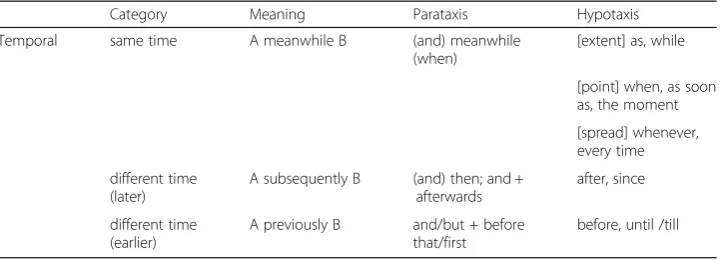
Fawcett identifies a further problem with Halliday & Matthiessen’s claim that a hypotac-tic clause complex (such as (12)) is agnate with a paratachypotac-tic clause complex (such as (13)), namely that we can observe a significant discrepancy regarding the logico-semantic rela-tions that can be established by means of coordinating and subordinating conjuncrela-tions, respectively (Fawcett2000). This can be illustrated with the domain of temporal conjunc-tions. Halliday & Matthiessen list the set of temporal conjunctions (cf. Halliday and Mat-thiessen,2013: 477) that are shown Table2.
The table illustrates
(i) that the hypotactic clause complex can realise temporal meaning in a more delicate way than the paratactic clause complex, since the subordinating temporal
system ofTAXISas we do when we choose hypotaxis, and this is in principle a problem, sinceTAXISandLOGICO-SEMANTIC TYPEare said to be simultaneous and independently variable systems, and
(ii) that the coordinating conjunctions listed for temporal parataxis are not in fact coordinating conjunctions but combinations of a conjunction (and, but) and a Textual Adjunct (meanwhile, then, afterwards, before that, first).10 A conjunction (and, but) always establishes a paratactic structure, whereas a Textual Adjunct may occur in other types of structures as well, e.g. in a simplex clause (cf. example (14)).
As Fawcett states:
It is always possible, of course, to express a roughly equivalent meaning by a combination of the [conjunction]andand an Adjunct such asafterwardsorduring that time, etc. (…) But this is a very different matter, in terms of the systemic choices that are available (…) because the introduction of an Adjunct opens up a much larger range of possibilities than is available within the [conjunction] (Fawcett2000: 327-8).
If we use a strict criterion, by which a conjunction is defined as the function that estab-lishes a syndetic paratactic construction, the possible lexemes constitute a very small group: Quirk et al. (1978: 552) regard three conjunctions (and, or, but) as coordinators, whileforandso thatare“on the gradient between the‘pure’coordinators and the‘pure’ subordinators”. In other words, the empirical basis of the system network (cf. Fig. 1) is undermined, since most of the hypotactic clause complexes do not have a paratactic counterpart, and a lot of the logico-semantic meanings (e.g. most of the enhancing types of meaning) cannot be combined with parataxis.
Now, it could be argued that by taking this strictly syntactical approach, we ignore that the lexicogrammar is in fact presenting the paratactic relationship as temporal in examples like (13). However, in our opinion, the fact that there is a temporal relation is accounted for at a different place in the analysis, viz. in the textual description. As illus-trated in Fig. 2 and as stated by Halliday and Hasan (1976: 227 ff.), the different logico-semantic relations (e.g. temporal relations) may hold both between single clauses with no structural relationship between them and between clauses in a clause complex. If we compare examples (13) and (14):
Table 2Categories of enhancement and principal markers (shortened version)
Category Meaning Parataxis Hypotaxis
Temporal same time A meanwhile B (and) meanwhile
(when)
[extent] as, while
[point] when, as soon as, the moment
[spread] whenever, every time
different time (later)
A subsequently B (and) then; and + afterwards
after, since
different time (earlier)
A previously B and/but + before
that/first
(13) He left and then the vote was taken (14) He left. Then the vote was taken
we see that thenhas the same function in both examples; it establishes a cohesive tie between the clauses. This is not different from other cohesive mechanisms such as ref-erence, e.g.:
(15) Wash and core six cooking apples, and put them into a fireproof dish. (16) Wash and core six cooking apples. Put them into a fireproof dish.
In (15) and (16) themestablishes a reference that is independent of the grammatical construction in which it occurs. In our opinion, conjunctive relations should be inter-preted in the same way.
Towards an alternative description of clause complexing
As discussed in the previous section, the hypotactic clause complex causes problems for Halliday and Matthiessen’s description of clause complexing for a number of reasons:
– β-clauses do not differ from prepositional phrases (or embedded clauses) with respect to their ability to construe figures, which makes this criterion ineffective for singling out and grouping paratactic and hypotactic clause structures as an
opposition to prepositional phrases.
– All major clauses–whether free or bound, whether embedded or hypotactically related–have a thematic structure, and this blurs the idea of the message. – β-clauses and paratactically related clauses seem to behave very differently with
respect to their relationship to the semantic category of the move. The common assumption seems to be that aβ-clause does not realise a move. A distinction has been set betweenβ-clauses and embedded clauses in terms of a negotiation hier-archy. However, this hierarchy also concerns the variable of finite/non-finite, mean-ing that non-finiteβ-clauses are less challengeable than finite ones. This raises the question as to whether it is finiteness or the distinction between hypotaxis and em-bedding that is of importance when it comes to the negotiability of a bound clause. The analysis of theβ-clause as a supporting move, with theα-clause realising the proposition or proposal on its own, seems functionally inappropriate, since some clauses analysed asβ-clauses are in fact a crucial part of the proposition or proposal (cf. below). This means that theseβ-clauses are functionally no different from prep-ositional phrases or embedded clauses.
so-called traditional analysis, but as demonstrated this rejection is problematic, since it gives rise to an inconsistent description of clause complexing (which fur-thermore–it could be argued–holds form over function).
– There is a systemic problem, since the number of possible conjunctions for hypotaxis and parataxis differs significantly; we do not have the same range of choices when we choose parataxis in the system ofTAXISas we do when we choose hypotaxis. This is–at least to some degree–problematic for the claim that the two are agnate terms in a system.
Our conclusion is that the description inIFGneither supports the functional nor the systemic argument in a consistent way.
As mentioned earlier, the clause complex analysis has been reviewed critically by Fawcett, and the Cardiff Grammar actually suggests a rather different analysis of con-structions like examples (1)–(10). Fawcett treats all subordinate clauses as constituents of the other clause filling Circumstantial Roles (Adjuncts) in the case of expansion and Participant Roles (Complements) in the case of projection (Fawcett 2000: 28–9). Although the Cardiff Grammar solves some of the problems identified inIFG(cf. Butler 2003: 291 f.), Fawcett’s description too could be accused for ignoring functional aspects of the clause complex – like the IFG analysis, the Cardiff Grammar-analysis implies that all subordinate clauses are functionally alike.
Our proposal for analysing subordinate expanding clauses within the framework of the IFG-model is based on the assumption that not all clauses treated as expanding
β-clauses are alike. We thus agree with Matthiessen and Thompson (1988: 285), who warn us not to equal class with function and therefore not to analyse all subordinate clauses as embedded, but we reach a different conclusion. Our description takes advan-tage of the distinction between embedded clauses and β-clauses that is available in the IFG-model, but we suggest that the line between the two be drawn differently, based upon different functional features that we observe in the field of expanding β-clauses. We suggest that a functionally based differentiation between expanding embedded clauses and expandingβ-clauses may also strengthen the systemic description. The pro-posal put forward in the following has been developed for and tested on German and Danish (Holsting 2008, Andersen and Holsting 2015) and we shall refer to those lan-guages in the following and consider to what degree the qualities in these lanlan-guages can be transferred to the description of English.
The functional issue has to do with the question of clausehood examined earlier. As pointed out, this is best discussed with reference to the interpersonal category move, since the experiential figure is not exclusively tied to the ranking clause, and since the textual message relates to all units displaying a Theme-Rheme structure – including embedded dependent clauses.
Earlier, we addressed how IFG treats the β-clauses with respect to negotiability. We encountered an inconsistency between the assumption that all clauses in clause com-plexes have the functional potential of a clause and hence realise moves, on the one hand, and the assumption thatβ-clauses as bound clauses are not open for negotiation, on the other. Instead of realising propositions or proposals (i.e. challengeable moves),
Matthiessen2013: 171). Contrary to embedded clauses, which are considered a part of a challengeable move, theβ-clauses are placed outside of the move realised by theα-clause.
A distinction between expanding embedded clauses and β-clauses is only acknowl-edged at one place in theIFG-model, namely with respect to relative clauses, where de-fining relative clauses like (17) are seen as embedded and non-dede-fining ones like (18) as
β-clauses:
(17) I don’t like men who lecture me.
(18) I don’t like my uncle, who always lectures me.
The defining relative clause in (17) is a part of a statement, and if the relative clause is removed, the intention of the statement is altered (example (17) does not mean the same as I don’t like men). The non-defining relative clause (theβ-clause) in (18), on the other hand, presents additional information that is not a part of the challengeable statement realised by the superordinate clause. The statement can be reduced to the superordinate clause without changing the intention of the statement (I don’t like my uncle). Here it seems reasonable to claim that the subordinate clause represents supporting information that should be taken for granted.
If we examine this feature with respect to other expanding subordinate clauses, we observe that some show the same properties as the defining relative clause, e.g.
(19) Andre Agassi never played tennis while he was high.
If we want to challenge this statement by contradicting it, we do not only challenge the superordinate clause –we challenge the content of both clauses. The statement in (19) cannot simply be reduced toAndre Agassi never played tennis. In order to account for this, we should see the move as covering both the superordinate and the subordin-ate clause. Similarly if we ask a question like:
(20) Did Andre Agassi ever play tennis while he was high?
we do not expect an answer relating only to the part Did Andre Agassi ever play tennis?
This pattern is no different from the one we see when Circumstantial Adjuncts occur in the form of a prepositional phrase:
(21) Andre Agassi never played tennis on Mondays.
where a contradiction like Oh yes he did, I saw him play last Tuesdaywould not make any sense.
This possibility of standing in the scope of the proposition or proposal was addressed also by Huddleston (1988), and it is related to other scope features as well. For in-stance, a Polarity or Modality Adjunct of the superordinate clause may have scope over an expanding dependent clause:
(23) The actor didn’t participate in the second season of the show because he needed the money.
In (22) the meaning of the Modality Adjunct maybe does not contribute as a modalisation of the content of the superordinate clause (the director left the party). He did in fact leave the party, only the speaker is not sure about the reason. Simi-larly, in (23) where the Polarity Adjunct does not negate the superordinate clause (the actor did participate in the second season of the show), but the reason expressed in the because-clause. All in all, an analysis that treats the two clauses as ‘complete’, as standing in their own right, will have trouble explaining what the Modal Adjunct and the Polarity Adjunct do in the clause in which they are placed. Only if the two clauses are seen as one interpersonal unit, our analysis can account for these issues.
This seems to be an argument in favor of treating all expanding subordinate clauses as embedded. However, the issues addressed above are not alike in all expanding subor-dinate clauses.
(24) The actor didn’t participate in the second season of the show, although he needed the money.
(25) The parents wanted to go to Paris, whereas the children wanted to go to the beach.
In (24) and (25) the challengeable statement is in fact the content of the superordin-ate clause – this does not change if we leave out the dependent clause. Likewise, the Polarity Adjunct in (24) ‘belongs’ to the superordinate clause – it cannot cross the border between the two clauses as we saw in (23). This seems to justify that the subor-dinate clauses in (24) and (25) are treated as supporting moves not as part of the chal-lengeable move of the superordinate clause. With respect to this, (24) and (25) can be said to be examples of univariate structures where each clause stands as a functioning whole.
The two types not only show differences with respect to interpersonal features like the ones mentioned above. They also differ with respect to textual differences, for in-stance the possibility of standing in the scope of a textual Adjunct likeonly:
(26) He only got the money back because the parcel was damaged. (27) He only got his money back, although the parcel was damaged.
In (26) the scope of only covers the because-clause (‘he got his money back, but only because the parcel was damaged’), but in (27) only belongs to the super-ordinate clause (‘he only got his money back, but we should have expected that he was indemnified in some other way as well’). Another textual feature is the possibility of theme predication that only holds for examples like (28), not for ex-amples like (29):
The fact that expanding subordinate clauses react differently to theme predication is mentioned in IFG (2013: 122, 550, 553), but not elaborated on, and it has no conse-quences for the analysis. Since theme predication is possible for “any element having a representational function in the clause” (2013: 122), this could be an indication that subordinate clauses that allow for theme predication should in fact be considered ele-ments with a representational function in (and not outside of ) the (superordinate) clause.
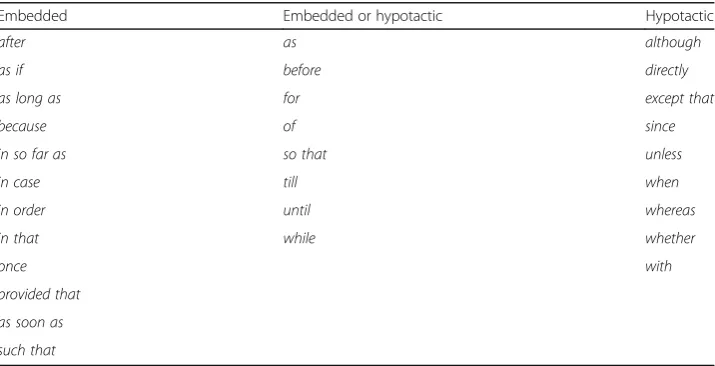
The fact that subordinate expanding clauses can be grouped together in two groups according to the way they behave with respect to the criteria listed above seems to be functionally relevant and should therefore be accounted for in our grammatical descrip-tion. Our suggestion is to treat examples like (19), (22), (23) and (26) as embedded and the whole structure as multivariate, and examples like (24), (25) and (27) as β-clauses and the whole structure as univariate. This suggestion differs from the double analysis suggested by Matthiessen and Martin and from Fawcett’s analysis of subordinate expanding clauses as Adjuncts, since these analyses do not differentiate between the subordinate clauses in the examples above. Martin (1988) has however touched upon a differentiated view on the field and presents a division based on the subordinating con-junctions that introduce the subordinate clause, which is shown in Table3.
Our proposal for Danish and German assumes a similar division of the subordinate expanding clauses. It should be noted that Danish and German differ from English by making a formal distinction between what is called the main and subordinate clause word order. In Danish the difference has to do with the placement of Modal Adjuncts and Polarity Adjuncts:
(30) Peter er ikke blevet syg. (‘Peter has not become sick’)
(31)…fordi Peter ikke er blevet syg. (’…because Peter has not become sick’)
In the main clause in (30), the Polarity Adjunctikke is placed after Subject and Finite (these may occur in any order) and in the subordinate clause in (31) it is placed between Subject and Finite. In German, the difference is even more explicit (cf. (32) and (33)).
Table 3(after Martin1988: 104–5)
Embedded Embedded or hypotactic Hypotactic
after as although
as if before directly
as long as for except that
because of since
in so far as so that unless
in case till when
in order until whereas
in that while whether
once with
provided that
as soon as
(32) Peter ist nicht krank geworden. (‘Peter has not become sick’)
(33)…weil Peter nicht krank geworden ist. (’…because Peter has not become sick’)
Here, the Finite is placed in the second position in the main clause, and in the last position in the subordinate clause. These formal differences co-occur with functional differences (clauses with subordinate word order is typically bound, clauses with main word order is typically free), but there are exceptions. While the word order may signal dependency, it does not in itself indicate whether a subordinate clause behaves like a supporting move or part of a move (cf. above).
When analysing both Danish and German data, we can establish that some logico-semantic categories are exclusively embedded or hypotactic, while others may be both. Thus, all temporal subordinate clauses behave like embedded clauses with respect to the reactances described above (cf, Hansen and Heltoft 2011: 1028; Pasch et al.2003: 271ff.), whereas all concessive and adversative ones behave like β-clauses. Causal clauses, however, may be either-or. When we look further into their pattern, we observe that both languages make use of different subordinating conjunctions for the two categories. Embedded causal clauses are introduced by weil in German and fordi in Danish, whereas causal β-clauses are introduced by German da, zumal and Danish da, siden, eftersom. This seems to correspond to Martin’s differentiation between be-cause and since in Table 3.
(34) Er bleibt vielleicht zu Hause, weil er wieder krank geworden ist. (35) Er bleibt vielleicht zu Hause, da er wieder krank geworden ist. (36) Han bliver måske hjemme, fordi han igen er blevet syg. (37) Han bliver måske hjemme, da han igen er blevet syg.
The scope of the Modal Adjunct vielleicht/måske (‘perhaps’) covers the subordinate clause in examples (34) and (36) (‘perhaps the reason was that he has become ill again’), but not in (35) and (37) (‘perhaps he stayed at home, since he has in fact become ill again’).
Furthermore, both languages have a causal coordinating conjunction as well (German denn, Danishfor, thi):
(38) Er bleibt vielleicht zu Hause, denn er ist wieder krank geworden. (39) Han bliver måske hjemme, for han er igen blevet syg.
(notice the main clause word order in the clause introduced bydenn/for).11
To make a causal clause challengeable as a move, German and Danish will present it in a main clause as in (38) and (39) and thus in a paratactic clause complex.
The fact that English because-clauses can in fact present challengeable moves, as pointed out by (Halliday and Matthiessen,2013: 172) with respect to the example:
(40) That’s the one I should have if I had any because it’s jolly, isn’t it?
them, and sincebecause is considered to be a subordinating conjunction, thebecause -clause is considered subordinate in (40). It is however stated that some subordinate clauses can contain ‘main clause phenomena’ (cf. Green 1976) which indicate a freer, less dependent status (Halliday & Matthiessen talk about “interactive features” which suggest that although the clause looks like a tagged bound clause, it is“closer to being free rather than bound”(Halliday and Matthiessen,2013: 172)).
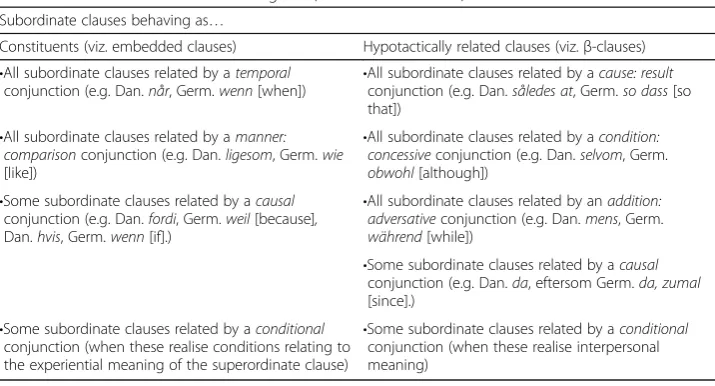
In Danish and in German, we see the following distribution of logico-semantic types with respect to the categories of embedded andβ-clause suggested above in Table4.
The functional advantage of the analysis suggested here is that it makes it possible to account for the different interpersonal statuses of the subordinate clause as either real-izing a part of a move (as embedded) or a supporting move (as a β-clause). There is however also a systemic advantage for dividing the field in this way.
First of all, by leaving out the embedded expanding clauses, we are left withβ-clauses that without problems can be described as univariate structures, since both theα- and the β-clause can be considered functioning wholes without anything in the α-clause having scope over the β-clause. In this respect, they are identical to paratactically re-lated clauses. The difference with respect to taxis is then concerned with the weighing of these functional wholes against each other. This is typically described with reference to the concepts of ‘equal’ and ‘unequal’ (cf. Halliday and Matthiessen 1999; Halliday and Matthiessen, 2013: 439–440), whereby the equal weight means that both clauses can stand on their own, and unequal weight means that only theα-clause can stand on its own.12
(41) Most children’s fathers worked at an office, but my father worked at the studio. (42) Most children’s fathers worked at an office, whereas my father worked at the
studio.
The two clause complexes share the logico-semantic relationship of adversativity but differ with respect to the status assigned to the adversative clause.
It should be noted that although the continuing clause in (41) and the β-clause in (42) share a common structure property (they are both clauses), this is not what defines
Table 4subordinate clauses behaving as... (Danish and German) Subordinate clauses behaving as…
Constituents (viz. embedded clauses) Hypotactically related clauses (viz.β-clauses)
•All subordinate clauses related by atemporal
conjunction (e.g. Dan.når, Germ.wenn[when]) •
All subordinate clauses related by acause: result conjunction (e.g. Dan.således at, Germ.so dass[so that])
•All subordinate clauses related by amanner: comparisonconjunction (e.g. Dan.ligesom, Germ.wie [like])
•All subordinate clauses related by acondition: concessiveconjunction (e.g. Dan.selvom, Germ. obwohl[although])
•Some subordinate clauses related by acausal conjunction (e.g. Dan.fordi, Germ.weil[because], Dan.hvis, Germ.wenn[if].)
•All subordinate clauses related by anaddition: adversativeconjunction (e.g. Dan.mens, Germ. während[while])
•Some subordinate clauses related by acausal conjunction (e.g. Dan.da, eftersom Germ.da, zumal [since].)
•Some subordinate clauses related by aconditional conjunction (when these realise conditions relating to the experiential meaning of the superordinate clause)
them as agnates and thereby as terms in a system. Rather it is their status as function-ing wholes that can then be assigned an equal or an unequal status with respect to the other functional whole of the construction.
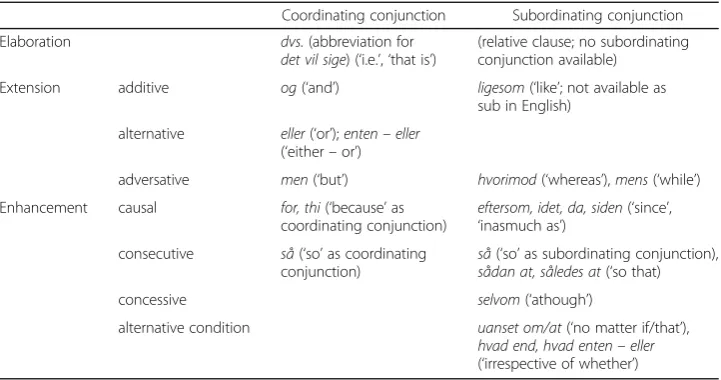
The division of the expanding subordinate clauses may also–to some degree–solve the issue brought forward by Fawcett (cf. Table 2), that the logico-semantic choices available for paratactic clause complexes differ significantly from those available for hypotactic clause complexes, which makes the claim that both select from the same system inadequate. While the different logico-semantic categories presented in IFG show remarkable differences with respect to parataxis and hypotaxis, a more restricted view on hypotaxis results in fewer logico-semantic categories. As pointed out by Faw-cett, no coordinating conjunction in English actually expresses temporal meaning in its own right. Parataxis established byandis not in itself temporal but needs to be quali-fied by other linguistic means that are not exclusively connected to the clause complex. However, since temporal clauses are considered embedded (according to the criteria above), there is actually no imbalance between parataxis and hypotaxis in that respect. To exemplify, Table 5 shows the logico-semantic categories available for parataxis and hypotaxis in Danish.
As the table shows, there is a high amount of overlap, but still some lexicogrammati-cal relations can only as it seems occur paratactilexicogrammati-cally and others only hypotactilexicogrammati-cally. Interestingly, however, it seems that Danish language users tend to fill in the gap with respect to concessive meaning, in that they often use the subordinating conjunction sel-vomas a coordinating one (cf. Christensen et al.in press).
A description like the one suggested here is to some degree identical to the one sug-gested by Morley (2004). Morley divides the bound clauses into two groups, integral and supplementary subordinate clauses. An integral clause“can be interpreted as oper-ating as a constituent element within the structure of them main (superordinate) clause and functioning in the same manner as a phrasal constituent”(2004: 124). Such clauses would be embedded in terms of IFG, and this category covers nominal clauses (func-tioning as Subject or Complement), adjectival clauses (func(func-tioning as Modifiers in
Table 5Logico-semantic categories available for parataxis and hypotaxis in Danish (after Andersen and Holsting,2015: 279–287)
Coordinating conjunction Subordinating conjunction
Elaboration dvs.(abbreviation for
det vil sige) (‘i.e.’,‘that is’)
(relative clause; no subordinating conjunction available)
Extension additive og(‘and’) ligesom(‘like’; not available as
sub in English)
alternative eller(‘or’);enten–eller (‘either–or’)
adversative men(‘but’) hvorimod(‘whereas’),mens(‘while’)
Enhancement causal for, thi(‘because’as
coordinating conjunction)
eftersom, idet, da, siden(‘since’,
‘inasmuch as’) consecutive så(‘so’as coordinating
conjunction)
så(‘so’as subordinating conjunction), sådan at, således at(‘so that)
concessive selvom(‘athough’)
alternative condition uanset om/at(‘no matter if/that’),
nominal groups) and adverbial clauses (functioning as Circumstances). The last group covers allIFG’senhancingβ-clauses.
Supplementary clauses do not function as constituents of the superordinate clause – as opposed to integral clauses, they can be removed “without affecting the grammat-icality of the meaning content of the remaining main clause”(2004: 127). This group is further divided into adjunctive clauses and secondary proposition clauses. The first group covers bound clauses that add further information of a textual or interpersonal kind, e.g. comments to, statements of the validity of or connective leads into the super-ordinate clause:
(43) What is particularly annoying, she didn’t even phone. (44) As far as I am concerned, she didn’t even phone. (45) What is more, she didn’t even phone.
This addresses the fact that although the clause complex is considered to be an idea-tional construction inIFG, the subordinate clause can in some cases be said not to have an ideational function with respect to the superordinate clause, but rather to serve a textual or an interpersonal function with respect to the meaning content of the super-ordinate clause. This distinction is sometimes treated as an opposition between exter-nal and interexter-nal connection, whereby an exterexter-nally related β-clause relates to the
α-clause as a figure and the internally related one to theα-clause as a move (cf. Halli-day and Matthiessen, 2013: 484, Martin1992: 217; Thompson (2005: 775) adds to the picture that it may also be related to theα-clause as a message).
Morley’s supplementary clauses are ideationally related subordinate clauses that“ pro-vide an additive, replacive or contrastive proposition relating to (the whole or just part of ) the superordinate clause”(2004: 126). This category coversIFG’s enhancing and ex-tendingβ-clauses, e.g.:
(46) You can lie there all day, which wouldn’t give you much exercise.
(47) The present treasurer, who has managed the finances excellently, ought to be re-appointed.
(48) Besides having an enjoyable time, we also learned a great deal.
Compared toIFG, Morley’s treatment of expanding subordinate clauses can be illus-trated in Table6.
While this description is identical to our suggestion in many ways, it differs with re-spect to the treatment of IFG’s enhancing β-clauses. While Morley treats all such clauses as integral (and thereby embedded), we suggest dividing the field according to whether the subordinate clause serves as part of the move or as a supporting move.
clauses share many formal features, they do not necessarily have the same function. Furthermore, it makes use of a distinction between embedded clauses and
β-clauses that is already available in the model.
Coda
With the aim of making the system of clause complexing a powerful generalisation, we have here taken a step towards a nuanced description, in which we treat those bound expanding clauses that behave like constituents as constituents and treat those that do not as clauses in the IFG-sense (cf. Andersen and Holsting, 2015). Such a description will fully support the functional and systemic foundations of systemic functional linguistics.
Endnotes 1
The term‘recursion’is however also used with reference to the multivariate structures, since rank shifting in some sense allows us to start over in a system network. This type of recursion is labelled ‘cyclic recursion’ (Halliday 1981: 40) or ‘incursion’ (Caffarel et al. 2004: 34), as opposed to the recursion in complex structures which is called‘linear recur-sion’(Halliday1981: 40) or simply‘recursion’(Caffarel et al.2004: 34).
2
There is some uncertainty as to whether the categories formingTAXISand
LOGICO-SE-MANTIC TYPE are indeed lexicogrammatical or semantic or both at the same time (cf.
Butler2003: 290).
3
The message, the move and the figure and the way these semantic categories are re-alized linguistically in the clause are crucial to the classification of systemic functional linguistics as a functional linguistic theory; in other words, we are contemplating key concepts in this article. In (very) short, the argument goes as follows: since the clause configures textual, interpersonal and experiential meaning and thereby functions simul-taneously as a message, a move and a figure in the exchange of meanings, i.e. in the communication between two or more interlocutors, systemic functional linguistics regards grammar as motivated, not arbitrary (cf. Butler2003: 44–45); hence language is first and foremost regarded as a system of functions/meanings, and thereby systemic functional linguistics fulfills the functional hypothesis (cf. Hasan1985: 6).
4
TheIFGtradition labels this approach“traditional”; however,IFGstands fairly alone with their approach to subordination, which means that‘traditional’here equates‘ non--IFG’(cf. Butler2003).
5
Martin (1992) has a slightly different approach to the one just discussed, since he states that: “[t]he unit message will be adopted here, where this is realized as a ranking clause that is neither a projection, nor a hypotactically dependent elaborating clause. This means that locutions and ideas, elaborating β-clauses and all embedded clauses will be treated as part of messages rather than as conjunctively related units in their own right”
Table 6Expanding subordinate clauses according to IFG and Morley2004
IFG Embedded β-clause elaborating β-clause extending β-clause enhancing
Morley Integral adjective clause
Supplementary > secondary proposition
Supplementary > secondary proposition
(Martin 1992: 235). In Martin’s view, only a sub-group of bound clauses (viz. extending and enhancingβ-clauses) realizes messages. This again challenges Halliday and Matthies-sen’s idea of the (textual)‘clause-hood’quality of anyβ-clause.
6
The text says‘two’; we assume that Halliday and Matthiessen mean three, since their analysis identify three separate thematic structures.
7
One quote in IFG could solve the problem of whether a clause complex is consid-ered a realization of one or two messages:“Clauses are linked to one another by means of some kind of logico-semantic relation to form clause complexes representing sequences of figures (or moves) that are presented as textually related messages”(Halliday and Mat-thiessen 2013: 428) Unfortunately, the quote is ambiguous, since the enhancing that--clause could specify both“sequence”and“figure/move”.
8
This would be parallel to the analysis of the nominal group that is analysed in terms of both an experiential and a logical structure (Halliday and Matthiessen2013: 364ff.).
9
This of course only goes for languages that make a formal distinction between main clauses and subordinate clauses.
10
The word order of English to some degree allows for such fuzziness with respect to the boundaries of the conjunction, since there is no clear topological border to mark the end of a conjunction. In V2-languages like German or Danish where the declarative clause is organized topologically differently, we cannot argue that parallel word combi-nations like und dann/og så function as conjunctions, since the Adjunct part always fills the position of a clause constituent, whereas the conjunction part does not.
11
This picture that divides the field of cause betweenweil/fordi, da/da and for/denn is somewhat idealized, since –especially in spoken discourse –many speakers tend to use weil/fordi in all cases. So while the use of da/da is exclusively connected to
β-clauses anddenn/forcan only be used as coordinating conjunctions,fordi/weilcan be used in all categories. However, onlyfordi/weilcan be used in embedded cause clauses.
12
The important difference with respect to embedding does not concern the dependent clause, since neither β-clauses not embedded clauses can stand on their own–it concerns the superordinate clause, since theα-clause in a hypotactic clause complex can in fact stand on its own, as its meaning is not restricted by theβ-clause, whereas the superordinate clause cannot stand on its own without its embedded clause. By removing the embedded clause, we change the meaning (cf. the relative clause example in (17) and the embedded clause in (19)).
Abbreviation
IFG:An Introduction to Functional Grammar
Acknowledgements
We are grateful for the helpful comments from our colleagues in the international systemic functional milieu, which we received in a paper presentation on this subject at the 27th ESFLC in Salamanca, 2017. We also wish to thank the anonymous reviewers for their guidance and comments.
Availability of data and materials
The research has been carried out with empirical data from The British National Corpus (https://corpus.byu.edu/bnc/) and KorpusDK (http://ordnet.dk/korpusdk).
Authors’contributions
Each of the two authors has contributed 50% to this work. Both authors read and approved the final manuscript.
Authors’information
Alexandra Emilie Møller Holsting, Ph.D., is an associate professor at the University of Southern Denmark. Her research focusses on systemic functional description of German and Danish lexicogrammar.
Competing interests
The authors declare that they have no competing interests.
Publisher’s Note
Springer Nature remains neutral with regard to jurisdictional claims in published maps and institutional affiliations.
Received: 8 March 2018 Accepted: 2 July 2018
References
Andersen, Thomas Hestbæk and Alexandra Holsting. 2015.Teksten i grammatikken.Odense: Syddansk Universitetsforlag. Butler, Christopher S. 2003.Structure and function–A guide to three major structural-functional theories. Part 2: From
clause to discourse and beyond. Amsterdam: Benjamins.
Caffarel, Alice, James R. Martin, and Christian M.I.M. Matthiessen. 2004. Introduction: Systemic functional typology. In
Language typology: a functional perspective, ed. Alice Caffarel, James R. Martin, and Christian M.I.M. Matthiessen, 1– 76. Amsterdam: Benjamins.
Christensen, Marie H., et al. in press, 2017. Does main clause word order affect attention to change in subordinate clauses?Linguistics.
Fawcett, Robin P. 2000.A theory of syntax for systemic functional linguistics. Amsterdam: Benjamins. Green, Georgia M. 1976. Main clause phenomena in subordinate clauses.Language53 (2): 382–397.
Halliday, M.A.K. 1981. Types of Structure. InReadings in Systemic Linguistics, ed. M.A.K. Halliday & James R. Martin, 29–41. London: Basford.
Halliday, M.A.K. 1994.An introduction to functional grammar. 2nd ed. London: Arnold. Halliday, M.A.K., and Ruqaiya Hasan. 1976.Cohesion in English. London: Longman.
Halliday, M.A.K., and Christian M.I.M. Matthiessen. 1999.Construing Experience Through Meaning. A Language-based Approach to Cognition. London: Continuum.
Halliday, M.A.K., and Christian M.I.M. Matthiessen. 2013.Halliday’s Introduction to Functional Grammar. 4th ed. London and New York: Routledge.
Halliday, M.A.K., and Christian M.I.M. Matthiessen. 2013.An introduction to functional grammar. 3rd ed. London: Routledge.
Hansen, Erik and Lars Heltoft. 2011.Grammatik over det danske sprog.Odense: Syddansk Universitetsforlag. Hasan, Ruqayia. 1985. Offers in the making: A systemic-functional approach. Macquarie University. InMimeo:“Revised
and enlarged version of a paper presented at the XIIth international systemic workshop”.
Holsting, Alexandra. 2008.Det tyske sætningskompleks - en kritisk-konstruktiv diskussion af en systemisk-funktionel kategori og dens applikation på tysk. Københavns Universitet.
Huddleston, Rodney. 1981. Rank and Depth. InReadings in Systemic Linguistics, ed. M.A.K. Halliday and James R. Martin, 42–53. London: Batsford.
Huddleston, Rodney. 1988. Constituency, multi-functionality and grammaticalization in Halliday’s functional grammar.
Journal of Linguistics24: 137–174.
Martin, James R. 1988. Hypotactic Recursive Systems in English: Towards a Functional Approach. InSystemic Functional Approaches to Discourse: Selected papers from the 12th International Systemics Workshop, ed. James Benson and William Greaves, 240–270. Norwood: Ablex.
Martin, James R. 1992.English text. System and structure.Philadelphia: Benjamins.
Matthiessen, Christian M.I.M. 1995.Lexicogrammatical cartography: English systems. Tokyo: International Language Science Publishers.
Matthiessen, Christian M.I.M. 2002. Combining clauses into clause complexes. A multi-faceted view. InComplex sentences in grammar and discourse. Essays in honour of Sandra A. Thompson, ed. Joan Bybee and Michael Noonan, 235–319. Amsterdam and Philadelphia: Benjamins.
Matthiessen, Christian M.I.M., and James R. Martin. 1991. A response to Huddleston's review of Halliday's introduction to functional grammar.Occasional Papers in Systemic Linguistics5: 55–84.
Matthiessen, Christian M.I.M., Kazuhiro Teruya, and Marvin Lam. 2010.Key terms in systemic functional linguistics. London: Continuum.
Matthiessen, Christian M.I.M., and Sandra A. Thompson. 1988. The structure of discourse and‘subordination’. InClause Combining in Grammar and Discourse, ed. John Haiman and Sandra A. Thompson, 275–329. Amsterdam and Philadelphia: Benjamins.
Morley, George D. 2004.Explorations in functional syntax. London and Oakland: Equinox.
Pasch, Renate, et al. 2003. Handbuch der deutschen Konnektoren. Linguistische Grundlagen der Beschreibung und syntaktische Merkmale der deutschen Satzverknüpfer (Konjunktionen, Satzadverbien und Partikeln). InSchriften des Instituts für Deutsche Sprache 9. Berlin: de Gruyter.
Quirk, Randolph, Sidney Greenbaum, Geoffrey Leach, and Jan Svartvik. 1978.A grammar of contemporary English. 7th ed. London: Longman.