Primate Biol., 1, 1–9, 2014 www.primate-biol.net/1/1/2014/ doi:10.5194/pb-1-1-2014
© Author(s) 2014. CC Attribution 3.0 License.
Genotyping of non-human primate models: perspectives
and challenges for the implementation of the “three R’s”
T. Haus1, K. Prinz1, B. Pauling1, and C. Roos2
1EUPRIM-Net, Research Coordination, German Primate Center, Leibniz Institute for Primate Research,
Göttingen, Germany
2Gene Bank of Primates and Primate Genetics Laboratory, German Primate Center,
Leibniz Institute for Primate Research, Göttingen, Germany
Correspondence to: T. Haus ([email protected])
Received: 31 July 2014 – Revised: 2 September 2014 – Accepted: 8 September 2014 – Published: 15 October 2014
Abstract. Although non-human primates (NHPs) represent only a minor fraction of all animals used in biomed-ical research, there is a continuous effort to further reduce, refine and replace research with NHPs in accordance with the principles of the three R’s. Most of the NHP model species are genetically highly diverse, and signif-icant variation occurs among populations of different geographic origins, particularly in macaques. Since such differences can considerably affect the outcome of biomedical experiments, genotyping represents a promising tool to refine research approaches and to reduce the number of NHPs in biomedical research. Accordingly, the European Primate Network (EUPRIM-Net) developed an anonymous online survey to evaluate possibilities and potential hindrances for the application of genotyping in NHP research. On the one hand, our results point to the importance of genetic variation in NHPs and the need to consider the genetic background for future research approaches. On the other hand, our survey identified several hindrances and limiting factors for the application of genotyping and its incorporation in research, primate husbandry and breeding. We provide some fundamental recommendations on how to meet these challenges and how genotyping can be efficiently used to refine NHP research and to reduce the number of NHPs in biomedical research in the long term.
1 Introduction
Non-human primates (NHPs) are widely used as model species in several fields of biomedical research. Each year more than 100 000 NHPs are globally used for scientific purposes. Major consumers are the United States, Europe and Japan (Carlsson et al., 2004; Hau and Shapiro, 2006; SCHER, 2009). Tight regulations already restrict the usage of NHPs in biomedical research and require that their ap-plication provides sufficient benefits over other animal mod-els and that no alternative methods and techniques are avail-able (Bontrop, 2001; SCHER, 2009; EU, 2010). Accord-ingly, only a minor fraction of all animals used in scientific procedures are NHPs (Roelfsema and Treue, 2014). For ex-ample, in the European Union, NHPs constitute only 0.05 % of the total number of animals used in research (EC, 2013). However, due to their close genetic relationship to humans,
specific disciplines still depend on NHP model species, among them research on infectious diseases, in particular hu-man immunodeficiency virus (HIV) research, neurosciences, vaccine development, drug safety and efficacy testing, and transplantation biology (Bontrop, 2001; SCHER, 2009).
Rogers and Gibbs, 2014; Haus et al., 2014). While the latter approach is already more common in some fields of biomedi-cal research, e.g. the typing of major histocompatibility com-plex (MHC) haplotypes in immunogenetics and infectious disease research (e.g. Mothé et al., 2003; Mee et al., 2009, 2010; Saito et al., 2012), genotyping of study animals to de-termine the genetic background and ancestry of an individual lags far behind.
Many of the NHP model species are widely distributed on the Asian or African continent, and geographic populations exhibit substantial genetic differences. This is particularly relevant for the most commonly used NHP model species, like the macaques (e.g. Lankau et al., 2014), which, after hu-mans, have the widest distribution among primates and oc-cur over large parts of the Asian continent (Roos and Zinner, 2014). Genetic variation among (sub)species and populations are known to cause physiological and immunological differ-ences, and as a result individuals from different populations can produce different responses to specific biomedical ex-periments (Reimann et al., 2005; Luetjens and Weinbauer, 2012; Rogers et al., 2013; Seekatz et al., 2013). Accordingly, genotyping may not only help to detect and explain such dif-ferences, but can also assist in the selection of animals for specific experiments.
However, to date there are uncertainties in academia and industry regarding how to adopt the potentials of modern se-quencing, and how to apply and incorporate genomic anal-yses and data in NHP research, breeding management and husbandry. For this purpose the European Primate Network (EUPRIM-Net) initiated an anonymous online survey to col-lect opinions and experiences from researchers from all fields of biomedical research. Based on these results we evaluate the current situation of genotyping as well as future perspec-tives and hindrances for its implementation in NHP research.
2 Methods
2.1 Online survey
We developed an anonymous online questionnaire using SoSci Survey (Leiner, 2004, www.soscisurvey.de). The sur-vey was directed to researchers from all fields of biomedicine (e.g. neurosciences, immunology, virology, transplantation, vaccine development and drug safety/efficacy testing), breed-ing managers and veterinarians workbreed-ing with NHPs. We gen-erated a 16-item questionnaire concerning the knowledge of geographic origin and hybrid status of NHP model species housed and used, the application of genotyping, experiences in the influence of genetic variation on research results, and expected difficulties and possibilities for the implementation of genotyping in biomedical research. We further added six questions to evaluate personal background information of participants to control for responses depending on profes-sion/position and facility type, as well as on regional dif-ferences and model species in use. All responses are only
used in aggregate and do not allow for conclusions to be drawn about individual participants or institutions repre-sented by the participants. The survey was voluntary, strictly anonymous and we did not record names, e-mails or IP ad-dresses. The survey was limited to a 5-week period from 25 March 2014 to 30 April 2014. The items of the complete online survey are available as a supplement.
2.2 Participant invitation
Although this survey was primarily developed to reach Euro-pean institutes and pharmaceutical industries using NHP models in biomedical research, we also invited researchers from non-European countries to obtain as much information as possible and to reach a wider range of participants (Ta-ble 1). Because we expected that opinions may differ among people of the same institute depending on position and ob-jectives, we did not restrict the number of participants of the same institute. We generated a password-protected link, which was included in the invitation e-mail to avoid mis-use by unrequested participants. However, links were not restricted to specific IP addresses and we encouraged in-vitees to forward the advertisement of the questionnaire to colleagues and other people working closely with NHPs in biomedical research. We further attached an informative ab-stract to the invitation providing background information and explaining the intention of our project. Invitations were sent to 125 e-mail addresses, including staff from European, American, Chinese, Indian, South African and Japanese in-stitutes, as well as to members of the association of the Eu-ropean Primate Veterinarians (EPV).
2.3 Data analysis
Due to the relative small number of participants, we anal-ysed results of the survey only descriptively. All graphs were prepared with Excel 2013 (Microsoft).
3 Results
3.1 Characterization of respondents
T. Haus et al.: Genotyping of non-human primate models 3
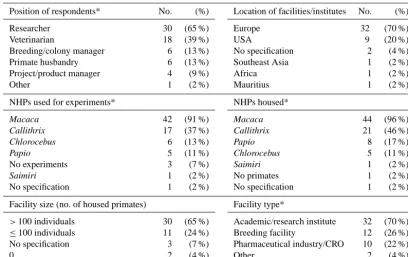
Table 1.Characterization of respondents and represented facilities (N=46).
Position of respondents* No. (%) Location of facilities/institutes No. (%)
Researcher 30 (65 %) Europe 32 (70 %)
Veterinarian 18 (39 %) USA 9 (20 %)
Breeding/colony manager 6 (13 %) No specification 2 (4 %)
Primate husbandry 6 (13 %) Southeast Asia 1 (2 %)
Project/product manager 4 (9 %) Africa 1 (2 %)
Other 1 (2 %) Mauritius 1 (2 %)
NHPs used for experiments* NHPs housed*
Macaca 42 (91 %) Macaca 44 (96 %)
Callithrix 17 (37 %) Callithrix 21 (46 %)
Chlorocebus 6 (13 %) Papio 8 (17 %)
Papio 5 (11 %) Chlorocebus 5 (11 %)
No experiments 3 (7 %) Saimiri 1 (2 %)
Saimiri 1 (2 %) No primates 1 (2 %)
No specification 1 (2 %) No specification 1 (2 %)
Facility size (no. of housed primates) Facility type*
>100 individuals 30 (65 %) Academic/research institute 32 (70 %)
≤100 individuals 11 (24 %) Breeding facility 12 (26 %)
No specification 3 (7 %) Pharmaceutical industry/CRO 10 (22 %)
0 2 (4 %) Other 2 (4 %)
* multiple responses possible; CRO: contract research organization
researchers (65 %) at academic or research institutes. More than 90 % of represented facilities and respondents housed or used macaques (genus Macaca). The second most com-monly used NHP was the common marmoset (Callithrix jac-chus), whereas other primates like baboons (Papio spp.) and African green monkeys (Chlorocebus spp.) were less fre-quently kept or used (Table 1).
3.2 Consideration of geographic origin, hybrid status and genetic variation
Most participants indicated that geographic origins are well known for the NHPs housed at represented facilities (37; 80 %) as well as for those NHPs which were used in exper-iments (40; 87 %; Fig. 1a). We obtained similar results for the knowledge of the presence or usage of hybrid individ-uals at represented facilities. Eighty percent of respondents specified that hybrids were either housed (12; 26 %) or not housed (25; 54 %) at their facility. Similarly, 78 % of par-ticipants reported that hybrids were used (8; 17 %) or not used (28; 61 %) for experiments at their facility. Only eight (17 %) candidates indicated uncertainty in the existence and usage of hybrids by responding with “I do not know” or “not aware of” hybrids (Fig. 1b). Furthermore, 24 (52 %) of the represented facilities put effort into maintaining pure breed-ing lineages from specific geographic regions or populations by selective breeding and purchasing, 14 (30 %) did not, and 5 (11 %) did not consider the geographic origin but did consider the respective species when breeding or purchasing
(4 % chose “I do not know” and 2 % “we do not house pri-mates”). Similarly, 28 (61 %) of respondents preferred an-imals from specific geographic regions or populations for their experiments. The remaining participants did not pre-fer populations from specific geographic regions (8; 17 %), or considered only the species level (8; 17 %); two (4 %) par-ticipants indicated that they did not conduct experiments.
We further asked participants whether they had already ex-perienced an influence of genetic variation in NHP model species on their experimental approaches or results. Twenty-one (46 %) of the respondents had already experienced an influence of genetic variation, most of whom were work-ing in the field of infectious disease (Fig. 2). Other respon-dents mentioned that genetic variation could produce certain background influences (e.g. differences in stress levels), and plays a role in metabolic or autoimmune diseases and in the development of collagen-induced arthritis (CIA; “others” in Fig. 2). Only five (11 %) participants had never experienced an influence of genetic variation, and seven (15 %) respon-dents answered that they had not specifically tested such an influence before. The remaining contributors (13; 28 %) chose the option “we do not conduct experiments with pri-mates”.
3.3 Genotyping behaviour of respondents and at represented facilities
0 20 40 60 80 100
Yes No Not of all Don't know No primates /experiments
%
o
f r
es
po
ns
es
Knowledge of geographic origin A
animals housed study animals
0 20 40 60 80 100
Yes No Not aware of Don't know No primates /experiments
%
o
f r
es
po
ns
es
Occurrence and usage of hybrids B
animals housed study animals
Figure 1.Knowledge of (a) geographic origin of primates housed and used in experiments, and (b) occurrence and usage of hybrids at represented facilities (N=46).
Fig02
0 10 20 30 40 50 60
Infectious disease Neurosciences Drug efficacy/safety Vaccine development Other No specification
% of responses
Figure 2.Frequency of experienced influence of genetic variation in major biomedical disciplines (N=21).
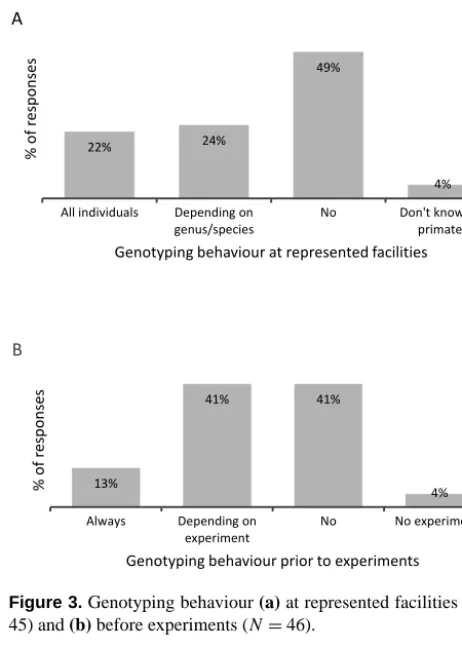
facility. In contrast, 10 (22 %) participants reported that all their NHPs were genotyped, and 11 (24 %) stated that only individuals of specific genera or species were genotyped (Fig. 3a). Of these latter respondents, all indicated that they used to type macaque individuals (M. mulatta (22 %), M. fas-cicularis (9 %), M. nemestrina (2 %), and only a few par-ticipants used to genotype individuals of the genera Papio (2 %), Chlorocebus (2 %), and Callithrix (2 %). We had to exclude the response of one candidate for this item, since he/she wrongly chose response options from more than one category (see Supplement, item 7).
22% 24%
49%
4% All individuals Depending on
genus/species No Don't know/Noprimates
%
o
f r
es
po
ns
es
Genotyping behaviour at represented facilities A
13%
41% 41%
4% Always Depending on
experiment No No experiments
%
o
f r
es
po
ns
es
Genotyping behaviour prior to experiments
B
Figure 3.Genotyping behaviour (a) at represented facilities (N= 45) and (b) before experiments (N=46).
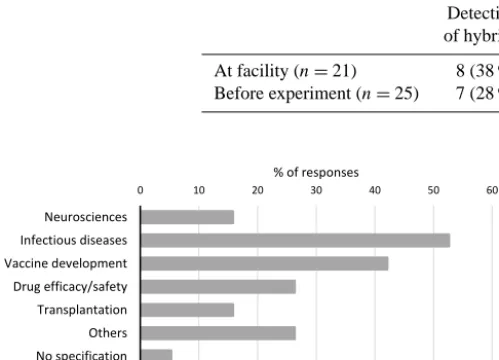
We further asked for the frequency of genotyping before animals are used in experiments. Here, 19 (41 %) respon-dents did not use to genotype animals before experiments, while 6 (13 %) of the participants indicated that study an-imals were always genotyped. Interestingly, 19 (41 %) re-spondents answered that they genotyped study animals de-pending on the type of experiment (Fig. 3b). Most of these participants are working in the fields of infectious disease and vaccine development (Fig. 4).
T. Haus et al.: Genotyping of non-human primate models 5
Table 2.Objectives for conducting genotyping at represented facilities in general (“at facility”) and prior to experiments (“before experi-ments”).Ncorresponds only to the number of respondents that conducted genotyping.
Detection (Sub)species/ Determination of
of hybrids geographic origin haplo/genotype
At facility (n=21) 8 (38 %) 10 (48 %) 20 (95 %)
Before experiment (n=25) 7 (28 %) 11 (44 %) 22 (88 %)
Fig04
0 10 20 30 40 50 60
Neurosciences Infectious diseases Vaccine development Drug efficacy/safety Transplantation Others No specification
% of responses
Figure 4.Genotyping frequency prior to experiments with regard to discipline (N=19).
3.4 Possibilities and hindrances for the implementation of genotyping
Of the 46 respondents, 24 (52 %) completely agreed with the statement that genotyping prior to experiments would reduce the number of test animals and at the same time increase the quality of the results. Six (13 %) did not agree with this state-ment and further six (13 %) had no opinion. The remaining participants (10; 22 %) provided different comments; for ex-ample, they argued that genotyping might increase the qual-ity of the results, but not that it could be used to reduce the number of test animals (3; 7 %), and others quoted that this supposition could not be generalized and depended on the ex-periment (4; 9 %). One participant commented that the num-ber of test animals could not be reduced, since the numnum-ber of animals in NHP studies is already very low and in some cases even statistically inadequate.
Most of the 46 participants stated that there were several hindrances or limiting factors that might impede genotyp-ing of breedgenotyp-ing and study animals (28; 61 %). Among them “limited budget” represented the most frequent factor (25; 54 %). Other relevant hindrances were “limited staff” (12; 26 %) and “limited time” (11; 24 %), and 7 (15 %) respon-dents indicated that the cost–benefit ratio would be too high. Other factors mentioned by the participants were the possi-bility of wrong genotyping results and the lack of interest of researchers. Two of them provided only a comment. Of the remaining respondents, 10 (22 %) did not believe that there were factors that might impede the application of genotyping of NHP model species, and 6 (13 %) chose the option “I do not know”.
Fig05
0 10 20 30 40 50
%
o
f r
es
po
ns
es
Methods and markers
Figure 5.Preferred genotyping methods and markers according to responses (N=46). WGS: whole-genome sequencing; WES: whole-exome sequencing; SNP: single-nucleotide polymorphisms; STR: short tandem repeats; mtDNA: mitochondrial DNA; YDNA: Y chromosomal DNA; MHC: major histocompatibility complex.
Of the 46 respondents, 27 (59 %) indicated that there were factors which further impede the implementation of geno-typing results in research approaches, primate breeding or husbandry. Among them the most frequent factor was the limited number of available NHP individuals with specific genotypes (20; 44 %). Other factors were difficulties in selec-tive breeding (16; 35 %), e.g. artificial insemination or group housing and the maintenance of genetic diversity in breeding colonies (14; 30 %). Furthermore, respondents mentioned the difficulty of interpreting and analysing genotyping results as well as the lack of interest of investigators or institutes. An-other fact pointed out was the limited number of vendors to order NHPs due to banning of NHP transport by airlines. Two of the respondents provided only a comment. Eleven (24 %) participants did not think that there were problems with the implementation of genotyping results, and seven (15 %) re-spondents chose the option “I do not know”.
4 Discussion
et al., 2014). Since this survey was strictly anonymous, we were not able to control for the number of participants per institute. Accordingly, background data on represented facil-ities, as well as on NHP species housed or used, must be in-terpreted carefully. Similarly, biomedical disciplines are not equally represented by participants and do not allow for anal-ysis of differences between disciplines. However, the high frequency of macaques in NHP research is in concordance with previous statements and studies (Carlsson et al., 2004; Fang et al., 2011; Lankau et al., 2014). We observed some discordance across response behaviours. The question “Have you ever experienced an influence of genetic variation in non-human primates on your experimental approaches or re-sults?” (item 12, Supplement) was most probably not reli-ably answered by several of the 13 participants who chose “I do not conduct experiments with primates”. According to personal background data (Table 1), only three respon-dents indicated that they did not conduct experiments with NHPs, which is also in concordance with responses to most of the other questions. We assume that this misrepresenta-tion occurred due to the lack of “no specificamisrepresenta-tion” or “I do not know” options in that item. However, for most questions these options were available to avoid false-positive or nega-tive responses (Supplement).
4.1 Knowledge and significance of geographic origin, hybrid status and genetic variation
Our survey identified that more than three-quarters of both the participants and the represented facilities claim to have good genetic background knowledge of their breeding and study animals with respect to geographic origin and hybrid status. Moreover, more than half of the represented facilities have an interest in the maintenance of pure breeding lineages from specific geographic regions or populations by selective breeding or purchasing, which implies a good knowledge of genetic background data of animals. The availability of pure breeding lineages from specific geographic regions is par-ticularly important for disciplines like infectious diseases, in which the genetic make-up of study animals can have a sig-nificant influence on experimental results (e.g. Reimann et al., 2005). This is supported by 46 % of the participants who had already experienced an influence of genetic variation on their results. More than half of these respondents were work-ing in the field of infectious disease. Although less repre-sented in this study, genetic variation also plays an influential role in neurosciences, drug and vaccine development, arthri-tis research, and research into metabolic or autoimmune dis-eases (Fig. 2).
Interestingly, 48 % of represented facilities did not geno-type their NHPs, and 41 % of respondents did not genogeno-type their study animals prior to experiments. Compared to the much greater number of respondents and represented facil-ities that specified to know the geographic origins and hy-brid status of their animals (≥80 %), these statements must
be treated carefully. It is assumed that geographic origins of imported NHPs cannot be reliably traced back, because a significant number of traded animals, especially macaques, are not directly imported from their native country of origin (Street et al., 2007; Hsu, 2011). Moreover, past hybridization events as well as different geographic origins are often not detectable based on phenotypical characters (Kanthaswamy et al., 2008, 2014; Haus et al., 2013a, b; Roos and Zinner, 2014), challenging a later species determination. Accord-ingly, genotyping represents the only method to reliably identify species status, geographic origin, and potential ad-mixture with individuals from other populations or with for-eign species (Yan et al., 2011; Kanthaswamy et al., 2014). Thus, with respect to the high intra- and interspecies ge-netic diversity as well as the not-infrequent presence of intro-gressed individuals in some NHP model species, our survey results identified a huge lack of genetic background knowl-edge in study and breeding animals. Moreover, most of the participants who conducted genotyping intended to deter-mine geno- and haplotypes (>85 %), and only less than 50 and 30 % intended to characterize the geographic origin and hybrid status, respectively (Table 2). We recommend that pri-mate facilities and researchers start to pay much greater at-tention to the genetic make-up of their animals and to geno-type their NHPs more frequently to characterize their genetic background and ancestry. This is of particular importance since macaques, which are genetically highly diverse (Street et al., 2007; Yuan et al., 2012; Kanthaswamy et al., 2014; Roos and Zinner, 2014), represent the most frequently used and housed primate genus (results of this survey; Lankau et al., 2014).
4.2 Implementation of genotyping in research and breeding management
T. Haus et al.: Genotyping of non-human primate models 7
of the progress in biomedical research (Bosinger et al., 2011; Yan et al., 2011; Rogers, 2013; Rabbani et al., 2014; Haus et al., 2014). Such an approach would substantially increase our understanding of gene variants and respective susceptibilities to diseases and disorders (Bosinger et al., 2011; Ebeling et al., 2011; Rogers and Gibbs, 2014).
More than 30 % of participants had no opinion about the methods and markers of choice for genotyping. This uncertainty also includes the interpretation and analysis of genome-wide collected data, which was mentioned by some participants as hindrance for the implementation of geno-typing results in biomedical research. A general problem for the implementation of genotyping might be that the fast progress in the development of modern high-throughput se-quencing techniques represents a challenge for non-experts on this field. However, with a continuing development to-wards genetic-based research in human biomedicine, e.g. in personalized medicine (Simon and Roychowdhury, 2013; Workman et al., 2013), primate facilities and institutes work-ing with NHPs need to invest in specialized staff to manage these challenges.
Another important factor is the limited number of available individuals of a specific genotype, which was the most fre-quently mentioned hindrance in this survey. If genotyping be-comes a common tool in biomedical research, requests for in-dividuals of specific genotypes will inevitably increase. One possibility to accommodate such a demand is to selectively breed eligible genotypes for specific research fields. How-ever, this will be a long process due to the slow reproduction of NHPs (Carlsson et al., 2004). European and US breed-ing colonies are not able to supply the current demand for NHPs for biomedical research, and researchers and industries still rely on the import of thousands of NHPs from South-east Asia, China, Mauritius and Israel yearly (Goodman and Check, 2002; Carlsson et al., 2004; Lankau et al., 2014). Moreover, despite the request for specific genotypes today, we have to ensure that the genetic diversity of NHP models in captivity is maintained for future research fields, restricting the extent of selective breeding (results of this study; Haus et al., 2014). Other problems derive from primate husbandry. Artificial insemination is non-trivial in many NHP species and not consistent with other efforts within the framework of the three R’s like group housing and the general refinement of procedures.
Despite these hindrances, 59 % of participants expected that the usage of genotyped individuals would increase the reliability and efficacy of the results, and 52 % of the respon-dents believed that the number of NHPs in experiments could be reduced through genotyping. As a first step, we recom-mend that much more emphasis be put into separating and maintaining pure breeding lineages from specific geographic regions and populations as outlined in Haus et al. (2014). Subsequently, the establishment of genomic data banks for these colonies would highly advance NHP research by en-abling a better exchange of information, NHPs and NHP
material of specific haplotypes across facilities – something that has already been started up by the National Primate Re-search Centers (NPRCs) in the US (Ferguson et al., 2009; Kanthaswamy et al., 2009). Such approaches can further re-duce the background noise in biomedical experiments, since they allow for selection of study subjects from the same ge-ographic origins for a single experiment (Haus et al., 2014). This might be particularly beneficial with regard to the oc-currence of introgression as a result of past hybridization in macaques and other NHP model species, because individ-uals from the same geographic origins are usually equally affected by genomic admixture (Stevison and Kohn, 2009; Roos and Zinner, 2014).
5 Conclusions
Genetic variation of NHP model species can affect the out-come of experiments in diverse biomedical disciplines. Ac-cordingly, there is an increasing trend of considering the ge-ographic origins of study subjects, which can be reliably de-termined only on a genetic basis. Our survey results indi-cate that genotyping to characterize the genetic background of study animals needs much more consideration in future biomedical research. To this end, genotyping has a great po-tential to reduce the number of animals in NHP research and to refine experimental approaches and the reliability of re-sults. Thereby comparative whole-genome sequencing data might represent an essential basis for the application of geno-typing in future research. Once genomic data sets are estab-lished, a wide range of researchers should be able to use markers like MHC and SNPs, which are the most promis-ing tools to genotype and select study subjects dependpromis-ing on the experiment.
Author contributions. T. Haus, K. Prinz, B. Pauling and C. Roos designed the project and developed the online survey. T. Haus con-ducted the analysis and wrote the manuscript with contributions from all co-authors.
The Supplement related to this article is available online at doi:10.5194/pb-1-1-2014-supplement.
Acknowledgements. We thank Robert Teepe, Gerhard Wein-bauer and Uwe Schönmann for providing helpful discussions and comments during the development of the online survey, as well as Stefan Treue for commenting on a previous version of the manuscript. We are grateful to all respondents for participating in our survey. This work has been supported by EUPRIM-Net under the EU grant agreement 262443 of the 7th Framework Programme.
Edited by: J. Tung
References
Bontrop, R. E.: Non-human primates: essential partners in biomedi-cal research, Immunologibiomedi-cal Rev., 183, 5–9, doi:10.1034/j.1600-065x.2001.1830101.x, 2001.
Bosinger, S. E., Johnson, Z. P., and Silvestri, G.: Primate genomes for biomedicine, Nat. Biotechnol., 29, 983–4, doi:10.1038/nbt.2032, 2011.
Carlsson, H.-E., Schapiro, S. J., Farah, I., and Hau, J.: Use of pri-mates in research: a global overview, Am. J. Primatol., 63, 225– 237, 2004.
Ebeling, M., Küng, E., See, A., Broger, C., Steiner, G., Berrera, M., Heckel, T., Iniguez, L., Albert, T., Schmucki, R., Biller, H., Singer, T., and Certa, U.: Genome-based analy-sis of the nonhuman primate Macaca fascicularis as a model for drug safety assessment, Genome Res., 21, 1746–1756, doi:10.1101/gr.123117.111, 2011.
EC (European Commission): Seventh Report on the Statistics on the Number of Animals used for Experimental and other Scientific Purposes in the Member States of the European Union, available at: http://eur-lex.europa.eu/resource.html?uri=cellar: d2e73ac5-60d0-11e3-ab0f-01aa75ed71a1.0001.01/DOC_ 1&format=_PDF (last access: 13 June 2014), 2013.
Editorial: Reduce, refine, replace, Nat. Immunol., 11, 971, doi:10.1038/ni1110-971, 2010.
EU (European Union): Directive 2010/63/EU of the
Eu-ropean Parliament and the Council on the protection
of animals used for scientific purposes, Official
Jour-nal of the European Union, L276/33, available at:
http://eur-lex.europa.eu/LexUriServ/LexUriServ.do?uri=OJ: L:2010:276:0033:0079:en:PDF (last access: 19 May 2014), 2010.
Fang, X., Zhang, Y., Zhang, R., Yang, L., Li, M., Ye, K., Guo, X., Wang, J. and Su, B. Genome sequence and global sequence vari-ation map with 5.5 million SNPs in Chinese rhesus macaque, Genome. Biol., 12, R63, doi:10.1186/gb-2011-12-7-r63, 2011. Ferguson, B., Capitanio, J., Folks, T., Hotchkiss, C., Johnson, Z.,
Kean, L., Kubisch, H. M., Lank, S., Lyons, L., Miller, G. M., Nylander, J., O’Connor, D., Vallender, E. J., and Wiseman, R.: Resource brief: the National Non-Human Primate DNA Bank, Methods, 49, 3–4, doi:10.1016/j.ymeth.2009.07.011, 2009. Goodman, S. and Check, E.: The great primate debate, Nature, 417,
684–687, doi:10.1038/417684a, 2002.
Guhad, F.: Introduction to the 3Rs (refinement, reduction and re-placement), Contemp. Top. Lab. Anim. Sci., 44, 58–59, 2005. Hau, J. and Schapiro, S. J.: Non-human primates in biomedical
re-search, Scand. J. Lab. Anim. Sci., 33, 9–12, 2006.
Haus, T., Akom, E., Agwanda, B., Hofreiter, M., Roos, C., and Zin-ner, D.: Mitochondrial diversity and distribution of African green monkeys (Chlorocebus Gray, 1870), Am. J. Primatol., 75, 350– 360, doi:10.1002/ajp.22113, 2013a.
Haus, T., Roos, C., and Zinner, D.: Discordance Between Spatial Distributions of Y-Chromosomal and mitochondrial haplotypes in African green monkeys (Chlorocebus spp.): a result of intro-gressive hybridization or cryptic diversity?, Int. J. Primatol., 34, 986–999, doi:10.1007/s10764-013-9717-5, 2013b.
Haus, T., Ferguson, B., Rogers, J., Doxiadis, G., Certa, U., Rose, N. J., Teepe, R., Weinbauer, G. F., and Roos, C.: Genome typing of nonhuman primate models: implications for biomedical research,
Trends Genet., 1–6, doi:10.1016/j.tig.2014.05.004, online first, 2014.
Hsu, C. K.: China as a resource for NHP, in: Animal Research in a Global Environment – Meeting the Challenges, 224–227, The National Academies Press, Washington D.C., 2011.
Kanthaswamy, S., Satkoski, J., George, D., Kou, A., Erickson, B. J.-A., and Smith, D. G.: Interspecies hybridization and the strat-ification of nuclear genetic variation of rhesus (Macaca mulatta) and long-tailed macaques (Macaca fascicularis), Int. J. Prima-tol., 29, 1295–1311, doi:10.1007/s10764-008-9295-0, 2008. Kanthaswamy, S., Capitanio, J. P., Dubay, C. J., Ferguson, B., Folks,
T., Ha, J. C., Hotchkiss, C. E., Johnson, Z. P., Katze, M. G., Kean, L. S., Kubisch, H. M., Lank, S., Lyons, L. a, Miller, G. M., Ny-lander, J., O’Connor, D. H., Palermo, R. E., Smith, D. G., Vallen-der, E. J., Wiseman, R. W., and Rogers, J.: Resources for genetic management and genomics research on non-human primates at the National Primate Research Centers (NPRCs), J. Med. Prima-tol., 38, 17–23, doi:10.1111/j.1600-0684.2009.00371.x, 2009. Kanthaswamy, S., Johnson, Z., Trask, J. S., Ramakrishnan, R.,
Bahk, J., Ng, J., Wiseman, R., Kubisch, H. M., Vallender, E. J., Smith, D. G., Rogers, J., and Ferguson, B.: Development and validation of a SNP-based assay for inferring the genetic an-cestry of rhesus macaques (Macaca mulatta), Am. J. Primatol., doi:10.1002/ajp.22290, online first, 2014.
Lankau, E. W., Turner, P. V., Mullan, R. J., and Galland, G. G.: Use of nonhuman primates in research in North America, J. Am. Assoc. Lab. Anim. Sci., 53, 278–282, 2014.
Leiner, D. J.: SoSci Survey (Version 2.4.00-i), Computer Software, available at: https://www.soscisurvey.de, last access: 30 April 2014.
Luetjens, C. M. and Weinbauer, G. F.: Functional assessment of sexual maturity in male macaques (Macaca fascicularis), Regul. Toxicol. Pharmacol., 63, 391–400, 2012.
Mee, E. T., Berry, N., Ham, C., Sauermann, U., Maggiorella, M. T., Martinon, F., Verschoor, E. J., Heeney, J. L., Le Grand, R., Titti, F., Almond, N., and Rose, N. J.: Mhc haplotype H6 is associated with sustained control of SIVmac251 infection in Mauritian cynomolgus macaques, Immunogenetics, 61, 327–39, doi:10.1007/s00251-009-0369-8, 2009.
Mee, E. T., Berry, N., Ham, C., Aubertin, a, Lines, J., Hall, J., Steb-bings, R., Page, M., Almond, N., and Rose, N. J.: Mhc haplo-type M3 is associated with early control of SHIVsbg infection in Mauritian cynomolgus macaques, Tissue Antigens, 76, 223–229, doi:10.1111/j.1399-0039.2010.01500.x, 2010.
Mothé, B. R., Weinfurter, J., Wang, C., Rehrauer, W., Wilson, N., Allen, T. M., Allison, D. B., and Watkins, D. I.: Expres-sion of the Major Histocompatibility Complex Class I Molecule Mamu-A * 01 is associated with control of simian immunod-eficiency virus SIV mac 239 replication, J. Virol., 77, 2736, doi:10.1128/JVI.77.4.2736, 2003.
Rabbani, B., Tekin, M., and Mahdieh, N.: The promise of whole-exome sequencing in medical genetics, J. Hum. Genet., 59, 5–15, doi:10.1038/jhg.2013.114, 2014.
T. Haus et al.: Genotyping of non-human primate models 9
with early T-lymphocyte responses, J. Virol., 79, 8878–8885, doi:10.1128/JVI.79.14.8878, 2005.
Roelfsema, P. R. and Treue, S.: Basic neuroscience research with nonhuman primates: a small but indispensable component of biomedical research, Neuron, 82, 1200–1204, 2014.
Rogers, J.: In transition: primate genomics at a time of rapid change, ILAR J., 54, 224–233, 2013.
Rogers, J. and Gibbs, R. A: Comparative primate genomics: emerg-ing patterns of genome content and dynamics, Nat. Rev. Genet., 15, 347–359, doi:10.1038/nrg3707, 2014.
Rogers, J., Raveendran, M., Fawcett, G. L., Fox, a S., Shelton, S. E., Oler, J. A, Cheverud, J., Muzny, D. M., Gibbs, R. A, Davidson, R. J., and Kalin, N. H.: CRHR1 genotypes, neural circuits and the diathesis for anxiety and depression, Mol. Psychiatry, 18, 700– 707, doi:10.1038/mp.2012.152, 2013.
Roos, C. and Zinner, D: Diversity and evolutionary history of macaques with special focus on rhesus and long-tailed macaques, in: The Nonhuman Primate in Nonclinical Drug Development and Safety Assessment, edited by: Blümel, J., Korte, S., Schenck, E., and Weinbauer, G. F., Elsevier, in press, 2014.
Russell, W. M. S. and Burch, R. L.: The principles of humane ex-perimental technique, Methuen and Co. Ltd, London, 1959. Saito, Y., Naruse, T. K., Akari, H., Matano, T., and Kimura, A.:
Diversity of MHC class I haplotypes in cynomolgus macaques, Immunogenetics, 64, 131–141, doi:10.1007/s00251-011-0568-y, 2012.
SCHER (Scientific Committee on Health and Environmental Risks): The need for non-human primates in biomedical re-search, production and testing of products and devices, European Commission, 38 pp., available at: http://ec.europa.eu/health/ph_ risk/committees/04_scher/docs/scher_o_110.pdf (last access: 27 June 2014), 2009.
Seekatz, A. M., Panda, A., Rasko, D. A., Toapanta, F. R., Eloe-Fadrosh, E. A, Khan, A. Q., Liu, Z., Shipley, S. T., Detolla, L. J., Sztein, M. B., and Fraser, C. M.: Differential response of the cynomolgus macaque gut microbiota to Shigella infection, PLoS One, 8, e64212, doi:10.1371/journal.pone.0064212, 2013.
Simon, R. and Roychowdhury, S.: Implementing personalized can-cer genomics in clinical trials, Nat. Rev. Drug Discov. 12, 358– 369, 2013.
Stevison, L. S. and Kohn, M. H.: Divergence population ge-netic analysis of hybridization between rhesus and cynomol-gus macaques, Mol. Ecol., 18, 2457–2475, doi:10.1111/j.1365-294X.2009.04212.x, 2009.
Street, S. L., Kyes, R. C., Grant, R., and Ferguson, B.: Single nucleotide polymorphisms (SNPs) are highly conserved in rhe-sus (Macaca mulatta) and cynomolgus (Macaca fascicularis) macaques, BMC Genomics, 8, 480, doi:10.1186/1471-2164-8-480, 2007.
Workman, P., Al-Lazikani, B., and Clarke, P. A.: Genome-based cancer therapeutics: targets, kinase drug resistance and future strategies, Curr. Opin. Pharmacol., 13, 486–496, 2013.
Yan, G., Zhang, G., Fang, X., Zhang, Y., Li, C., Ling, F., Cooper, D. N., Li, Q., Li, Y., Gool, A. J. Van, Du, H., Chen, J., Chen, R., Zhang, P., Huang, Z., Thompson, J. R., Meng, Y., Bai, Y., Wang, J., Zhuo, M., Wang, T., Huang, Y., Wei, L., Li, J., Wang, Z., Hu, H., Yang, P., Le, L., Stenson, P. D., Li, B., Liu, X., Ball, E. V, An, N., Huang, Q., Zhang, Y., Fan, W., Zhang, X., Li, Y., Wang, W., Katze, M. G., Su, B., Nielsen, R., and Yang, H.: Genome se-quencing and comparison of two nonhuman primate animal mod-els, the cynomolgus and Chinese rhesus macaques, Nat. Biotech-nol., 29, 1019–1025, doi:10.1038/nbt.1992, 2011.