R E S E A R C H
Open Access
Relationship between risk perception and
occupational accidents: a study among
foundry workers
Mohammad Javad Jafari
1, Fahimeh Saghi
1*, Ebrahim Alizadeh
2and Farid Zayeri
3Abstract
Background:Risk perception is an effective factor in the determining of the incidence of unsafe behaviors and the occurrence of occupational accidents in the workplace.
Objective:The purpose of this study is to determine the relationship between risk perception and occupational accidents among foundry workers in Tehran, Iran.
Methods:In this cross-sectional study, all male workers in a foundry unit were initially selected (n= 245). After applying the study criteria and dismissing incomplete returned questionnaires, only 109 workers were included in the study. The General Health Questionnaire and the Flynn et al. Risk Perception Questionnaire were used to assess the mental health and risk perception of workers, respectively. Data regarding the occupational accidents of workers were also extracted from the accidents’records of the foundry. Workers with a record of occupational accidents during 2013–2016 were compared with workers without an occupational accident record.
Results:Findings showed that a one-unit increase in the risk perception score resulted into an increase of
approximately 33% in the odds of the occurrence of occupational accidents, but this rate was not significant (p= 0.695). In addition, the study found no significant relation between the risk perception score and the frequency of occupational accidents (Spearman’s r= 0.003,p= 0.977).
Conclusion:There is no statistically significant relationship between risk perception and occupational
accidents among foundry workers in Tehran, Iran.
Keywords:Accidents, Occupational, Perception, Risk
1 Introduction
Occupational accidents are of major concern in both de-veloped and developing countries because of their detri-mental effects on health, society, and economy [1]. According to an estimation carried out by the Inter-national Labor Organization, approximately 340 million occupational accidents occur annually throughout the world [2]. Therefore, it is essential that preventive
programs consider the causes of occupational accidents and the underlying factors affecting them.
Risk perception is defined as“an individual’s subjective judgment about the characteristics and severity of risks” [3]. Risk perception is one of the human features that affect an individual’s behavior in as such that the incor-rect perception of risks is considered as a factor in the incidence of unsafe behaviors [4–6]. An increase in the level of an individual’s risk perception leads to an in-crease in the incidence of safe behaviors [4].
Studies have shown that unsafe behaviors are the major cause of occupational accidents [1,7] and poor or incorrect perception of a workplace’s risks (or even the lack of risk perception) is a factor contributing to the in-cidence of occupational accidents [1,3,8].
© The Author(s). 2019Open AccessThis article is distributed under the terms of the Creative Commons Attribution 4.0 International License (http://creativecommons.org/licenses/by/4.0/), which permits unrestricted use, distribution, and reproduction in any medium, provided you give appropriate credit to the original author(s) and the source, provide a link to the Creative Commons license, and indicate if changes were made.
* Correspondence:[email protected]
1Department of Occupational Health Engineering, School of Public Health
During the casting process in a foundry, workers are ex-posed to various hazards (such as noise, pollution, vibra-tion, or heat) or accidents (such as explosions, fires, or burns) [9]. The present study aimed at determining the re-lationship between risk perception and the occurrence and frequency of occupational accidents among workers of a foundry unit in Tehran, Iran, in 2016.
2 Methods
2.1 Study design and participants
In this cross-sectional analytical study, all male workers (n= 245) in a foundry unit in Tehran were initially included as the study population. The inclusion criteria were as follows: having a mental health score of 0–22 in the 28-item General Health Questionnaire, and having at least 3 years of job experience in the unit (as workers’ occupational accidents over 3 years will be investigated). The attrition effect of the workers was considered as study exclusion criteria. After applying the study criteria and dismissing incomplete returned questionnaires, only 109 workers were included in the study. Data was collected during June to September 2016.
2.2 Tools
2.2.1 Questionnaires
The workers completed the questionnaires in the form of self-reporting. The 28-item General Health Questionnaire has been used to determine the severity of the individual’s mental disorders [10]. This questionnaire consists of four subscales:“somatic symptoms,” “anxiety,” “social dysfunc-tion,” and “depression” [11]. The validity of the Persian version of this questionnaire (Nazifi et al.) showed that Cronbach’s alpha coefficient for the somatic symptoms, anxiety and insomnia, social dysfunction, severe depres-sion, and questionnaire’s total scale were 0.865, 0.883, 0.746, 0.897, and 0.923, respectively [12]. In the study by Yaghoubi et al., [11] and Noorbala and Mohammad [13], the reliability coefficient of this questionnaire has also been reported as 0.88 and 0.91 respectively. The total score ranges from 0 to 84. A score of 0–22 in the 28-item General Health Questionnaire indicates that there is no (or minimum) level of mental disorder in the worker. A score range of 23–40 is considered mild, 41–60 is moderate, and 61–84 is considered as severe mental disorders [10].
The Flynn et al. Risk Perception Questionnaire has been used to assess an individual’s risk perception. This ques-tionnaire consists of two major parts: (a) general informa-tion and (b) 133 quesinforma-tions divided into 10 separate secinforma-tions (entitled in order as“job situation,” “the physical conditions of working environment,” “the experience of risk-hazards,” “the probability of injury,” “the experience of risk-work tasks,” “job satisfaction,” “the assessment of safety,” “safety and accidents prevention,” “personal support and receiving help from others,” and “the experience of accidents and
near-misses.”This questionnaire was validated by Soltani in Iran (2016). The content validity ratio, the content validity index, and Cronbach’s Alpha coefficient of this question-naire were reported as 0.77, 0.96, and 0.93, respectively. The average of all scores for the domains of the Risk Per-ception Questionnaire was considered as the risk percep-tion score. After evaluapercep-tion, the worker receives a score of 1–5 (the minimum and maximum scores of the perception risk are 1 and 5, respectively) [14].
2.2.2 Records
The data related to the occupational accidents of workers (the occurrence of occupational accidents and the frequency of accidents) were extracted from the re-cords of occupational accidents of the foundry. In order to obtain adequate information and generalizable infer-ence, the data related to the occupational accidents over a consecutive 3-year period (2013–2016) was extracted. The workers with an occupational accidents’record dur-ing 2013–2016 were compared with the workers without an occupational accident record (in terms of job cat-egory, age, and job experience).
2.2.3 Occupational accidents
In this study, occupational accident occurrence was de-fined as any occupational accident which has occurred (i.e., the occurrence or non-occurrence of accidents). The occupational accidents frequency for each worker was determined by counting the number of occupational accidents that had occurred over the past 3 years (from 2013 to 2016) for the individual.
2.3 Statistical analysis
3 Results
3.1 Participant characteristics
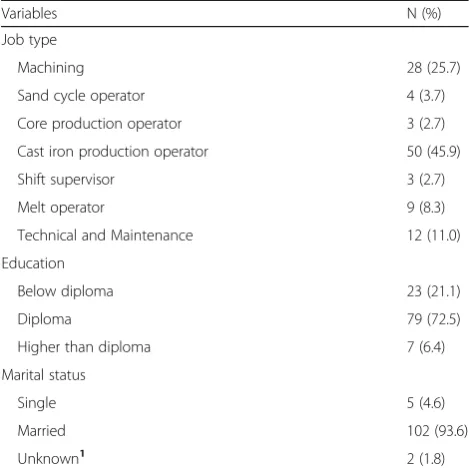
In this study, all workers (N= 109) were males. Most of them were married (93.6%) and the majority was educated up to the level of diploma (72.5%). The demographic vari-ables of workers are presented in Tvari-ables1and2.
3.2 Occupational accidents
Table 3 shows the frequency distribution of workers by the occurrence of occupational accidents. Less than half of the workers (46.8%) had ever experienced occupa-tional accidents.
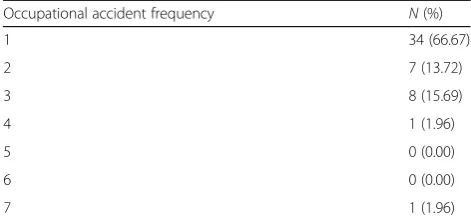
Table 4 shows the frequency distribution of occupa-tional accidents among injured workers in the foundry. The majority experienced one accident while none of the injured workers had experienced five or six occupa-tional accidents.
3.3 Risk perception
The risk perception score is slightly higher among in-jured workers than those who had not been inin-jured, but this difference was not statistically significant, as shown in Table5.
3.4 Relationship between risk perception and occupational accidents
Table 6 shows the results of investigating the relation-ship between risk perception score and occupational ac-cident occurrence. With a single unit increase in the risk perception score, the odds of occupational accident oc-currence increased by about 33%; however, this rate was not statistically significant.
In this study, the distribution of the workers’risk percep-tion score and the distribupercep-tion of the workers’occupational accident frequency was normal and non-normal, respect-ively. Thus, in order to determine the association between the risk perception score and occupational accident fre-quency, the Spearman correlation coefficient was used. This coefficient showed that there is no statistically significant relationship between the risk perception score and occupa-tional accident frequency (Spearman’sr= 0.003,p= 0.977).
4 Discussion
The present study was performed with the aim of deter-mining the relationship between risk perception and
occupational accidents among the workers of a foundry unit in Iran. The risk perception score of workers with an occupational accident record was higher than those without an occupational accident record. However, the observed difference was not statistically significant be-tween both groups. One of the reasons for this non-significant difference may be the small sample size used in this study.
The results obtained by the present study are parallel to those obtained by Cezar-Vaz et al. who carried out a similar study among apprentice welders. Their results indicated that apprentice welders with an occupational accident rec-ord had higher risk perception than those without an occu-pational accident record [15]. In another study carried out by Cezar-Vaz et al., to identify risk perception and the types of occupational accidents among gas station workers, the perception of chemical risk was reported more among workers having records of chemical risk-related occupa-tional accidents [16]. In a study done by Rundmo with the purpose of investigating the relationship between risk per-ception, job stress, and the frequency of accidents and near-accidents among petroleum personnel, it was observed
Table 1Descriptive statistics for quantitative demographic variables of foundry workers (N= 109) in Tehran, Iran, 2016
Variables Min Mean ± SD Max Age (year) 28 39.15 ± 5.22 57 Job experience1(year) 3 12.84 ± 5.49 26 Work experience2(year) 5 14.59 ± 5.07 26
1
The duration of employment in the current job
2
The duration of employment in the current job and other jobs
Table 2Distribution of categorical demographic variables of foundry workers (N= 109) in Tehran, Iran, 2016
Variables N (%) Job type
Machining 28 (25.7) Sand cycle operator 4 (3.7) Core production operator 3 (2.7) Cast iron production operator 50 (45.9) Shift supervisor 3 (2.7) Melt operator 9 (8.3) Technical and Maintenance 12 (11.0) Education
Below diploma 23 (21.1) Diploma 79 (72.5) Higher than diploma 7 (6.4) Marital status
Single 5 (4.6) Married 102 (93.6) Unknown1 2 (1.8)
1
In the status of Unknown, workers have not specified their marital status in the questionnaire
Table 3Distribution of foundry workers by occupational accident occurrence (N= 109) in Tehran, Iran, 2016
Occupational accident occurrence N(%)
Yes 51 (46.8)
No 58 (53.2)
that job stress and risk perception have a significant contri-bution in the rate of human errors and injuries (25% of the dependent variable variation was described by the inde-pendent variable (R2= 0.25)) [17].
It is expected that by increasing an individuals’ risk perception, the occurrence of occupational accidents will be reduced [1]. Conversely, it should be taken into ac-count that the occurrence of occupational accidents can also increase an individual’s risk perception [18].
4.1 Study limitations
The relatively small sample size due to the screening of the workers in terms of mental health, the impossibility of evaluating the risk perception of workers before an occupational accident, and the inability to perform stat-istical tests to investigate the cause and time of accident occurrence due to the small sample size is considered as some limitations of the present study.
Risk perception is a human factor; hence, in order to in-vestigate the relationship between risk perception and oc-cupational accidents, it is proposed that only the accidents caused by human factors, i.e., unsafe acts, be considered. In addition, in order to obtain information about the effect of risk perception on occupational accident occurrence, it is suggested that the risk perception of individuals be assessed before the occurrence of occupational accidents.
5 Conclusion and recommendation
The present study found no significant relationship be-tween the risk perception score with the occurrence and frequency of occupational accidents. The researchers
recommend conducting studies with a larger sample size to assess the aforementioned relationship with more accuracy.
Investigating the relationship between risk perception and occupational accidents and paying attention to this relationship in preventive programs could play an im-portant role in the control of occupational accidents in the future.
Acknowledgements
This manuscript has been adopted from Fahimeh Saghi’s M.Sc. dissertation, under the supervision of Dr. Mohammad Javad Jafari and with the advice of Dr. Ebrahim Alizadeh and Dr. Farid Zayeri. The authors of this article sincerely appreciate the cooperation extended by the authorities and workers of the foundry unit and the authorities of Shahid Beheshti University of Medical Sciences.
Authors’contributions
All authors have made contributions to the conception and design of the study. FS collected the research data. FZ conducted the analysis and interpretation of data. FS wrote the manuscript and MJJ, FZ, and EA revised it. All authors read and approved the final manuscript.
Funding
This study has been funded by the corresponding author.
Availability of data and materials
Data can be made available from the corresponding author upon request and with the permission of foundry authorities.
Ethics approval and consent to participate
The study protocol was approved by the research ethics committee at Shahid Beheshti University of Medical Sciences, Tehran, Iran (IRB no. IR.SBMU.PHNS.REC.1395.31).
The study proposal was presented to the managerial body of the foundry and their approval was obtained prior to carrying out the study (such as informed written consent of participants to take part in the study, the anonymity of the applicants, and the confidentiality of information related to the participants) were considered during all stages of the study.
Consent for publication
Not applicable.
Competing interests
The authors declare that they have no competing interests.
Author details
1Department of Occupational Health Engineering, School of Public Health
and Safety, Shahid Beheshti University of Medical Sciences, Tehran, Iran.
2
Department of Applied Psychology, Faculty of Education and Psychology, Shahid Beheshti University, Tehran, Iran.3Proteomics Research Center and
Department of Biostatistics, Faculty of Paramedical Sciences, Shahid Beheshti University of Medical Sciences, Tehran, Iran.
Table 5Descriptive statistics for foundry workers’risk
perception score by injury occurrence (N= 109) in Tehran, Iran, 2016
Injury Min Mean ± SD Max pvalue Injured 2.32 2.84 ± 0.26 3.42 0.699 Not injured 2.29 2.82 ± 0.26 3.27
Total 2.29 2.83 ± 0.26 3.42
Table 6Results of logistic regression analysis for assessing the relationship between risk perception score and occupational accident occurrence of foundry workers in Tehran, Iran, 2016
Independent variable
Coefficient
β Standarderror pvalue
Odds ratio 95% confidence interval Risk perception
score
0.29 0.742 0.695 1.337 0.312–5.724
Table 4Distribution of the number of occupational accidents in the injuredfoundry workers (N= 51) in Tehran, Iran, 2016
Occupational accident frequency N(%)
1 34 (66.67)
2 7 (13.72)
3 8 (15.69)
4 1 (1.96)
5 0 (0.00)
6 0 (0.00)
Received: 29 January 2019 Accepted: 5 September 2019
References
1. Ghahramani A, Abbasi A. Assessment of the relationship between occupational accident experience and personal and job factors in tar paper manufacturing companies. Iran Occup Health. 2016;12:48–57.
2. International Labor Organization (ILO). World Statistic: the enormous burden of poor working conditions; [cited 2018 Aug 18].http://www.ilo.org/ moscow/areas-of-work/occupational-safety-and health/WCMS_249278/ lang%2D%2Den/index.htm.
3. Jahangiri M, Sareban Zadeh K, Bashar O, Saleh Zade H. Investigation risk perception, safety attitude and safety performance in supervisors of construction sites Shiraz-Iran. Iran J Ergon. 2013;1:10–8.
4. Jafari M, Kouhi F, Movahedi M, Allah-Yari T. The effect of job safety analysis on risk perception of workers at high risk jobs in a refinery. Iran Occup Health. 2010;6:12–25.
5. Arezes PM, Miguel AS. Risk perception and safety behaviour: a study in an occupational environment. Safety Sci. 2008;46:900–7.
6. Xia N, Wang X, Griffin MA, Wu C, Liu B. Do we see how they perceive risk? An integrated analysis of risk perception and its effect on workplace safety behavior. Accid Anal Prev. 2017;106:234–42.
7. Neissi A, Hashemi Sheykhshaba E, Rahimi Pordanjani T, Arshadi N, Beshlideh K. Investigating personal, cognitive and organizational variables as predictors of unsafe behaviors among line workers in an industrial company. J Health Saf Work. 2013;3:13–26.
8. Jahangiri M, Sareban Zadeh K, Bashar O, Saleh Zade H. Investigating effective factors on risk perception, safety attitude and safety performance of construction workers of Shiraz city, 2012. J Health Field. 2017;1:30–6. 9. Zakaria AM, Noweir KH, El-Maghrabi G. Evaluation of occupational hazards
in foundries. J Egypt Public Health Assoc. 2005;80:433–62.
10. Fathi Ashtiani A, Dastani M. Psychological tests: evaluation of personality and mental health. 3rd ed. Tehran: Besat; 2009. p. 321–325.
11. Yaghoobi H. Mental disorders screening: the situation of tests and determining their cut off score and validation. Q J Ment Health. 2008;1:39–51.
12. Nazifi M, Mokarami H, Akbaritabar A, Faraji Kujerdi M, Tabrizi R, Rahi A. Reliability, validity and factor structure of the Persian translation of General Health Questionnaire (GHQ-28) in hospitals of Kerman University of Medical Sciences. Journal of Fasa University of Medical Sciences/ Majallah-i Danishgah-i Ulum-i Pizishki-i Fasa. 2014;3:336–42.
13. Noorbala AA, Mohammad K. The validation of general health questionnaire-28 as a psychiatric screening tool. Hakim Res J. 2009;11:47–53.
14. Soltani M. Determining the efficacy of safety educational intervention on the risk perception of an electronic industries employees [dissertation]. Tehran: Shahid Beheshti University of Medical Sciences; 2016. (Iranian) 15. Cezar-Vaz MR, Bonow CA, Rocha LP, de Almeida MCV, Severo LO, Borges AM,
et al. Risk communication as a tool for training apprentice welders: a study about risk perception and occupational accidents. Sci World J. 2012;2012:10. 16. Cezar-Vaz MR, Rocha LP, Bonow CA, da Silva MRS, Vaz JC, Cardoso LS. Risk
perception and occupational accidents: a study of gas station workers in Southern Brazil. Int J Environ Res Public Health. 2012;9:2362–77. 17. Rundmo T. Risk perception and safety on offshore petroleum platforms—Part
II: Perceived risk, job stress and accidents. Safety Sci. 1992;15:53–68. 18. Taylor WD, Snyder LA. The influence of risk perception on safety: a
laboratory study. Safety Sci. 2017;95:116–24.
Publisher’s Note