Robust Controller Design For A Cylindrical
Manipulator With Dynamic And Static Disturbances
S.A.A Yaghobi
1, M. Ramezani
1,21 . Department of Electrical Engineering, University of Tafresh, Tafresh, Iran. 2. Department of Mathematics, University of Tafresh, Tafresh, Iran.
Corresponding Author email: [email protected]
Abstract : This paper presents a robust control method for cylindrical manipulator with dynamic and static disturbances and external disturbances. As we know, in the industry, follow the desired trajectory by manipulators for sensitive tasks, is very important. So our main purpose is study about desired trajectory tracking by cylindrical robotic manipulator. Furthermore, parametric model uncertainties such as mass parameter variation and external disturbances and the static and dynamics of the model uncertainties are also taken into simulation results. A Lyapunov function is employed to prove the proposed controller stability. Simulation results on a cylindrical robotic manipulator show the proposed controller track desired trajectory better than PID, FOPID and adaptive optimal controller.
Keywords: robust control, cylindrical manipulator, trajectory tracking, dynamic and static disturbances, Lyapunov function.
INTRODUCTION
When we want to track desired trajectory, try to reduce the error between the generated trajectory and desired trajectory, as long as attain to zero or very close to zero. So far, a lot of research has been done on trajectory tracking by manipulators. Trajectory tracking is known as a control problem. In reference (Cheah et al., 2005), a adaptive jacobian controller to control the position tracking with uncertainties is presented and this method against uncertainties in the parametrs of the manipulator is very flexible. In paper (Shi et al., 2005), decentralized robust tracking control method in robot with uncertain parameters is presented. Robust tracking control in this way, include a feedforward and a feedback robust control. The feature of this method is that you can set control parameters online.
In reference (Torres et al., 2014), the linear quadratic regulator method (LQR) for optimal control of a linear time-varying model of a robot is used to design an online adaptive optimal stable controller to trace the robot arm path.
In today's research, some studies relating to the use of neural networks for design tracking controller (Cuong and Nan, 2016, Zuo et al., 2010, Wai and Chen, 2006). In (Cuong and Nan, 2016), a radial basis function (RBF) is used to a multi-link robotic arm with a robust compensator, for increasing the accuracy of tracking. In this paper, the existing uncertainties, including external disturbances and uncertainties in the system parameters considered. The RBF network, control the position of the joint. Here robust compensator, as an auxiliary control, stability and robustness of the system guarantees under the existing uncertainties.
been studied (Zuo et al., 2010, Wai and Chen, 2006, Ngo et al., 2014).
There are research on sliding mode and combine it with other methods in the field of mechanical arm (Park et al., 2001, Sassi and Abdelkrim, 2015, Islam and Liu, 2011). In the article (Park et al., 2001), an adaptive sliding mode control law present for uncertain nonlinear robotic arm model. This paper results good and fast trajectory tracking, and robustness against uncertainties.
In most presented methods, controllers are designed to trace desired trajectory in joint space (Torres et al., 2014, Biess et al., 2006). Because the end effector trace desired trajectory, we need to solve inverse kinematics problem. Based on accurate models of the dynamics of mechanical arm, linearization of the system is presented (Luh et al., 1980). But these methods because of the uncertainty of dynamics and kinematics will have errors. The researchers in this field, control laws such as robust performance and optimal function are provided to control the mechanical arm (Shi et al., 2005, Islam and Liu, 2011, Pan and Xin, 2014).
Now, we refer to the section of this article. In section 2, we analyze dynamic model of a rigid robot and in section 3, we present proposed method for robust controller and the end section, we simulate trajectory tracking for cylindrical manipulator and compare proposed method with PID, FOPID and adaptive optimal controllers.
Problem Staetments
The dynamical model of a rigid robot with considering the uncertainties:
,
d s
dM q q C q q q G q
F q
F q
T
(1)Where
M q
ò
R
n n* is the inertia matrix,C q q
,
ò
R
n n* is the vector of Coriolis and centripetal forces,
n*1G q
ò
R
is a vector function consisting of gravitational forces, *n n
d
F
ò
R
is a diagonal matrix of viscousand dynamic friction coefficients,
F q
s
ò
R
n*1 is the vector of unstructured friction effects such as static frictionterms, n*1
d
T
ò
R
is the vector of any generalized input due to disturbances or un-modeled dynamics and *1n
ò
R
is the vector of applied joint torques. The robot dynamics described above has the following properties:
Property 1: The inertia matrix
M q
is symmetric and positive semi-definite for allq R
ò
nandM q
is uniformly bounded. That is1
||
M q
( ) ||
2
or
1I
M q
( )
2I
(2)Where
|| . ||
is Euclidean norm. Also
1 and
2 are positive constant.Property 2: The centripetal and Coriolis matrix are skew-symmetric, that is, satisfies the following relationship
( )
2
( , )
T T
y M q y
y C q q y
,
y q q
, ,
n (3)Assumption 1: To simplify the dynamic Eq. (1), we assume
,
( , )
M q q C q q q
N q q
( , )
d s dN q q
G q
F q
F q
T
(4) (5)
Assumption 2: Because of the uncertainty, dynamics Eq. (4), divided into two parts, known parts and unknown parts. That is
0
Where
M C
0,
0 andN
0 are known parts and
M
,
C
and
N
are unknown parts.Assumption 3: For uncertain parameters
||
M
||
m,||
C
||
c,||
N
||
g
Fd|| ||
q
Fs
Td (7)
Robust Control Design
In control theory, robust control is an approach to controller design that explicitly deals with uncertainty (Razmjooy et al., 2016, Razmjooy and Khalilpour, 2015, Hosseini et al., 2013, Khalilpour et al., 2013). As we know dynamic Eq. (4), divided into known parts and unknown parts. According to the nominal model of robot dynamic, control law for simplified Eq. (4) is presented as follows:
0 d 0
,
d 0( , )
rM
q q
C
q q q
N q q
M q u
(8)Where n
r
u
R
is robust control vector, it should be designed andq q
d,
d
R
n are desired acceleration vectorand desired velocity vector.
According to Eq. (6) and equal the Eq. (4) and Eq. (8), we have
(
M
M q
)
d
(
C
C q
)
d
(
N
N
)
Mu
r
Mq
Cq
N
(9)With the following equations:
d d d
e
q
q
e
q
q
e
q
q
(10)
Where respectively, related to the position error, velocity error and acceleration error in workspace, Eq. (9) can be simplified as follows:
1 1
(
)
re
M
H
M Ce u
d d
H
Mq
Cq
N
(11)
Also can be considered Eq. (12) to simplify as follows:
1 1
(
)
K
M
H
M Ce
(12)Where,
K
is the sum of all uncertainties. Now, with considering the following equationr
e
K
u
(13)According to our assumptions, we have 1
1
||
||
(
||
||
||
||
|| ||
|| ||)
d s d
m d c d g F F T c
K
q
q
q
e
(14)Since 1
,
,
,
,
,
,
d s d
m c g F F T
are positive constants, we can simplify the Eq. (14) as follows:1 1
||
K
||
m||
q
d||
||
q
d||
|| ||
q
|| ||
e
(15)Where
, , ,
are positive constant. We consider the variable S as follows:S
e ce
(16)Now for design of control vector, consider the following equation equal zero:
0
With place Eq. (13) into Eq. (17)
0
eq
c
K
S
u
e
(18)eq
u
K
ce
(19)According to Eq. (19), we have:
||
u
eq|| ||
K
ce
|| ||
K
||
||
ce
||
(20)Robust control vector is proposed as follows:
||
|| sign( )
r eq
u
k u
S
(21)Where
k
is positive constant andsign( )
S
is sign function.Analysis Of System's Stability
To prove the stability of the closed-loop system expressed in Eq. (13), the function of the Lyapunov was selected as follows:
1
( )
2
T
V S
S S
(22)The derivative of V, we have:
( )
TV S
S S
(23)With place equation Eq. (17) into Eq. (23)
( )
(
)
TV S
e
ce
S
(24)From inserting Eq. (13) and Eq. (20) into Eq. (24), we have
( )
(
||
eq|| sign( )
)
TV S
K
k u
S
ce
S
(25)With place Eq. (20) into Eq. (25)
( )
T||
|| . ||
T||
||
|| . ||
T|| (
)
TV S
K S
k
K
S
k
ce
S
ce
S
(26)As we can see, by taking
k
1
is asymptotically stable system. According to the stability of the system, robust control vector is||
|| sign( )
r eq
u
k u
S
(27)1
1
||
||
||
||
|| ||
|
||
u
eq||
mq
d
q
d
q
| ||
e
||
ce
||
(28) Eq. (28) can simplify as follows:1
1
||
||
||
||
|| ||
||
u
eq|
|
mq
d
q
d
q
d e
|| ||
(29)Where, dis difference between
andc
.Analysis And Simulation
Now we are going to apply robust control system for proposed cylindrical manipulator. The dynamic model of cylindrical manipulator achieved using the Euler-Lagrange. We have
,
M q q C q q q G q
(30)Where
2 13 2 3 2
2 3 3
0
0
4
0
4
0
0
0
J
m
m q
M q
m
m
22 33
2221
2 3
2 14 4 0
, 4 0 0
0 0
0
m m q q m m q q
C q q m m q q
(32)
3 0 0 G q m g (33)Also with consider Eq. (1), we have dynamic and static disturbances and external disturbances as follow
0.9 0 0 0 0.9 0 0 0 0.9
d F (34)
0.9
0.9
0.9
sF
(35)
10 sin 10 10 d t T (36)At first, we consider dynamic system with uncertainties. This system simulate with
c
10
andk
1
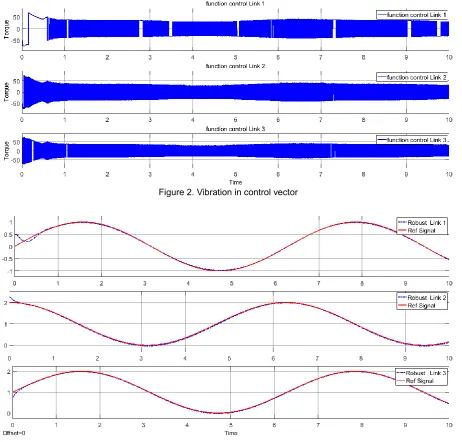
and robust control vector in Eq. (27) and Eq. (28).As shown in Figure 1, the system will follow the desired trajectory well. But due to vibration in the control vector (torque), shown in the Fig. (2), the system will not be in real terms. To fix this problem, the function
sign( )
S
with the functionS
replaced. So we have||
||
rs eq
u
k u
S
(37)As shown in Fig. (3), trajectory tracking compared to Fig. (1), a small error has been created. Instead the control vector (torque), are acceptable Fig. (4).
Figure 2. Vibration in control vector
Figure 3. Trajectory tracking with
u
rsNow, we want to simulate system without considering uncertainties, and check trajectory tracking for control vector
u
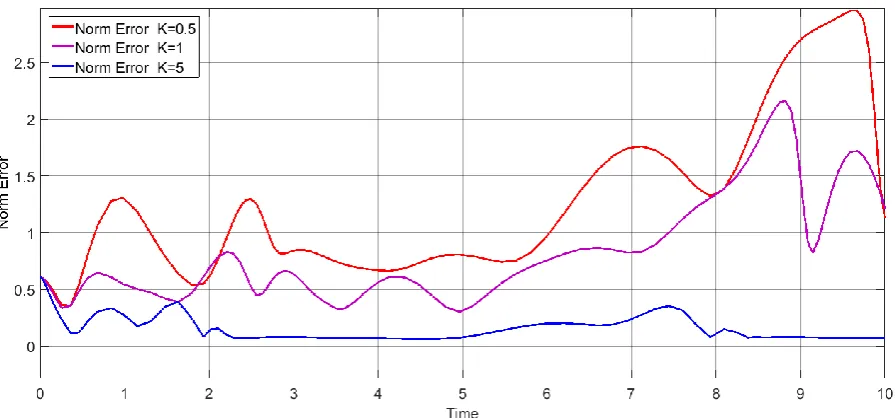
rs. In Fig. (5), we analyze trajectory tracking for links with several, error norms are )6( and in Fig.k
shown.Figure 5. Trajectory tracking with
u
rs and without uncertaintiesFigure 6. Error norms with
u
rs and without uncertaintiesFigure 7. Trajectory tracking with
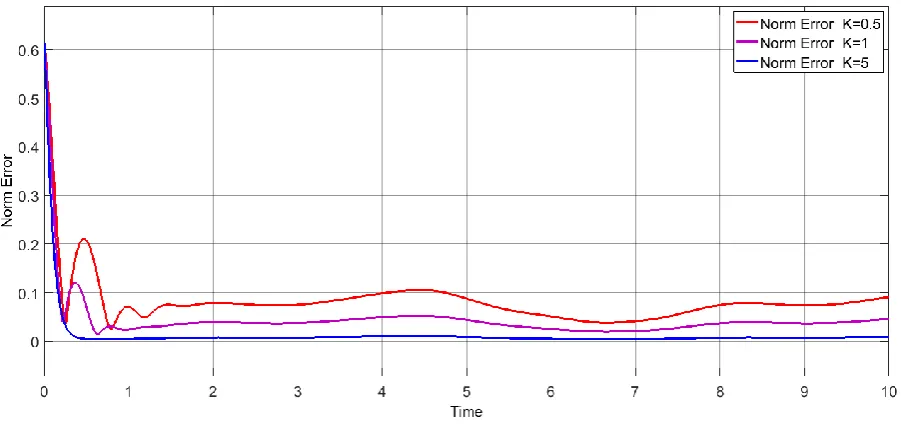
u
rs and uncertaintiesFigure 8. Error norms with
u
rs and uncertaintiesAccording to the results, the best value
k
for the control vector is equal 1. To be able to improve error, coefficientc
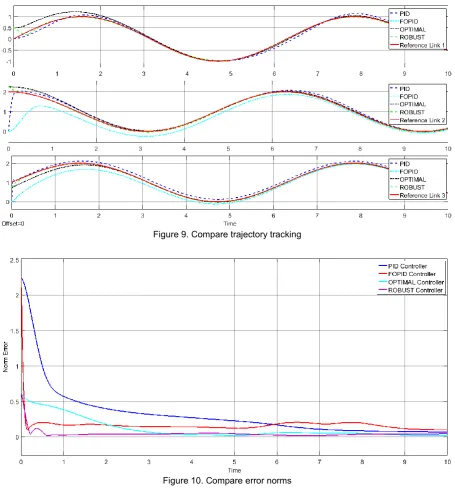
in Eq. (16) is equal 15.Now our method compared with PID, FOPID and optimal adaptive controller (Fig. (9) and Fig. (10)). In PID controller
k
P,k
I andk
Dcoefficients, respectively, are equal 20, 2 and 30. In FOPID controller, which is basedon
PI D
have five control elements, respectively, are equalk
P
30
,k
I
2
,k
D
30
,
0.5
and0.35
Figure 9. Compare trajectory tracking
Figure 10. Compare error norms
CONCLUSION
In this paper present and simulate robust controller for cylindrical manipulator to trace the desired trajectory. This method was compared with PID, FOPID and optimal adaptive controller and the results shows proposed method track desired trajectory as well. Also proposed method is better in speed to answer.
REFERENCES
BIESS, A., NAGURKA, M. & FLASH, T. 2006. Simulating discrete and rhythmic multi-joint human arm movements by optimization of nonlinear performance indices. Biological cybernetics, 95, 31-53.
CUONG, P. & NAN, W. 2016. Adaptive trajectory tracking neural network control with robust compensator for robot manipulators. Neural Computing & Applications, 27.
HOSSEINI, H., TOUSI, B., RAZMJOOY, N. & KHALILPOUR, M. 2013. Design robust controller for automatic generation control in restructured power system by imperialist competitive algorithm. IETE Journal of Research, 59, 745-752.
ISLAM, S. & LIU, X. P. 2011. Robust sliding mode control for robot manipulators. IEEE Transactions on Industrial Electronics, 58, 2444-2453.
KHALILPOUR, M., VALIPOUR, K., SHAYEGHI, H. & RAZMJOOY, N. 2013. Designing a robust and adaptive PID controller for gas turbine connected to the generator. Research Journal of Applied Sciences, Engineering and Technology, 5, 1544-1551.
LUH, J. Y., WALKER, M. W. & PAUL, R. P. 1980. On-line computational scheme for mechanical manipulators. J. DYN. SYS. MEAS. & CONTR., 102, 69-76.
NGO, T., WANG, Y., MAI, T. L., NGUYEN, M. H. & CHEN, J. 2014. Robust adaptive neural-fuzzy network tracking control for robot manipulator. International Journal of Computers Communications & Control, 7, 341-352. PAN, H. & XIN, M. 2014. Nonlinear robust and optimal control of robot manipulators. Nonlinear Dynamics, 1,
237-254.
PARK, J.-S., HAN, G.-S., AHN, H.-S. & KIM, D.-H. 2001. Adaptive approaches on the sliding mode control of robot manipulators. Transactions on Control, Automation and Systems Engineering, 3, 15-20.
RAZMJOOY, N. & KHALILPOUR, M. 2015. A Robust Controller For Power System Stabilizer By Using Artificial Bee Colony Algorithm.
RAZMJOOY, N., RAMEZANI, M. & NAMADCHIAN, A. 2016. A New LQR Optimal Control for a Single-Link Flexible Joint Robot Manipulator Based on Grey Wolf Optimizer. Majlesi Journal of Electrical Engineering, 10, 53.
SASSI, A. & ABDELKRIM, A. Adaptive sliding mode control for trajectory tracking of robot manipulators. Modelling, Identification and Control (ICMIC), 2015 7th International Conference on, 2015. IEEE, 1-7. SHI, Z., ZHONG, Y. & XU, W. 2005. Decentralized robust tracking control for uncertain robots. Electrical
Engineering, 87, 217-226.
TORRES, C., DE JESÚS RUBIO, J., AGUILAR-IBÁÑEZ, C. F. & PÉREZ-CRUZ, J. H. 2014. Stable optimal control applied to a cylindrical robotic arm. Neural Computing and Applications, 24, 937-944.
WAI, R.-J. & CHEN, P.-C. 2006. Robust neural-fuzzy-network control for robot manipulator including actuator dynamics. IEEE transactions on industrial electronics, 53, 1328-1349.