Karanam et al. World Journal of Engineering Research and Technology
EXPERIMENTAL STUDY ON SOIL STABILIZATION WITH
SUGARCANE STRAW ASH
Suresh M.1, Dr. Hari Krishna Karanam*2 and Damodhar Naidu C. H.3
1
PG Student, Gokul Group of Institutions, Bobbili.
2
Professor of Civil Engineering, Sanketika Vidya Parishad Engineering College, Visakha
Patnam.
3
Assistant Professor, Gokul Group of Institutions, Bobbili.
Article Received on 01/08/2019 Article Revised on 21/08/2019 Article Accepted on 11/09/2019
ABSTRACT
The soil bed should bear all the stresses, transmitted by the structure. If
the soil is weak and has not enough stability is resist heavy loading the
soil should be stabilized and quality of the soil is also increased, the
ability of the soil to distribute the load over a greater area is generally
increased. Using of traditional stabilizers like lime, cement, bitumen
etc, will become high cost and problem of disposal of agricultural
industry waste resulted into investigation of potential of agricultural industry waste in
stabilizing clayey soils. Here the soil stabilization material is sugarcane straw ash, the use of
this ash reduce is vulnerability to water if the treated soil is able to with stand the stresses
imposed on it by traffic under all weather conditions without excessive deformation, then it is
generally regarded as table. This research determined the geotechnical properties of soil
modified with sugar straw ash with a view to obtaining a cheaper and effective replacement
for the conventional soil stabilizers preliminary tests were performed on one samples, A and
B for identification and classification purposes followed by the consistency limit tests.,
Geotechnical strength tests, (compaction, California bearing ratio(CBR)) (unconfined
compressive strength and triaxial) were also performed on the samples both at the stabilized
and un stabilized states adding (0,2.5,5,7.5,10% sugarcane straw ash).
World Journal of Engineering Research and Technology
WJERT
www.wjert.org
SJIF Impact Factor: 5.218*Corresponding Author Dr. Hari Krishna Karanam
1. INTRODUCTION
Soil stabilization refers to the any land-based structure; the foundation is very important and
has to be strong to support the entire structure. In order for the foundation to be strong, the
soil around it plays a very critical role. In order to work with soil, we need to have proper
knowledge about their properties and factors which affect their behavior. The process of soil
stabilization helps to achieve the required properties in a soil needed for the construction
work. Soil Stabilization is the process of altering some properties by different methods,
mechanical or chemical in order to produce an improved soil material which has all the
engineering properties. Soils are generally stabilized to increase their strength and durability
or to prevent erosion and dust formation in soils. The main aim is the creation of a soil
material or system that will hold under the design use conditions and for the designed life of
the engineering project. The properties of soil vary a great deal at different places or in
certain cases even at one place. Various methods are employed to stabilize soil and the
method should be verified in the lab with the soil material before applying on the field.
Several experiments and papers discuss the characterization of sugar industry solid waste as
pozzolanic materials. Table 1 shows the chemical composition of sugarcane straw ash. It was
already known that sugarcane bagasse and sugarcane straw (sugarcane leaves) can be
recycled in the manufacture of commercial cements and other composites, either as raw
material or as pozzolanic material. For use as pozzolans, the agricultural wastes need prior
calcination but pozzolanic activation can vary substantially as a result of the calcining
conditions and the source of the materials. However, there are contradictory reports about the
pozzolanic effectiveness of sugarcane bagasse ash, possibly due to the use of different
calcining temperatures (Paya et al. 2002). It has been reported that sugarcane straw ash
obtained from heaps of open-air burnt straw in the vicinity of a sugar factory showed a high
pozzolanic activity (Martirena et al. 1998). In recent years, the possibility of mixing this solid
waste of sugarcane with clay has been evaluated by getting an agglutinative material which
permits an easy handling as well as an improvement in the environmental aspects
(Middendorf et al. 2003). Villar-Cocin˜ a et al. (2003) studied the pozzolanic behaviour of a
mixture of sugarcane straw with 20 and 30% clay burned at 800 and 1000oC and calcium
hydroxide and proposed a kinetic–diffusive model for describing the pozzolanic reaction
Agricultural wastes such as sugar cane bagasse ash, rice husk ash and groundnut shell ash are
used to stabilize the weak sub grade soil. The weak sub grade soil is treated with the above
three wastes separately at 0%, 3%, 6%, 9%, 12% and 15% and CBR test is carried out for
each percent. The results of these tests showed improvement in CBR value with the increase
in percentage of waste (M.Chittaranjan et al, 2011). Different percentages (4%, 8% and
12%) of bagasse ash and additive mix proportions. The strength parameters like CBR, UCS
were determined. It was observed that blend results of bagasse ash with different percentage
of cement for black cotton soil gave change in density, CBR and UCS values. The density
values got increased from 15.16 KN/m3 to 16.5 KN/m3 for addition of 8% bagasse ash with
8% cement, Then CBR values got increased from 2.12 to 5.43 for addition of 4% bagasse ash
with 8% cement and UCS values got increased to 174.91 KN/m2 from 84.92 KN/m2 for
addition of 8% bagasse ash with 8% cement (Kiran R. G and Kiran L 2013). The effect of
adding 3%, 5%, 8% and 10% Sugarcane bagasse ash on the compressive strength of
compressed earth brick. They observed that improvement in its compressive strength by 65%
with the addition of 10% Sugarcane Bagasse Ash (Salim 2014).
The materials used for this study were: soil, water and sugarcane straw ash (SCSA). Three
soil sample were collected from near SSIT locations at ckapalem, srikakulam. They were all
collected at depths representative of the soil stratum and not less than the 1.2m below the
natural ground level. These were kept safe and dry in jute bags in the Geotechnical
laboratory. Sugarcane straws were obtained from a sugarcane juice point at srikakulam, The
straws were spread out on the ground and air dried to facilitate easy burning. After air drying,
the sugarcane straws were burnt openly into ash and collected in polythene bags, stored under
room temperature until used. The SCSA was sieved through BS sieve 75μm to get the very
fine ash. It was ensured that the sugarcane straw ash remained covered before and after use to
prevent moisture and contaminations from other materials.
2. Use of soil stabilization
The soil stabilization techniques are mainly used for
1. To improve the strength of soil.
2. To reduce the permeability and compressibility of soil.
3. To increase the bearing capacity of soil.
3. Materials Used 3.1 Soil
The soil sample was brought from a place nearer to sri sivani institute of technology,
chilakapalem at depth of 1.2 m below the ground level. The soil is initially allowed to dry for
2days and the dried soil is thoroughly grinded. The grinded soil is allowed to pass through
4.75mm IS sieve and this soil is used for the present study.
3.1.1 Properties of soil
The texture of the red soils varies from sand to clay, the majority being loam. Their other
characteristics include porous friable stricter, absence of lime, kankar and free carbonates,
and small quantity of soluble salts. Their chemical composition include non -soluble
materials 90.47%, iron 3.61%, aluminium 2.92%, organic matter 1.01%,magnesium 0.70%,
lime 0.56%, carbon di-oxide 0.30%, potassium 0.24%, soda 0.12%, phosphorus 0.09% and
nitrogen 0.08% however significant regional differences are observed in the chemical
composition.
In general these soils are deficient in lime, magnesia, phosphate, nitrogen, humus and potash.
intense leaching is a menace to these soils. on the uplands, they are thin, poor and gravelly,
sandy, or stony and porous, light-colored soils on which food crops like bajra can be grown.
But on the lower plains and valleys they are rich, deep, dark colored fertile loam on which,
under irrigation, they can produce excellent crops like cotton, wheat, pulses, tobacco, jowar,
linseed, millet, potatoes and fruits. These are also characterized by stunted forest growth and
are suited to dry farming.
Table 1: Engineering Properties of Soil.
Property of Soil Values Field water content 14.4% Field density 1.57 gm/cc
Dry density 1.95 gm/cc
OMC 12.36%
MDD 1.95 gm/cc
CBR 1.66%
UCS 0.96 Kg/cm²
Undrained cohesion 0.48 Kg/cm²
Liquid limit 14.8 %
Plastic limit 31.8%
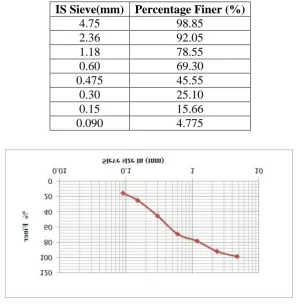
Table 2: Grain size analysis of soil.
IS Sieve(mm) Percentage Finer (%)
4.75 98.85
2.36 92.05
1.18 78.55
0.60 69.30
0.475 45.55
0.30 25.10
0.15 15.66
0.090 4.775
Figure 1: Grain size analysis graph.
3.2 Sugarcane straw ash
Sugarcane straw is brought from juice point in srikakulam. After air drying then straw is
converted into Ash using openly incineration process and collected in polythene bags stored
under room temperature until used.
3.2.1 Properties of sugarcane straw ash
Sugarcane (Saccharum) is a genus of 6 to 37 species (depending on taxonomic interpretation)
of tall perennial grasses (family Poaceae, tribe Andropogoneae), native to warm temperate to
tropical regions of the Old World. They have stout, jointed, fibrous stalks that are rich in
sugar and measure 2 to 6 meters tall. All of the sugarcane species interbreed, and the major
commercial cultivars are complex hybrids. Sugarcane was originally from tropical South Asia
and Southeast Asia. The thick stalk stores energy as sucrose in the sap. From this juice, sugar
is extracted by evaporating the water. Crystallized sugar was reported 5000 years ago in
India. Plate 1 shows cut sugarcane.
3.2.2 Chemical analysis of SCSA
The chemical analysis indicated that the ash contained mainly silica, calcium, magnesium and
aluminium with other minor elements Table 4.1. The combined percent composition of SiO2,
Al2CO3 and Fe2O3 of the ash is more than 70% hence exhibits pozzolanicity property
according standards for pozzolanic reaction.
Table 3: Chemical composition of sugarcane straw ash. Compound Percentage (%)
SiO2 48.65
Al2O3 1.22
CaO 4.52
Fe2O3 2.85
MgO 1.46
Na2O 0.52
K2O 4.12
SO3 1.53
4. Experimental Study 4.1 Mixing Procedure
Soil passing through 4.75mm IS sieve is used for the present study. To this soil sample
required percentage of stabilizer by weight is added and a uniform mixture is made. For this
mixture water is added and properly mixed in order to ensure the bonding of ash and soil. The
prepared sample is tested for maximum dry density, optimum moisture content, unconfined
compressive strength, direct shear test and CBR value. This procedure is repeated for 2.5%,
5%, 7.5% and 10% of sugarcane straw ash. Index and Engineering properties of the soil used
4.2 California bearing ratio (CBR)
California bearing ratio is determined for the soil samples as per IS 2720 (part 16) 1973.
Take 6kg of oven dry soil sample and add required amount of water (water content value of
the soil) and mix it thoroughly. The cylinder is fitted with the extension collar and thin film
of oil is applied to the inside faces. The spacer disk is placed over base plate. Now the well
mixed soil is compacted in the prepared mould in 5 layers and each layer should receive 55
blows with the rammer. Remove the collar and trim the extra soil. Remove the spacer disc
and invert the mould. Then place the surcharge weights and also 2.5kg annular weight shall
be placed on the soil surface prior to the penetration of the piston. Seat the penetration piston
at the center of the specimen and full contact should be established between the surface and
the piston. The loads are applied at a rate of 1.25mm/min. Load readings shall be recorded at
plunger penetration values of 0, 0.5,.1.0, 1.5, 2.0, 2.5, 3.0, 3.5, 4.0, 5.0, 7.5, 10.0,
12.5mm/min. after noting the values the specimen is unloaded and the mould is detached
from the loading frame. Collect some amount of soil sample and determine its moisture
content.
Calculations
CBR2.5=P2.5/PS2.5 (1370kg)
CBR5=P5/PS5 (2055kg)
Where PS2.5 = standard axle load for 2.5mm penetration
PS5 = standard axle load for 5mm penetration
Table 4: Results of soils.
% OF SCSA MDD (gm/cc) OMC (%) UCS (kg/cm2) Cu (kg/cm2) CBR (%)
0 1.95 12.36 0.96 0.48 1.66
2.5 1.96 15.70 1.11 0.55 2.07
5.0 1.99 18.00 1.32 0.66 2.9
7.5 1.81 19.35 0.11 0.05 3.32
10 1.84 20.50 0.12 0.06 4.15
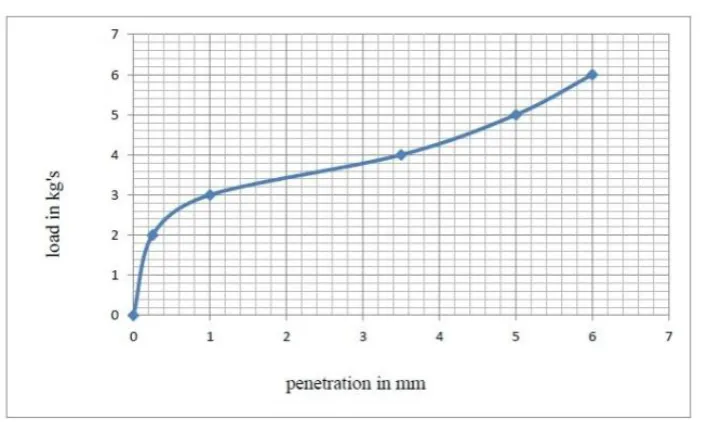
A graph is plotted with penetration on x-axis and load on y-axis. From the graph plotted, load
for penetrations of 2.5mm and 5mm are found. The MDD value for natural soil is 1.95 gm/cc.
By adding of 2.5% of SCSA 0.01gm/cc increase in MDD value. further increasing the
percentage up to 5% of SCSA, MDD value increased to 1.99 gm/cc which shows an
content value for natural soil is 12.36% and increased to 15.70% at 2.5% of SCSA. By further
increasing the ash up to 5% of SCSA 3.3% of OMC will be increased which shows the
increment of 27% and 21% respectively. And fatherly increasing 7.5% and 10% of ash
content the OMC is 19.35%, 20.50% respectively.
The unconfined compressive strength for natural soil is 0.96 kg/cm2. By increasing the
percentage of SCSA up to 2.5% the value of UCS is increased by 15.6% and reaches value of
1.11 kg/cm2. By further increasing of SCSA 5% the value is increased by 18.9% and reaches
value of 1.32% kg/cm2. After increasing of SCSA 7.5%, 10% the value is decreased by 9%
and value of 0.11 kg/cm2, then slightly change the value with 0.12 kg/cm2 respectively.
Figure 4: CBR curve for soil only.
The CBR value for natural soil is 1.66%.And increased to 24.7% for 2.5% of SCSA. By
increasing the percentage of SCSA to 5% the CBR value is increased to 40% and reaches a
value 2.9%. Further increasing SCSA to 7.5%, 10% the CBR value is increased up to
14.48%, 25% respectively.
When compared to natural soil, all the values of blended soil sample are higher than the
natural soil sample by 24.7%, 40%, 14.48% and 25% respectively where as the values of
CBR is 2.07%, 2.9%, 3.32%, 4.15% respectively of adding SCSA of 2.5%, 5%, 7.5%, 10%.
to the natural soil.
CONCLUSIONS
1. MDD of modified soil is maximum at 5% of SCSA, which shows the increment of 0.04
gm/cc and OMC is 18% at adding 5% of SCSA.
2. The UCS value of modified soil increases from 0.96 kg/cm2 to 1.32 kg/cm2 by the
adding 5% of SCSA to the natural soil.
3. The CBR value of modified soil increases with increase in ash content with an increase of
4.15% at 10% of SCSA.
4. OMC increases with increase in percentage of SCSA and MDD increases up to 5% of
SCSA and then decreased at 7.5% of SCSA after slightly increase at 10% of SCSA added
to the soil.
5. The UCS value of modified soil is maximum at 5% of SCSA which shows an increment
of 37.5%.
6. The CBR value of modified soil is maximum at 10% of SCSA which shows an increment
of 150%. And 74.7% increment at 5% of SCSA.
7. The MDD, OMC, UCS and CBR are higher at 5% of SCSA compared to the natural soil
and remaining percentages of modified soil.
REFERENCES
1. Chittaranjan, M. Vijay and D. Keerthi “Agricultural wastes as soil stabilizers”
International Journal of Earth Sciences and Engineering, 2011; 04(06): 50-51.
2. Kiran R.G. and Kiran L. “Analysis of strength characteristics of Black cotton soil using
Bagasse ash and additives as stabilizer”, IJERT, 2013; 7.
3. Martirena, J.F., Middendorf, B., Budelman, H., Use of wastes of the sugar industry as
4. Middendorf, B., Mickley, J., Martirena, J.F. and Day, R.L Masonry wall materials
prepared by using agriculture waste, lime and burnt clay. In: Masonry: Opportunities for
the 21st Century. eds. Throop D. and R. Klingner. ASTM STP 1432, West
Conshohocken, PA, 2003; 274-283.
5. Paya,´ J., Monzo,´ J., Borrachero, M.V., Dı´az, P. and Ordon˜ ez, L.M. Sugarcane bagasse
ash (SCBA): Studies on its properties for reusing in concrete production. Journal of
Chemical Technology and Biotechnology, 2002; 77: 321–325.
6. Salim, R. W., J. M Ndambuki, and D. A. Adedokun, “Improving the bearing strength of
sandy loam soil compressed earth block bricks using sugercane bagasse
ash,” Sustainability, 2014; 6(6): 3686–3696.
7. Villar-Cocina, E., Frías, M., & Valencia-Morales, E. Sugar cane wastes as pozzolanic