Optimization of Digital Textile Printing
Process using Taguchi Method
Jin Joo Jung1, Sungmin Kim2, Chang Kyu Park1
1
Department of Organic and Nano System Engineering, Konkuk University, Seoul, KOREA
2
Department of Textiles, Merchandising, and Fashion Design, Seoul National University, Seoul, KOREA
Correspondence to:
Chang Kyu Park email: [email protected]
ABSTRACT
Digital textile printing has become one of the most important manufacturing processes for mass customization of clothing goods, especially for short-run prints. In this method, high color strength and fastness are very important. In this study, the optimization of the printing process was investigated using the Taguchi method. To determine the optimum conditions for color strength and fastness, two types of multiple characteristic parameter design methods were used, including the single characteristic value conversion method and the minimum-maximum selection method. Both methods suggested better conditions than currently used methods.
INTRODUCTION
Until recently, customers had little choice other than ready-made goods offered by manufacturers. In the near future, customer oriented mass customization will become one of the most important trends in many manufacturing industries.
Bae claimed that DTP (Digital Textile Printing) is suitable for mass customization in garment the industry [1]. However, DTP is not so suitable for mass production because of low productivity and relatively high cost compared to conventional printing processes. For commercial textile products, good strength and fastness of color are necessary. Therefore most studies on DTP focused on the pre and post-processing of fabric, as well as modification of additives to increase color strength and fastness [2]. Yuen et al. used cotton fabric and reactive dye ink to determine the optimum printing condition for each color [3]. Yang et al. tried to find the optimum steaming condition including process time and temperature for reactive dyes [4].
In such previous studies, it has been revealed that
pre-process and in post-process steaming
significantly affects color strength and fastness. However, there has been little research on the optimization of the overall printing process.
In this study, Taguchi method was used to find the overall optimum printing condition. Although the Taguchi method is widely used in many research fields, there have been few applications in garment manufacturing process. Park et al. used the Taguchi method to find sewing conditions that minimize the seam pucker [5]. Yoon et al. used an expert system and the Taguchi method to find the bonding conditions that maximize the delamination strength of fusible interlinings [6].
Color strength and fastness were used as the characteristic values for Taguchi analysis. However, the Taguchi method is primarily suited for single characteristic value problems and does not easily handle multiple characteristic values [7-11]. To solve this multiple-characteristic value problem, two methods were implemented in this study- single characteristic value conversion and minimum-maximum selection method.
MULTIPLE-CHARACTERISTIC PARAMETER DESIGN
Definition of Characteristic Parameters
Single Characteristic Value Conversion Method
This is a method in which multiple characteristic values are converted into a single value. The average of normalized characteristic values becomes a new characteristic value and is used for single characteristic value problem as follows [7]. First, experiments are designed considering the number and level of each parameter. Next, S/N (Signal to Noise) ratio is calculated for each experiment. Then, parameters that significantly affect the S/N ratio are chosen through statistical analysis such as ANOVA (analysis of variance). The levels of chosen parameters are adjusted so the S/N ratio is maximized. Other parameters are designed considering the cost or convenience of application. Finally, verification experiments are performed with the parameters chosen in the previous step to prove whether the parameter design is successful or not.
Minimum-Maximum Selection Method
This is a method in which the overall optimum condition is determined after choosing the optimum level for each characteristic value. First, the optimum level for each characteristic value is chosen according to the single characteristic value parameter design process. Then, conflicting parameters that have different optimum levels among characteristic values are chosen. The optimum levels of non-conflicting parameters are determined by considering the S/N ratio of each characteristic value and the average of nominal-the-best characteristics. Then, S/N ratios are
normalized and compromised for conflicting
parameters. There are two methods in this step. One is the elimination of the minimum value and the other is the selection of the maximum value. In the former method, the minimum value of normalized S/N ratio is selected and the level including this value is eliminated. This prevents the worst case scenario where the optimum level of a characteristic value has the worst influence on the S/N ratios of other characteristic values. In the latter method, the maximum value of normalized S/N ratio is selected and the level including this value is selected. Finally, the optimum level for each parameter is determined.
EXPERIMENTAL DESIGN Digital Textile Printing
Materials
Cotton twill fabrics were used for experiment. Eight colored reactive dyes were used in printing including cyan, magenta, yellow, black, light cyan, light magenta, light yellow, light black (Shima Seiki, Japan).
Pre-process
Pre-process increases the sharpness, strength, and fastness of color on final product by preventing the over spreading of ink. Specimens were soaked in the cotton preprocessing agent DTP for one hour. They were then pad-dried according to the level of each experiment point. Pick-up ratio was calculated using Eq. (1),
(1)
where, w0 = specimen weight before preprocess and
w = specimen weight after preprocess
Printing
Cyan, magenta, yellow, and black patches were printed on the preprocessed fabric using SIP-100F textile printer (Shima Seiki, Japan).
Post-processes
Post-processes include steaming, washing, and drying. Steaming is used for fixing the dye on the printed fabric. The temperature, pressure, and time should be determined for optimum results. In this study, a SIP-SSM100 steamer (Shima Seiki, Japan) was used followed by washing and drying to eliminate the excessive dye.
Evaluation of Color Fastness to Washing
Color fastness to washing was evaluated according to ISO-105-C06 (A2S). The color degradation was measured by a CCM (Color coordinate measurement) apparatus.
Determination of Factors and Levels
There are various factors affecting the fk (apparent
color strength) value and wash fastness. However, four factors which could be controlled easily were chosen in this study. Those include pre-process pick-up ratio (A), postprocess steaming temperature (B), pressure (C), and time (D). The number of level for each factor was determined as three according to the preparatory experiments. The factors and their levels
are as shown in Table I.
TABLE I. Factors and Levels.
A (%) B (℃) C (MPa) D (min)
1 70 95 0.1 10
2 80 97 0.14 20
3 90 99 0.18 30
Factor
Experimental Design
The experiment was designed using an L9(34)
orthogonal array table as shown in Table II. In this
method the effect of four factors could be analyzed by 81 experiments, which was the minimum required number of experiments to determine the optimum
process condition that maximized the fk value and
wash fastness.
TABLE II. L9(34) Orthogonal Array Table.
A B C D y1 y2 y3
1 1 1 1 1 y11 y12 y13
2 1 2 2 2 · · ·
3 1 3 3 3 · · ·
4 2 1 2 3 · · ·
5 2 2 3 1 · · ·
6 2 3 1 2 · · ·
7 3 1 3 2 · · ·
8 3 2 1 3 · · ·
9 3 3 2 1 y91 · y93
Characteristic Value (fk value / fastness) Exp. No.
Factors and Levels (treatment conditions)
Each experiment was repeated for three times. Both fk
and wash fastness values were larger-the-best characteristic value and the S/N ratio of each experiment was calculated using Eq. (2).
(2)
where, yij = jth characteristic value of ith experiment
and n = repeat count of y in an experiment
In the Taguchi method, S/N ratio is equal to the inverse of expected loss. Therefore, expected loss
decreases as S/N ratio increases. In this study, fkand
wash fastness were chosen for characteristic value y
and 9 S/N ratios were calculated using three characteristic values, which were measured three times for each experiment. A total of eight characteristic values were chosen including four
values of fk (cyan, magenta, yellow, and black) and
four values of wash fastness (cyan, magenta, yellow, and black).
RESULTS AND DISCUSSION
Single Characteristic Value Conversion Method
Parameter Design
In the single characteristic value conversion method, the average of eight normalized characteristic values becomes a new characteristic value. The averaged normalized characteristic values and S/N ratio
TABLE III. S/N ratio of averaged normalized characteristic values.
S/N ratio
A B C D y1 y2 y3
1 1 1 1 1 0.999 1.021 0.991 0.031 2 1 2 2 2 0.982 0.987 0.972 -0.174 3 1 3 3 3 0.964 0.974 0.954 -0.319 4 2 1 2 3 0.945 0.937 0.947 -0.509 5 2 2 3 1 1.083 1.074 1.071 0.637 6 2 3 1 2 0.984 1.003 0.994 -0.056 7 3 1 3 2 1.042 1.035 1.041 0.333 8 3 2 1 3 0.953 0.947 0.943 -0.468 9 3 3 2 1 1.057 1.036 1.065 0.441
Factors and Levels (treatment conditions)
Characteristic Value (4 fk value + 4 fastness) Exp. No.
The sum, average, variance, and contribution of the S/N ratio at each level have been calculated. The effect or sum of square on one column in an orthogonal array is calculated using Eq. (3).
Sum of Square =
level
at values stic characteri of Number
) level at values stic characteri of (Sum
2
1
1
2
N y
i i
p
i i p
i
− ∑
∑ =
=
(3)
value stic characteri of
number total
level of number
level at value stic characteri ,
= = =
N p
i y
where i
Contribution of S/N ratio is calculated using Eq. (4).
Contribution at each level =
S/N Ratio average Total -level each at S/N Ratio
Average (4)
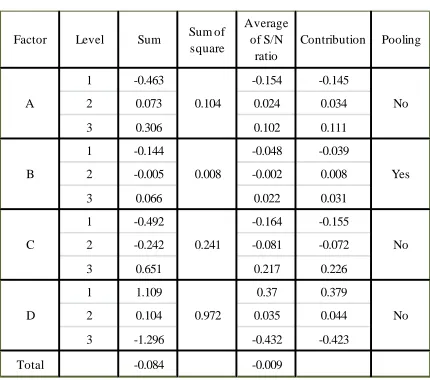
The results of the analysis of the S/N ratio are as
shown in Table IV.
TABLE IV. Analysis results of S/N Ratio.
1 -0.463 -0.154 -0.145
2 0.073 0.024 0.034
3 0.306 0.102 0.111
1 -0.144 -0.048 -0.039
2 -0.005 -0.002 0.008
3 0.066 0.022 0.031
1 -0.492 -0.164 -0.155
2 -0.242 -0.081 -0.072
3 0.651 0.217 0.226
1 1.109 0.37 0.379
2 0.104 0.035 0.044
3 -1.296 -0.432 -0.423
Total -0.084 -0.009
C 0.241 No
D 0.972 No
A 0.104 No
B 0.008 Yes
Factor Level Sum Sum of square
Average of S/N
ratio
The cause and effect diagram at each level is as
shown in Figure 1. The sum of square of factor D had
the largest value of 0.972. Error was not chosen for a factor and factor B with relatively small sum of square was pooled to error.
A
B
C
D
FIGURE 1. Cause and effect diagram (single value conversion).
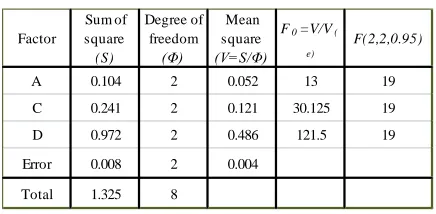
The results of F-test are shown in Table V.
TABLE V. ANOVA results.
Factor Sum of square (S) Degree of freedom (Φ) Mean square (V=S/Φ)
F0=V/V( e)
F(2,2,0.95)
A 0.104 2 0.052 13 19
C 0.241 2 0.121 30.125 19
D 0.972 2 0.486 121.5 19
Error 0.008 2 0.004
Total 1.325 8
As shown in Table V, factors C and D could be
considered to be meaningful. Therefore, steam pressure and time were considered to be the factors affecting the color strength and wash fastness. The optimum condition was C3 D1 where S/N ratio of each factor becomes largest, in other words, steam pressure of 0.18Mpa and time of 10 minutes.
Prediction of Average and Confidence Interval under Optimum Condition
S/N ratio at optimum experiment can be predicted using Eq. (5).
(5) 596 . 0 379 . 0 226 . 0 009 . 0 ˆ ˆ
ˆ+ 3+ 1=− + + =
=u c d SN 1 1 3 3 D of on contributi C of on contributi ratio S/N average total ratio S/N predicted , = = = = d c u SN where
95% confidential range of S/N ratio at the optimum condition can be calculated by t-distribution using Eq. (6). ) 853 . 0 , 339 . 0 ( 256 . 0 596 . 0 004 . 0 3 1 9 5 ) 975 . 0 , 2 ( 596 . 0 ) ( 1 2 1 ), ( = ± = × + ± = + ± = − t e V r k t SN SN e
f f α
(6) repetition of number 9 ) 2 2 1 ( s experiment of number Total SN in each term of freedom of degree the of Sum error of freedom of degree ) ( , = + + = = = r k e wheref
The S/N ratio of the experiment performed under the suggested optimum condition was 0.637, which was within the predicted range
Comparison of Expected Loss
The expected losses of current and the optimum condition found by the single characteristic value conversion method were compared. The current
condition was experiment 2 in Table III and its S/N
ratio (SNC) was -0.174. The predicted S/N ratio at the
optimum condition (SNO) was 0.596. The comparison
of expected losses can be done using Eq. (7).
(7)
L is the expected loss of characteristic value and it
Minimum-Maximum Selection Method
Single Parameter Design for Each Characteristic Value
The optimum levels of eight characteristic values have been chosen according to the single parameter design method. It can be explained as follows with the example of cyan color.
A. fk results for cyan color
S/N ratios of fk for cyan color are as shown in Table
VI.
The analysis results of fk value are as shown in Table
VII.
Figure 2 is the cause and effect diagram.
TABLE VI. S/N ratio (fk value of cyan).
Exp. S/N
No. ratio
A B C D y1 y2 y3
1 1 1 1 1 144.372 145.629 147.56 43.277 2 1 2 2 2 140.04 143.116 145.168 43.09 3 1 3 3 3 121.416 123.86 124.62 41.818 4 2 1 2 3 123.354 127.683 128.082 42.029 5 2 2 3 1 147.288 146.517 146.975 43.342 6 2 3 1 2 141.322 153.411 154.248 43.481 7 3 1 3 2 137.606 136.467 132.92 42.646 8 3 2 1 3 122.085 114.25 110.596 41.241 9 3 3 2 1 146.452 146.829 149.466 43.38
Factors and Levels (treatment conditions)
Characteristic Value (fk value)
TABLE VII. Analysis results (fk value of cyan).
1 128.19 42.728 0.028
2 128.85 42.951 0.25
3 127.27 42.422 -0.278
1 127.95 42.651 -0.049
2 127.67 42.558 -0.143
3 128.68 42.893 0.192
1 128 42.666 -0.034
2 128.5 42.833 0.133
3 127.81 42.602 -0.098
1 130 43.333 0.633
2 129.22 43.073 0.372
3 125.09 41.696 -1.005
Total 384.3 42.7
C 0.085 Yes
D 4.644 No
A 0.423 No
B 0.18 Yes
Factor Level Sum Sum of square
Average of SN
ratio
Pooling Contribution
A
B
C
D
FIGURE 2. Cause and effect diagram (fk value of cyan).
The sum of square of factor D had the largest value of 4.644. B and C factors which had relatively smaller sum of square values were pooled to error.
F-test results are shown in Table VIII.
TABLE VIII. ANOVA results (fk value of cyan).
Factor
Sum of square
(S)
Degree of freedom
(Φ)
Mean square
(V=S/Φ)
F0=V/V( e) F(2,4,0.95)
A 0.423 2 0.212 3.192 6.94
D 4.644 2 2.322 35.049 6.94
Error 0.265 4 0.066
Total 5.332 8
As can be seen in Table VIII, factor D (steaming
time) was statistically valid. The condition which maximized the S/N ratio of factor D was D1, steaming time of 10 minutes. Similar statistical analysis was applied on other colors to get the results as follow.
B. fk results for magenta color
Factors affecting the strength of magenta color were pre- process pick-up ratio, steaming pressure, and steaming time. The condition which maximized the color strength was A3 C3 D1, pre-process pick-up ratio of 90%, steaming pressure of 0.18MPa and steaming time of 10 minutes
C. fk results for yellow color
TABLE IX. S/N ratio (fastness of cyan).
A B C D y1 y2 y3
1 1 1 1 1 4.5 4.5 4.5 13.064
2 1 2 2 2 4 4.5 4 12.356
3 1 3 3 3 4 4 4 12.041
4 2 1 2 3 4.5 4 4 12.356
5 2 2 3 1 4 4 4 12.041
6 2 3 1 2 4.5 4.5 4.5 13.064
7 3 1 3 2 4 4 4 12.041
8 3 2 1 3 4 4 4.5 12.356
9 3 3 2 1 4.5 4 4.5 12.696
S/N Ratio Factors and Levels
Characteristic Value (fastness) Exp. No.
D. fk results for black color
Factors affecting the strength of yellow color were steaming pressure and steaming time. The condition which maximized the color strength was C3 D1, steaming pressure of 0.18MPa and steaming time of ten minutes.
The analysis results for wash fastness can be explained as follows for the example of cyan color.
A. Wash fastness results for cyan color
S/N ratios for wash fastness of cyan color are shown in Table IX.
Analysis results are shown in Table X.
TABLE X. Analysis results of SN ratio (fastness of cyan).
1 37.462 12.487 0.041
2 37.462 12.487 0.041
3 37.093 12.364 -0.082
1 37.462 12.487 0.041
2 36.754 12.251 -0.195
3 37.801 12.6 0.154
1 38.485 12.828 0.382
2 37.408 12.469 0.023
3 36.124 12.041 -0.405
1 37.801 12.6 0.154
2 37.462 12.487 0.041
3 36.754 12.251 -0.195
Total 112.016 12.446
C 0.932 No
D 0.19 No
A 0.03 Yes
B 0.19 No
Factor Level Sum Sum of square
Average of
SN ratio Contribution Pooling
Figure 3 is the cause and effect diagram.
A
B
C
D
FIGURE 3. Cause and effect diagram (fastness of cyan).
The sum of square of Factor C had the largest value of 0.932. Factors B, C, and D with relatively small sum of square values were pooled to error. The
results of the F-test are shown in Table XI.
TABLE XI. ANOVA results (fastness of cyan).
Factor Sum of square (S)
Degree of freedom
(Φ)
Mean square (V=S/Φ)
F0=V/V( e) F(2,2,0.95)
B 0.19 2 0.095 6.333 19
C 0.932 2 0.466 31.067 19
D 0.19 2 0.095 6.333 19
Error 0.03 2 0.015
Total 1.342 8
As can be seen in Table XI, Factor C (steaming
pressure) was statistically valid. The condition that maximized the wash fastness was C1, steaming pressure of 0.10MPa. Similar analysis process has been applied to other colors as follows:
B. Wash fastness results for magenta color
The only factor that affects the wash fastness of magenta color was pre-process pick-up ratio. The condition that maximized the wash fastness was A3, pre-process pick-up ratio of 90%.
C. Wash fastness results for yellow color
The only factor that affects the wash fastness of magenta color was the pre-process pick-up ratio. The condition that maximized the wash fastness was A3, pre-process pick-up ratio of 90%.
D. Wash fastness results for black color
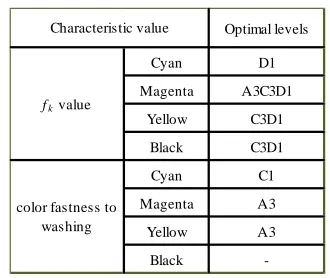
The optimum levels of characteristic values are as
shown in Table XII.
TABLE XII. Optimal levels of characteristics values.
Optimal levels
Cyan D1
Magenta A3C3D1
Yellow C3D1
Black C3D1
Cyan C1
Magenta A3
Yellow A3
Black
-Characteristic value
fk value
color fastness to washing
Classification of Factors
The S/N ratio and optimum level of each
characteristic value are as shown in Table XIII. As
can be seen, C was the only conflicting factor in this experiment, which had different optimum level
between fkand wash fastness.
TABLE XIII. S/N ratio and optimum level of characteristics.
o o o o
p p p p
t t t t
A1 42.728 41.622 38.151 48.377 A2 42.951 42.066 38.12 48.33 A3 42.422 42.209 O 38.196 48.679 B1 42.651 41.892 38.103 48.32 B2 42.558 42.03 38.217 48.512 B3 42.893 41.975 38.146 48.553 C1 42.666 41.653 37.57 47.981 C2 42.833 41.828 37.93 48.232 C3 42.602 42.416 O 38.967 O 49.173 O D1 43.333 42.262 39.432 49.255 D2 43.073 41.973 38.188 48.422 D3 41.696 41.661 36.846 47.708
S/N o S/N o S/N o S/N o ratio p ratio p ratio p ratio p
t t t t
A1 12.487 12.469 11.117 12.696 A2 12.747 12.819 11.245 12.941 A3 12.364 12.941 O 11.901 O 12.941 B1 12.487 12.705 11.386 12.941 B2 12.251 12.705 11.632 12.819 B3 12.6 12.819 11.245 12.819 C1 12.828 12.828 11.268 12.696 C2 12.469 12.583 11.363 12.941 C3 12.041 12.819 11.632 12.941 D1 12.6 12.583 11.373 12.941 D2 12.487 12.828 11.386 12.819 D3 12.251 12.819 11.503 12.819
O
Black
O O O O
Factor
Color fastness to washing Cyan Magenta Yellow
Black
S/N Ratio S/N Ratio fk value Cyan
Factor
S/N Ratio
Magenta Yellow
S/N Ratio
Factors A and D were non-conflicting factors and the optimum level of each factor was A3 and D1. Normalized S/N ratios of conflicting factor C are
shown in Table XIV.
TABLE XIV. Normalized SN ratio of conflicting factor.
C M Y K C M Y K
C1 0.999 0.993 0.985 0.99 1.031 1.007 0.987 0.987 C2 1.003 0.997 0.994 0.995 1.002 0.987 0.995 1.006 C3 0.998 1.011 1.021 1.015 0.967 1.006 1.018 1.006 Factor
fk value Wash Fastness
To resolve such conflict, two methods were used. One method was the elimination of the minimum value, where the levels including the minimum S/N ratio are eliminated. In this case, level 1 with the minimum value of 0.967 was eliminated. The other method was the selection of the maximum value, where the levels including the maximum value are selected. In this case, level 1 with the maximum value of 1.031 was selected.
Fortunately, the same level was selected by both methods in this case. However, as the minimum value can cause imperfections in most textile processes, the minimum value elimination method seems more suitable in this case. The selected optimum condition after compromise was A3 C1 D1.
Prediction of Average and Confidence Interval of S/N Ratio under Optimum Condition
To compare the results with those from the single characteristic value conversion method, the average S/N ratio at optimum experimental condition was calculated using Eq. (8).
326 . 0 379 . 0 ) 155 . 0 ( 111 . 0 009 . 0
ˆ ˆ ˆ
ˆ 3 1 1
= + − + + =
+ + +
=u a c d
SN (8)
1 1
1 1
3 3
D of on contributi ˆ
C of on contribudi ˆ
A of on contributi ˆ
ratio S/N average total ˆ
ratio S/N predicted ,
= = = =
=
d c a u SN where
) 583 . 0 , 069 . 0 ( 256 . 0 326 . 0 004 . 0 3 1 9 5 ) 975 . 0 , 2 ( 326 . 0 ) ( 1 2 1 ), ( = ± = × + ± = + ± = − t e V r k t SN SM e
j f α
(9) repetition of number 9 ) 2 2 1 ( s experiment of number Total SN in freedom of degree the of Sum error of freedom of degree ) ( , = + + = = = r k e wheref
Comparison of Expected Loss
Expected losses of the current condition and the optimum condition found by minimum-maximum selection method were compared using Eq. (10). The current condition is experiment 2 with S/N ratio of
-0.174 (SNC). S/N at the optimum condition was
predicted to be 0.326 (SNO).
(10)
L is the expected loss of characteristic value, which is
the variance of the characteristic value. Therefore, the expected losses of color strength and wash fastness were 1.12 times bigger at current condition than those at the optimum condition.
Comparison of Two Methods
Quantitative Comparison
The improvement effect of the determination of the
optimum condition is as shown in Table XV. The
Single characteristic value conversion method showed more improvement than the minimum-maximum selection method.
TABLE XV. Comparison of improvement effect.
Method Optimal
levels
Improvement effect single characteristic value
conversion method C3D1 1.19
A3C1D1 A3C1D1 1.12 minimum-maximum selection method Qualitative Comparison
In the minimum-maximum selection method, the optimum condition for each characteristic value was calculated and the minimum and maximum values of each characteristic value were considered while determining the overall optimum condition. However, in the single characteristic value conversion method, all the values were converted into a single value and therefore it was impossible to take into account of individual characteristics of each value. Although the single characteristic value conversion method showed better results, the improvement would be invalid if any of the characteristic values had an imperfection. Therefore, it could be dangerous to deal with the multiple parameter design using the single value conversion method only.
CONCLUSION
In this study, the Taguchi method was used to find the optimum conditions for DTP processing. Color strength and wash fastness were chosen as characteristic values and two kinds of multiple-characteristic value analyses were performed to find the conditions that satisfy both criteria. According to the single characteristic value conversion method, the optimum process condition was steam pressure of 0.18MPa, with a processing time of ten minutes. According to the minimum-maximum selection method, the optimum condition was steam pressure of 0.10MPa, with a processing time of ten minutes. The single characteristic value conversion method thus proved to be more efficient compared to the minimum-maximum selection method. However, there is a serious drawback to the single characteristic conversion method- the whole result could be rendered meaningless if any of the characteristic values resulted from failed experiments. Therefore, the single characteristic value conversion method would be better only if the zero failed process condition were guaranteed. Otherwise the minimum-maximum selection method would be more suitable.
REFERENCES
[1] Bae J. and May-Plumlee T., "Customer Focused
Textile and Apparel Manufacturing Systems: Toward an Effective e-Commerce Model",
Journal of Textile and Apparel, Technology and Management, 4(4), 2005, pp. 1-19.
[2] Ujiie H., "Digital Printing of Textiles",
Woodhead Publishing, Cambridge, UK, 2006.
[3] Yuen C. W. M., Ku S. K. A., Choi P. S. R., and
Kan C. W., "Study of the Factors Influencing Color Yield of an Ink-jet Printed Cotton
Fabric", Coloration Technology, 120(6), 2004,
[4] Yang Y. and Naarani V., "Improvement of the Lightfastness of Reactive Inkjet Printed
Cotton", Dyes and Pigments, 74(1), 2007, pp.
154-160.
[5] Park C. K. and Ha J. Y., "A Process for
Optimizing Sewing Conditions to Minimize Seam Pucker using the Taguchi Method",
Textile Research Journal, 75(3), 2005, pp. 245-252.
[6] Yoon S. Y., Park C. K., Kim H. S., and Kim S.,
"Optimization of Fusing Process Conditions
using the Taguchi Method", Textile Research
Journal, 80(11), 2010, pp. 1016-1026.
[7] Taguchi G., "Introduction to Quality
Engineering", Asian Productivity
Organization, Tokyo, Japan, 1986.
[8] Roy R. K., "A Primer on the Taguchi Method",
Society of Manufacturing Engineers, Dearborn, USA, 1990.
[9] Fowlkes W. Y. and Creveling C. M.,
"Engineering Methods for Robust Product Design: Using Taguchi Methods in Technology and Product Development", Prentice Hall, New York, USA, 1995.
[10] Furferi R. and Carfagni M., "Prediction of the
Color and of the Color Solidity of a Jigger Dyed Cellulose based Fabric: a Cascade
Neural Network approach", Textile Research
Journal, 80(16), 2010, pp. 1682-1696.
[11] Hossain I., Hossain A., and Choudhury I.A.,
"Dyeing Process Parameters Optimisation
and Colour Strength Prediction for
Viscose/Lycra blended Knitted Fabrics using
Taguchi Method", The Journal of The Textile
Institute, ahead-of-print, 2015, 1-11.
AUTHORS’ ADDRESSES Chang Kyu Park
Jin Joo Jung
120 Neungdong-ro Gwangjin-gu, Seoul 05029 KOREA, REPUBLIC OF
Sungmin Kim
1 Gwanak-ro