IJIRT 147624
INTERNATIONAL JO URNAL OF INNOVATIVE RESEARCH IN TECHNOLOGY241
Numerical Analysis of Performance of Solar Pond having
Heat Exchanger provided with Circular Fins
Prof. Ashish Muchrikar¹, Satyam Mishra²
1
Assistant Professor, Department of Mechanical Engineering, Corporate institute of Science and
Technology, Bhopal462022, India
2
M.Tech Scholar, Department of Mechanical Engineering, Corporate institute of Science and
Technology, Bhopal462022, India
Abstract- The Present era of Industrial revolution continuously increase in the level of greenhouse gas emissions in global level and the rise in fuel cost are the main driving forces behind the attempt to be made for more effectively utilize various sources of renewable energy. Renewable energies are expected to play the major role to overcome the energy supply in the near future. In many parts of the world direct or indirect solar energy is considered to be one of the most prospective sources of energy. In this work, the thermal performance of a phase change thermal storage device is studied. The storage unit is a paraffin solar wax melting system being developed for latent heat storage studies. Paraffin was used as PCM in thermal energy storage with a melting temperature of 42-50´C.This study is based on experimental results of the PCM employed to analyze the thermal behavior of the storage of heat energy during the charge and discharge periods of the paraffin wax. The time wise temperatures of the PCM and solar intensity were recorded during the processes of charging. The heat transfer characteristics were studied.
The Latent heat energy storage systems using PCM as paraffin wax could have lower heat transfer rates during melting/freezing processes due to its low thermal conductivity. The thermal conductivity of paraffin wax can be increased by using high thermal conductivity materials such as alumina (Al2O3). A numerical analysis has been carried out to study the thermal performance enhancement of paraffin wax with nanoalumina (Al2O3) particles in comparison with simple paraffin wax in a concentric double pipe shell and tube type heat exchanger. Numerical analysis of paraffin wax as pcm with nano partials indicates that the charge-discharge rates of thermal energy can be greatly enhanced using paraffin wax with alumina as compared with a simple paraffin wax as PCM with the Heat exchanger having Fins.
Index Terms- Phase change material (PCM), Thermal energy storage (TES ), solar pond, Paraffin Wax, Nanoparticles.
1. INTRODUCTION
The sun is the largest source of renewable energy and this energy is abundantly available in all parts of the earth. It is in fact one of the best alternatives to the non-renewable sources of energy. One way to tap solar energy is through the use of solar ponds. Solar ponds are large-scale energy collectors with integral heat storage for supplying thermal energy. It can be use for various applications, such as process heating, water desalination, refrigeration, drying and power generation
Solar hotspots in India uphold the prospects as major hubs of clean power generation to meet the ever increasing electricity demands coupled with the diminishing stock of fossil fuels
Solar ponds for trapping solar energy
The sun is the largest source of renewable energy and this energy is abundantly available in all parts of the earth. It is in fact one of the best alternatives to the non-renewable sources of energy.
One way to tap solar energy is through the use of solar ponds. Solar ponds are large-scale energy collectors with integral heat storage for supplying thermal energy. It can be use for various applications , such as process heating, water desalination, refrigeration, drying and power generation.
IJIRT 147624
INTERNATIONAL JO URNAL OF INNOVATIVE RESEARCH IN TECHNOLOGY242
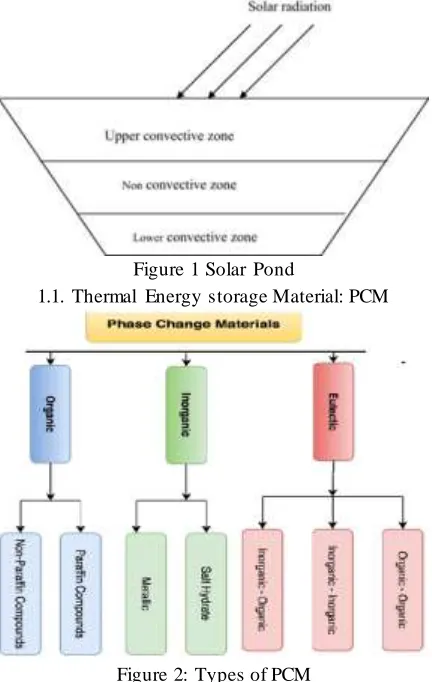
atmosphere. The net result is that the pond waterremains at the atmospheric temperature. The solar pond restricts this tendency by dissolving salt in the bottom layer of the pond making it too heavy to rise. When the sun's rays contact the bottom of a shallow pool, they heat the water adjacent to the bottom. When water at the bottom of the pool is heated, it becomes less dense than the cooler water above it, and convection begins. Solar ponds heat water by impeding this convection. Salt is added to the water until the lower layers of water become completely saturated. High-salinity water at the bottom of the pond does not mix readily with the low-salinity water above it, so when the bottom layer of water is heated, convection occurs separately in the bottom and top layers, with only mild mixing between the two. This greatly reduces heat loss, and allows for the high-salinity water to get up to 90 °C while maintaining 30 °C low-salinity water.
Figure 1 Solar Pond
1.1. Thermal Energy storage Material: PCM
Figure 2: Types of PCM
A phase change material (PCM) is a substance with a high Latent Heat of fusion which, melting and solidifying at a certain temperature and capable of storing and releasing large amounts of energy. Heat is
absorbed or released when the material changes from solid to liquid and liquid to solid state; thus, PCMs are classified as latent heat storage (LHS) units. The use of the latent heat of a PCM as a thermal energy storage medium has gained considerable attention recently by finding however practical difficulties usually arise in applying the latent heat method due to its low thermal conductivity, density change, and stability of properties under extended cycling and sometimes phase segregation and sub cooling of the PCMs. Over the last decade, a number of studies have been performed to examine the overall thermal behavior and performance of various latent heat thermal energy storage systems. These studies focused on the melting/freezing problem of the PCM and on the convective heat transfer problem of the HTF used to store (melt) and/or retrieve energy (solidification) from the unit . PCMs have been widely used in latent heat thermal storage systems for heat pumps, solar engineering, and spacecraft thermal control applications. The uses of PCMs for heating and cooling applications for buildings have been investigated within the past decade .The increase of the heat transfer rate obtained by using vertical fins could be very useful for applications of PCM modules inside water tanks.
2. BLOCK DIAGRAM AND CONSTRUCTION DETAILS OF THE SOLAR POND
Figure 3 Block diagram
IJIRT 147624
INTERNATIONAL JO URNAL OF INNOVATIVE RESEARCH IN TECHNOLOGY243
Table - 1Constructional Details of the Experimental SetupSl.
No Parameter Description
1 Dimension
600mm(Length)X500mm(Width)X6 00mm(Height)X15mm (thickness)
2 M aterial Galvanized Iron Sheet
3
Inside of
Pond Black Painted
4
Outside of Pond
Insulated with 20mm thick glass wool followed by 30 mm thick Styrofoam
5
Heat exchanger (tube)
Outer diameter- 12 mm
Inner diameter-10 mm
Thickness -1 mm
6 Shell
outer diameter- 44mm
Inner diameter-42mm
Thickness -1 mm
7 Fins
Fin diameter -35,nmber-55, fin space-20mm
Figure 5: Side View of Shell and Tube Type Arrangement
Figure 6: Cross Section of Model for Numerical Analysis
3. CALCLATION
3.1. Paraffin Wax
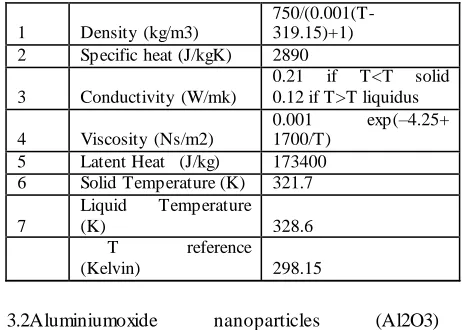
Table 2 Properties of paraffin wax S.No. Operating Parameters
Paraffin Wax
1 Density (kg/m3)
750/(0.001(T-319.15)+1)
2 Specific heat (J/kgK) 2890
3 Conductivity (W/mk)
0.21 if T<T solid 0.12 if T>T liquidus
4 Viscosity (Ns/m2)
0.001 exp(–4.25+
1700/T)
5 Latent Heat (J/kg) 173400
6 Solid Temperature (K) 321.7
7
Liquid Temperature
(K) 328.6
T reference
(Kelvin) 298.15
3.2Aluminiumoxide nanoparticles (Al2O3)
Aluminium oxide nanoparticles have been applied in many branches of industry. The properties of aluminium oxide nanoparticles are given in table Table 3 Properties of Al2O
S. no. Properties of Al2O3
1 Chemical symbol Al2O3
2 CAS No. 0017-18-0
3 Group
Aluminum 11
Oxygen 16
4 Aluminium 90.90%
5 Oxygen 9.10%
6 Density 0.38 g/cm3
7 M olar mass 59.55 g/mole
8 M elting point 933.2 °c
3.3 Sensible heat storage:In sensible heat
storage (SHS), thermal energy is stored by raising the temperature of a solid or liquid. SHS system utilizes the heat capacity and the change in temperature of the material during the process of charging and discharging. The amount of heat stored depends on the specific heat of the medium, the temperature change and the amount of storage material.
3.4.Latent heat
IJIRT 147624
INTERNATIONAL JO URNAL OF INNOVATIVE RESEARCH IN TECHNOLOGY244
3.5 Shell and Tbe type Heat Exchanger with Fins:Figure 7: Construction Details of Numerical model
4. RESULT AND DISCUSSION
From figure It can be observed that, the solar po nd having Heat Exchanger without Fins was able to provide water at a higher temperature only till
evening 6.30 PM. The solar pond without
nanoparticles was able to provide hot water only till the availability of sun. But the solar pond with Heat Exchanger having Fins and nanoparticals was able provide hot water till evening 7.30 PM. The solar pond with Shell and tube type heat exchanger having fins is able to provide hot water for one and half hours even after the sunset.
Figure 8: Comparison of outlet water Temperature with different arrangement
Figure 9: Comparison of outlet water Temperature with different arrangement
5. CONCLUSION
In the present work, a numerical investigation has been carried out to find out the performance enhancement of paraffin wax with nano alumina (Al2O3) particles with concentric Shell and tube type heat exchanger having fins on outer surface of inner pipe. Numerical cyclic analysis indicates that the charge-discharge rates of thermal energy can be greatly enhanced using nano PCM with the heat exchanger having fins as compared with a simple heat exchanger without fins. Embedding Fins in heat exchanger with alumina particles with paraffin wax enhances its low thermal conductivity and thus heat transfer rate.
IJIRT 147624
INTERNATIONAL JO URNAL OF INNOVATIVE RESEARCH IN TECHNOLOGY245
[1] P. Sarathkumar1, A.R. Sivaram2, R. Rajavel3, R.Praveen Kumar4,S.K. Krishnakumar,
Experimental Investigations on The Performance of A Solar Pond by using Encapsulated Pcm with Nanoparticles.
[2] http://www.synergyenviron.com/tools/s
olar-irradiance/bhopal
[3] Atul Sharma, V.V. Tyagi , C.R. Chen , D. Buddhi Review on thermal energy storage with phase change materials and applications
[4] K.Kavitha and S.Arumugam Perforance of
parafin as PCM Solar Thermal Energy Storage. [5] Rajesh Baby, C. Balaji, Thermal optimization of
PCM based pin fin heat sinks: An experimental study, Applied Thermal Engineering.
[6] a. Valan arasu, Agus p. Sasmito, Arun S.