e-ISSN: 2278-067X, p-ISSN: 2278-800X, www.ijerd.com
Volume 12, Issue 8 (August 2016), PP.56-65
A Comparative Study on the Efficiency of Koh Impregnated and
H
3PO
4Impregnated Jackfruit Leaf Based Carbon as Adsorbent
for Removal of Ni from Its Aqueous Solution
Merlin Thomas
a*, Sagar P. Patel
a, Ankit V. Patel
a, Jigar V. Patel
aaDepartment of Industrial Chemistry, Institute Of Science & Technology For Advanced Studies & Research
(ISTAR), Vallabh Vidyanagar, Gujarat, India.
Abstract:
This research work investigates the efficiency of H3PO4and KOH impregnated jackfruit leaf powderbased carbon as adsorbent to remove Ni from wastewater. The removal characteristics of Nickel using both the adsorbents were investigated under various operating variables like contact time, adsorbent dosage, initial metal concentration, solution pH, temperature and stirring speed. The results showed that the H3PO4impregnated
jackfruit leaf powder based carbon is a better adsorbent than the KOH impregnated adsorbent. The experimental results were found to fit well with langmuirand freundlich isotherms.The maximum adsorption capacity of theH3PO4impregnated adsorbentwas found to be 62.98 mg/g and that of the KOH impregnated adsorbent to be
54.66 mg/g.
Key words:
Ni, adsorption, Jackfruit leaf powder, adsorption isotherm.I.
INTRODUCTION
Water is the greatest gift of nature. Increase in pollution of this natural resource has become a matter of grave concern recently due to increased release of toxic chemicals in water. Rapid industrialization and non-implementation of regulations have jointly aggravated the problem. Water of highquality is essential to human life and water of acceptable quality is essential for agriculture, industrial, domestic and commercial activities. So the development of new purification and extraction methods for removal of pollutants from water has become essential. Some of these techniques have been successful, but at great cost or with detrimental effects to environment. The release of toxic materials like Ni into water has been a major challenge to environmental engineers today due to the pollution of water. Priority should be given to regulate the concentration of these pollutants at the discharge level. Ni is a heavy metal used in a large no. of industries like electroplating, Ni-Cd batteries manufacturing, forging, mining [31] coal and oil-burning power plants, etc.[32]. The discharge of heavy metals in water has adverse effects on the health of humans, animals, plants and other organisms [27].The maximum contamination limit of Ni in drinking water is 0.1 mg/L, as set by United States Environmental Protection Agency.
Methods like Chemical precipitation, coagulation, ion exchange, solvent extraction, and membrane filtration were widely used for the removal of contaminants from industrial effluents. But these methods produce large amounts of sludge and waste that need to be disposed off and can consequently cause a lot of problems to the environment due to the presence of high content of contaminants. This has led to the development of new adsorption techniques.
Over the last few decades, adsorption using activated carbon has gained importance as a purification, separation and recovery process on industrial scale. Adsorption by various natural adsorbents, especially waste materials as adsorbent not only solves the problem of waste disposal and also converts a potential waste to a valuable product. Cheap material with high carbon content and low inorganics can be used as a raw material for the production of activated carbon [6]. Low cost adsorbents made from agricultural wastes like coconut shells, almond shells, rice husk and date pits [5,8,13] are found to be effective in the removal of pollutants from water.
and pore size distribution influence the adsorption capacities of activated carbons. These unique characteristics are functions of the type of raw materials employed for preparation of AC and the method of activation.
Impregnated activated carbons are carbonaceous adsorbents which have chemicals finely distributed on their internal surface. The impregnation optimizes the existing properties of the activated carbon giving a synergism between the chemicals and the carbon [15]. KOH and H3PO4 are widely used as an impregnating agents
[23,25,30]. Porosity, pore size distribution, surface area and degree of surface reactivity are the important factors of the adsorbents which determine their efficiency [22].
The main objective of this study is to investigate and compare the efficiency of KOH and H3PO4
impregnated jackfruit leaf powder based carbon to remove Nickel from wastewater. The choice of this material is based on its low cost, considering its abundance in in the tropical regions. Conversion of jackfruit peel into activated carbon would increase its economic value, help reduce the cost of waste disposal, and provide a potentially inexpensive raw material for commercial activated carbon [25]. Jackfruit seeds are rich in protein. The fruit is also rich in vitamin B6, potassium, calcium, and iron. Carbonised Jackfruit leaf and jack fruit peel
are already established as efficient adsorbents for basic dyes , Cd (II) , Ni [9] and chlorophenols [2,14,16,17,18,19,30]. However, no work is reported about the use of KOH and H3PO4 impregnated carbonized
jackfruit leaf as adsorbent for removal of Ni from aqueous solution.
II.
MATERIALS AND METHODS
Raw materials and chemicals
Jackfruit leaves were collected from Anand Agricultural University, Anand (Gujarat, India). Potassium hydroxide, Nickle sulphate (NiSO4.6H2O) were purchased from Sigma (St. Louis, U.S.A). Ammonia,
Hydrochloric acid, sodium hydroxide, phosphoric acid, Potassium Iodide, Iodine, Sodium Citrate and DMG (Dimethyl Glyoxime) were purchased from Hi-media (Mumbai, India). All the chemicals used in the present study were of analytical grade and of the highest purity available.
Impregnation and Carbonization
Jackfruit leaves were collected, sun dried, crushed and ground in a ball mill. The ground sample was sieved to obtain the particles of uniform size of 0.3 – 0.8mm. The precursor obtained was washed to remove surface bounded impurities and mud and dried at 100ºC for 12 h. This was impregnated with H3PO4 for 12h in
varying impregnation ratios, holding time and carbonisation temperatures and the yield was determined. Impregnation ratio was varied from 10% to 50% for H3PO4 and 0.5 to 2.5 for KOH. Holding time of 30 min to
90 min and carbonisation temperature of 400ºC to 700ºC were tried and the yield of the resultant carbon determined.
Porosity Determination
Porosity was determined using Mercury porosimeter (Model : Pascal-140, Pascal-440, Make : Thermo Quest). The technique involves the intrusion of mercury at high pressure into a material through the use of a porosimeter. The test is performed assuming cylindrical pore geometry. Porous materials are prone to absorb water and hence the experiment is done after removal of moisture. The most important variable to be controlled for getting proper porosity of activated carbon is the ratio of the chemical agent to the precursor [12]. Optimum values of carbonisation temperature, holding time and impregnation ratio were determined using the results of yield and porosity.
Proximate Analysis
Moisture Content, Volatile Matter, Ash Content and Fixed Carbon of the prepared sample was determined using process described in IS 1350, 1984 (Methods of test for coal and coke).
Surface Area determination
The particle size distribution and surface area of the prepared sample was determined using Particle size analyser (Model: Helos (H1004) &Sucell Make: Sympatec, German). Surface area is important to be measured in adsorption studies as it affects the adsorption capacity of adsorbents. For particles of small size, surface area will be high.
Study of Surface Morphology
5000-20000 Å having surface area ranging between 0.5 and 2.0 m2/g. The effective radius of transitional pores usually falls within 40-200 Å and their surface area lies between 20-70 m2/g. Micropores, which have radius less than 20 Å usually amounts to at least 95 % of total surface area. Micropores are of greatest significance for adsorption due to their large surface area [1].
Adsorption Studies
Jack fruit leaf based KOH and H3PO4 impregnated carbon were used as adsorbents to carry out batch
adsorption tests for removal of Nickel from water. Stock solution of 100 mg/L of Ni was prepared by dissolving 447.8 mg of Nickel Sulphate ( NiSO4.6H2O) in 1L distilled water. The stock solution was then
diluted as per requirement. The tests were carried out by varying adsorbent dosage, contact time, pH, temperature, initial Ni concentration and stirring rate. After the adsorption, the sample was filtered and the filtrate was checked for the Ni concentration using UV-Visible spectrophotometer ( Model : Lambda19,Make : Perkin Elmer, U.S.A.) at 540 nm by complexing Ni with DMG (Dimethyl Glyoxime). The effects of all the factors were studied as per Table 1.
The adsorption isotherm
The adsorption isotherm for Ni was studied using Langmuir and Freundlich isotherms using the optimum conditions.
Langmuir isotherm is defined as 𝐶𝑒
𝑞𝑒 = 1 𝑏 𝑞𝑚𝑎𝑥 +
𝐶𝑒
𝑞𝑚𝑎𝑥 and the Freundlich isotherm is defined as log qe=log K
+ (1/n) log Ce where qmax is the maximum adsorption capacity (mg/g), and b is the adsorption equilibrium
constant (l/mg). Ce is the equilibrium concentration of metal ions, qe is the amount of metal ions adsorbed per unit weight of adsorbent (mg/g). K and n represent the adsorption capacity and measure of heterogeneity respectively. The type of isotherm can be favourable if 1/n <1 and unfavourable if 1/n >1.
III.
RESULTS AND DISCUSSION
Selection of KOH and H3PO4 impregnation ratio, holding time and carbonisation temperature.
The results of effect of H3PO4 and KOH impregnation ratio on the yield is shown in table 2, effect of
holding time and carbonisation temperature on yield & porosity given in table 3 a&b and 4 a &b respectively. The transformation from lignocellulose materials into carbon involved releasing of O and H atoms as H2O, CO,
CO2, CH4 and distillation of tar. The drop in yield after a certain range of impregnation ratio may be due to
enhancement of carbon burn off by extra amount of H3PO4 andKOH. The % yield decreased with increase in
temperature due to carbon burn off and tar volatilization at higher temperatures.
From the study of table 2, 3a & b and 4 a & b, the impregnation ratio, holding time, carbonisation temperature were fixed as shown in table 5.
Proximate Analysis
Low amount of moisture, ash and volatile matter, indicate that the particle density is relatively small and that the biomaterial should be an excellent raw material for adsorbent.Ash content can also affect activated carbon as it reduces the overall activity of activated carbon. It also reduces the efficiency of reactivation, the lower the ash value therefore the better the activated carbon for use as adsorbent.
Surface area determination
The total specific surface area of H3PO4 and KOH adsorbents were determined as
66.777m2/gand14.258 m2/g respectively (Table7a & b) using particle size analyser. High surface area implies that the nature of the prepared activated carbon consists mainly of mesopores which are very favourable for adsorption of large molecules.
Morphology Study
Scanning electron micrographs of the surface morphology of the sample of the activated carbon impregnated with H3PO4 and KOH are given in Fig. 1 a & b. The SEM image shows the adsorbent to be an
effective one. SEM image shows the presence of some wide pores which resulted due to chemical activation with H3PO4 and KOH. This activation depends on the cellulose content of the adsorbent. Under the electrolytic
action of the activating agent, the cellulose swells during which the arrangement of molecules in the direction of longitudinal axis remains unchanged as the lateral bonds are broken down with the result that inter and intra micelle voids increase.
Effect of adsorbent dosage on % adsorption
for KOH impregnated sample (Fig 3) after which there was no substantial increase in Ni removal. As the dose of adsorbent increases, the number of adsorbent sites increases. This results in attachment of more ions to their surfaces [1].
Effect of contact time on % adsorption
Ni adsorption was studied by varying the contact time between the adsorbate and adsorbent in the range 30-120 min while keeping all other parameters constant. The data showed that the sorption of Nickel ions on jackfruit leaf powder based carbon was relatively fast for H3PO4 impregnated adsorbent where the
equilibrium was reached after 80 min (Figure 4). The adsorption process is fast at the beginning of the reaction due to the adsorption of Ni on the surface sites of adsorbent.
Effect of solution pH on % adsorption
Solution pH is an important variable which controls the adsorption of the heavy metal from wastewater. The effect of pH on the removal of Ni ions by H3PO4 and KOH impregnatedjackfruit leaf based
carbon powder was investigated. The adsorption of Ni was studied in the pH range 2–11, keeping all other parameters constant. The results (Fig 5) show that the adsorption of Ni decreased from 98 % to 88 % for H3PO4
impregnated adsorbent and from 95.3 % to 86 % for KOH impregnated adsorbent.
Effect of initial Ni concentration) on % adsorption
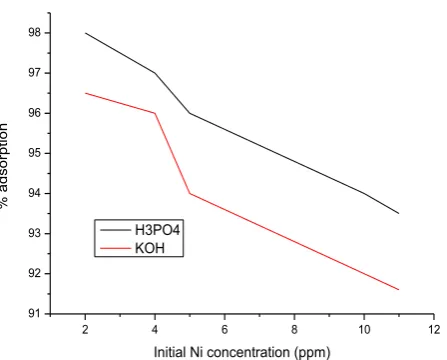
Adsorption studies were conducted within the initial Nickel concentration of 2 ppm to 11 ppm. At low Ni concentrations, sufficient adsorption sites are available for adsorption of Ni ions. At higher concentrations, relatively less available sites caused reduction in % adsorption (Fig 6). Increasing the initial Ni concentration decreased percentage removal of Ni from the solution due to the saturation of adsorbent with Ni.
Effect of temperature on % adsorption
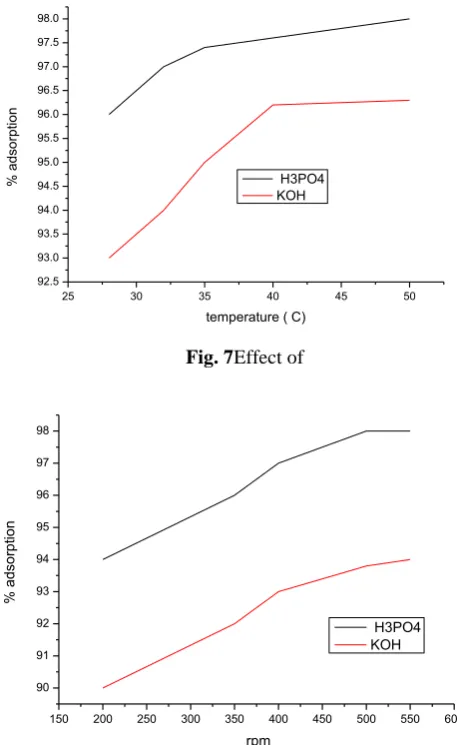
Adsorption studies were conducted between 28ºC to 50ºC. The adsorption efficiency was found to sharply increase from 28ºC to 35ºC and progressing slowly thereafter (Fig 7). There was no significant increase after 45ºC. At higher temperatures, the rate of diffusion to the pores of adsorbent increases since diffusion is an endothermic process. Thus the % adsorption increases at higher diffusion rate of Nickel. Moreover, at low temperatures, the kinetic energy of Nickel species is low and hence contact between adsorbate and adsorbent is insufficient.
Effect of rpm on % adsorption
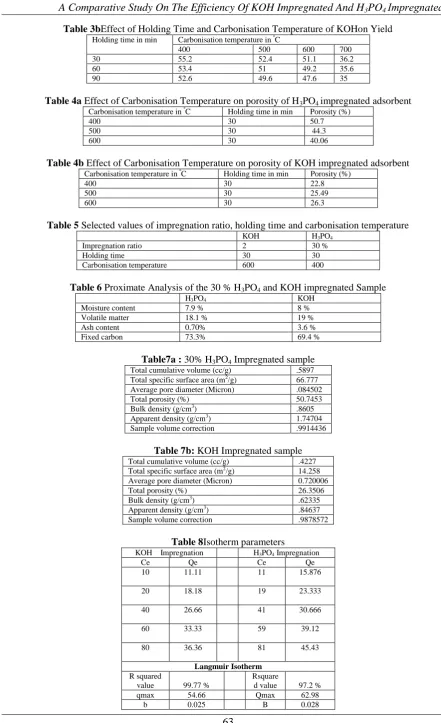
The adsorption efficiency was observed to be low at small speeds whereas the maximum efficiency was observed at 500 rpm. The adsorption efficiency increases with the change in rpm from 200 to 550 rpm (fig 8). Due to agitation, proper contact was developed between metal ion in solution and the binding sites, which promoted effective transfer of adsorbate ions onto the adsorbent sites. But the effect of rpm on adsorption efficiency is minimum as compared to other parameters.
Adsorption isotherm
Isotherm parameters are given in table 8. The maximum adsorption capacity of the adsorbent was found to be 66.98 mg/g for H3PO4 and 54.66 mg/g for the KOH impregnated sample using Langmuir isotherm,
n values between 1 and 10 for the Freundlich isotherm indicate effective adsorption [27]. The experimental data fits well into both the isotherms with R squared values of 97.2 and 99.7 respectively for H3PO4and
KOHforLangmuir isotherm and R squared values of 98.76 and 99.28 respectively for H3PO4and
KOHFreundlich isotherms.
IV.
CONCLUSIONS
The results obtained in present study indicate the H3PO4 impregnated jackfruit leaf powder based
carbon is a better adsorbent than KOH activated jackfruit leaf powder based carbon though both can be successfully used for the removal of Nickel from aqueous solutions. The yield of activated carbon impregnated by potassium hydroxide is lower than those activated with phosphoric acid at high temperature and so, the carbon content is less than fixed carbon. The presence of metallic potassium will intercalate to the carbon matrix [14], yielding lower yield of activated carbon, less than the carbon content of the raw material.
The amount of Nickel adsorbed in both the cases was found to be heavily dependent on solution pH, adsorbent dose and initial Ni ppm, temperature and contact time. The effect of rpm on adsorption efficiency was negligible. The sorption of Nickel on the adsorbent was relatively fast with H3PO4 than KOH impregnated
The optimum conditions of above parameters were tested with Freundlich and Langmuir isotherm models. Based on R squares values obtained from different isotherm models, it was found that both Freundlich and Langmuir isotherms gave good data fitting for both H3PO4 than KOH impregnated jackfruit leaf based
carbon with R squared values above 97. The maximum adsorption capacity of the H3PO4 impregnated jackfruit
leaf powder was found to be 62.98 mg/g and that with KOH impregnated jackfruit leaf powder was found to be 54.66 mg/g.
Fig.1a SEM of H3PO4 impregnated adsorbent
Fig 1b. SEM of KOH impregnated adsorbent
0.00 0.05 0.10 0.15 0.20
74 76 78 80 82 84 86 88 90 92 94 96 98 100
%
a
dso
rp
tio
n
adsorbent dosage (gm/ 100 ml) H3PO4 KOH
20 40 60 80 100 120 84
86 88 90 92 94 96 98
%
a
d
so
rp
tio
n
time in minutes H3PO4 KOH
Fig 4. Effect of contact time on % adsorption
2 4 6 8 10 12
86 88 90 92 94 96 98
%
a
d
so
rp
tio
n
pH H3PO4 KOH
Fig 5.Effect of pH on % adsorption
2 4 6 8 10 12
91 92 93 94 95 96 97 98
%
a
d
so
rp
tio
n
Initial Ni concentration (ppm) H3PO4
KOH
25 30 35 40 45 50 92.5
93.0 93.5 94.0 94.5 95.0 95.5 96.0 96.5 97.0 97.5 98.0
%
a
d
so
rp
tio
n
temperature ( C) H3PO4 KOH
Fig. 7Effect of
150 200 250 300 350 400 450 500 550 600 90
91 92 93 94 95 96 97 98
%
a
dso
rp
tio
n
rpm
H3PO4 KOH
Fig. 8Effect of rpm on % adsorption temperature on % adsorption
Table 1
Variable Value
Adsorbent dosage 0.01 -0.2gm/100 ml
Initial concentration of Cr(VI) 2-11 ppm
pH 2-11
Contact time 30-120 min
Temperature 28-50ºC
Rpm 200-550
Table 2 Effect of Impregnation Ratio of H3PO4 and KOH on Yield
Sr. No.
H3PO4 impregnation ratio % Yield KOH impregnation ratio
% Yield
1 10% 56% 0.5 75.5
2 20% 62% 1 78.6
3 30% 71.5% 1.5 80.3
4 40% 71% 2 83.3
5 50% 70.5% 2.5 81.1
Table 3a Effect of Holding Time and Carbonisation Temperature of 30% H3PO4 on Yield
Holding time in min Carbonisation temperature in ºC
400 500 600
30 56 % 46.5% 38.2%
60 52.3% 43.5% 36.1%
Table 3bEffect of Holding Time and Carbonisation Temperature of KOHon Yield
Holding time in min Carbonisation temperature in ºC
400 500 600 700
30 55.2 52.4 51.1 36.2
60 53.4 51 49.2 35.6
90 52.6 49.6 47.6 35
Table 4a Effect of Carbonisation Temperature on porosity of H3PO4 impregnated adsorbent
Carbonisation temperature in ºC Holding time in min Porosity (%)
400 30 50.7
500 30 44.3
600 30 40.06
Table 4b Effect of Carbonisation Temperature on porosity of KOH impregnated adsorbent
Carbonisation temperature in ºC Holding time in min Porosity (%)
400 30 22.8
500 30 25.49
600 30 26.3
Table 5 Selected values of impregnation ratio, holding time and carbonisation temperature
KOH H3PO4
Impregnation ratio 2 30 %
Holding time 30 30
Carbonisation temperature 600 400
Table 6 Proximate Analysis of the 30 % H3PO4 and KOH impregnated Sample
H3PO4 KOH
Moisture content 7.9 % 8 %
Volatile matter 18.1 % 19 %
Ash content 0.70% 3.6 %
Fixed carbon 73.3% 69.4 %
Table7a : 30% H3PO4 Impregnated sample
Total cumulative volume (cc/g) .5897 Total specific surface area (m2/g) 66.777 Average pore diameter (Micron) .084502
Total porosity (%) 50.7453
Bulk density (g/cm3) .8605
Apparent density (g/cm3) 1.74704
Sample volume correction .9914436
Table 7b: KOH Impregnated sample
Total cumulative volume (cc/g) .4227 Total specific surface area (m2/g) 14.258 Average pore diameter (Micron) 0.720006
Total porosity (%) 26.3506
Bulk density (g/cm3) .62335
Apparent density (g/cm3) .84637
Sample volume correction .9878572
Table 8Isotherm parameters
KOH Impregnation H3PO4 Impregnation
Ce Qe Ce Qe
10 11.11 11 15.876
20 18.18 19 23.333
40 26.66 41 30.666
60 33.33 59 39.12
80 36.36 81 45.43
Langmuir Isotherm
R squared
value 99.77 %
Rsquare
d value 97.2 %
qmax 54.66 Qmax 62.98
Freundlich Isotherm
n 1.72 N 1.97
k 3.01 K 1.99
R squared value
99.28 % Rsquare
d value
98.76 %
Acknowledgements
The authors want to acknowledge Sophisticated Instrumentation Centre for Applied Research and Testing (SICART) for providing the necessary instrumentation facilities.
References
[1]. Abollino O, Aceto M, Malandrino M, Sarzanini C, Mentasti E “Adsorption of heavy metals on Na-montmorillonite. Effect of pH and organic substances’. Water Res 37(7),2003,1619-27. doi:10.1016/S0043-1354(02)00524-9
[2]. Ahmadpour A, Do DD “ The preparation of activated carbon from macadamia nutshell by chemical activation”. Carbon 35(12),1997,1723-32.
[3]. Aksu Z, Kutsal T“ Abioseparation process for removing lead(II) ions from waste water by using Chlorella vulgaris”. J. Chem. Technol. Biotechnol 52,1991,109–118. doi:10.1002/jctb.v52.
[4]. Aworn A, Thiravetyan P, Nakbanpote W “ Preparation of CO2 activated carbon from corncob for monoethylene glycol adsorption”. Colloids and Surfaces A: Physicochemical and Engineering Aspects 333(1),2009,19-25. doi:10.1016/j.colsurfa.2008.09.021 [5]. Azevedo DC, Araujo JC, Bastos-Neto M, Torres AE, Jaguaribe EF, Cavalcante CL “ Microporous activated carbon prepared from
coconut shells using chemical activation with zinc chloride”. Microporous and Mesoporous Mater 100(1),2007,361-4. doi:10.1016/j.micromeso.2006.11.024.
[6]. Bansal RC, Donnet JB, Stoeckli F “ Active carbon”. M. Dekker, New York,1988 [7]. Bansal RC, Goyal M Activated carbon adsorption. CRC press, Taylor & Francis,2005.
[8]. Bansode RR, Losso JN, Marshall WE, Rao RM, Portier RJ “ Adsorption of volatile organic compounds by pecan shell-and almond shell-based granular activated carbons”. Bioresour. Technol 90(2),2003,175-84. doi:10.1016/S0960-8524(03)00117-2.
[9]. Boruah P, Sarma A, Bhattacharyya KG “ Removal of Ni (II) ions from aqueous solution by using low cost biosorbent prepared from jackfruit (Artocarpusheterophyllus) leaf powder”. Indian J. Chem. Technol22(6),2015,322-327.
[10]. Budinova T, Ekinci E, Yardim F, Grimm A, Bjrnbom E, Minkova V, Goranova M “ Characterization and application of activated carbon produced by H3PO4 and water vapor activation”. Fuel Process. Technol,87,2006,899–905. doi:10.1016/j.fuproc.2006.06.005. [11]. Din MI, Mirza ML “Biosorption potentials of a novel green biosorbentSaccharumbengalense containing cellulose as carbohydrate
polymer for removal of Ni (II) ions from aqueous solutions”. Int. J. Biol. Macromol 54, 2013,99-108. [12]. Dubinin MM “ Chemistry and Physics of Carbon”, second ed. Marcel Dekker, New York,1996.
[13]. Fierro V, Muñiz G, Basta AH, El-Saied H, Celzard A “ Rice straw as precursor of activated carbons: Activation with ortho-phosphoric acid”. J. Hazard. Mater 181,2010,27–34. doi:10.1016/j.jhazmat.2010.04.062.
[14]. Hameed BH “Removal of cationic dye from aqueous solution using jackfruit peel as non-conventional low-cost adsorbent”. J. Hazard. Mater 162,2009,344–350.
[15]. Henning KD, Schäfer S “Impregnated activated carbon for environmental protection”. Gas Sep. Purif 7(4),1993, 235-240. [16]. Inbaraj BS, Sulochana N “ Basic dye adsorption on a low cost carbonaceous sorbent-kinetic and equilibrium studies”. Indian J
ChemTechn 9(3),2002,201-208.
[17]. Inbaraj BS, Sulochana N “ Carbonised jackfruit peel as an adsorbent for the removal of Cd (II) from aqueous solution”. Bioresour. Technol 94(1),2004,49-52.
[18]. Inbaraj BS, Sulochana N “ Use of jackfruit peel carbon (JPC) for adsorption of rhodamine-B, a basic dye from aqueous solution”. Indian J ChemTechn 13 (1),2006,17-23.
[19]. Jain S, Jayaram RV “ Adsorption of phenol and substituted chlorophenols from aqueous solution by activated carbon prepared from jackfruit (Artocarpusheterophyllus) peel‐kinetics and equilibrium studies”. Sep. Sci. Technol 42(9),2007,2019-2032.
[20]. Klijanienko A, Lorenc-Grabowska E, Gryglewicz G “ Development of mesoporosity during phosphoric acid activation of wood in steam atmosphere”. Bioresour. Technol 99,2008, 7208–7214. doi:10.1016/j.biortech.2007.12.059.
[21]. Munoz-Gonzalez Y, Arriagada-Acuna R, Soto-Garrido G, Garcia-Lovera R “Activated carbons from peach stones and pine sawdust by phosphoric acid activation used in clarification and decolorization processes”. J. Chem. Technol. Biotechnol 84,2009,39–47. doi:10.1002/jctb.2001.
[22]. Ncibi MC, Sillanpaa M “Mesoporous carbonaceous materials for single and simultaneous removal of organic pollutants:activated carbons vs. carbon nanotubes”. J MolLiq 207,2015,237–247.
[23]. Patel S, Thomas M, Patel A, Patel J “ Study of KOH impregnated jack fruit leaf based carbon as absorbent for treatment of wastewater contaminated with Nickel”. International Journal of recent trends in engineering & research 02,2016,219-229.
[24]. Petrov N, Budinova T, Razvigorova M, Parra J, Galiatsatou P” Conversion of olive wastes to volatiles and carbon adsorbents”. Biomass Bioenergy 32,2008,1303–1310. doi:10.1016/j.biombioe.2008.03.009.
[25]. Prahas D, Kartika, Y, Indraswati N, Ismadji S “ Activated carbon from jackfruit peel waste by H3PO4 chemical activation: Pore structure and surface chemistry characterization”. Chem. Eng. J 140,2008,32–42. doi:10.1016/j.cej.2007.08.032.
[26]. Rosas JM, Bedia J, Rodríguez-Mirasol J, Cordero T “ HEMP-derived activated carbon fibers by chemical activation with phosphoric acid”. Fuel 88,2009,19–26. doi:10.1016/j.fuel.2008.08.004.
[27]. Sharma S, Garg S “A Brief Study of Various Adsorbents for Removal of Ni Metal Ions from Waste Water”. An International Journal of Engineering Sciences 3,2014,201-207.
[28]. Smíšek M, Černý S “ Active carbon: manufacture, properties and applications”, Vol. 12. Elsevier Publishing Company, Amsterdam,1970.
[29]. Soleimani M, Kaghazchi T “ Activated Hard Shell of Apricot Stones: A Promising Adsorbent in Gold Recovery”. Chinese J. Chem. Eng 16,2008,112–118. doi:10.1016/S1004-9541(08)60048-8.
[30]. Uddin MT, Rukanuzzaman M, Khan MM, Islam MA “ Jackfruit (Artocarpusheterophyllus) leaf powder: An effective adsorbent for removal of methylene blue from aqueous solutions”. Indian J ChemTechn 16(2),2009,142-149.
[31]. Xu H, Liu Y, Tay JH “ Effect of pH on nickel Biosorption by aerobic granular sludge”.Bioresour. Technol, 97,2006,359-363. [32]. Zabaniotou A, Stavropoulos, Skoulou V “Activated carbon from olive kernels in a two-stage process: Industrial improvement”.
[33]. Zhu Y, Gao J, Li Y, Sun F, Gao J, Wu S, Qin Y “ Preparation of activated carbons for SO2 adsorption by CO2 and steam activation”. J. Taiwan Inst. Chem. Eng 43,2011, 112–119. doi:10.1016/j.jtice.2011.06.009.