Abstract
The world today is becoming highly aware of the challenges posed to the environment and the resulting problems. An optimistic step towards mitigating the effect of challenges is a shift in the consumer attitude towards a green lifestyle. As businesses have seen this change in consumer attitudes, they are trying to gain an edge in the competitive market by exploiting the potential in the green market industry by incorporating environmental friendly practices in designing, making, packaging, and marketing of products and services as part of the corporate social responsibility. As Indian marketers and consumers have started to understand the importance of green marketing and its resultant benefits, this research is mainly conducted to identify the level of awareness, perceptions, and preferences of consumers towards products that are produced and marketed the green way in Coimbatore city. The results of the study reveal an increased concern of the consumers towards the environment and the different types of environment friendly products purchased by them. The finding of the study also reveals that eco-friendly values of the consumer do not have a significant influence on their decision to purchase green products.
Keywords: : Green marketing, Eco-friendly products, Consumers, Green Value
Introduction
A world-wide alert in the environmentaldegradation has compelled today's consumers to become more apprehensive about theirbuying and consumption habits and the effects that these have on the environment.As consumers have become increasingly choosy and started avoiding products that impact the environment, organizations are adopting green marketing practices not only to meet consumer expectations but also to gain a competitive advantage and establish a strong consumer base.Green marketing also termed as environmental marketing or ecological marketing refers tothe marketing of products that are presumed to be environmentally safe. The concept of green marketing includes a wide range of activities such as modifying the product, making changes in the production, packaging and advertising processes whilediscarding any process that influences the environment in a negative way. Green marketing includes all actions taken to fulfilthe needs and requirements of the consumer with minimal disastrousrepercussions inflicted on the natural environment.
A Study on the Consumer Behaviour towards Green Marketing
Practices -With Special Reference to Coimbatore City
In business context, the terms green products and eco-friendly products are used commonly to describe the products that are produced in wayswhich protect the natural environment by conserving energy/resources and reducing or eliminating the use of toxicagents. This in turn brings down the waste discharge significantly thereby controlling the pollution level. Thus green marketingstrategy is adopted by many corporate houses to shift the consumers'opinion when they have to decide on buying a product. All these factors have prompted to take up the present study foranalyzing theconsumer behavior regarding green products in Coimbatore city.
Review of Literature
Mohammad Azam(2014) in his study on green marketinghas identified that corporate people as well as consumers are giving more importanceto the issue of green marketing. The corporates have accepted the green production as they have seen a positive interest of the customers with green products.
Rao et al. (2011) suggests that if businesses offer environmental friendly products to consumers atreasonable prices and high quality, consumers will develop positive intentions to purchase them.
Banerjee, 2003; Hay and Lichter 2000 in their study have identified that the overwhelming increase in the overall environmental consciousness among different classes of consumershave encouraged the companies to "go green" by presenting the concept of corporate environmentalism.
Chang and Fong (2010) made a survey of the consumers who purchased environmentally friendly products in Taiwan and found that green product quality and green corporate image could bring greater customer satisfaction and customer loyalty.
A study done by Chase and smith (1992) revealed that 70% of the consumer purchase decisions were in?uenced by environmental protection message given in advertising and product labelling.
Patra and Joshi (2009) revealed that the majority of respondents wanted individuals in the societyto be socially responsible and take appropriate action to protect the environment.
Gurau, C. &Ranchhod, A. (2005) in their study have identified the issues surrounding the marketing of ecological products in the international marketplace.
Harrison (1993) is of the view that green marketing is the strategy that companies use to position the benefits of green products in such a way that it influences purchasing decisions of consumers.
Objectives of the study
1. To analyze the level of consumer awareness regarding green products and practices.
3. To identify the factors that influences the consumers for buying green products.
4. To identify the type of green products purchased by the consumers.
5. To analyze the influence of green value on the purchase decisions of the consumers.
Research methodology
The data for the study was collected from various parts of Coimbatore City using convenience sampling method. Field survey was conducted to collect the primary data from 120 respondents using a well-structured questionnaire and also through interviews conducted with the respondents.The secondary data required for the study was collected from the journals and the internet. The data collected from the respondents was tested with suitable statistical techniques.
Analysis and interpretation
Table 1:Personal profile of the respondents
Gender No. of
Respondents Age
No. of Respondents
Annual Income (In lacs)
No. of Respondents
Educational Qualification
No. of Respondents
Male 54 <30 32 <3 20 High School 8
30-40 40 3-5 42 UG 64
Female 66 40-50 >50 34 14 5-10 >10 44 14 Doctorate PG 38 10
Total 120 Total 120 Total 120 Total 120
Table 1 reveals that out of the 120 respondents, 45% of the respondents were male and 55% of the respondents were female respondents.Majority 33% of the respondents belong to the age group of 30 -40 years, while 11% of the respondents were above 50 years. 37% of the respondents were earning the yearly income between 5-10 lakhs and 35% of the respondents were earning the yearly income 3 to 5 lakhs. Most of (53%) the respondents are educated with undergraduate degree and 32% with master's degree.
Table 2: Level of awareness about green products
S. No Level of awareness No of respondents %
1 Completely aware 68 56
2 Partially aware 44 37
3 Unaware 8 7
Total 120 100
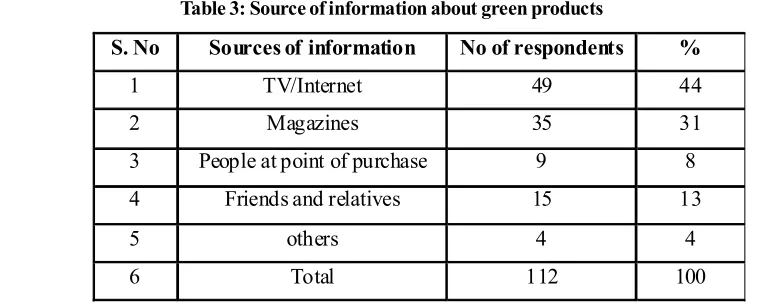
eco-Table 3: Source of information about green products
S. No Sources of information No of respondents %
1 TV/Internet 49 44
2 Magazines 35 31
3 People at point of purchase 9 8
4 Friends and relatives 15 13
5 others 4 4
6 Total 112 100
44% of the respondents came to know about green products through TV advertisements / internet,31% of the respondents became aware of the ecofriendly products through magazines/dailies,8% of the respondents were aware through the salesmen who were presentat the point of purchase, while 13% of the respondents came to know about green marketing through friends and relatives.4% of the respondents came to know about green products through other sources.
Table 4: Perceptions regarding the prices of ecofriendly products
S. No Perceptions regarding prices No of respondents %
1 Higher 82 73
2 Same as other products 19 17
3 Not concerned 5 5
4 Lower 6 5
Total 112 100
Table 5: Green products purchased by the respondents
S. No. Products purchased No of respondents %
1 LED lights 43 24
2 5 star energy saving equipment 34 19
3 Solar heaters/Cookers 19 11
4 Wooden toys 4 2
5 Reusable shopping bags 5 3
6 Herbal cosmetics 36 17
7 Recycled stationery 2 1
8 Organic food products 15 9
9 Eco friendly clothing 13 7
10 others 12 7
Total 183 100
Table 5 shows the different types of green products purchased by the respondents. Majority (24%) of the respondents purchase LED tubes which they feel saves energy consumeption.19% of the respondents purchase the star rated energy saving equipment followed by 17% of the respondents who purchase herbal cosmetics items from soaps to creams. Customers also purchase other items like organic food products (9%),eco-friendly clothing (7%), reusable shopping bags,softdrinks (7%) etc.
Table 6: Reasons for purchase of eco-friendly products
S. No Reasons for purchase No of respondents %
1 Health benefits 72 30
2 Good quality & reliability 67 28
3 Promotional efforts 22 9
4 Doctors/friends advice 34 14
5 Brand popularity 12 5
6 Package and design of the product 15 6
7 Proximity and availability of the shop 19 8
Table 6 reveals the main reasons for purchase of ecofriendly products. A majority (30%) of the respondents purchase eco-friendly products because of the health benefits.28% of the customers buy the products because they feel that these green products are of good quality and are reliable.9 % of them buy because of the promotional efforts of the company and the retailers at point of purchase,14 % of them buy because of the doctors/friends advice, while 5% of them buy due to brand popularity.6% of them buy due to the package and design of the product ,while 8 % of them buy if the product is available in their proximal shop.
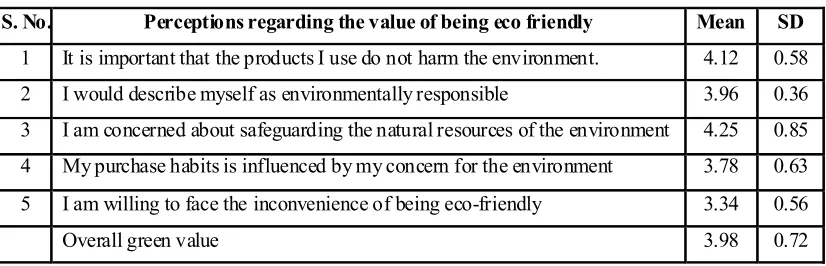
Table 7: Consumer perceptions regarding value of being eco friendly
S. No. Perceptions regarding the value of being eco friendly Mean SD
1 It is important that the products I use do not harm the environment. 4.12 0.58
2 I would describe myself as environmentally responsible 3.96 0.36
3 I am concerned about safeguarding the natural resources of the environment 4.25 0.85
4 My purchase habits is influenced by my concern for the environment 3.78 0.63
5 I am willing to face the inconvenience of being eco-friendly 3.34 0.56
Overall green value 3.98 0.72
Table 7 shows the perceptions of the consumers regarding the values of being eco-friendly. The respondents were asked to rate their green value in a scale of one to five, and the mean scores indicate that people have a positive attitude towards concern for nature and the importance of buying ecofriendly products.
Table 8: Influence of green consumer values on purchase decision of green products
S. No. R R Square Adjusted R
square
Standard error of
estimate
1 0.453 0.256 0.156 0.768
The correlation coefficient value of R=0.453 suggests that there is a moderate positive correlation between green values of the customers and the purchasing decisions. However only 25.6% (R-square value of 0.256) variation in purchase decisions is influenced by the impact of green consumer values. This implies that there are still other factors which impact the green purchase behavior that remain to be explored in future research.
Conclusion and Recommendations
green products which include healthbenefit, quality and reliability, doctors/friends advice, brand popularity etc.Discussions with the respondents reveal that even though majority of the respondents claim to be aware of green products, the awareness seems to be incomplete and they did not know exactly as to what sort of products constitute the green product list. Barring the energy saving equipment, the real motivation to particularly go for green products is a bit less due to the cost and lack of knowledge. The study also reveals that consumers' decision making process is influenced by thegreen promotional campaign of the company, and recommendations made bythe people at the point of purchase. The marketers therefore have to devise an effective strategy for educating and promoting green products among the consumers. This will help the consumers in better understanding the good effects of eco-friendly products from the perspective of health and environment.Further, such an effort will enable thecompanies to enhance their goodwill and build a strong brand image in the consumers view point.
References
1. Mohd Rafi Y and Azman Z (2003), "Customers' Awareness, Perception and Future Prospects of Green Products in Pahang, Malaysia", The Journal of Commerce, Vol. 3, No. 2, pp. 1-10.
2. Rao, P., Basha, K. & Kumar, S. (2011). Consumers Perception and Purchase Intentions towards Green Products, 1, pp. 63 - 74.
3. Banerjee, S. B., Iyer, E.S., &Kashyap, R. K. (2003). Corporate Environmentalism: Antecedents and Influ-ence of Industry Type. Journal of Marketing, 67(2), 106-122.
4. Chang, N. & Fong, C. (2010). Green Products Quality, Green Corporate Image, Green Customer Satisfaction and Green Customer Loyalty. African Journal of Business Management, 4, pp. 2836 - 2844.
5. Chase, D. & Smith, T. K. (1992). Consumer Keen on Green but Marketers Don't Deliver. Advertising Age, 63, pp. 82 - 84.
6. Patra, S. & Joshi, S. (2011). Attitude towards the Environment And Green Products: An Empirical Study. International Journal of Research in Computer Application & Management, 1, pp. 34 - 41.
7. Gurau, C. &Ranchhod, A. (2005), International Green Marketing: A Comparative Study of British and Romanian Firms. International Marketing Review, 22, pp. 547 - 561.
8. Harrison, R. V. (1993). Person-environment fit theory: some history, recent developments, and future directions. Journal of Social Issues, 49, pp. 253-275.
9. https://hbr.org/search?term=green%20marketing