Licensed under Creative Common Page 1367
http://ijecm.co.uk/
ISSN 2348 0386
IDENTIFICATION AND PRIORITIZATION OF THE EFFECTIVE
FACTORS IN THE DEVELOPMENT OF SMALL AND
MEDIUM-SIZED KNOWLEDGE-BASED ENTERPRISES USING AHP
Fatemeh Firoozi Nia
MA in Public Management, Islamic Azad University, Iran
Davood Kia Kojoori
Assistant Professor & Faculty Member of Islamic Azad University, Chalus Branch, Chalus, Iran [email protected]
Abstract
Knowledge-based companies are established to transform ideas and innovations to products,
the commercialization of research, Synergy of wealth and knowledge, empowerment and
leading graduates to enter business contexts. These enterprises play a main role in economic
success of country in terms of creating sustainable jobs based on technology and exploitation of
new opportunities; therefore, to identify and evaluate the factors influencing the growth and
development of entrepreneurship in these organizations can be useful in planning and policy
making for the promotion of entrepreneurial activities. In this regard, the present study was done
to evaluate the factors influencing the development of entrepreneurship in the small and
medium knowledge-based enterprises. This study is a descriptive survey and its population
consists of entrepreneurs and owners of knowledge-based companies located in west of
Mazandaran province, Iran. The results obtained from 10questionnaires investigated showed
that financial support, academic entrepreneurship, the growth center and government support
are of highest priorities as the factors influencing the development of these companies. To this
end, there are practical proposals presented to improve the infrastructure of these companies.
Keywords: Small and medium-sized enterprises (SMEs), Knowledge-based enterprise,
Licensed under Creative Common Page 1368 INTRODUCTION
In the past, tangible factors such as physical capital, labor and natural resources are considered as factors of production and economic growth, but now in addition to the above factors, intangible factors are taken into account such as knowledge, information and cultural features as new resources of economic growth. In fact, in the past, technology and knowledge influence production and economic growth as exogenous factors, but it is now believed that these factors are endogenous factors that influence the efficiency of all factors and sources of economic growth. According to the definition of OECD, knowledge-based economy is an economy which is formed based on the production, distribution and use of knowledge and information and investment in knowledge and basic knowledge industries are of particular interest. The prerequisites of the knowledge-based economy includes education and investment in human capital, government support policies, information and communication technology(ICT), the existence of sufficient social, political, economic and legal environment for investment, production and trading. The features of a knowledge -based economy also includes creation and entering of new ideas, the sufficient environment for economic activity, international orientation, innovation, investment, education and continuous learning, employment, ICT infrastructure (Memarnezhad, 2005)
Universities generate knowledge and also are active in basic research and applied research near innovation and invention. Universities are productive and supporters of researchers and scholars, working in the process of knowledge transfer to the economy, and act as a path that enables enterprises to achieve international academic research highway. (Bramwell and Wolfe, 2005).of the most important and the most basic knowledge-based economy issues are commercialization results of academic research, the development of productive companies and creating knowledge-based companies.
Licensed under Creative Common Page 1369 activities are growing. These small companies lack the ability to absorb technology from the National Institutes of Technology and require different types of support mechanisms.
To identify key factors of success in creation and development of knowledge-based enterprises, necessary contexts for establishment and development of such enterprises couldbe recognized and steps could be taken o implement them(Akbar Zade, ShafieeZadeh, 2012). However, studies conducted on the factors influencing the creation and development of small and medium knowledge-based enterprises in the country are not rich enough. The present study considers this main question by help of documentary studies and surveys that what factors influence the creation and development of these companies in this country and how they are influencing priorities.
THEORETICAL BACKGROUND
In the evolving world of today, the success is for the communities and organizations that establish a meaningful relationship between scarce resources and capabilities of human resources management and entrepreneurship. In other words, society and organization can move forward rapidly toward development that equips it human resources to productive entrepreneurial knowledge and skills by creating necessary contexts so that they can guide other resources of society and organization to create value and growth and development using this valuable capability (DeljuiiShahir, 2007).
Licensed under Creative Common Page 1370 the basis for their formation is creative ideas of entrepreneurs /engineers, as founders of the company ( Fakhari and Salmani, 2013) in knowledge-based companies, economic growth and job creation are developed according to the capacity of innovation. This means that the results of research and continuously by investing transforms to product, process or new system and access to capacities of investment for entrepreneurs and researchers, is an important factor in innovation and exploitation of the technology strength in national economy (Allahyarifard & Abbasi, 2011, Azimi & Barkhordari, 2010).
Effective activity of these centers and supportof knowledge-based companies leads to operationalize achievements of university and helps efficient relationship university-industry and results in reducing risks resulted from lack of experience, capabilities and resources. Research shows that companies based in the science parks have more organizational effectiveness than firms that are not based in such parks (Colombs. M., & Delmastro. M, 2002). Support from growth centers for university graduates, entrepreneurs and professionals who do not have necessary resources to enter business and industry, provides opportunity to develop businesses. Small and medium-sized enterprises that are formed in the heart of these centers are talented, creative, flexible and entrepreneurial one and can quickly change environments (Anila, N and kishore, S, 2008). Given the key role that SMEs have played so far in the field of technological progress in the world, there has been special approach to such institutions (Carson, D. Towards a research Agenda, 2005).
In definition of SMEs, the focus is mostly on quantitative criteria such as number of employees and the turnover and there is this belief that these criteria have three characteristics of ownership and management, individual and family ownership and independence from other firms (Pour Sadeq ,2013). Fakhari and colleagues introduce knowledge-based companies as small and medium enterprises of the private sector that are established with the aim of technology development, innovation and invention commercialization, operationalization of research and required technologies by experts. In these companies, R & D is the core of activities and their main advantage is the technical knowledge and scientific skills of its personnel (Fakhari, Salmani, Daraii, 2013). Studies by Albino et al indicate this fact that the companies use the knowledge to analyze carefully in order to give an appropriate answer to keep pace with changes in the components of the market environment, also the tastes and needs of their customers (Izadian, Abdolahi, Kiani, 2013, Albino, V., Garavelli, AC., Gorgogline, 2004, M.).
Licensed under Creative Common Page 1371 firms, especially IT companies during the economic downturn and inflammation, is more sustainable that job created by big enterprises (Feizpour, Push duzbashi, 2008).
Nowadays, organizational and individual entrepreneurship are considered as important factors in economic development, so that in the West and some other countries, the past two decades has been called the golden decades of entrepreneurship, as well as in most developed countries is considered as the main source of development (Mccline, R. Opportunity Recognition, 2004). Entrepreneurship is a process that entrepreneur creates new jobs and companies and innovative organization using new and creative ideas and identifying new opportunities and mobilizing resources. This process that involves risk taking and leads to provide new products and service to society (Moghimi,2002) and it is to accomplish the exploitation of resources and their activation for productivity and meeting national interests and creative institutions are established that cause multi-dimensional development (Hashemi, 2001).
It can also be concluded that entrepreneurship is the process of creating something new and valuable by devoting the time and effort required, taking into account the financial, psychosocial and social risks and ultimately achieving personal and financial satisfaction and independence (Hisrich, Peters, translated by Feyzbakhsh & Taqiyari, 2003). Entrepreneurs are those who value opportunities along with risk taking and seek new strategies for profitability by relying on their ideas and experiences (Jahangiri, 2001). William Baibelieves: entrepreneur is who finds an opportunity and to pursue that opportunity, establishes an organization. The entrepreneurial process covers all functions, activities and operations that are in relation to understand that opportunity and the creation of an organization in order to pursue those opportunities (Shah Hosseini, 2003). Also an entrepreneur is who launches new and small enterprise by his own capital (Saeedikia, 2005). Entrepreneurship is a way of thinking and acting that occupies the minds of people, and based on this, a trend to create knowledge has been established by orientation in approach and balanced management (Moghimi, 2004) In other words, entrepreneurship means the tendency to apply calculated risks, both financial and in terms of job and then do whatever is possible to make the advantage and privilege (James R. Cook, 2006).Entrepreneurship is considered as one of the major causes of the economic value and efficient tool to reduce the number of unemployed and is also the process of creating profit from new and unique compounds (ShaemiBarzaki & Teymouri, 2006).
Licensed under Creative Common Page 1372 Over the past few years, the need to have institutions that operate in the creation of high risk businesses has attracted much attention (Miri, 2008). But contrary to appearance, this concept does not mean to create jobs and is the common mistakes. While creating job is possibly one of the results of entrepreneurship (Sabaghian, Ahmadpour, Azizi, 2005).
Factors influencing the development of knowledge-based companies
AllahyariFard and Abbasi (2011) stated that several factors influence the development of based companies. These factors are different due to the nature of the knowledge-based companies. Know-how and technical knowledge, professional human resources, effective protection of the government at the beginning of formation of these companies are the most important factors influencing their development. Some effective factors in the development of knowledge-based companies include:
Governmental policy, including supportive climate of trade, the legal system, the tax system, and appropriate regulatory policies
Infrastructure, including telecommunications, information and communication technologies, scientific networks,
Funds, including risk taking investors, foreign investment, government budgets
Educated, skillful, creative and innovative workforce
Knowledge, skills and life-long learning
World Wide Web as a synergy factor of global knowledge and knowledge-based development tools
E-government and e-commerce and information and communication technologies
Efficient organizational structure appropriate to the development of related technology.
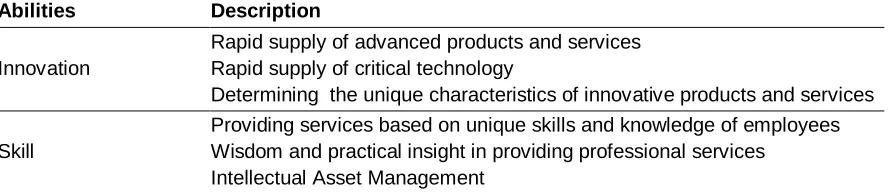
Kumar (2003) stated the allocation and use of knowledge to improve the ability of knowledge-based enterprises as components in table 1:
Table 1: Allocation and use of knowledge in knowledge-based enterprises
Abilities Description
Innovation
Rapid supply of advanced products and services Rapid supply of critical technology
Determining the unique characteristics of innovative products and services
Skill
Providing services based on unique skills and knowledge of employees Wisdom and practical insight in providing professional services
Licensed under Creative Common Page 1373 Specialty Field
Creating valuable implicit knowledge Providing unique service program
Development and management of creative skills Offering a variety of products and services
Communications
Attracting and maintaining customer loyalty
Attracting and keeping shareholders, employees, suppliers Elation with retailers and professional services
Sale of service to customer
Marketing
Creating knowledge and promoting the value of implicit knowledge Providing products and services under the exclusive brand
Sales, marketing, advertising, scheduling for offering products and services
Coordination Paying attention to the mode of transport in production units The information collected on time
Research methodology
This research is an applied research. The required information was collected in two stages. First, it includes library studies and documents that help to identify the factors influencing the establishment of knowledge-based companies and with the help of a questionnaire about these factors, statistical population were polled.
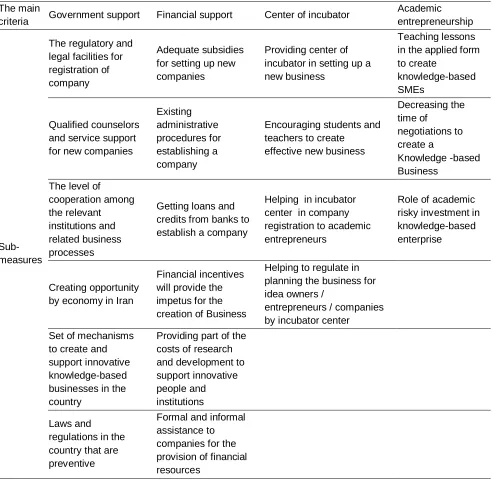
In this study the researcher has used AHP to identify and prioritize the factors influencing creation of knowledge-based SMEs. Thus after making hierarchy of decision, a questionnaire was prepared based on the hierarchical structure of the sample and was distributed among sample. The technique is based on a matrix of pairwise comparisons that subjects of sample compare criteria as paired criteria and expressed their judgment using numbers 1 through 9 in relation to the preference of one over the other. Questionnaires were designed based on hierarchical structure. The first level is the target level and includes "identification and prioritization of factors influencing the creation of small and medium-sized knowledge-based enterprises. In the second level, are the main criteria of the factors influencing the creation of small and medium-sized knowledge-based enterprises and in the third level, there are four criteria having secondary options and criteria.
Licensed under Creative Common Page 1374 Table 2: Sub-criteria and factors influencing the creation of knowledge-based SMEs The main
criteria Government support Financial support Center of incubator
Academic
entrepreneurship
Sub- measures
The regulatory and legal facilities for registration of company
Adequate subsidies for setting up new companies
Providing center of incubator in setting up a new business
Teaching lessons in the applied form to create
knowledge-based SMEs
Qualified counselors and service support for new companies
Existing administrative procedures for establishing a company
Encouraging students and teachers to create
effective new business
Decreasing the time of negotiations to create a Knowledge -based Business
The level of
cooperation among the relevant institutions and related business processes
Getting loans and credits from banks to establish a company
Helping in incubator center in company registration to academic entrepreneurs
Role of academic risky investment in knowledge-based enterprise
Creating opportunity by economy in Iran
Financial incentives will provide the impetus for the creation of Business
Helping to regulate in planning the business for idea owners /
entrepreneurs / companies by incubator center
Set of mechanisms to create and support innovative knowledge-based businesses in the country
Providing part of the costs of research and development to support innovative people and institutions
Laws and
regulations in the country that are preventive
Formal and informal assistance to companies for the provision of financial resources
ANALYSIS AND FINDINGS
Licensed under Creative Common Page 1375 of comparisons and then combined the results. In ordinary AHP pairwise comparison is done for each level according to a goal using 9 degrees scale. In this research,10 questionnaires were distributed among elites of knowledge-based SMEs in west of Mazandaran Province, Iran and data were analyzed using AHP.
In this method, before pairwise comparisons of and determining the relative weight of indicators it is necessary to normalize questionnaire. For this purpose, the geometric mean of the responses to the questionnaire is used. The results of this work are presented in table 3. So the same has also been carried out in relation to criteria taken into account for each of these four factors.
Table 3: normalized matrix of factors related to creation of knowledge-based SMEs Government
support Incubator center
Academic
entrepreneurship
Financial support
2.7339 2.7808 2.5946 1 Financial support
2.5210 2.6703 1 0.3854 Academic
entrepreneurship
2.5946 1 0.3745 0.3596 Incubator center
1 0.3854 0.3967 0.3658 Government
support
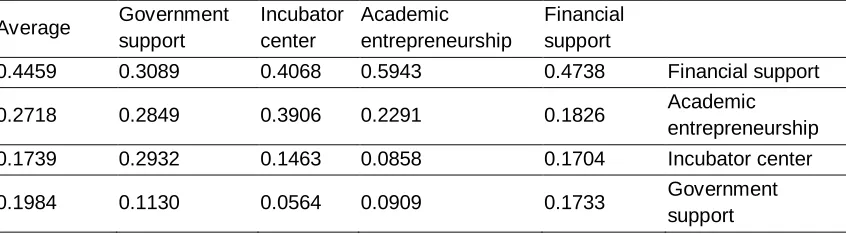
To form indicators of a pairwise comparison matrix, first we must add the column of integrated values of tables above. After the indicator formation of pairwise comparison matrix, the values are normalized. For this reason, the amount of matrix is divided by total column. To calculate the relative weight of each indicator, we calculate the arithmetic mean of each row. The results are in tables 4 and 5. These calculations about sub-criteria have been done for these factors.
Table 4: Normalized matrix of pairwise comparisons of indicators and relative weights related to factors influencing the establishment of knowledge-based SMEs
Average Government support
Incubator center
Academic
entrepreneurship
Financial support
0.4459 0.3089 0.4068 0.5943 0.4738 Financial support
0.2718 0.2849 0.3906 0.2291 0.1826 Academic
entrepreneurship 0.1739 0.2932 0.1463 0.0858 0.1704 Incubator center
Licensed under Creative Common Page 1376 Table 5: The priority of indicators related to factors influencing the
establishment of knowledge-based SMEs
Indicators Final score Priority
Financial support 0.4459 First
Academic entrepreneurship 0.2718 Second
Incubator center 0.1739 Third
Government support 0.1084 Fourth
These findings show that among the factors influencing the development of knowledge-based SMEs, financial support with average of 0.4738 was ranked first, academic entrepreneurship with average of 0.1826 was ranked second, incubator center with average of 0.1704 was ranked as third and government support with average of 0.1084 was ranked fourth.
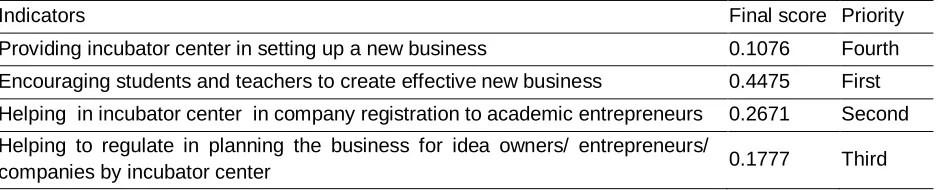
These analyses about the characteristics of these four factors have also been carried out and the results of the prioritization of these criteria are presented in tables 6 to 9.
Table 6: The prioritization of the indicators of the financial support
Indicator Final score Priority
Adequate subsidies for setting up new companies 0.1580 Third Existing administrative procedures for establishing a company 0.1080 Fourth Getting credit from banks to establish a company 0.2289 Second Financial incentives will provide the impetus for the creation of Business 0.4106 First Providing part of the costs of research and development to support
innovative people and institutions 0.0309 Sixth
Formal and informal assistance to companies for the provision of
financial resources 0.0635 Fifth
Table 7: The prioritization of the indicators of academic entrepreneurship
Indicators Final score Priority
Teaching lessons in the applied form for Knowledge-based Business 0.2964 Second Decreasing time of negotiations to create a Knowledge-based Business 0.5619 First Role of academic risky investment in knowledge-based enterprise 0.1417 Third
Table 8: The prioritization of the indicators of the incubator center
Indicators Final score Priority
Providing incubator center in setting up a new business 0.1076 Fourth Encouraging students and teachers to create effective new business 0.4475 First Helping in incubator center in company registration to academic entrepreneurs 0.2671 Second Helping to regulate in planning the business for idea owners/ entrepreneurs/
Licensed under Creative Common Page 1377 Table 9: The prioritization of the indicators of government support
Indicators Final score Priority
The regulatory and legal facilities for company registration 0.0270 Sixth Qualified counselors and support services for new companies 0.0524 Fifth The level of cooperation among the relevant institutions and related
business processes 0.4429 First
Create opportunity by Iran's economy 0.0777 Fourth Set of mechanisms to create and support innovative knowledge-based
businesses in the country 0.1523 Third
Laws and regulations available in the country which are preventive 0.2474 Second
DISCUSSION AND CONCLUSION
In the knowledge-based era, knowledge has become the most important capital of leading societies and organizations and taking advantage of this valuable asset has become one of the main priorities of managers as well as and the organizations. It can lead to achieve and maintain a sustainable competitive advantage and significant value creation. Meanwhile the creation and development of emerging entrepreneurial companies has become a strategy for achieving this goal. Accelerating the growth and development of new businesses that often lack the capital needed to start a small business requires to expand infrastructure and support However, existence of such infrastructure can have good areas for development of entrepreneurship and creation of employment in a form of launching small and medium-sized businesses, academics and practical commercialization of scientific achievements, creating value and wealth for the community and public.
Licensed under Creative Common Page 1378 launching such enterprises. Thus facilitating measures that can be carried out in these centers are: encouraging students and teachers to create new business effectively, help of incubator center to register company to academic entrepreneurs and their help to set up planning to idea owners/entrepreneurs/companies. Finally, some of the measures that the government can do to support the setting up of such companies include: accelerating the legal process and regulations and legal facilities for company registration, the use of qualified counselors and service support for new companies, development of cooperation agencies and relevant stakeholders in the process of work, expanding economic opportunity, improving infrastructure and mechanisms to create and support innovative knowledge-based business in the country, and to facilitate existing laws and regulations on the establishment of these companies.
Entrepreneurship development in all countries is faced with serious obstacles and its development requires national commitment and must be considered in all organs, organizations and public institutions. The experience of other countries indicates that the development of science parks could have a significant role in creating jobs and supporting entrepreneurs.
Since continuing and survival of knowledge-based companies is through their effective relationship with academic, research institutions; this relationship can increase partnership and participation between companies and academic institutions and can provide opportunities specialized workforce .It is also recommended to support the establishment of the think tanks to take advantage of the power of elites and thinkers and dissemination of technological and scientific journals and holding professional meetings and conferences . Holding Training courses for managers on arrival can also strengthen the management skills of the entrepreneurial managers. Strengthen substrates of teamwork in the organization and creation of an appropriate structure based on teamwork can help knowledge based institutions. Also, according to the results of social, cultural aspects, creating culture, and support and positive attitude of the authorities and in government regulations and policies aspect, rules and cumbersome government bureaucracy as well as the instability of the rules are of the most important themes raised. Finally, according to the results the followings are suggested:
Requirement of entrepreneurship training for all personnel as required in-service training and special concessions for them.
Removal of administrative bureaucracy, transparency of business regulation.
Formation of entrepreneurial offices in organization with a legal requirement.
Reducing administrative barriers to setting up new businesses and entrepreneurial activities.
Licensed under Creative Common Page 1379
The creation, development and strengthening of entrepreneurship counseling clinics in towns and industrial clusters.
Developing a culture of entrepreneurship and entrepreneurial experience transfer, through the preparation and construction of the documentary film, cartoons about the life and success of the famous Iranian entrepreneurs and innovators.
Providing flexible workspace with basic amenities to rent office and computing.
Efforts to provide legal support to accelerate the process of technology incubators.
Facilitating network synergies and increasing the competitiveness.
Participation in projects and marketing.
Holding festivals and markets for entrepreneurship and innovation at all levels of education and universities in the provincial and national levels in order to exploit and promote creative and innovative ideas by Iranian entrepreneurs, professionals and investors.
educational programs in all disciplines and administrative processes must be designed in such a way that requires skills in two pillars, personal skills and expertise are provided to students and within these programs ,doing entrepreneurial activities at universities and in particular entrepreneurship education are placed.
REFERENCES
Akbarzade, N. Safi zade,E. (2012),Review of the role of government to improve the process of creation and development of knowledge-based businesses, Quarterly of technology development, (33), 46-53. Albino, V., Garavelli, AC, Gorgogline, M. Organization and technology in knowledge transfer. An International benchmarking Journal, 11 (6), 12-13, 2004th
Ali miri, M. (2008), Entrepreneurship education: emergence, development, orientation and challenges, Journal of Entrepreneurship development, 1 (1), 133-169
Allahyari, N. Abbasi, R.(2011), Study the pattern of organizational structure of knowledge-based companies, Quarterly of technology development, (29), 47-54.
Allahyarifard,N. Abbasi,R.(2011), Checking the appropriate pattern of organizational structure of knowledge-based companies, Quarterly of technology development, 8 (29), 47-54
AnilaNandkishore, S. The effectiveness of a government high_technology small business program within a small incubator: a case study in government university and business collaboration. University of Laverne, the 2008th .
Bramwell, A., & Wolfe, A. (2005). Universities and regional economic development: The Entrepreneurial university of waterloo. Canadi an Association political science (Cpsa ).
Carson, D. Towards a research Agenda, Conference discussion paper, Academy of marketing / Entrepreneurship Interface SIG, Southampton, the 2,005th .
Colombs, M., &Delmastro. M. How effective are technology incubators evidence from Italy. Research policy, 2,002th .
Licensed under Creative Common Page 1380 Deljuiishahir,J.(2007), Entrepreneurship in today’s world : the infrastructure, the need and importance. www.jobportal.ir
Fakhari, H. Salmani, D. (2013), leadership in engineering; an approach to improve management of emerging knowledge-based companies, Quarterly of technology development, 9 (35), 52-58
Fakhari,H. Davoud, Daraii, MR. (2013), Studying the effects of economic sanctions on performance of knowledge-based companies located in science and technology park, Quarterly of science and technology policy, 5 (3), 1-17
Feiz pour, MA. Push Duzbashi,. (2008), SMEs with rapid growth and their role in creation employment, Journal of economic research of Iran, 37(12),19-143.
Hashemi,H. (2001), The eternal capital, Newsletter of Conference onEntrepreneurship andAdvancedTechnology, Tehran, Iran'sInstitute forDevelopmentand Research
Hisrich, R. Peters, P.(2004), Entrepreneurship, translated by Feizbakhsh ,A. and Taghiyari, HR. Tehran: Scientific publication Institute
Izadian,Z.Abdolahi, B. Kiani, M. (2013), Knowledge management; a pattern for managing knowledge-based companies located in parks of science and thechnology, Quarterly of technology development, 10(37),64-70
Jahangiri,A. (2001), Entrepreneurial government, Public administration, 51
Mahdavi,H. Sheikh ZainalDin, M. Asharafizade ,F., Important factors in acceptance of the incubator institutions. Quarterly of innovation growth, 4 (28), 15-23.
Mccline, R. Opportunity Recognition: An exploratory Investigation of a Component of the Entrepreneurial Process in the Context of the Health Care Industry: Theory and Practice, Tertiary Education Management, 25 (2), 81 to 94, 2004th .
Memarzade, A.(2005), Knowledge-based economy: requirements, indicators, Iran’s situation, challenges and strategies, Quarterly of economy and new business, (1), 83-108
Moghimi,F. (2002), Entrepreneurship ,evaluation and research, Periodicals of Center of National Education Assessment Organization, 3,
Moghimi,M.(2004), Entrepreneurship in institutions of civil society, Tehran, Tehran University Press Pour Sadeq N.(2013), Study the relationship between decision making styles with a competitive advantage in the small and medium enterprises of industrial towns in west Azerbaijan province, Quarterly of industry and university, 6 (19 and 20), 33-45
Radfar, R. (2008), Explaining the effect of networking R&D on increasing value in small companies,Quarterly of technology development, 14(4),2-12
Sabaghiyan, Z. Ahmadpour,M. Azizi, M. (2005), Investigation the entrepreneurial characteristics of students, Quarterly of management message, 13 and 14
Saeedikia, M.(2005), Familiarity with entrepreneurship, NashreSepas publication
Shadan, S., Pour serajian, D. Zare, R. (2013), Analysis and design appropriate structure for Park of Science and Technology, technology development, 10 (37), 22-37
Shaemi /Barzaki,A. Teymouri,H. (2006), The relationship between entrepreneurship and innovation at micro and macro levels, Proceedings of the First National Conference of change management , Isfahan, Isfahan University
Shafizade, H. Mohseni, H(2012),The role of technology transfer offices and universities in commercialization of knowledge, Quarterly of industry and university, 5 (17, 18), 17-25
Shah hosseini, A. (2004), Entrepreneurship, Tehran: Abizh publication