International Journal of Educational Methodology
Volume 4, Issue 3, 153 - 160.
ISSN: 2469-9632 http://www.ijem.com/
Teachers’ Perceptions of Innovative Learning Model toward Critical
Thinking Ability
Hamdah Munawaroh*
Sebelas Maret University, INDONESIA Sebelas Maret University, INDONESIA Sudiyanto Sebelas Maret University, INDONESIA Riyadi
Received: July21 2018 ▪ Revised: August 8, 2018 ▪ Accepted: August 10, 2018
Abstract: The aim of this study is to investigate teachers’ perceptions about the importance of learning innovation toward critical thinking ability in learning mathematics. The subjects in this study are the teachers and the students of grade Vin Al-Islam 6 Al-Fajar, Muhammadiyah 23 and Cokroamino to Islamic Elementary School Surakarta. The research method used in this research is qualitative case study. The problem in the research is the students' mathematics score is low that is seen from the results of the daily test’s students which showed 85% get grades below the minimal mastery criteria there is 60. The analysis technique used is triangulation. Validation used is qualitative descriptive. Based on the results of interviews to a number of teachers who teach mathematics in the fifth-grade in Pasarkliwon sub-district, it can be concluded that students' critical thinking ability in mathematics is low so that it is required innovative learning model used by the teachers.
Keywords: Innovative learning model, critical thinking ability, Mathematics, teachers' perceptions.
To cite this article: Munawaroh, H., Sudiyanto, & Riyadi. (2018). Teachers’ perceptions of innovative learning model toward critical thinking ability. International Journal of Educational Methodology, 4(3), 153-160. https://doi.org/10.12973/ijem.4.3.153
Introduction
Based fromNugroho and Arifin’s Opinion (2016) in the current era of the 21st century, there are three important
contents of academy such as 3Rs (Reading, Writing and Arithmetic) and 4Cs (critical thinking and problem solving, collaboration, communication, and creativity) underlying individuals in high-order thinking. In following the development of the 21st century, students are required to be able to have high-order thinking skills. However, the facts
show that high-order thinking skills in elementary school are still difficult. In the development of high-order thinking skills, students need facilitators to bridge it. Critical thinking is the ability to give reasons in an organized way and to evaluate the quality of the reasons systematically. Based from Wulandaril at all (2017) opinions Critical thinking is the ability to analyze and evaluate information, increase important questions, formulate problems clearly, collect and assess relevant information, use abstract ideas, think openly, and communicate effectively with others . Critical thinking usually includes a simple explanation in developing basic skills, drawing conclusions, giving more explanations, and setting strategies and tactics. In Bloom's taxonomy, the indicator of the critical thinking achievement in learning occurs when students can perform at the level of analyzing, synthesizing, and evaluating.
One of the learnings that apply high-order thinking ability is learning mathematics. In learning mathematics known as a deductive science not only by memorizing and reading but also requiring thought and understanding. Learning related to mathematics has become a necessity for individuals in our society. A merchant or buyer also uses calculations which is one of mathematics applications in everyday life. Based Farikhin’s opinion (2010) Mathematics contains a process of combining the use of reasoning power, critical thinking and mathematics knowledge itself, so that in the process of learning mathematics more emphasizes on the process of mathematics exploration and investigation. Mathematics learning especially for elementary school students is very useful for their living need in the environment that is useful for developing their mindset and studying the science then apply it in their life. In addition, based on Khairunnisa (2016) there is an opinion revealing that mathematics serves as a symbolic language that is a scientific means in developing individual’s logical thinking. Based on some experts’ opinion above, it can be synthesized that mathematics is a learning that emphasizes the critical thinking process which requires reasoning and good analysis in order to be useful in everyday life especially in the process of problem solving. However, the real conditions that occur at schools at every level including in elementary school, students often experience many difficulties in solving problems that cause the results of learning mathematics is less satisfactory. This shows that students’ critical thinking ability in learning is low. This can be seen from the interview results with students and teachers about mathematics subject in some
*Corresponding Author:
Hamdah Munawaroh, Department of Primary Education, Sebelas Maret University, Indonesia.
elementary schools in Pasarkliwon area. After conducting an observation and interview with teachers and students, it is found that in the process of developing critical thinking ability, the teachers still use traditional models such as frequently asked questions, assignments and lectures. Students feel bored and saturated with traditional models used by the teacher. Students just sit and listen to the teacher's explanation without being given the freedom to explore the problem. Through exploring the students independently, it is able to train them in carrying out high-level thinking processes. According to Hosnan (2014), learning model is a conceptual framework, which describes a systematic learning process in organizing learning experiences to achieve the expected learning goals and serves as a guide for the teacher in conducting learning activities from planning and acting the process. Learning model used is very important and influential in the learning process. In accordance with the results of interviews with students in grade V elementary school. So that in overcoming this problem requires the teacher's opinion about the importance of using appropriate and innovative learning models in the process of learning mathematics with regard to higher-order thinking skills. Sugiyanto (2007) revealed that innovative learning, among the others, has a systematic procedure, specified learning outcomes, the determination of a specific learning environment, a measurement of success and interaction with the environment. One of the innovative learning models that fit the problem of students' critical thinking skills is the Problem Based Learning (PBL) model. As noted by Duch in Shoimin (2014), the Problem-based Learning (PBL) model is one type of learning model that has characteristics with students' real problems as content for them to learn the reason, think critically and develop skills in solving problems and obtain their knowledge. In addition, it is supported by Smith & Ragan in Rusmono (2017) who revealed that learning with the problem-based learning model is an attempt to form a student learning process towards understanding the content of a subject. This can be considered to overcome the low critical thinking skills of the fifth-grade students in mathematics learning. With the existence of an innovative learning model, it is not just direct learning or traditional learning that emphasizes more passive students turn into active students learning by exploring their critical thinking skills.
In addition, this study refers to some previous research that examine the importance of critical thinking ability in the learning process for students’ inventory in facing problems in their everyday life. Based on Salihu, Linda and Rasanen opinions this study refers to a study entitled elementary school students’ mathematics ability that contains the importance of mathematics ability and the difficulties experienced by them. The difference from the previous one, this research is to know the teachers’ perceptions toward the use of innovative learning models on students' critical thinking ability. Based on Wulandaril at all (2017) then a study entitled Students' Critical Thinking Improvement through PDEODE and STAD Combination in The Nutrition and Health Lecture. The similarity in this research is equally study about student's critical thinking ability. The difference is that this research uses research model development that has been combined to determine the impact on students' critical thinking ability. Based on Dehghani at all opinion (2011) then a research entitled The Role of Graduate Students' Achievement Goals in Their Critical Thinking Disposition. The similarity in this research is to study about students' critical thinking ability, while the difference is that the previous study was done in the level of postgraduate education with the aim of disposition of critical thinking ability while this research is for elementary school level. Furthermore, based on Azru and Katranci’s opinions (2014) a study entitled “The opinions of elementary mathematics student-teachers on problem-based learning method”. This study emphasizes on the use of problem based learning on mathematics for students' critical thinking ability. The similarity in this research is equally examine about critical thinking. While the difference is that this research has applied learning model studied in the field.
The novelty in this study contains the teachers’ perceptions of the low critical thinking ability and the use of innovative learning models on students' critical thinking ability. It is very important in this 21st century to improve students'
critical thinking because this aspect is one that helps them to make good changes in the future. The teacher's view is very important as a material consideration for the improvement or solutions in the learning process because a teacher knows the weaknesses or shortcomings occurred in the classroom.
Research Method
General Research Background
Based on Sugiyono (2017) the method used in this research is qualitative research model with case study type. Qualitative research is one of the research used to identify unclear problems, understand the meaning behind the apparent data, understand the social interactions that occur, understand people’s feelings, develop theories, verify the truth of the data and to examine the historical development of a subject under investigation. This research is to ensure the truth and know the problem clearly in the field by analyzing and observing the process of mathematics learning in grade the fifth-grade elementary school.
Data Collecting
Techniques of collecting the data used in this study include the interview with teachers and students and observations during the learning process. Interviews were conducted to find out the problems experienced by students and teachers in the process of mathematics learning, it was also conducted to obtain data from resource persons namely students and teachers. Observation is observational activities undertaken by researchers to observe the process of learning and to find the limitation, and the cause of low critical thinking ability in learning the mathematics of the fifth-grade elementary school students. Then, it tries to find out the teachers’ perceptions of the innovative model in the mathematics learning process and ask their opinion about the advantages and disadvantages of applying innovative models in the learning process.
Data Analysis
A ttechnique of analyzing the data used by researcher is interactive model technique (interactive model). The interactive model is an analysis model that is done by connecting the results of interviews and observations other than that with the support of expert' theories. This analytical technique is done by finding the cause of the problems that exist in the field related to the existing theories and then assessing teachers’ perceptions on the application of innovative models used by teachers in the learning process. Therefore, the overall teachers’ perceptions about the use of innovative models toward students' critical thinking ability that tend to be difficult to do by the students are clearly investigated.
Results and Discussion
Result
A qualitative research with field study or a case study type was conducted in three elementary schools in Pasarkliwonsub-district, Surakarta, Indonesia. The research was started by conducting interviews with three teachers in the fifth-grade in Pasarkliwon sub-district. In addition, researchers conducted observations to find out the problems in the field. This research was started in December 2017 until January 2018.
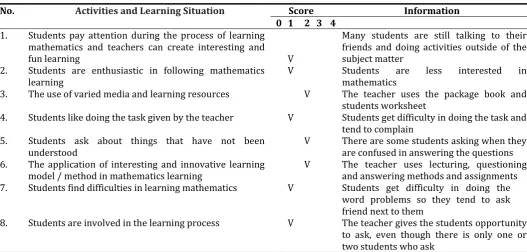
The observations at the fifth-grade in Pasarkliwon, Surakarta, Indonesia were conducted on Monday and Tuesday, January 8 and 9, 2018, at Cokroaminoto Islamic elementary school; on Wednesday and Thursday, January 10 and 11, 2018, at Al Al Islam 6 Al Fajar; and on Friday and Saturday, January 12 and 13, 2018, at Muhammadiyah 23 Surakarta. Here are the observations at the fifth grade in Pasarkliwon Surakarta Indonesia
Table 1. The observations’ result of mathemathic learning in fifth grades elementary school
No. Activities and Learning Situation Score Information
0 1 2 3 4 1. Students pay attention during the process of learning
mathematics and teachers can create interesting and fun learning
V
Many students are still talking to their friends and doing activities outside of the subject matter
2. Students are enthusiastic in following mathematics
learning V Students mathematics are less interested in 3. The use of varied media and learning resources V The teacher uses the package book and
students worksheet
4. Students like doing the task given by the teacher V Students get difficulty in doing the task and tend to complain
5. Students ask about things that have not been
understood V There are some students asking when they are confused in answering the questions 6. The application of interesting and innovative learning
model / method in mathematics learning V The teacher uses lecturing, questioning and answering methods and assignments 7. Students find difficulties in learning mathematics V Students get difficulty in doing the
word problems so they tend to ask friend next to them
8. Students are involved in the learning process V The teacher gives the students opportunity to ask, even though there is only one or two students who ask
Information :0 = Never done 1 = Done but not good2 = Performed pretty well 3 = Well done4 = Very good
observation sheets that have been made by previous researchers as research instruments. In a qualitative research, a researcher is an instrument itself in a study.
Then the researcher conducted interviews with teachers and students about the problems occurred. Furthermore, the researcher asked the teachers’ opinion about the use of an innovative learning model toward critical thinking ability to student's mathematics learning. Following is the interview results to students about the problems in the classroomconducted on Tuesday, December 12, 2017, at Cokroaminoto Islamic elementary school; on Wednesday, December 13, 2017, at Al-Islam 6 Al Fajar elementary school; and on Thursday, December 14, 2017, at Muhammadiyah 23 Surakarta.
Table 2. The interviews’ result with the students about mathemathic learning in fifth grades elementary school
No. Questions Answers
1. What are the learning materials that you find
difficult? Mathematics, because it has a lot of arithmetic
2. What do you think about the learning? Mathematics is difficult, especially if you use too many formulas so it is getting harder
3. How was the lesson be applied by your
teacher? The teacher gives the material, explains it then gives the task to be done and then assessed
4. What make you feel difficult in learning? What that makes it difficult is too many formulas, and if there is a word problem, sometimes it is confusing to use which formula
5. What is your suggestion to make the learning
more fun? Students are invited to learn while playing in ordernot to get bored
Based on the interview results with some students, it can be seen that they have difficulty in learning mathematics because of too many formulas and calculations. In addition, students are easily bored while working on word problems and following the learning process. Teachers often do the learning with the same atmosphere from explaining the material then giving the task to be assessed by the teachers. The selection of sample in this interview is one student who has high achievement and one has a low achievement. Then it is concluded from each of the interview results and synthesized into the results of the interview above. Because students have the same problems and causes namely the difficulties of critical thinking skills in learning mathematics at the fifth-grade elementary schools.
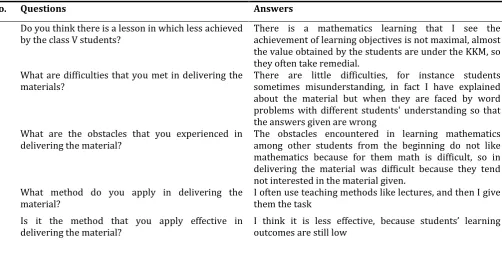
Following is the interviews results to the teachers about the problems and their perceptions on the existence of innovative learning models toward students' critical thinking ability on Tuesday, December 12, 2017, at Cokroaminoto Islamic elementary school; on Wednesday, December 13, 2017, at Al-Islam 6 Al Fajar elementary school; and on Thursday, December 14, 2017, at Muhammadiyah 23 Surakarta.
Table 3. The interviews’ result with the teacher about their perceptions in fifth grades elementary school
No. Questions Answers
1. Do you think there is a lesson in which less achieved
by the class V students? There is a mathematics learning that I see the achievement of learning objectives is not maximal, almost the value obtained by the students are under the KKM, so they often take remedial.
2. What are difficulties that you met in delivering the
materials? There are little difficulties, for instance students sometimes misunderstanding, in fact I have explained about the material but when they are faced by word problems with different students' understanding so that the answers given are wrong
3. What are the obstacles that you experienced in
delivering the material? The obstacles encountered in learning mathematics among other students from the beginning do not like mathematics because for them math is difficult, so in delivering the material was difficult because they tend not interested in the material given.
4. What method do you apply in delivering the
material? I often use teaching methods like lectures, and then I give them the task 5. Is it the method that you apply effective in
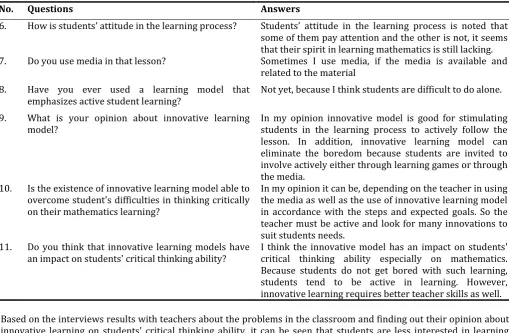
Table 3. Continued
No. Questions Answers
6. How is students’ attitude in the learning process? Students’ attitude in the learning process is noted that some of them pay attention and the other is not, it seems that their spirit in learning mathematics is still lacking. 7. Do you use media in that lesson? Sometimes I use media, if the media is available and
related to the material 8. Have you ever used a learning model that
emphasizes active student learning? Not yet, because I think students are difficult to do alone. 9. What is your opinion about innovative learning
model? In my opinion innovative model is good for stimulating students in the learning process to actively follow the lesson. In addition, innovative learning model can eliminate the boredom because students are invited to involve actively either through learning games or through the media.
10. Is the existence of innovative learning model able to overcome student's difficulties in thinking critically on their mathematics learning?
In my opinion it can be, depending on the teacher in using the media as well as the use of innovative learning model in accordance with the steps and expected goals. So the teacher must be active and look for many innovations to suit students needs.
11. Do you think that innovative learning models have
an impact on students' critical thinking ability? I think the innovative model has an impact on students' critical thinking ability especially on mathematics. Because students do not get bored with such learning, students tend to be active in learning. However, innovative learning requires better teacher skills as well.
Based on the interviews results with teachers about the problems in the classroom and finding out their opinion about innovative learning on students' critical thinking ability, it can be seen that students are less interested in learning mathematics. They find it difficult to do word problemsin math that require a lot of reasoning and analysis. As a result, it can be concluded that students’ ability to think critically about learning mathematics is low. Besides, teachers only use the direct learning model such as lectures, questions and answers, and assignments. According to teachers’ opinion about the existence of an innovative learning model that can help students to be active in the learning process is very good to solve students’ low critical thinking ability in learning mathematics. The teacher interviewed was as a class teacher who taught in the fifth-grade in each of the elementary schools.
Discussion
Based on the researchers' assessment of the three classes in those elementary school, it turns out that from the results of observation and interviews with three teachers and six students, the ability to think is low due to the less innovative use of teacher models. Through the results of observations and interviews, it can be said that there is a relationship between the problem of students’ lack critical thinking ability in learning mathematics and the use of teacher learning model. Based on Heruman (2018) this is in line with the opinions stating about the implementation of mathematics learning in elementary schools to develop students 'creativity and competence, so a teacher is required to be able to present innovative, creative, effective and efficient learning, adapted to the students' curriculum and thinking patterns. Increasingly, the teachers must understand that the ability of each individual is different and the teachers’ task is to make students' ability sharpened. As a result, it takes a good learning model in developing students' critical thinking ability. In line with the teachers’ perceptions about the good impacts from using innovative learning models, teachers should also be able and know about the learning model that is appropriate for students.
Based on Abidin’s opinion (2014) model is a mental picture that helps explain a mindset and action on something that will be done, while learning is an activity undertaken by teachers in order to create a conducive atmosphere for students learning environment. It can be concluded that the learning model is a pattern of action and form of learning steps used by teachers in an effort to achieve the expected learning objectives. Furthermore, the learning model serves as a guide for the designer of learning to carry out teaching and learning activities. Teachers’ perception about the importance of innovative learning model that is able to assist students in developing their critical thinking ability in mathematics. Supported by expert opinion relates to mathematics learning with students' critical thinking ability and is integrated with the use of appropriate innovative models that suit students’ needs and the curriculum.
pay attention to the teacher when giving a material explanation in front of the class. This is due to various influenced factors, one of them is the use of teacher learning models that tend to still be traditional lectures, question and answer and the assignment. That factor causes students bored in the process of learning mathematics. Increasingly, teachers argue that in the process of learning mathematics that require reasoning related to students' critical thinking ability, which became one of the high-level thinking skills expected in the 21st century needs to be developed by using
innovative learning models that emphasize students’ activeness in the learning process. With the existence of learning models such as inquiry, direct observation and also the learning process by presenting the problems that must be solved by the students, it helps students to think by doing reasoning, analysis and evaluating well.
This opinion from Winataputra (2010) is consistent with the theory that learning activities carried out through problem solving can be useful for developing students' ability to identify, develop alternative or innovative thinking skills and they can have decision-making skills based on available alternatives made through students’ reasoning, analysis and evaluation. As a result, the teachers’ perceptions about the existence of innovative learning model toward
critical thinking ability is stated to have a good correlation. With the innovative learning model, it is expected to overcome the problem of students’ critical thinking ability in learning mathematics, especially in elementary schools that basically at their ages, they tend to play and do new things.
Conclusion
Based on the analysis results and discussion above, it can be concluded that teachers’ perceptionsof the existence of innovative learning models can influence in developing critical thinking ability of elementary school students in learning mathematics. In addition, it also encourages teachers to be creative and innovative in conducting an effective and innovative learning process.
Acknowledgements
Acknowledgment of the authors to the beloved almamater of Sebelas Maret University Surakarta that provides an opportunity to make this research run well.
References
Abidin, Y. (2014). Desain sistem pembelajaran dalam konteks kurikulum 2013 [Learning System Design in the Context of
2013 Curriculum]. Bandung : Refika Aditama.
Afidah., & Khairunnisa.(2016). Matematika Dasar [Basic Mathematic]. Jakarta: PT Raja Grafindo Persada.
Arı, A., & Katranci, Y. (2013). The opinions of primary mathematics student-teachers on problem based learning method. Procedia–Social and Behavioral Sciences, 116, 1826-1831
.
Dehghania, M., Mirdoraghib, F., & Pakmehr, H. (2011). the role of graduete student’s achievement goals in their critical thinking disposition. Elsevier: Procedia Social and Behavior, 15 (2011), 2426-2430
Farikhin. (2010). Mari Berpikir Matematis :Panduan Olimpiade Sains Nasional SMP [Let's Think Mathematically: Guide to
the National Science Olympic of Senior High School]. Yogyakarta: Graha Ilmu.
Heruman. (2018).Model Pembelajaran Matematika di Sekolah Dasar [Mathematics Learning Model in Primary Schools].
Bandung: PT Remaja Rosdakarya.
Hosnan, M. (2014)Pendekatan Saintifik dan Kontekstual dalam Pembelajaran Abad 21 [Scientific and Contextual
Approach in 21st Century Learning]. Bogor : Ghalia Indonesia
Nugroho, A. (2016). HOTS (Kemampuan Berpikir Tingkat Tinggi, Konsep, Pembelajaran, Penilaian , Penyusunan Soal Sesuai HOTS [HOTS (High-Level Thinking Ability, Concept, Learning, Assessment, Questions Preparation based on
HOTS)]. Jakarta: PT Gramedia Widiasarana Indonesia.
Rusmono. (2017). Strategi Pembelajaran dengan Problem Based Learning . Bogor: Penerbit Ghalia Indonesia.
Salihu. (2018). Mathematics skills of kosovar primary school children: a special view on children with mathematical learning difficulties. International Electronic Journal of Elementary Education, 10(4), 421-430.
Shoimin, A. (2014). 68 Model Pembelajaran Inovatif dalam Kurikulum 2013 [68 Innovative Learning Models in 2013
Curriculum]. Yogyakarta: AR- Ruzz Media
Sugiyanto. (2007) Modul Pendidikan dan Latihan Profesi Guru (PLPG): Model-model Pembelajaran Inovatif [Professional
Teacher Education and Training Module (PLPG): Innovative Learning Models]. Surakarta: Panitia Sertifikasi Guru
Rayon 13 Surakarta.
Sugiyono. (2017). Metode Penelitian Pendidikan Pendekatan Kuantitatif, Kualitatif, dan R&D [Educational Research
Winantaputra. (2010).Buku Pedoman Sertifikasi Pendidik untuk Dosen Tahun 2010
[
Guidebook for Educator Certificationfor Lecturers in 2010]. Jakarta: Kemendikbud.
Attachements
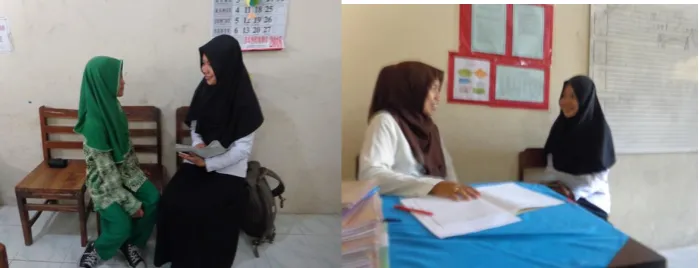
Figure 1. Interviews with The Teacher and Student in Muhammadiyah 23 Surakarta Elementary School
Figure 2. Interviews with The Student in CokroaminotoIslamic Elementary School
Figure 3. Interviews with The Teacher in Cokroaminoto Elementary School