INTERNATIONAL JOURNAL OF PHARMACEUTICAL, CHEMICAL AND BIOLOGICAL SCIENCES
Available online atwww.ijpcbs.com
USE OF A SIMPLE Sp STATISTIC IN COMPARISON OF MODELS FOR
ESTIMATION OF GENETIC PARAMETERS IN GOATS
N. Assan1 and A. Masache2
1Department of Agriculture, Faculty of Science, Zimbabwe Open University, Bulawayo Region, Box 3550 Bulawayo, Zimbabwe.
2Department of Applied Mathematics, Faculty of Applied Sciences, National University of Science and Technology, Box AC 939, Ascot, Bulawayo, Zimbabwe.
INTRODUCTION
Estimates of genetic parameters for carcass length using different animal models in the tropics for goats are scarce. Models with maternal effects and corresponding genetic parameters has always been considered problematic (Meyer, 1997). Difficulties in estimation arise because direct and maternal effects are generally confounded. The animal models commonly fitted when estimating maternal effects include maternal genetic and
permanent environmental effects were
suggested (Willham, 1963). Genetic models, including maternal effects and the covariance of direct and maternal genetic effects, fit data than the simple additive model. High negative correlations between direct and maternal genetic effects for early weight traits are common but biologically impossible. No studies have investigated the use of different models on parameter estimates for carcass length in indigenous Matebele goat in Zimbabwe. The
objective of this study was to investigate the importance of maternal effects on carcass length of indigenous Matebele goat, fitting different animal models including both genetic maternal and permanent environmental effects.
MATERIALS AND METHODS Study area
Matopos Research Station is situated in southwest Zimbabwe, an area primarily suited to semi-extensive forms of land utilization (Vincent and Thomas, 1961). The climate is characterized by wide fluctuations in the quantity and distribution of rainfall within and across season. Mean recorded rainfall is 609mm with a range of 257 to 1376mm. Rainfall normally occurs between November and April and is followed by a long dry season (Ward, et al., 1979). Very high summer temperatures, maximum and minimum mean temperatures of hottest months are 21.6 0 C and 11.4 0 C, respectively with possibility of severe droughts
Research Article
ABSTRACT
Variance components for additive direct, additive maternal, permanent environmental effects, the covariance between additive direct and maternal effects were estimated by maximum likelihood, fitting six animal models from 2341 carcass length pedigree records of indigenous Matebele goats in Zimbabwe. All investigated models included a random direct genetic effect but different combinations of random 0.49 when the maternal heritability when the maternal genetic effects were included in the model, while h2 estimates were 0.04 and 0.32 when the maternal effects were excluded. The maternal heritability (h2m) was 0.00 when only maternal
genetic effects were included in the model and were 0.32 to 0.37 when the permanent environmental effect of the dam was added. The permanent environmental effect of the dam was negligible. The negative covariance between direct and maternal genetic effects of carcass length (σ2am) were observed. Using an Sp statistic comparison, Model 2 which had
additive direct and additive maternal only, excluding the covariance of direct and maternal genetic effects proved to the ‘best’ among the six models for carcass length evaluation.
(Hagreveas et al., 2004). The most common type of vegetation is sweet veldt with comparatively high nutritional value of browse and annual grass species (Ward et al 1979). Day et al (2003) and Gambiza and Nyama (2000) give a detailed description of the climate and vegetation type, respectively.
Flock management and slaughter Method Animals were humanely slaughtered at a local commercial abattoir and carcass length was measured using a measuring tape. The flock management and slaughter methods were described in detail by Assan (2009).
Statistical methods
The data included a total of 2341 pedigree carcass length records from 37 sires and 218 dams of the indigenous Matabele goat. Genetic parameters were estimated using the Average Information Restricted Maximum Likelihood (AIREML) methodology (Gilmour, 1995) using an Animal Model. The analytical models included fixed effects of sex, age at slaughter of dam and year of slaughter. Six animal models were fitted. Model 1 was a simple animal model with additive direct genetic effects as the only random effect. Model 2 fitted in addition, the maternal effects as an uncorrelated random effect. Model 3 ignored maternal genetic effects and included permanent maternal effect as the second random effect. Model 4 consisted of both
maternal and permanent environmental
maternal effect as uncorrelated to the additive direct genetic effect. Model 5 considered maternal effects as the second random effect but allowed for covariance between the direct and maternal effects. Model 6 considered maternal effects as a second random effect but allowed for covariance between the direct and maternal
effects but without fitting permanent
environmental effects. The following models were used:
y=Xb + Zaa + e (1)
y=Xb + Zaa + Zmm + e (2)
y=Xb + Zaa + Zcc + e (3)
y=Xb + Zaa + Zmm+ Zcc + e Cov(a,m)= 0 (4)
y=Xb + Zaa + Zmm + Zcc + e Cov(a,m)=Aσam (5)
y=Xb + Zaa + Zmm + e Cov(a,m)=Aσam (6) where Y is the vector of observations b, a, m, c and e are the vectors of fixed effects, direct additive genetic effects (animal), maternal genetic effects, permanent environmental effect of dam and the residual, respectively. X, Za, Zm, and Zc, are the incidence matrices of fixed effects, direct additive genetic effects, maternal genetic effects and permanent environmental effect of dam. A is the numerator additive
genetic relationship matrix between animals
and Cov (a,m) = σam A, where σam is the covariance between direct and maternal genetic
effects, σ2a the direct additive genetic variance,
σ2m the maternal genetic variance, σ2c the variance of the permanent environmental effect
of the dam and σ2
e the variance of the residuals Depending on the model, the log likelihood function was maximized with respect to direct heritability (h2a), maternal heritability (h2m), permanent environmental variance of the dam as a proportion of the phenotypic variance (c2), and the genetic effects as a proportion of the total variance (cam). Heritability of total additive genetic contribution to a maternally influenced trait was calculated according to the following equation (Willham, 1972),
2
2 2
2
2
0
.
5
1
.
5
p
am m
a T
h
Model selection using the Sp Statistic
O'Gorman (2004) suggested the Sp statistic that is of the form,
1
)
(
p
n
p
MS
S
ep and the
general behavior of Sp as p increases is as shown in the diagram below.
The choice of the best model is based on: i. The minimum Sp.
ii. The value of p such that Sp is approximately equal to Sp of the full model.
iii. A value of p near the point where the smallest Sp turns up.
Note: p is the number of parameters in the animal model whilst n is the number of animals observed.
S
pRESULTS
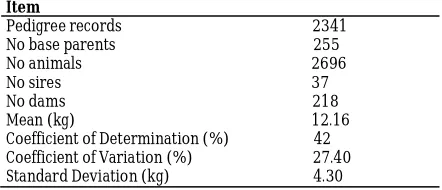
Table 1: Structure and descriptive statistics of the data set of carcass length of indigenous
Matebele goats of Zimbabwe Item
Pedigree records 2341
No base parents 255
No animals 2696
No sires 37
No dams 218
Mean (kg) 12.16 Coefficient of Determination (%) 42 Coefficient of Variation (%) 27.40 Standard Deviation (kg) 4.30
The descriptive statistics of the data set for carcass length in indigenous Matebele goats of Zimbabwe are presented in Table 1. Variance component ratios and genetic parameters for carcass length using different models are shown in Table 2 below. All models included a random additive effect and ranking of animal models was done using Sp statistic (Table 3). Variance components for additive direct, additive maternal, permanent environmental maternal effects, the covariance between additive direct and maternal effects were estimated by fitting six animal models (Table 2). Estimates for the direct additive heritability were low to moderate ranging from 0.04 to o.49. The direct additive variance ranged from 25.71 to 33.39. Estimates of the maternal additive heritability were generally ranging from zero to 0.12. The direct additive variance ranged from 0.46 to 10.52. Estimates of the direct heritability were higher than maternal additive heritability in all models. All investigated models included a random direct genetic effect, but different combinations of random maternal genetic and permanent environmental effects as well as for direct-maternal genetic covariance. The direct heritability (h2) ranged from 0.12 to 0.49 when the maternal genetic effects were included in the model, while h2 estimates were 0.04 and 0.32 when maternal effects were excluded. The maternal heritability (h2m) was 0.00 when only maternal genetic effects were included in the model and were 0.32 to 0.37 when the permanent environmental effect of the dam was added. The permanent environmental effect of the dam was negligible and negative covariance between direct and maternal genetic effects of carcass length were found. When the maternal effects, genetic and/ or environmental, were included in the model, the direct additive variance ranged from 25.71 to 33.39. Total heritability estimates were low to moderate ranging from 0.04 to 0.36.
DISCUSSION
Estimates of the direct additive heritability depended highly on the model used. In model 1, maternal effects were ignored, heritability was small, while inclusion of maternal genetic effects in model 2 increased heritability by 12%. Model 4 showed that the maternal effect was portioned into genetic and environmental component. In model 1, 4 and 5 had 12% and 2% of the total variance attributed to maternal genetic effects respectively. Permanent environmental variance contributed less than 1% of the total variance. It is evident that the relative values of direct additive heritability and additive maternal heritability were influenced by the model used in the analysis. It was noted that the maternal genetic effect and permanent environmental effect of the dam were not of the same magnitude. In model 4, where the permanent environmental effect of the dam was zero, the maternal variance was large resulting in general improvement of the maternal heritability. The covariance between direct and maternal genetic effects were negative in model 5 and 6 where maternal effects were considered as a second random effect but allowed for covariance between the direct and maternal effects , but without fitting environmental effects.
The proportion of variance due to permanent environmental effects was not different from zero and were small compared to other variance components. Permanent environmental effect did not change in models 3, 4 and 5 were both maternal genetic effects and permanent environmental effects were accounted for. The inclusion of the covariance of direct and maternal effects in model 5 did not change the magnitude of permanent environmental effect from model 4. Higher estimates of permanent environmental effects have been associated with permanent environmental effects of the uterus and the effect of multiple birth in small ruminants (Snyman et al., 1995). Maternal heritability was lower than direct additive heritability in all models. Negative estimates of the correlation between the direct and maternal genetic effects were found in the present study. In this study fitting additional effects resulted in lower estimates of direct-maternal covariances as well as of the direct and maternal variances. Higher negative estimates of direct-maternal correlations have been attributed to the small number and structure of the data. Negative covariance between direct and maternal genetic effects could be explained from an evolutionary
view, prevents species from becoming
increasingly larger (Cundiff, 1972). However, several workers mentioned that a possible
covariance between dam and offspring could result in a based estimation of genetic correlation between direct and maternal effects (Meyer, 1992). Allowing for a direct-maternal covariance in model 5 reduced maternal heritability by 6% as compared to model 4. Not fitting permanent environmental effects in model 6 and allowing for a direct-maternal covariance reduced direct heritability by almost 50%. In this population, the environmental covariance between direct and maternal, although negative, was negligible. Studies in future should try and measure the magnitude of covariance between dam and offspring and to what extent these affect the estimation of genetic parameters for carcass length in
different goat breeds and management systems. Comparison of the magnitude of covariance estimates with other studies is difficult due to the different types of records, of models and methods used for estimation of the co variances.
The negative direct-maternal correlation
magnitude could vary due to models differing in accounting for sources of variation as in Model 5 and 6. Reports of non-genetic factors influencing the negativity of covariance between direct-maternal genetic effects have been reported in beef (Robinson, 1996 a,b; Lee and Pollak, 1997; Meyer, 1997; Dodenhoff et al., 1998). Total heritability estimates depend on the model used and were low to moderate.
Table 2: Estimates of covariance components and genetic of carcass length in indigenous Matebele goat in Zimbabwe
Component Model 1 Model 2 Model 3 Model 4 Model 5 Model 6
σ2a 3.05 41.93 25.71 33.39 28.92 8.89
σ2m 0.46 10.52 1.38 0.19
σ2am -0.20 -0.30
σ2pe 0.37 0.78 0.25
σ2e 70.91 44.33 54.68 45.99 52.02 67.19 σ2p 73.96 86.72 80.76 90.68 82.37 75.97 h2a 0.04 0.49 0.32 0.37 0.35 0.12
h2m 0.00 0.12 0.02 0.003
cam -0.002 -0.02
ram -0.03 -1.00
h2t 0.04 0.04 0.32 0.43 0.36 0.11
Se 0.000 0.001 0.001 0.000
σ2
a-additive direct genetic variance
σ2
m-additive maternal genetic variance
σ2
am-direct-maternal additive variance
σ2
pe-permanent environmental maternal variance
σ2
p-phenotypic variance-sum of variance and covariance components
σ2
e-error variance
h2
a-direct heritability
h2m-maternal heritability
h2
t-total heritability (total genetic effect)
cam-direct and maternal covariance
ram-direct and maternal correlation
Table 3: The computed Sp statistic used to rank animal models for carcass length in indigenous Matebele goat of Zimbabwe
Model Sp Rank
2 1.34 1
4 1.44 2
5 1.62 3
3 1.66 4
1 2.09 5
6 2.03 6
CONCLUSION
The relative higher estimate for maternal genetic component show Model 2 to be better than other models with maternal genetic effects, and it could be suggested that maternal genetic effects could be considered when evaluating genetic merit of carcass length in indigenous Matebele goats.
ACKNOWLEDGEMENT
REFERENCES
1. Assan N, (2012). Dentition and carcass evaluation in goats. J. Anim. Prod. Adv. 2(3): 153- 160.
2. Cundiff LV (1972). The role of maternal effects in breeding. VII. Comparative aspects of maternal effects, J. Anim. Sci. 35:1335-1337.
3. Dodenhoff J, Van Vleck LD, Gregory KE (1999). Estimation of direct, maternal genetic effects for weaning weight in several breeds of beef cattle, J. Anim. Sci. 77:840-845.
4. Gilmour A (1995). Average Information
Restricted Maximum Likelihood
(AIREML) manual, Polycopy.
5. Lee C, Pollak EJ (1997). Relationship between sire×year interactions and direct-maternal genetic correlation for weaning weight of Simmental cattle, J. Anim. Sci. 75:68-75.
6. Meyer K (1992). Variance components due to direct and maternal effects for growth traits of Australian beef cattle, Livest. Prod. Sci. 31:179-204.
7. Meyer K (1997). Estimates of genetic parameters for weaning weight of beef cattle accounting for direct-maternal
environmental covariances, Livest.
Prod. Sci. 52:187-199.
8. O'Gorman TW (2004). Using adaptive methods to select variables in case-control studies. Biometrical Journal. V46(5): 595-605.
9. Robinson DL (1996a). Estimation and interpretation of direct and maternal genetic parameters for weights of Australian Angus cattle, Livest. Prod. Sci. 45:1-11.
10. Robinson DL (1996b). Models which might explain negative correlations between direct and maternal genetic effects, Livest. Prod. Sci. 45:111-122. 11. Vincent V, Thomas RG (1961). An
agricultural survey of southern
Rhodesia. Part 1. Agro-ecological Survey. Government Printer, Salisbury. Rhodesia.
12. Ward H K, Richardson FD, Denny RP and Dye PJ (1979) Matopos Research Station: A perspective: Rhod. Agric. J. 76 (1): 5- 18.
13. Willham RL (1963). The covariance
between relatives for characters
composed of components contributed by related individuals. Biometrics. 19:18-27.
14. Willham RL (1972). The role of