PEDIATRICS Vol. 66 No. 1 July 1980 109
Comparison
of the
Effects
of Inhaled
SCH
1000
and
Fenoterol
on Exercise-Induced
Bronchospasm
in Children
R. Yeung, C. M. Nolan, MB,BCh, and H. Levison, MD
From the Pulmonary Function Laboratory, Hospital for Sick Children, Toronto
ABSTRACT. The effect of4O g ofSCH 1000 (ipratropium bromide, an anticholinergic agent) on bronchodilation and suppression of exercise-induced bronchospasm (EIB) was compared with 400 .tg of fenoterol and a placebo in a single-blind controlled study. Twenty-seven randomly selected asthmatic children performed a standardized treadmill exercise challenge and the 17 children who were shown to have EIB continued in the study. Pulmonary function was evaluated before and after drug administra-tion and exercise. When individual results were analyzed
and grouped according to the responsiveness of EIB to
the drugs, two patterns emerged: (1) the EIB was more severe in those (6/17) children who did not respond to
either drug than in the rest of the children; (2) the resting pulmonary function was significantly better in the
chil-dren (4/17) who responded to both drugs than in those
(7/17) who responded to fenoterol alone. In conclusion
SCH 1000 was shown to be an effective bronchodilator comparable to, but no better than, fenoterol. It had minimal side effects. As an EIB inhibitor it depended on
relatively normal base line pulmonary function and only a moderate deterioration following exercise, whereas
fen-oterol depended on the exercise response alone. Although anticholinergic drugs are not very extensively used, SCH 1000 may be useful in some patients where the $2 adre-nergic drugs cause significant side effects or are
contrain-dicated. Pediatrics 66:109-1 14, 1980; exercise-induced
bronchospasm, bronchodilation, SCH 1000, fenoterol.
and xanthine ri2 Recently, there have
been conflicting reports of the efficacy of anticho-linergic drugs in suppressing EIB.7 This conflict could be due to variations in the standards for the definition of EIB, exercise techniques, drug dosages,
or interindividual differences in the role of the
parasympathetic pathway in EIB.
SCH 1000 (ipratropium bromide), a quarternary
isopropyl derivative of atropine, has been shown to
be an effective anticholinergic drug with minimal
side effects although the occurrence of blurred
vi-sion and thirst have been reported.4’8’9 The most
appropriate route of administration is by
inhala-tion8 with an optimum dose of 40 g.9 Doses greater than 40 provide little improvement in pulmonary
function and increase side effects.4’8 The onset of
maximal bronchodilation action is within 30
mm-utes and the effect persists for three to four hours.’#{176}
The present investigation was undertaken to try
to assess the relative importance of the
parasym-pathetic and sympathetic pathways in the
patho-genesis of EIB and to determine the clinical use of
SCH 1000 in the prevention of EIB and as a
bron-chodilator.
MATERIALS AND METHODS
Airway constriction induced by physical exertion may put severe limitations on the daily activities of
many asthmatic children. Pharmacologic
preven-tion of such exercise-induced bronchospasm (EIB)
has involved the use of diverse agents including
$2-sympathomimetic amines, disodium cromoglycate,
Received for publication Oct 2, 1979; accepted Nov 28, 1979.
Mr Yeung was a Cystic Fibrosis Foundation summer student. Dr Nolan is a Cystic Fibrosis Foundation Research Fellow.
Reprint requests to (H.L.) Pulmonary Function Laboratory,
Hospital for Sick Children, 555 University Aye, Toronto, M5G 1X8 Ontario, Canada.
PEDIATRICS (ISSN 0031 4005). Copyright © 1980 by the American Academy of Pediatrics.
This single blind controlled study was conducted
to assess the efficacy of SCH 1000 in comparison to
fenoterol, a $2 adrenergic agent known to be
effec-tive in EIB,’ 1.12 and a placebo. Twenty-seven chil-dren (14 boys, 13 girls) with a previous diagnosis of
asthma’3 were randomly selected to participate in
the study. The age range was from 9 to 18 years
(mean 13 years). The spectrum of severity of
asthma in the subjects studied varied from
asth-matic patients who had occasional attacks not
re-quiring
regular medication to those who requireddaily maintenance therapy including oral
theophyl-line (short acting), oral and/or inhaled
at Viet Nam:AAP Sponsored on September 7, 2020
www.aappublications.org/news
110- 100-9#{216}: 0 80 0 0 70 S 60 50 40 0 - FENOTEROL Schl000
--- PLACEBO -
-PEFR
$ 15 30 45 EXERCISE :
DRUG TIME mm)
Fig 1. Mean PEFR (% predicted) in the total group of 17 patients showing bronchodilation (0 to 45 minutes) and exercise response (3 to 15 minutes) following treat-ment with fenoterol, SCH 1000, and the placebo. Bars indicate SE.
mimetic agents, disodium cromoglycate, and
in-haled beclomethazone diproprionate. All
medica-tions were stopped 12 hours prior to each study.
Each subject was tested on three separate days
within one week at the same time of the day to
minimize variations in EIB.’4 Informed consent was
obtained from subjects and their parents.
Pulmonary
function
tests
were performed usinga Wright peak flow meter (Airmed, Harlow,
Eng-land) to measure peak expiratory flow rate (PEFR)
and a Wedge spirometer with a model 270
x-Y plotter (Med-Science Electronics, mc, St
Louis) to measure forced expiratory volume in one
second (FEy,) and forced midexpiratory flow
(be-tween 25% and 75% of the forced vital capacity)
(FEF2575). Seven sets of tests were performed on
each study day at the following times: 0 minutes
(resting base line), 15 minutes, 30 minutes, and 45
minutes following drug administration and 3
mm-utes, 9 minutes, and 15 minutes postexercise. Each
drug was delivered as two puffs from a metered
aerosol delivering 40 ig of SCH 1000 (20 g/puf,
400 tg of fenoterol (200
tg/puff),
or placebo. Theplacebo was given single blind on day 1 to establish
the existence of EIB and the two active drugs were
randomly assigned on the subsequent days. Heart
rate, blood pressure, and tremor were measured and
side effects (dryness of mouth, gastric irritation, blurred vision, flushing, headache, nervousness)
were monitored by direct questioning before each
pulmonary function test during the preexercise
pe-nod.
Exercise provocation performed 45 minutes after
inhalation of the drug involved six minutes of run-ning on a treadmill (Collins treadmifi) at 15-degree
gradient. The speed was adjusted so that the mean
heart rate as monitored by a telemetered ECG
(CDC 70 Cardiac Diagnostic Center, Hittman
Med-craft, Skippack, PA) was between 170 to 180 beats
per minute. The average speed used in this study
was 3.1 mph (range 2.25 to 4.75 mph). The speed
used on the first day for each patient was used on
subsequent days. Patients were encouraged to
breathe through their mouths. To normalize for
differences in height, age, and sex, results were
expressed as percentages of normal predicted
val-ues.’5 The values at 45 minutes postdrug inhalation
were used as base lines for analyzing the EIB
re-sponse to normalize for the degree of basal
bron-choconstriction and the degree of bronchodilation following drug inhalation.
The criteria for EIB with treadmill exercise pre-viously established at this laboratory’6 were used:
namely, a minimal postexercise decrease of 12.5%
in PEFR, 10% in FEy,, and 26% in FEF2575,. If two
or more of these criteria were met the EIB response
was termed positive. As changes in PEFR and FEy,
were shown to detect 99% of those who developed
EIB these parameters were used for the tables and
figures in this paper.
In this study an active drug was regarded as: (1)
a complete EIB blocker when the postexercise
de-crease in PEFR and FEy, was less than 12.5% and
10%, respectively; (2) a partial EIB blocker
(clini-cally effective) when the postexercise decrease in
PEFR and FEy, was greater than 12.5% and 10%,
respectively, but less than half of the magnitude of
the fall seen with the corresponding placebo; (3) a
non-EIB blocker when the postexercise decreases
in PEFR and FEy, were greater than half those
seen with the placebo. Results were expressed as
means ± SE. Statistical analysis was performed
using Student’s paired and unpaired t-tests where
appropriate.
RESULTS
Of the 27 subjects, only 17 demonstrated positive
EIB response on day 1 (placebo run). The negative
response group (ten subjects) showed a mean ± 1
SE postexercise lowering of 1.6 ± 1.7%, 0.5 ± 4.4%,
and 3.7 ± 3.3% in PEFR, FEV1 and FEF2575,
respectively. These patients were excluded from the
study. Four subjects (two negative, two positive
EIB) had repeat placebo studies and similar results
were found on both days.
Total Group
The base line pulmonary function data (Fig 1 and
Table 1) showed no significant differences on
dif-ferent days (P > .05). Bronchodilator response (Table 2) ,as measured by the differences between
0 and 45 minutes, showed significantly better
bron-chodilation with both fenoterol and SCH 1000 than
ARTICLES I II placebo. Although the results appeared to be better
with fenoterol than with SCH 1000, this difference was not significant (P > .05).
The response to exercise (Table 3) as measured
by the maximum percent of decrease from the 45
minute base line showed significant differences in
the EIB responses between the three treatments
(placebo, SCH 1000, and fenoterol). The mean
val-ues for the total group indicated that SCH 1000 did
not block EIB and that fenoterol was an effective EIB blocker. This did not take into account individ-ual differences in patterns of response; therefore,
when the group was rearranged according to the
EIB response to the drugs, three groups emerged:
(1) F group-those who were completely blocked
by fenoterol alone (seven subjects); (2) F + S
group-those who were completely blocked by
fen-oterol and SCH 1000 (four subjects); and (3) N
TABLE 1. Base Line Pulmonary Function and Group Comparison (% Predicted)*
Group PEFR FEy,
Placebo Fenoterol SCH 1000 Placebo Fenoterol SCH 1000
Total (n = 17) 90.3 ± 6.3 88.4 ± 5.2
Nt
85.0 ± 5.1 77.1 ± 5.3
I
72.7 ± 3.7
N
71.3 ± 4.5
F group (n = 7) 83.1 ± 4.5 79.3 ± 7.9 . 76.9 ± 3.9 72.5 ± 5.1 71.3 ± 4.9 71.5 ± 4.4
F + S group (n = 4) 109.6 ± 4.6 104.0 ± 3.5 105.5 ± 2.6 93.3 ± 10.4 85.9 ± 5.0 89.7 ± 4.0
N group (n = 6) 85.9 ± 15.9 88.7 ± 10.0 80.9 ± 11.8 71.6 ± 11.2 65.5 ± 6.9 58.9 ± 8.8
Group comparison
F/F + S P < .001 P < .05 P < .001 P < .05 P < .05 P < .05
F/N NS NS NS NS NS NS
N/F + S NS NS NS NS P < .05 P < .05
A Abbreviations used: F group, EIB completely blocked by fenoterol; F + S group, EIB completely blocked by fenoterol and SCH 1000; N group, EIB completely blocked by neither drug; PEFR, peak expiratory flow rate; FEy,, forced expiratory volume in one second. Values are means ± SE.
t
NS P > .05.TABLE 2. Bronchodilator Response and Group Comparison: Change in % Predicted from 0 to 45 Minutes*
Group PEFR FEV
Placebo Fenoterol SCH 1000 Placebo Fenoterol SCH 1000
Total -1.9±2.6 +18.1±3.4 +12.5±2.3 -1.1±1.7 +17.0±1.7 +10.2±2.7
-P<.001 LNS I t-P<.001 I 1-P<.05
F group -3.3±2.4
P<xxfl
+19.8±5.4 +16.8±3.2
I
+0.8±2.1 +17.5±3.0
I
+9.7±3.9
-P<.001 LNS -NS
F + S
I
-1.1±2.0
P.cz.0O1 I
+13.9±2.4 +12.5±2.0
___________
-1.2±4.9
NS
+19.7±3.3
I
+10.6±4.4
group
I P<.05 ILNSJ 1-P<.05 -NS
N group
I
-0.9±7.2
P<.05 I
+19.0±7.6 +7.6±4.8
I
NS
-3.2+2.8 +14.7±2.4 + 10.4±6.2
P<05 LNS I L_ Pz.005
LNS
IL
NS I I NSI
6 Values are means ± SE. Group comparison among all groups was not significant. NS P > .05. See Table 1 for definition of
abbreviations.
at Viet Nam:AAP Sponsored on September 7, 2020
www.aappublications.org/news
group-those who were not completely blocked by
CO either drug (six subjects).
-i
I
LO q q q The time course of changes in PEFR and FEV1+1+1 H
ILd
LO N for each group following the three drug treatmentsCl I C I iS shown in Fig 2. The base line values (Table 1) in
I V
L
the F + S group were significantly higher than the
J
F group. Because the range of the base line in theN group was so great, there was no significant
difference between it and the other two groups.
Bronchodilation (Table 2) was observed in all
groups after fenoterol and SCH 1000 inhalation. In
- 6 cz N each group (Fig 2) fenoterol gave better results than
oe
aS H
1
©- 0l1 ‘5H Cl-H CI) V V fenoterolSCH 1000waswhencomparedcompared to SCHto placebo1000 therebut whenwas;cL CC
I I Cjl
z
generajiy
no difference.
The difference between theS
- groupstheWhenmagnitudefor eachthe EIBof thetreatmentresponseresponsewas(Tablenotappeared3) wassignificant.toanalyzedbere-s,,;
I
lated to the responsiveness to the individual drug.M When the groups were compared following
treat-4) I “p.
_]
_J
c’ © - ,_ ‘-4 ment with the placebo, the nonresponsive N group.
I 2
‘ C xi8 5
#{149}showed the largest decrease in PEFR and FEy1.-
I
+1 +1 41 H . . This was significantly different from the decrease8 I,CC cOC CC VV
I LL ci C Z in the other two groups (F and F + 5).
I
?
ceiI I LOI Fenoterol was a “complete EIB blocker” in bothI
the F and F + S groups, it was also a “partial EIB
. c e tO CC blocker” in the N group. SCH 1000 was a “complete
i
H
ce .:L6 - #{149}f1 +1 -H H EIB blocker” only in the F + S group and although
R0
E
-CI)01 - LO CO 0 V V V the decreases in the F and the N groups wereS8) I I I .
significantly
pletely or partiallydifferent,block SCHEIB 1000in eitherfailedgroup.tocom-I
‘CV I , SIDE EFFECTS
I
E . C,]
©O 0C’ #{149} ,.0 toleratedpulseBoth rateactiveandand haddrugsbloodminimalusedpressurein thisside wereeffects.studysimilarThewereformeanwellall-r q ei CC 0 V V V treatments. Slight tremor was noted more
fre-LO4 -H
.
?
I
V’”as quently with fenoterol (5/17) than with SCH 1000
E (2/17). Three subjects reported dryness of mouth
C4
I- following SCH 1000 inhalation and one after
feno-0
0 - I 4)
04
I
Cl)4) terol. Other side effects such as gastric irritation,0 ‘;
I
Ed blurred vision, headache, and flushing were nodif-‘.4
j]
a)e)e ‘0 0AAl. ferent before and after drug administration.2 ‘-4 - Cl) DISCUSSION
0 41 11H +1
4 a) as’-. CC
4)
,
C ,.: V V V Individual variations in the response to exerciseC, C1- LO
. I I I I and the efficacy of a drug may be masked in results
4) that consider only the total group tested. Grouping
V ‘.4
4 4) according to the degree of EIB protection afforded
c
E
C. . 4) by a certain drug can assess the efficacy of a drug
(4 g C4 C,Cl) more clearly and consequently explain the
conflict-B C’
E+
+Cl) ‘
,
ing results in the total group.( c. + g
z
In this study the data were separated into groups< 0
120
100-
80-PEFR
-60
-.-.- FS
-F
---N
,
,A,.
B
, ,- -
-1
-FEV
DRUG
15 30 45 I 3
EXERCISE
FENOTEROL
9 15
TIME (mm.)
0
I
DRUG Sch 1000
ARTICLES 113
were small, the differences between them are such
that we feel the groupings are valid. The differences in the groups could not be explained by the degree
of bronchodilation of a drug. The severity of the
exercise response and the base line pulmonary func-tion were the two significant differences.
The nonresponsive (N) group had greater
de-creases in pulmonary function after exercise than
either of the other two groups (F and F + 5). The
base line pulmonary function in this
group
covered
such a large range that it was difficult to separate
it from the other groups. Those patients who had a
less severe exercise response could be separated
according to the base line values; those with a
relatively normal base line responded to both SCH
1000 and fenoterol (F + S group); while those with
40
0 20 LU
I,)
LU
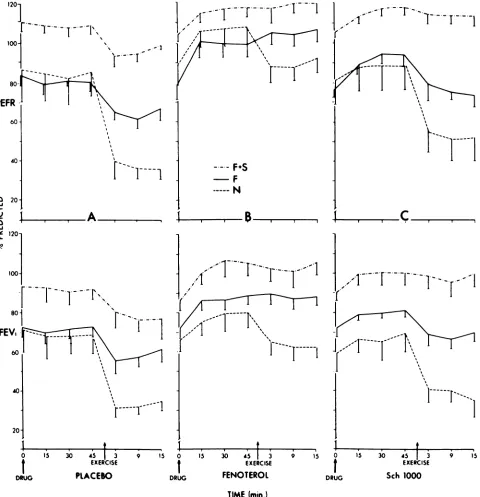
Fig 2. Mean PEFR (upper three graphs) and mean
FEV1 (lower three graphs) in the three groups (F + S, F, and N), showing bronchodilation (0 to 45 minutes) and
exercise response (3 to 15 minutes) following treatment with placebo, fenoterol, and SCH 1000. Bars indicate SE.
F + S group, EIB completely blocked by both fenoterol and SCH 1000 (N = 4); F group, EIB completely blocked
by fenoterol only (N = 7); N group, EIB completely
blocked by neither fenoterol nor SCH 1000 (N = 6).
at Viet Nam:AAP Sponsored on September 7, 2020
www.aappublications.org/news
lower base line pulmonary function responsed to fenoterol alone (F group).
The groups could not be clearly separated
clini-cally but the main differences between them tended
to be that the N group was obviously more
dis-tressed following the exercise, and these patients
were more labile asthmatics with more frequent
attacks than those in the other groups. The F + S
group
tended to have less severe asthma andre-quired less regular medication. The F group was
intermediate between the other groups. There was
no difference in the types of medication between
the groups. We feel that it is possible that these
groups were not static and that a patient’s respon-siveness to a drug may alter depending on base line
pulmonary function and exercise response at the
time of the study. Clinically, asthmatic patients do have different responses to exercise at different
times and reproducibility of EIB has been shown to
diminish as time elapses between studies.’4
In summary, the participation of the vagal path-way in the pathogenesis of EIB was demonstrated
in those patients who were protected by SCH 1000,
but it appears to play a minor role and suggests
multifactorial involvement in EIB. SCH 1000 was
shown to be an effective bronchodilator with
mini-mal side effects. The bronchodilation was
compa-rable to but not better than that of fenoterol. As an
EIB inhibitor, it depended on a relatively normal
base line and only a moderate deterioration
follow-ing exercise, whereas fenoterol depended on the
exercise response alone. Although anticholinergic
drugs are not very extensively used, SCH 1000 may
be useful in some patients in whom the $2
adrener-gic drugs cause significant side effects or are
con-traindicated.
REFERENCES
1. Anderson SD, Silverman M, K#{246}nigP, et al: Exercise-induced
asthma. Br J Dis Chest 69:1, 1975
2. Godfrey S, K#{246}nigP: Inhibition of exercise-induced asthma
by different pharmacological pathways. Thorax 31:137, 1976 3. Poppius H, Salorinne Y: Comparative trial of salbutamol
and an anticholinergic drug, SCH 1000, in prevention of exercise induced asthma. Scand J Respir Dis 54:142, 1973 4. Borut TC, Tashkin DP, Fischer TJ, et al: Comparison of
aerosolized atropine sulfate and SCH 1000 on
exercise-in-duced bronchospasm in children. J Allergy Clin Immunol
60:127, 1977
5. Kivioog J: The effect of pretreatment with atropine in exercise-induced bronchoconstriction. Pediatrics 56(suppl): 940, 1975
6. Chan-Yeung M: The effect of SCH 1000 and disodium
crom-oglycate on exercise-induced asthma. Chest 71:320, 1977 7. Tinkelman DG, Cavanaugh MJ, Cooper DM: Inhibition of
exercise-induced bronchospasm by atropine. Am Rev Respir
Di.s 114:87, 1976
8. Engelhardt A: Pharmacology and toxicology of Atrovent.
Scandinavian Symposium on Chronic Obstructive Airway Disease 1978. Stockholm, A Lingren & S#{246}ner,M#{246}lndal, 1979,
p 110
9. Ahonen A, Alanko K, Mattson K: Bronchodilator action of
two different doses of ipratropium bromide (SCH 1000)
compared with fenoterol and placebo. Curr Ther Res 24:65, 1978
10. Gross NJ: SCH 1000: A new anticholinergic bronchodilator. Am Rev Respir Dis 1 12:823, 1975
11. Weinberg EG, Shore SC, Marshall S, et al: The effect of
fenoterol (berotec) on exercise-induced asthma in children.
Med Proc 18:73, 1972
12. Eggleston PA, McMahan SA: The effects of fenoterol, epheclrine, and placebo on exercise-induced asthma. Chest 73:1006, 1978
13. Pulmonary terms and symbols: A report of the ACCP-ATS
Joint Committee on Pulmonary Nomenclature: Chest 68:
583, 1975
14. Silverman M, Anderson SD: Standardization of exercise
tests in asthmatic children. Arch Dis Child 47:882, 1972 15. Weng T-R, Levison H: Standards of pulmonary function in
children. Am Rev Respir Dis 99:879, 1969
1980;66;109
Pediatrics
R. Yeung, G. M. Nolan and H. Levison
Bronchospasm in Children
Comparison of the Effects of Inhaled SCH 1000 and Fenoterol on Exercise-Induced
Services
Updated Information &
http://pediatrics.aappublications.org/content/66/1/109
including high resolution figures, can be found at:
Permissions & Licensing
http://www.aappublications.org/site/misc/Permissions.xhtml
entirety can be found online at:
Information about reproducing this article in parts (figures, tables) or in its
Reprints
http://www.aappublications.org/site/misc/reprints.xhtml
Information about ordering reprints can be found online:
at Viet Nam:AAP Sponsored on September 7, 2020
www.aappublications.org/news