Bloxham, Sefton, Cerevkova, Andrea and Waddelove, Christine (2007)
Embedding personal development planning within a WebCT supported module: a
collaborative venture. Practitioner Research in Higher Education, 1 (1). pp. 3-9.
Downloaded from: http://insight.cumbria.ac.uk/id/eprint/3319/
Usage of any items from the University of Cumbria’s institutional repository ‘Insight’ must conform to the
following fair usage guidelines.
Any item and its associated metadata held in the University of Cumbria’s institutional repository Insight (unless
stated otherwise on the metadata record) may be
copied, displayed or performed, and stored in line with the JISC
fair dealing guidelines (available
here
) for educational and not-for-profit activities
provided that
• the authors, title and full bibliographic details of the item are cited clearly when any part
of the work is referred to verbally or in the written form
• a hyperlink/URL to the original Insight record of that item is included in any citations of the work
• the content is not changed in any way
• all files required for usage of the item are kept together with the main item file.
You may not
• sell any part of an item
• refer to any part of an item without citation
• amend any item or contextualise it in a way that will impugn the creator’s reputation
• remove or alter the copyright statement on an item.
The full policy can be found
here
.
development planning
within a WebCT supported
module—a collaborative
venture
Sefton Bloxham, Andrea Cerevkova and Christine Waddelove Edge Hill University
Abstract
This paper describes the background to and development of a fi rst year
undergraduate law module which has been re-designed to enable the embedding
of Personal Development Planning (PDP) within the curriculum, with particular
emphasis on career management skills. The pedagogic rationale for the approach
adopted is identifi ed and it is then demonstrated how skills development, careers
management and refl ective learning have been embedded and delivered through
a combination of classroom and online activities using WebCT. Finally, the paper
presents a brief evaluation, based on student feedback at the end of the module.
Background
The institutional background consists of three main elements. Firstly, recent policy changes now require that Personal Development Planning (PDP) for fi rst year undergraduates is assessed either as an independent module or by being embedded within the existing curriculum. Secondly, both institutional and departmental policies promote the use of WebCT for the delivery of all modules as part of a broader strategy to support more fl exible, student-centred learning. Thirdly, the Careers Centre, in addressing the employability agenda saw this as an ideal opportunity to work in partnership with the law tutors.
The main impetus for the introduction of PDP into UK HEIs can be traced back to the 1997 Dearing Report on Higher Education, which proposed the introduction of Progress Files for the recording of student achievement as ‘a means by which students can monitor, build and refl ect upon their personal development’ (National Committee of Enquiry into Higher Education, 1997). Subsequently, this was endorsed by the joint UUK-SCOP-QAA Progress File Policy statement of 2000, which required all UK HEIs to introduce ‘opportunities’ for PDP by 2005-06, as a ‘structured and supported processes to develop the capacity of individuals to refl ect upon their own learning and achievement, and to plan for their own personal
educational and career development’ (QAA, 2000).
Rationale
In the context of a university that places widening access and employability at the core of its mission, this challenge is particularly important because both skills development and PDP opportunities have been identifi ed as key factors in improving retention rates of ‘non traditional’ students (Warren, 2003). A HEFCE study of nine HEIs that had been successful in dealing with student diversity identifi ed ‘curriculum-linked opportunities for student personal development’ as a key ingredient in that success (HEFCE, 2002). More recently, a survey of six UK universities performing above their benchmarks for widening participation, retention and completion, identifi ed the ‘integration of skills development, employment and careers education, and personal tutor systems’ as areas of practice associated with such success (Yorke and Thomas, 2003). Both studies also identify the importance of a co-ordinated approach involving both academic and support staff.
However, other studies have identifi ed challenges to the successful implementation of PDP. Probably the main challenge is that of overcoming the scepticism of both learners and academic staff, neither of whom may see the value of PDP (Cottrell, 2003). Studies have shown that students often fail to relate to institutional
in Higher Education
Copyright © 2007 University of Cumbria
PRACTITIONER RESEARCH IN HIGHER EDUCATION 1 (1)
descriptions of the relevant skills and do not always see the relevance of ‘bolt on’ skills modules divorced from the curriculum (Lucas, et al., 2004). The lack of enthusiasm of academic staff has been linked with inadequate resourcing of personal tutor systems (East, 2006) and the perception that the employability focus of PDP is not central to their role (Jenkins, 2000). Despite these diffi culties, case studies within legal education identify strong approval of PDP from students (East, 2006; Prince, 2001), especially when embedded within the assessment structure (Humphreys, 2001).
One suggested solution to this is to embed PDP within the existing subject curriculum in a way which is both meaningful to learners and which supports and enhances the study of the subject matter (Ward, 2001). This demands the involvement of careers staff in PDP implementation, which may present further problems within a culture where collaboration between academic and support staff has been limited (Slight and Bloxham, 2006).
To summarise, the literature on PDP suggests that the processes of recording achievement and engaging in personal development planning can support the twin purposes of heightening learners’ awareness of their skills development for career planning purposes and of developing a more refl ective approach to their learning of the curriculum content. Against this, a number of potential diffi culties have been identifi ed — lack of understanding by learners and the scepticism of academic staff as to the purpose of PDP; inadequate resourcing of personal tutor systems; cultural opposition to, or at least unfamiliarity with, collaboration between academic and support staff.
Implementing changes
The Personal Tutoring (PT) system for a fi rst year law degree was reorganised to involve only those tutors who taught on the Year 1 programme. PT meetings were timetabled to provide feedback and opportunities for refl ection on assignments. The assessment structure was re-structured and now consists of a Refl ective Practice Log (RPL), worth 40%; a Careers Management Portfolio (CMP) worth 30%; an Oral Presentation (OP) on a legal issue, worth 30%.
The RPL, introduced to encourage legal skills development and refl ection on learning, consists of
• an online quiz designed to test students’ library/research skills
• a court visit report, designed to enable students to refl ect on the legal process and profession
• a research log, detailing the research and writing methodologies used for a formative essay
• a Year 1 performance refl ection exercise.
The CMP, introduced to develop careers management awareness, consists of
• a PowerPoint presentation on the structure of the legal profession and the qualifi cations, skills and personal qualities required for work within it
• a refl ective essay and an initial skills/careers development plan, based on a legal/personal skills audit
• a CV, designed to encourage early recording of, and refl ection on, achievement.
In response to the drive to integrate career planning within the curriculum, Career Management Skills (CMS) have been developed within HEIs using different models. The National Institute for Careers Education and Counselling (NICEC, 1998), in summarising the conclusions of a series of DfEE projects on career management skills, identifi ed three major strategies or models
a Delivery through generic or customised programme modules
b Integration within programmes, by linking the process of skills acquisition to existing course components
c Delivery outside the curriculum, through technology or discrete activities.
In this context, an ‘embedded’ careers module is one where the content is tailored to the pedagogic profi le of the subject, presenting challenges for careers staff who ‘teach’ such modules. In our own case, Careers Centre staff had experience of running programmes based on models A and C, neither of which had been particularly successful, and were keen to collaborate with academic staff in integrating an existing institutional
The Certifi cate structure is based on the four stage DOTS model - Decision Learning; Opportunity Awareness; Transition Learning; Self Awareness (Law, 1996). The key aim of the Certifi cate is to understand and
demonstrate practical application of CMS necessary for successful progression and development through and beyond university. The CMP is a result of close collaboration between the law tutors and the Careers Centre and demonstrates how CMS can be customised and embedded within the law curriculum. The basic structure of the institutional CMOC was maintained, with tasks specifi cally tailored to the legal profession, thus establishing a strong link between the curriculum and PDP.
Supporting WebCT infrastructure
It was decided to make full use of the WebCT platform to provide an online supporting infrastructure for delivery of the new programme. This decision clearly was not without inherent risks, as the case studies of the experience in law schools at the Universities of Glamorgan and Exeter have shown (East, 2006; Prince, 2001). However, those experiences need to be set against the evidence of positive student feedback on the use of ICT in the delivery of undergraduate law programmes at Coventry and Lancaster Universities (Davidson and Orsini-Jones, 2002; Bloxham and Armitage, 2003) and on postgraduate programmes at Glasgow Graduate School of Law (Maharg, 2001) and at Glasgow Caledonian University (McKellar and Barton, 1999).
Originally, WebCT acted primarily as a source of access to module learning resources. However, the tutors felt that this alone did not engage students suffi ciently with the subject of law, nor did it allow for the refl ection or appropriate skills development that was required for an effective PDP programme. The changes described above represent a more proactive approach to supporting skills development, refl ective learning and personal development planning by provision of
• learning and teaching resources, including access to module documentation as well as discussion forums designed for interstudent and student-tutor communication to encourage collaborative learning and active student participation and involvement with the subject
• online formative and summative assessment and feedback which, through online quizzes and the WebCT Assignment Drop Box facility, enables personal tutors to assess coursework online, release marks and provide feedback electronically prior to PT meetings
• an administrative structure for tracking student engagement, performance and progress, consisting of the ‘Track Students’ tool, enabling tutors to monitor student usage and engagement with the WebCT pages; and the ‘Manage Students’ tool, allowing tutors to track performance
• a mechanism for the creation of student records of achievement is provided through the ‘My Grades’ facility and RPL4, which forms the basis for student Progress Files in Years 2 and 3, although the authors are currently exploring the possibility of using e-portfolios in future.
PRACTITIONER RESEARCH IN HIGHER EDUCATION 1 (1)
Figure 1 CMP Session 1-1
Figure 2 CMP Session 1-2
Figure 3 CMP Session 1-3
Evaluation
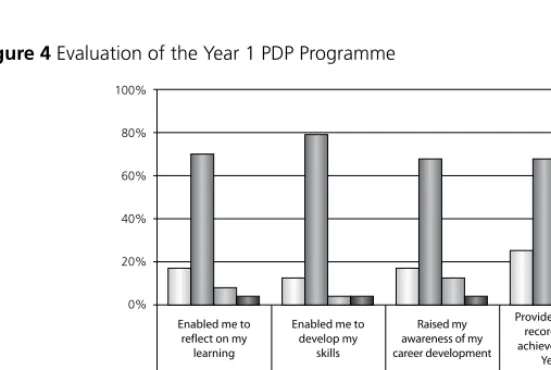
The main source of data was the evaluative quantitative and qualitative student feedback, gathered on completion of the module. Students were asked to complete a questionnaire relating to their overall experience of the PDP programme. Questionnaires were completed by 24 of the 32 full-time students who were enrolled at the time— a response rate of 75%. The fi rst question asked about satisfaction ratings for the overall programme. Responses were generally very positive, with most students ‘agreeing’ or ‘strongly agreeing’ that it had enabled them to refl ect on their learning (88%), that it enabled them to develop their skills (92%), that it raised their awareness of career development issues (84%) and that it provided a good record of their achievement (92%) (Figure 4).
Figure 4 Evaluation of the Year 1 PDP Programme
100%
80%
60%
40%
20%
0%
17%
71%
8%
4% Strongly agree
Agree
Disagree
Strongly disagree
13%
79%
4%
4%
17%
67%
13%
4%
25%
67%
4%
4%
Enabled me to reflect on my learning
Enabled me to develop my
skills
Raised my awareness of my career development
Provided a good record of my achievement in
The questions relating to careers awareness were designed to identify particular learning outcomes—subject knowledge, refl ection on skills/careers, CV development—and relate them to the specifi c learning tasks that had been undertaken as part of CMP. Responses were very positive, with between 71-92% ‘agreeing’ or ‘strongly agreeing’ that the learning tasks had developed their subject knowledge (Figure 5) and enabled them to refl ect on their skills’ needs and career options (Figure 6) as well as developing CV writing skills (Figure 7), although the latter was the least positively regarded. A number of students commented that a task considering a wider range of career options, beyond the legal profession, would have been more useful. This needs to be addressed, although uncoupling the subject knowledge, which would have to remain focussed on the legal profession, from the process of refl ection on skills and career options will present diffi culties.
Figure 5 Evaluation of CMP1 (Legal Profession PowerPoint)
0% 10% 20% 30% 40% 50% 60% 70% 80% 90% 100%
Strongly Agree 33% 33%
Agree 42% 54%
Disagree 21% 8%
Strongly Disagree
raised my awareness of the nature of the legal profession
enabled me to become familiar with the qualifications, skills and personal qualities
required to enter the profession
Figure 6 Evaluation of CMP2 (Skills Audit) 100% 80% 60% 40% 20% 0% 33% 42% 21% -Strongly agree Agree Disagree Strongly disagree 33% 54% 8%
-Raised my awareness of the nature of the legal profession
Enabled me to become familiar with the qualifications, skills and personal qualities
required to enter the profession
100% 80% 60% 40% 20% 0% 21% 67% 8% -Strongly agree Agree Disagree Strongly disagree 21% 71% 4% -21% 58% 13% 4%
Enabled me to reflect on my current skills/personal
qualities
Enabled me to reflect on my skills development
needs
Enabled me to reflect on potential career
PRACTITIONER RESEARCH IN HIGHER EDUCATION 1 (1)
Figure 7 Evaluation of CMP3 (CV)
Conclusion
In conclusion, this paper outlines the development of an embedded PDP process within an undergraduate law module. The approach adopted for implementation has been located within the context of the research literature that identifi es both the pedagogic rationale for PDP and how the use of ICT applications can support skills development and refl ective learning. Finally, the paper has provided an evaluation, based on student feedback.
To summarise, the evaluation data suggests that although the new module appears to have been successful in achieving its objectives, attention needs to be addressed to further develop and improve the following aspects
• clarifi cation of assessment criteria for refl ective writing, for the benefi t of the tutors
• additional support and guidance on refl ective writing, for the benefi t of the students
• consideration to extending elements of the CMP beyond the legal profession, to cater for students who do not intend to pursue legal careers.
Other issues may emerge in the future as the new module ‘beds in’ and as student numbers increase. Tutors are also considering the introduction of e-portfolios to further support and encourage student refl ection and to promote an enhanced sense of ‘ownership’ of their progress fi les. On the positive side, the challenges of resourcing the PT system, online delivery of the programme, and academic-support staff collaboration, appear to have been successfully met. Indeed, the tutors are satisfi ed that the new module is effectively designed to achieve the intended educational objectives and will continue to critically refl ect on the process with a view to introducing further changes as and when necessary.
100%
80%
60%
40%
20%
0%
21%
54%
13%
8% Strongly agree
Agree
Disagree
Strongly disagree
21%
50%
17%
8%
Raised my awareness of the different CV writing techniques
References
Bloxham, S. M. and Armitage, S. (2003). ‘What a LUVLE way to learn law’. International review of law, computers and technology. 17 (1). 39-50.
Cottrell, S. (2003). Skills for success—The personal development planning handbook. Basingstoke—Palgrave Macmillan.
Davidson, A. and Orsini-Jones, M. (2002). ‘Motivational factors in students’ online learning’ in Fallows. S. and Bhanot, R. (2002). Educational development through information and communications technology. SEDA—Kogan Page. 73-86.
East, R. (2006). ‘A progress report on progress fi les—The experience of one higher education institution’
Active learning in higher education. 6 (2). 160-171.
HEFCE. (2002). ‘Successful student diversity—Case studies in learning and teaching and widening participation. Bristol —HEFCE.
Humphreys, V. (2001). ‘Introducing personal development planning at the University of Central England’. (LTSN Generic Centre, Case study No 5) at http://www.ukcle.ac.uk/resources/pdp/uce.html (accessed 13.09.06).
Jenkins, A (2000) ‘It’s a long hard road’, in Fallows, S. and Steven, C. (2000) Integrating key skills in higher education. London —Kogan Page.
Law, B. (1996). ‘Careers education in a curriculum’, in Watts, A.G., Law, B., Killeen, J., Kidd, J.M. and Hawthorn, R. (1996). Rethinking careers education and guidance. London—Routledge.
Lucas, U., Cox, P., Croudace, C. and Milford, P. (2004). ‘Who writes this stuff?’, Students perceptions of their skill development. Teaching in higher education. 9 (1). 55-68.
Maharg, P. (2001). ‘Multimedia—Enhancing student learning’, BILETA conference paper, at http://www.bileta. ac.uk/Document%20Library/1/Multimedia%20-%20Enhancing%20Student%20Learning.pdf
(accessed 13.09.06).
McKellar, P. and Barton, K. (1999). ‘The virtual court action—Procedural facilitation in law’, Seminar on getting more from electronic conferencing CTI Law Technology Centre, University of Warwick, at http://www.law. warwick.ac.uk/seminars/99-1-pm.html (accessed 13.09.06).
National committee of enquiry into higher education. (1997) ‘Dearing report, recommendation 20’, at http://www.ncl.ac.uk/ncihe/ (accessed 13.09.06).
NICEC (National Institute for Careers Education and Counselling). (1998). ‘Developing career management skills in higher education’. CRAC.
Prince, S. (2001). ‘PESCA—Introducing personal development planning at Exeter’, LTSN Generic Centre, case study No 4, at http://www.ukcle.ac.uk/resources/pdp/exeter.html (accessed 13.09.06).
Prospects, at http://www.prospects.ac.uk (accessed 19.09.06).
QAA. (2000). ‘Policy statement on a progress fi le for higher education’, at http://www.qaa.ac.uk/ academicinfrastructure/progressFiles/archive/policystatement/default.asp#pdp (accessed 13.09.06).
Slight, A. and Bloxham, S. (2006). ‘Embedding personal development planning into the social sciences’
Learning and teaching in the social sciences (forthcoming).
Ward, R. (2001). ‘Developing and implementing institutional policy on personal development planning’, in Ward, R. and Jackson, N. (2001). Personal development planning—Institutional case studies. York—LTSN.
Warren, D. (2003). ‘Improving student retention—A team approach’, Annual conference of the ILTHE, Coventry, 2-4th July.
Windmills, at http://www.windmillsprogramme.com/ (accessed 13.09.06).
Yorke, M. and Thomas, L. (2003). ‘Improving the retention of students from lower socio-economic groups’