Stinkens, Elliott, and Leijssen
Bridging the Gap between Therapy
Research and Practice in a
Person-Centered/Experiential Therapy Training
Program: The Leuven Systematic Case
Study Research Protocol
Abstract. The goal of the Leuven Systematic Case Study Research Protocol project is to stimulate practice-oriented research in order to bridge the gap between research and practice. In this article we give a progress report of the project, in which a set of Dutch-language research instruments was created and tested with postgraduate trainees in person-centered/experiential therapy at the University Leuven (Belgium). We begin by presenting the general framework for the protocol, including the three major domains of therapy process, therapy outcome, and client/therapist characteristics. Then we give an overview of the quantitative and qualitative instruments used. We explain how the project has been implemented in the postgraduate program. To evaluate the success of the project, we analyzed the answers of our trainees on a questionnaire. We give an overview of the clinical cases involved and the variety of research questions that have been formulated in the individual case studies. Finally we discuss the value of this pilot project.
Keywords:systematic case study research, practice-oriented research, therapy process, therapy outcome, therapy training
Die Kluft zwischen Therapieforschung und -praxis überbrücken in einem personzentrierten/ experienziellen Therapietrainingsprogramm: Das Systematische Löwener Fallstudienforschungs-protokoll
Das Ziel des Projekts mit dem Systematischen Löwener Fallstudienforschungsprotokoll ist es, praxisorientierte Forschung anzuregen, um die Kluft zwischen Forschung und Praxis zu überbrücken. In diesem Artikel berichten wir über die Fortschritte in unserem Projekt. Wir entwickelten und testeten Forschungsinstrumente in holländischer Sprache mit Postgraduierten, die die Ausbildung in
Nele Stinckens,
1Robert Elliott,
2& Mia Leijssen
3 1. Katholieke Universiteit Leuven, Belgium2. University of Strathclyde, Glasgow, UK
Bridging the Gap between Therapy Research and Practice
Personzentrierter/Experienzieller Therapie an der Universität in Löwen (Belgien) durchliefen. Wir stellen zuerst die generellen Rahmenbedingungen für das Protokoll vor, einschliesslich der drei Hauptgebiete Therapieprozess, Therapie-Outcome und Klient-/Therapeut-Charakteristika. Dann geben wir einen Überblick zu den verwendeten quantitativen und qualitativen Instrumenten und erklären, wie wir das Projekt in das Postgraduierten-Programm einbauten. Um den Erfolg des Projektes zu evaluieren, analysierten wir die Antworten unserer Ausbildungsteilnehmer und -teilnehmerinnen mit einem Fragebogen. Wir geben einen Überblick über die darin involvierten klinischen Fälle und die Vielzahl der Forschungsfragen, die wir in den individuellen Fallstudien formulierten. Schließlich diskutieren wir den Stellenwert dieses Pilotprojekts.
Tendiendo un puente entre la investigación y práctica de la terapia en el programa de entrenamiento centrado en la persona y experiencia: El Protocolo de Investigación del Caso de Estudio Sistemático Leuven
La meta del proyecto de protocolo de investigación sistemática del caso de estudio Leuven es estimular la investigación orientada a la práctica para tender un puente que salve la distancia entre la investigación y la práctica. En este escrito damos un informe sobre la marcha del proyecto, en el cual se creó un sistema de instrumentos de investigación en holandés y se probó con los graduados en terapia centrada en la persona y experiencial en la Universidad en Leuven (Bélgica). Comenzamos presentando el marco general para el protocolo, incluyendo los tres dominios principales el proceso de terapia, el resultado de la terapia, y las características del cliente/terapeuta. Luego damos una descripción de los instrumentos cuantitativos y cualitativos usados. Explicamos cómo se implementó el proyecto en el programa de posgrado. Para evaluar el éxito del proyecto, analizamos las respuestas de nuestros estudiantes en un cuestionario. Damos una descripción general de los casos clínicos implicados y la variedad de preguntas de investigación que se han formulado en los estudios de casos individuales. Finalmente discutimos el valor de este proyecto piloto.
Créer des liens entre la recherche et la pratique en thérapie dans un programme de formation à la psychothérapie centrée-sur-la-personne/expérientielle : le Protocole de Louvain de Recherche Systématique d’Études de Cas
Le but du protocole de recherche systématique sur les études de cas est de stimuler la recherche orientée sur la pratique pour créer des liens entre elles. Dans cet article nous proposons un rapport sur l’avancement des travaux : un jeu d’instruments de mesure pour la recherche en néerlandais fut crée et testé avec les stagiaires post-licence dans la thérapie Centrée-sur-la-Personne/expérientielle à l’Université de Leuven (Louvain) (Belgique). Nous avons commencé par présenter le cadre général pour le protocole comprenant les trois domaines majeurs : le processus de la thérapie, le résultat de la thérapie et les caractéristiques du client et du thérapeute. Puis nous proposons une vision d’ensemble des instruments quantitatifs et qualitatifs utilisés. Nous expliquons la manière dont le projet a été mis en œuvre dans le programme post-licence. Pour évaluer le succès du projet, nous avons analysé les réponses de nos stagiaires à partir d’un questionnaire. Nous donnons une vision d’ensemble des cas cliniques impliqués et la variété des questions de recherche qui ont été formulées dans les études de cas individuels. Finalement nous discutons de la valeur de ce projet pilote.
centrada no cliente e experienciais da Universidade de Lovaina (Bélgica). Começamos por apresentar o enquadramento geral do protocolo, incluindo os 3 domínios fundamentais: processo terapêutico, resultados da psicoterapia e características do sistema cliente/terapeuta. Em seguida, apresentamos uma perspectiva geral dos instrumentos quantitativos e qualitativos utilizados. Explicamos de que forma o projecto foi implementado no programa da pós-graduação. De forma a avaliar o sucesso do projecto, analisámos as respostas dos nossos formandos a um questionário. Apresentamos uma perspectiva geral dos casos clínicos envolvidos e da variedade de questões de investigação que foram formuladas nos estudos de caso individuais. Por último, discutimos o valor deste projecto-piloto.
In the present mental health climate there is a growing demand for accountability in therapy practice and training. Researchers, universities, mental health services, psychiatric hospitals and insurance companies want to have evidence on which psychotherapeutic treatments are effective and clinically useful. They almost exclusively rely on randomized controlled trials (RCTs) to spell out recommendations for how to do therapy.
Client-centered and experiential psychotherapy can rely on a rich and extensive empirical tradition. Over the past 15 years, Elliott and colleagues (e.g., Elliott, Greenberg, & Lietaer, 2004) have produced a series of meta-analyses of the existing research literature pointing to the strength of the research evidence. They concluded that experiential therapies are efficacious and specific (based on superiority to another treatment or equivalence to an established treatment in two or more research settings) for the treatment of depression, trauma/abuse and couples problems. These therapies have also been shown to be “possibly efficacious” for anxiety disorders, and they are “promising and worthy of further study” for problems related to anger and aggression; for problems of severe client dysfunction, including schizophrenia and severe personality disorders; and for health-related problems (such as cancer and psychosomatic problems).
Nevertheless, several researchers applying more humanistic and person-centered principles to the conduct of therapy research have criticized the reductionistic and one-sided research methodology that is widely promoted. Lietaer (2003) is among those who have questioned the view of RCTs as the so-called “gold standard” for the empirical validation of psychotherapies. A common criticism is that RCTs follow positivistic research principles that are quite antithetical to a person-centered philosophy. For example, some RCTs focus mainly on the efficiency and outcome results of therapy treatment, thereby neglecting the client’s lived
ࡄ࠰ࡦࡦ࠲࠼߅ࠃ߮㛎ㆊ⒟≮ᴺ࠻࠾ࡦࠣࡊࡠࠣࡓߦ߅ߌࠆ⎇ⓥߣታ㓙ߩࠡࡖ࠶ࡊࠍ߆ߦ ၒࠆ߆㧦࡞ࡌࡦ♽⛔⊛⎇ⓥᴺߦߟߡ
࡞ࡌࡦ♽⛔⊛⎇ⓥࡊࡠࠫࠚࠢ࠻ߩ⋡⊛ߪޔ⎇ⓥߣታ〣ߩࠡࡖ࠶ࡊࠍၒࠆߚߦޔታ〣ᔒะߩ⎇ⓥ ࠍଦㅴߔࠆߎߣߢߞߚޕᧄ⺰ᢥߢߪޔߎߩ⎇ⓥࡊࡠࠫࠚࠢ࠻ߩㅴⴕ⁁ᴫߦߟߡႎ๔ࠍⴕ߁ޕߎߩࡊࡠ ࠫࠚࠢ࠻ߢߪޔࠝࡦ࠳⺆ߦࠃࠆ⎇ⓥߩߚߩዤᐲ߇ᚑߐࠇޔࡌ࡞ࠡߩ࡞ࡌࡦᄢቇᚲዻߩࡄ࠰ࡦ ࡦ࠲࠼߅ࠃ߮㛎ㆊ⒟≮ᴺ࠻࠾ࡦࠣࡊࡠࠣࡓߩᄢቇ㒮↢ߦߘࠇࠄߩዤᐲ߇ᣉⴕߐࠇߚޕᧄ⺰ᢥ
ߢߪޔ߹ߕ⎇ⓥࡊࡠࠫࠚࠢ࠻ߩᄢ߹߆ߥᨒ⚵ߺ․ߦޔࡇࡊࡠࠬߦ㑐ߔࠆߟߩਥⷐߥ㗔ၞޔ
experience of the ongoing therapeutic process. Furthermore, essential information about the processes of change and the elements contributing to the change process is lacking. This kind of information can greatly enhance the practice of therapy (Lietaer, 2003). Other authors (e.g., Lauteslager, 2006) criticize the fact that the selected client samples are rarely clinically representative because of the large number of clients who are excluded. For example, there is often a systematic screening out of clients with personality disorders and comorbid problems. Also, the therapeutic procedures that are generally studied are standardized, short term, and of a fixed length in order to minimize the within-group variability. This reduces the external validity of the results, hampering generalization to real-life therapeutic practice.
Since the 1980s, alternative research paradigms that better address the complexity of therapy have been developed. Rice and Greenberg (1984) introduced the events paradigm, featuring the intensive study of significant in-therapy events to improve and enrich our therapeutic knowledge. This paradigm has fostered the development of innovative research methods, such as comprehensive process analysis (Elliott et al., 1994), consensual qualitative research (Hill, Thompson, & Williams (1997), assimilation theory research (Stiles et al., 1990), and interpretive systematic case study methods (Elliott, 2002). It also gave rise to a large number of process studies that shed light on a wide range of process variables: helpful or hindering processes that occur in therapy, micro-processes that evolve during constructive personality change, and relationship factors that are of crucial importance to this change process.
Although this kind of research better corresponds to the complex reality of therapy practice, there still remains a gap between research and ongoing practice. Little is known about contemporary applications of client-centered and experiential therapies, especially within specific client populations or with respect to specific client problems. Therapists, on the one hand, are not really implementing research in their clinical work, and researchers, on the other hand, are not fully addressing the problems and opportunities of the therapeutic field. Elliott & Zucconi (2006) made a case for practice-based research on person-centered/ experiential psychotherapies. A promising development along these lines is the Practice Research Network (PRN) approach, promoted in the USA by Borkovec, Castonguay and colleagues (Borkovec, Echemendia, Ragusea, & Ruiz, 2001; Castonguay et al., 2004) and the International Project on the Effectiveness of Psychotherapy and Psychotherapy Training (IPEPPT), promoted in Italy by Elliott and Zucconi (2006).
THE LEUVEN SYSTEMATIC CASE STUDY PROJECT
The Leuven Systematic Case Study project is a pilot study of the IPEPPT. The general goal of IPEPPT is to improve psychotherapy and research by encouraging systematic research in therapy training institutes and university-based training clinics.
which follows a broad scientist-practitioner model. Supervision, seminars and workshops are both clinically and scientifically founded and the trainees are trained in both clinical and scientific skills. The research protocol also has incentive potential for our trainees since it has a strong practice-based emphasis. Our trainees are all practicing therapists with a first degree in psychology, educational science, or psychiatry, but relatively little scientific background. They work in public health care settings, in psychiatric hospitals, and in private practices. In order to motivate our trainees to do research, it had to be practice-oriented.
Practice-oriented research connects well with the needs and interests of those working in the therapeutic field in that it has the following characteristics (Elliott & Zucconi, 2006):
• The research is bottom-up oriented: clients and therapists are involved in selecting the research questions and methods;
• The research is focused: instead of trying to be comprehensive, it is limited to some key elements of therapy process and outcome;
• The methodology is pluralistic: a variety of methods is used to catch the complexity of the therapy situation;
• The research is practical: the instruments are inexpensive, easy-to-use, and do not interfere with the ongoing therapy process;
• It is collaborative: therapists work together in planning and doing research in order to stimulate cross-fertilization and data sharing.
In developing the Leuven Protocol, we stuck to these practice-oriented principles. We intentionally chose a broad common framework to allow some flexibility for the divergent interests of our trainees. Within this general framework the trainees could focus on specific topics or processes that aroused their interests (e.g. dealing with an alliance rupture, working with the inner critic, short-term therapy with a depressive client). This general framework focuses on three major domains of therapy research:
1. Therapy outcome: how clients change over the course of therapy
2. Therapy process: what happens within therapy sessions that is potentially related to outcome
3. Client and therapist characteristics: important features of client and therapist that may affect therapy outcome and process
reality of the therapy situation. Because the qualitative data enrich and enliven the “dry numbers,” it also fits better with the interest and prior experience of our trainees.
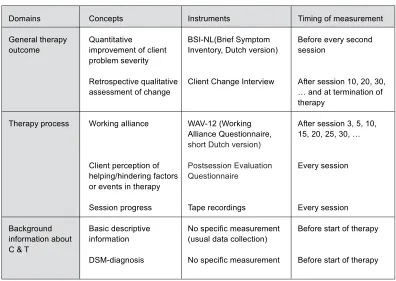
The Leuven Protocol (see Table 1) meets the requirements for a systematic case study protocol (Elliott, 2002; Elliott & Zucconi, 2006; Fishman, 1999):
• There is a quantitative measurement of client problem severity, given every two sessions. • There is an additional qualitative assessment of the general therapy outcome by means of a retrospective in-depth interview. It asks about client change and important therapy processes. It is given every ten sessions and at the end of therapy.
• With respect to the therapy process, the working alliance is evaluated systematically every five sessions.
• Every session the client completes a qualitative postsession assessment of helping and hindering processes of therapy.
• The trainees keep detailed process notes and recordings of all therapy sessions. • Some basic descriptive information about client and therapist is gathered, including gender,
age, educational background, ethnicity (for both C and T), occupation, presenting problems, diagnosis (for C), discipline, therapy orientation, experience level (for T). This kind of systematic case study research answers some basic questions asked by most practicing therapists, including our trainees:
1. Has the client changed substantially?
2. Was the therapy substantially responsible for these changes? 3. What kind of processes contributed to these changes?
Besides the ecological validity of this kind of research, the findings are potentially appropriate for publication in clinically oriented or case-research journals, which is also of interest to our trainees (Elliott & Zucconi, 2006).
The instruments we have selected are all shortened versions of existing instruments. They are easy to use for the therapist and do not overload the client.
• The WAV-12 is the revised shortened version (Hatcher & Gillaspy, 2006) of the Working Alliance Inventory (Horvath & Greenberg, 1989; Dutch translation: Vertommen & Vervaeke, 1990). It is one of the most frequently used alliance measures today, consisting of 12 items. It is based on the working alliance model of Bordin that distinguishes three central dimensions: therapeutic bond, agreement about therapy goals, and collaboration on therapeutic tasks.
• The Postsession Evaluation Questionnaire is the Dutch revised version (Lietaer, 1992) of Llewelyn’s (1988) Helpful Aspects of Therapy Form. This brief form contains a series of open-ended questions that ask for helpful or important in-therapy events. Hindering aspects are also asked for. The client is invited to describe in detail what precisely happened that was experienced as helpful, important, or hindering. • The Client Change Interview is more time consuming. It is a qualitative in-depth
[image:7.536.63.459.66.347.2]interview that was developed by Elliott and colleagues (Elliott, Slatick, & Urman, 2001) and translated by Franssen & Stinckens (2005). The major topics of the interview are the changes that the client has noticed since therapy began, what he/she believes may have brought about these changes, and the helpful or unhelpful aspects of the therapy. Clients generally welcome the interview as an opportunity to reflect more deeply on the therapy process. In order to encourage them to give open and honest answers on the evaluative questions, in this situation the interview is given by an independent masters student.
Table 1. Domains, Concepts, Instruments and Timing Used in the Leuven Protocol
Domains General therapy outcome Therapy process Background information about C & T
Concepts
Quantitative
improvement of client problem severity
Retrospective qualitative assessment of change
Working alliance
Client perception of helping/hindering factors or events in therapy
Session progress Basic descriptive information DSM-diagnosis Instruments BSI-NL(Brief Symptom Inventory, Dutch version)
Client Change Interview
WAV-12 (Working Alliance Questionnaire,
short Dutch version)
Postsession Evaluation Questionnaire
Tape recordings
No specific measurement (usual data collection)
No specific measurement
Timing of measurement
Before every second session
After session 10, 20, 30, … and at termination of therapy
After session 3, 5, 10, 15, 20, 25, 30, …
Every session
Every session
Before start of therapy
A last characteristic of the Leuven project is that we consider it to be a collaborative enterprise. A lot of energy is spent discussing and sharing questions and concerns in groups. Our trainees are also invited to join the international research network (www.communityzero.com/pcepirg). To offer more individual and immediate help, a “research buddy system” was developed where two trainees act as buddies for each other, sustaining and helping each other during the whole research process.
IMPLEMENTATION OF CASE STUDY RESEARCH INTO THE POSTGRADUATE PROGRAM
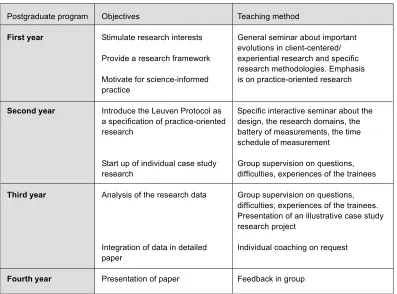
The implementation of the case study research happens in different phases (see Table 2). The postgraduate program takes four years in total and consists of four major training parts: psychotherapy practice and supervision; theoretical-technical training; personal work in group; and case study research. The research part is a minor part of the training; it takes up 200 hours of study and has the highest load in the third year.
In the first year a foundational seminar about research in client-centered and experiential psychotherapy is given. We highlight the importance of client-centered and experiential research, and we give a historical overview of important recent developments in the field, including systematic case study designs, intensive process research, qualitative research methods, and practice-oriented research. The seminar introduces our trainees to different research methods. It is also meant as a warm up to familiarize our trainees with the research topic.
At the start of the second year the Leuven Protocol is introduced: we discuss the three domains that will be focused on, we bring in the different measurement instruments, we present the time schedule of measurements, and we answer trainees’ questions and remarks. We also present an example of a systematic case study. This supplies a vivid and specific illustration of the cross-fertilization that might happen between research and therapy practice. After this introduction, the trainees start doing their own case study research. Since the research is quite time-consuming, it is restricted to only one client. We advise our trainees to begin as soon as possible with one of their new clients, keeping the possibility of starting another case study client if there happens to be an early dropout.
Midterm, a very interactive research supervision session (of three hours) is organized. The trainees share experiences, questions, difficulties and so on within groups. The focus is on the start up of the individual case study research and the use of the different measurements. At the beginning of the third year another research supervision session takes places. The focus this time is on the analysis of the specific data. Again an example of a systematic case study research is presented. The trainees learn how to read and interpret quantitative and qualitative data. They also learn how to integrate them and how to make sense of them in light of the whole therapeutic experience.
psychotherapy literature. The coaching is also individual: one coach (the first author) assists with the elaboration of their research in its successive stages. The intensity of this coaching varies according to the needs of the trainees. Some trainees ask for a very close follow-up; others prefer to work more autonomously. This process results in the writing of a detailed paper that has to be submitted at the end of the training year. Two reviewers evaluate the papers: one is part of the same postgraduate program, the other a staff member of another University therapy program (cognitive-behavioral therapy, psychodynamic therapy, relational and family therapy).
[image:9.536.65.462.321.615.2]In the fourth year the trainees present their individual case study research to the training staff and the second-year trainees. By involving their younger colleagues, we address two needs at the same time: our senior trainees have an audience to get feedback from and our junior trainees become acquainted with the practice and the value of practice-oriented research. Besides this individual work, there is also a joint data collection. The data from the individual case studies are collected in a global uniform database. This database belongs to the research unit of the Center for Client-Centered and Experiential Psychotherapy. It provides an extensive and rich set of data that can be used for future projects in the center and for exchange programs between research centers.
Table 2. Implementing the Leuven Protocol in Postgraduate Training
Postgraduate program
First year
Second year
Third year
Fourth year
Objectives
Stimulate research interests
Provide a research framework
Motivate for science-informed practice
Introduce the Leuven Protocol as a specification of practice-oriented research
Start up of individual case study research
Analysis of the research data
Integration of data in detailed paper
Presentation of paper
Teaching method
General seminar about important evolutions in client-centered/ experiential research and specific research methodologies. Emphasis is on practice-oriented research
Specific interactive seminar about the design, the research domains, the battery of measurements, the time schedule of measurement
Group supervision on questions, difficulties, experiences of the trainees
Group supervision on questions, difficulties, experiences of the trainees. Presentation of an illustrative case study research project
Individual coaching on request
AN EVALUATION OF THE CASE STUDY RESEARCH IN THE TRAINING PROCESS
To get an idea of how the trainees evaluate the implementation of the case study research in their training program, we used a questionnaire to ask them several questions. It was given once at the end of their second year of training and again at the end of their third year.
1. Progress of the research:
Have you started your research yet? How many sessions have you done? What instruments have been used? Has the Client Change Interview already taken place? Has the client dropped out? If you have not started yet, what are the reasons for this? Has your research been finished?
2. Attitude towards the research:
Describe briefly your attitude toward the introduction of the case study research. Were you enthusiastic, motivated, or curious? Or were more negative feelings prevalent (such as dislike, fear, or irritation)? Have your initial feelings changed during the research process? If yes, which factors were responsible for this change?
3. Importance of coaching:
How do you evaluate the coaching of the case study research? What did you experience as positive or helpful? What did you experience as not helpful or negative? What was missing? What do you think about the seminars and supervisions? How did you experience the individual coaching while writing your research paper?
4. Estimated relevance of the research:
Do you think the case study research is a relevant part of your training? What have you learned up to now? To what extent and in what ways has it contributed to your becoming a therapist?
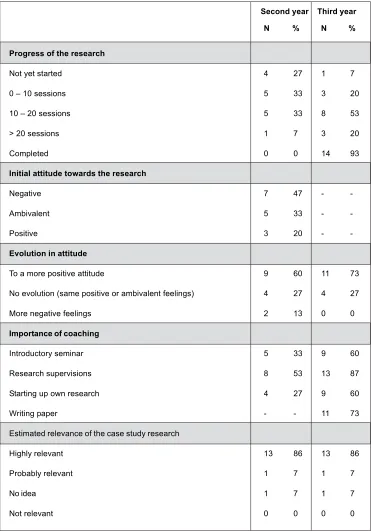
Table 3 gives an overview of the trainees’ answers to the central questions. More detailed information will be presented below.
Table 3. Evaluation of the Research Project at the End of the Second and Third Year (N & %)
Second year Third year
Progress of the research
Not yet started 4 27 1 7
0 – 10 sessions 5 33 3 20
10 – 20 sessions 5 33 8 53
> 20 sessions 1 7 3 20
Completed 0 0 14 93
Initial attitude towards the research
Negative 7 47 -
-Ambivalent 5 33 -
-Positive 3 20 -
-Evolution in attitude
To a more positive attitude 9 60 11 73
No evolution (same positive or ambivalent feelings) 4 27 4 27
More negative feelings 2 13 0 0
Importance of coaching
Introductory seminar 5 33 9 60
Research supervisions 8 53 13 87
Starting up own research 4 27 9 60
Writing paper - - 11 73
Estimated relevance of the case study research
Highly relevant 13 86 13 86
Probably relevant 1 7 1 7
No idea 1 7 1 7
Not relevant 0 0 0 0
Openly discussing their problems, doubts, and fears decreased their initial resistances and activated their curiosity and motivation. By the end of their second year, 33% of the trainees had done between 5 and 10 sessions, and 33% had done more than 10 sessions. However, four trainees (27%) had not yet started, mostly because of practical reasons. For example, one trainee was working with French-speaking clients and she could not use all of the instruments; one trainee interrupted her work because of pregnancy. This trainee did not resume her research activities in the third year because she wanted to give priority to the care of her child. All other trainees had finished their case study research at the end of the third year and they also had written their research papers.
With respect to the attitudes toward the research question, only 20% reported having had unequivocally positive feelings right from the beginning; these students felt motivated and enthusiastic about doing the research. In contrast, almost half of the trainees (47%) reported negative feelings: they reported not being interested, feeling fearful of failure, being overwhelmed by the complexity of the protocol, feeling nervous about scrutinizing their therapy, disliking the project because of the extra work, and being reluctant to bother the client with all kinds of measurements. The remaining 33% mentioned feelings of ambivalence. Over time, these initial feelings mostly changed in the direction of a more positive attitude. At the end of the second year, 60% of the trainees reported that their motivation had grown during the research process; at the end of the third year this percentage was even higher (73%). They became more open and enthusiastic about the possibilities of doing case study research. They experienced personally the benefits of the research for themselves and for their clients. This becomes clear in the following answers:
• I have experienced that the research offers a surplus value to the therapy. It intensifies the therapeutic contact, which I hadn’t expected in advance. I was afraid that it would bring to light my inabilities as a therapist, but now I realize that it can be really helpful. • I was afraid that the research would be very time consuming, but since I’ve started my own
research it turned out to be not that bad. Now I’m really curious about the results. • This kind of research isn’t interfering with the therapeutic process. Quite the contrary, it is
contributing to the deepening of the process.
• The research brought into light a rupture in the working alliance which I hadn’t noticed in the therapeutic contact.
• The systematic evaluation contributed to the continuity of the therapy. It clearly raised a bridge between the different sessions.
• The research proved to have a kind of monitoring function: it helped my client to reflect upon and to anchor his therapeutic experiences and it made me as therapist more sensitive to helpful and hindering processes.
with the ecological validity of the data; they were wondering if research would do justice to the complexity of the therapeutic reality.
Two trainees became a bit demoralized after the second year. They were quite disappointed about the limited information they got from the instruments that had been used so far. The quantitative instruments did not bring them “new insights” and their clients’ answers on the Postsession Evaluation Questionnaire were rather short and revealed little. They were looking forward to having more enriching qualitative data from the Client Change Interview. They also questioned how the different sources of information could be integrated in a significant way.
At the end of the third year, however, none of the trainees reported negative feelings about the research project.
The factors that contributed to a more positive research attitude mostly relate to the coaching of the trainees. On the guidance question 86% of the trainees answered (at the end of the second year) that their feelings changed due to the introductory seminar and the research supervision. The extensive explanations, the specific guidelines, the presentation of an interesting case study research illustration, and the fact that this was all presented with enthusiasm, encouraged them to do their own research. In addition, a kind of “systematic desensitization” took place for some trainees (27%); by simply starting their research, some of their fears and resistances began to fade away.
At the end of the third year, the importance of coaching and actually doing their research was valued even more. During this year, there were fewer collective meetings; the coaching mostly happened on an individual basis via e-mail. The majority of the trainees experienced this as very accessible and efficient. A few of them, however, did not make use of this individualized way of coaching; they did not meet the deadlines and they finished their papers on their own during the summer break.
Most of the trainees (86%) perceived the case study research as a highly relevant part of their psychotherapy training (relevance question). They offered several reasons. The majority of them pointed to the clinical significance of the research: “It deepens the client process”; “It sheds light on helping and hindering factors”; “It brings more transparency into the therapeutic relationship”; “It helps to improve the quality of therapy”; “It adds to my therapeutic expertise”; “It stimulates discussing the therapy goals”; “It helps to anchor in-therapy experiences”; “It fosters a more differentiated treatment, since it focuses attention on various micro-processes”; “It makes me more alert for imminent ruptures in the working alliance”; “the systematic evaluations force adjustment of the therapeutic treatment on a regular basis.”
Two of the trainees thought of the research as probably relevant or did not have an idea about its relevance. There appeared to be a difference between the second and the third year. At the end of the second year the doubts about relevance had to do with a lack of familiarity with the research; whereas at the end of the third year, there were questions about the balance between efforts and results. One trainee, for example, wondered if such a comprehensive research method was a necessary tool for analyzing the therapy process.
SPECIFICATION OF THE LEUVEN PROTOCOL: OVERVIEW OF INDIVIDUAL CASE STUDIES
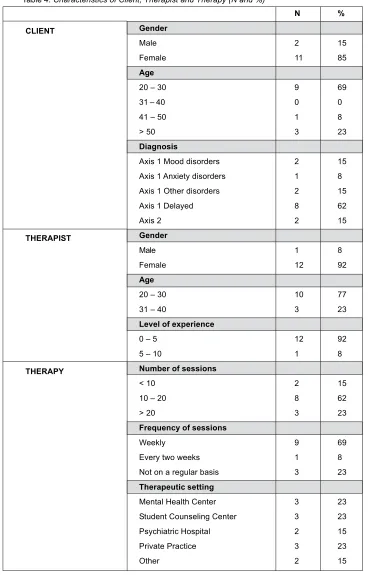
The first cohort of trainees to go through the Leuven Research Protocol produced a total of 14 individual case studies. In this section, we present an overview of the individual case studies. In Table 4 we list the main characteristics of 13 of these clients and therapists (one case, conducted in French, is not included here), including length and setting of the therapies and pre- and post-scores on the BSI-NL and the WAV-12. We also give some illustrations of the trainees’ completed case studies. The focus is on the variety of research questions that served as guidelines for analyzing the data.
With respect to the client characteristics, the majority of the clients were young females. Most of them did not receive a diagnosis at the start of the case study research. Thirty-eight percent of them were diagnosed on Axis 1 (mood disorder, anxiety disorder or other disorder), while 15% were considered to have a personality disorder as well (Axis 2). The therapists were all young people between 24 and 36 years old. The majority of them were female. Their level of experience was rather low: 92% had less than five years’ experience.
The therapy sessions mostly took place on a weekly basis (69%). The therapeutic settings were quite diverse; they included mental health centers, student counseling centers, and psychiatric hospitals, with 84% being outpatients. The number of sessions mostly ranged between 10 and 20 (62%).
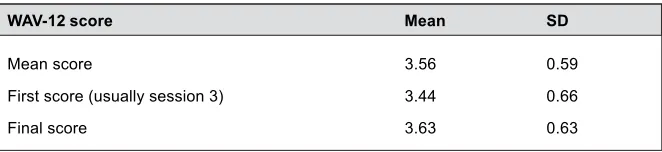
Outcome and process data are summarized in Tables 5 and 6. With respect to the BSI-NL, the mean pre-therapy score was 1.19, which corresponds with a moderate clinical level of distress (De Beurs & Zitman, 2005). The mean post-therapy score was 0.78; this reflects a mild clinical level of distress. The mean improvement (-0.45) meets the Reliable Change Index (RCI) minimum using Elliott’s (2002, 2006) relaxed standard for practice-based research (p < .2) (Elliott, 2002). The effect size is .65 SD, somewhat smaller than is typically reported for client symptom distress measures, but similar to that reported by Klein and Elliott (2006) for a comparable practice-based research study with a largely student therapist sample. Unsurprisingly, then, when we look at change levels in individual clients, only 6 of the 13 show reliable change: four with nearly certain progress (RCI highest standard, p < .05, Elliott, 2006) while two more show likely progress (RCI relaxed standard, p < .2).
post-Table 4. Characteristics of Client, Therapist and Therapy (N and %)
N %
CLIENT Gender
Male 2 15
Female 11 85
Age
20 – 30 9 69
31 – 40 0 0
41 – 50 1 8
> 50 3 23
Diagnosis
Axis 1 Mood disorders 2 15
Axis 1 Anxiety disorders 1 8
Axis 1 Other disorders 2 15
Axis 1 Delayed 8 62
Axis 2 2 15
THERAPIST Gender
Male 1 8
Female 12 92
Age
20 – 30 10 77
31 – 40 3 23
Level of experience
0 – 5 12 92
5 – 10 1 8
THERAPY Number of sessions
< 10 2 15
10 – 20 8 62
> 20 3 23
Frequency of sessions
Weekly 9 69
Every two weeks 1 8
Not on a regular basis 3 23
Therapeutic setting
Mental Health Center 3 23
Student Counseling Center 3 23
Psychiatric Hospital 2 15
Private Practice 3 23
[image:15.536.68.436.61.636.2]treatment score: 3.63; “fairly often” to “very often” range). For three clients, the scores on the WAV-12 revealed a problematic therapeutic relationship (< 3.0).
[image:16.536.91.430.83.238.2]The trainees formulated different research questions to analyze their clients’ data. Most of the case study research projects had a discovery-oriented, exploratory character. The trainees aimed to explore the specific outcome and process data of their individual case. The focus was mostly on a specific client problem (e.g., eating problems, cannabis addiction, obsessive compulsive difficulties, depression). Some of the trainees were concentrating on a specific process disturbance (e.g., problematic inner relationship, alliance rupture, fragile process, early dropout). One trainee analyzed in detail the client change process. In line with the hermeneutic single case efficacy design (Elliott, 2002), she evaluated to what extent the psychotherapeutic process had contributed to the assessed changes. She integrated process and outcome measures and weighed alternative hypotheses, which included: relational artifacts, expectancy artifacts, self-correction processes, psychobiological causes, and extra-therapy events.
Table 5. Outcome Data: Brief Symptom Inventory
BSI-NL Global Symptom Index score Mean SD
Total score 0.86 0.56
Pre-therapy 1.19 0.68
Post-therapy 0.78 0.57
Improvement (post – pre) -0.45 0.45
BSI-NL Reliable Change N %
No reliable progress 7 54
Likely progress* 2 15
Almost certain progress** 4 31
* Reliable Change Index, relaxed standard (p < .2): 0.42 (Elliott, 2006)
** Reliable Change Index, highest standard (p < .05): 0.63 (Elliott, 2006)
Table 6. Process Data: Working Alliance Inventory
WAV-12 score Mean SD
Mean score 3.56 0.59
First score (usually session 3) 3.44 0.66
Final score 3.63 0.63
[image:16.536.95.426.315.391.2]DISCUSSION
Setting up this case study research project required a substantial investment. It took a lot of time and energy to develop an appropriate protocol and to select a workable set of instruments. We also worked hard to motivate our trainees to do research and to get them going on their individual case study project. Furthermore, we offered guidance and support on a regular basis to help them continue their data collection and analyses.
The answers of the trainees show that the case study research can be successfully implemented in a person-centered/experiential psychotherapy training program. Eight months after the introduction of the project almost all trainees had gotten their individual case study research on track. At the end of the third year all trainees (except one) had completed their research and had written their paper. However, this did not happen without a struggle. Most of the trainees were not very research-minded at the beginning. They had serious reservations about starting up the case study research. But convincing them of the value of the Leuven project proved to be quite possible. Important factors were: the choice of a practice-oriented kind of research that fit with the needs and interests of therapists in the field; developing a research protocol that was not overly ambitious or abstract, but instead closely connected to real-life therapeutic practice; the selection of a small battery of short and easy-to-use instruments, both quantitative and qualitative; an intensive coaching process that helped motivate the trainees and that addressed their fears, questions, and concerns; and placing some tools for data processing at their disposal (e.g., Signal Alarm Approach, Excel spreadsheet). Although the research process is not yet completed — our trainees have not yet presented it to their junior colleagues — we would like to evaluate the work in progress so far. The questions that arise are: “Is it worth the investment in time and energy?” and “What are its effects?”
We evaluate the effects of the Leuven Protocol pilot project as predominantly positive. We consider it to be of great value on several levels. First of all, there is the educational level.
research data also gave them a more solid foundation to rely on. It made their general impressions of client change more concrete and specific and it helped them to process theoretical concepts about therapy and therapeutic process in a more vivid and embodied way. They also experienced for themselves that using the questionnaires and the interview did not interfere with the development of a working alliance. Quite to the contrary, they found that by making use of these research tools both client and therapist became more actively involved in co-creating the therapeutic process.
We do realize that this project was a serious undertaking demanding significant time and energy. But some factors can facilitate and lighten this undertaking. Being coached by an expert researcher who gives advice at different stages can be very helpful. Being connected with a research network can also be an important source of support: useful ideas and suggestions are shared, information about research instruments is listed, articles about research data are available online. In this respect, we refer to www.communityzero.com/pcepirp. The most crucial motivational aspect, however, is to get practicing therapists familiar with doing research and to experience how their enthusiasm is growing along the course of the research.
Taking a close look at one’s own therapeutic practice also serves an ethical goal. It is an ethical duty for therapists to improve their knowledge and skills for the benefit of their clients. Of course there are multiple ways of improving the quality and richness of one’s body of knowledge, including supervision, training, clinical reflection, and empirical research. But research generally provides only a minor part of therapist training. Creating an attitude of openness and receptiveness for science-informed therapeutic practice has an ethical value as well. The best way to develop a positive attitude about research is to start doing research during one’s basic or specialized therapy training (Elliott & Zucconi, 2006).
An additional result of the case study project is the improvement of the general quality of the postgraduate program. Implementing research as a new training component raises our training program to a higher level of excellence and it helps the center to maintain a leadership position in the domain of therapeutic training.
centers will be inspired by this project and will follow this example by implementing the IPEPPT framework in a way that best fits their own needs and interests. As more formal collaborations develop in the near future, data pooling will become possible, which will allow for fruitful cross-fertilization of ideas about how to measure therapy and training outcomes. We envision a widespread community of collaborative person-centered/experiential training centers in many countries and organizational settings (universities, private training institutes), joined together to advance training and to promote the standing of our approaches to therapy.
REFERENCES
APA Presidential Task Force on Evidence-Based Practice (2006). Evidence-based practice in psychology. American Psychologist, 61(4), 271–284.
Arrindell, W. A., & Ettema, J. H. M. (1986). SCL-90: Handleiding bij een multidimensionele psychopathologie-indicator. [SCL-90: Manual for a multidimensional indicator of psychopathology]. Lisse, The Netherlands: Swets & Zeitlinger.
Borkovec, T. D., Echemendia, R. J., Ragusea, S. A., & Ruiz, M. (2001). The Pennsylvania Practice Research Network and future possibilities for clinically meaningful and scientifically rigourous psychotherapy effectiveness research. Clinical Psychology: Research and Practice, 8, 155–167. Castonguay, L., Pincus, A., Arnett, P., Roper, G., Rabia, B., & Borkovec, T. (2004). Psychology
training clinic as a research practice network. Paper presented at conference of the Society for Psychotherapy Research, Montreal, Canada.
Chambless, D. L., Baker, M. J., Baucom, D. H., Beutler, L. E., Calhoun, K. S., Crits-Cristhoph, P., et al. (1998). Update on empirically validated therapies, II. The Clinical Psychologist, 49(2), 5– 18.
De Beurs, E., & Zitman, F. (2005). De Brief Symptom Inventory (BSI). De betrouwbaarheid en validiteit van een handzaam alternatief voor de SCL-90. Maandblad Geestelijke Volksgezondheid, 61, 120–141.
Elliott, R. (2002). Hermeneutic single case efficacy design. Psychotherapy Research, 12, 1–20. Elliott, R. (2006). Using weekly change measures to identify therapeutic difficulties with the Brief Symptom
Inventory (Nederlands versie) (BSI-NL): An adaptation of Lambert et al.’s (2002) Signal Alarm Approach. Unpublished manuscript, University of Toledo.
Elliott, R. (2007). Person-centred approaches to research. In M. Cooper, P. F. Schmid, M. O’Hara & G. Wyatt (Eds.), The handbook of person-centred therapy (pp. 327–340). Basingstoke, UK: Palgrave Macmillan.
Elliott, R., Greenberg, L. S., & Lietaer, G. (2004). Research on experiential psychotherapies. In M. J. Lambert (Ed.), Bergin & Garfield’s handbook of psychotherapy and behavior change (5th ed.) (pp. 493–539). New York: Wiley.
Elliott, R., Shapiro, D. A., Firth-Cozens, J., Stiles, W. B., Hardy, G., Llewelyn, S. P., & Margison, F. (1994). Comprehensive process analysis of insight events in cognitive-behavioral and psychodynamic-interpersonal therapies. Journal of Counseling Psychology, 41, 449–463. Elliott, R., Slatick, E., & Urman, M. (2001). Qualitative change process research on psychotherapy:
Alternative strategies. Psychologische Beiträge, 43(3), 69–111.
Elliott, R., & Wexler, M. M. (1994). Measuring the impact of treatment sessions: The Session Impacts Scale. Journal of Counseling Psychology, 41, 166–174.
Elliott, R., & Zucconi, A. (2006). Doing research on the effectiveness of psychotherapy and psychotherapy training: A person-centered/experiential perspective. Person-Centered and Experiential Psychotherapies, 5, 81–100.
Fishman, D. B. (1999). The case for pragmatic psychology. New York: New York University Press. Franssen, A., & Stinckens, N. (2005). Nederlandstalige vertaling van het Client Change Interview
van Elliott. Intern document. Centrum voor Cliëntgericht-experiëntiële Psychotherapie en Counseling, K.U. Leuven.
Hatcher, R.L., & Gillaspy, A. (2006). Development and validation of a revised short version of the Working Alliance Inventory. Psychotherapy Research, 16(1), 12–25.
Hill, C. E., Thompson, B. J., & Williams, E. N. (1997). A guide to conducting consensual qualitative research. The Counseling psychologist, 25, 517–572.
Horvath, A. O. & Greenberg, L. S. (1989). Development and validation of the working alliance inventory. Journal of Counseling Psychology, 56, 885–892.
Klein, M. J., & Elliott, J. (2006). Client accounts of personal change in process-experiential psychotherapy: A methodologically pluralistic approach. Psychotherapy Research, 16, 91–105. Lauteslager, M. (2006). Het evidence-beest heeft kuren. Gebruik en misbruik van EBP, RCT- en
EST- methodologie. Tijdschrift voor Psychotherapie, 32(5), 347–366.
Lietaer, G. (1992). Helping and hindering processes in client-centered/experiential psychotherapy: A content analysis of client and therapist post-session perceptions. In S. G. Toukmanian & D. L. Rennie (Eds.), Psychotherapy process research (pp. 134–162). Newbury Park, CA.: Sage. Lietaer, G. (2003). De empirische ondersteuning van experiëntieel-humanistische psychotherapieën:
stand van zaken en taken voor de toekomst. Tijdschrift Cliëntgerichte Psychotherapie, 4, 4–25. Llewelyn, S. (1988). Psychological therapy as viewed by clients and therapists. British Journal of
Clinical Psychology, 27, 223–238.
Rice, L. N., & Greenberg, L. S. (1984). Patterns of change: Intensive analysis of psychotherapy process. New York: Guilford.
Schneider, K. J. (1999). Multiple-case depth research. Journal of Clinical Psychology, 55, 1531– 1540.
Stiles, W. B., Elliott, R., Llewelyn, S. P, Firth-Cozens, J. A., Margison, F. R., Shapiro, D. A., & Hardy, G. (1990). Assimilation of problematic experiences by clients in psychotherapy. Psychotherapy, 27, 411–420.