© 2013 Electronic Journal of Science Education (Southwestern University) Retrieved from http://ejse.southwestern.edu
Becoming an Activist Science Teacher: A Longitudinal Case Study of an Induction Intervention
Sarah Elizabeth Barrett York University
Abstract
This longitudinal case study follows a new science teacher throughout his first 5 years of teaching in a publicly funded alternative high school. It explores the ways in which he reconciled learning to accommodate his professional and personal responsibilities with his ambition to be an activist science teacher. Framed as a form of professional development, the study examined his beliefs and the ways in which developing and discussing a professional belief web aided in his evaluation of the extent to which he realized his goals. The techniques used in this study have the potential to be used for new teachers‟ professional development and the case itself can aid in that endeavour.
Correspondence concerning this article should be addressed to: Sarah Elizabeth Barrett, York University, Toronto, Ontario, Canada. Email: [email protected]
KeyWords: new teacher; professional development, socioscientific issues
Introduction
Richard grew up in Nova Scotia. He is White. His father worked in the local pulp and paper mill and his mother worked as a lunch supervisor at his school. Lack of money was a constant issue in the household. When Richard was 12, his father was hospitalized due to stress. At that point, his mother, who had been the primary caregiver, fell into a deep depression. Richard said:
Where I come from they call it “losing your nerves”. It was really bad for about a year and a half where it wasn’t often that I found my mother and her eyes were dry. She was always crying. She was always upset. Before that my mom was a rock and she was the person that was taking care of everything because my dad worked so much. (Fall 2010)
These experiences led Richard to feel the urge to “run screaming into the night” when he felt stressed by his own work, “[I began] really associating stress with what happened to them.”
The sexual assault of a cousin to whom he was very close contributed to his developing a strong commitment to women’s issues. He became aware of the sexism displayed by some of his school teachers and peers. However, he chose to deal with these issues in ways that he now acknowledges were inappropriate:
Electronic Journal of Science Education ejse.southwestern.edu think about it as a cycle of violence and that it’s really not going to solve a
lot of the issues for women if they're not involved with trying to make the decisions. (Fall 2010)
He gave his wife credit for teaching him how to channel his energies more positively and so, after teaching overseas for two years, he arrived at the faculty of education with strong views about social justice and increasing the voice of the marginalized (Barrett & Nieswandt, 2008). While at the faculty, Richard took part in a study on teacher beliefs and identity (Barrett & Nieswandt, 2008, 2010) and, shortly after graduation, at the age of 29, he elected to participate in this follow-up study where he stated his teaching goals: “to make sure that all voices are heard in the curriculum. That’s the idealism of the feminist movement.” (Spring 2008)
What does it mean to become an activist science teacher given the ways in which school science has evolved and the disconnect that often emerges between school science content and political ends (Bencze & Carter, 2011)? New science teachers developing their professional identities may find this question particularly challenging to address. Beliefs are central to the identity work in which novice teachers engage over their first years of teaching. Although teachers‟ espoused beliefs are known to significantly affect their teaching practice (enacted beliefs) (Brock & Boyd, 2011), very little is known about the path from one to the other (Bryan, 2003; Luft, 2007). To address this gap, this paper introduces a conceptual model that can be used as a tool to incorporate the analysis of beliefs into professional development activities. The research study was a pilot of a professional development program for new science teachers based on reflection on practice through dialogue. As an example, I focus on one high school teacher‟s beliefs with regard to teaching for social justice by teaching about and through socioscientific issues.
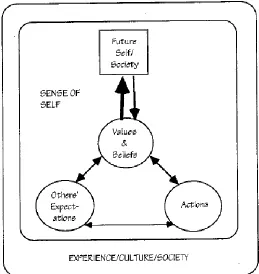
The concepts of teacher beliefs, being an activist science teacher and teaching about and through socioscientific issues are related through identity. Helms (1998) described teacher identity as anchored by beliefs and the intentions that flow from those beliefs. In her words, “the self comes not just from what a person does, or his or her affiliations, but also from what a person believes, what a person values and what a person wants to become.” (Helms, 1998, p . 812) (see Figure 1). Figure 1 illustrates how Helms described our sense of self as being made up of 4 domains. Values and Beliefs inform our sense of becoming while, to a lesser extent, ideas about our Future Self and Future Society inform our values and beliefs. At the same time, there is an internal dialogue between our ideas about Others‟ Expectations of us, our Values and Beliefs and our Actions. A teacher who aspires to be an activist intends to have a political impact on society, one that they may choose to work toward through their teaching. They may do so through the ways in which they interact with their students or the curricular choices that they make when teaching their subject. These actions are affected by their pedagogical and political beliefs as well as their understanding of what is expected of them as science teachers.
Electronic Journal of Science Education ejse.southwestern.edu beliefs.
Figure 1: Model of Identity (Helms, 1998, p. 829)
Socioscientific Issues
Electronic Journal of Science Education ejse.southwestern.edu Hodson (2003) has described four levels of increasing sophistication for the inclusion of socioscientific issues in science education:
Level 1: Appreciating the societal impact of scientific and technological change, and recognizing that science and technology are, to some extent, culturally determined.
Level 2: Recognizing that decisions about scientific and technological development are taken in pursuit of particular interests, and that benefits accruing to some may be at the expense of others. Recognizing that scientific and technological development are inextricably linked with the distribution of wealth and power.
Level 3: Developing one‟s own views and establishing one‟s own underlying value positions.
Level 4: Preparing for and taking action. (p. 655)
In this scheme, an activist science teacher would aim for Level 4 but it is important to note that these levels can refer to three different aspects of teaching-learning: (1) the teacher‟s purpose, (2) the teacher‟s curricular choices, and (3) the student‟s learning. For example, the teacher‟s purpose may be at Level 4, curricular choices may be at Level 3, while the student‟s learning is at Level 2. This complexity in the same instance of teaching-learning suggests that teachers‟ espoused and enacted beliefs about how to teach a particular topic are highly contingent.
Web of Beliefs
Luft (2009) defines beliefs as “propositions held to be true by the individual; they can be non-evidential and based on personal judgment and experience, unlike knowledge that is evidential and requires community or group consensus” (p. 2358). I emphasize two dimensions within Luft‟s definition. First, the emotional attachment to ideas must be included; so that the distinction between knowledge and beliefs is not just epistemological (i.e. based on the believer‟s orientation to the quality of evidence supporting them) but axiological (based on the believer‟s sense of “rightness”)1
. For example, knowing that students from families with low-incomes are more likely to struggle academically (Brown, 2006) might be knowledge but believing this introduces a sense of “rightness” that makes that understanding difficult to change even in light of evidence to the contrary. Beliefs about knowledge drive action because they determine the influence of that knowledge. Thus, when analyzing new teachers‟ conceptions, I will be using the term “beliefs” for various understandings about teaching based on the nature of the experience of that understanding rather than the quality of the evidence to support them. Second, following Kane, Sandretto, and Heath (2002), I distinguish between espoused and enacted beliefs, the former being those beliefs that people express verbally and the latter being actions based on beliefs.
Electronic Journal of Science Education ejse.southwestern.edu understand the relationship between new teachers‟ changing (or unchanging) espoused and enacted beliefs, it is important to follow the actual trajectory over time (Fletcher & Luft, 2011).
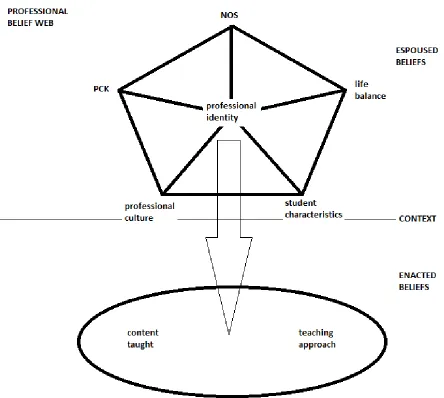
Electronic Journal of Science Education ejse.southwestern.edu Figure 2: A professional belief web – based on literature.
Figure 2 shows a generic professional belief web. Espoused beliefs form a web with professional identity at its centre. Professional culture and student characteristics, which relate to context, are located on the border between espoused and enacted beliefs. Enacted beliefs include both the content that the teacher teaches and his or her approach to teaching. The trajectory between espoused and enacted beliefs is represented by an arrow that is anchored by professional identity. While this arrow is depicted as straight, this is not meant to imply a static trajectory. Changes in other nodes on the web shift it so that it can curve or land differently within the domain of enacted belief. Nor should the web as a whole be viewed as static. Rather, it is constantly stretching and contracting based on the relative importance of different beliefs at different times.
Electronic Journal of Science Education ejse.southwestern.edu formally and informally. In cases where formal teacher induction is provided, the goal tends to be to help new teachers to become familiar with procedures and workplace culture (Luft, 2009). Indeed, discussions of equity or social justice are rarely part of the agenda in formal induction (Barrett, Solomon, Singer, Portelli, & Mujawamariya, 2009; Bianchini & Brenner, 2010). However, regardless of any formal professional development in which new teachers might participate, it is the informal induction that they receive from colleagues with whom they work that has the biggest influence on their enacted beliefs (Luft, Bang, & Roehrig, 2007; Milner et al., 2012). Thus, the enacted beliefs of new teachers espousing a belief in the necessity of teaching social justice through socioscientific issues may be highly influenced – positively or negatively – by the professional culture in which they work.
Professional content knowledge (PCK) has been described as “an experiential knowledge that is acquired as a teacher works with students in the classroom, and is an integrated set of knowledge, conceptions, beliefs, and values that teachers develop in the context of a teaching situation” (Luft, 2009, p. 2359). Within PCK, it is difficult to tease out any one of knowledge, conceptions, beliefs or values from each other and no attempt is made to do so here. However, specific PCK beliefs include beliefs about the efficacy of specific teaching strategies for realizing the teacher‟s goals as well as their beliefs about their own ability to implement them. Formal and informal induction will influence the development of beliefs related to PCK, but time spent witnessing and practising strategies within the classroom will be more influential. Teachers‟ own past experiences as high school students are also important. Specifically, since, as students, they were unlikely to have studied social justice–related socioscientific issues as part of their own science education, aspiring new activist science teachers may lack vision of how it might look. When faced with developing a program in line with their social justice goals, this will impact their confidence in the PCK that they are in the process of developing.
Closely related to teachers‟ beliefs about PCK are their beliefs about the nature of science (NoS). Much has been written about the significance of teachers‟ understanding of NoS (see, for example, Capps & Crawford, 2013; Donnelly & Argyle, 2011; Herman, Clough, & Olson, ; Lewthwaite, 2007). Again, stressing the axiological distinction between beliefs and knowledge described earlier, a teacher who believes science is an acultural activity based on a singular linear algorithm of inquiry will teach differently than a teacher who believes science is socially constructed and practised using a variety of approaches. Given that the former understanding of NoS appears to drive the usual approach to teaching science in K–12 (Donnelly & Argyle, 2011) (although whether most teachers think this interpretation of NoS is accurate is up for debate), a teacher who believes such an interpretation is incorrect may make more of an effort to teach differently than usual than one who knows but has no attachment to that knowledge. The understanding of NoS suggested by K-12 school science has little room for teaching for social justice through socioscientific issues (Bencze & Carter, 2011), which aims for activism on the part of teachers and students.
Electronic Journal of Science Education ejse.southwestern.edu According to Luehmann (2007):
Identity is socially constituted, that is, one is recognized by self and others as a kind of person because of the interactions one has with others.
Identity is constantly being formed and reformed, though the change process for one‟s core identities is long term and labor intensive.
Identity is considered by most to be multifarious, that is, consisting of a number of interrelated ways one is recognized as a certain kind of person, participating in social communities.
Identity is constituted in interpretations and narrations of experiences. (p. 827)
Specifically, Laskay (2005) sees teacher professional identity as “how teachers define themselves to themselves and to others.” Helms (1998) noted that beliefs are at the core of identity. This is why professional identity is in the centre of the belief web in Figure 1 – because all espoused and enacted beliefs are connected through it.
Methodology
This case study is part of a larger longitudinal multi-case study of physics and chemistry teachers in their early years of teaching. I utilized a case study approach because my purpose is to provide a detailed illustration of a complex “contemporary phenomenon within a real life context” that cannot be separated from that context (Kelly-Jackson & Jackson, 2011; Yin, 2009).
Data collection began at the end of Richard‟s first year of teaching. I was a participant-observer because I provided resources and feedback to Richard and participated in classroom activities when appropriate (Glesne, 2011). During the first three years of the project, email correspondence and course materials were collected from Richard and he was interviewed bi-annually at the end of each semester. During the final year of the project, monthly classroom visits were added, each followed by an interview. Thus, data sources included field notes from classroom visits, students work, course materials, long range plans and interviews. All interviews were audio recorded and fully transcribed.
Electronic Journal of Science Education ejse.southwestern.edu levels to discuss his work with his students. Together, we determined the levels of sophistication of his espoused and enacted beliefs. Finally, a professional belief web specific to Richard was constructed and verified by him.
Validity was established through (1) extended engagement with the participant, (2) multiple data sources, (3) member-checking of both the interpretations and the means of analysis, (4) discussions with other researchers in the science education field, (5) maintaining an electronic log of data, and (6) preliminary analysis using NVivo computer software.
Findings and Discussion
In the following account, some details have been changed to protect the participant‟s anonymity. Four main themes emerged out of the analysis of the data: (1) a supportive professional environment, (2) the elusive big picture, (3) aspiring to be a teacher activist, and (4) managing expectations. I begin, however, with a description of the context in which Richard taught, from his perspective.
Context: An Alternative High School Program
In Ontario, Canada, there is a set curriculum, mandated by the province. The rationale for this curriculum is largely derived from the framework provided by the Canadian Council of Ministers of Education (1997) and is similar to directives from bodies in other jurisdictions (see, for example, National Research Council (U.S.A), 2011)). Teachers refer to lists of “expectations” of what “students will” learn. Teachers, however, have a great deal of leeway as to how the students will learn the material and the emphasis placed on individual expectations.
Since graduating from the faculty of education, Richard had been working in a publicly funded alternative high school program for students with attendance problems. The students are drawn from 10 to 15 nearby high schools. The entire program has nine locations with one principal who is not on Richard‟s site. Richard‟s curriculum leader for science and mathematics is also not at this site. Instead, the day-to-day program is run by Richard, one other teacher and an education assistant.
Each of the 15 to 20 students in the program arrives with a history of disengagement from school and often many problems at home. Because of their tendency to skip class, they are supervised all day. The program is structured so that they can focus on science and/or mathematics (taught by Richard) in the morning and on English, history, and/or geography in the afternoon. Students work on their individualized programs at their own pace, aiming to pass four courses each semester.
Richard‟s science classroom is equipped with a counter at the back of the room with a single sink. He has limited equipment. There are whiteboards at the front of the classroom and four computers at the side of the room. The atmosphere in the school is relaxed – Richard generally wears jeans and a T-shirt or sweatshirt and students call him by his first name.
The following vignette illustrates the atmosphere:
Electronic Journal of Science Education ejse.southwestern.edu Richard: You‟re not quite done yet.
Student 1: [stops putting her things in her bag, drops shoulders] This is like school.
Richard: You are at school.
[Moments later, Student 2 arrives. Everyone looks up and smiles and greets him] Richard: Hey! 5 days in a row, man! You‟re awesome.
[Student 1 is laughing]
Richard: It‟s not funny. We‟re going to celebrate. (Fall 2010)
Beliefs about Professional Culture: A Supportive Professional Environment
At the beginning of this study, Richard‟s espoused belief was that students‟ greatest need was to be heard both in school and in their lives. However, his students seemed too overwhelmed to have anything to say:
If you ask them [students] what their plan is for their future, they don‟t have a plan. They don‟t think there‟s a future and that‟s what‟s been really difficult to try and get around this year: It‟s to try and help them understand that they can make a change and that they have [the] power to do things. (Spring 2007)
This challenge continued into subsequent years as he struggled to motivate students who “had never felt or seen success” (Spring 2007). Yet Richard expressed admiration for their resilience, saying, “I‟ve been kind of stupefied by how they can take on those challenges at home and still come to school and work.” (Fall 2010)
Richard‟s activism was rooted in feminist pedagogy and a commitment to leveling the playing field for women and other marginalized minorities. From the beginning, he felt supported in his social justice goals because he, the other teacher and the education assistant regularly discussed how best to do so. The result of these discussions was a cumulative project that replaced final exams in all subjects except science and math. Developed in consultation with the students themselves, the two-week project was designed to empower the students by helping them to focus on problems and causes bigger than themselves. In this way, the program‟s approach to teaching seems to be in line with Atwey‟s (2011) social justice focus on recognition and redistribution. Thus, even though Richard‟s colleagues were supportive of his social justice goals, that support was not specific to science.
Richard‟s espoused beliefs with respect to science focused on recognition. These beliefs were also consistent with Hodson‟s (2003) Level 4 – preparation for and taking action. Richard said that he wanted to get his students to that level of sophistication as well, but struggled with enacting that belief. As the only science and math teacher on site, Richard did not have the benefit of a colleague knowledgeable in teaching science and math on site to help him in his early years – something that new teachers cite as the most helpful for professional development (Luft, 2009). Although Richard noted that he felt he had the support of his curriculum leader and the principal, he still felt isolated because they were not on-site. When the curriculum leader position opened up, he expressed some optimism about his situation:
Electronic Journal of Science Education ejse.southwestern.edu Yet, while Richard‟s (and his colleagues‟) espoused beliefs were consistent with social justice education through feminist pedagogy and with Level 4 in Hodson‟s (2003) scheme, his enacted beliefs were not. Thus, although his professional culture was supportive, other factors – to be described in subsequent sections - intervened.
Beliefs about PCK: the Elusive Big Picture
Throughout the study, Richard sought the “big picture,” a comprehensive view of the curriculum that would allow him to recognize appropriate spaces within the curriculum for presenting social justice–related socioscientific issues. He expressed gratitude for being lucky enough to work within a program that allowed for so much flexibility in program planning, but he was challenged in his first years by getting himself oriented in his new position as a full-time teacher. As he put it: “I didn‟t know what was going on this year, so I had a [hard] time seeing the big picture.” (Summer 2007).
Having a big picture of the curriculum is part of PCK. A teacher with a comprehensive understanding of the curriculum she teaches not only knows the content but also how each topic relates to other topics in past and future studies. They are able to prioritize teaching–learning goals and to recognize appropriate enrichment opportunities. Such a vision is difficult in the early stages of a science teacher‟s career and developing it requires support from senior colleagues with expertise in teaching science. As participant-observer, I often offered such support, but, in the early years, Richard did not generally have enough of a handle on the curriculum to know what specific help he needed. By his third year, however, he was beginning to feel more confident:
Before, if I had a socioscientific issue, I couldn‟t look through and say “I can use that expectation” or “I can use this for this expectation.” [Before], I never really had any connectivity between the whole thing. I never really saw it [the curriculum] as a whole document, [but] I feel like I really can see that now after looking through it a number of times and teaching the expectations a number of times. (Spring 2009)
However, he still found it difficult to bring his new vision to fruition, given his responsibilities with a growing family at home and the immediacy of day-to-day responsibilities at the school:
You get so caught up in all of these things that are happening all the time...final projects and running around like a chicken with their head cut off and trying to make sure you get a unit done and that a student has the next lesson ready because they're waiting for it and that sort of stuff. You kind of forget what you're really wanting to do and the direction that you really want to go in. (Fall 2010)
This struggle to find the mental space to think about goals that went beyond the day-to-day was a constant challenge for Richard, even as he gained confidence in his purpose and his vision of the curriculum. This problem is not unique to new teachers, but Richard‟s experience of this struggle was filtered through his aspirations to be an activist science teacher.
Beliefs about NOS and Professional Identity: Becoming an Activist Science Teacher
Electronic Journal of Science Education ejse.southwestern.edu issues into his teaching of science and math. He said:
I really want them to get the idea that they can be critical and that they can own knowledge and come up with new ideas and question those people that are coming up with decisions about the things that affect their lives. (Summer 2007)
Richard noted that his students‟ experiences could be used as a jumping-off point for discussions about recognizing the contributions of non-dominant groups to science:
I think most of them [the students] had been thought of as being left behind, forgotten in some way or another. So I think they could really relate well to the people who have no voice. (Spring 2008)
This focus on recognition, while consistent with Atwey (2011), is only on Level 1 – applying and recognizing issues – In Hodson‟s (2003) scheme. It does indicate, however, a concept of NOS that emphasizes the universality of science across cultures while recognizing the role ethnocentrism has played in the dissemination of scientific knowledge from one culture to another.
As time went on, Richard espoused a commitment to inching students toward Hodson‟s Level 2 – recognizing vested interests in science/technology decision-making – by encouraging them to think critically about the reasons they were learning what they were learning. Richard‟s approach to encouraging critical thinking in his students during his first few years of teaching was ad hoc, pointing out the socially and politically contingent nature of science content in the curriculum in casual discussions with students as they worked:
Like to say: “Whose science are we learning? Where is that coming from? Why is it that we‟re learning science that has been „developed‟ by these rich white guys?” .... [This approach works] because they‟re all students that have been marginalized in one way or another, in their lives. Even the ones that have come from what seems like fairly stable homes…they‟ve been marginalized in one way or another. (Winter 2009)
Here, Richard notes the ways that these students‟ personal experiences help them to understand what he is trying to teach them.
In year three, in addition to these casual conversations with his students, he also added content related to socioscientific issues to the curriculum. For example, he added such topics as chemical dumping on First Nations‟ reserves, society‟s oil dependency, scientists‟ responsibilities relating to the results of their research, and the hegemony of Western science. These topics were a formal part of the curriculum and not just casual topics of conversation. As students worked through the materials he had prepared, Richard would try to engage them at a personal level through informal conversation about the material.
By Project Year 4, Richard was making attempts to push his students to Hodson‟s (2003) Level 3 – developing one‟s own views and establishing one‟s own value positions – through assignments within particular science units. Yet, as he and I discussed his accomplishments while preparing this paper, Richard noted that he really did not feel his students got past Level 1.
Electronic Journal of Science Education ejse.southwestern.edu he was very encouraged by this new responsibility and had suggested that he and his colleagues could collectively implement a curriculum that would fulfill his social justice goals.
Beliefs about Life Balance: Managing Expectations
Midway through Year 2, I asked Richard to imagine what advice he would like to have given to himself when he first started teaching:
The advice I think I would‟ve given myself was to know that I would be overwhelmed, and that being overwhelmed does not mean that I am never going to be able to go back to including the things that I like to include, like social justice topics, in my science. And [I also know] that I am not going to be able to get it done overnight, but piece by piece I am going to be able to include these things in my work. (Winter 2008)
As time wore on, his optimistic and confident attitude was replaced by frustration, as evidenced by the following reflection a year later:
Maybe one thing that is getting in the way of it is inertia – that idea of staying in the same situation and you‟ve got all your courses made up. And it‟s like you‟re running at Mach 5 during the run of the day because there‟s no such thing as prep time with our students. From 9 in the morning until 2:30 in the afternoon – and that includes lunch; we sit together and eat lunch together, supervising them all day. So it‟s easier when you‟re running around like a chicken with its head cut off to just go ahead and grab the work that you‟ve already made and hand it off to a student that‟s just arrived with their parents that you have done an intake with. It‟s kind of a crazy life at times. (Winter 2009)
A year later, Richard again considered his advice to himself as the brand new teacher:
Don‟t try and do everything at once. It‟ll come online. You just have to develop little things at a time and start incorporating them within…and it doesn‟t all have to be through curriculum – just the way you carry yourself in the classroom and talk about current issues in the classroom.… I think that as a new teacher coming in, don‟t be too uptight about what‟s expected of you from the Ministry [of Education] and try and develop your own style of how you‟re going to introduce these socioscientfic issues into what you‟re doing every day. (Summer 2009)
By the end of Year 4, Richard still alternated between acceptance of his limitations and frustration with his perceived lack of progress. When asked how I might help, he responded:
I think it's already being done with regards to just being able to reflect. It's a really good time of year right now to sit there and reflect while it's fresh in my head about what‟s happened in the past year. I felt like I kept letting myself down, especially after I‟d come to the interviews and I‟d talk to you and be reminded of all these things that were my goals, and I‟d start to get kind of upset with myself that I haven‟t done any of that stuff yet. (Spring 2010)
Electronic Journal of Science Education ejse.southwestern.edu When Richard took on the role of curriculum leader in the beginning of his fifth year of teaching, he expressed a great deal of optimism about accomplishing his goals because his colleagues seemed enthusiastic about introducing more social justice–related socioscientific issues into the curriculum. However, their group curriculum writing sessions always ended up focusing on day to day concerns such as students‟ emotional needs and challenging behaviour, instead. Richard expressed frustration about this and his own inability to do what he wanted to do because of his increased daily workload due to his new responsibilities.
Furthermore, in anticipation of the arrival of his second child, Richard was also tutoring students outside work so that he could save up for a house. I have described all of these jobs and responsibilities to emphasize the range of difficulties (personal as well as professional) that Richard encountered in translating his espoused beliefs – which did not change over the five years of the study – into enacted ones. Richard evaluated his accomplishments in the following way:
I feel that my role as curriculum leader is going OK, but I feel like although I had the greatest of intentions and dreams of transforming some of the ways we deliver curriculum, it just didn't fly the way I wanted it to and certainly didn't move along at a pace I tried to get everyone to set. I guess it was my intentions and dreams and not [those] of my colleagues. I am not sure if the work will ever get done unless I do it all myself…. I think that my colleagues are interested, but not to the same extent as me. I think that the pressures of just keeping up with the day-to-day grind and not wanting to or not having time to work at night on curriculum development was what happened. (Fall 2010)
As we discussed his work, Richard said that he was not sure what teaching social justice through socioscientific issues would look like, but that regardless of his expectations of what he could and could not manage in his quest to act as the activist teacher he wished to be, the ideal was still worth striving to achieve.
Belief Webs – A Tool for Reflection and Professional Development
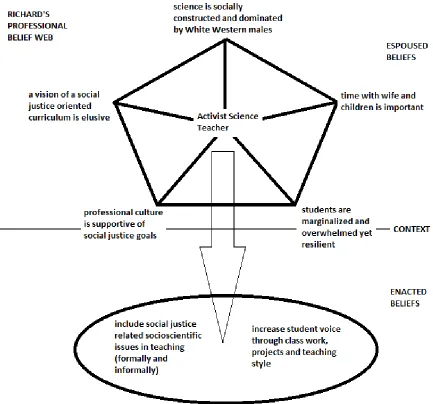
Electronic Journal of Science Education ejse.southwestern.edu Figure 3: Richard‟s professional belief web.
Electronic Journal of Science Education ejse.southwestern.edu experience is a vivid illustration of this.
Conclusions
Figure 3 shows the professional identity to which Richard aspired – activist science teacher – as the centre of his belief web. The other espoused beliefs connected to it did not necessarily always pull equally. At certain points during the four years of the study, different nodes were more important and skewed the web in their direction. For example, during the beginning of his fifth year teaching, as he prepared for interviews for the curriculum leader position, his web skewed toward professional culture. Similarly, once he got the position and felt challenged both professionally by having to deal with new responsibilities and personally in learning that he had a second child on the way, the web was pulled in three directions: PCK, life balance, and professional culture. These pulls in turn affected the trajectory from espoused to enacted beliefs.
Partly because of his participation in this study, Richard was keenly aware of the distance between his espoused and enacted beliefs. This distance framed his experience as he strove toward his goal of becoming an activist science teacher. Richard‟s experience of becoming an activist science teacher is instructive in that he accomplished a great deal yet still felt frustrated in spite of the moral support he had from his principal and colleagues (both on and off site) and myself. What this research project provided for him was an outside view of his accomplishments as a science teacher. He had included several social justice–related socioscientific issues (and social justice, in general) in his teaching, a fact about which I often had to remind him. The significance of Richard‟s espoused beliefs compared to his enacted ones is that it was the espoused beliefs which framed his experience of enacting his beliefs.
In moving toward his goal, Richard benefitted from: (1) the support of his colleagues, (2) his sophisticated concept of NOS, and, as time went on, (3) the vision needed to achieve his goals. If we examine Richard‟s experience, it appears that the type of support that a new teacher with social justice goals needs is not only technical but emotional, too. Beyond the moral support of his colleagues, Richard‟s experience seems to indicate a need for connection with other new (or experienced) teachers with similar goals (Luft et al., 2007; McCann & Johannessen, 2004).
Suggestions for Teachers and Researchers
Electronic Journal of Science Education ejse.southwestern.edu development where teachers engage in analyzing their own beliefs. This could compliment other professional development initiatives such as action research and lesson study to provide a truly praxis-oriented approach to PD – engaging mind, heart and hand.
I would also suggest on-going conversations. In this study, beyond discussions following classroom visits, in depth interviews occurred twice a year and this – according to the participants – was helpful in encouraging reflection and accountability with respect to including socioscientific issues in their teaching that was easy to incorporate into busy schedules. This is especially important because, in spite of encouragement from various science education and STEM organizations, socioscientific issues of any kind still play a peripheral role in science education. It is easy to see beliefs simply as cognitive constructs that may or may not be factually true; however more research needs to be done on (a) the complex connections of beliefs with each other and with identity and (b) on the tensions between intentions (espoused beliefs) and actions (enacted beliefs). This specific case study was concerned with social justice and activism within science education but research on teacher belief webs can apply to and be used within any professional development supporting innovations in science education that challenge conventional approaches.
The significance of this case study, then, can be summarized as follows:
It provides an illustrative example of the experience of being a new teacher struggling to become an activist science teacher.
It shows the ways in which examining teacher beliefs can be used to analyze that experience.
It provides an example of how cooperative analysis between a participant and participant-observer can be a form of professional development.
A limitation of a single case study is that it cannot be generalized. However, over time, several case studies, as were done for the larger study of which this research was a part, become a valuable resource. Single case studies of individual teachers can serve as tools for understanding the experiences of others in a detailed and personal way. Richard is one teacher in one context, but through his professional belief web, his case has the potential to inform both future research into and the design of professional development for new science teachers.
Electronic Journal of Science Education ejse.southwestern.edu References
Atwey, B. (2011). Reflections on social justice, race, ethnicity and identity from an ethical perspective. Culltural Studies of Science Education, 6, 33–47. doi: 10.1007/s11422-010-9305-3
Barrett, S. E., Ford, D., & James, C. (2010). Beyond the lone hero: Providing the necessary supports for new teachers in high needs schools. Bankstreet Occasional Paper Series, 25, 67-80.
Barrett, S. E., & Nieswandt, M. (2008). The role of science education in fostering democracy: Perspectives of future teachers. In D. E. Lund & P. R. Carr (Eds.), Doing democracy: Striving for political literacy and social justice (pp. 231-246). New York: Peter Lang Publishing.
Barrett, S. E., & Nieswandt, M. (2010). Teaching ethics through socioscientific issues in physics and chemistry: Teacher candidates' beliefs. Journal of Research in Science Teaching, 47, 380-401. doi: 10.1002/tea.20343
Barrett, S. E., Solomon, R. P., Singer, J., Portelli, J. P., & Mujawamariya, D. (2009). The hidden curriculum of a teacher induction program. Canadian Journal of Education, 32, 677-702. Bencze, L., & Carter, L. (2011). Globalizing students acting for the common good. Journal of
Research in Science Teaching, 48, 648–669. doi: 10.1002/tea.20419
Bianchini, J. A., & Brenner, M. E. (2010). The role of induction in learning to teach toward equity: A study of beginning science and mathematics teachers. Science Education, 94, 164-195. doi: 10.1002/sce.20353
Brock, C. H., & Boyd, F. B. (2011). Fostering Meaningful Middle School Literacy Learning: Investigating Beliefs and Practices. Voices From the Middle, 19(1), 13-18.
Brown, R. (2006). The TDSB Grade 9 Cohort Study: A Five-Year Analysis, 2000-2005. Toronto: Toronto District School Board.
Bryan, L. A. (2003). Nestedness of beliefs: Examining a prospective elementary teacher‟s belief system about science teaching and learning. Journal of Research in Science Teaching, 40, 835-868. doi: 10.1002/tea.10113
Capps, D. K., & Crawford, B. A. (2013). Inquiry-based instruction and teaching about nature of science: Are they happening? Journal of Science Teacher Education, 24(3), 497-526. Council of Ministers of Education (Canada). (1997). Common framework of science learning
outcomes, K-12 : Pan-Canadian protocol for collaboration on school curriculum. Toronto: Author.
Donnelly, L. A., & Argyle, S. (2011). Teachers' Willingness to Adopt Nature of Science Activities Following a Physical Science Professional Development. Journal of Science Teacher Education, 22, 475-490. doi: 10.1007/s10972-011-9249-9
Fletcher, S. S., & Luft, J. A. (2011). Early career secondary science teachers: A longitudinal study of beliefs in relation to field experiences. Science Education, 95, 1124 - 1146. doi: 10.1002/sce.20450
Friedman, A. A., Galligan, H. T., Albano, C. M., & O'Connor, K. (2009). Teacher subcultures of democratic practice amidst the oppression of educational reform. Journal of Educational Change, 10, 249-276. doi: 10.1007/s10833-008-9090-x
Electronic Journal of Science Education ejse.southwestern.edu Helms, J. V. (1998). Science and me: Subject matter and identity in secondary school science
teachers. Journal of Research in Science Teaching, 35, 811-834. doi: 10.1002/(SICI)1098-2736(199809)35:7<811::AID-TEA9>3.0.CO;2-O
Herman, B. C., Clough, M. P., & Olson, J. K. Teachers' Nature of Science Implementation Practices 2-5 Years After Having Completed an Intensive Science Education Program. Science Education, 97(2), 271.
Hodson, D. (2003). Time for action: Science education for an alternative future. International Journal of Science Education, 25, 645-670. doi: 10.1080/09500690305021
Kane, R., Sandretto, S., & Heath, C. (2002). Telling half the story: A critical review of research on the teaching beliefs and practices of university academics. Review of Educational Research, 72, 177-228.
Kelly-Jackson, C. P., & Jackson, T. O. (2011). Meeting Their Fullest Potential: The Beliefs and Teaching of a Culturally Relevant Science Teacher. Creative Education, 2, 408-413. doi: 10.4236/ce.2011.24059
Lasky, S. (2005). A sociocultural approach to understanding teacher identity, agency and professional vulnerability in a context of secondary school reform. Teaching and Teacher Education, 21, 899-916. doi: 10.1016/j.tate.2005.06.003
Lewthwaite, B. (2007). Critiquing Science Lessons for Their Authenticity as a Means of Evaluating Teacher-Candidate Understanding of the Nature of Science. Journal of Science Teacher Education, 18(1), 109-124.
Luehmann, A. L. (2007). Identity development as a lens to science teacher preparation. Science Education, 91, 822-839. doi: 10.1002/sce.20209
Luft, J. A. (2007). Minding the gap: Needed research on beginning/newly qualified science teachers. Journal of Research in Science Teaching, 44, 532-537. doi: 10.1002/tea.20190 Luft, J. A. (2009). Beginning secondary science teachers in different induction programmes: The
first year of teaching. International Journal of Science Education, 31, 2355-2384. doi: 10.1080/09500690802369367
Luft, J. A., Bang, E., & Roehrig, G. H. (2007). Supporting beginning science teachers. The Science Teacher, 74, 24-29. .
Lumpe, A., Czerniak, C., Haney, J., & Beltyukova, S. (2012). Beliefs about Teaching Science: The Relationship between Elementary Teachers' Participation in Professional Development and Student Achievement. International Journal of Science Education, 34, 153-166. doi: 10.1080/09500693.2010.551222
McCann, T. M., & Johannessen, L. (2004). Why do new teachers cry? The Clearing House, 77, 138
Milner, A. R., Sondergeld, T. A., Demir, A. P., Johnson, C., & Czerniak, C. (2012). Elementary Teachers' Beliefs about Teaching Science and Classroom Practice: An Examination of Pre/Post NCLB Testing in Science. Journal of Science Teacher Education, 23, 111-132. doi: 10.1007/s10972-011-9230-7
National Research Council (U.S.A). (2011). A Framework for K-12 Science Education. Washington: The National Academies Press.
Reeves, J. (2007). Inventing the chartered teacher. British Journal of Educational Studies, 55, 56–76. doi: 10.1111/j.1467-8527.2007.00365.x
Electronic Journal of Science Education ejse.southwestern.edu Sachs, J. (2003). The activist teaching profession. Buckingham ; Philadelphia, PA: Open
University Press.
Strauss, A., & Corbin, J. (1990). Basics of qualitative research. Newbury Park: Sage Publications Inc.
Tesch, R. (1990). Qualitative research: analysis types and software tools. Bristol, PA: Falmer Press.
Theriot, S., & Tice, K. C. (2009). Teachers' Knowledge Development and Change: Untangling Beliefs and Practices. Literacy Research and Instruction, 48, 65-75. doi: 10.1080/19388070802226287
Topcu, M. S., Sadler, T. D., & Yilmaz-Tuzun, O. (2010). Preservice Science Teachers‟ Informal Reasoning about Socioscientific Issues: The influence of issue context. International Journal of Science Education, 32, 2475-2495. doi: 10.1080/09500690903524779
Wenger, E. (1998). Communities of practice: learning, meaning, and identity. Cambridge [England]: Cambridge University Press.
Yin, R. K. (2009). Case study research : design and methods (4th ed.). Los Angeles: Sage Publications.