ANGLIA RUSKIN UNIVERSITY
Teaching Modes of Teacher-educators
teaching Distance-learning in a
Teacher-training College in Israel:
A Case Study
by
Smadar Bar-Tal
A thesis presented in partial fulfilment of the
requirements of Anglia Ruskin University for the
degree of Doctor of Philosophy
Submitted: March 2010
II
This thesis is dedicated with much love to my dear mother of blessed memory, Eda Efrati. To her great regret and definitely to mine we were only able to enjoy two
short decades of love and happiness together
She herself was an educator, valued and respected by her pupils, their parents and her colleagues in the education system Her positive approach to the world, and her infinite ability to find good, worth and beauty in everyone, granted me a firm
and trustworthy foundation for life as a human being and in particular as a qualitative education researcher.
My mother studied more than half a century ago in the same teachers-training college where I have been privileged to teach and to conduct this research, enabling
me to complete a very personal and meaningful family cycle.
III
Acknowledgements
The research work and writing-up of this thesis constituted a challenging quest for me. The support that I was granted throughout this fascinating and lengthy journey helped me to reach my target. I would therefore like to thank all those who accompanied me on this journey:
To my supervisors, Dr. Gill Robinson and Dr. Roger Taylor for their continual professional guidance and support as I wandered through the intriguing paths of investigation and research.
To Dr. Edna Gutman and Dr. Sara Shimoni for their clear-cut thinking and for enabling me to appreciate the beauty and uniqueness of this study.
To Naomi Yalin for her help with translation and linguistic editing.
To my colleagues in the college, thank you for receiving me with such warmth and love. You readily opened a window for me into your internal world, and shared your experiences, your deliberations, difficulties and successes and your thinking as distance-teaching teachers, so that each of you contributed significantly to my research.
To my dear father, David Efrati, to my mother-in-law, Haviva Bartfeld and to my sister Shirley Leiter, my extended family and my beloved friends, for enveloping me with much love and reinforcing my strength to overcome the obstacles in my path and to reach this exciting occasion.
And of course to my dear and precious children, Shahar, Or and Zohar for their encouragement, support and everlasting patience that strengthened me significantly and allowed me to realise my dream.
Last, but by no means least, my special gratitude to my husband Asher, my partner and true friend for his support, assistance and constant willingness and ability to give in all areas of our lives together, enabling me to develop and enrich myself professionally. My partnership with you makes everything possible.
IV
TABLE OF CONTENTS
ITEM PAGE NO Acknowledgments II Table of Contents IV Abstract XII Prologue 1 Introduction 3Chapter 1: Background of the Study: Training Teachers
and Teacher-Educators 4
1.1 Teacher Learning in the 21st Century 4
1.2 Teaching 5
1.2.1 Distance Teaching 7
1.2.1.1 The Significance of Online Teaching in Teacher
Training 10
1.2.1.2 Online Assessment 11
1.2.1.3 Importance of integrating Distance-teaching in
Teacher-training. 11
1.2.1.4 Anticipated Technologies 19
1.2.1.5 How Teachers cope with the Transition to
Distance-teaching 20
1.2.1.6 Support for Teacher-educators teaching
Distance Teaching 22
1.3 Data Representation and the Communications Media 25
1.4 Interaction 26
1.5 The Structure of the Israeli Education System 27
1.5.1 Categorisation by Education Level 27
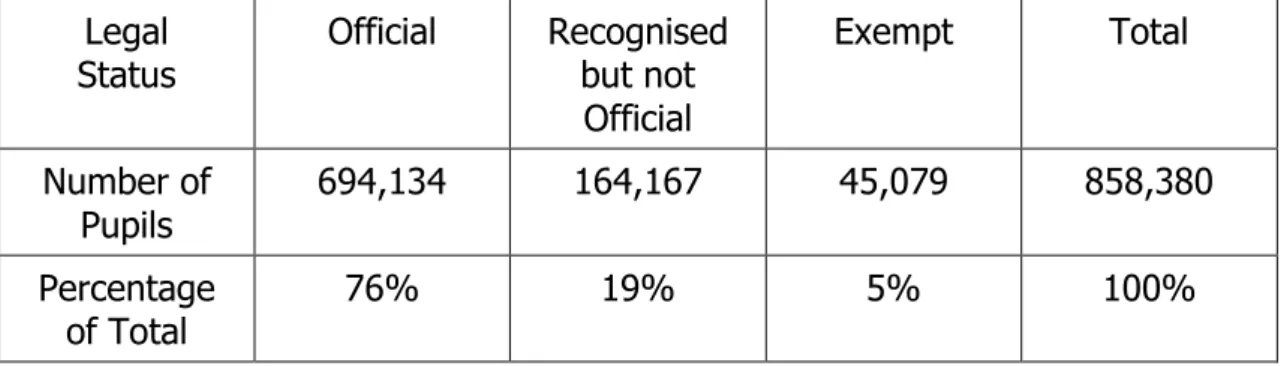
1.5.2 Cross-section according to Legal Status 28
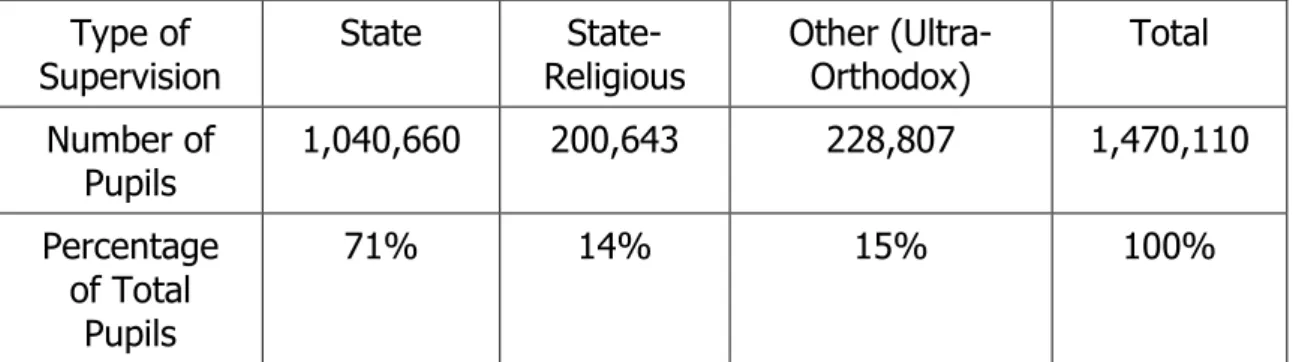
1.5.3 Cross-section according to Type of Supervision 29
1.5.4 Sector Cross-section 30
1.5.5 Number of Pupils in a Class in Primary and
Upper Schools 31 1.5.6 Education Staff 32
1.5.7 Teachers' Wages 32 1.6 The Development of Higher Education in Israel 33
V
1.7 The Research Issue 34
1.8 The Research Questions 35
Chapter 2 Theoretical Perspectives 36
2.1 Teacher-training Approaches in an Era of Change 36
2.1.1 Teacher-educators: Identities, Sub-identities
and the Implications for Professional Development 39
2.2 Teachers' Professional Knowledge 40
2.3 Introducing Change 45
2.4 Teaching and Learning 48
2.4.1 The Teacher's Role in Distance Teaching 48
2.4.2 Constructivism 51
2.4.3 Teacher-focused Teaching 55
2.4.4 On-line Pupil-Focused Teaching 56
2.4.5 Teaching Presence 58
2.4.6 The Role of the Learning Forum Instructor 60
2.4.7 Assessment 66 2.5 Channels of Interaction 70 2.5.1 Learner-interface Interaction 70 2.5.2 Instructor-learner-content Interaction 72 2.5.3 Learner-instructor Interaction 75 2.5.4 Learner-learner Interaction 76 2.5.5 Social Presence 81 2.6 Disciplinary Fields of Knowledge 83
2.6.1 Sciences 86
2.6.2 Literature and Social Sciences 87
2.6.3 Academic Literacy 88
2.7 Chapter Summary 90
2.8 The Conceptual Framework of the Research 92
Chapter 3: Methodology 96
3.1 The Research Aims 96
3.2 The Field of Knowledge to which the Research
related 96
3.3 The Methodological Paradigm 97
3.4 The Case Study 99
VI
3.5.1 The Pilot Study 102
3.5.2 The Subsequent Research Process 104
3.6 Research Tools 107
3.6.1 The Focus Group 109
3.6.2 Interviews 110
3.6.3 Observations 113
3.6.4 The Researcher's Personal Log 114
3.6.5 Documents 116
3.7 Data-collection and Data Analysis 117
3.7.1 Referees 119
3.8 Reliability, Validity and Generalisation 120
3.8.1 Reliability 120 3.8.2 Validity 121 3.8.3 Generalisation 124 3.9 Triangulation 125 3.10 Ethical Issues 126 3.11 Chapter Summary 126 Chapter 4: Findings 127 4.1 Introduction 127
4.2 Characteristics common to all Teacher-Educators 127
4.2.1 Teacher-Educators' Internal Intrinsic Motives 128
4.2.2 Teacher-Educators External Extrinsic Motives 130
4.2.3 The Acquisition of the Necessary Knowledge 131 4.2.4 The Desire for Change 134
4.2.5 Section Summary 137 4.3 The Teaching Modes of Teacher-Educators working
in Distance Education 137
4.3.1 The Representation Mode – characterising Science
Disciplines – The 'Museum' Mode 141
4.3.1.1 Creative Data Representation 141
4.3.1.2 Organisation and Management of a Fixed and
Focused Order of Learning 144
4.3.1.3 Few Channels of Interaction 148
4.3.1.4 Technology-Oriented 155
4.3.1.5 Summary of the Representative Mode 156
Teacher-VII
Educators teaching Literacy in different Languages – The Mary Poppins Mode
159
4.3.2.1 Conservative Data Representation 159
4.3.2.2 Organisation and Management of Open and
Flexible Teaching 160
4.3.2.3 Multiple Channels of Interaction 163
4.3.2.4 Technology Users 173
4.3.2.5 Summary of the Interactive Mode 174
4.3.3 The Organisational Mode – characterising Teacher-Educators teaching Education Disciplines – The
Puppet Theatre Mode 177
4.3.3.1 Conservative Data Representations 177
4.3.3.2 Organisation and Management of Consistent
and Focused Teaching 178
4.3.3.3 Few Channels of Interaction 184
4.3.3.4 Technology Users 191
4.3.3.5 Summary of the Organisational Mode 192
4.3.4 The Holistic Mode – characterising Teacher-Educators teaching Education and Literacy
Disciplines – The Mother Goose Mode 194
4.3.4.1 Creative Data Representations 195
4.3.4.2 Open and Flexible Organisation and
Management of Teaching 197
4.3.4.3 Multiple Channels of Interaction 201
4.3.4.4 Technology-Oriented 212
4.3.4.5 Summary of the Holistic Mode 214
4.4 Chapter Summary 217
Chapter 5: Discussion 222
5.1 Introduction 222
5.2 Common Characteristics of all the Teacher-Educators
in the Transfer to Distance-teaching 223
5.2.1 Internal Intrinsic Motives 223
5.2.2 External Extrinsic Motives 225
5.2.3 Acquisition of Knowledge 227
5.2.4 Professional Change and Development 231
5.2.5 Factors that Support or Block the Penetration of
Change 233
VIII
5.3 How did the Teacher-educators harness Technology
to organise Information? 235
5.3.1 The Creation of a new Teaching and Learning Style as a result of the use of Internet Links and
Documentation 237
5.3.2 Choosing Appropriate Information for each
Learner 238
5.3.3 Preparing the Students for Web 2 239
5.3.4 Efficient Work through Data Organisation 240
5.3.5 Concern regarding Excess Information 241
5.3.6 The Contribution of Multimedia to Teaching and
Learning 241
5.3.7 Section Summary 244
5.4 How did the Teacher-educators harness Technology for the Organisation and Management of Distance-teaching?
245
5.4.1 Teacher-focused Teaching in contrast to
Learner-focused Teaching 246 5.4.2 Constructivist Learning 249
5.4.3 Formative and Summative Assessment in Contrast
to Summative Assessment Alone 251 5.4.4 Organisation and Management of Teaching in
affinity with Teacher Training Paradigms and
Orientation 257
5.4.5 Section Summary 259 5.5 How did the Teacher-educators harness Technology
for different forms of Interaction? 260
5.5.1 Face-to-Face Sessions 261 5.5.2 Virtual Meetings 262 5.5.3 Social Presence 271 5.5.4 Personal Interaction 273 5.5.5 Section Summary 277 5.6 Chapter Summary 278
Chapter 6: Conclusions and Implications 281
6.1 Factual Conclusions 282
6.2 Conceptual Conclusions 285 6.3 Limitations of this Research 286
IX
References 291
LIST OF APPENDICES Appendices for Chapter 1
IA The Status of Teacher-Training 333 IB Distance-Learning 337 IC Definitions and Models of Distance Teaching 338 ID Reading and Writing Internet Language 339 IE Tele-communications and Distance-Teaching
Tools 341
Appendices for Chapter 2
IIA Learning Styles 347 IIB A Platform and Supportive Software used in
Distance-Teaching 351
Appendices for Chapter 3
IIIA The Research Field 352 IIIB The Research Population 356
IIIC Ethical Issues 357
IIID Participant Information Sheet 367 IIIE Participant Consent Form 369 IIIF Letter of Approval from APU 371
Appendices for Chapter 4
IVA The Learners Learning Styles 372 IVB Organisation and Management of Distance
Teaching adapted for the Adult Learner 376
X
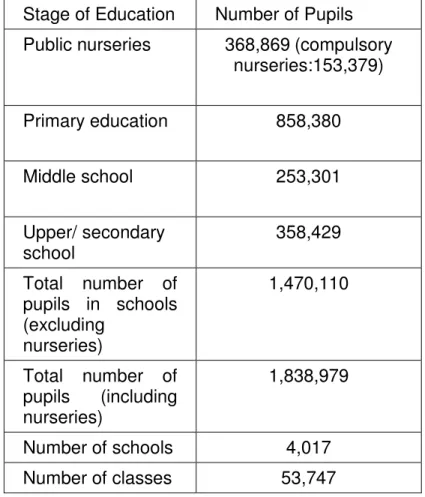
1. Number of Pupils in Israel's State Schools
2008/2009 by education stage 28 2. Number of Pupils 2008/2009 by legal status,
type of supervision and sector 30 3. Number of Pupils in all Schools, by Type of
Supervision 2008/2009 31 4. Number of Pupils in all Schools, by Sector
2008/2009
31
5. Roles for the On-line Teacher 65 6. The Research Tools and their Purposes 108 7. Modes and Dimensions of Teacher-educators
who perform Distance-teaching 220 8. Explaining why Teachers using the Interactive
Mode blocked the use of Constructivist
Learning 250
9. Integration of Distance-teaching Modes with a training Paradigm and a
Teacher-training Orientation 257 10. Teaching Modes according to Theoretical
Perspectives 259
11. Teaching Modes' Practice in the Forum
according to Development Stage 269 12. Computerised Courses (integrating the use of
computers) at the College 353 13. Two Models of Learning Styles 373 14. Teaching Modes and Distance-teaching
Strategies for the Adult Learner 376
LIST OF FIGURES
1. The Conceptual Framework of the Research 95 2. The Representative Mode 158 3. The Interactive Mode 176 4. The Organisational Mode 193
5. The Holistic Mode 216
XI
LIST OF FLOWCHARTS
1. A Graphic Description of the Research process 105 2. The Research Framework 106
XII
ANGLIA RUSKIN UNIVERSITY
Doctor of Philosophy
Teaching Modes of Teacher-educators teaching Distance-learning in a Teacher-training College in Israel: A Case Study
By Smadar Bar-Tal
ABSTRACT
The introduction of technology and the widespread use of ICT in the wealthier nations have led teacher-educators to integrate technological applications in their teaching environment. The research investigated the new teaching modes created by teacher-educators in teacher-training colleges in Israel, due to their transition from traditional teaching to distance-teaching through the Internet.
This was a qualitative research using case study within an interpretative paradigm that enabled the researcher to consider the viewpoints of the informants together with her own viewpoint. The research tools included: 14 open interviews, a non-participatory observation, documentation reading and the writing of a personal log. The rich variety of research tools enabled triangulation of data. The conceptual framework of the research was based on theories of teacher-training, distance-teaching, academic disciplines, and several teaching dimensions: organisation and representation of data, organisation and management of teaching and different types of interaction.
The research findings indicated intrinsic and extrinsic motives for the teacher-educators transition to distance-teaching. The transition created a pedagogy characterised by four teaching modes that corresponded to different academic disciplines. Each discipline harnessed the technology for intensive use in one or more of the teaching dimensions. The Representation mode used by teacher-educators in the natural sciences and statistics used a large variety of data representations and Internet writing characterised by multiple links. The Interactive mode employed by teacher-educators in the field of literacy principally dealt with formative assessment of the students' writing and used virtual communication tools to tighten the teacher-learner inter-personal interaction. The Organisational mode used in education disciplines focused on organisation and management of teaching and learning through the use of computer applications. The Holistic mode employed by teacher-educators in the fields of education and literature, in substance constituted a combination of all the characteristics of the above-mentioned modes with an emphasis given to social presence of both learners and the teacher. Analysis of the teaching modes led to the creation of a typology of four modes positioned at different points along the following scales: organisation of teaching, flexible – fixed, types of interaction few – multiple; data representation, creative – conservative; computer literate – computer users. There was ah clear contrast between teacher-educators teaching education disciplines as a continuation of traditional frontal teaching and those who had previously taught in workshops.
At the crossroads of pedagogy with technology, the changes in location, time and lesson character have meant that the implementation of the teaching paradigm of Zeichner and the teaching orientations of Feiman-Nemser have taken on fresh dimensions. The new teaching modes necessitate appropriate training for all teacher-educators working in distance-teaching in accordance with their academic disciplines. The research findings contribute to the reduction of a gap in knowledge concerning the new teaching modes of teacher-educators teaching distance-learning in a teacher-training college in Israel.
1
Prologue
For many years I taught according to the traditional method of transmission of knowledge until 15 years ago when I was privileged as a middle school teacher to participate together with my class, in a computer-assisted project. This experience deepened my understanding of technology's immense potential and the understanding that the computer embodies tremendous power as an inexhaustible source of knowledge for the world of education.
Later, in 2002, in my work at a teacher-training college, we held a seminar in which each of the teacher-educators, who operated a course site, presented their site to their colleagues. This event was from my point of view, an inaugural event, because it was here that I understood that the sites were not uniform, their manners of organisation, the sites played in the course and the ways in which the teacher-educators used technology for the site differed and the focus was placed on different aspects of teaching and learning. I understood that this was a special and interesting issue that should be researched in order to understand its motives, processes and results.
At a later date, I accepted the suggestion of the college and studied a course in distance-teaching. Exposure to the theoretical aspects alongside the practical experience contributed to my personal and professional development and engendered a significant change in me as a teacher, as a distance-teacher, as a person and as a member of society. I became a source of knowledge and support and guidance for my colleagues in the college teaching staff and a member of the Centre for Digital Learning. Working together with these people strengthened my comprehension concerning this subject. At the same time I read much research and other literature and became aware of new applications as I searched for innovations and originality in this area.
2 I have for several years been an active participant in a group with an interest in qualitative research at the Mofet Institute (School for Research, Curriculum and Programme Development for Teacher-educators). I entered the world of 'qualitative research', discovering its abundant treasure and acquiring tools and skills in order to observe and interview people, and to extract detailed data from documents.
Going deeper into teaching theory, I understood that there are several teaching methods and not just the traditional model of transmission that I had learnt as a student and applied as a teacher. My research and experiences in distance-teaching led me to alter my distance-teaching approach and distance-teaching methods that I had previously employed. The wealth of materials that I gathered opened up many and varied directions and research fields, all of which appeared to be very interesting and innovative.
In my research, I chose to focus on the subject of the distance-teacher's role perception from the viewpoint of each of those who shared this role. During my research I understood that my work actually dealt with their teaching modes and not their role perceptions and so the study led to the characterisation of four modes of teaching style, which will in this thesis be referred to as 'modes', and their association with the teaching of different academic disciplines.
3
Introduction
This research deals with teacher-educators, teaching in teacher-training colleges in Israel. Teacher-training in many world states, in Israel, relies on different approaches such as the traditional behaviourist, personal and research-centred paradigms and practical, personal, technical, academic and critical/social orientations. Teacher-training colleges are run by teacher-educators with knowledge of academic disciplines acquired from different sources and constructed from different types of knowledge.
The widespread use and influence of the computer and Internet for both
children and adults in the 21st century/ has engendered change in the teaching
and learning environment including teacher-training colleges. The transition to distance-teaching in colleges and universities, and also the integration and use of technology has created new modes of teaching expressed in three main dimensions: (1) organisation of information, using reading and writing of Internet language and employing presentations and software, and Internet tools such as forums and e-mail; (2) the organisation and management of teaching expressed in teacher-focused teaching or learner-focused teaching, assessment methods and their adaptation to the adult learner's learning styles; (3) the contribution of a teaching presence and the status of the constructivist approach in teaching and learning; manners of interaction embroidered between teacher-student-students-content, and a multiplicity of communication channels that they create or prevent. All these elements enrich or hinder the social presence of teachers.
The purpose of the research is to understand the intrinsic and extrinsic motives for the transition of teacher-educators to the on-line teaching environment, while the principal research question aims to uncover the uniqueness of the new teaching modes created by this transition in relation to specific academic disciplines.
4
Chapter 1:
Background of the Study:
Training Teachers and Teacher-Educators
This chapter introduces the reader to the subject of teacher-training in Israel and internationally explaining how teacher-educators enter their roles and how they receive their training. (For further details on this issue see Appendix
IA
: The Status of Teacher-Training)1.1 Teacher Learning in the 21st Century
Today there is a general expectation that schools throughout the world will undergo serious reform due to demographic changes, economic globalisation and technological and cultural trends. There is also widespread consensus that the teacher should be seen as the focal figure in these processes (Darling-Hammond & Bransford, 2005), and an understanding that teachers' professional development constitutes the central tool for the improvement of teaching. One of the problems involved is that teachers perceive their present professional development as truncated, non-cohesive and irrelevant to their teaching difficulties and context (Lieberman & Miller, 2001; Hatch et al., 2005). Lieberman & Pointer-Mace (2010) suggest that teacher learning progresses in a series of stages:
1. From isolation to colleagueship
2. From colleagueship to professional learning community
3. Turning it into practice – a practice community – see 'Professional learning communities 2.0: Moving teacher development online' in Lieberman & Pointer-Mace, 2010).
4. Insights about networked learning communities and teaching.
5. The translocation (and transformation) of knowledge of-and-for teaching. 6. A vision of home-grown professional learning, applying the tools for the
5 Lieberman & Pointer-Mace (ibid) note that willingness to expose daily teaching practice, with all its details and contents to the public, reflects a meaningful process of professional development. It is important that teachers follow recording practices and they should have suitable tools and instruments available for this purpose that they can integrate into their daily work, viewing
this process as something important and relevant.
1.2 Teaching
'Teaching' encompasses a very wide area and has been the subject of copious studies. Teaching is not an independent entity. It is bonded with the learner's learning, according to the learner's age, ability and skills. Teachers maintain the pedagogic beliefs and teaching behaviour that they themselves experienced as pupils, or the methods of teaching that suit the learning methods they prefer rather than reflecting the teaching theories that they learnt during their teacher-training process (Soter, 1993; Felder & Silverman, 1993). Student-teachers' perceptions play a decisive role in the formation of the teacher image and style of teaching they will adopt in the future (Wang, 2000) (Byrum & Cashman, 1993).
Clark & Peterson (1986) point out that the teaching process involves two components with reciprocal relations between them: the teacher's thinking and the teacher's actions. These two components interrelate with two types of teachers' thinking about their teaching:
Preparatory thinking of the teachers, including pre-active thoughts (before the teaching) at the stage when the teaching is planned.
Post- activity thoughts as feedback after the teaching process.
Lowman (1996) indicates that effective teaching includes two central dimensions. The first dimension relates to skills used to present learning material, i.e. the ability to present the material in an organised and interesting manner, while the second relates to inter-personal relations, i.e. a relationship
6 of respect for learners while encouraging them to invest in the learning and to achieve highly (Galland, 2002).
Many difficulties are encountered in teaching, so that a gap is evident between teachers' declared pedagogic perceptions and their pedagogic activity (Yakobi & Sharon, 1985). Teachers find it difficult to combine theory with practice because theories are defined for the teachers by others while they create their practice themselves (Lampert, 1985). It is therefore necessary to connect the teaching with the learning, to encourage the students' commitment to learning and to develop teaching and learning strategies.
Teaching does not operate in an empty space; it exists within a continuous dialogue with the learner. In a study that related to universities and colleges, Hativa (1997) found that many teachers feel that they do not succeed in implementing effective learning as they would like to and are able to, and that there is a real gap between what they try to teach and what the pupils do learn. Thus one of the goals of teaching is to improve the learning process to enable learners to reach high achievements.
One of the means is development of self-learning management, where the teachers' role is to create a suitable and focused environment in which the students can receive inspiration and where they will be able to plan their self-learning (Boekaerts, 1997). Research has found that learners who manage self-learning are characterised by strong initiative in the management of their academic development, high motivation to learn and an ability to cope successfully with learning tasks that they set for themselves (Zimermann & Martinez-pons, 1986; 1988; William, 1996).
Students who manage their learning autonomously are characterised by setting realistic goals for themselves, choosing suitable strategies to achieve them, confidence in their ability and in problem-solving on their path to their goal (Winne, 1996). Self-learning is a process that includes several areas: the behavioural area, the motivational area and the cognitive area and the
meta-7 cognitive area (Zimermann, 1990). Further information concerning distance learning can be found in Appendices: 1A, 1B, 1C and 1D.
1.2.1 Distance Teaching
Definitions and models of distance teaching are presented in Appendix 1C.
Computer-mediated teaching developed without consideration for previous, traditional teaching methods (Buchanan, 1999; Williams, 2001). In distance-teaching the teachers need to adapt to a new approach to distance-teaching and its perception as 'webagogy' and not 'pedagogy' (LaMonica, 2001). Teachers need to be aware not only of the learnt contents but especially aware of the way these contents are processed through the new teaching methods they have chosen, and to adapt their didactic method to different cognitive perceptions and learning styles, while using the different options made accessible to them by technology for the presentation of learning materials in different formats in order to respond to the learners' needs. Computer-mediated learning without 'eye contact' with learners obliges the teachers to be aware of the different difficulties and changes involved in the use of this strategy (Sherry, 1996; Carnevale, 2001; Edelstein, 2002; Anderson, 2003).
Additionally, according to Newman (2000) staff members feel threatened by technology; they may try to transfer strategies of face-to-face teaching directly to the cyberspace environment. In many cases this may lead to failure because they have no experience in managing virtual learning.
It takes more time to plan and construct a distance-teaching course than a face-to-face course, so that the teacher's time restrictions or lack of willingness to provide the necessary accessibility can constitute significant obstacles for the success of an on-line course. However the teacher can dedicate more time to the course than in face-to-face teaching because the time and place are unlimited (Buss, 2001; Galland, 2002). The teachers can spend time on or skip different subjects, but in contrast they devote part of their time to the creation of
8 links to other sources and knowledge and data-representation and providing support for the students' learning (Fox & MacKeogh , 2003; Collins, Schuster & Ludlow, 2002).
Additionally, on-line teaching demands that the teacher and students devote more time to reading than in face-to-face teaching (Lynch, 2002). In order to cope with this difficulty Lynch (2002) suggested ways to cope with the wealth of knowledge: definition of contents interesting the teacher, selective reading of materials, definition of the time framework for updating, not to be a slave to knowledge, not all knowledge is power.
Already at the planning stage the teacher must ask a number of questions and clarify several details (Sherry, 1996; Rotem, 1997; Harrison & Bergen, 2000; Volery & Lyon, 2001; Lynch, 2002; Killion, 2002; Collins et al, 2002; Wickstrom, 2003; Morland & Bivens, 2004; Heckman & Annabi, 2005):
1. Who is the target population? Familiarity with the readers will help the teacher to design the knowledge connection. The age of the learner, the learner's culture and socio-economic background and fields of interest, experience and educational level should be considered. It is also important to know whether the learner has mastery of distance-learning methods and technology. Answers to these questions will help construct the learner's profile.
2. How to organise the information on the site? 3. How to integrate technological tools?
4. Integration of examinations with a personal assessment using on-line forms and data reservoirs.
5. To observe existing courses.
Khan (2004) distinguishes two stages of content formation: the development of content and transfer and maintenance of content. It is first necessary to plan the course and then to choose the appropriate technology and not the opposite because pedagogy should lead (Lynch, 2002). Boonk & Dennen (1999) indicate that on-line courses lack a pedagogic facet and do not exploit the full
9 potential embodied in the new technology. Thus, Moore & Kearsley (1996) support conducting face-to-face sessions with the students in order to demonstrate the computer-mediated teaching, although there is still no certainty that the students will be able to use the technological expertise when they need it. In order to cope with this difficulty, Stodel et al. (2006) suggested creating a period of acclimatisation to computer-mediated learning, to help students integrate as participants within the cyberspace discussion and to familiarise them with computer-mediated team work.
In addition, Treacy et al (2002) suggested a face-to-face meeting during this maintain the impetus and to get to know the learners' learning strategies and their works and to present the teaching goals. It is also possible at this point to relate to technical aspects and to allow people the opportunity to meet one another, Chepya (2005) raises an important issue that has been neglected by distance-learning and this is the question of the course design. When software is chosen to manage the computer-mediated course it is wise to consider the design and aesthetics that will express the computer-mediated pedagogy; as in a regular course the personal and pedagogic style of the instructor should be taken into account as a factor for success. Thus issues of graphic design, design and usability of the site environment should be considered by instructors for computer-mediated pedagogy without simply relying on the decision of technical managers of the distance-learning system.
At the start of the course the students should be presented with the conceptual framework: what are the goals and how the course subjects are organised for accessibility. The importance of such a framework is that it serves as a basis on which to anchor concepts, ideas and knowledge studied in the course and thus it provides the students with a complete picture, of the entire course structure. The subjects should be organised within the framework in a logical order. The conceptual framework may include the presentation of the structure of the materials, ideas and central theses, selecting concepts or a unifying theory (Hativa, 1997).
10 During the course the teachers need to provide a flexible presentation and activities in order to prevent frequent and direct questions and to take responsibility for the knowledge acquired by the students, and for the participation of the group while supplying periodic updates and reviewing discussions. (Mason, 1991; Hativa, 1997; Lynch, 2002; Aune, 2002)
1.2.1.1 The Significance of On-Line Teaching in Teacher Training
The rapid development of the virtual on-line schools (in which all learning stages are transmitted through the Internet outside the school) has not yet been expressed and recognised by the world's teacher-educators in their colleges and universities. Davis (2010) recommends that teacher training institute should take into account the developments that have occurred and will occur in full on-line teaching and that they should provide practical experience for student teachers in partial or full on-line teaching. Preparations should be made in order to meet the challenges of computerised teaching by teaching suitable teaching strategies and methods, which should become a core part of teacher training programmes and not merely a marginal supplement. These programmes should train teachers to take part in introducing change in the schools and to engender innovative leadership in the field of educational computerisation. In order to implement this system much more investment is necessary in research and development of appropriate teacher training programmes for the new generation of computer-assisted teachers.
Computerised on-line teaching through Internet, known as Virtual Schooling (VS) has gained momentum and according to various forecasts a third of USA high schools will employ VS by the year 2020. Similarly even traditional schools offer computerised courses for their regular students that enable them to study for one day a week from home. Full VS on the Internet requires completely other teaching methods and pedagogic strategies need to be adapted for on-line learning. For this reason USA teacher training programmes have begun to prepare programmes relating to this issue (Compton, Davis & Mackey, 2009)
11
1.2.121 Online Assessment
Scholars note that in most cases online assessment remains traditional and is constructed from a few short questions, each of which has a correct short answer (Zakrewski & Bull, 1998). In contrast, the studies by Shimoni et al. (2002) found that courses conducted in distance-learning almost without any face-to-face sessions, make it difficult for teachers to examine whether learning has taken place from lesson to lesson. The teachers find it difficult to relinquish this interim assessment which is perceived by most of them as a formative assessment. Some of them 'solve' this by providing 'small' tasks such as reading an excerpt and analysing it etc. almost immediately after the lesson. Goldstein (2001) examined a wide variety of on-line courses and found that the methods of assessment differed from course to course, however in principle there were three types of assessment:
1. Formative self-assessment: using interactive tests that provide the learner with immediate feedback on the knowledge that the learner has understood and referring the learner if necessary to relevant learning material for revision.
2. Lecturer-assessment: relating to the learner's connection with the lecturer, the learner's active participation during the learning, compliance with the timetable and cooperation with other learners.
3. Peer-assessment: conducted by learners who assess the products of their peers and assess the extent of their participation in collaborative tasks.
1.2.1.3 The Importance of integrating Distance-teaching in Teacher- training
The Internet has become part of the environment within which we live, to the extent that it constitutes one of the components that define a society – a data-enriched society. Its rapid development is an obvious fact in all fields of life including the field of education (Crossman, 1997; Becker, 2000; Gibson & Oberg, 2004). Swift changes in the areas of technology, culture and society
12 (Toffler, 1970; Ball, 1987) mean that the education system needs to react in order to cope with the constantly changing reality and also to change (Fullan,
2001). Today, technology-fluency is increasingly considered to be a
precondition for acceptance by a workplace and to take a full and active part in society (Resnick & Rusk, 1996).
The use of computers and the Internet is an inseparable part of their lives for youth or 'the net generation' as they are called by Tapscott (1998) in his book 'Growing up digital'. Published data indicate that 98% of the children and adolescents in Britain have already used the Internet at least once (Livingstone & Bober, 2003). In the USA in 2008, 87% of all youths between the ages 12-17, i.e. 21 million people use the Internet, for them the use of a cyberspace environment is like 'oxygen for breathing' (Brown, 2006). People find that they are now communicating through many means with a host of friends that they have never met, and with whom they can exchange materials in common fields of interest that fascinate them. The net generation is an independent generation that will in the future change the appearance of the work setting, learning and world society, and the education system needs to adapt to the spirit of the time, while exploiting existing potential in the network for the improvement of learning and teaching processes. This data-enriched net generation motivates teachers to renew their thinking about their educational practice (Garrison and Anderson, 2004).
The abilities of synchronic and a-synchronic communication using sound, video, text and graphics mean that the Internet is an effective means to advance the school and those who learn within it (Anderson & Kanuka, 1997; Hara et al., 2000). Thanks to the Internet the school has access to far more knowledge and people than was possible in the past. It is possible to learn at different levels and to join different communities beyond their schoolhouse doors (Gomez et al., 2008).
13 The creation of a professional approach that provides the teachers with an opportunity for lifelong learning is a path that promises successful achievements for the children they teach, especially for those for whom education is the only path to survival and success (Darling-Hammond, 1988).
The international scarcity of teachers and learning facilities also encourages the use of distance learning at all learning stages (Baal Schem & Shinar, 1998). In this data-rich era, learning is a life-long process. Most learning activities will need to be conducted outside school and university and it is clear that there will be insufficient funds and teachers to provide these activities through traditional teaching. Distance-education is perceived as an economic way to provide continuous learning for professionals (Ball et al., 1998). By providing a response to the demand for distance-learning through modern applied technology, a new lifestyle will evolve in the 21st century. Education will be supplied at least partially through telecommunications media and each pupil and student can choose not only areas of interest but also preferred teachers (Ball et al., 1998). The use of the network may also produce a revolution in class dynamics and decisively alter the learning environment as it exists today (Schrum & Berenfeld, 1997).
Working from a distance has many advantages – it enables employees to have considerable control over their time, it opens new working opportunities for them. Studies (Ball, 1987; Baal Schem & Shinar, 1998) have shown that the effectiveness of distance-employees work rose by 20%. There is no doubt that from an economic viewpoint computer-mediated education is cheaper than education on campus and also more egalitarian (Salomon, 2000). It enables flexibility regarding time and location (Gell & Cochrane, 1996; Bentley, 1998; Enoch & Soker, 2006). Computer-mediated laboratories also enable access to simulations, low costs and saved time (Himelbloom, 2006), and are therefore convenient for students who have a heavy schedule and work to keep themselves (Laurillard, 1997; McConnell, 1998). It saves students' expenses on transportation to the campus (Ramirez, 2002). The teachers burdened by fulfilment of their home needs are saved the journey to the campus, finding
14 parking in an overcrowded space, and coordination of meetings with students in a heavy teaching timetable.
Distance-learning also enables each student to voice views, including shy students (Spencer, 1997). These technologies embody the potential to make many areas more accessible, to promote creativity and productivity and to enable the social and educational integration of different populations (Kozma, 2003). The fact that information technology is used improves achievements in the areas of education and training processes beyond previous levels (Rheingold, 2002). The new learning and teaching environment can be used and modified according to the users' needs (Harris, 1999). The main change in goals of the education system is the need to prepare the pupils for continuous learning by equipping them with thinking and learning skills and the ability to deduce conclusions (Resnick & Klopfer, 1989).
Towards the end of the 20th century it was reported that 13 million people had
registered for courses in distance-teaching, this number is still increasing (Thomas, 1999). Distance-learning has spread throughout the world in recent years, especially with regard to universities and college (Navarro & Shoemaker, 2000). In the USA the movement for virtual high schools is growing. More and more schools offer on-line courses with distance-learning (Roblyer, 2003; Setzer, Lewis & Green, 2005).
According to different assessments, the demand for on-line courses in school will increase because a new generation of children has grown up in Internet-rich homes with broad-band communication (Wood, 2005). In the last two years virtual schools have significantly developed in the USA, the growth rate of virtual schools in recent years reached 25%. In 2008, 170 completely virtual schools operated alongside 25 government programmes for virtual-learning in primary and secondary schools (iNACOL Internet site, 2009); for example, the Virtual School of Florida (Florida Virtual School Internet site, 2009) includes thousands of pupils and also transmits virtual courses for another 55,000 pupils studying throughout the USA. Thus, the use of computer-mediated technology
15 and computer-mediated learning environments is now a central component and pupils need training to function in a data-rich world and to reinforce their skills to acquire and use knowledge (Department for Education and Skills, UK, 2006). From current statistics in June 2009 (Minute Bio site, 2009) it appears that there are more than 50,000 authorised and active MOODLE sites (a free and open source e-learning software platform) on the Internet in 210 world states. The amount of MOODLE-based courses in the world exceeds 3 million and the number of active participants, correct to June 2009, had reached 32 million. In Israel an article that describes the process of assimilation of on-line teaching in Tel Aviv university (from 1.2000-8.2007) indicates that the number of courses studied in their university that have a presence on the net, increased from 346 to 4,395 (out of 6,000) (Nachmias & Ram, 2009).
This process poses a difficult challenge for academics, the central question being how to create quality learning with the help of technology, learning that will respond to the requirements and needs of learners (Motiwalla & Teloo, 2000). According to Mason (1998) high development and assimilation costs for on-line courses necessitate examination and follow-up of the process and role definitions for all participants (Commission of the European Communities, 2003a).
A study by OECD (2006) indicated for the first time the clear and significant correlation between the frequent use of the computer and learning achievements in literacy and mathematics among tens of thousands of pupils aged 15 in 36 industrialised world states. Nevertheless, in a study conducted in Israel by Enoch & Soker (2006) concerning the participation of students in web-based instruction, it was found that it was necessary to augment computer use by this population. Acquisition of computer literacy and Internet skills will be important to students outside the academic area to facilitate absorption and progress at work, in leisure-time activities and political participation.
16 The early experience of student-teachers, serves as a significant foundation for the ways in which they think and act as teachers (Korthagen, 2001). According to Law et al. (2008) the influence of data and communications technology in teaching depends on the pedagogic perceptions of student-teachers. These perceptions are formed during their training in teacher-training institutions. Studies have shown that student-teachers do not use computerised tools in their school practicum since they do not learn these skills in the training institutes from lecturers who integrate computerisation in their teaching and therefore had no suitable model to imitate (Lan, 2001). There are only a few teachers who are able to include the use of technology in their teaching without experiencing such teaching as students (Flick & Bell, 2000), In contrast student-teachers who experienced computerised learning in college knew how to implement what they had learnt and used the technology in their school teaching (Mason, 2000).
Bracey (1993) found that teachers who initiate and lead the introduction of computers and have positive attitudes towards the use of the computer in education, developed in schools that exploited computers for more significant learning and intellectual profundity in learning. The International Society of Technology in Teacher Education (ISTE, 2000a) recommended different models for pre-service teacher training in computerised teaching: the integration of computerised teaching in didactic courses should include computerised teaching practice and acquisition of a computerised learning experience in general courses transmitted through data technology (Bullock, 2004). Despite the swift spread of distance-learning and the penetration of technology in education, it is still necessary to overcome the teachers' fear that they will become unwanted tools (Ball et al., 1998).
This field is still new among the higher education institutions and this new media engenders new styles to impart knowledge, raising new methodological and didactic questions (Herberger et al., 1998). The fast integration of the Internet in teaching has not allowed time for assessment and orderly thinking about many questions concerning the pedagogic and organisational substance
17 of this process. Studies in this field claim that technology has advanced both the pedagogical (Mioduser & Nachmias. 2002) and the strategic-organisational facets (Beller & Or, 2001) of teaching. It is known that the teaching of any educational subject that the teacher of the future is likely to have to teach will also be influenced by concepts formed during the teacher's experiences as a student (Ball & McDiarmid, 1990). The gap between intention on the verbal and theoretical level and its actual implementation in the learning environment, expressed today in the computerisation of education, stems from deficits in teacher-training (Salomon, 2000); this is training that focuses mainly on the acquisition of computer-using skills, without any connection to actual implementation of the skills in the specific learning environment of the class and without the teachers having any practical experience as learners in this new technology-assisted environment. Thus, irresolution and lack of willingness to cope with the new tools may damage the status of teacher-training institutions (Guri-Rosenblit, 2004).
An important issue in the educational renewal process is the issue of adapting teacher-training for full exploitation of the potential embodied in a computer-mediated learning environment and opportunities for its direct integration in teaching/learning processes in school.
Many researchers agree that teachers and their teaching methods together constitute the central and most important link in the entire process of educational renewal (Goodlad, 1994; Sarason, 1995). Published research (Henderson & Dancy, 2008) indicates that only a small percentage of lecturers tend to adopt new teaching approaches.
The adoption of such an approach necessitates change in lecturers' attitudes towards teaching, but as noted most lecturers in higher-education institutions have not been exposed to a process of identification of problems in computer-assisted teaching and attempts to provide responses for these problems (Redish, 2003; Maharshak & Pundak, 2004; Henderson & Dancy, 2008). In addition, adoption of a new teaching method necessitates development and
18 examination of new learning materials, practice of different teaching methods, changes in perception of the lecturer's role and additional methods of assessment. These changes require a long process of assimilation, with continual support by agents of change (Fagen et al., 2002). This was illustrated by the research conclusion of Zemsky & Massy (2004) in the USA that the revolution of distance-learning had failed. In their estimation, the main reason for this failure was that alongside the technological revolution, no similar pedagogical revolution occurred.
Technological advances have created a revolution and present a challenge to the education system in general and to higher education in particular (Leung & Levy, 2003). Lecturers, teachers and instructors have continued to learn according to the traditional principles of the physical class, blackboard and chalk, and these principles are unsuitable for the innovative methods of e-learning. Focusing on teachers as leaders of change and investing efforts in their training and professional pedagogic development for intelligent use of data technology in teaching should advance the pupils' use of computerisation for learning (Farby & Higgs, 1977).
Research by Easton (2003) found that the on-line teacher's role necessitates a substantial change in the whole perception of exploitation of time and teaching strategies. This involves a significant change in the perception of the teaching space and the time space in order to interest and challenge the learner-pupil in a computer-mediated course. This means that in the coming years there will be a need for teachers skilled in the delivery of computer-mediated learning because it is impossible to rely solely on the regular teachers that exist in the school to cope with the new environment.
Given the technological changes involved in the process of bonding the education system to the knowledge society, the teachers' role becomes central in the creation and structuring of teaching and learning processes suitable for the cyberspace. The new tools necessitate renewed thinking about methodologies in the academic field of teaching (Passig, 2003).
19 Gomez et al. (2008) recommended that technology should be used in teacher education to:
1. Create technically literate educational professionals 2. Strengthen the practice-theory connection
3. Provide more practice-centered training
4. Reflect deeply into the scholarship and practice of teaching (p.119).
A different viewpoint is expressed by Hogarth & Dawson (2008): a typical e-leaning project is at the intersection of two error-prone domains: information systems (IS) and human systems. A 2003 Hackett Group study reported that 30% of information systems projects fail (Brown, 2007). E-learning, being an information system, suffers even higher failure rates (Hogarth & Dawson, 2008). These high failure rates indicate the existence of misconceptions regarding the implementation process and use of e-learning.
1.2.1.4 Anticipated Technologies
The Horizon Report (2010) focuses on a description of six technologies anticipated to be the most influential from now on. In the near future, the report's authors envisage that the use of portable computers, which most students already use, will increase and new opportunities for learning activities will be launched.
An additional short term trend is 'Open Course Ware' (OCW) that is expected to blend into leading higher education streams. In the longer term (two to three years), the authors of the Horizon Report (ibid) expect an increase in the use of electronic books and Simple Augmented Reality. Finally within the next four to five years it is anticipated that there will be increased adoption of Gesture-Based Computing and Visual Data Analysis (VDA), two relatively new technologies that form the focal concern of present research, but are not yet widely used in the universities. Gesture-Based Computing involves the control of computers by the user's natural bodily gestures, so that the computer reacts
20 to and creates an interaction with the user. VDA is a developing field that combines statistics, data mining and visualization.
1.2.1.5 How
Teachers cope with the Transition to Distance TeachingResearchers and educators from the field of distance-learning emphasise the substantial change between the role of the teacher in a traditional classroom and the role in a computer-mediated environment (Rossman, 1999; Bonk et al., 1999; Salomon, 1996; Sherry, 1996)
Rutherford & Grana (1995) found that academic staff may have fears relating to the new technology, for example fear of changes, fear of the need to invest time to learn the new technologies, fear that they lack suitable skills to use these technologies and fear of failure.
Brown (1999) asserts that whether technology is seen as the motivating power for teaching or as a system of tools to improve communications and broaden a variety of teaching methods, the development of processes and products begins with a small number of individuals or staffs and it is they who will determine whether the innovation filters into the general system or not (Oliver & McLoughlin, 1999).
Some scholars (Anderson & Ronnvist, 1999; Mioduser, 2006) point out that the number of teachers leading the implementation of the new computerisation is not large and there are few teachers who integrate computerisation into their teaching and learning. In research conducted in 2002 with professional teachers in Ohio and Taiwan (Lu & Mile, 2002), it was demonstrated that irrespective of the teachers' demographic characteristics, all the teachers needed suitable training, after which it could be expected that they would change their traditional teaching methods into computer-integrated teaching methods. Bates (2000) supports this approach, claiming that colleagues should exercise these activities with the staff and not technicians because good educational experience is more important than good technical skill. Similarly,
21 Rosenblum (2000) argues that when the staff sees effective models that are used by others in their disciplines, in live demonstrations and through virtual tours, they gain new ideas, so that they can create their own on-line courses. Other possible sources for practice are a number of universities and professional organisations, since the teachers need at least one semester of training before creating and teaching their own courses (Paloff & Pratt, 2001; Gabbard et al., 2002). In addition Spektor-Levy, Sonnenschein & Zion (2005) notes that if teachers are more willing to transfer responsibility for the learning to their pupils – they will also be more prepared to integrate the computer within the learning.
Wozney et al. (2006) found that insofar as teachers use the computer and Internet for their own personal needs outside school, they are likely to be the first to use the computer for teaching needs at school while Collins & Hess (2000) also believe that this process of computerisation should be successful with teachers who have a high-level usage of technology.
Computer-mediated distance-learning on the Internet does not necessarily resemble regular teaching in class and suitable pedagogic training is necessary that takes into account the variable of the computer-mediated environment and the special needs of the distance-learner (Gonzalez Kotala, 2009). A computer-mediated learning environment alters the relative importance of the knowledge concepts of teachers. The teachers' content knowledge is constructed and grows out of multiple interactions between the teachers and the learners, between the teachers themselves and by accessing different sources of information. The teacher is not the principle source of knowledge in the class (Hoover, 1996).
Hodgson (1999) indicated that teacher-educators thought it advantageous for student-teachers to have some experience of distance-learning before teaching according to this method. When planning the course they should already practice the management of the course and the delivery system, enabling them to exercise planning, construction and implementation techniques that they
22 should use in the course. In accord with this view, the University of Florida in cooperation with the Florida Virtual School network, offers student-teachers a specialist course in computer-mediated teaching in the virtual schools. The students who intend to become teachers undergo these specialist courses under the guidance of experienced teachers working in computer-mediated learning environments, in addition to their regular teaching studies (Gonzalez Kotala, 2009).
1.2.1.6 Support for Teacher-Educators Teaching Distance Teaching
The research literature indicates that initial planning should preferably be at the college level, in cooperation and coordination with role partners (Barker & Dickson, 1994; Hiltz & Goldman, 2005; Bonk & Zehang, 2006; Hixon, 2008). This is because the following elements are needed in order to successfully transfer to computer-mediated teaching: an economic foundation, sources of investment, a different computer-appropriate language and culture (Lynch, 2002). All the above-mentioned preparations mean that time is required to plan a computer-mediated course, at least a semester ahead. This time range allows for selection of staff members, definition of their roles and responsibilities (Collins et al., 2002).
Distance-teaching requires more time, more investment, and greater effort from the teacher than traditional teaching (Garrison & Anderson, 2004). The development of an on-line course requires more prior preparation than a face-to-face course because the students are distant from the teacher and from each other, so that the teacher needs to plan well all the variables that create the course (Eastmond et al., 2000). In contrast to a regular lesson, in a computer-mediated course, it is difficult for a teacher to correct the learning materials during the lesson according to a pupil's reaction so the teacher must plan every detail well ahead of time (Carnevale, 2000). Most instructors who deliver on-line courses invest many hours in preparing high quality challenging on-line learning materials and provide feed-back to the students to a greater extent than in face-to-face courses. The flexibility of computer-assisted
23 courses means that it is continually necessary to challenge the students during the teaching and this has clear implications for the instructors work burden (Lynch, 2002; Rubanks, 2009; Worley & Tesdell, 2009).
There are two main essential components for the integration of the computer in teaching (Allan, 1999). The first component is comprehensive organisational support. The academic institute needs to examine needs, to define policy, to plan resources such as: material means, communication media, development, maintenance and regular support for course sites, unit development that includes graphics-site designers, programmers and site managers, The second component is support for the teachers: development of teaching staffs, supervised by experts. Swift development of distance-learning in higher education institutes, in the last decade, has confronted the heads of academia with a challenge that is not simple, the main question being how to create high-quality teaching and learning that will respond to the needs and requirements of the learners and teachers (Motiwalla & Tello, 2000).
Eighty percent of professors teaching distance-teaching asserted that they suffer from technological difficulties when they teach (Perreault et al., 2002). Studies that have examined the influence of technology on the effectiveness of learning, determine that technological faults constitute one of the most significant obstacles to the success of a computer-mediated course (Buss, 2001). It seems that technical faults have a difficult psychological effect on learners and they reduce confidence during the learning process (Frankola, 2001a, 2001b; Cifunetes & Shih, 2001). Thompson & McGrath (1999) note that the factor that most influences satisfaction of the students during a virtual course is comfortable access. Recently published research findings (Kopkalli-Yanuz & Mutlu, 2009) demonstrated a correlation between the frequency of computerised support and the students' achievements. If the frequency of interaction between students and the computer support system is higher, an improvement appears in the quality of learning and achievements during the course. Technical support is therefore very important for learners using computer-mediated teaching, and technical difficulties should be minimised (Djoudi & Harous, 2001; Killion, 2002). Immediate technical support may
24 influence the continued participation of the lecturer and/or student in computer-mediated education. Frequent problems may lead to an increase in dropout of on-line learners (Hannafin et al, 1996; Killion, 2002).
Technical support staff fulfils three main roles in distance-teaching (1) support for the teacher-educators with regard to site planning, construction, maintenance and design and (2) providing a response and solutions for all the difficulties and (3) updating for technological innovations (Baker, 2001). Boston (1992) argues that the responsibility for a solution to technical problems lies with the teachers and technical staff. Support should be provided according to demand. Thus the professional level of the technical support staff is very important so that they can assist students with all levels of difficulties. Technical support may be provided by 'search', 'chat', 'e-mail, telephone or in face-to-face dialogue (Bates, 2000, Wallhaus, 2000).
Recent research by Maguire (2009) found that many academic institutes only shape their distance-education policy after the teaching framework is already completed, and without any intensive participation in the preparatory process by staff members. Their study was conducted among academic staff in academic institutions in USA and indicated that staff members are interested in participating in policy making for distance-teaching. Additionally, Wiesenmayer, Kupcynski & Ice (2008) argue that even if lecturers have broad knowledge in their particular disciplines and have high level skills in traditional teaching, they may be unprepared for teaching in a computerised environment.
To summarise, the process of teacher-educators entry into the profession and their training to teach teaching-students differs and is not structured in the same way as the training provided to teachers. Additionally, although teacher-educators understand the need for the transition to distance-teaching they need to undergo a process of change through special training and in their work practices.