Searching One Pure-Strategy Nash Equilibrium
Using a Distributed Computation Approach
Zhengtian Wu
a,b, Chuangyin Dang
b, and Changan Zhu
aa
Department of Precision Machinery and Precision Instrumentation, University of Science and Technology
of China, Hefei, China
b
Department of Systems Engineering and Engineering Management, City University of Hong Kong,
Kowloon, Hong Kong
[email protected](Wu), [email protected](Dang), [email protected](Zhu)
Abstract— A distributed implementation of Dang’s Fixed-Point algorithm is proposed for searching one Nash equilib-rium of a finite n-person game in normal form. In this paper, the problem consists of two subproblems. One is changing the problem form to a mixed 0-1 linear programming form. This process is derived from applications of the properties of pure strategy and multilinear terms in the payoff function. The other subproblem is to solve the 0-1 linear programming generated in the former subproblem. A distributed computation network which is based on the Dang’s Fixed-Point method is built to solve this 0-1 linear programming. Numerical results show that this distributed computation network is effective to finding a pure-strategy Nash equilibrium of a finite n-person game in normal form and it can be easily extended to other NP-hard problems. Index Terms— Finite Game, Nash Equilibrium, Mixed 0-1 Linear Programming, Fixed-Point Method, Distributed Implementation
I. INTRODUCTION
N
ASH equilibrium [1], which is defined to analyze the outcome of the strategic interaction of several decision makers, is a fundamental concept in game theory. It has wide applications in social sciences, economics and management (e.g., war, auction, bargaining, traffic flow, matching, penalty kicks in soccer). In these applications, a main issue is how to find a Nash equilibrium, especially a pure-strategy Nash equilibrium for a finite n-person game in normal form. To tackle this issue, many contributions have been made in the literature.After considering mixed-strategy equilibrium, every finite game has a Nash equilibrium [1]. However, the computing of such equilibrium has been proved to be PPAD-complete [2], [3]. A large number of researchers pay their attention to the approximation methods for the computing of Nash equilibrium. The Lemke-Howson [4] algorithm which is the first path following algorithm is one of the most efficient method for two person games and was extended to finding Nash equilibrium of n-person games independently in [5] and [6]. In order to approximate the fixed points of a continuous mapping, simplicial methods were first developed in [7] and were
This research was partially supported by GRF: CityU 112610 of the Government of Hong Kong SAR.
considered for searching Nash equilibria in [8]. Several further developments about simplicial methods for Nash equilibria can be found in [9], [10]. The pivoting pro-cedure was presented for searching the Nash equilib-ria of two-person games selected by the linear tracing procedure of [11]. This procedure was used to n-person games in [12]. After considering the differentiability of the problem, several algorithms have been developed for searching Nash equilibria. A differentiable homotopy method, which was presented in [13], is derived from the well-chosen nonlinear transformations of variables of the system of the optimality conditions together with a linear tracing procedure. Some further presentation on homptopy method for searching Nash equilibrium can be found in [14]. More information about the methods of finding Nash equilibrium and its application are referred to the literature [15]–[18].
All the algorithms mentioned above play an important role in the computation of Nash equilibrium. However, it is still a very challenging issue to find a pure-strategy Nash equilibrium effectively. This paper is concerned with the distributed computation of one pure-strategy Nash equilibrium of a finite n-person game in normal form. To tackle this problem, Wu’s method in [19], [20] is used to reformulate the Nash equilibrium problem to a mixed 0-1 linear programming form by exploiting the properties of pure strategy and multilinear terms in the payoff functions. One feasible solution of the mixed 0-1 linear program yields one pure-strategy Nash equilibrium. In the next step, a distributed computation network is built based on Dang’s Fixed-Point algorithm [21], [22] to solve the mixed 0-1 linear programming. Numerical results show that the distributed method is promising and it can be easily extended to other NP-hard problems.
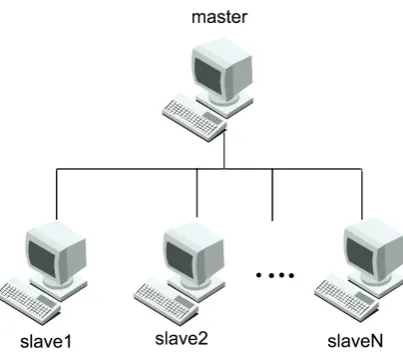
Figure 1. The simple distributed model.
Figure 2. The interactive distributed model.
The fist model is called simple distributed model. In this model, all the slave computers can only communicate with the master computer. The task is scheduled and divided into several smaller subproblems by the master computer. And then each subproblem is sent to a different slave computer by the master computer . Finally, the mas-ter compumas-ter receives the result from the slaves and output it. Compared with the simple model, the interactive model is more advanced. In this model, the slave computers also could communicate with each other by message passing. Therefore, if one slave computer finishes its work, it can help others. The details of the distributed computation will be presented in the section IV.
The rest of the paper is organized as follows. The section II introduces the outline of Wu’s method [19], [20] for changing the searching Nash equilibrium problem to a mixed 0-1 linear programming form. The section III presents Dang’s Fixed-Point iterative method [21], [22]. The details of implementation of the distributed
Fixed-Point method will be given in the IV section. In the V section, the computation results are presented. Finally, conclusions of this paper are offered in the last section
II. CHANGING THE SEARCHINGNASH EQUILIBRIUM PROBLEM TO A MIXED0-1LINEAR PROGRAMMING
FORM
Let N ={1,2, . . . , n} be the set of players. The pure strategy set of playeri∈N is denoted bySi={si
j |j∈ Mi} with Mi = {1,2, . . . , mi}. Given Si with i ∈ N, the set of all pure strategy profiles is S =Qni=1Si. We denote the payoff function of player i∈N byui:S→ R. For i ∈ N, let S−i = Q
k∈N\{i}Sk. Then, s =
(s1
j1, s 2
j2, . . . , s
n
jn)∈S can be rewritten ass= (s
i ji, s
−i) with s−i = (s1
j1, . . . , s
i−1
ji−1, s
i+1
ji+1, . . . , s
n
jn) ∈ S
−i. A mixed strategy of player i is a probability distribution on Si denoted by xi = ¡xi
1, xi2, . . . , ximi
¢
. Let Xi be the set of all mixed strategies of player i. Then, Xi =
{xi = (xi
1, xi2, . . . , ximi)∈R
mi +
¯ ¯ ¯Pmi
j=1xij= 1}. Thus, for xi ∈ Xi, the probability assigned to pure strategy si
j ∈Si is equal toxij. GivenXi withi∈N, the set of all mixed strategy profiles is X =Qni=1Xi. Fori∈N, let X−i=Q
k∈N\{i}Xk. Then,x=
¡
x1, x2, . . . , xn¢∈ X can be rewritten as x = (xi, x−i) with x−i = (x1, . . . , xi−1, xi+1, . . . , xn)∈X−i. Ifx∈X is played, then the probability that a pure strategy profile s = (s1
j1, s 2
j2, . . . , s
n
jn) ∈ S occurs is
Qn
i=1xiji. Therefore, for x∈ X, the expected payoff of player i is given by ui(x) = P
s∈Sui(s) Qn
i=1xiji. With these notations, a finite n-person game in normal form can be represented as Γ =hN, S,{ui}
i∈NiorΓ =hN, X,{ui}i∈Ni.
Definition 1: (Nash, [1]) A mixed strategy profilex∗∈
X is a Nash equilibrium of game Γ if ui(x∗) ≥
ui(xi, x∗−i)for alli∈N andxi ∈Xi.
With the application of optimality condition, one can obtain that x∗ is a Nash equilibrium if and only if there
are λ∗ andµ∗ together with x∗ satisfying the system of
(1)
ui(si
j, x−i) +λij−µi= 0, ei>xi−1 = 0,
xi jλij= 0, xi
j≥0, λij≥0,
j= 1,2, . . . , mi, i= 1,2, . . . , n,
(1)
whereei= (1,1, . . . ,1)>∈Rmi.
Let β be a given positive number such that
β≥max i∈N{maxs∈S u
i(s)−min s∈Su
Then, (1) is equivalent to (2).
ui(si
j, x−i) +λij−µi= 0, ei>xi−1 = 0,
xi j ≤vij, λi
j≤β(1−vij), vi
j ∈ {0,1}, xi
j ≥0, λij≥0,
j= 1,2, . . . , mi, i= 1,2, . . . , n.
(2)
Thus, finding a pure-strategy Nash equilibrium is equiv-alent to computing a solution of the system of (3).
ui(si
j, x−i) +λij−µi= 0, ei>xi−1 = 0,
xi j ≤vij, λi
j≤β(1−vij), xi
j ∈ {0,1}, vij∈ {0,1}, λi
j≥0,
j= 1,2, . . . , mi, i= 1,2, . . . , n.
(3)
where
ui(sij, x−i) = X
s−i∈S−i
ui(sij, s−i) Y
k6=i xkjk.
One can find a pure strategy Nash equilibrium through solving the system (3). However, it is difficult to solve the system (3) directly because of the multilinear terms. To address this issue, Wu [19], [20] developed a method which can convert the system (3) to an equivalent mixed 0-1 linear formulation. This method is based on exploiting the properties of pure strategy and multilinear terms in the payoff functions. Let y(s−i) =Q
k6=ixkjk for s
−i = (s1
j1, . . . , s
i−1
ji−1, s
i+1
ji+1, . . . , s
n jn)∈S
−i. Then,
ui(si
j, x−i) = X
s−i∈S−i
ui(si
j, s−i)y(s−i).
And the mixed 0-1 linear program obtained is shown in (4) as follows:
P
s−i∈S−iui(sij, s−i)y(s−i) +λij−µi= 0,
ei>xi−1 = 0, λi
j≤β(1−xij), xi
j ∈ {0,1}, λi
j≥0,
j= 1,2, . . . , mi, i= 1,2, . . . , n, y(s−i)≥P
h6=ixhjh−(n−2),
y(s−i)≤xk
jk, k6=i,
0≤y(s−i),
s−i∈S−i, i= 1,2, . . . , n.
(4)
The derivation process of the formulation and the de-tailed proofs can be obtained in the paper [19]. Therefore, we can solve the mixed 0-1 linear program (4) to get a Nash equilibrium in (1). The distributed Dang’s Fixed-Point method which will be presented in the next sections plays well to the computation of this mixed 0-1 linear program.
III. DANG’SFIXED-POINTITERATIVEALGORITHM
Let P ={x∈Rn|Ax+Gw ≤b, f or some w∈ Rp}, where A ∈ Rm×n is an m×n integer matrix with n ≥ 2, G ∈ Rm×p an m ×p matrix, and b a vector of Rm. Let xmax = (xmax
1 , xmax2 , . . . , xmaxn )T with xmax
j = maxx∈Pxj, j = 1,2, . . . , n and xmin = (xmin
1 , xmin2 , . . . , xminn )T with xminj = minx∈Pxj, j = 1,2, . . . , n. Let D(P) ={x∈Zn|xl≤x≤xu}, where xl=bxmincandxu=bxmaxc. Forz∈Rnandk∈N
0, let P(z, k) = {x ∈ P|xi = zi,1 ≤ i ≤ k, and xi ≤
zi, k+ 1≤i≤n}.
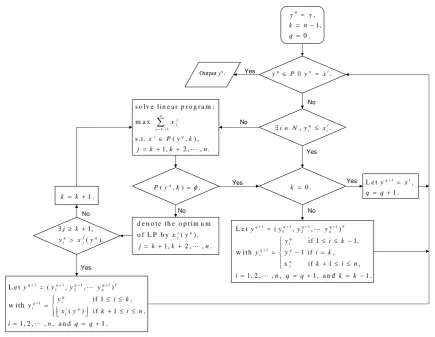
Given an integer point y ∈ D(P) with y1>xli, Dang and Ye [21], [22] developed a iterative method which is presented in Fig.3. It determines whether there is an integer point x∗ ∈P withx∗≤
ly.
An example given below is used to illustrate the method. Consider a polytope P = {x ∈ R3|Ax ≤ b} with
A=
−1 0 2
0 −2 1
−1 0 −2
1 1 0
0 , 1, 0 . y y k n q || .
q q l
y P y x
, q l.
i i
i N y x
d
No
1
s o l v e li n e a r p r o g r a m :
m a x
s . t . ( , ) , 1, 2 , , .
n j j j k j q x
x P y k
j k k n
¦
"
( q, ) .
P y k I
No
d e n o t e t h e o p t i m u m o f L P b y ( ) ,
1, 2 , , .
j q j
x y
j k k " n
1, ( ) .
q j q
i j
j k
y x y
t
!
Yes
1 1 1 1
1 2
1
L e t ( , , )
i f 1 , w i t h
( ) i f 1 , 1, 2 , , , a n d 1 .
q q q q T
n q
i q
i i q
i
y y y y
y i k
y
x y k i n
i n q q
®° d d
« » d d
° ¬ ¼ ¯ " " No Yes 0 . k Yes 1
L e t , 1 . q l y x q q No 1 . k k
Output .q
y Yes
Yes
No
1 1 1 1
1 2
1
L e t ( , , )
i f 1 1, w i t h 1 i f ,
x i f 1 , 1, 2 , , , 1, a n d 1 .
q q q q T
n q i q q i i u i
y y y y
y i k
y y i k
k i n
i n q q k k
d d
° ®
° d d
¯
"
"
Figure 3. Flow diagram of the iterative method.
and b= 0 1 1 0
It is easy to obtain xu = (1,0,0)T and xl = (−1,−2,−2)T. Lety=xu, y0=y, andk= 3−1 = 2.
y1 = (1,−1,0) can be obtained in the first iteration, and y2 = (1,−1,−1) which is an integer point inP is obtained in the second iteration. An illutration of y0, y1 andy2 can be found in Fig.4.
The idea of Dang’s method [21], [22] to solve integer programming is to define an increasing-mapping from a finite lattice into itself. All the integer points outside theP are mapped into the first point in P that is smaller than them in the lexicographical order of xl. All the integer points inside the polytope are the fixed points under this increasing mapping. Given an initial integer point, the method either yields an integer point in the polytope or proves no such point exists within a finite number of
Figure 4. An illustration of the iterative method.
iterations. For more details and proofs about this iterative method, one can consult Dang [21], [22].
IV. DISTRIBUTEDIMPLEMENTATION
in this section.
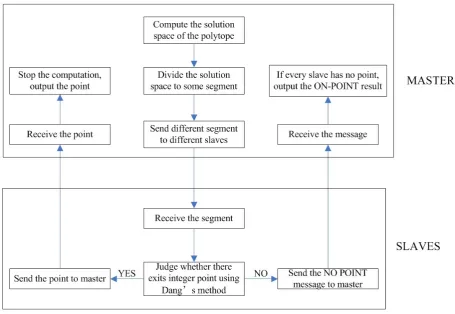
The simple distributed model as described in Fig.1 has been used in our implementation. There are one master computer and a certain number of slave computers in this distributed computing system. The master computer takes charge of computing the solution space of the polytope, dividing the solution space to segments, sending the segments to the slave computers, receiving the com-putation result from the slave computers and exporting the computation result. Each slave computer receives the segment, judges whether there exits an integer point in its segment using Dang’s Fixed-Point iterative method and sends its result to the master. The outline of the distributed computation process in this paper can be explained in the Fig.5.
All the programs are coded in C++, and run on Mi-crosoft Windows platform. Two algorithms have been considered to the bounding linear program in Dang’s iterative method. One is the simplex algorithm [23] which is the most popular algorithm for linear programming. We can call the API function in CPLEX Concert Technology to carry out this method. The other algorithm is the self-dual embedding technique presented in [24]. This algorithm detects LP infeasibility based on a proved criterion, and it is the best method to solve the linear programming in Dang’s algorithm to our knowledge.
The MPICH2, which is a freely available, portable implementation of Message Passing Interface(MPI), is used to send and receive message between the master computer and slave computers in this implementation. More information about the Message Passing Interface can be obtained in the literature [25].
It is important to assign equal amount of work to each slave computer. Two methods have been implemented for the assignment. One is to divide the interested space into a number of more or less equal regions. The other is to randomly divide the interested space into a number of regions according to the Latin Squares method in [26]. The first method has a good performance when the number of slave computers is small. When the number of slave computers increases big enough, the later method performs better.
The slave computers may complete their work allo-cations at different times. So the interactive distributed model(in Fig.2), in which the slave computers could communicate with each other by message passing, is our next work. By doing so, a slave computer can help others if it completes its work earlier. This will be quite helpful to enhance efficiency of the method.
V. NUMERICALRESULTS
In this section, some numerical results will be pre-sented. The distributed computation network consists of 3 computers of OptiPlex 330 with 2 processors. All pro-grams are coded in C++, and CPLEX Convert Technology is used to solve the linear programming in the Fixed-Point
algorithm in this distributed network. Each subsegment divided by the master computer is independent to each other. Therefore, each slave computer can conduct each subsegment simultaneously. Message Passing Interface (MPI) is used to establish a communication network between the master computer to the slave computers. And the master computer takes charge of outputting the computation result.
In the presentation of numerical results, some symbols are explained as follows.
N: The number of players in the instance.
S: The number of strategies for each player in the instance.
Niteration: The number of iteration of the Fixed-Point algorithm.
Result: “Yes” appears if the method finds a Nash equilibrium and “No” otherwise.
Only three-player game needs to be considered since any n-player game can be reduced to a three-player game in polynomial time as shown in [27]. In this paper, the computation examples which are generated randomly are given as follows.
Example 1: Consider a three-player game Γ = (N, S,{ui}
i∈N), where N = {1,2,3}. The number of strategies for each player, N umS, is generated from 2 to 15 randomly. The {ui}
i∈N are generated randomly too. There are four different ranges for {ui}
i∈N in this example, which are from 0 to 1, from 0 to 10, from 0 to 50, and from 0 to 100.
Let β = 1000. For different range of {ui} i∈N, 80 instances have been solved by this distributed computation network. Numerical results of this distributed computation network are given in Table I, Table II Table III and Table IV respectively. Table I presents the numerical results when the payoff functionui(si
j, s−i)is generated from 0 to 1 randomly. Table II gives the numerical results when the payoff functionui(si
j, s−i)is generated from 0 to 10 randomly. For the payoff functionui(si
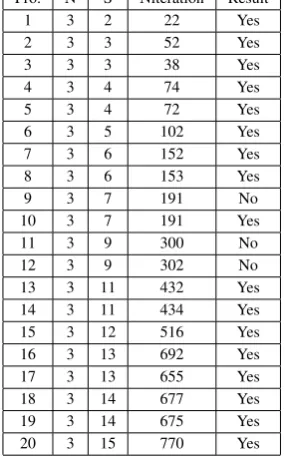
j, s−i)is generated from 0 to 50 randomly, the numerical results are shown in Table III. And Table IV is for the range of 0 to 100.
With compare of the numerical results generated by Fixed-Point method in the paper [20], one can see that the distributed network could obtain the same computation results for the same example. The comparison of the computation time has no meaning since two methods are run on different computers.
Figure 5. Flow diagram of the distributed computation process.
TABLE I. THE PAYOFF FUNCTIONui(si
j, s−i)IS GENERATED FROM0TO1 RANDOMLY.
Pro. N S Niteration Result
1 3 2 23 Yes
2 3 3 44 Yes
3 3 3 44 Yes
4 3 4 98 Yes
5 3 4 71 Yes
6 3 4 70 Yes
7 3 5 104 Yes
8 3 7 188 Yes
9 3 9 433 Yes
10 3 9 296 Yes
11 3 9 296 Yes
12 3 10 470 Yes
13 3 10 491 Yes
14 3 10 360 Yes
15 3 11 429 Yes
16 3 12 697 Yes
17 3 13 781 Yes
18 3 15 765 Yes
19 3 15 1019 Yes
20 3 15 770 Yes
TABLE II. THE PAYOFF FUNCTIONui(si
j, s−i)IS GENERATED FROM0TO10 RANDOMLY.
Pro. N S Niteration Result
1 3 2 25 No
2 3 2 15 Yes
3 3 2 22 Yes
4 3 3 51 Yes
5 3 3 44 Yes
6 3 4 80 Yes
7 3 4 80 Yes
8 3 5 124 Yes
9 3 6 166 Yes
10 3 7 203 Yes
11 3 8 243 No
12 3 8 274 Yes
13 3 8 276 Yes
14 3 9 303 Yes
15 3 11 435 Yes
16 3 11 446 Yes
17 3 12 519 Yes
18 3 13 625 Yes
19 3 14 688 Yes
TABLE III. THE PAYOFF FUNCTIONui(si
j, s−i)IS GENERATED FROM0TO50 RANDOMLY.
Pro. N S Niteration Result
1 3 2 21 Yes
2 3 4 74 Yes
3 3 4 76 Yes
4 3 4 73 No
5 3 5 110 Yes
6 3 6 179 Yes
7 3 7 199 Yes
8 3 8 244 Yes
9 3 9 300 Yes
10 3 10 424 Yes
11 3 10 364 Yes
12 3 11 496 Yes
13 3 12 508 No
14 3 13 589 Yes
15 3 13 609 Yes
16 3 13 591 Yes
17 3 13 597 Yes
18 3 14 678 Yes
19 3 14 757 Yes
20 3 15 779 Yes
TABLE IV. THE PAYOFF FUNCTIONui(si
j, s−i)IS GENERATED FROM0TO100 RANDOMLY.
Pro. N S Niteration Result
1 3 2 22 Yes
2 3 3 52 Yes
3 3 3 38 Yes
4 3 4 74 Yes
5 3 4 72 Yes
6 3 5 102 Yes
7 3 6 152 Yes
8 3 6 153 Yes
9 3 7 191 No
10 3 7 191 Yes
11 3 9 300 No
12 3 9 302 No
13 3 11 432 Yes
14 3 11 434 Yes
15 3 12 516 Yes
16 3 13 692 Yes
17 3 13 655 Yes
18 3 14 677 Yes
19 3 14 675 Yes
20 3 15 770 Yes
of this distributed network would be more powerful.
VI. CONCLUSIONS
In this paper, Wu’s method has been introduced to convert the searching Nash equilibrium problem to a mixed 0-1 linear programming. Then Dang’s Fixed-Point iterative method was presented to solve the mixed 0-1 linear program generated the former section. In the next section, the distributed implementation of Dang’s method has been proposed and a distributed computation network has been built. Some numerical results have been given in the last part. The results show that our distributed computation network is effective and can be easily extended to other NP-hard problems.
ACKNOWLEDGMENT
The authors are grateful to the anonymous referees for their valuable comments and suggestions to improve the presentation of this paper.
REFERENCES
[1] J. Nash, “Non-cooperative games,”The Annals of Mathe-matics, vol. 54, no. 2, pp. 286–295, 1951.
[2] C. Daskalakis, P. W. Goldberg, and C. H. Papadimitriou, “The complexity of computing a nash equilibrium,” in
Proceedings of the 38th Annual ACM Symposium on Theory of Computing, 2006, pp. 71–78.
[3] X. Chen and X. Deng, “Settling the complexity of two-player nash equilibrium,” in Proceedings of the 47th Annual Symposium on Foundations of Computer Science (FOCS), 2006, pp. 261–272.
[4] C. E. Lemke and J. T. Howson, “Equilibrium points of bimatrix games,” Journal of the Society for Industrial & Applied Mathematics, vol. 12, no. 2, pp. 413–423, 1964. [5] J. Rosenm¨uller, “On a generalization of the lemke-howson
algorithm to noncooperative n-person games,”SIAM Jour-nal on Applied Mathematics, vol. 21, no. 1, pp. 73–79, 1971.
[6] R. Wilson, “Computing equilibria of n-person games,”
SIAM Journal on Applied Mathematics, vol. 21, no. 1, pp. 80–87, 1971.
[7] H. E. Scarf, “The approximation of fixed points of a con-tinuous mapping,”SIAM Journal on Applied Mathematics, vol. 15, no. 5, pp. 1328–1343, 1967.
[8] C. B. Garcia, C. E. Lemke, and H. Luethi, “Simplicial approximation of an equilibrium point of noncooperative n-person games,”Mathematical Programming, vol. 4, pp. 227–260, 1973.
[9] T. M. Doup and A. J. J. Talman, “A continuous defor-mation algorithm on the product space of unit simplices,”
Mathematics of Operations Research, vol. 12, no. 3, pp. 485–521, 1987.
[10] G. Van der Laan, A. J. J. Talman, and L. Van der Heyden, “Simplicial variable dimension algorithms for solving the nonlinear complementarity problem on a product of unit simplices using a general labelling,” Mathematics of Op-erations Research, vol. 12, no. 3, pp. 377–397, 1987. [11] J. C. Harsanyi, “The tracing procedure: A bayesian
ap-proach to defining a solution for n-person noncooperative games,” International Journal of Game Theory, vol. 4, no. 2, pp. 61–94, 1975.
[13] P. J. J. Herings and R. J. A. P. Peeters, “A differentiable homotopy to compute nash equilibria of n-person games,”
Economic Theory, vol. 18, no. 1, pp. 159–185, 2001. [14] P. J. J. Herings and R. J. A. P. Peeters, “Homotopy methods
to compute equilibria in game theory,”Economic Theory, vol. 42, no. 1, pp. 119–156, 2010.
[15] R. D. McKelvey and A. McLennan, “Computation of equilibria in finite games,” Handbook of Computational Economics, vol. 1, pp. 87–142, 1996.
[16] D. Avis, G. D. Rosenberg, R. Savani, and B. Von Stengel, “Enumeration of nash equilibria for two-player games,”
Economic Theory, vol. 42, no. 1, pp. 9–37, 2010. [17] R. S. Datta, “Finding all nash equilibria of a finite game
using polynomial algebra,” Economic Theory, vol. 42, no. 1, pp. 55–96, 2010.
[18] Y. Yang, Y. Zhang, F. Li, and H. Chen, “Computing all nash equilibria of multiplayer games in electricity markets by solving polynomial equations,” Power Systems, IEEE Transactions on, vol. 27, no. 1, pp. 81–91, 2012. [19] Z. Wu, C. Dang, and C. Zhu, “A mixed 0-1 linear
program-ming approach to the computation of all pure- strategy nash equilibria of a finite n-person game in normal form,”
submitted to Optimization, 2013.
[20] Z. Wu, C. Dang, and C. Zhu, “Finding the pure-strategy nash equilibrium using a fixed-point algorithm,” in Pro-ceedings of 2013 International Conference on Computer Science, Electronics Technology and Automation, 2013. [21] C. Dang, “An increasing-mappingapping approach to
inte-ger programming based on lexicographic ordering and lin-ear programming,” inProceedings of the 9th International Symposium on Operations Research and Its Applications, 2010, pp. 55–60.
[22] C. Dang and Y. Ye, “A fixed-point iterative approach to integer programming and distributed computation,” City University of Hong Kong, vol. TR-1, 2011.
[23] G. B. Dantzig, Linear programming and extensions. Princeton university press, 1998.
[24] Y. Ye,Interior point algorithms: theory and analysis. John Wiley & Sons, 2011, vol. 44.
[25] Message Passing Interface Forum. MPI: A message-passing interface standard, version 2.2., http://www.mpiforum. org/docs/mpi-2.2/mpi22-report.pdf., 2009.
[26] Y. Wang and C. Dang, “An evolutionary algorithm for global optimization based on level-set evolution and latin squares,” Evolutionary Computation, IEEE Transactions on, vol. 11, no. 5, pp. 579–595, 2007.
[27] V. Bubelis, “On equilibria in finite games,” International Journal of Game Theory, vol. 8, no. 2, pp. 65–79, 1979. Zhengtian Wu received his BSc degree in mechanical manu-facturing & automation from Hefei University of Technology, China, in 2008. He is currently pursuing the PhD degree at the University of Science and Technology of China and City Uni-versity of Hong Kong Joint Advanced Research Center, Suzhou, China. His research interests include Nash equilibrium, mixed integer programming, approximation algorithm and distributed computation.
Chuangyin Dangreceived BSc degree in Computational Math-ematics from Shanxi University, China, in 1983, MSc de-gree in Applied Mathematics from Xidian University, China, in 1986 and PhD degree (Cum Laude) in Operations Re-search/Economics from Tilburg University, the Netherlands, in 1991. He is an associate professor at the department of systems engineering and engineering management, City University of Hong Kong, China. He has published over 100 papers in journals and his research interests include computational optimization, logistics, supply chain management and modeling in economics.