Codal Comparison of Seismic Analysis of a
High-Rise Structure
Asmita Wagh Prof. T. N. Narkhede
PG Student Assistant Professor
Department of Civil Engineering Department of Civil Engineering MGM’s College of Engineering & Technology, Navi
Mumbai, India
MGM’s College of Engineering & Technology, Navi Mumbai, India
Prof. P. J. Salunke Assistant Professor
MGM’s College of Engineering & Technology, Navi Mumbai, India
Abstract
This paper depicts the study carried out on comparison of International standards for seismic behavior of a high-rise structure when designed and analysed by three International Seismic Codes namely, Indian, European & New Zealand Codes. The chosen standards are Indian code i.e. IS 1893:2002, Eurocode 8:2004 and New Zealand Code NZS 1170.5 2004. The study helps in understanding the main contributing parameters responsible for poor performance of a high-rise structure during an earthquake, so as to achieve their adequate safe behavior under future earthquakes. The structure analysed and modeled for the study is a G+24 RCC residential structure with a Special Moment Resisting Frame (SMRF). The performance of the building is reviewed by carrying out Response Spectrum Analysis using the software ETABS2015, by implementing the seismic parameters relevant in the Indian, Eurocode and New Zealand standards. The analytical results of the model buildings are then represented graphically and in tabular form, it is compared and analysed taking note of the significant differences. The paper focuses on putting forward the variations in the results obtained by using the three codes i.e. Indian, Eurocode and New Zealand code. A comparative analysis is performed in terms of Base shear, Story Displacement and Story Drifts in X, Y and Z direction Floor wise of different codes. Keywords: Seismic Analysis, Codal Comparison, Design Base Shear, Story Displacement, Story Drift, Response Reduction Factor, Special Moment Resisting Frame (SMRF)
________________________________________________________________________________________________________
I. INTRODUCTION
In today’s world, a scenario that cannot be unnoticed is the “Revitalization” of construction of high rise buildings happening globally. The increasing state of employment on financial services is one of the major reasons for increase in the rural-to-urban migration. This migration has led to a huge rise in the demand on land use in urban metropolitan cities. Consequently, more high rise structures are being constructed now than a decade or two ago. However, a keen observation brings to notice that little work has been undertaken on the economics of whole buildings and their behavior under earthquake loading. It has been figured out that the design of tall buildings in seismically active regions varies dramatically from region to region wherein rigorous performance-based assessments are required in some countries; while many to other countries do not require anything beyond a traditional design based on force reduction factors.
Moving forward, every Country has developed its own guidelines on how to construct safe buildings/houses/structures in its own ways since times immemorial based on its own experiences with materials, construction practices and nature. The buildings constructed are based on the design and seismic codes adapted by the respective countries. It is essential for all these design and seismic codes related to structural engineering to be based on the ideal principles of mechanics. These fundamental codes are to be experimentally verified and should be logical, rational and efficient. It is most essential that these codes are revised as frequently as necessary.
Codal Comparison of Seismic Analysis of a High-Rise Structure (IJSTE/ Volume 5 / Issue 4 / 005)
the results obtained for the codes to improvise or take into account any factors/parameters, remove any discrepancies and suggest and any modifications or improvisations for development of an explanatory article on these codes for future studies.
III. PARAMETERS GOVERNING THE SESIMC BEHAVIOUR
It is to be noted that all the present seismic design codes are based on a prescriptive Force-Based Design approach wherein, a linear elastic analysis is performed and inelastic energy dissipation is considered indirectly, through a response reduction factor. Different national codes vary significantly on account of various specifications that govern the design force level. This factor, along with other interrelated provisions, governs the seismic design forces and the seismic performance of code-designed buildings. The building codes define different ductility classes and specify corresponding response reduction factors based on the material, configuration, and detailing for all the international standards. Codes also differ significantly in specifying the effective stiffness of reinforced concrete members, procedures to estimate the drift, and allowable limits on drift. The response reduction factor considered in the design codes, depends on the ductility and strength of the structure.
One important factor that also governs the design and expected seismic performance of a building is control of drift. Drift is as an important control parameter analysed by all the codes; with differences in the effective stiffness of reinforced concrete members. The method to estimate this drift and its allowable limits also varies subsequently. Codes also differ with respect to the Design Base Shear and different load and material factors or strength reduction factors for the design of members. This difference has a direct effect on the expected performance of the buildings when the buildings are designed using different codes. These various provisions in various codes govern the seismic performance of a High-rise building and hence suggest the need for a Codal Comparison or Codal Study. There emerges a need for convergence of design methodologies to result in buildings with uniform risk of suffering a certain level of damage or collapse. This could be anticipated by comparing the expected seismic performance of buildings designed using the provisions of different international codes.
IV. METHODOLOGY
The objective of this comparative study has been served by performing a problem formulation. The Problem Formulation is prepared for explaining the study and deciding the approach and parameters for comparison of codes. A G+24 RCC residential structure with a Special Moment Resisting Frame (SMRF) is modeled and analyzed for Earthquake in the software ETABS-15 using the major countries codes for comparative study viz. Indian, European and New Zealand Codes. The comparison between the mentioned codes will be carried out in the analysis. The performance of the building is then checked by implementing Response Spectrum Analysis in all three aforementioned codes using ETABS2015. The results obtained are interpreted for the following important parameters after the analysis:
1) Base shear
2) Maximum storey drift for earthquake
3) Maximum storey deformation considering earthquake
The Proposed residential building considered is Ground floor + 24 floors. The height of Ground floor is 4.2m and that of typical floors is 2.9m. The floors are of beam and slab type construction. Foundations rest on soil having S.B.C of 60T/m2. The structural
Design is in accordance with IS 456- 2000 “Code of Practice for plain and reinforced concrete. The description of the building has been given below:
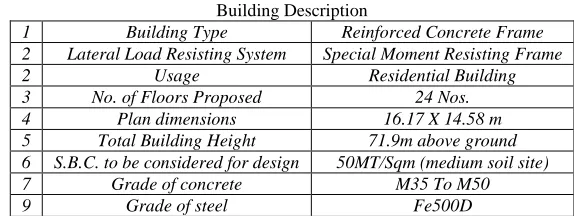
Table – 1 Building Description
1 Building Type Reinforced Concrete Frame
2 Lateral Load Resisting System Special Moment Resisting Frame
2 Usage Residential Building
3 No. of Floors Proposed 24 Nos.
4 Plan dimensions 16.17 X 14.58 m
5 Total Building Height 71.9m above ground
6 S.B.C. to be considered for design 50MT/Sqm (medium soil site)
7 Grade of concrete M35 To M50
9 Grade of steel Fe500D
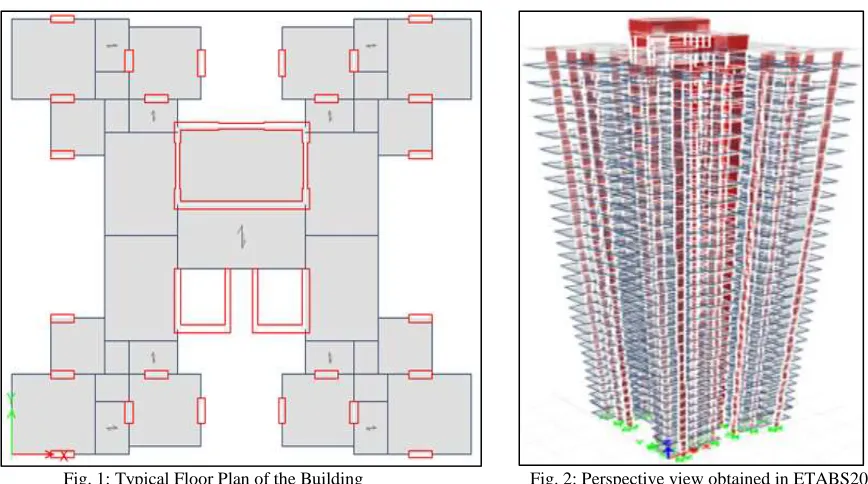
Fig. 1: Typical Floor Plan of the Building Fig. 2: Perspective view obtained in ETABS2015
Loading Considerations for the Dead and Live Loads have been kept similar in the analysis for the three international standards while the Input Parameters for Seismic Loads have been considered as equivalent in the three international codes.
Table – 2 Dead Loads Considered
150 mm thick siporex wall including plaster 8.5kN/m Masonry 230 mm thick including plaster 13.4 kN/m
Density of Brick Masonary 20 kN/m
Height of structure 2.9 m
Floor finish and ceiling plaster 1.5 kN/m2 Filling including water proofing for sunk slab of toilet 6.0 kN/m2 Water proofing/ finish for Terrace and Balcony 3.0 kN/m2
Table – 3 Live Loads Considered
Typical Floor Slab 2.0 kN/m2 Corridors, Balconies, Staircases 3.0 kN/m2
Parking floor
Vehicle ≤ 2 Tonnes 2.5 kN/m2 2 Tonnes < Vehicle ≤ 5 Tonnes 5.0 kN/m2
The three international codes considered for comparison are IS-1893:2002, Eurocode 8:2004 and NZS 1170.5 2004. The results are obtained for the values of Design Base Shears, Story Displacements and Story Drifts drawing conclusions that could be efficient while designing the high-rise buildings in future.
Table – 4
Input Parameters Considered for Seismic Load
Sr. No. Equivalent Parameter Considered IS-1893:2002 Eurocode 8:2004 NZS 1170.5
1. Zone Factor/Ground Type/ Site subsoil Zone III Ground Type C Class C
2. Zone Factor/Ground Acceleration/Hazard Factor 0.16 ag/g = 0.4 Z = 0.13
3. Importance Factor/level 1 1 2
4. Response Reduction Factor/Behaviour Factor/Return Period Factor 4 3.9 1
Codal Comparison of Seismic Analysis of a High-Rise Structure (IJSTE/ Volume 5 / Issue 4 / 005)
Table – 6
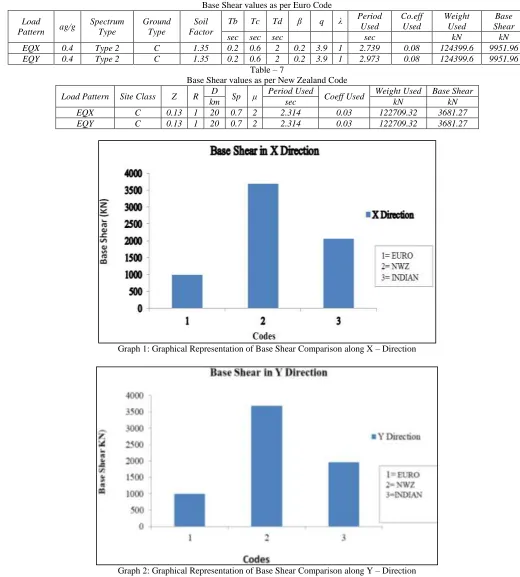
Base Shear values as per Euro Code
Load
Pattern ag/g
Spectrum Type
Ground Type
Soil Factor
Tb Tc Td β q λ Period
Used
Co.eff Used
Weight Used
Base Shear
sec sec sec sec kN kN
EQX 0.4 Type 2 C 1.35 0.2 0.6 2 0.2 3.9 1 2.739 0.08 124399.6 9951.96
EQY 0.4 Type 2 C 1.35 0.2 0.6 2 0.2 3.9 1 2.973 0.08 124399.6 9951.96
Table – 7
Base Shear values as per New Zealand Code
Load Pattern Site Class Z R D Sp μ Period Used Coeff Used Weight Used Base Shear
km sec kN kN
EQX C 0.13 1 20 0.7 2 2.314 0.03 122709.32 3681.27
EQY C 0.13 1 20 0.7 2 2.314 0.03 122709.32 3681.27
Graph 1: Graphical Representation of Base Shear Comparison along X – Direction
Graph 3: Displacement Comparison along X – Direction
Codal Comparison of Seismic Analysis of a High-Rise Structure (IJSTE/ Volume 5 / Issue 4 / 005)
Graph 6: Drift Comparison along Y – Direction
VI. CONCLUSIONS
The above results and graphs lead to some prominent and distinct conclusions and interpretation.
The parameters of base shears, displacements and storey drifts are compared with respect to the three mentioned codes of Indian, European and New Zealand standards under gravity loading and seismic loading. From the codal comparison of these parameters, it is observed that the variations in the values of the different parameters are dependent on the load combinations considered for the codes.
From the graphical representation depicting the base shear values obtained; it is noticed that the base shear is lowest as per the Indian Code when compared to the Euro and New Zealand Codes. This is because of the value of Response Reduction Factor. As per IS1893, the Response Reduction Factor for Special Moment Resisting frame (SMRF) is 4 as considered for this case study. While according to Euro Code 8, SMRF is equivalent to medium dissipative structures category (DCM) for ductility having a value of 3.9. Return Period Factor for New Zealand Code is taken as 1. Hence, it can be concluded that because of higher value of Response Reduction Factor, the base shear for Indian Standards is lesser.
Design Base Shear calculated according to Euro Code 8 is higher than IS - 1893 by upto 79% whereas Design Base Shear calculated according to the New Zealand standards NZS 1170.5 is higher than IS 1893 by upto 44%. This is on account of the high value of Response Reduction Factor specified by the Indian Code.
Due to higher design base shear values, the storey displacements at top and storey drifts for Euro Code are lowest as compared to the Indian Code and New Zealand Code.
Apart from these interpretations, one major and serious issue that the case study highlights is about the various limitations of the Indian seismic design codes. A comparative study of various provisions related to site classification, design response spectrum, modelling guidelines, drift control criteria and ductile detailing has been made between Indian, European and New Zealand codes. It is observed that the Indian site classification is based on a single parameter, i.e. SPT value. As it is a well-known fact that reliability of seismic design to a greater extent depends on the accuracy of the modeling, the Indian code does not provide any modeling guidelines, leaving it to the skills of individual designers.
Ductile detailing provisions of the current Indian code are outdated and important issues like strong column and weak beam and joint shear design are ignored. Code limits the inter storey drift to 0.4% at design load level, which makes it dependent on the ductility class of the building. Further, the code does not provide any guidelines about effective stiffness of Reinforced Concrete members, resulting the check on inter-storey drift to be meaningless. Therefore, there seems to be an urgent need to revise the relevant provisions of the Indian code in the light of the new research and the state of the art in the other major national codes.
REFERENCES
[1] Yogendra Singh & Vijay Namdev Khose, Dominik H. Lang, “Comparative Study Of Code Provisions For Ductile RC Frame Buildings” Indian Institute of
Technology Roorkee, India, WCEE Lisboa, 2012
[2] S. Karthiga, Hanna Elza Titus, Reetwiz Raj Hazarika & Mohamed Harrish, “Design And Comparison Of A Residential Building (G+10) For Seismic Forces
Using The Codes: IS1893, EUROCODE8, ASCE 7-10 And BRITISH Code”, International Journal of Research in Engineering and Technology (IJRET), Volume: 04 Issue: 06, June 2015
[3] Sergio Hampshire De C. Santos, Luca Zanaica, Carmen Bucur, Silvio De Souza Lima, Ana Arai, “Comparative Study Of Codes For Seismic Design Of
Structures”, VERSITA, Mathematical Modeling in civil engineering, Volume 9- No. 1, 2013
[4] F. Atique and Z. Wadud, “A Comparison Of Bnbc-93 With Other Building Codes With Respect To Earthquake And Wind Analysis”, Paper No. 1443,
International Journal Of Scientific & Technology Research Volume 3, Issue 11, November 2014
[5] “A Comparative Study Of Design Seismic Hazard In Major National Codes”, International Conference on Structural Engineering and Construction
[6] G. V. S. SivaPrasad, S. Adiseshu, “Comparative Study Of OMRF & SMRF Structural System for Tall & High Rise Buildings subjected to Seismic Load”, International Journal of Research in Engineering and Technology (IJRET), Volume: 02 Issue: 09, September 2013
[7] Dr. S.V. Itti, Prof. Abhishek Pathade, Ramesh B. Karadi, “A Comparative Study on Seismic Provisions Made in Indian and International Building Codes for
RC Buildings”, Dept. of Civil Engg., KLESCET, Belgaum – 590008 (Karnataka)
[8] Pravin Ashok Shirule, Bharti V. Mahajan, “Response Spectrum Analysis of Asymmetrical Building”, Pratibha: International Journal Of Science, Spirituality,
Business And Technology (IJSSBT), Vol. 1, No.2, February 2013
[9] Pamela Jennifer J P, Jegidha K J, “Review on Seismic Design Of Multi-storeyed RC Building Using Various Codes”, Pamela Jennifer J P, Jegidha K J,