Analysis of New Type Air-conditioning for Loom
Based on CFD Simulation and Theory of
Statistics
Yang Ruiliang, Zhou Yide, Zhao Nannan
Dept. of Energy and Environmental Engineering, Zhongyuan University of Technology, Zhengzhou, China Email: [email protected]
Song Gaoju
No. 6 Institute of Project Planning & Research of Machinery Industry, Zhengzhou, China Email: [email protected]
Abstract— Based on theory of statistics, main factors affecting effects of loom workshop’s large and small zone ventilation using the CFD simulation in this paper. Firstly, four factors and three levels of orthogonal experimental table is applied to CFD simulation, the order from major to minor of four factors is obtained, which can provide theoretical basis for design and operation. Then single-factor experiment method is applied to CFD simulation, certain factor changing can be obtained with best levels of other factors. Base on above recommend parameters, CFD software is applied to simulate relative humid and PMV on the loom. Lastly, comparison of simulation results and experiment is used to verify feasibility of simulation results.
Index Terms—large and small zone ventilation, four factors and three levels of orthogonal experimental table, single-factor experiment method, theory of statistics, CFD simulation
I. INTRODUCTION
With development of textile industry to high-grade fabrics and awareness of energy-saving air-conditioning, high-speed, high degree of automation of air-jet loom is widely used in China. Due to specificity of the production, air-jet loom requires high relative humidity in job areas of workshop (t≤31℃, RH≥75%). However, it is difficult for traditional air-conditioning system to achieve such a high relative humidity. For entire loom workshop, such high humidity leads large-scale air-conditioning and energy waste. Furthermore, RH≥75% may be more suitable for cloth surface, but such high humidity is not comfortable [1] for regional operations.
To overcome above-mentioned design defects of traditional loom workshop, a new energy-saving type of ventilation named large and small zone ventilation for loom workshop is proposed in paper [1]. The basic principle of large and small zone ventilation is: the small
zone ventilation is applied above the loom to provide air with high humidity; the large zone ventilation is applied under the ceiling to provide air with low humidity, which can meet the requirement of textile technology and workshop worker together.
As shown in Fig. 1 of loom workshop, there is a small zone inlet above the loom to offer small zone ventilation, and there is a large zone inlet under the ceiling to offer large zone ventilation.
Different with the traditional air-conditioning system, large and small zone ventilation is suitable for loom workshop, which airs to loom workshop and surface of fabric respectively. Large and small zone ventilation not only can satisfy the humidity requirements of the loom surface, but also achieve a high satisfacted comfort in the operation area. Besides, compared to the traditional air-conditioning system, large and small zone ventilation can save energy about 30%.
Figure 2. Design illustration of large and small zone ventilation. Figure 1 Illustration of large and small zone ventilationNote how the
caption is centered in the column.
Figure3. A simplified model of simulated region
II. THE MAIN FACTORS OF LARGE AND SMALL ZONE VENTILATION
Long-term analysis and research of engineering practice show that: there are four factors which effect greatest large and small zone ventilation and are concerned by most designer and operators. These factors are: relative humidity of air-inlet in working area, speed of air-inlet in working area, relative humidity of background air-inlet, speed of background air-inlet. It would cost large fare and time to research the comprehensive effect of these factors in experiment, even can’t operate in reality. So combined with engineering practice, main factors affecting the effects of the loom workshop 's large and small zone ventilation are analyzed in detail with CFD simulation software and the theory of statistics in this paper.
III.INTRODUCTIONONSIMULATIONSOFTWARE,
MODELSANDMETHODS
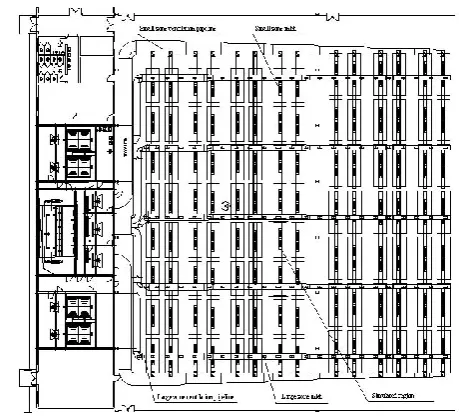
As Fig. 2 shows, a loom workshop installs 106 looms, with area of 57 m × 50m. This workshop uses large and small zone ventilation. The large zone ventilation and the small zone ventilation adopt the same air-conditioned room, with the electric control valve using to adjust the proportion of the wind in the large zone ventilation.
CFD simulation theory [4] and software becomes more and more popular to simulate temperature and humidity of textile workshop in recent years. AIRPAK software is one of the specialized CFD software used in HVAC field of CFD simulation, which can accurately simulate air flow and air quality of the ventilation system, heat transfer and comfort and so on. Thus, AIRPAK software is used as simulation software in this paper.
According to the theories of higher heat transfer fluid mechanics and numerical heat transfer, using AIRPAK software needs to set up mathematical model at first, then simulates the temperature field and satisfacted comfort of the workshop. The mathematical model should embody characteristics of typical area in workshop. Considering
characteristics of workshop, the mathematical model can be simplified as follows:
• Simplifies the calculative zone as a region similar to a typical rectangular.
• In accordance with arrangement of the characteristics of air supply outlet background area, a background air-conditioning opening-air inlet is arranged in the region.
• Two looms are disposed in the region, there is an operation region on each machine to opening -air outlet, and each machine has two outlets under the loom.
• The loom is assumed to be constant heating source; The rest heat from the loom is taken away by the venting-air outlet.
IV.CFDSIMULATIONBASEDONFOURFACTORS
ANDTHREELEVELSMETHOD
According to the simplified mathematical model, the extent of impact by these main factors is analyzed through AIRPAK simulation software based on four factors and three levels method.
A. Four factors and three levels method
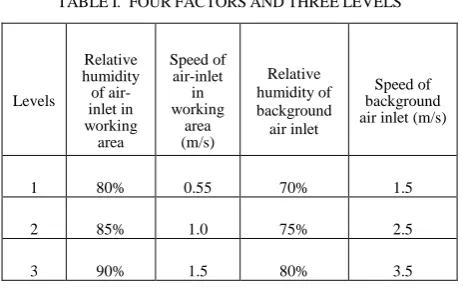
In order to better describe the effect of four main factors, here introduces three levels to represent the typical cases of each factor. One is the value of practical engineering; the other two are the higher one and lower one. There will be 81 times simulations considering four main factors in three cases, which is a heavy work.
To solve this problem, four factors and three levels method in the orthogonal experiment is introduced into simulation. Four factors and three levels method has been proved to be a scientific and proper approach. Its fundamental principle is to: select 9 representative experiments from 81 experiments. A deal of research shows that the method is a highly efficient and economically feasible method for experimental design.
In this paper, four factors and three levels method is introduced into CFD simulation in order to reduce the number of CFD simulation. If four factors and three levels method is used, the number of CFD simulation reduces to 9, that is 1/9 of comprehensive simulation, which can reduce the workload of simulation greatly.
Based on the analysis of main factors, three levels of each factor are choosing: the first level is the lower limit of practical engineering, the third level is the higher limit of practical engineering, and the second is the middle. The four main factors and three levels are shown in TABLE I.
In addition to the main factors, other parameters are accordance with the actual situation to select. For example, the size of calculative zone, the volume of loom, and the size of openings should be set according to typical condition. The temperature of air inlet in work region is 24℃,the temperature of air inlet in background area is 26℃. In addition, to ensure the convenience of worker, the space between openings of work zoon and loom surface is 1.0m.
B. Analysis of simulation result
The scheme of four factors, three levers and the results of simulation is shown in table II. A, B, C, D represent four main factors of relative humidity of air-inlet in working area, speed of air-inlet in working area, relative humidity of background air-inlet, speed of background air-inlet. The 1, 2, 3 in the middle of table are the levers of corresponding row; the result of simulation is shows in table II. In this table, relative humidity of fabric surface and comfort in operating area are simulated by the AIRPAK software. The relative humidity in the table is the average relative humidity in the surface that is 1cm above loom, while the comfort in the table is the average comfort in the vertical surface that is 35cm away from loom side.
From TABLE II it can be seen the relative humidity of fabric are all above 70%, which can meet the requirements of production, but the comfort in operating area are all above 1, which feels uncomfortable.
It can research the effect of four main factors further more through further analysis, which are shown in table III. In the table, “Kij” shows the sum of data in both “j”factor and “i” level, “Rj”shows the average value of data in both “j”factor and “i” level. For relative humidity, the biggest average value is preferred level, while the smallest average value is preferred level for comfort in operating area. “Rj”shows the difference between maximum and minimum of Kij. The larger “Rj” is, the more important the level to target of assessment; Otherwise, It is unimportant.
It can be seen from TABLE III that the order from primary to secondary of four factors is ABCD for relative humidity of fabric and the optimal scheme is A3B3C2D1.In other words, if relative humidity of fabric surface is chosen as criteria for assessment, the order from major to minor of four factors is relative humidity of air-inlet in working area, speed of air-inlet in working area, relative humidity of background air inlet, speed of background air inlet. While for comfort in operating area, the order from major to minor of four factors is BACD, and the optimal scheme is A2B3C1D1. In other words, if comfort of worker near the loom is chosen as criteria for assessment, the order from major to minor of four factors
TABLE IIFOUR FACTORS, THREE LEVERS AND THE RESULTS OF SIMULATION
Number of
simulation A B C D
Relative humidity of fabric Comfort sensation in operating area
1 1 1 1 1 72.0% 1.553
2 1 2 2 2 74.8% 1.248
3 1 3 3 3 76.4% 1.130
4 2 1 2 3 76.2% 1.523
5 2 2 3 1 79.2% 1.223
6 2 3 1 2 80.8% 1.059
7 3 1 3 2 81.0% 1.555
8 3 2 1 3 83.7% 1.226
9 3 3 2 1 85.8% 1.082
TABLEI. FOURFACTORSANDTHREELEVELS
Levels Relative humidity of air-inlet in working area Speed of air-inlet in working area (m/s) Relative humidity of background air inlet Speed of background air inlet (m/s)
1 80% 0.55 70% 1.5
2 85% 1.0 75% 2.5
Figure 4. Relative humidity of fabric surface and comfort in operating area versus relative humidity of air-inlet
is speed of air-inlet in working area, relative humidity of air-inlet in working area, relative humidity of background air inlet, speed of background air inlet.
Consequently, whether relative humidity of fabric or comfort sensation in operating area as criteria, relative humidity of inlet in working area and speed of air-inlet in working area are more important than other factors. So it should focus on the parameters of air-inlet in work zone to save energy during the course of design and operation.
C. Conclusion of CFD simulation based on four factors and three levels method
If relative humidity of fabric surface is chosen as criteria for assessment, the order from major to minor of four factors is: relative humidity of air-inlet in working area, speed of air-inlet in working area, relative humidity of background air inlet, speed of background air inlet. If comfort of worker near the loom is chosen as criteria for assessment, the order from major to minor of four factors is: speed of air-inlet in working area, relative humidity of air-inlet in working area, relative humidity of background air inlet, speed of background air inlet. Thus it should focus on the parameters of air-inlet in work zone to save energy during the course of design and operation.
V. CFDSIMULATIONBASEDON SINGLE-FACTOR
EXPERIMENTMETHODS
By analyzing main factors of large and small zone ventilation, with the help of simplified mathematical models and previous work, influence law of certain factor is analyzed by CFD simulation and single-factor experiment method.
A.. Single-factor experiment method
Single-factor experiment method is characterized by having only one independent variable that is manipulated, which purpose is to quantify relationship between a single factor and a single measured or response variable. Single-factor experiment method is commonly used in the orthogonal experiments to analyze result versus to certain factor changing with the best levels of other factors.
Therefore, based on pre-simulation results, that is, relative humidity of air-inlet in working area with 90%, speed of air-inlet in working area with 1.5m/s, relative humidity of background air-inlet with 75% and speed of background air-inlet with 1.5m/s, choosing six levels for each factor, influence law of certain factor is analyzed by CFD simulation and single-factor experiment method, which can provide a theoretical basis for practical engineering design and operation.
In addition to main factors, other parameters are accordance with the actual situation to select. For example, the size of calculative zone, the volume of loom, and size of openings should be set according to typical condition. Temperature of air inlet in work region is 24℃, and temperature of air inlet in background area is 26℃. In addition, to ensure convenience of worker, space between openings of work zoon and loom surface is 1.0m.
To deal with simulation results, relative humidity of fabric surface and comfort in operating area is applied to describe simulation results. Relative humidity in the table is average relative humidity in the surface that is 1cm above loom, while comfort in the table is average comfort in vertical surface that is 35cm away from loom side. Generally speaking, high relative humidity in the table and appropriate average comfort mean good air-conditioning.
B. Simulation by single-factor experiment method
(a) Relative humidity of air-inlet in working area changing
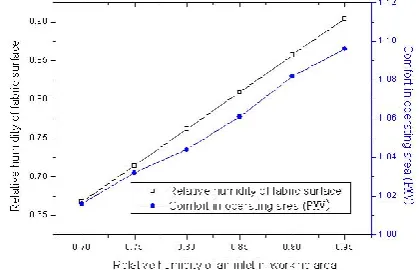
When relative humidity of air-inlet in working area changes with other three factors to be optimal, influence of relative humidity of air-inlet in working area can be simulated and analyzed based on CFD software by single-factor experiment method. Results are shown in Fig. 4.
It can be seen from Fig. 4: with relative humidity of air-inlet in working area gradual increasing, relative humidity of fabric surface and comfort in operating area increases gradually. Due to the specificity of the production, to ensure the production of normal operation relative humidity of fabric surface should maintain a high
TABLE IIIRESULT OF FOUR FACTORS AND THREE LEVELS SIMULATION
target Relative humidity of fabric Comfort sensation in operating area
factors A B C D A B C D
K1j 2.226 2.284 2.358 2.364 3.931 4.631 3.838 3.858
K2j 2.361 2.377 2.365 2.360 3.805 3.697 3.853 3.862
K3j 2.500 2.426 2.364 2.363 3.863 3.271 3.908 3.879
1
K j 0.742 0.761 0.786 0.788 1.310 1.544 1.279 1.286
2
K j 0.787 0.792 0.788 0.787 1.268 1.232 1.284 1.287
3
K j 0.833 0.809 0.788 0.788 1.288 1.090 1.303 1.293
Figure 5. Relative humidity of fabric surface and comfort in operating area versus speed of air-inlet in working area
Figure 7. Relative humidity of fabric surface and comfort in operating area versus speed of background air-inlet
Figure 6. Relative humidity of fabric surface and comfort in operating area versus relative humidity of background air-inlet
relative humidity (RH ≥ 75%). At the same time, when relative humidity of air-inlet is over 80%, relative humidity of fabric surface can reach 75%, which can meet the humidity requirement. At that moment, PMV of operating area is slightly uncomfortable area with PMV of 1.05 to 1.07, which can reach the design aim of large and small zone ventilation. Thus relative humidity of air-inlet should be chosen as 80% ~ 85%.
(b) Speed of air-inlet in working area changing
When speed of air-inlet in working area changes with other three factors to be optimal, influence of speed of air-inlet in working area can be simulated and analyzed based on CFD software by single-factor experiment method. Results are shown in Fig. 5. It can be seen from Fig. 5: with speed of air-inlet in working area gradual increasing, relative humidity of fabric surface increases gradually, while comfort in operating area decreases gradually. When speed of air-inlet in working area is chosen in 0.8~1.2m/s, relative humidity of fabric surface can meet humidity requirement and comfort requirement. Thus, speed of air-inlet in working area should be chosen as 0.8~1.2m/s.
(c) Relative humidity of background air-inlet changin
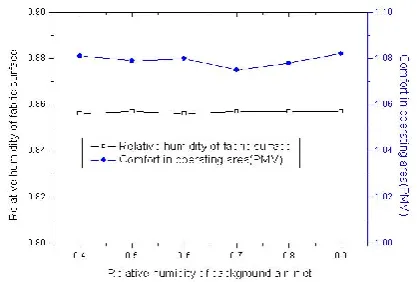
When relative humidity of background air-inlet changes with other three factors to be optimal, influence of relative humidity of background air-inlet can be simulated and analyzed based on CFD software by single-factor experiment method. Results are shown in Fig. 6. It can be seen from Fig. 6: relative humidity of background air-inlet has a little influence on relative humidity of fabric surface and comfort in operating area. Thus, only considering the fabric surface and comfort in operating area, relative humidity of background air-inlet can be arbitrary. But in reality, beside comfort around the machine, channel's comfort should also be properly considered. Therefore, relative humidity of background air-inlet should be chosen as 70% ~ 80%.
(d) Speed of background air-inlet changingRelative humidity of background air-inlet changin
When speed of background air-inlet changes with other three factors to be optimal, influence of speed of
background air-inlet can be simulated and analyzed based on CFD software by single-factor experiment method. Results are shown in Fig. 7. It can be seen from Fig. 7: change of speed of background air-inlet has a little influence on relative humidity of fabric surface and comfort in operating area. But in reality, beside comfort around the machine, channel's comfort should also be properly considered. Therefore, speed of background air-inlet should be chosen as 1.5 ~ 3.5m / s.
C. Conclusion of CFD simulation based on single-factor experiment method
Based on pre-simulation results of four factors and three levels method, combined with engineering practice, main factors of the loom workshop’s large and small zone ventilation are researched through CFD simulation software and single-factor experiment method, which provides a theoretical basis for energy-saving control in the actual operation.
• With relative humidity of air-inlet in working area gradual increasing, relative humidity of fabric surface and comfort in operating area increases gradually. Relative humidity of air-inlet should be chosen as 80% ~ 85%.
Figure 8. The relative humidity on the loom (from the loom surface of 5 cm)
Figure 10. The PMV values of 20cm vertical plane from the loom surface
Figure 9. The PMV values of 5cm horizontal plane from the loom surface
gradually, while comfort in operating area decreases gradually. Speed of air-inlet in working area should be chosen as 0.8~1.2m/s.
• Relative humidity of background air-inlet and speed of background air-inlet have a little influence on relative humidity of fabric surface and comfort in operating area. But in reality, beside comfort around the machine, channel's comfort should also be properly considered. Therefore, relative humidity of background air-inlet should be chosen as 70% ~ 80%, speed of background air-inlet should be chosen as 1.5 ~ 3.5m / s.
VI. CFDSIMULATIONBASEDONABOVE RECOMMEND PARAMETERS
Base on above recommend parameters, CFD software is applied to simulate relative humidity and PMV on the loom.
A. The relative humidity of the calculated region equations
The relative humidity on the loom (from the loom surface of 5 cm) is shown as Fig. 8. It can be seen from Fig. 8 that: relative humidity about the loom is above 75 percent, which can meet the specific requirements of cloth for high humidity. In the operating area, relative humidity of most region below 65%. Therefore, the design of the relative humidity meets the design requirements.
B. The comfort of the calculated region
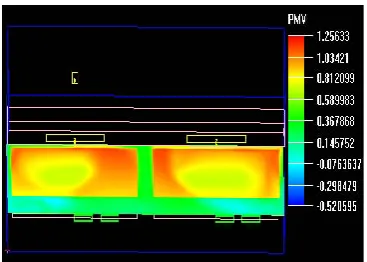
The PMV values of 5cm horizontal plane and 20cm vertical plane from the loom surface are shown as figures 9 and 10, separately. ISO7730 recommends the comfort PMV values between -0.5 ~ 0.5. In that range, more than 90% of people express satisfaction with the thermal comfort, so the PMV in this range can be considered a comfort value. It can be seen from Fig. 9 that: PMV value on the loom is above 1, and this zone is an uncomfortable zone. In the operating area, PMV values are almost between -0.5 ~ 0.5. It can be seen from Fig. 10 that PMV values are almost between -0.5 ~ 0.5, that is, these regions are in a comfortable area.
C. Rresults of above design
• CFD simulation is applied for the relative humidity of the large and small zone ventilation. The relative humidity about the loom is above 75 percent, which can meet the specific requirements of cloth for high humidity. In the operating area, most of the region below 65%. Therefore, the design of the relative humidity meets design requirements.
• CFD simulation is applied for the comfort of the large and small zone ventilation. PMV value on the loom is above 1. In the operating area, PMV values are almost between -0.5 ~ 0.5. Therefore, the design of the comfort meets design requirements.
• The air distribution result by the new ventilation is quite remarkable. This new energy-saving type of ventilation not only meets the technological requirements, but also saves a great deal of energy.
D. The results of above design
Figure 11. Photo of large and small zone ventilation.in loom workshop
Figure 12. Measuring flow field result of vertical cross on the loom at a typical area
Figure 13. Simulation g flow field result of vertical cross on the loom at a typical area
-0.2 0.0 0.2 0.4 0.6 0.8 1.0 1.2 1.4 1.6 1.8 0.70
0.75 0.80 0.85 0.90 0.95 1.00 1.05
PMV
X(m)
Simulation Value Experiment Value
Figure 14. Experiment and simulation of PMV in vertical cross section at a typical area
over 75 percent. Then this new energy-saving type of ventilation not only meets technological requirements, but also save a great deal of energy.
VII. EXPERIMENT BASE ON ABOVERECOMMEND PARAMETERS
The comparison of simulation results and experiment is used to verify feasibility of simulation results in this section.
A. Experiment and simulation of flow field in vertical cross section
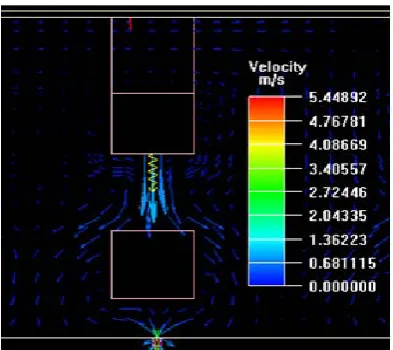
As Fig. 2 shows, the object of experiment is a loom workshop with large and small zone ventilation, which is designed with above recommend parameters. The loom workshop installs 106 looms, with area of 57 m × 50m, which is shows in Fig. 11. Measuring instrument is chosen as multi-parameter ventilation meter TSI9555. Result of measuring at a typical area is shown as Fig. 12. Result of simulation is provided as Fig.13 at the same time for comparison purpose.
It can be seen form Fig. 12~13 that test results and simulation results are almost the same trend and very close with difference less than 10%, which belongs to the scope can be accepted in engineers.
B. Experiment and simulation of PMV in vertical cross section
According to the relevant knowledge of PMV, the corresponding PMV value can be calculated by temperature and humidity. Experiment and simulation of PMV are shown in Fig. 14.
It can be seen from Fig. 16~17 that: simulation and experimental results are less than 1.1, slightly uncomfortable in hot conditions, which meet the operational needs of workers. Simulation and experimental results are very similar, with difference below 10%. Due to interference in the actual project many factors, difference below 10% is acceptable range. The results show that: numerical results are more
accurate, and numerical models are high precision, which can be reflected in the actual construction. Therefore, the calculated method proposed in this paper is feasible.
Ⅷ. CONCLUSIONS
Based on theory of statistics, main factors affecting the effects of the loom workshop’s large and small zone ventilation using the CFD simulation in this paper. Firstly, CFD simulation is applied based on four factors and three levels of orthogonal experimental table to obtain the order from major to minor of four factors; then CFD simulation is applied based on single-factor experiment method to obtain certain factor changing; experiment is carry out to verify feasibility of simulation results. The conclusions are as follows.
It should focus on the parameters of air-inlet in work zone to save energy during the course of design and operation.
simulation is applied for the relative humidity of the large and small zone ventilation. The relative humidity about the loom is above 75 percent, which can meet the specific requirements of cloth for high humidity. In the operating area, most of the region below 65%. Therefore, the design of the relative humidity meets design requirements. CFD simulation is applied for the comfort of the
large and small zone ventilation above recommend parameters. PMV value on the loom is above 1. In the operating area, PMV values are almost between -0.5 ~ 0.5. Therefore, the design of the comfort meets design requirements. Simulation and experimental results are very
similar. Which shows that: numerical results are more accurate, numerical models are high precision, and the calculated method proposed in this paper is feasible.
ACKNOWLEDGMENT
The project is supported by the Education Department Natural Science Fund of Henan Province (Project No: 2006560008) and Henan Science and Technology Research Project (Project No: 092102210317).
REFERENCES
[1] Zhu Caixia, Zhao Nannan, Gao Long, Song Gaoju. New
Energy-saving Type of Ventilation for Loom Workshop. ICEET09, 210-213.
[2] Zhou Yide, Zhao Nannan, Yang Ruiliang. Based on four
factors and three levels of simulation analysis of cloth machine shop area air-conditioning factor. Zhongyuan Institute of Technology, 2009.7, 26 (7) ,14-18. ( in Chinese)
[3] Yang Ruiliang, Zhao Nannan, Zhou Yide, Song Gaoju.
Analysis of New Type Air-conditioning for Loom Based on CFD Simulation and Theory of Statistics, IFCSTA 2009, 2009, 363-366. ( in Chinese)
[4] Fan Rui, Yang Ruiliang, Zhou Yide, Gao Long. Cloth
machine shop air supply of new energy-saving methods and CFD simulation, Energy-saving Technology, 2008,26 (149): 241-246. ( in Chinese)
[5] Zhou Yide, Fan Rui, Yang Ruiliang. Jet loom workshop
area air-conditioning energy-saving principle of analysis, Textile Technology, 2008,36 (10): 9-11. ( in Chinese)
[6] Zhou Yide, Yang Ruiliang etc. Energy-saving technology
for textile air conditioning and dust [M], China Textile Press, Beijing, 2009. ( in Chinese)
[7] Yang Ruiliang, Lang Wanchen, Advance of personalized
ventilation, Western Refrigeration of Air-conditioning and HVAC,2006.4, 40-43. ( in Chinese)
[8] Yang Ruiliang, Zhou Yide, Wang Hui, Design Ideas of Air
Conditioning for Energy-saving Textile Enterprises, Shanghai Textile Science & Technology,2009,37(8):56-58. ( in Chinese)
Yang Ruiliang, China, 1977, received Ph.D. degree from Shanghai Jiaotong University in China in 2004. His major field of study inludes: numerical simulation, energy-saving design for air conditioning.
He is presently a teacher in school of energy and
environmental engineering, Zhongyuan University of
Technology, which is located in Zhengzhou City, China. He has published more than 20 journal paper and the publication of "noise rapid diagnostic techniques - HELS method of application of theory and engineering".
Dr. Yang is a senior member of China Refrigeration Association.
Zhou Yide, China, 1957, received Bachelor degree from China Textile University in China in 1982. His major field of study inludes: numerical simulation, Textile Air Conditioning.
He is presently a teacher in school of energy and
environmental engineering, Zhongyuan University of