Erdös Conjecture on Connected Residual Graphs
Jiangdong Liao
College of Mathematics and Computer Sciences, Yangtze Normal University, Fuling 408100, Chongqing, P.R. China, Email: [email protected]
Gonglun Long
Information Technology Center of Chongqing Normal University, Chongqing 401331, P.R. China
Mingyong L
i
College of Computer and Information Science, Chongqing Normal University, Chongqing 401331, P.R. China
Abstract—A graph G is said to be F-residual if for every point u in G, the graph obtained by removing the closed neighborhood of u from G is isomorphic to F. Similarly, if the remove of m consecutive closed neighborhoods yields Kn, then G is called m-Kn-residual graph. Erdös determine the minimum order of the m-Kn-residual graph for all m and n, the minimum order of the connected Kn-residual graph is found and all the extremal graphs are specified. Jiangdong Liao and Shihui Yang determine the minimum order of the connected 2-Kn-residual graph is found and all the extremal graphs are specified expected for n=3, and in this paper, we prove that the minimum order of the connected 3-Kn-residual graph is found and all the extremal graphs are specified expected for n=5, 7, 9,10, and we revised Erdös conjecture.
Index Terms—Residual-graph, Closed neighborhood, Adjacent, Cartesian product
I. INTRODUCTION
A graph G is said to be F-residual if for every point u in G, the graph obtained by removing the closed neighborhood of u from G is isomorphic to F. If G is a graph such that the deletion from G of the points in each closed neighborhood results in the complete graph Kn-residual graph. We inductively define multiply-Kn-residual graph by saying that G is m-F-multiply-Kn-residual if the removal of the closed neighborhood of any point of G result in an (m−1)-F-residual graph, where of course a 1-F-residual graph is simply an 1-F-residual graph.
It is natural to ask what is the minimum number of points that an m-Kn-residual graph must contain. We easily prove that this number is (m+1)n and that the only m-Kn-residual graph with this number of point is (m+1)Kn. In [2] they show that a connected Kn-residual graph must have at least 2n+2 points if n
≠
2. Furthermore, the cartesian product G≅
Kn+1×
K2 is theonly such graph with 2n+2 points for n
≠
2; 3; 4. They complete the result by determining all connected Kn-residual graph of minimal order for n = 2, 3, 4.The concept of residual graphs was firrst in-duced[1], by Paul. Erdös, Frank. Harary and Maria.Klawe.They studied residually complete graphs, determined the minimum order of m-Kn-residual graphs are (m+1)n, and (m+1)Kn is the corresponding extremal graph for any posi-tive integers m and n.C5 is the unique connected K 2-residual graph with least order 5. For1< n
≠
2, the least order of connected Kn-residual graphs is 2(n+1), for n≠
2; 3; 4 Kn+1×K2 is unique connected Kn-residual graphs with least order. The authors[2] proved that for any positive integers n and k, there exist Kn-residual graphs with even order 2(n + k). For n= 2; 3; 4 there exist Kn-residual graphs with odd order 2n+3. And for n = 6, C5[K3] is the unique connected. K6-residual graph with least odd order 15. In this paper we proved that for any positive odd number t and n = 2t, C5[Kt] is the unique connected Kn-residual graphs with least odd order 5t. The least odd order of Kn-residual graphs is 5(n + 1)/2. It is easy to prove that for any odd number n, there is no K n-residual graphs with odd order. For t = 5,n = 2; 4; 6; 8, we construct the corresponding connected Kn-residual graphs with odd order 2n+t = 9; 13; 17; 21 respectively. For t is odd, n = 2t−2 and n = 2t−4, we constructed the corresponding connected Kn-residual graphs with odd order 2n + t as well.We state the following conjecture [2].
Conjecture 1. If n
≠
2, then every connectedm-Kn-residual graph has at least Min{2n(m + 1); (n + m)(m + 1)} points.
Conjecture 2. For n large, there is a unique smallest
connected m-Kn-residual graph.
The known supportting results are summarized in the following theorem.
Theorem 1.1 (Erdös [2]). (1) If G is F-residual, then
for any point u in G, the degree
Manuscript received May 10, 2011; revised June 20, 2011, accepted July 1, 2011.
d(u) = P(G) −P(F) −1.
(2) Every m-Kn-residual graph has at least (m+1)n points, and (m+1)Kn is the only m-Kn-residual graph with (m + 1)n points.
(3) Every connected Kn-residual graph has at least 2n + 2 points if n
≠
2.(4) If n
≠
2, then G≅
Kn+1×
K2 is a connected Kn-residual graph of minimum order, and except for n = 3 and n = 4, it is the only such graph.In this paper, [Theorem 3.1, Theorem 3.2] we show that a connected 3-Kn-residual graph must have at least 4n+12 points if n≥11. Furthermore, the cartesian product G
≅
Kn+3×
K4 is the only such graph with 4n + 12 points for n≥
11, we construct the result by determining all connected 3-Kn-residual graph of minimal order for n = 3, 4, 6, and connected 3-K8-residual graph has only one graph G≅
K11×
K4 with mini- mum order. In Section 4, we revise Erdös conjecture.In general the notation follows that of [1]. In particular P(G) is the number of points in a graph G, N(u) is the neighbor- hood a point u consisting of all points adjacent to u.N*( )u is the closed neigh- borhood of u.
Definition 1.1. Let F
⊂
G,then dG(F)=
( ) ( )
G F
x F x F
d x d x
∈ − ∈
∑
∑
Definition 1.2. If x
∈
X and y∈
Y are adjacent, then Xand Y are said to be adjacent, and vice verse. For any point x
∈
X and any point y∈
Y, if x is adjacent to y then said to X is complete adjacent to Y .Definition 1.3. G = 1
m i i= G
∪ , where Gi is a subgraph G,
G
≅
F, Gi∩
Gj =∅
, and Gi is nonadjacent to Gj(i, j = 1; 2 m; i≠
j), denoted by G≅
mF.II. 2-KN-RESIDUAL GRAPH
We begin third section with a simple obser-vation which will turn out to be extremely useful lemmas, these lemmas in [3].
Lemma 2.1. Let G be a Kn-residual graph for n is
odd,then P(G) is even.
Lemma 2.2. Let G be a Kn-residual graph with
P(G)
≠
2n + 3 for n≠
2, 4, 6.Lemma 2.3. Let G be a connected 2-Kn- residual
graph with P(G) =3n+t for n≥ 3, where 1≤ t ≤ 2n. Then
(1) n ≤ d(u)≤ n+t−1, ∀u∈G; (2) d(u)
≠
n + t − 2, ∀u∈G;(3)There exist some point u∈G, thus d(u)
≠
n + t −1;
≠
Lemma 2.4. Let G be a connected 2-Kn-residual graph
with P(G)=3n +t for n≥ 3, where 1≤t≤2n. Then d(u)
≠
n, ∀u∈G.Lemma 2.5. Let G be a 2-Kn-residual graph with
P(G)≥ 3n+4 for n≥ 3.
Lemma 2.6. The connected 2-Kn-residual graph with
P(G) =3n+t for n ≥ 3. If there exist u ∈G, d(u) = n+1, then exist there d(v)=n+t− 1, where v∈G.
Lemma 2.7. The connected 2-Kn-residual graph with
P(G)=3n+t for n and t are odd, then d(u) is odd.
Lemma 2.8. Let G=<H1∪H2∪X> be a connected
Kn-residual graph with P(G)=2n+t for n≥3 and t < 2n, where H1≌Kn and H2=Kn, |X| =t, then
(1). H1 is adjacent to H2;
(2). Hj is not complete adjacent to X, where j= 1, 2.
Lemma 2.9. Let G be a connected 2-Kn-residual graph
with P(G) = 3n+t for n ≥ 5 and 4 ≤t≤ 6, then there dose not exist three mutually non adjacent points whose degree are n + t−1.
Lemma 2.10. Let G be a connected 2-Kn-residual
graph with P(G) = 3n+t for n ≥5 and n≠6, where 4 ≤t≤ 6, then there does not exist mutually nonadjacent points whose degree are n + t−1.
Lemma 2.11. Let G be a connected 2-Kn- residual
graph with P(G) =3n + t for n≥5, where 4≤t≤6, then there does not exist complete mutually adjacent points whose degree are n+ t−1.
Theorem 2.1. Every connected 2-Kn-residual graph
has at least 3n+6 for n≥ 5.
Lemma 2.12. Let G be a connected 2-Kn-residual
graph with P(G)=3n+6 for n≥ 5 and n≠ 6, then d(u) = n + 3,
∀
u
∈
G
.Theorem 2.2. If n≥ 5, then G Kn+2×K3 is a
connected 2-Kn-residual graph of minimum order, and expect for n=6, it is only such graph.
Fig. 1. 2-K2-residual graph
III. 3-KN-RESIDUAL GRAPH
Lemma 3.1. Let G be a connected 3-Kn- residual
graph with P(G) = 4n+t for n≥ 7, where 1≤t≤2n. Then (1) n + 3 ≤d(u)≤ n + t-1;
∀
u
∈
G
;(2) d(u) ≠ n + t-4, d(u) ≠n + t-5,
d(u) ≠n + t-6,
d(u) ≠n + t-8 for
∀
u
∈
G
.Proof.(1) Since G−N*(u) =G1 is a 2-Kn-residual
graph, let d(u) = n+ t, then P(G1)= 3n, by Theorem 2.2 we have
P(G1) ≥3n + 6, a contradiction. By Theorem 2.2 we have
d(u)≥n + 3.
So n + 3≤d(u)≤n + t-1,
∀
u
∈
G
.(2) Set G−N*(u) = G1;
∀
u
∈
G
, G1 is a 2-Kn-residual graph, by Theorem 2.2 we haveP(G1) ≠3n+3; 3n+4; 3n + 5 for n≥7, P(G1) ≠3n + 7 for n ≠4; 6,
then
d(u) = P(G)−P(G1)−1 ≠n +t−4; n +t−5; n + t−6; n + t −8, for n ≥7.
By proof method of Lemma 2.9, we have
Lemma 3.2. Let G be a connected 3-Kn-residual graph
with P(G) =4n+ t for n ≥ 11 and 1≤ t ≤2n, then there dose not exist four mutually nonadjacent vertices whose degree are n + t −1.
By proof method of Lemma 2.10, we have
Lemma 3.3. Let G be a connected 3-Kn- residual
graph with P(G)=4n+t for n ≥11 and 1 ≤ t ≤2n, then there dose not exist three mutually nonadjacent points whose degree are n + t − 1.
Lemma 3.4. Let G be a connected 3-Kn-residual
graph with P(G) =4n+t for n≥11, where 1≤t≤2n, then there does not exist mutually nonadjacent points whose degree are n + t − 1.
By proof method of Lemma 2.11, we have
Lemma 3.5. Let G be a connected 3-Kn-residual
graph with P(G) = 4n + t, for n ≥ 11, where 1≤t≤2n, then there does not exist complete mutually adjacent points whose degree are n + t − 1.
By proof method of Lemma 2.12, we have
Lemma 3.6. Let G be a connected 3-Kn-residual
graph with P(G)=4n+t, for n≥ 11, where 1 ≤ t ≤ 2n, then there does not exist case that G has just only one point of degree is n + t − 1.
So, let G be a connected 3-Kn-residual graph with P(G) = 4n + t, where 1 ≤ t ≤ 2n, by Lemma 3.2, 3.3, 3.4, 3.5, 3.6, we have d(u)
≠
n + t − 1 for∀
u ∈ G, Shihui Yang and Huiming Duan [3] determined d(u)≠
n+t−3, d(u)≠
n+t−5 for∀
u ∈G. By proof method of Theorem 2.2 and Theorem 2.3, we haveTheorem 3.1. Every connected 3-Kn-residual graph
has at least 4n + 12 for n≥11.
Proof. Let P(G)=4n+t, by Lemma 3.1, 3.2, 3.3, 3.4,
3.5, 3.6 we have
n+4 ≤d(u)≤ n+t-7 then t≥11.
We now prove that t ≠11.
Suppose that t=11, then d(u) = n + 4,
∀
u
∈
G
, if u is nonadjacent to v, where u, v∈
G, setN*(u)∩ N*(v) = X;
G1 = G−N*(u); G2 = G−N*(v), then u
∈
G2, v∈
G1. SetG-N*(u)-N*(v) = G-N*(v) −N*(u) = H
≅
Kn. By P(G1) = P(G2) = 3n + 6,dG1(w) = dG2(w) = n + 3,
∀
w∈
H, thenN*(v)-X has (n+3)-dH(w) = (n+3)-(n-1) = 4 points adjacent to w
∈
H in G1, andN*(u)-X has four points adjacent to w
∈
H in G2. By (N*(u) −X)∩
N*(v)-X) =∅
, thusd(w)≥ dH(w) + 4 + 4 = n−1+ 4 + 4 = n + 7, contrary to d(w) = n + 4.
So P(G) ≥4n+12.
Lemma 3.7. Let G be a connected 3-Kn-residual graph
with P(G)=4n+12 for n≥11,then d(u) = n + 5;
∀
u
∈
G
.Proof. Since d(u) ≥n+3, t = 12, d(u) ≠ n+t-8 = n+4, then d(u)≥n+5.
Theorem 3.2. If n ≥11, then G Kn+3×K4 is a
connected 3-Kn-residual graph of minimum order, it is only such graph.
Proof. Fact 1. Let F =<H1∪ H2∪ H3>
≅
Kn+2×K3,where H1
≅
H2≅
H3≅
Kn+2, then Hi and Hj have bijectionθ
: V (Hi)→
V (Hj),and u1
∈
Hi is adjacent to µ(u1)∈
Hj , where i ≠j; i; j = 1; 2; 3. If H⊂
F and H≅
Ks; 3≤ s≤n + 2, thenH
⊂
H1 or H⊂
H2 or H⊂
H3. Fact 2. By Lemma 3.2 we haved(u) = n+5, G1 = G-N*(u),∀u
⊂
G, P(G1) = 3n + 6so G1
≅
Kn+2×K3, setG1=<H1 ∪ H2 ∪ H3>=< | 1,2, ,1,2,3 2
j j n
r r
x == + >,,
whereHr=<
x
r 1,
x
r2
,…,
x
nr 2 +>,
and
x
il is adjacent to
x
jm if i = j,
x
il is nonadjacent tox
jm if i ≠ j.
wherel ≠m; l,m = 1, 2, 3 (3.1)
Set G2 = G-N*(
x
n 2 2+
) =<
H
*0 ∪ H* 1 ∪
H
* 3>
≅
Kn+2 × K3,by(3.1) we have Kn+1
≅
H1-x
n2 1
+
=<
x
1 1,x
2 1 ,…,
x
n1 1
+
>
⊂
G2, by Fact 1 without loss of generality we may assume that<
x
1 1,
x
2 1,…,
x
n1 1
+ >
⊂
H
* 1
=<
x
0 1,
x
1 1,…,
x
n 1 1 + >, <
x
1 3,x
2 3,…,
x
n 1 3
+
>
⊂
H
* 3
=<
x
0 3,
x
1 3,…,
x
n 1 3
+
> (3.2)
If 0 j
x
∈
*0
H
is adjacent tox
3j, where j=0, 1,… ,n+1, obvious
x
0
0 = u, then
H
*0 =<x
0 0,
x
1 0,…,
x
n1 0
+
>. We now prove
x
10is adjacent tox
n 2 1
+
. Suppose the contrary, set
G3 = G-N*(
x
1n2 +);
x
01∈
G3,by (3.1) and (3.2) we have
x
01is adjacent to {x
11,x
2 1,…,x
n1 1
+
}
⊂
N*(x
n1 2 +), thus d(
x
10)≥
dG3(x
0
1) + n + 1 = n + 2 + n + 1 > n + 5,
a contradiction. So
x
0
1is adjacent to
x
n 2 1+
, hence
x
01is adjacent toH1.Set H1 =<
x
0 1,
x
1 1,…,
x
n2 1
+
>
≅
Kn+3. Similarx
0
3 is adjacent to
x
n2 3+ ,
x
03is adjacent to H3. Set H3 =<x
0 1,
x
1 1,…,
x
n2 1
+
>
≅
Kn+3. Similarx
0
2
∈
N*(u) is complete adjacent to H2 ,obvious
x
0 2≠
x
0 1,
x
0 2≠
x
0 3,
so
H2 =<
x
0 2,
x
1 2,…,
x
n2 2
+
>
≅
Kn+3.Similar, in G-N*(
x
n 2 2+ ) =<
H
*0∪H* 1∪H
* 3>,
we have
x
n 2 0+
∈
N*(x
n 2 2+
)=<
H
*0∪
H
*
1>complete
adjacent to
H
*0.Obvious
x
n 2 0+
∈
(H2 ∪x
1n 2 + ∪x3n2 +
)
⊂
N*(xn22 +) So H0 =<
x
0 0,
x
1 0,…,x
n2 0
+
>
≅
Kn+3.Fact 3. Any point in Hr is adjacent to single point in Hs
≠
r. Suppose the contrary, let xj∈
H0 be nonadjacent to H2, then G*=*
0 2 3
( )j n
G−N x ≅K + ×K , but H
≅
Kn+3,H2⊂
G*, contrary to *2 3
n
G ≅K + ×K x0
j
is adjacent to H2. If H2 has two points adjacent to
0
j
x
, by dH0( 0jx
) = n + 2, d 0jx
) = n + 4, so 0jx
is nonadjacent to H1∪
H2, a contradiction.Fact 4. By Fact 3 we have
x
10 is adjacent to H2. Ifx
10adjacent to x
0 2
j≠
, by x
0 2
j≠
is adjacent to 1j
x
, thus H1 hastwo points adjacent to 2j
x
, contrary to Fact 3.So
x
10is adjacent tox
20 .Similar
x
30 is adjacent tox
20 ,2 0
n
x
+ is adjacent to 1n 2x
+ ,2 0
n
x
+ is adjacent to 3n 2x
+ .Fact 5. Since 0j
x
is adjacent to 2jx
for j = 0, n + 2, let0
j
x
be nonadjacent to 2jx
for j≠
0, n + 2,by Fact 3 we have 0j
x
adjacent to 0i jx
≠ .Since 0j
x
is adjacent to 1jx
and 3jx
, set* j 0
(x )
G
−
N
1 1 2 2 2 3
(
j) (
j) (
j)
H
x
H
x
H
x
2 3
n
K
+K
≅
×
(3.3)By Fact 4 we have 2t
x
adjacent to 1tx
and 3tx
for t≠
i, j,by (3.1) we have 2i
x
adjacent to 1jx
and 3jx
, contrary to (3.1).So 0j
x
is adjacent to 2jx
.Hence j
|
j 0,1,2,30,1,2,n 2 r rG
=<
X
><
x
== +>
, where ir
x
is adjacent to j sx
if and only if r = s, i≠
j or i = j, r≠
s. So G≅
Kn+3×
K4.We now prove the remainder of the Theorem 3.2 involving the small cases n
≤
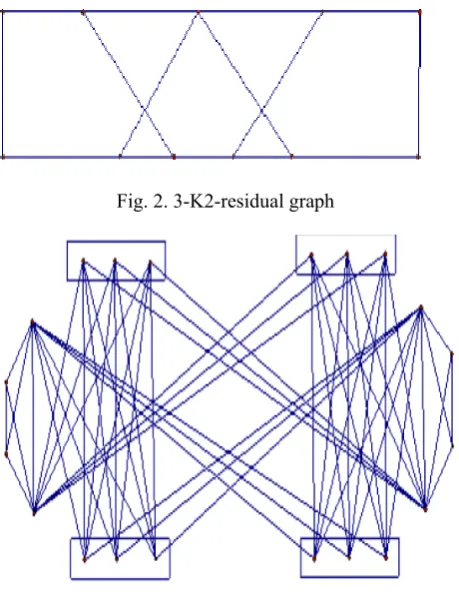
11. For n = 2, Erdös [2] construct a connected 3-K2-residual graph in Fig. 2. For n = 3 suppose G is a connected 3-K3-residual graph with P(G) = 20<4×
3+12=24, the graph in Fig.3. In the Section2, we by connected 2-K2-residual graph construct connected 2-K4-residual graph and connected 2-K6-residual graph, similar by con-nected 3-K2-2-K6-residual graph construct con-nected 3-K4-residual graph G1, connected 3-K6-residual graph G2 and connected 3-K8-residual graph G3,where P(G1)= 22, P(G2) =33, P(G3) = 44. For n= 8 we construct a connected 3-K8-residual graph G3≅
K11×
K4.Fig. 2. 3-K2-residual graph
Fig. 3. 3-K3-residual graph
In the above Fig. 3, we can see that all points in the same square adjacent.
IV. MULTIPLY-KN-RESIDUAL GRAPHS
To conclude the paper, let us present a conjecture. A connected (m−1)-Kn-residual graph, denoted by (m− 1)-Knm-1-residual graph, a connected m-Kn-residual graph, denoted by m-Knm-residual graph.We revised Erdös conjecture.
Conjecture 3. For all m and n, then every connected m-Kn-residual graph has at least min{2n(m+1), (n+m)(m+1), 2n
(3 2)
m
+
} points.For example: connected 2-K2-residual graph, connected 2-K4-residual graph, connected 3-K2-residual graph, connected 3-K4-residual graph, connected 3-K6-residual graph.
Conjecture 4. If nm
≥
nm−1 + 2m−1 for m≤
n andm
≠
4y + 1, where y is a Natural Number and n1=5, then G≅
Kn+m×
Km+1 is a connected m-Kn-residual graph of minimum order, it is only such graph.We have determined the minimum order of the connected m-Kn-residual graph for all m and n large, Kn+m×Km+1 is the only such graph with (n+m)(m+1) points. We suppose that Erdös conjectures is true for n≥
n0.
problem 1. What is n0 ?
problem 2. What are the extremal graphs on connected
m-Kn-residual graph for n < n0?
REFERENCES
[1] J.A. Bondy and U.S.R. Murty, U. S. R. Graph Theory, Springer Series: Graduate Texts in Mathematics , Vol.244 , 2008.
[2] P. Erdös, F. Harary and M. Klawe, Residually-Complete-Graphs, Annals of Discrete Mathematics, Vol. 6, pp 117- 123 (1980).
[3] Jiangdong LIAO and Shihui YANG, On M ultiply-Residually-Complete Graphs(unpublished).
[4] YANG Shihui. Residually Complete Graph with Odd Order, Acta Mathematics Applicate Sinca, Vol. 34 No. 4, July, 2011, pp: 1-8(in Chinese).
[5] Yang Shihui, Duan Huiming. Residually-complete Graphs with Weakly-minimum Order. Southwest China Normal University (Natural Science), 2006, 6: 7–10 (in Chinese). [6] Yang Shihui, Liu Xuewen. F[Kt]- residual Graphs.
Southwest China Normal University (Natural Science, 2003, 6: 373–376 (in Chinese).
[7] DONG Fang-ying; ZHANG Guo-fen. Normalization for microarray data: the weight function of local weight regression. Journal of Zhejiang University (Science Edition), Vol. 37 No.1 Jan. 2010, pp: 22-29.
[9] A. A. Chernyak. Residual reliability of P-threshold graphs. Discrete Applied Mathematics, Volume 135, Issues 1-3, 15 January 2004, Pages 83-95.
[10] Matthias Aschenbrenner and Stefan Friedl. Residual properties of graph manifold groups. Topology and its Applications Volume 158, Issue 10, 15 June 2011, Pages 1179-1191.
[11]Primož Lukšič, Tomaž Pisanski. Distance-residual subgraphs. Discrete Mathematics, Volume 310, Issue 12, 28 June 2010, Pages 1653-1660.
[12]Joachim B. Kaffanke, Tony Stöcker, Sandro Romanzetti, Thomas Dierkes, Martin O. Leach, N. Jon Shah. Phase- cycled averaging for the suppression of residual magnetisation in SPI sequ- ences. Journal of Magnetic Resonance, Volume 199, Issue 2, August 2009, Pages 117-125.
[13]C. Sueur, G. DauphinTanguy. Bondgraph modelling of flexible robots: the residual flexibility. Journal of the Franklin Institute, Volume 329, Issue 6, November 1992, Pages 1109-1128.
[14][Laurent Coupry. A simple linear algorithm for the edge-disjoint (s, t)- paths problem in undirected planar graphs. Information Processing Letters, Volume 64, Issue 2, 28 October1997, Pages 83-86.
[15]A.K. Samantaray, K. Medjaher, B. Ould Bouamama, M. Staroswiecki, G. Dauphin-Tanguy. Diagnostic bond graphs for online fault detection and isolation. Simulation
Modelling Practice and Theory, Volume 14, Issue 3, April 2006, Pages 237-262.
[16]Chavdar Dangalchev Residual closeness in networks Physica A: Statistical Mechanics and its Applications, Volume 365, Issue 2, 15 June 2006, Pages 556-564
[17]Marston Conder, Roman Nedela Symmetric cubic graphs of small girth Journal of Combinatorial Theory, Series B, Volume 97, Issue 5, September 2007, Pages 757-768 [18]Tuan-Fang Fan, Churn-Jung Liau, Tsau-Young LinA
theoretical investigation of regular equivalences for fuzzy graphs International Journal of Approximate Reasoning, Volume 49, Issue 3, November 2008, Pages 678-688 [19]Wassim El Osta, Belkacem Ould Bouamama, Christophe
Sueur Monitorability indexes and bond graphs for fault tolerance analysis Fault Detection, Supervision and Safety of Technical Processes 2006, Pages 1485-1490
[20]Charles J. Colbourn, A. Satyanarayana, C. Suffel, K. Sutner Computing residual connectedness reliability for restricted networks Discrete Applied Mathematics, Volume 44, Issues 1-3, 19 July 1993, Pages 221-232 [21]M. Shirvani On residually finite graph products Journal of