Incremental Mining of Across-streams Sequential
Patterns in Multiple Data Streams
Shih-Yang Yang
Department of Media Art, Kang-Ning Junior College of Medical Care and Management, Taipei, Taiwan 114, R.O.C. Email:[email protected]
Ching-Ming Chao
Department of Computer Science and Information Management, Soochow University, Taipei, Taiwan 100, R.O.C. Email:[email protected]
Po-Zung Chen and Chu-Hao Sun
Department of Computer Science and Information Engineering Tamkang University, Tamsui, Taiwan 25137, R.O.C. Email:[email protected], [email protected]
Abstract—Sequential pattern mining is the mining of data
sequences for frequent sequential patterns with time se-quence, which has a wide application. Data streams are streams of data that arrive at high speed. Due to the limita-tion of memory capacity and the need of real-time mining, the results of mining need to be updated in real time. Mul-tiple data streams are the simultaneous arrival of a plurality of data streams, for which a much larger amount of data needs to be processed. Due to the inapplicability of tradi-tional sequential pattern mining techniques, sequential pat-tern mining in multiple data streams has become an impor-tant research issue. Previous research can only handle a single item at a time and hence is incapable of coping with the changing environment of multiple data streams. In this paper, therefore, we propose the IAspam algorithm that not only can handle a set of items at a time but also can incre-mentally mine across-streams sequential patterns. In the process, stream data are converted into bitmap representa-tion for mining. Experimental results show that the IAspam algorithm is effective in execution time when processing large amounts of stream data.
Index Terms— Multiple data streams, Data stream mining,
Sequential pattern mining, Incremental mining
I. INTRODUCTION
In the era of knowledge economy, the creation, com-munication and application of knowledge are the driving force behind the growth of industry. As a result, know-ledge has become one of indispensable requirements to success. Therefore, how to acquire valuable knowledge is very important. Data mining is to discover useful know-ledge from a great amount of data. Sequential pattern mining is to find out sequential patterns that frequently happen with time or specific sequence. For example, in terms of web pages access, the access patterns of web surfers can be explored to predict the next possibly ac-cessed web page for advance access to expedite the web access.
There are many user behaviors in our daily life that can generate stream data such as the signal data of mobile
communication, stock transaction data, web pages brows-ing records, etc. These stream data have the followbrows-ing characteristics [1]: (1) unlimited data input, (2) limited memory capacity, (3) one-time processing of input data, (4) fast data arrival, (5) inability of system to halt data inflow. As the characteristics of data streams are different from those of traditional databases, database mining algo-rithms are inapplicable in the data stream environment. Data streams can be classified into single data stream and multiple data streams. Sequential pattern mining in mul-tiple data streams is an important research issue.
With the change of environment in multiple data streams, data will not only grow larger and larger but also get more and more complicated. Existing algorithms can only handle a single item at a time and hence are incapa-ble of coping with the changing environment of multiple data streams. Besides, the sequential patterns mined may cross different data streams but are regarded as existing in a single data stream. To solve these problems, in this pa-per we propose the IAspam (Incremental Across-streams Sequential Pattern Mining) algorithm to cope with more complicated multiple data streams environment. IAspam not only can handle a set of items at a time but also can incrementally mine across-streams sequential patterns.
In the process of mining sequential patterns in multiple data streams, the efficiency in calculating the support and searching for frequent sequential patterns must be taken into account. To improve efficiency, we use a bitmap representation, in which each item is converted into one bit, to reduce execution time.
The remainder of this paper is organized as follows. Section 2 reviews related work. Section 3 presents the ASPAMDAS method, which covers data sampling and the IAspam algorithm. Section 4 evaluates and compares the performance of the IAspam algorithm. Section 5 con-cludes this paper.
Due to the advent of data stream environment, tradi-tional data mining algorithms are not applicable. Conse-quently, many researches were conducted on modifying algorithms to be applicable to data stream environment, e.g. mining frequent itemsets, sequential patterns, max-imal sequential patterns, and closed sequential patterns in data stream environment. On the other hand, there are also many researches on the types and characteristics of stream data. The MSDD (Multi-Stream Dependency De-tection) algorithm proposed by Oates and Cohen [2] aims to find out the dependency rules among stream data in a multiple data streams framework. Whereas, Golab and Ozsu [3] explore the characteristics, models, and query semantics of data stream as well as explain the applica-tion of data stream in real life. After the presentaapplica-tion of data stream framework, there are many researches on mining sequential patterns in data stream environment.
In data stream environment, incremental mining retains previous mining results. However, if not updated for a long time, previous mining results might become incor-rect, for which, many studies put forward decay mechan-isms for data stream mining to prevent data from becom-ing obsolete and save memory space. Chang and Lee [4] proposed a decay mechanism for data stream environ-ment, using (1) to decay the mining results not updated for a long time to ensure correct mining results. The “d” in the equation stands for “decay rate”, “b” for “decay-base”, and “h” for “decay-base-life”.
1)
<
d
≦
b
1,
≧
h
1,
>
(b
b
=
d
-(1/h) (1)The MILE algorithm proposed by Chen et al. [5] is based on the prefix-projection concept of PrefixSpan. It is used for handling multiple data streams in a time period and mining sequential patterns in time sequence data stream environment. It identifies the prefix subsequence and suffix subsequence in stream data to reduce the gen-eration of surplus candidate sequences and combine the sequential patterns with the same prefix. The main pur-pose is to avoid repeated data searching and speed up the mining of new sequential patterns. However, as MILE is a one-time fashioned algorithm that cannot retain pre-vious mining results, it will take more time in re-mining. IncSPAM mentioned in the previous subsection is a se-quential pattern mining algorithm for single data stream environment. It adopts a sliding window to sample stream data and incrementally mines sequential patterns. As se-quential patterns will be outdated if not updated for a long time, it uses the weight to decay the support. This concept is based on the decay mechanism proposed in [6], which uses (1) to decay the support of sequential patterns.
Later the SPEED (Sequential Patterns Efficient Extrac-tion in Data Streams) algorithm was proposed by Raissi et al. [7] for mining maximal sequential patterns in data stream. It uses a new data structure to maintain frequent sequential patterns and a fast pruning strategy to allow users to locate at any time the maximal sequential pat-terns in arbitrary time intervals. The SSM algorithm pro-posed by Ezeife and Monwar [8] differs from those men-tioned above. It uses a D-list structure to effectively store
and maintain the support of all items in data stream envi-ronment. Meanwhile it continuously builds a PLWAP tree to effectively mine in batches sequential patterns in data stream, after which an FSP-tree is used to incremen-tally maintain the mining results. Also, there are some algorithms that use graphs for mining sequential patterns. The GraSeq algorithm proposed by Li and Chen [9] adopts a directed weighted graph structure to store the synopsis of sequences and only needs to scan the data stream once. It also makes use of subsequence matching to reduce the handling time of longer sequences and adopts the concept of valid node to improve the correct-ness of mining results.
The behavior patterns of mobile user in mobile com-munication environment are also a kind of sequential patterns. Lee et al. [10] proposed the T-Map-Mine algo-rithm for mining the behavior patterns of mobile user. It mines mobile sequential patterns from mobile user's sig-nal data within each time interval at each location. A mo-bile sequential pattern includes a sequential pattern and a moving path. T-Map-Mine uses T-Map-Tree to store se-quential patterns and adds the moving locations and cus-tomer data to T-Map-Tree one by one to increase the support of locations and sequential patterns. The mining results are the sequential patterns with frequent moving paths found in Map-Tree. In the mining process, T-Map-Mine must continuously search and insert nodes. Besides, the tail node of each branch of T-Map-Tree is connected to a RST (Requested Services Tree) to store sequential patterns. Therefore, in processing large amount of data, more time is needed for the construction and tra-versal of the tree.
III.THE ASPAMDASMETHOD
A. Data Sampling
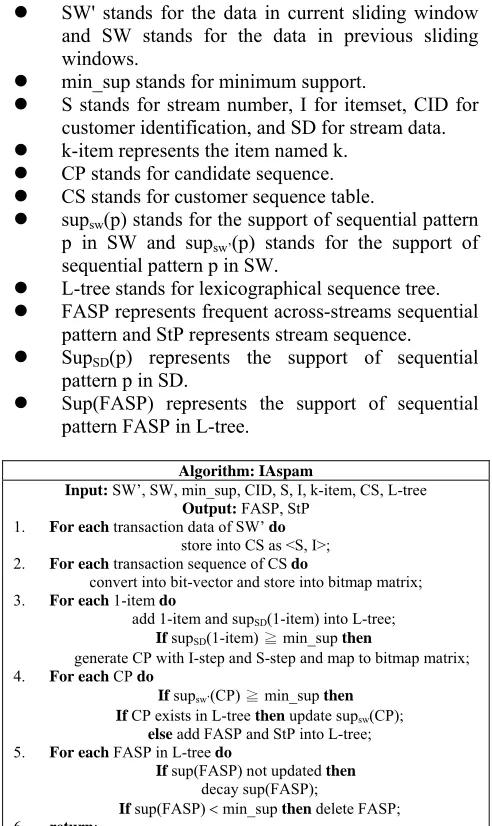
In data stream environment, due to the increasing need of real-time knowledge and the limitation of data streams, the newer the data is, the more important it becomes. Ac-cordingly, we use a sliding window to sample new stream data and dump the old ones that have been processed. As shown in Figure 2, the sliding window only maintains the newest N pieces of transaction data. N stands for the win-dow size. After the transaction data within the winwin-dow is processed, the window will move forward one time point to sample the newest stream data to process.
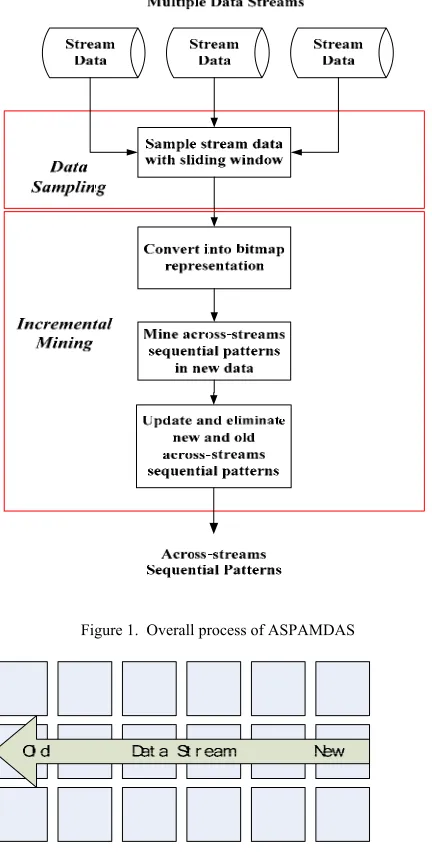
Figure 1. Overall process of ASPAMDAS
Figure 2. Sliding window in data stream environment
Figure 3 shows an example of multiple data streams. S1, S2, and S3 represent three data streams. Data from three data streams will be received at each time point. Wi stands for the ith window. Each data stream can be re-garded as a location of customer transaction; whereas the
stream data at each time point can be viewed as a piece of customer transaction data. These customer transaction data ordered by their arrival sequence become the trans-action sequence data. The window size is 3, which means each time the sliding window samples transaction data of the latest 3 time points. For example, the customer trans-action data sampled at the first time point are C1:(a,c), C3:(b,c,d), and C4:(b,c). The sliding window will move in the direction of time. After the transaction data in W1 are processed, the sliding window will move forward one time point to process the transaction data in W2. In this way, stream data will be mined incrementally.
Figure 3. Example of multiple data streams
B. Incremental Mining
As described in previous subsection, a sliding window is used to sample stream data for mining. But due to the characteristics of data stream and the limitation of memo-ry capacity, not all the mining results will be completely stored. Therefore, the concept of incremental mining is introduced to prevent the problem of imprecise mining results. As new stream data are produced continuously, the mining results will be continuously updated with the mining of new stream data. Below are possible situations of sequential pattern updating:
1. New data bring in new sequential patterns, which are frequent sequential patterns.
2. After updated, frequent sequential patterns remain frequent sequential patterns.
3. Frequent sequential patterns may become infre-quent seinfre-quential patterns.
4. Infrequent sequential pattern may turn into frequent sequential patterns.
Situation 1: A frequent sequential pattern mined in cur-rent sliding window does not appear in previous mining results. This sequential pattern is a new frequent sequen-tial pattern.
Situation 2: A frequent sequential pattern mined in cur-rent sliding window already exists in previous mining results. After updating its support, this sequential pattern remains a frequent sequential pattern.
its support decays to less than the minimum support, this sequential pattern will become an infrequent sequential pattern.
Situation 4: An infrequent sequential pattern may turn into a frequent sequential pattern in current sliding win-dow if in previous mining results each of its subse-quences is a frequent sequential pattern and does not have any supersequence.
Definition 1 (support): Let α be a sequential pattern.
The support of α is the ratio of the number of transactions containing α to the number of all transactions.
Definition 2 (frequent sequential pattern): Let α be a
sequential pattern. Then α is a frequent sequential pattern if and only if the support of α is greater than or equal to the minimum support.
Definition 3 (frequent across-streams sequential pattern): Let α be a sequential pattern, β be a stream
se-quence, and the sequence of streams containing the sub-sequences of α be a subsequence of β. Then α is a fre-quent across-streams sefre-quential pattern if and only if β is a frequent stream sequence.
Figure 4 shows the IAspam algorithm whose parameter definitions are as follows:
z SW' stands for the data in current sliding window and SW stands for the data in previous sliding windows.
z min_sup stands for minimum support.
z S stands for stream number, I for itemset, CID for customer identification, and SD for stream data.
z k-item represents the item named k.
z CP stands for candidate sequence.
z CS stands for customer sequence table.
z supsw(p) stands for the support of sequential pattern p in SW and supsw’(p) stands for the support of sequential pattern p in SW.
z L-tree stands for lexicographical sequence tree.
z FASP represents frequent across-streams sequential pattern and StP represents stream sequence.
z SupSD(p) represents the support of sequential pattern p in SD.
z Sup(FASP) represents the support of sequential pattern FASP in L-tree.
Algorithm: IAspam
Input: SW’, SW, min_sup, CID, S, I, k-item, CS, L-tree Output: FASP, StP
1. For each transaction data of SW’ do store into CS as <S, I>; 2. Foreach transaction sequence of CS do
convert into bit-vector and store into bitmap matrix; 3. Foreach 1-item do
add 1-item and supSD(1-item) into L-tree; If supSD(1-item) ≧ min_sup then
generate CP with I-step and S-step and map to bitmap matrix; 4. For each CP do
If supsw’(CP) ≧ min_sup then
If CP exists in L-tree then update supsw(CP); else add FASP and StP into L-tree; 5. For each FASP in L-tree do
If sup(FASP) not updated then decay sup(FASP);
If sup(FASP) < min_sup then delete FASP; 6. return;
Figure 4. IAspam algorithm
The IAspam algorithm consists of three parts. The first part is the conversion into bitmap representation (Step 1-2). Customer transaction data will be converted into a bitmap matrix. The second part is the mining of across-streams sequential patterns in new data (Step 3). I-step and S-step are conducted on the 1-item to generate candi-date sequences, which will be mapped to the bitmap ma-trix. The third part is the integration of new and old se-quential patterns (Step 4-5). The newly mined patterns will be compared with previous patterns to update se-quential patterns and decay the support of the sese-quential patterns not updated. Below is the detailed explanation of the steps of the IAspam algorithm.
Step 1: Store customer transaction data in current slid-ing window into the customer sequence table, in which data are ordered by customer identification. Data format is <S, I>.
Step 2: Convert each transaction sequence of the cus-tomer sequence table into a bitmap vector of the cuscus-tomer bitmap matrix. Judge if the itemset at each time point contains k-item. If yes, store bit 1 into the column of that time point of k-item; otherwise, store bit 0.
Step 3: Count the support of each 1-item in each stream and store each 1-item and its supports into L-tree. Judge if every support of a 1-item is greater than or equal to the minimum support. If yes, conduct I-step and S-step to generate candidate sequences and map them to a bit-map matrix. In the bit-mapping process, the candidate item-sets generated by I-step will be used to search for the ‘1’ bits that are at the same time point and in the same stream but not in the same item, and count the support. Whereas, the candidate sequences generated by S-step will be used to search, in different items and at different time points, for the ‘1’ bits whose prefix subsequences are at the same time point and in the same stream and the ‘1’ bits whose suffix subsequences are at the same time point and in the same stream, and count the support.
Step 4: Judge if the support of each candidate sequence in SW' is greater than or equal to the minimum support. If yes, check to see if the frequent sequential pattern exists in the lexicographical tree. If yes, update the support of this sequential pattern. Otherwise, insert a frequent across-streams sequential pattern (FASP) and a stream sequence (StP) into the lexicographical tree.
Step 5: Judge if the support of each FASPin the lex-icographical tree has been updated. If not, decay the sup-port of FASP and judge if the decayed supsup-port is less than the minimum support. If yes, delete FASP to get rid of the FASP that has not been updated for a long time.
Step 6: Output FASP and StP.
is not necessary to conduct I-step and S-step on infre-quent sequences and hence no surplus candidate se-quences will be generated.
Each leaf node of a lexicographical tree records a frequent across-streams sequential pattern plus its support and stream sequence. The purpose of constructing a lex-icographical tree is to store frequent across-streams se-quential patterns in order to insert new across-streams sequential patterns or to combine or update new and old across-streams sequential patterns. The nodes of a lexico-graphical tree have a lexicolexico-graphical order. The order of constructing a lexicographical tree is from top to bottom and from left to right. According to the characteristics of lexicographical order, the possible lexicographical orders of sequences are as below: [8]:
z If s’ = s ◇ p, then s < s’; e.g. <(a,b)> <
<(a,b)(b)>.
z If s = α◇I p, s’ = α◇I p’, and p < p’, then s <
s’; e.g. <(a,b,c)> < <(a,b,d)>.
z If s = α◇S p, s’ = α S p’, and p < p’, then s <
s’; e.g. <(a,b)(c)> < <(a,b)(d)>.
z If s = α I p and s’ = α S p’, then s < s’ regardless the order of p and p’; e.g. <(a,b,c)> <
<(a,b)(a)>.
After the construction of the lexicographical tree, the across-streams sequential patterns in the tree will be up-dated with the production of new mining results. The across-streams sequential patterns that have not been up-dated for a long time may become obsolete. In maintain-ing the lexicographical tree, it is therefore necessary to decay their supports to delete those sequential patterns that have not been updated for a long time. The decay equations are as follows:
p
d
weight
=
,0
≤
d
≤
1
(2)u
w
p
=
−
(3)sup
sup
_
=
weight
×
w
(4)In (2), d stands for the decay rate that is defined by the user to control the speed of decaying sequential patterns. In (3), p is the decay period of a sequential pattern, w is the number of times of sliding window movement, and u is the number of times of updating a sequential pattern in the lexicographical tree. The decay period of a sequential pattern is obtained by deducting the number of times of updating the sequential pattern from the number of times of sliding window movement. The longer a sequential pattern has not been updated, the bigger its p value be-comes, which means its weight will become lower accor-dingly. In (4), w_sup stands for the weighted support a sequential pattern, which is obtained by multiplying the support of the sequential pattern by its weight. An across-streams sequential pattern will be deleted when its weighted support is less than the minimum support.
We will use an example to illustrate the IAspam algo-rithm. Table I is the CID-ordered customer sequence ta-ble of the data sampled for the first execution of IAspam
(W1). In a customer sequence table, the transaction data of each customer transaction sequence are sequenced according to the order of their arrival time. Because the size of the sliding window is set to 3, customer transac-tion data at 3 time points in each data stream are sampled. Each customer transaction data is represented as <Si, α>, in which Si is a stream number and α is an itemset. <S1, (a,c)> means that itemset (a,c) comes from stream S1. The empty sets in the first and third columns whose CID is 2 mean that there is no transaction at these 2 time points for customer #2.
TABLE I.
CUSTOMER SEQUENCE TABLE OF W1
CID Customer transaction sequence
1 <S1, (a,c)> <S3, (b,d)> <S2, (c,d)>
2 <
∅
> <S2, (c,d)> <∅
>3 <S2, (b,c,d)> <S1, (a,c,d)> <S3, (b,c,d)>
4 <S3, (b,c)> <
∅
> <S1, (a,b,c)>After the data of W1 is mined, the sliding window will move forward one time point to sample data for the second execution of IAspam (W2). As shown in Table II, three pieces of new customer transaction data, <S2, (a,c,d)>, <S1, (c,d)>, and <S3, (a,d)>, are appended re-spectively to the customer transaction sequences whose CIDs are 1, 3 and 4. These three pieces of customer transaction data are the new stream data in W2. The cus-tomer transaction sequence whose CID is 2 does not have any new transaction data, which means this customer did not engage in any transaction at that time point.
TABLE II.
CUSTOMER SEQUENCE TABLE OF W2
CID Customer transaction sequence
1 <S3, (b,d)> <S2, (c,d)> <S2, (a,c,d)>
2 <S2, (c,d)> <
∅
> <∅
>3 <S1, (a,c,d)> <S3, (b,c,d)> <S1, (c,d)>
4 <
∅
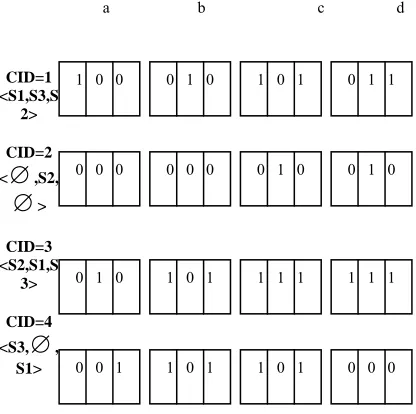
> <S1, (a,b,c)> <S3, (a,d)>point and does not appear in the transaction data at the second and third time points. The stream sequence <S1,S3,S2> means that the transaction data at the first, second, and third time points come respectively from streams S1, S3, and S2.
Figure 5. Bitmap matrix of W1
After the customer sequence table is converted into a bitmap matrix, the support of each 1-item will be counted to generate candidate sequences. Figure 6 shows the sup-port of each 1-item in each stream. Suppose the minimum support is set to 2. The supports of c-item in S1, S2, and S3 are 3, 3, and 2 respectively, all of which are greater than or equal to the minimum support. Therefore, c-item is a frequent item in each of these three streams.
Figure 6. Support of 1-item
Based on the 1-item in Figure 6, sequence extension will go through I-step and S-step to generate candidate sequences, which will be mapped to the bitmap matrix. As shown in Figure 7, different extension steps use dif-ferent ways of mapping, which are described below.
z I-step: The candidate itemset <(a,c)> extended using I-step will be mapped to the bitmap matrix and its support will be counted. As shown in Figure 8, a-item and c-item have bit 1 (the 1 in bold type) at the same time point for customers #1, #3, and #4 and all of them appear in S1. Therefore the support of <(a,c)> is 3. In Figure 6, as a-item is infrequent in S2 and S3, it will remain infrequent after I-step. Accordingly, it needs not to be processed.
z S-step: After going through S-step, <(a,c)> and <(b,d)> will become <(a,c)(b,d)>, which will be mapped to the bitmap matrix. Due to the time sequence of a sequential pattern, <(b,d)> must be mapped to a time point after that of <(a,c)>. As
shown in Figure 7, bit 1 (the underlined 1) appears at the first time point of a-item and c-item as well as the second time point of b-item and d-item for customer #1. Also, bit 1 (the underlined 1) appears at the second time point of a-item and c-item as well as the third time point of b-item and d-item for customer #3. In the meantime, <(a,c)> and <(b,d)> show up respectively in S1 and S3. Therefore, the support of <(a,c)(b,d)> is 2 and the stream sequence is <(S1)(S3)>.
Figure 7. Mapping candidate sequences to bitmap matrix
Suppose the minimum support is set to 2. Figure 8 and Table III show separately the lexicographical tree and result of the first execution of IAspam. The across-streams sequential patterns in the lexicographical tree include <(a)(b)>, <(a)(d)>, <(c)(b)>, <(c)(d)>, and <(a,c)(b,d)>. The stream sequence of all of these across-streams sequential patterns is <(S1)(S3)>, which means that their moving path goes from stream S1 to stream S3. As <(a,c)(b,d)> is the supersequence of all the other across-streams sequential patterns, it will be the only fre-quent across-streams sefre-quential pattern.
∅
Figure 8. Lexicographical tree of the first execution
TABLE III.
RESULT OF THE FIRST EXECUTION
CID=1 <S1,S3
,S2>
CID=2
<
∅
,S 2,∅
>CID=3 <S2,S1
,S3>
CID=4 <S3,
∅
,S1 >a b c d
1 0 0
0 0 0
0 1 0
0 0 1
0 1 0
0 0 0
1 0 1
1 0 1
1 0 1
0 1 0
1 1 1
1 0 1
0 1 1
0 1 0
1 1 1
0 0 0 CID=1
<S1,S3,S 2>
CID=2
<
∅
,S2,∅
>CID=3 <S2,S1,S 3>
CID=4
<S3,
∅
, S1>a b c d
1 0 0
0 0 0
0 1 0
0 0 1
0 1 0
0 0 0
1 0 1
1 0 1
1 0 1
0 1 0
1 1 1
1 0 1
0 1 1
0 1 0
1 1 1
0 0 0
Frequent across-streams
sequen-tial pattern Stream sequence
<(a,c)(b,d)> <(S1)(S3)> Figure 9 and Table IV show separately the
lexico-graphical tree and result of the second execution of IAs-pam. In Figure 9, the support within a red square is an updated support, which indicates the sequential pattern remains frequent in W2 and its support is updated from 3 to 2. The support within a red circle is a weighted sup-port, which is decayed from 2 to 1.8 under the condition that the decay rate is set to 0.9. Accordingly, the sequen-tial pattern will be deleted because its support is less than the minimum support, and the link will be represented as a dotted line.
∅
Figure 9. Lexicographical tree of the second execution
TABLE IV.
RESULT OF THE SECOND EXECUTION
Frequent across-streams
sequential pattern Stream sequence
<(a,c)(d)> <(S1)(S3)>
IV. PERFORMANCE EVALUATION
A. Experimental Environment and Data
Table V shows the experimental environment. In Net-Beans IDE 6.1 compilation environment, Java JDK 6.0 programming language is used to write programs. A Pen-tium D 2.8 GHz processor and 1 GB memory are used. Transaction data generated by the synthetic data genera-tor developed by IBM Almaden Research Center are used as experimental data. Table VI shows the parameters of experimental data. For instance, the expression S6T100I3 stands for a multiple data streams environment in which there are 6 data streams, 100 time points, and averagely 3 items per transaction.
TABLE V.
EXPERIMENTAL ENVIRONMENT
Equipment Specification
Processor Pentium D 2.8 GHz
Memory 1 GB
Hard Disk 160 GB
Operating System WINDOWS XP
Programming Language Java JDK 6.0
TABLE VI.
PARAMETERS OF EXPERIMENTAL DATA
Parameter Parameter Description
S Number of data streams
T Number of time points
I Average number of items per transaction
C Number of customers
D Number of item varieties
B. Performance Comparison
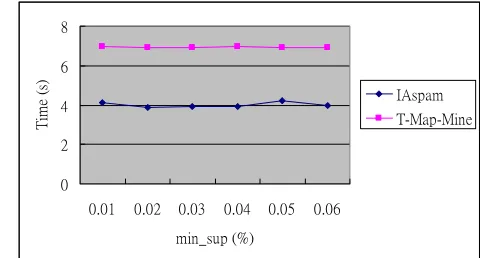
Both IAspam and T-Map-Mine are used for mining se-quential patterns of moving paths in data stream envi-ronment. IAspam uses a bitmap representation for mining frequent across-streams sequential patterns; whereas T-Map-Mine uses a T-Map-Tree structure for mining beha-vior sequence patterns. In the mining process, T-Map-Mine needs to repeatedly search T-Map-Tree to insert new nodes and increase the support, and hence may take a great amount of time in constructing and maintaining T-Map-Tree. On the contrary, IAspam maps candidate se-quences to a bitmap matrix based on the stream, which can save a lot of execution time while searching for across-streams sequential patterns. We compare the ex-ecution and memory usage of these two algorithms. (1) Execution Time
Figure 10 shows the comparison of execution time be-tween IAspam and T-Map-Mine in the S5T100C100I1 multiple data streams environment. The vertical axis is execution time in second and the horizontal axis is the minimum support in percentage. To be able to compare with T-Map-Mine, the average number of items per transaction is set to 1. The execution time of IAspam and T-Map-Mine are compared under various minimum sup-ports. As seen in Figure 10, the execution time of IAspam is less than that of T-Map-Mine under various minimum supports. This is because T-Map-Mine must repeatedly search T-Map-Tree and RST for each customer data as well as insert new nodes and increase the support, which will take more time in the mining process.
0 2 4 6 8
0.01 0.02 0.03 0.04 0.05 0.06
min_sup (%)
Tim
e (s
)
Figure 10. Comparison of execution time
(2) Memory Usage
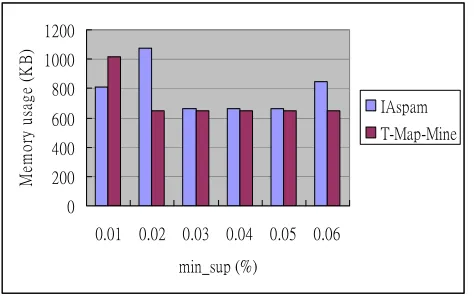
Figure 11 shows the comparison of memory usage be-tween IAspam and T-Map-Mine in the same environment as that for the comparison of execution time. The vertical axis is the maximum usage of memory in kilobyte (KB). As seen in Figure 11, the memory usage of IAspam is about the same as that of T-Map-Mine under various min-imum supports. The memory usage of IAspam will be affected by the number of item varieties and the number of customers. The branching of Tree of T-Map-Mine will depend on the complexity of customer transac-tion data. The more chaotic the data is, the bigger the T-Map-Tree becomes.
0 200 400 600 800 1000 1200
0.01 0.02 0.03 0.04 0.05 0.06
min_sup (%)
M
em
or
y u
sa
ge
(
K
B
)
IAspam T-Map-Mine
Figure 11. Comparison of memory usage
V. CONCLUSION
The primary difference between the IAspam algorithm proposed in this paper and existing algorithms for mining sequential patterns in multiple data streams is that IAs-pam is for mining across-streams sequential patterns, which are a new type of sequential patterns. To avoid inaccurate mining results caused by the re-mining of data, IAspam uses a sliding window to sample stream data and incrementally mines across-streams sequential patterns to maintain the newest mining results. To solve the ineffi-ciency problem caused by mining a massive amount of data, IAspam uses a bitmap representation to search for across-streams sequential patterns and count their sup-ports. As sequential patterns may cross different streams, IAspam searches for sequential patterns based on the stream, which enables the identification of not only across-streams sequential patterns but also stream se-quences. Experimental results show that the IAspam al-gorithm is effective in execution time when processing large amounts of stream data.
ACKNOWLEDGMENT
The authors would like to express their appreciation for the financial support from the National Science
Coun-cil of Republic of China under Project No. NSC 98-2221-E-031-003.
REFERENCES
[1] B. Babcock, S. Babu, M. Datar, R. Motwani, and J.
Wi-dom. Models and Issues in Data Stream Systems. The 21st ACM SIGMOD-SIGACT-SIGART Symposium on Principles of Database Systems. 2002 June 1-16; Madi-son, Wisconsin, USA.
[2] T. Oates and P. R. Cohen. Searching for Structure in
Multiple Streams of Data. The 13th International Confe-rence on Machine Learning. 1996 July 346-354; Bari, It-aly.
[3] L. Golab and M. T. Ozsu. Issues in Data Stream
Man-agement. ACM SIGMOD Record. 2003 June Volume 32 Issue 2: 5-14.
[4] J. Chang and W. Lee. Decaying Obsolete Information in
Finding Recent Frequent Itemsets over Data Stream. IEICE Transaction on Information and Systems, June, 2004; No. 6, Vol. E87-D.
[5] G. Chen, X. Wu, and X. Zhu. Sequential Pattern Mining
in Multiple Streams. The 5th IEEE International Confe-rence on Data Mining, Washington. 2005 Nobember 27-30; USA.
[6] J. H. Chang and W. S. Lee. Finding Recent Frequent
Itemsets Adaptively over Online Data Streams. The 9th ACM SIGKDD International Conference on Knowledge Discovery and Data Mining; 2003 August 487-492; Washington, USA.
[7] C. Raissi, P. Poncelet, and M. Teisseire. SPEED: Mining
Maximal Sequential Patterns over Data Streams. The 3rd IEEE International Conference on Intelligent Systems. 2006 September 546-552; London, UK.
[8] C. I. Ezeife and M. Monwar. SSM:A Frequent
Sequen-tial Data Stream Patterns Miner. The IEEE Symposium on Computational Intelligence and Data Mining, Honolu-lu. 2007 March 120-126; USA.
[9] H. Li and H. Chen. GraSeq: A Novel Approximate
Min-ing Approach of Sequential Patterns over Data Stream. The 3rd International conference on Advanced Data Mining and Applications. 2007 May 401-411; Harbin, China.
[10]S.-C. Lee, E. Lee, W. Choi, and U. M. Kim. Extracting
Temporal Behavior Patterns of Mobile User. The 4th In-ternational Conference on Networked Computing and Advanced Information Management. 2008 September 455-462; Gyeongju, Korea.
Shih-Yang Yang received his Ph.D. degree in Computer Science and Information Engineering from Tamkang Universi-ty, Taiwan, in January 2008. Since January 2008, he is an
Asso-ciate Professor with the Department of Media Art at
Kang-Ning Junior College of Medical Care and Management (Taipei, Taiwan). His research interests include parallel & distributed
systems, web technology, and multimedia.
associate professor. From 1992 to 1996, he served as the de-partment chair. Since 2003, he has been a professor in Depart-ment of Computer Science and Information ManageDepart-ment at Soochow University. During the past few years, he has pub-lished more than 90 refereed journal and conference papers. His research interests include data mining, data warehousing, data-base, and web technology.
Po-Zung Chen received his Ph.D. degree in Computer Science from the University of Iowa in December 1989. From November 1989 to May 1990, he was a visiting Assistant Pro-fessor at Michigan Technological University (Houghton, Mich-igan). Since August 1990, he is an Associate Professor with the
Department of Computer Science and Information Engineering at Tamkang University (Taipei, Taiwan). His research interests include object-oriented distributed programming, parallel & distributed systems, and simulation & modeling.