Ecotech Smart Green Toilet: The Need of The
Hour
Prashik V. Petare Suraj Y. Raje
Student Student
Department of Civil Engineering Department of Civil Engineering
MGM’s College of Engineering & Technology, Kamothe MGM’s College of Engineering & Technology, Kamothe
Manmohan M. Vidhate Adesh P. Vaghela
Student Student
Department of Civil Engineering Department of Civil Engineering
MGM’s College of Engineering & Technology, Kamothe MGM’s College of Engineering & Technology, Kamothe
P.J. Salunke Head of the Dept. Department of Civil Engineering
MGM’s College of Engineering & Technology, Kamothe
Abstract
India being a democratic country, it is important for the government to carry out its responsibilities efficiently. Providing basic facilities to the people of India is one of the important responsibilities. After independence, the government of India has been concentrating on various development activities in the country. Particularly, rural development initiatives were prominent activities that were taken up by the government and which saw a great change in the content. But even today open defecation is seen in rural as well as in many urban parts of the country. Thus, providing access to sufficient quantities of safe water, the provision of facilities for a sanitary disposal of excreta, and introducing sound hygiene practices are of capital importance to reduce the scourge of diseases caused by these risk factors. The paper focuses on the use of new smart and green technologies which can be incorporated to design an Ecotech Toilet. The paper also talks about the future scope of the development of smart green toilets and its need both the rural and the urban areas.
Keywords: Ecotech Smart Green Toilet, flooring slope, cross ventilation, smart toilet
________________________________________________________________________________________________________
I. INTRODUCTION
The words Ecotech and green mean environmental friendly and smart means being efficient. As the title of our project “Ecotech smart green toilet: The need of the hour” suggests, there is immense urgency and dire need of designing environmental friendly and efficient toilets. Considering the urgency and lack of sanitation we intend to design a hygienic and efficient toilet which incorporates the newest technologies and by studying all the information regarding smart toilets and eco-friendly toilets we have designed one toilet for our college. In this we have given two budgets one for medium type of toilet and another for expensive type of toilet. In both the budgets we have included materials required for construction along with labor cost.
II. DESIGN OF ECOTECH SMART GREEN TOILET
By studying all the information regarding smart toilets and eco-friendly toilets we have designed one toilet for our college.In this we have given two budgets one for medium type of toilet and another for expensive type of toilet. In both the budgets we have included materials required for construction along with labor cost. By redesigning the existing toilet, we have developed architectural plans for Ecotech Smart Green Toilet. Right now, we have designed the toilet which is situated on the 4th floor of our
college.
Highlights of Ecotech Smart Green Toilet
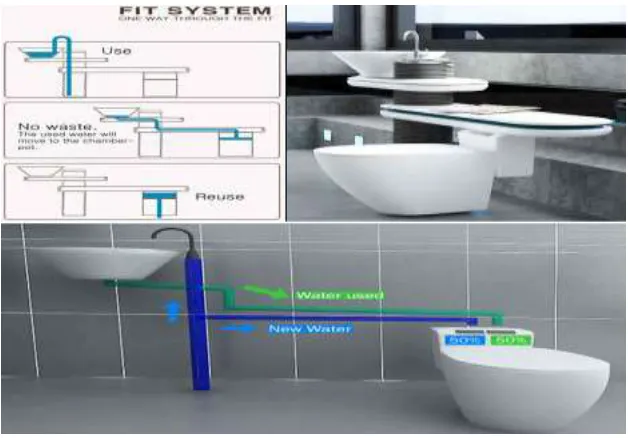
Fig. 1: 50% Usage of Flush Water
2) Partition wall which will separate urinals and entrance. Because of partition wall urinals cannot be seen directly from outside. It will obstruct the odor which is formed in the toilet and cannot pass directly to outside area.
Fig. 2: Wall which separates entrance and Urinals
3) Providing a slope in the flooring will permit water to flow directly into the drainage holes. So that no water can be seen on the flooring. Providing a slope between 1:60 to 1: 80 water can be transferred from flooring to drainage screens or holes by its own.
4) We can use the latest available smart toilet
Smart Toilet – An Intelligent type of toilet
These Toilets are latest toilets. What is smart toilet? A specially designed ceramic toilet is attached with the electronic seat cover. All functionally of the smart toilet are depends upon the seat cover.
It comes with a remote to set functions and parameters. Some of the features of this smart toilet are listed below,
Plays pre-set lyrics automatically when someone approaches.
Automatic seat cover opening by sensors which sense human approaches near to the toilet. It can even disgust between men and women.
It can also automatically open & close and UV cleaning facility.
You can set temperature and pressure of the water and position of the water jet.
User functionality can be saved.
Inbuilt Warm air drier and temperature can be set as per user input.
Fig. 3: Smart toilet
5) If we can install the system in which electricity can be produced from urine: -
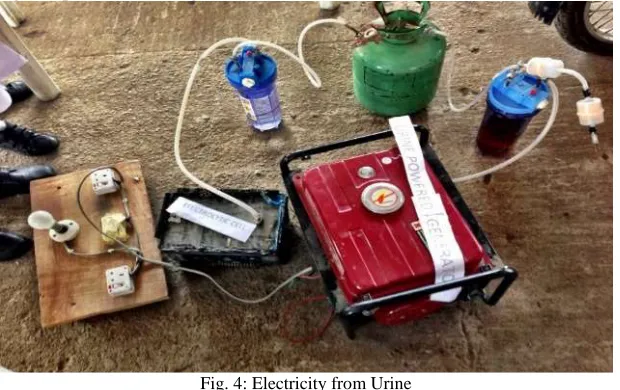
Urine consists of approximately 98 per cent water and 2 per cent urea, which is made up of carbon, oxygen, nitrogen, and hydrogen atoms. Human urine has been turned into all sorts of things over the centuries, ranging from phosphorous to gunpowder. It has also served as the basis of myriad chemical substances, including the first types of plastics. It is already well-known that manure or poop can be recycled for making products, such as paper as well as creating biogas power from methane gas. This readily available ‘resource’, whether from animal or human origin, is now being experimented to generate electricity by using its basic ingredients to create enough hydrogen to provide electricity for both homes and businesses. Today, over seven billion people populate our planet, which means on an average, around 10.5 billion liters (2.8 billion gallons) of human urine is produced and wasted each day. However, scientists are now hopeful that they can use this to generate power—for homes, cities, and vehicles. The process of electrolysis uses a jolt of electricity to split the urea into hydrogen and oxygen atoms and then captures the hydrogen to produce energy. The nitrogen can be used for artificial fertilizers. Researchers have also built a urinal that converts urine directly into electricity. The urinal prototype uses fuel cells to generate a steady stream of electricity. Students in Nigeria have come up with a power generator that runs on human urine. Their creation uses the process of electrolysis to isolate hydrogen gas from urine which is then used to power a generator. They earn a whopping six hours of power from one litre of urine, which does not seem like much until we consider that a normal person pees out roughly two litres per day. The model (Picture) was created by four students and the system developed works as follows:
1) Urine is put into an electrolytic cell, which separates out the hydrogen.
2) The hydrogen enters a water filter for purification, which then gets pushed into a gas cylinder.
3) The gas cylinder pushes hydrogen into a cylinder of liquid borax, which is used to remove moisture from the hydrogen. 4) This purified hydrogen gas is pushed into the generator.
Fig. 4: Electricity from Urine
Fig. 5: Lower vent provided door
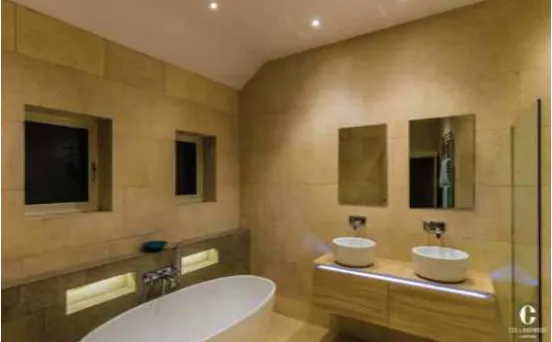
7) We will install warm lights in the toilet to create the atmosphere cheerful and pleasant. By installing warm lights in the toilet, it looks attractive.
Fig. 6: -Warm lights installed toilet
8) Advantages of installing Waterless urinals a)Water Savings
Toilets account for about half of a typical building’s water consumption. In the United States, almost 5 billion gallons of water is used every day to flush toilets, according to the Environmental Protection Agency. Newer models of conventional flush-type urinals use about one gallon per flush. Older ones can use from three to five gallons. Since no-flush urinals use no water, one to five gallons of water is saved with each use.
b)Low Maintenance
Waterless urinals generally require little maintenance other than a few simple procedures that are outlined below (see Maintenance). The absence of a flush valve eliminates valve repairs and reduces opportunities for tampering. Additionally, overflow due to clogged drains and vandalism is not a problem since large amounts of water are not being flushed. According to the manufacturers, drain lines on waterless urinals are less susceptible to clogging as the mixture of water and urine, absent with no-flush urinals, causes encrustations to form in the pipes. Occasional flushing with a few gallons of water is recommended to keep lines clean.
c)Improved Hygiene
Many people have the impression that urine is an unclean substance. However, it is generally a sanitary liquid, composed mainly of dissolved metabolic waste and excess water. A person’s urine normally does not contain harmful microorganisms unless they are harboring some type of urinary tract infection. Water used by conventional urinals gives germs in the restroom the moist environment they need to grow. Manufacturers design waterless urinals to dry out between uses. This makes them hostile to bacteria and viruses. Also, since there is no handle, no-flush urinals are touch-free, reducing the spread of communicable diseases.
Enhance efficiencies of sewer lines and wastewater treatment plants.
Conserve electricity used for pumping water & treating wastewater.
Replace chemical fertilizers with urine to grow crops.
Produce fertilizer & other chemicals from urine (industrial feedstock).
Recover hydrogen for producing energy and fuel.
Reduce emission of greenhouse gases and pollution of water bodies. 9) Advantages of having false ceiling
It is very easy toinstall false ceilingwith the help of right kind of tools. Although, you can install it by yourself, it is advisable to get it installed by a professional contractor.
A false ceiling hides the duct work, pipes and electrical wires giving the ceiling a clutter free neat and clean look.
It is easy to reassemble the panels of a false ceiling in case of repair works.
A false ceiling plays a key role in acoustics and sound absorption. It is designed in such a way that it adds to noise reduction thus, making the space quiet
It is much more economical to install a false ceiling than to get the entire ceiling renovated in case of damages as they are removable.
They can conceal wiring, while being energy efficient. They can be decorative, while being air regulators. They can be functional, and pretty at the same time. False ceilings are essentially used for concealing wires, sound proofing, fire safety, energy efficiency and to help in moisture and sag resistance. Earlier, false ceilings were usually made of gypsum boards, but these days, it is easy to have false ceilings that are not only functional, but also decorative. From wood to glass and fiber to plastic, just about any material can be used for the purpose. “Ceilings are one of the most important elements of your home as they offer the maximum unobstructed view of any interior space. Therefore, a big advantage of installing false ceilings is that instead of putting one or more tube lights inside your room, you get to use high quality LED lights that consume less energy and last many years. You can fit LED lights inside your false ceiling in different corners of your home and use as much light as you need.” False ceilings are also used for thermal insulation. The air-filled gap between the two layers of ceilings cools the room down. False ceilings are suspended a few inches below the basic ceiling on a metal framework which can be made of any lightweight construction material like wood, plaster of Paris, plywood, or gypsum, depending upon the budget or the requirement. Since there is a gap between these two layers, the air within gets trapped. Air, being a bad conductor of heat, does not allow the heat to flow into the room. This, in turn, helps reduce electricity bills. Many of us are not aware that false ceilings also help with better optimization of air conditioning. They reduce space in ceilings, thereby increasing air conditioning performance.
10) Use of Bottle traps in urinals.
Bottle traps as perhaps best known for their use on sinks are the most widely used trap for urinals, we widely recommend white plastic wastes for urinals due to the difficulties in keeping chrome effect bottle traps clean. In the event the bottle trap or in fact pipe work further along the system becomes blocked the bottle traps can be easier to clear. However, if the urinal flushing system fails for whatever reason the bottle trap may more readily block or spring a leak than perhaps an s trap or p trap will. They are also not recommended for waterless urinals as they will store too much waste urine in the bottle portion of the trap since they do not flush.
11) Frequent cleaning and drying of wet flooring. Cleaning time will be mentioned on the door of toilet. Name and contact number of cleaner will be mentioned so that any person can contact the cleaner when any damage occurs in the toilet.
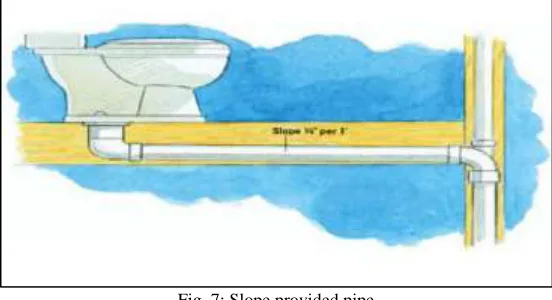
12) Slope provided in Ecotech Smart Green Toilet:
Fig. 7: Slope provided pipe
drain clogs and a slope of more than three inches will allow the water to drain without the solids. Calculating the slope of your drain pipe is easy.
1) Step 1 - Take Measurements
The first thing you need to do is take measurements. You need to know the distance the waste line has to travel before you can do anything else. This can sometimes be very difficult, depending on the location of the line. However, it is absolutely necessary. 2) Step 2 - Plan Drain Route
Once you know the length of the waste line, you can plan the drain route. Some drains will travel in a straight line, others will bend, and others will make 90 degree turns. Use a pencil and paper to map your drain route, remembering that you want to keep the drain as short as possible. The longer the drain, the greater the chance of clogs in the future.
3) Step 3 - Determine Drain Length
With the length and route of your waste line, you can determine the length of the piping. You need to purchase plumbing pipe in the length you calculated from taking measurements and routing the waste line. When you go to your local home improvement store, don’t forget to get the necessary components for any bends and turns. They will have a wide variety of pipe connectors. The final drain length is necessary to calculate the proper slope of the waste line.
Fig. 8: Slope table according to pipe diameter
4) Step 4 - Calculate the Slope
With the final drain length available, you can finally calculate the slope. Remember, the waste line has to slope a minimum of 1/4-inch per foot and a maximum of three 1/4-inches per foot or vertical. Here is an example: if your final drain length is 15 feet and you are going to slope the line at the minimum 1/4-inch per foot, the drain must slope a total of 3 3/4 inches from the start of the pipe to the end. To determine the slope, multiply the slope by the length of the line, in this case, 1/4 by 15. Calculating the slope of your drain pipe may be that simple, or it might be a bit more involved. If your drain route requires a bend or turn, you have to calculate the slope of each piece of pipe separately. If you have to route a longer drain pipe without a lot of space, you may opt for a deeper slope up to the maximum of three inches per foot. For example, if you want to route that same 15-foot drain pipe at a slope of three inches per foot, the drain has to slope a total of 45 inches from start to finish. To determine the total slope, you will multiply three by 15.
Fig. 9: Drain hole in the toilet
Placement of Ventilation Fan:
1) To Prevent Condensation Warm moist air is immediately attracted to cold surfaces, where it condenses into water droplets. Cold surfaces include glass, mirrors, tiles, wet-wall linings, cold uninsulated ceiling linings, etc. You cannot remove all of this air at a rate fast enough to stop this happening & if you could, you would be standing in a wind tunnel. Using a bathroom heater to warm the room prior to use greatly assists in reducing condensation by increasing the temperature of these cold surfaces.
Fig. 10: Poor and best circulation of air in the toilet
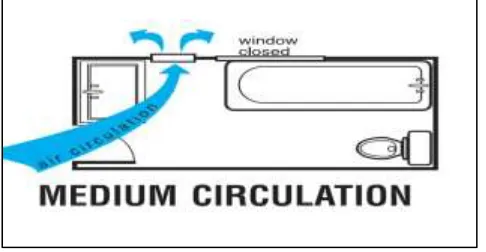
2) Consider your Location Options within the room. Careful location of an extraction fan will ensure maximum air-flow through the room. Air extracted from a bathroom should be replaced with dry air drawn from an adjacent room or hallway. Make up air is the amount of air that needs to enter the bathroom for the fan to work effectively.
Fig. 11: Medium air circulation in the toilet
Bathroom ventilation is simple, but are we doing it right? Adequate ventilation is an important, but often underrated feature for bathrooms in residential homes and even more so in accommodation premises, such as hotels, motels and care homes.
Building regulations and ventilation
A toilet / bath / shower room in domestic premises, apartments, hotels or care homes should be adequately ventilated for the following reasons:
To reduce or eliminate odours emanating from the space.
To reduce or eliminate condensation caused by steam from a shower or bath.
Design and installation of a ventilation system Exhaust and air intake positions
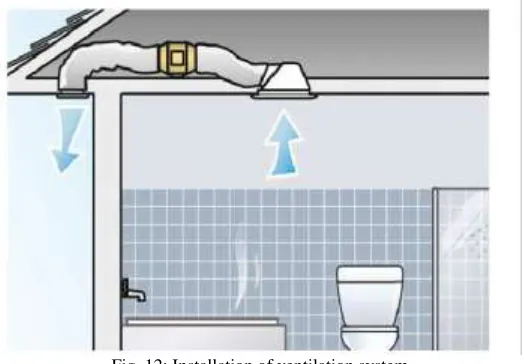
Exhaust fans, or in the case of a ducted system; the exhaust grille, should be mounted as high as possible and be opposite the air intake into the room (which is typically at the bottom of the door). Positioning of an air intake and exhaust points to ensure adequate cross ventilation. If possible the air entry should be on the opposite surface to the air exit to prevent short-circuiting and stagnant areas.
Make up air
Fig. 12: Installation of ventilation system
Estimate of Ecotech Smart Green Toilet
Estimate for Medium Class Toilet:
Table – 1
Materials required for medium class toilet
Serial No.
Items Quantity Price per item Total Amount
1 Flooring Tiles 160 sqft(each 60*60 cm)
115 per sqft 18400
2 Wall Tiles 737 sqft nos(each
30*45 cm)
70 per sqft 51590
3 W.C. Doors 1nos 1800 1800
4 Male Sticker 1nos 200 200
5 Window including exhaust fan
1nos 3000 3000
6 Screen mat 10nos 80 800
7 Urinal Separators 2nos 1500 3000
8 Faucets 2nos 170 340
9 Toilet Papers 1nos 175 175
10 Tissue Paper Box 1 no 500 500
11 Dustbins 2nos 220 440
12 Main door with vent
1no 2500 2500
13 Toilet bench 1no 4000 4000
14 Coat hooks 1nos 200 200
15 Cera Urinals 2nos 3050 6100
16 Hindware Wash
Basins
2nos 2250 4500
17 Mirrors 2no’s (each
45*52.5cm)
1550 3100
18 Led Lights 6nos 480 2800
19 Air Freshener 3nos 55 165
20 Taps 1nos 355 355
21 WC 1nos 3500 3500
22 PVC pipes 5m 400 per m 2000
23 Pipe fitting materials
L.S. 500
24 Cement bags 30 350 10500
25 Sand 2 cum 600 per cum 1200
26 Water proofing compound
35kg 70 per kg 2450
27 Bricks 85 no’s 6 Rs per brick 510
28 Scaffolding L.S. 300
29 Bottle Traps 2Nos 110 220
Table - 2
Labor Cost including task for medium class toilet
Total Cost of Project
=125145+139850=Rs.2,64,995/-
Estimate for Expensive Toilet
Table – 3
Materials required for expensive toilet
Sr.No
Task
Total Area in
sqft
Amt per sqft
Total amount
1.
Removing of tiles
863.15
25
22000
2.
Brickwork
2
100
200
3.
Plastering
593
50
29650
4.
Wall Tiling
737.35
50
37000
5.
Floor Tiling
160
100
16000
6.
Plumbing and Fittings
L.S.
15000
7.
Painting of false ceiling
160
35
5600
8.
False Ceiling
160
90
14400
Total Amt
139850
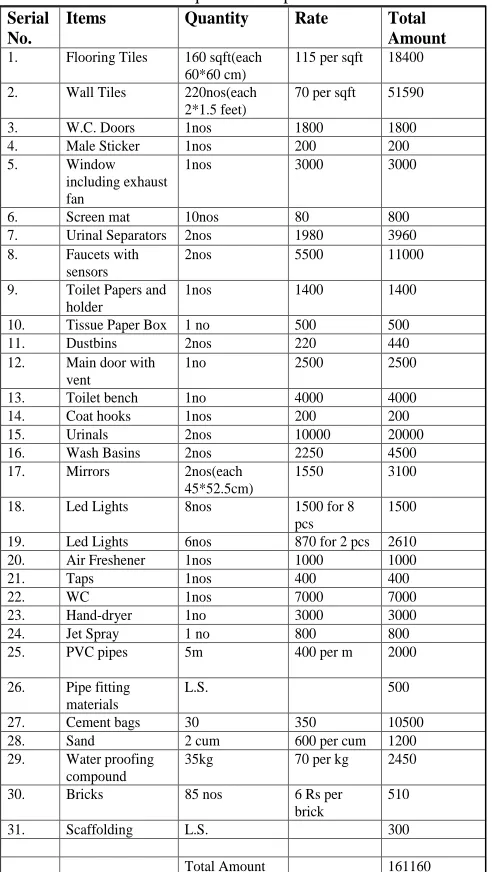
Serial No.
Items Quantity Rate Total
Amount
1. Flooring Tiles 160 sqft(each 60*60 cm)
115 per sqft 18400
2. Wall Tiles 220nos(each
2*1.5 feet)
70 per sqft 51590
3. W.C. Doors 1nos 1800 1800
4. Male Sticker 1nos 200 200
5. Window
including exhaust fan
1nos 3000 3000
6. Screen mat 10nos 80 800
7. Urinal Separators 2nos 1980 3960
8. Faucets with sensors
2nos 5500 11000
9. Toilet Papers and holder
1nos 1400 1400
10. Tissue Paper Box 1 no 500 500
11. Dustbins 2nos 220 440
12. Main door with vent
1no 2500 2500
13. Toilet bench 1no 4000 4000
14. Coat hooks 1nos 200 200
15. Urinals 2nos 10000 20000
16. Wash Basins 2nos 2250 4500
17. Mirrors 2nos(each
45*52.5cm)
1550 3100
18. Led Lights 8nos 1500 for 8
pcs
1500
19. Led Lights 6nos 870 for 2 pcs 2610
20. Air Freshener 1nos 1000 1000
21. Taps 1nos 400 400
22. WC 1nos 7000 7000
23. Hand-dryer 1no 3000 3000
24. Jet Spray 1 no 800 800
25. PVC pipes 5m 400 per m 2000
26. Pipe fitting materials
L.S. 500
27. Cement bags 30 350 10500
28. Sand 2 cum 600 per cum 1200
29. Water proofing compound
35kg 70 per kg 2450
30. Bricks 85 nos 6 Rs per
brick
510
31. Scaffolding L.S. 300
Table – 4
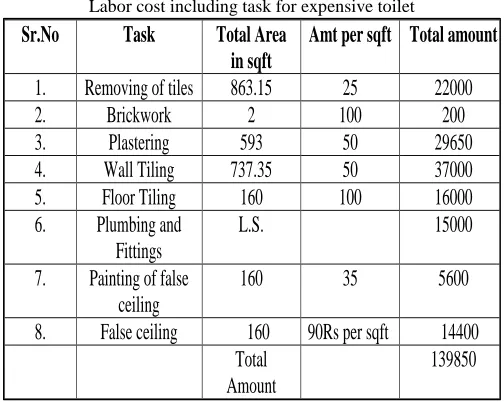
Labor cost including task for expensive toilet
Total cost of project
= 161160+ 139850= Rs 3,01,010/-
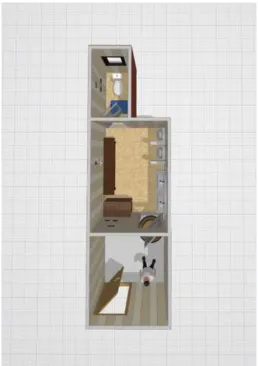
Architectural plan of Ecotech Smart Green Toilet
Fig. 13: 2D plan of Ecotech Smart Green Toilet
Sr.No
Task
Total Area
in sqft
Amt per sqft Total amount
1.
Removing of tiles
863.15
25
22000
2.
Brickwork
2
100
200
3.
Plastering
593
50
29650
4.
Wall Tiling
737.35
50
37000
5.
Floor Tiling
160
100
16000
6.
Plumbing and
Fittings
L.S.
15000
7.
Painting of false
ceiling
160
35
5600
8.
False ceiling
160
90Rs per sqft 14400
Total
Amount
Fig. 14: 3D plan of Ecotech Smart Green Toilet
III. CONCLUSION
Introduction
Wetness of the toilets, the lack of litter bins and refuse lids and the lack of ownership in toilets contribute most to the problem of hygiene and dirtiness of the college toilets. The wetness of toilets affect the cleanliness of toilets as when the sink tops and ground is wet, and more users step into the toilets with dirty shoes and hands, the toilets get dirtier even though it might have been cleaned earlier before. Germs might also multiply as the wet and stagnant toilets provide a relative breeding ground for them to reproduce, thus causing the spread of diseases as more users enter the toilets. The lack of bins and lids can also result in the multiplication of diseases as the users throw their trash into the bins. Bacteria can be spread around if there is no cover and some students do not bother to wrap them with tissue paper before disposing. The lack of ownership in toilets mainly due to the mindsets of students nowadays as the students do not regard shared property as their own personal property. 'If this is shared by everybody then why should I bother to treat it as my own and keep it clean?' Students do not treat the school toilets properly like they treat their own at home. This can be seen where by the students do not bother to throw their waste in the bins provided and keep the floor as dry as possible as they do at home. Negligence in this aspect piles up as the toilets get dirtier.
Concluding Remark
than for what it has been designed. Now a day’s various designs for Public Toilets both for in the rural as well as the urban areas have been designed by various government and private organisations. We have also seen the emergence of various plans which are taken by the Indian Government to make India a cleaner country such as “Swacch Bharat Abhiyan” and various other programmes related to sanitation facilities. There still a lot to do to overcome the shortage of sanitary facilities in India but if small steps like these are have its own toilet is not too far from reality.
Future Scope
1.From urine electricity can be generated.
2.Sewage water can be used in farming for growth of crops. 3.Ground water can be recharged using Urine.
4.Biotoilets if used worldwide water and electricity consumption can be reduced.
REFERENCES
Research Papers:
[1] Lister, S. (2005, January 21). Public Toilets to Re-open for Open. Daily Post, p2.
[2] Morgan, A. (2004, September 15). Public Toilet’s Lighting has Wrong Effect. Coventry Evening Telegraph, p. 11. [3] Morrell, A. (2004, September 22). Discovering the Bottom Line about Public Toilets Today. Western Mail, p.13. [4] Rutherford, E. (2005, December 13). Germ-wary Pol Pushes for Public Toilet Seat Covers. Boston Herald, no page.
[5] Vieira, A.D. S. (1985) Environmental Information in Developing Nations: Politics and Policies. Westport, CT: Greenwood Press. [6] Webber, R. (2001, July 15). Public Toilets. Gotham Gazette. Retrieved
[7] Young, P. (2005, September 28). Public Toilets Down the Pan! Evening Chronicle, p.18. [8] India country paper
[9] Swaccha Bharat Mission Guidelines [10] Guide to better public toilet Websites: